
Life, 1909-07-29 · page 23 of 28
Life — July 29, 1909 — page 23: what you’re looking at
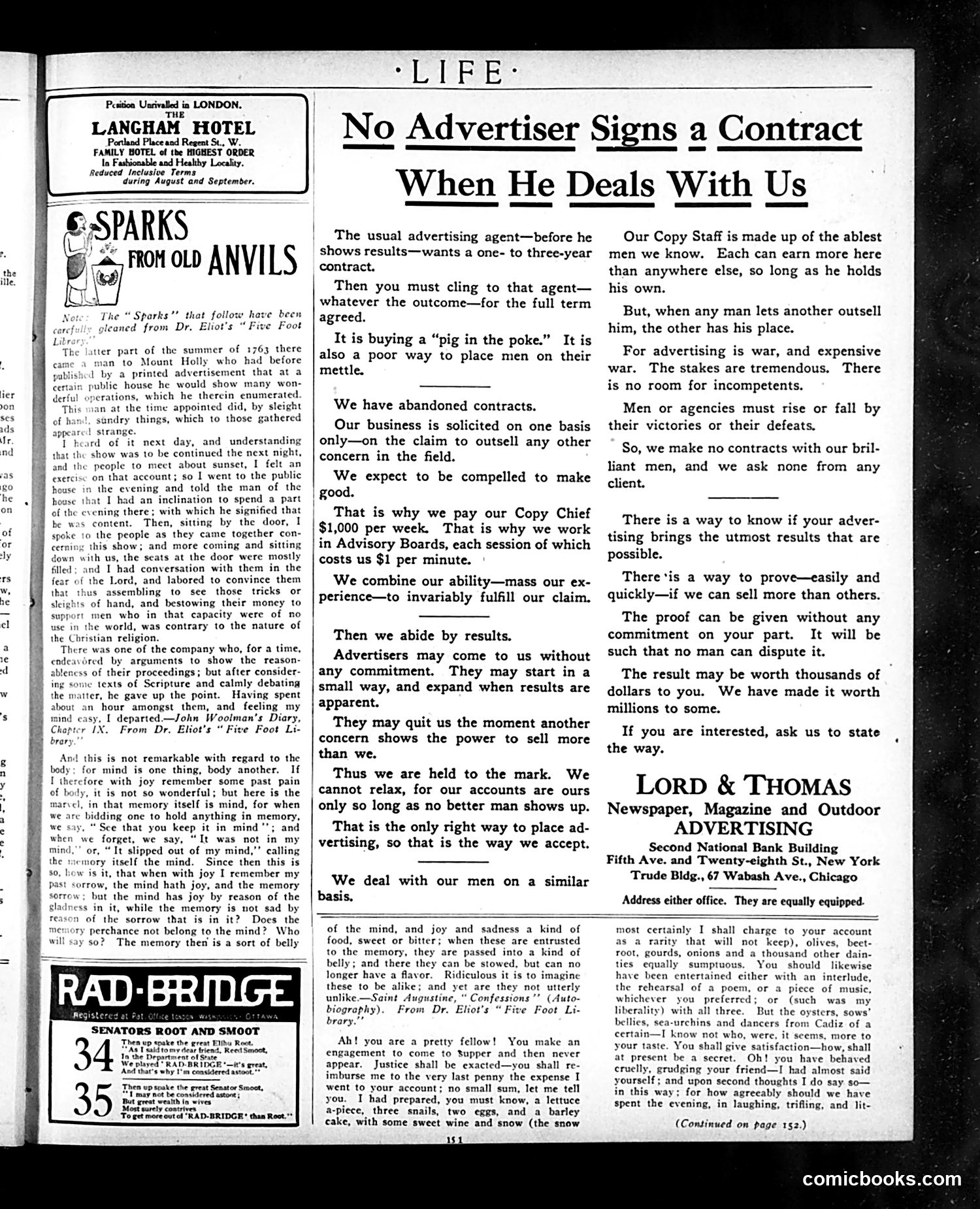
What you’re looking at
This page primarily features **advertising and business-related content** rather than political satire or comics in the traditional sense. The main article, "No Advertiser Signs a Contract When He Deals With Us," is a **Lord & Thomas advertising agency advertisement**. It argues against traditional long-term advertising contracts, claiming their agency operates on results alone—no commitment required. They justify this by highlighting their expensive investments (a $1,000/week copy chief, advisory boards costing $1 per minute), positioning themselves as confident enough to compete continuously rather than lock clients into agreements. The page also includes literary excerpts (Woolman's Diary, Dr. Eliot's writings) and hotel/product advertisements typical of the era. A reference to "Senators Root and Smoot" appears in fragmentary form, likely a satirical poem, though the context is unclear from this excerpt. **For modern readers**: This reflects early 20th-century advertising evolution—the shift from commission-based agent relationships toward performance-based partnerships.
📄 Transcribed text from this page (OCR, searchable)
Machine-transcribed from the original scan — historical spelling and the odd misread are preserved.
bd JE J8) Pcsition Unrivalied in LONDON. THE LANGHAM HOTEL Porland Place and Regent St, W. FAMILY BOTEL of the HIGHEST ORDER ln Fashionable and Healthy Locality, Reduced Inclusive Terms ‘during August and September. The “Sparks”? that follow have been gleaned from Dr. Eliot's ive Foot ter part of the summer of 1763 there man to Mount Holly who had before | by a printed advertisement that at a ‘n public house he would show many won- erations, which he therein enumerated an at the time appointed did, by sleight iry things, which to those gathered urd of it next day, and understanding show was to be continued the next night, people to mect about sunset, I felt an on that account; so I went to the public in the evening and told the man of the hat I had an inclination to spend a part of the evening there; with which he signified that be was content. Then, sitting by the door, I poke 10 the people as they came together con- cerning this show; and more coming and sitting down with us, the seats at the door were mostly filled; and I had conversation with them in the ¢ Lord, and labored to convince them assembling to see those tricks or of hand, and bestowing their money to support men who in that capacity were of no use in the world, was contrary to the nature of the Christian religion. There was one of the company who, for a time, endeavored by arguments to show the reason- plencss of their proceedings; but after consider- somie texts of Scripture and calmly debating er, he gave up the point. Having spent an hour amongst them, and feeling my I departed—John Woolman’s Diary, From Dr. Eliot's “ Five Foot Li- 1 this is not remarkable with regard to the for mind is one thing, body another. If ") [therefore with joy remember some past pain it is not so wonderful; but here is the vel, in that memory itself is mind, for when we are bidding one to hold anything in memory, we Sce that you keep it in mind"; and when we forget, we say, “It was not in my mind,” of, “It slipped out of my mind,” calling the memory itself the mind. Since then this is . how is it, that when with joy I remember my ast sorrow, the mind hath joy, and the memory sorrow: but the mind has joy by reason of the gladness in it, while the memory is not sad by n of the sorrow that is in it? Does the ¥ perchance not belong to the mind? Who sy So? The memory then is a sort of belly SENATORS ROOT AND SMOOT Then up spake the hen up scake the great Senator Smoot, Limay not be considered aston Fogel mort cuted RAD-BRIDGR: than Root.” _ No Advertiser Signs a Contract When He Deals With Us The usual advertising agent—before he shows results—wants a one- to three-year contract. Then you must cling to that agent— whatever the outcome—for the full term agreed. It is buying a “pig in the poke.” It is also a poor way to place men on their mettle. We have abandoned contracts. Our business is solicited on one basis only—on the claim to outsell any other concern in the field. We expect to be compelled to make | good. That is why we pay our Copy Chief $1,000 per week. That is why we work in Advisory Boards, each session of which costs us $1 per minute. ‘We combine our ability—mass our ex- perience—to invariably fulfill our claim. Then we abide by results. Advertisers may come to us without any commitment. They may start in a small way, and expand when results are apparent. They may quit us the moment another concern shows the power to sell more than we. Thus we are held to the mark. We cannot relax, for our accounts are ours only so long as no better man shows up. That is the only right way to place ad- vertising, so that is the way we accept. ‘We deal with our men on a similar basis, Our Copy Staff is made up of the ablest men we know. Each can earn more here than anywhere else, so long as he holds his own. But, when any man lets another outsell him, the other has his place. For advertising is war, and expensive war. The stakes are tremendous. There is no room for incompetents. Men or agencies must rise or fall by their victories or their defeats. So, we make no contracts with our bril- liant men, and we ask none from any client. There is a way to know if your adver- tising brings the utmost results that are possible. There ‘is a way to prove—easily and quickly—if we can sell more than others. The proof can be given without any commitment on your part. It will be such that no man can dispute it. The result may be worth thousands of dollars to you. We have made it worth millions to some. If you are interested, ask us to state the way. LoRD & THOMAS Newspaper, Magazine and Outdoor ADVERTISING Second National Bank Building Fifth Ave. and Twenty-eighth St., New York Trude Bldg., 67 Wabash Ave., Chicago Address either office. They are equally equipped. of the mind, and joy and sadness a kind of food, sweet or bitter; when these are entrusted to the memory, they are passed into a kind of belly; and there they can be stowed, but can no longer have a flavor. Ridiculous it is to imagine these to be alike; and yet are they not utterly unlike—Saint Augustine, “ Confessions"? (Auto- biography). From Dr, Eliot's “Five Foot Li- brary.” Ah! you are a pretty fellow! You make an engagement to come to Supper and then never appear. Justice shall be exacted—you shall re- imburse me to the very last penny the expense I went to your account; no small sum, let me tell you. I had prepared, you must know, a lettuce a-piece, three snails, two eggs, and a barley cake, with some sweet wine and snow (the snow 1 most certainly I shall charge to your account as a rarity that will not keep), olives, beet- root, gourds, onions and a thousand other dain- ties equally sumptuous. You should likewise have been entertained either with an interlude, the rehearsal of a poem, or a piece of music, whichever you preferred; or (such was my liberality) with all three. But the oysters, sows’ bellies, sea-urchins and dancers from Cadiz of a certain—I know not who, were, it seems, more to your taste. You shall give satisfaction—how, shall at present be a secret. Oh! you have behaved cruelly, grudging your friend—I had almost said yourself; and upon second thoughts I do say so— in this way; for how agreeably should we have spent the evening, in laughing, trifling, and lit- (Continued on page 152.) comicbooks.com