
Life, 1909-07-29 · page 12 of 28
Life — July 29, 1909 — page 12: what you’re looking at
What you’re looking at
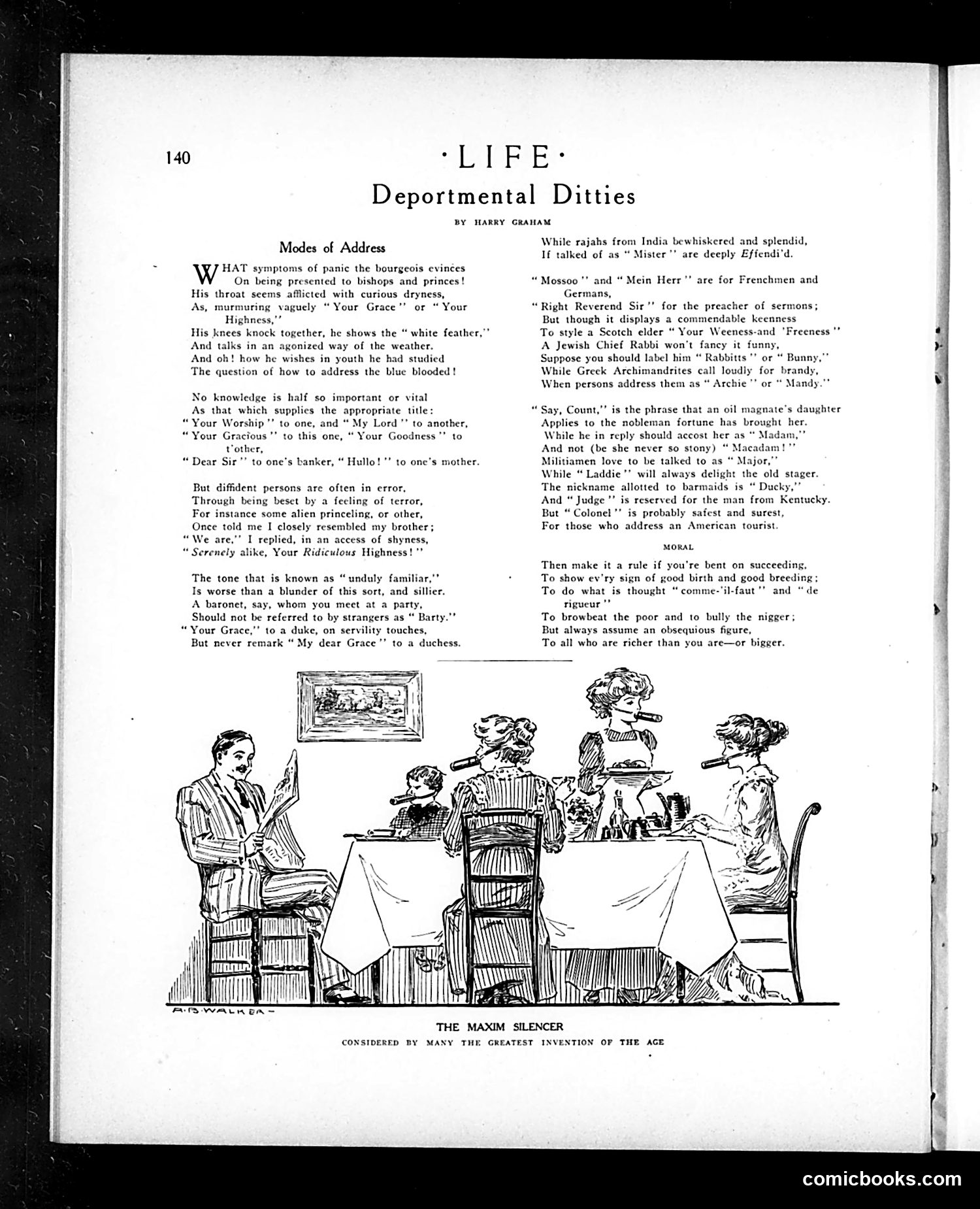
This satirical piece by Harry Graham critiques the confusion of proper forms of address across social classes and nationalities. The text mocks how bourgeois people struggle with correct titles for bishops, princes, and other dignitaries—whether to say "Your Grace," "Your Worship," or "Your Lordship." The accompanying illustration, titled "The Maxim Silencer," shows diners at a table equipped with what appear to be silencers (possibly mufflers or noise-suppression devices) protruding from their mouths. This is likely satirizing the social awkwardness of dinner conversation and the desire to suppress embarrassing verbal mistakes about proper forms of address—treating courtesy as a mechanical problem requiring technological "invention." The humor targets Victorian-era social anxiety about class etiquette.
📄 Transcribed text from this page (OCR, searchable)
Machine-transcribed from the original scan — historical spelling and the odd misread are preserved.
coh Wy Sh Deportmental Ditties BY HARRY GRAHAM Modes of Address HAT symptoms of panic the bourgeois evinées On being presented to bishops and princes! His throat scems afflicted with curious dryness, aguely “Your Grace’? or “ Your As, murmuring Highnes His knees knock together, he shows the “ white feather,” And talks in an agonized way of the weather. And oh! how he wishes in youth he had studied The question of how to address the blue blooded! No knowledge is half so important or vital As that which supplies the appropriate title: “Your Worship" to one, and “ My Lord’ to another, “Your Gracious "’ to this one, “ Your Goodness" to Vother, “ Dear Sir" to one’s banker, “ Hullo! "* to one’s mother But diffident persons are often in error, Through being beset by a fecling of terror, For instance some alien princeling, or other, Once told me I closely resembled my brother; “We are,’’ I replied, in an access of shyness, “ Serenely alike, Your Ridiculous Highness! "” The tone that is known as “unduly familiar,"* Is worse than a blunder of this sort, and sillier. A baronet, say, whom you meet at a party, Should not be referred to by strangers as “ Barty.”" “ Your Grace," to a duke, on servility touches, But never remark “My dear Grace? to a duchess. FOS WAL EN CONSIDERED BY MANY TH THE MAXIM SILENCER GREATEST INVENTION OF THE AGE While rajahs from India bewhiskered and splendid, If talked of as “ Mister’ are deeply Effendi'd. Mossoo " and “ Mein Herr" are for Frenchmen and Germans, “Right Reverend Sir’ for the preacher of serm But though it displays a commendable keenness To style a Scotch elder “ Your Weeness-and ‘Freeness "’ A Jewish Chief Rabbi won't fancy it funny, Suppose you should label him “ Rabbitts "’ or “* Bunn While Greek Archimandrites call loudly for brandy, When persons address them a! chie "’ or “ Mandy.”* “Say, Count,”’ is the phrase that an oil ma; Applies to the nobleman fortune h: While he in reply should accost And not (be she never so stony) “ Militiamen love to be talked to as “ Major,” While “ Laddie"’ will always delight the old stager. The nickname allotted to barmaids is “ Ducky,” And “ Judge "’ is reserved for the man from Kentucky. But “ Colonel’ is probably safest and surest, For those who address an American tourist te's daughter MORAL Then make it a rule if you're bent on succeeding, To show ev'ry sign of good birth and good breeding : To do what is thought “comme-‘il-faut ’ and “de rigueur To browbeat the poor and to bully the nigger; But always assume an obsequious figure, To all who are richer than you are—or bigger. comicbooks.com