
A complete issue · 44 pages · 1909
Life — March 4, 1909
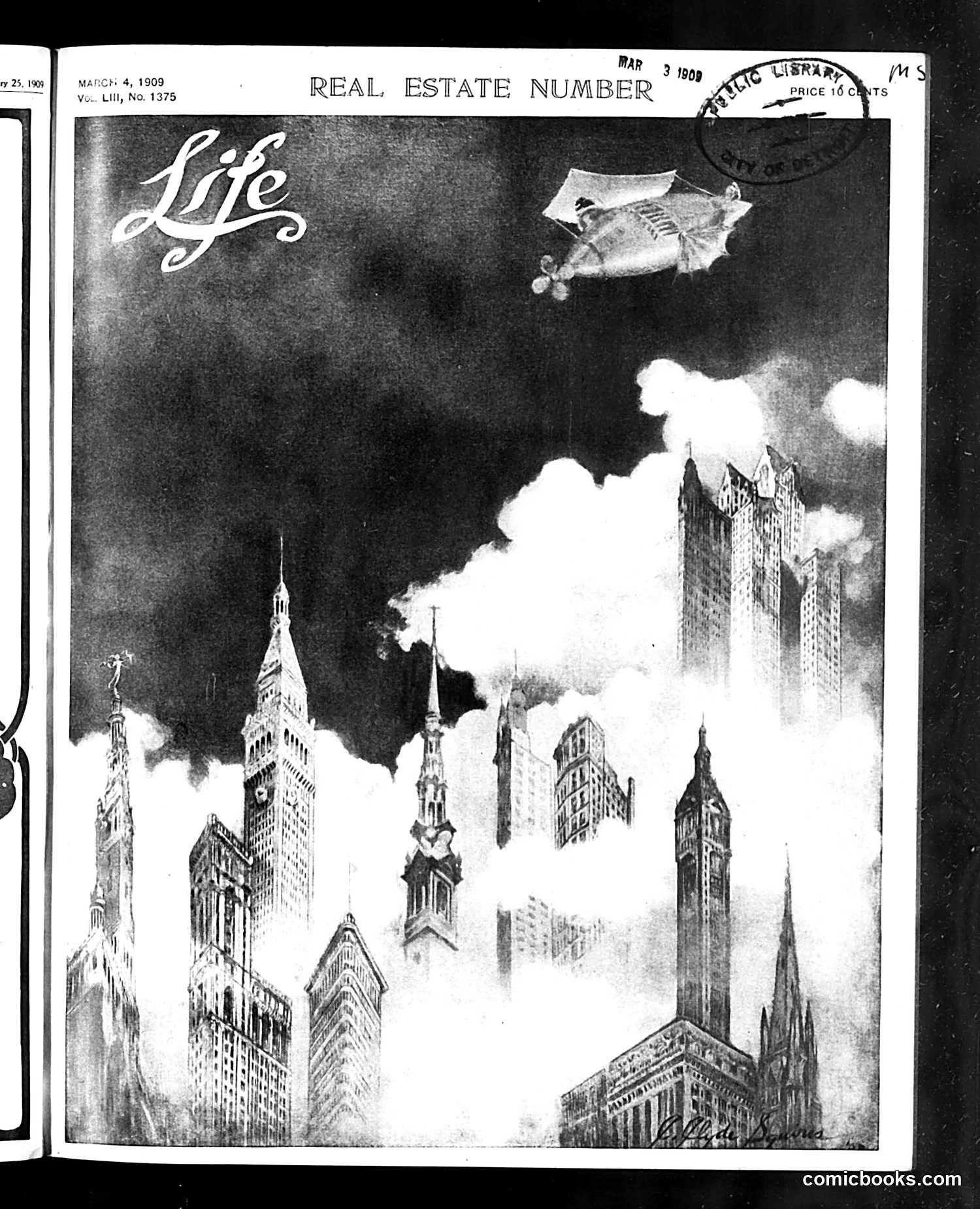
This is the cover of Life magazine's "Real Estate Number" from March 4, 1909. The illustration depicts a futuristic vision of New York City's skyline, with tall buildings emerging from clouds and an early airplane flying overhead. The image appears to be speculative fantasy about urban development and technological progress—specifically imagining how the city might look with continued architectural growth and aviation advancement. The airplane and elevated perspective suggest optimism about modern innovation transforming American cities. This was a period of rapid skyscraper construction in Manhattan and early aviation excitement (the Wright brothers' first flight was 1903). The "Real Estate Number" theme connects urban development to property investment and speculation, which were booming industries in early 1900s America.
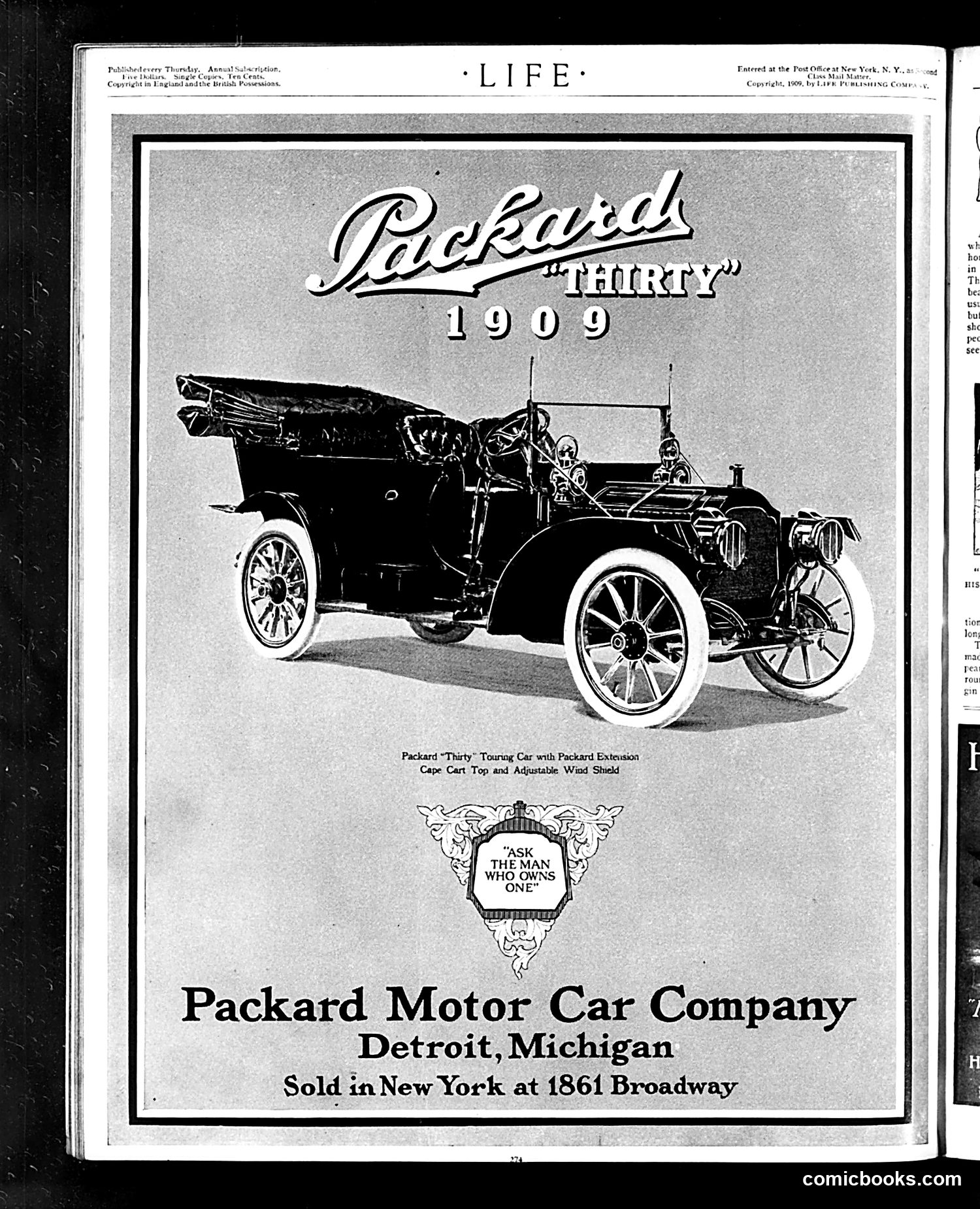
This page is **primarily an advertisement**, not political satire. It promotes the Packard "Thirty" automobile from 1909, published in *Life* magazine. The image shows a touring car with an open cabin, featuring passengers and a convertible top—luxury features of early 1900s automobiles. The caption identifies it as a "Packard 'Thirty' Touring Car with Packard Extension Cape Cart Top and Adjustable Wind Shield." The tagline "Ask the Man Who Owns One" was Packard's actual advertising slogan, suggesting satisfied customers as testimonial. The company, based in Detroit, sold vehicles through their New York showroom at 1861 Broadway. There is no political or satirical content visible here—this is straightforward automotive marketing in a magazine that mixed editorial content with paid advertisements.
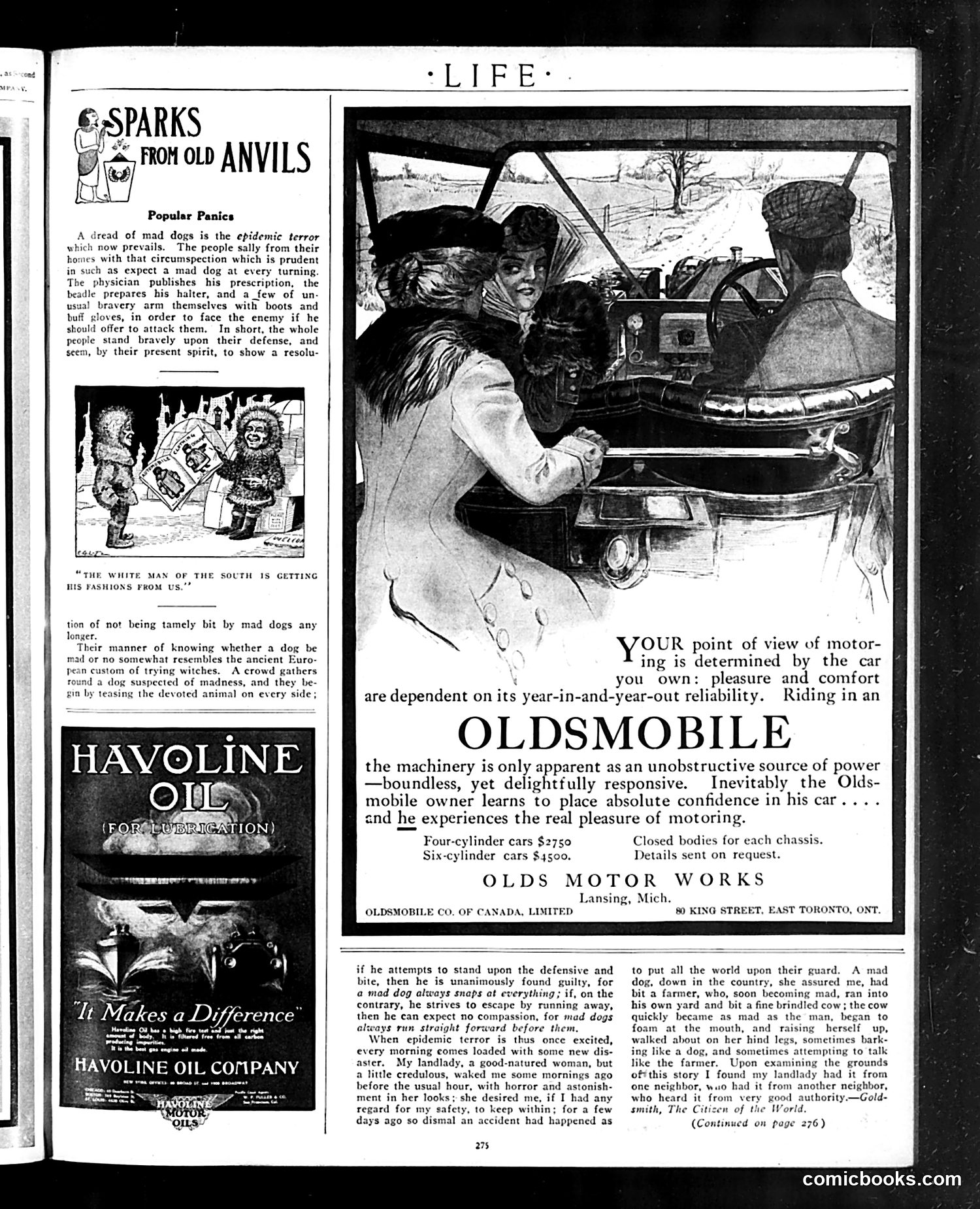
This page mixes satire with advertising. The left column's "Sparks from Old Anvils" cartoon satirizes public panic over rabid dogs. The cartoon shows a disheveled figure with a sign reading "THE WHITE MAN OF THE SOUTH IS GETTING HIS FASHIONS FROM US"—likely satirizing racial anxieties or cultural borrowing during this era, though the specific reference is unclear without fuller context. The bulk of the page features an Oldsmobile automobile advertisement emphasizing reliability and driving comfort. Below, a Havoline Oil ad promotes lubrication products. The rabid dog content and the cartoon's reference to "the white man of the South" suggest this issue addressed contemporary social anxieties, though the precise satirical target of the fashion reference remains ambiguous from this excerpt alone.
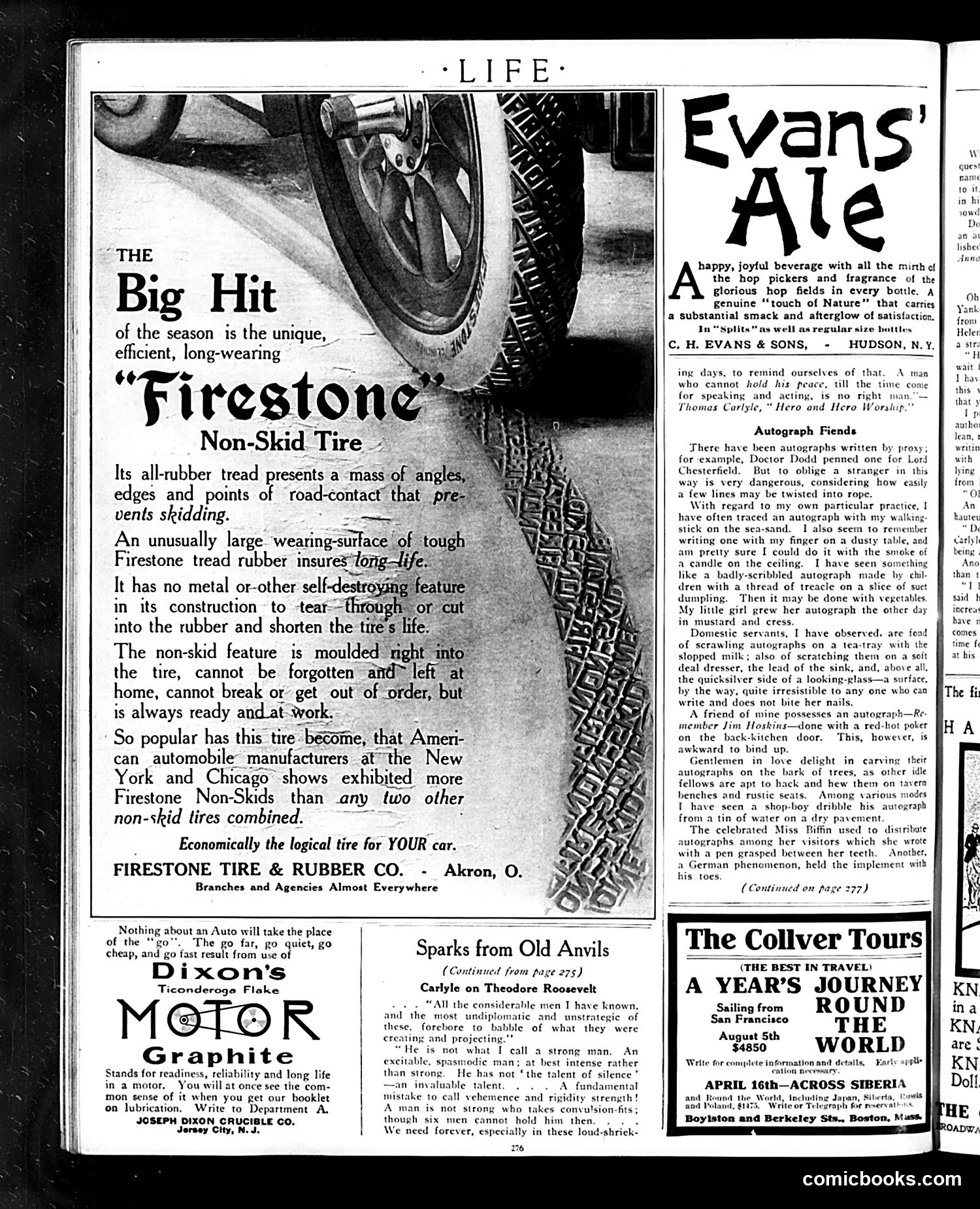
This page is primarily **advertising**, not satire or political commentary. The dominant left-hand advertisement promotes **Firestone Non-Skid Tires**, emphasizing safety features like the rubber tread pattern (visible in the large photograph) that prevents skidding. The copy claims these tires outsold "any two other non-skid tires combined" at New York and Chicago auto shows. Other advertisements include: - **Motor Graphite** (lubricant product) - **Evans' Ale** (beverage) - **The Collyer Tours** (travel packages around the world) A small article titled "Sparks from Old Anvils" discusses **Theodore Roosevelt and Carlyle**, appearing to be a historical/philosophical piece rather than current satire. The page contains no political cartoons or caricatures—it's a straightforward early 20th-century magazine advertisement layout.
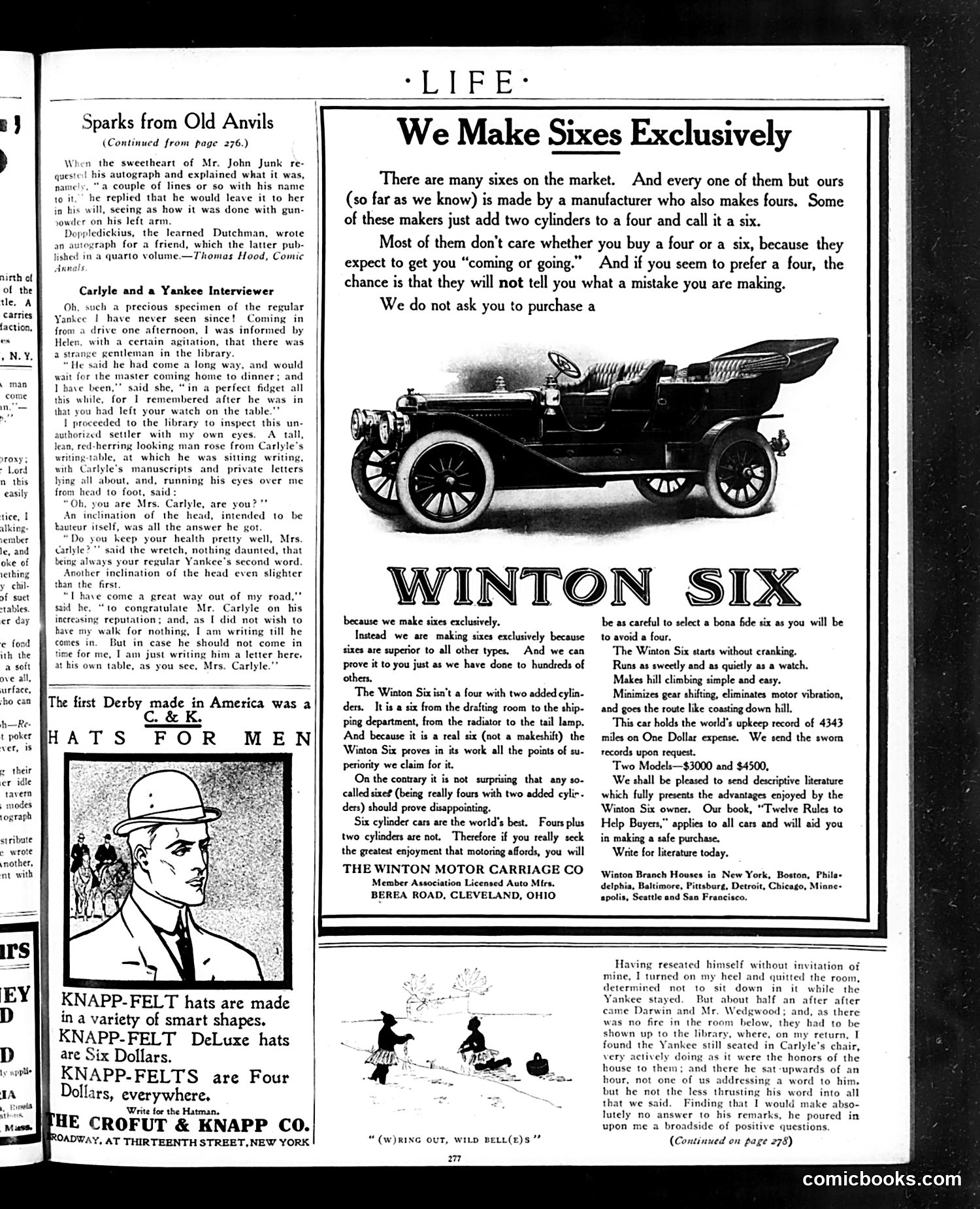
This page is primarily **advertising**, not satire or political commentary. The dominant content is a large advertisement for the **Winton Six automobile**, emphasizing that this manufacturer makes six-cylinder cars exclusively (not converted four-cylinder models). The ad claims superior engineering and quality compared to competitors who merely add cylinders to existing designs. A smaller advertisement below promotes **Knapp-Felt hats** for men, showing a stylized male face and highlighting price points. The left column contains non-illustrated text pieces: "Sparks from Old Anvils" (a humor column) and "Carlyle and a Yankee Interviewer" (a narrative anecdote). A small cartoon at bottom shows winter/sledding activity but lacks clear political meaning—it appears to be generic seasonal illustration rather than commentary.
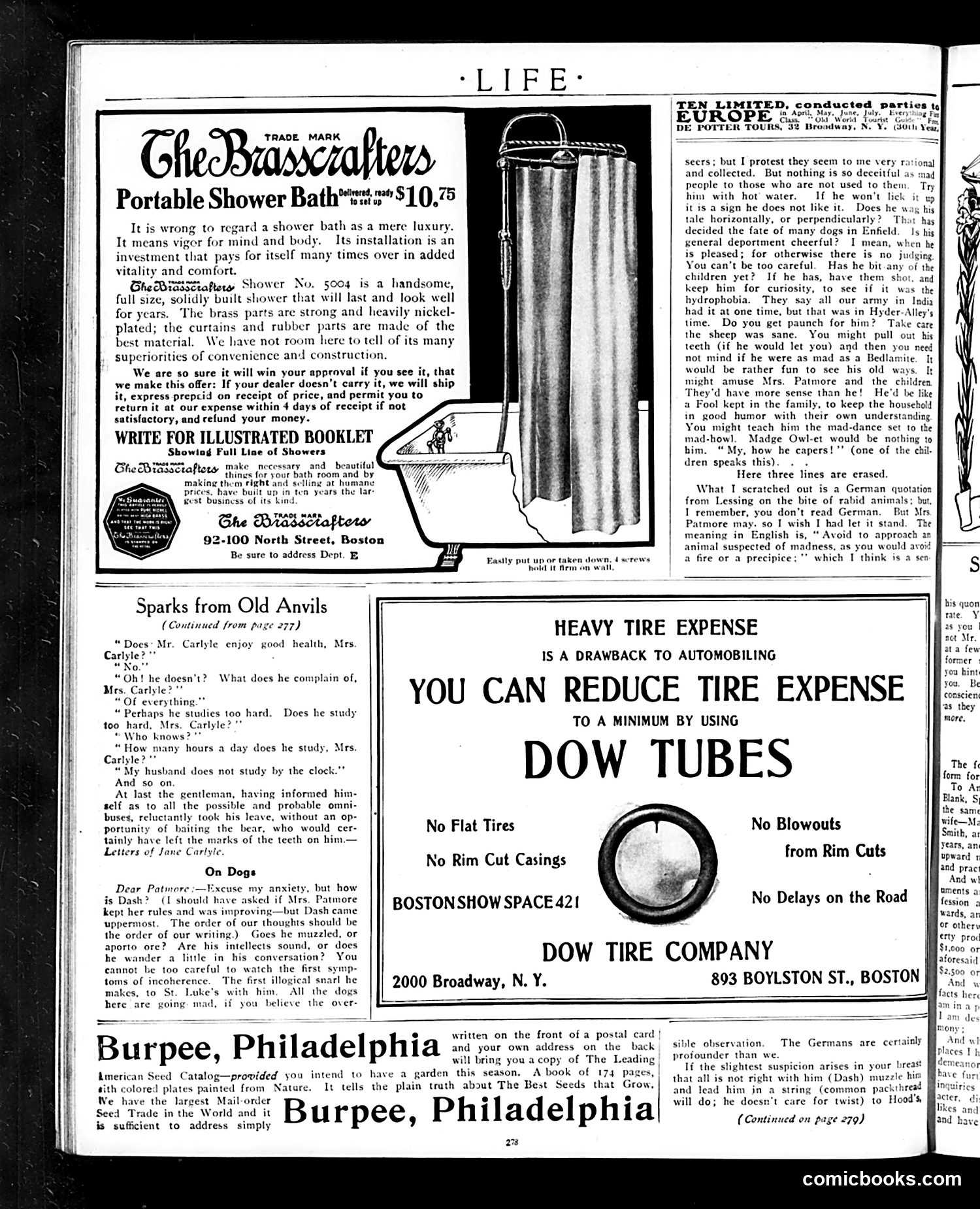
This page is primarily **advertisements** with one satirical column. The main content is "Sparks from Old Anvils," a humor column featuring brief comedic exchanges. The visible excerpt shows dialogue between Mr. and Mrs. Carlyle about his health and study habits, followed by a section "On Dogs" offering humorous advice about dog behavior and training. The satire appears gentle and domestic rather than political—poking fun at marital dynamics, intellectual pretension, and pet ownership. The humor relies on wordplay and ironic observations typical of 1920s-era American comedy magazines. The page also contains substantial advertising for The Brasscrafter's portable shower bath, Dow Tires, and Burpee seeds—representative of Life magazine's revenue model during this period.
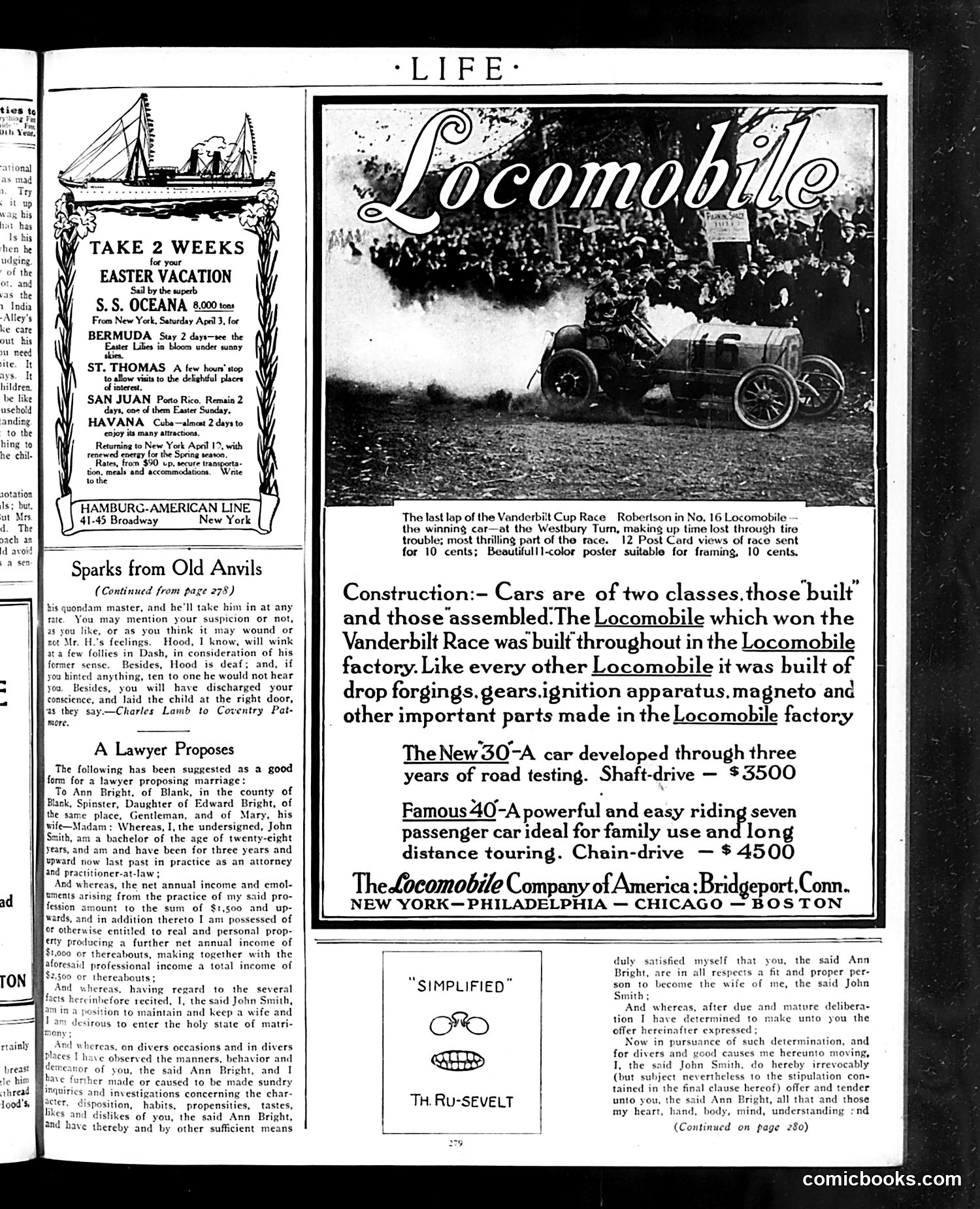
This page is primarily **advertising and commercial content** rather than political satire. The main featured advertisement is for the **Locomobile automobile**, prominently displayed with a racing car photo. The copy emphasizes that Locomobiles are factory-built and hand-assembled, highlighting their quality construction. Two models are advertised: the "New 30-A" ($3500) and the "Famous 40-A" ($4450), marketed for family touring and distance driving. A smaller section titled **"Simplified"** features "Th Ru-Sevelt"—an apparent pun on Theodore Roosevelt's name, though the cartoon itself is not clearly visible in this reproduction. The page also contains unrelated content about ocean voyages via S.S. Oceana and a legal notice proposing marriage requirements. This reflects *Life* magazine's dual role as both satirical publication and commercial platform.
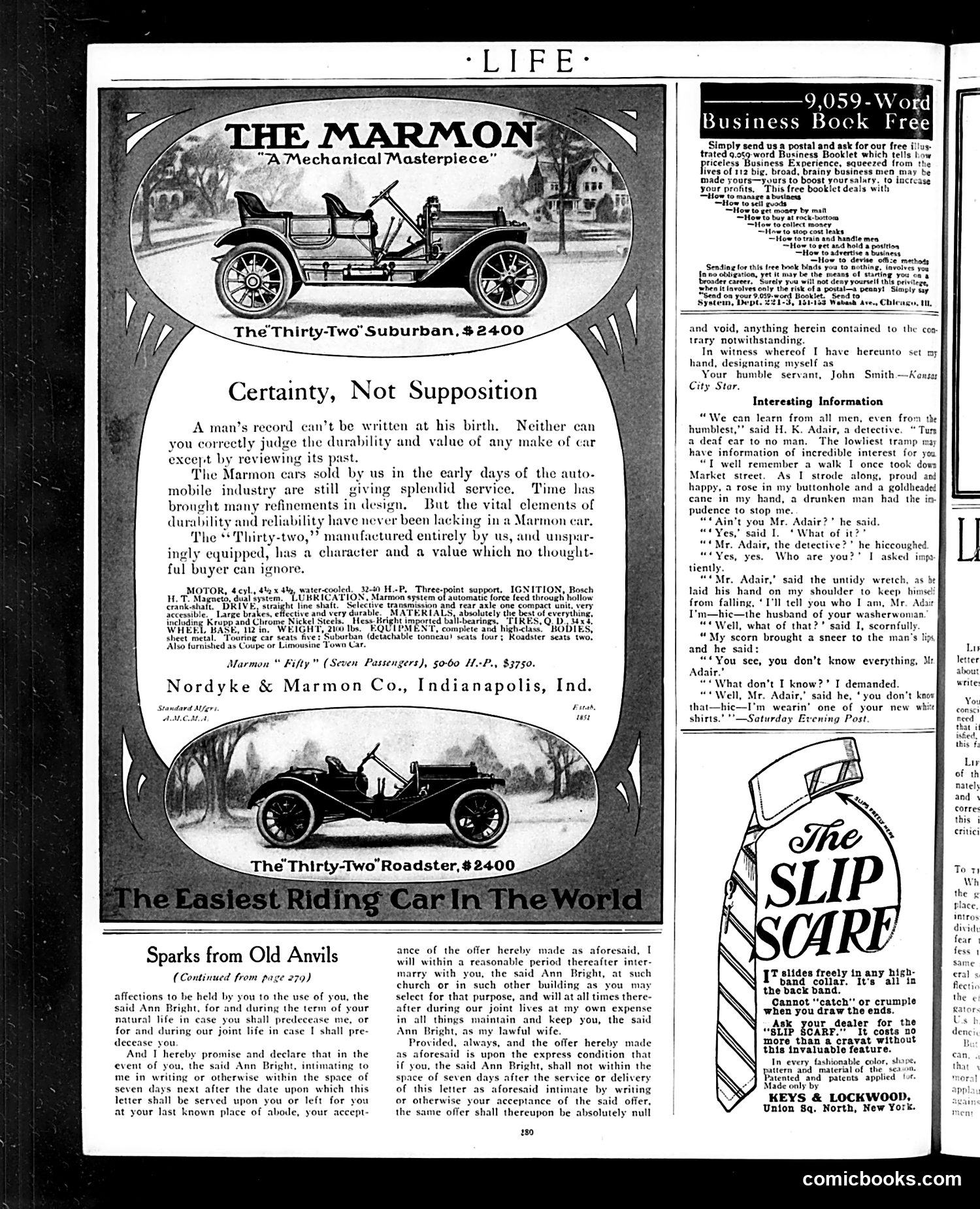
This page is primarily **automobile advertising**, not political satire. The main content features two advertisements for the Marmon automobile manufactured by Nordyke & Marmon Co. of Indianapolis. The ads emphasize the Marmon's durability and quality through the slogan "Certainty, Not Supposition" and "The Easiest Riding Car In The World." Both the Thirty-Two Suburban ($2400) and Thirty-Two Roadster ($2400) models are illustrated. The right column contains unrelated content: a business book offer, "Interesting Information" anecdotes, and an advertisement for "The Slip Scarf" product. There is **no political cartoon or satire** on this page—it's a period automotive trade advertisement emphasizing mechanical reliability to early 1900s consumers.
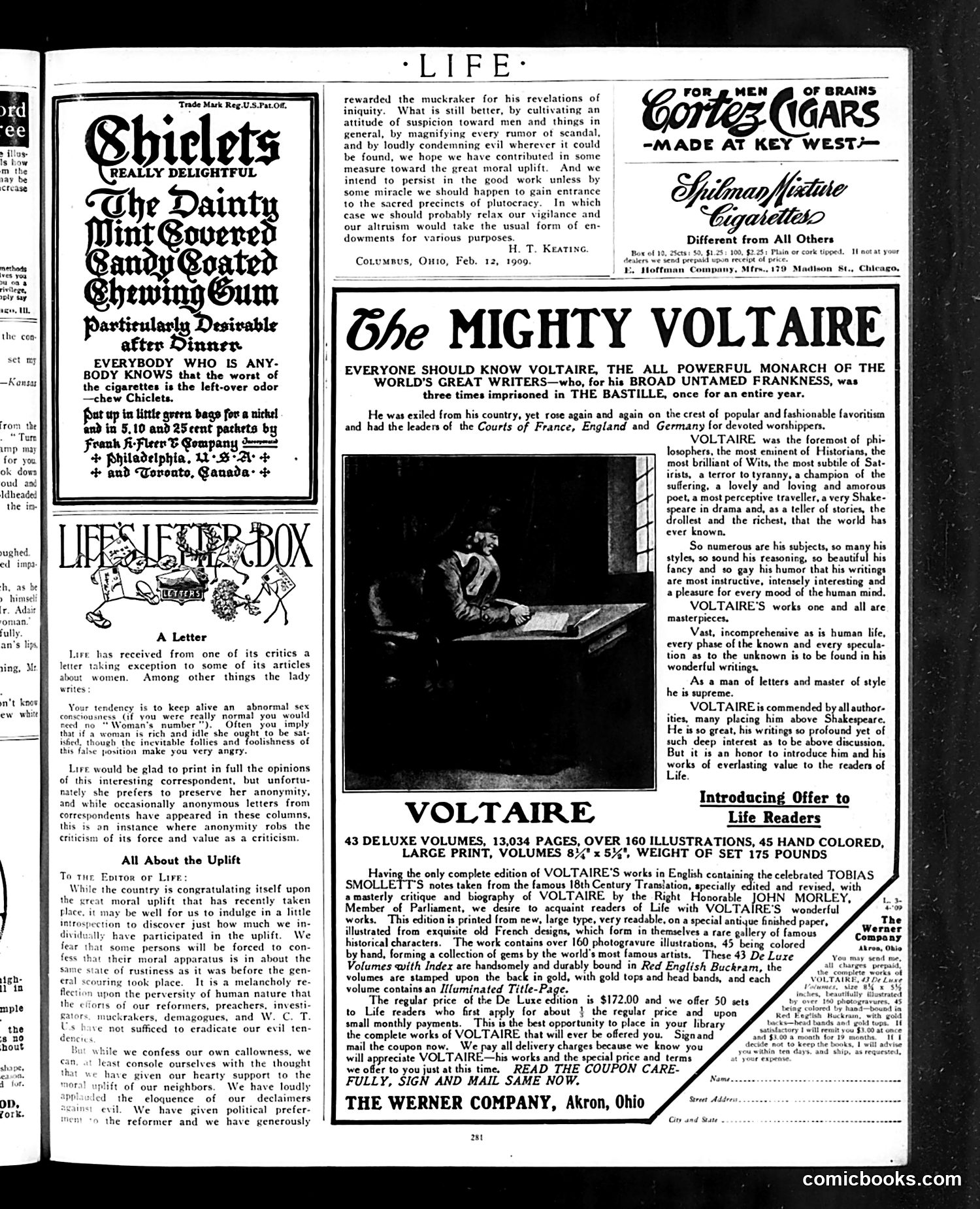
This page is primarily a **book advertisement** for a deluxe 43-volume complete edition of Voltaire's works, published by The Werner Company (Akron, Ohio). The ad promotes Voltaire as "the all-powerful monarch of the world's great writers," noting he was imprisoned in the Bastille and exiled for his writings. It emphasizes his significance as a philosopher, historian, and satirist whose works remain "masterpieces." The accompanying illustration shows a figure in period dress, likely representing Voltaire himself. The page also contains smaller advertisements for **Chiclets gum** and **Cortez cigars**, plus a "Life's Letter Box" editorial column addressing reader correspondence about social issues. The content reflects early 1900s American magazine publishing combining editorial matter with advertising.
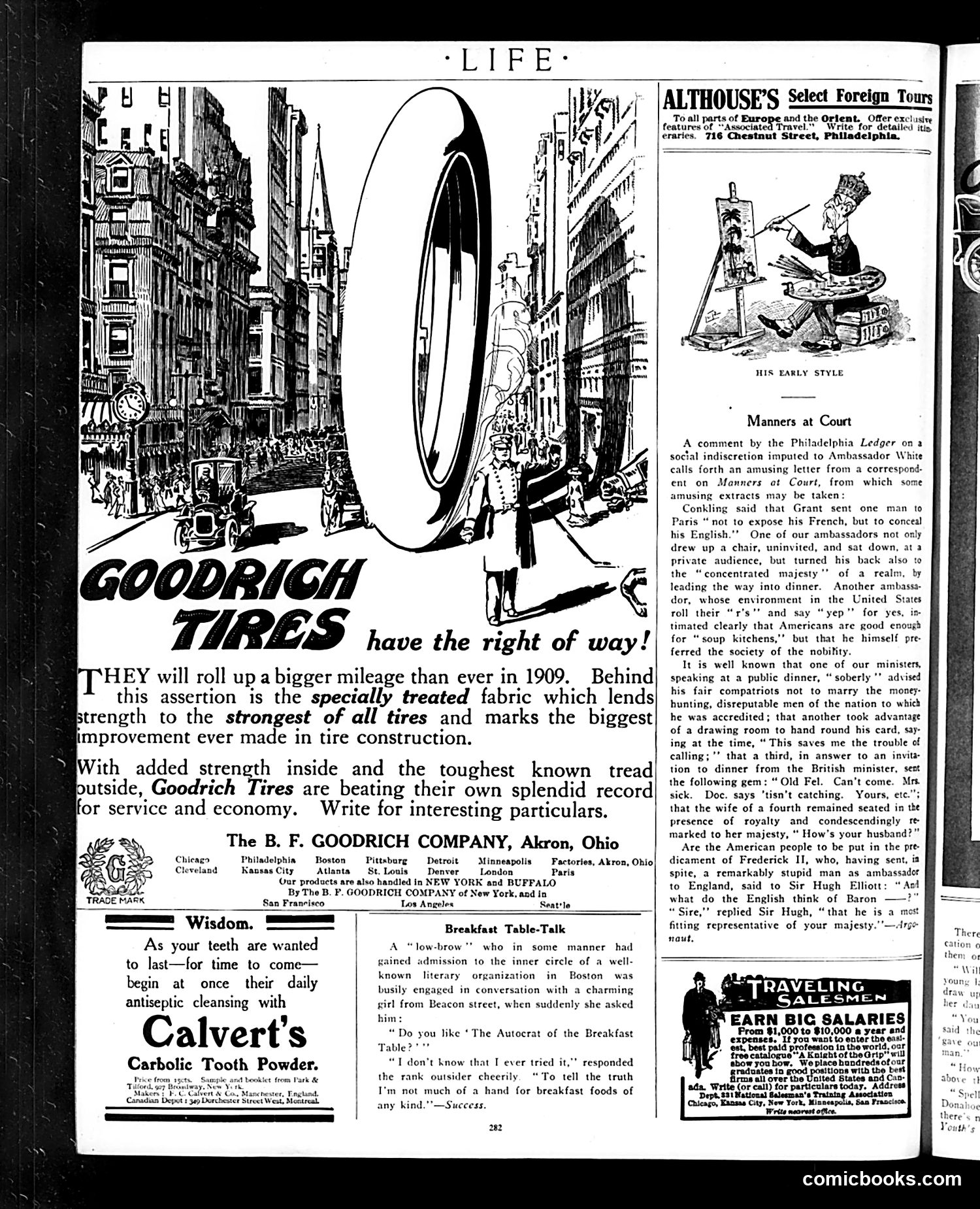
This page is primarily **advertising and lifestyle content** from *Life* magazine, not political satire. The dominant feature is a **Goodrich Tires advertisement** showing a giant tire dominating an urban street scene, claiming superior mileage and durability for 1909. Below that are two smaller ads: **Calvert's Carbolic Tooth Powder** and a **traveling salesman job recruitment** ad offering "big salaries." The text section titled **"Manners at Court"** satirizes American social pretension, mocking an ambassador's embarrassing behavior at a formal dinner—apparently speaking too informally and committing various etiquette violations. It's gentle social comedy about American crudeness versus European refinement, a recurring *Life* magazine theme. The **"Breakfast Table-Talk"** section appears to be humorous anecdotes, one about someone unfamiliar with "The Autocrat of the Breakfast Table." This is essentially a **lifestyle/humor/advertising hybrid page**, not political commentary.
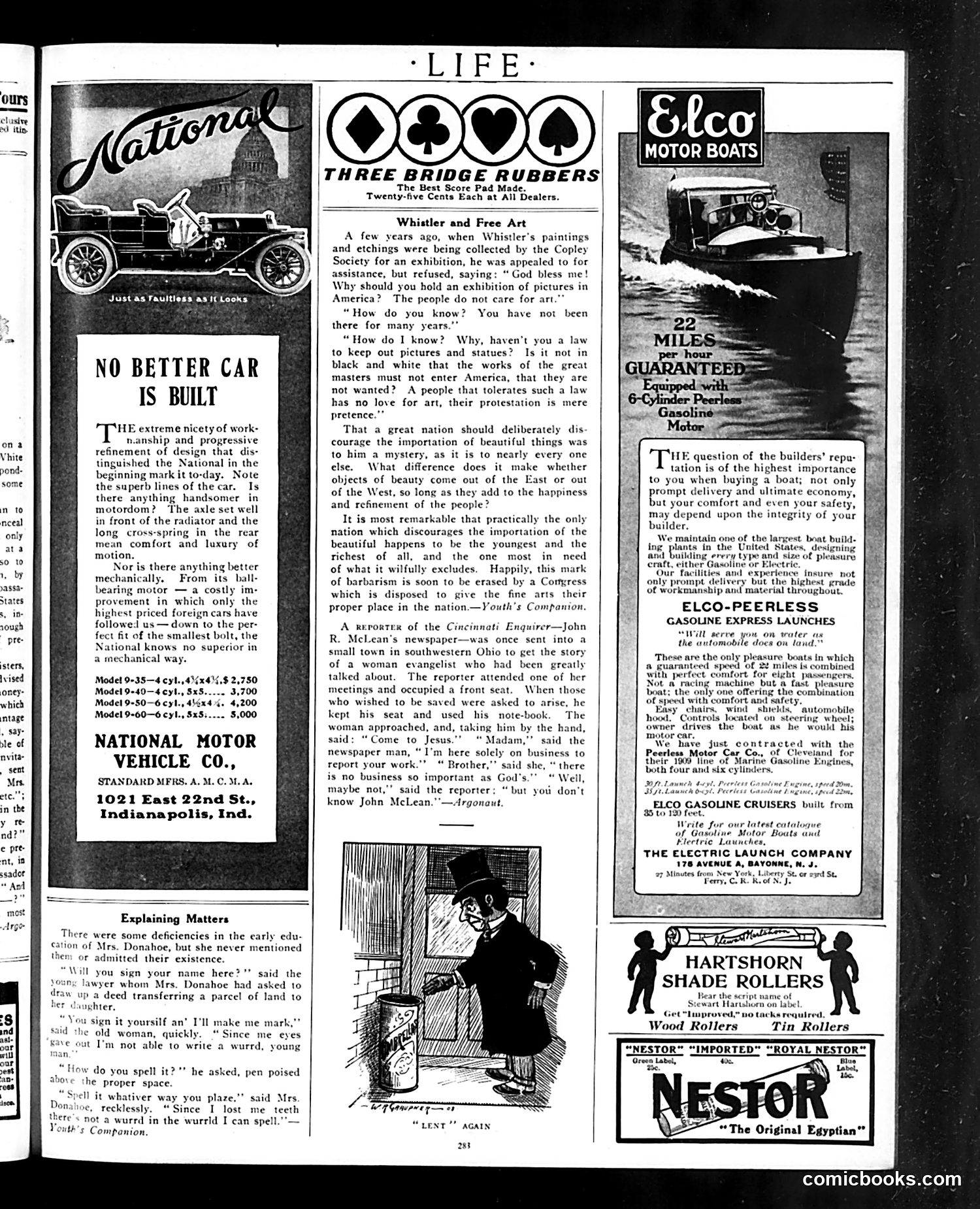
This page is primarily **advertising**, not political satire. It contains four product advertisements: 1. **National Motor** (automobiles) - emphasizing superior mechanical design 2. **Three Bridge Rubbers** (playing cards) - a brief text discusses artist Whistler's resistance to art importation restrictions 3. **Elco Motor Boats** - highlighting speed and engine performance 4. **Hartshorn Shade Rollers** and **Nestor** (automobile) - additional product ads The only satirical content appears in the Whistler text: it references a historical dispute where the artist refused to exhibit works in America due to protectionist attitudes against imported art. The passage critiques American insularity regarding artistic imports. The page reflects early 20th-century commercial magazine culture rather than political commentary.
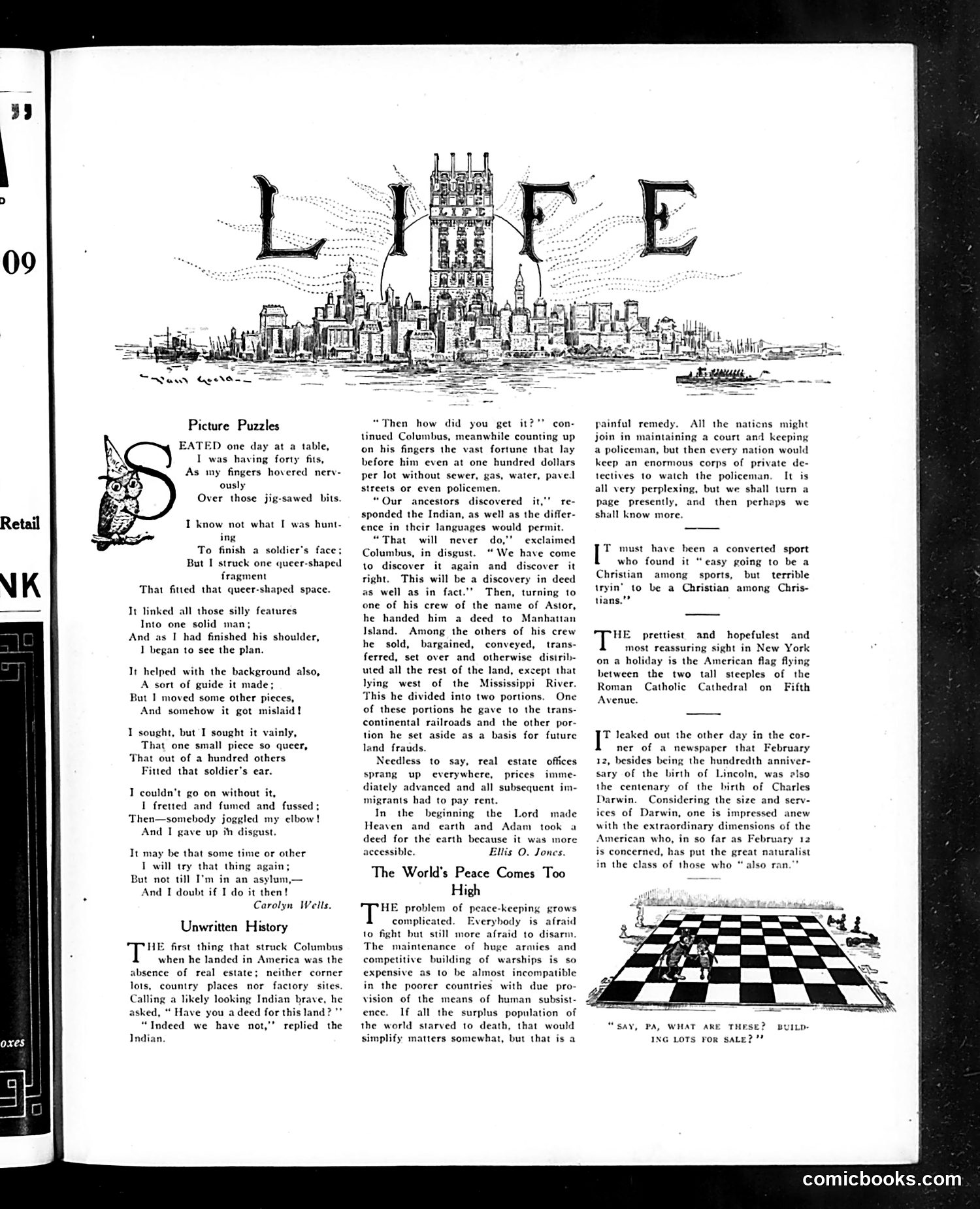
This page contains several distinct pieces: a "Picture Puzzles" section featuring an owl mascot and poetry about discovering Manhattan's real estate value; an "Unwritten History" anecdote about Columbus and Native Americans negotiating land sales; and an article titled "The World's Peace Comes Too High" discussing military spending and warships in poorer nations. The satirical thrust appears to be **critiquing American capitalism and imperialism**: the Columbus piece ironically frames land appropriation as commercial transaction, while the peace article questions whether massive military expenditures are truly necessary or sustainable for developing nations. The overall message suggests concern about how wealth and commerce dominate even fundamental geopolitical questions.
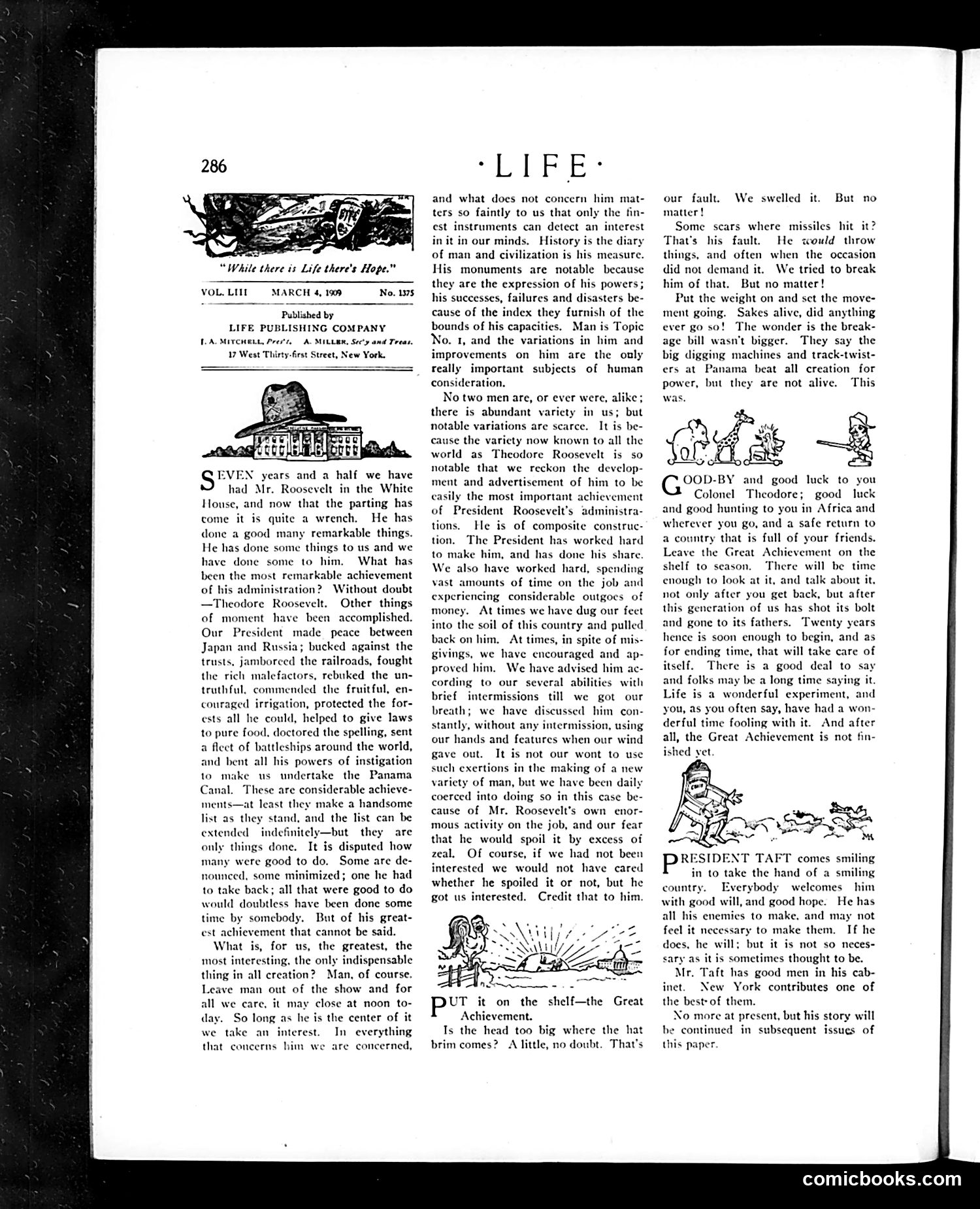
This is a farewell editorial on President Theodore Roosevelt's administration, published as he left office. The text argues Roosevelt's greatest achievement wasn't specific policies (peace with Japan, trust-busting, Panama Canal) but rather the development of his own distinctive personality and public image. The author claims Roosevelt himself—as a novel "variety of man"—is the most important product of his presidency. Life magazine boasts of its role in shaping and scrutinizing Roosevelt, describing how they've "worked hard" influencing him through constant discussion and advice, sometimes restraining his excessive zeal. The editorial reflects the magazine's self-importance as a cultural arbiter while offering a backhanded compliment: Roosevelt's real legacy is Roosevelt himself, not his accomplishments. The cartoon illustrations (barely visible) likely reinforce this focus on the president's personality rather than policy.
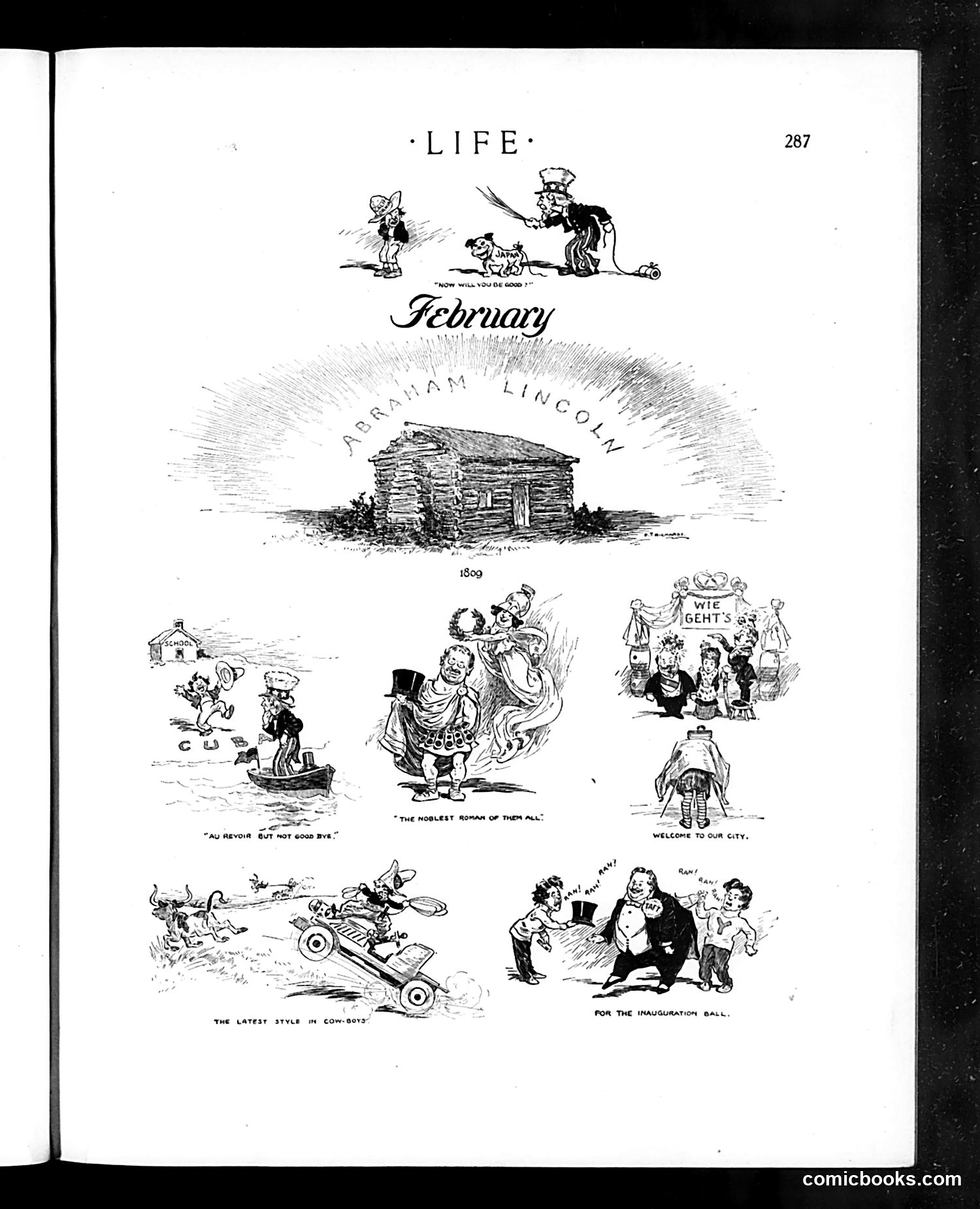
This page presents satirical cartoons celebrating Abraham Lincoln's centennial (1809-1909). The central image shows Lincoln's log cabin with his name and the date. The surrounding cartoons appear to mock contemporary politics through Lincoln references: - "The noblest Roman of them all" - likely comments on political figures claiming Lincoln's legacy - "Wie geht's" (German greeting) - possibly satirizing German-American or immigrant communities - "Welcome to our city" - depicts what appears to be political reception scenes - "The latest style in cow-boys" and "For the inauguration ball" - seem to contrast frontier authenticity with formal politics The cartoons suggest satirical tension between Lincoln's humble origins and contemporary political pretension, using his centennial as occasion to mock current political figures and social pretenses.
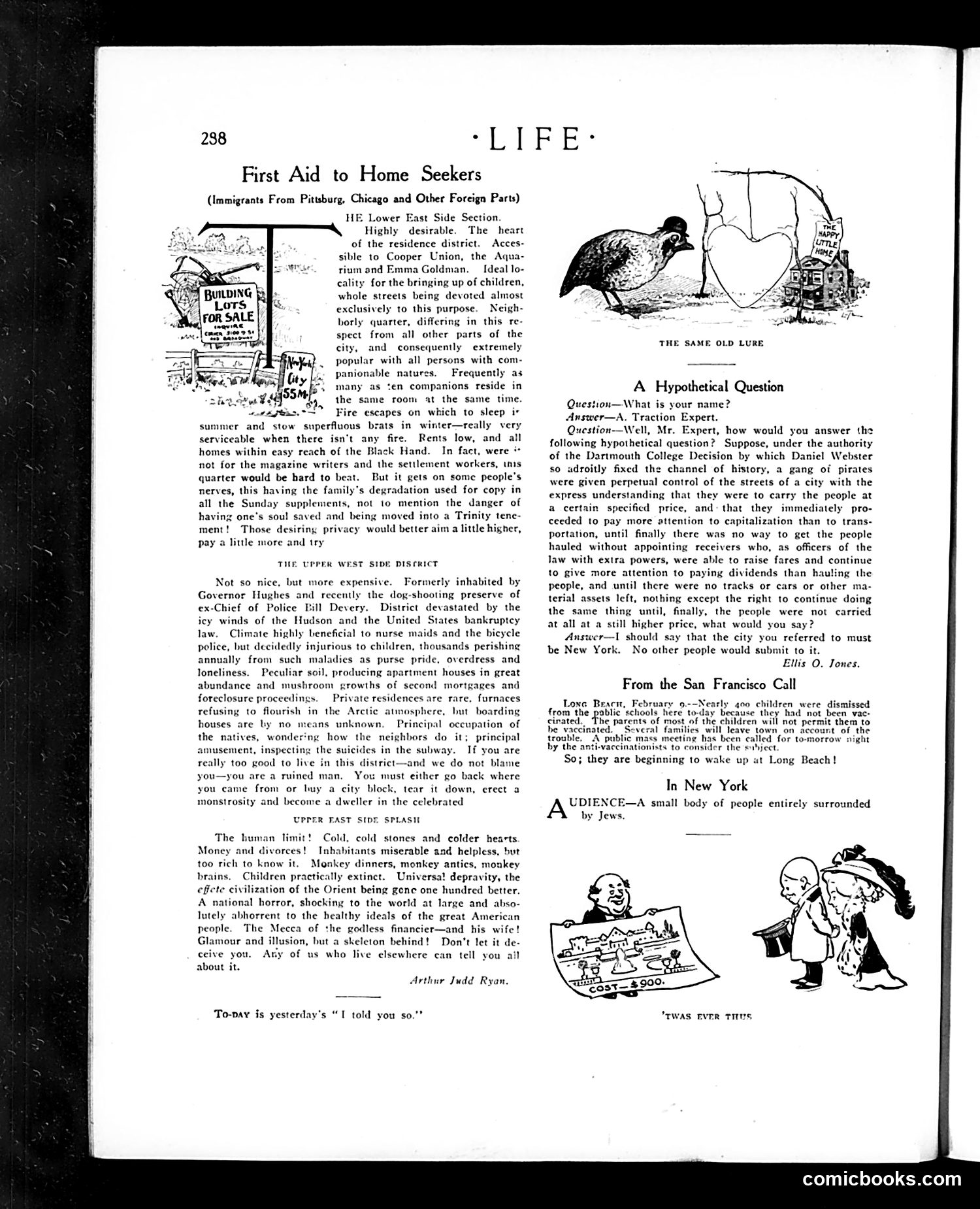
This Life magazine page satirizes New York City neighborhoods as "real estate listings" for immigrants from industrial cities like Pittsburgh and Chicago. **The Upper West Side** and **Lower East Side** sections are mocked as overcrowded, dangerous tenements where poor immigrants are packed together (ten people per room). The satire references "Emma Goldman" (anarchist activist) and the "Black Hand" (Italian mafia), suggesting these areas are crime-ridden and politically radical. **The Upper East Side** is portrayed as equally miserable—formerly home to Governor Hughes and ex-Police Chief "Kill" Devery, now an Arctic wasteland of bankruptcy and foreclosures, where wealthy residents obsess over status ("purse pride") while their children suffer. The cartoon mocks both immigrant poverty and wealthy pretension, suggesting New York offers nowhere suitable to live. The accompanying article by Arthur Judd Ryan continues this satirical critique of urban inequality and journalistic exploitation of tenement conditions.
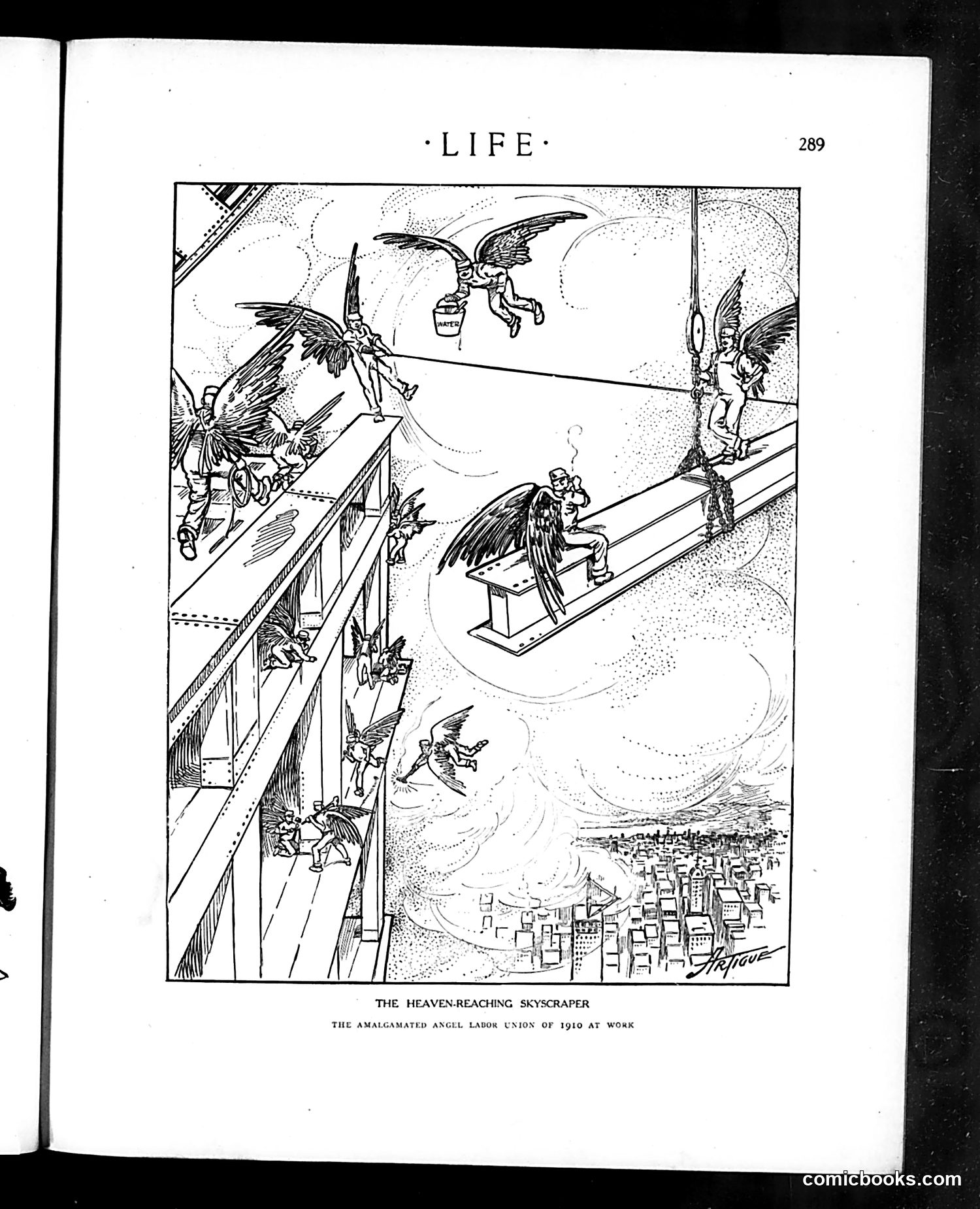
This 1910 satire depicts winged angels as construction workers building a towering skyscraper. The caption references "The Amalgamated Angel Labor Union of 1910 at Work." The cartoon satirizes labor unions by portraying them as heavenly or divine entities—ironically suggesting that unionized workers see themselves as celestial. The joke likely mocks either: 1. Union workers' perceived arrogance or inflated self-importance, or 2. The idea that unions were achieving "heaven-reaching" heights of power and ambition The skyscraper itself—a symbol of modern urban progress and capitalism—being constructed by unionized "angels" creates comedic tension between heavenly virtue and earthly labor disputes. This reflects early-20th-century anxieties about labor organizing's growing influence on American industry.
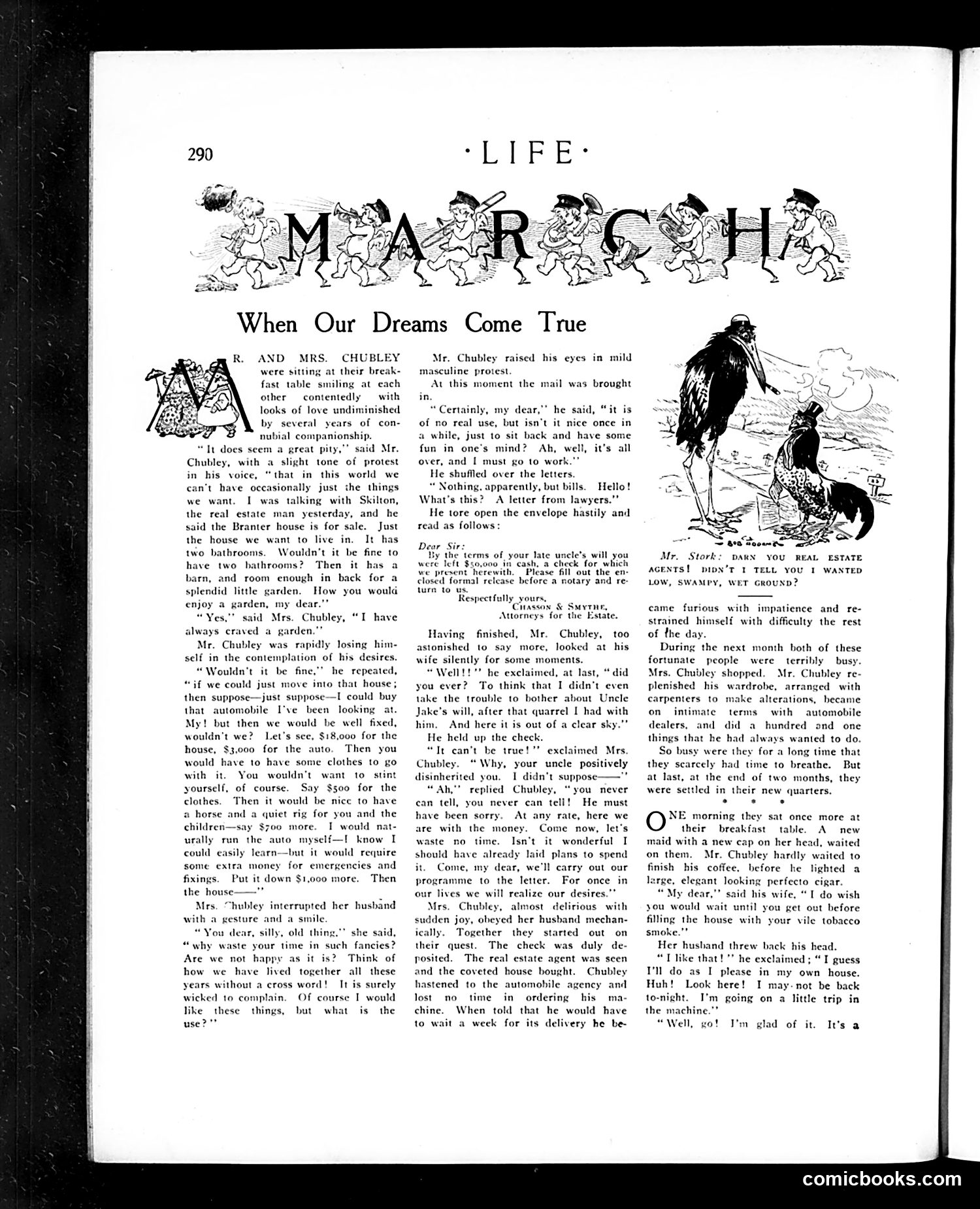
This is a satirical story about the Chubleys, a contented middle-class couple. Mr. Chubley daydreams about acquiring luxuries—a new house ($18,000), an automobile ($3,000), clothes, and a horse—mentally calculating the expenses while his wife wisely reminds him such fantasies are pointless given their contentment. The joke arrives when they receive an unexpected inheritance of $50,000 from his estranged uncle, allowing them to actually pursue these dreams. The satire targets American consumer culture and materialism: the story suggests that once financial barriers disappear, people immediately abandon philosophical contentment to chase previously-fantasized possessions. The accompanying illustrations show the couple and various figures in period dress, emphasizing the "March" (satirical) theme of Life magazine. The humor lies in exposing how quickly practicality and desire overcome the couple's earlier wisdom about happiness.
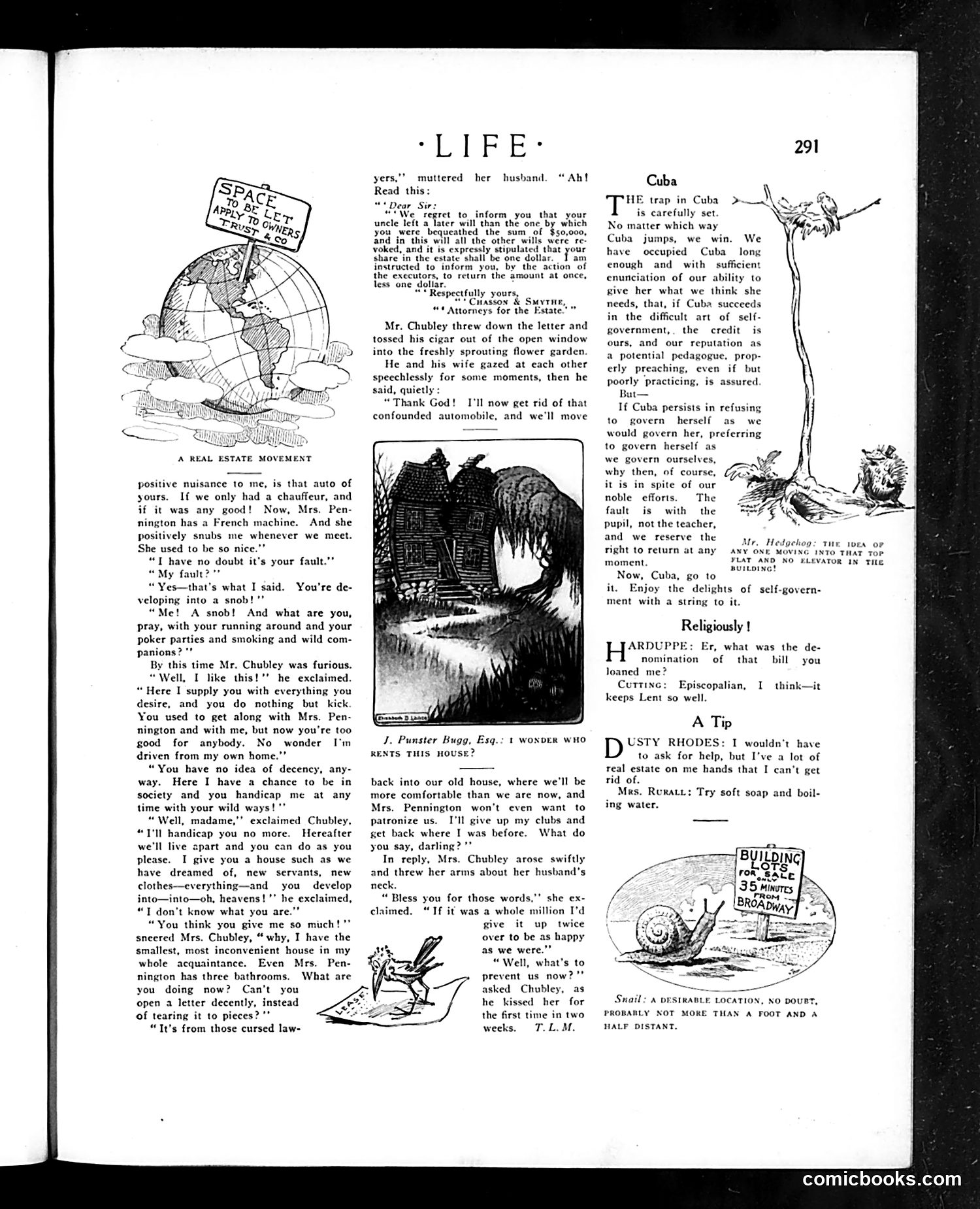
**Main Story ("A Real Estate Movement"):** A satirical domestic comedy about the Chubleys, a couple whose marriage deteriorates when they acquire wealth and social pretensions. Mrs. Chubley becomes a snob, envying neighbors like Mrs. Pennington who own fancier automobiles and have more bathrooms. The couple argues bitterly until Mr. Chubley receives news his uncle's will was changed—he now inherits only one dollar instead of $50,000. Paradoxically relieved, they reconcile, realizing their happiness came from modest circumstances, not wealth. **Political Cartoon ("Cuba"):** A commentary on American imperialism. The cartoon criticizes U.S. occupation policy toward Cuba, suggesting America takes credit for any Cuban success while blaming Cuba itself for any failure—a "win-win" arrangement regardless of outcomes. The rhetoric about America as "pedagogue" (teacher) patronizingly frames intervention as benevolent instruction. Both pieces satirize contemporary social anxieties: material aspiration and class climbing in the domestic story; American imperial hubris regarding Cuba.
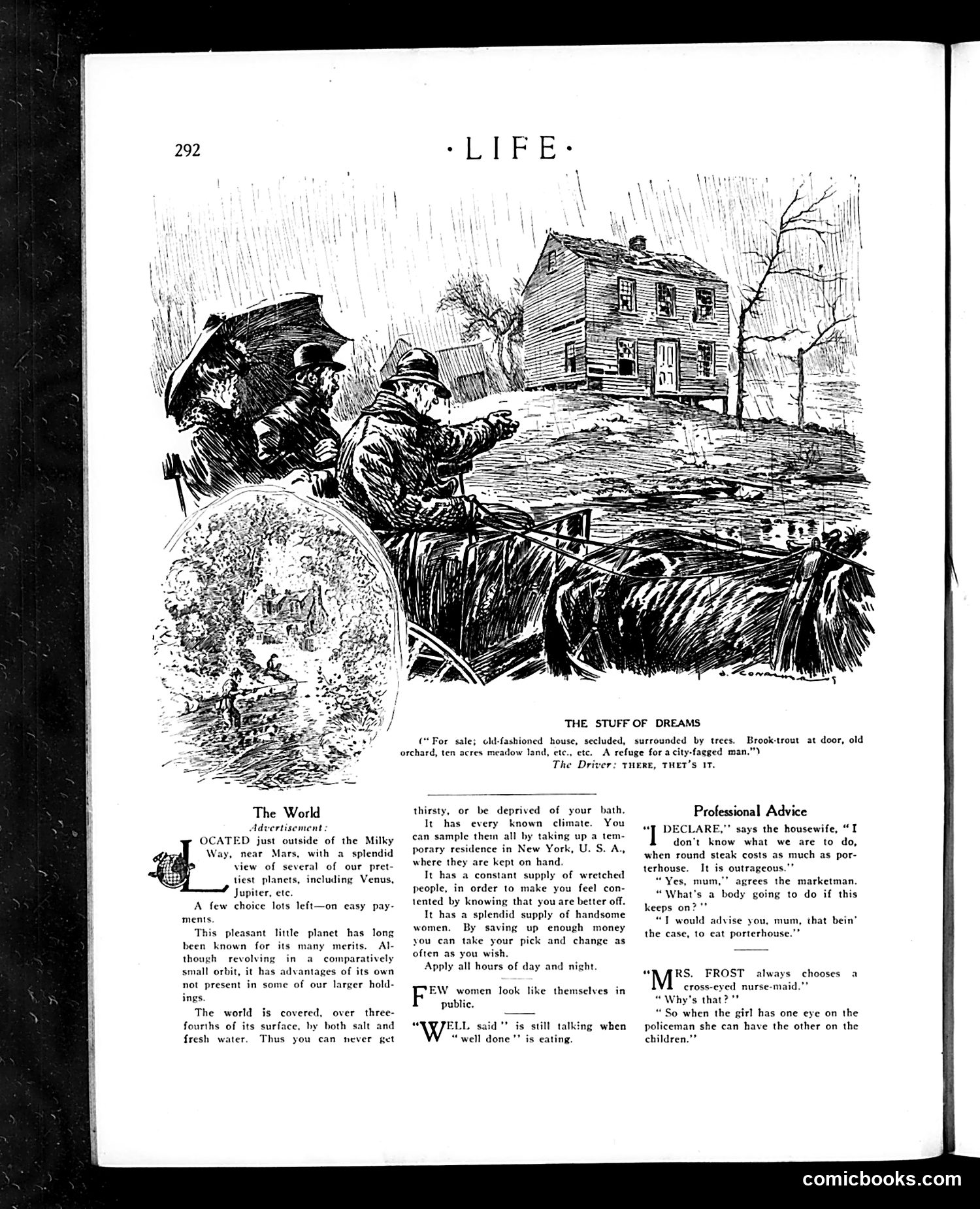
This page contains three separate satirical pieces: **"The World"** (left): A mock real-estate advertisement selling Earth itself like property. It humorously pitches the planet's "features"—water, climate variety, and crucially, "a constant supply of wretched people" to make buyers feel superior, plus "handsome women" available if you save enough money. The satire targets both real-estate hyperbole and male consumerism. **"The Stuff of Dreams"** (center): A cartoon showing two men viewing a rural house for sale. The caption indicates it's a refuge for the "city-fagged man"—satirizing urban professionals' romanticized fantasy of rural escape. **"Professional Advice"** (right): Humorous dialogue between a housewife and marketman debating high meat prices, followed by a joke about Mrs. Frost hiring a cross-eyed nurse-maid so "one eye" watches the policeman while the other watches children—absurdist humor about multitasking. All three mock contemporary consumer culture, aspirations, and domestic concerns of the early 20th century.
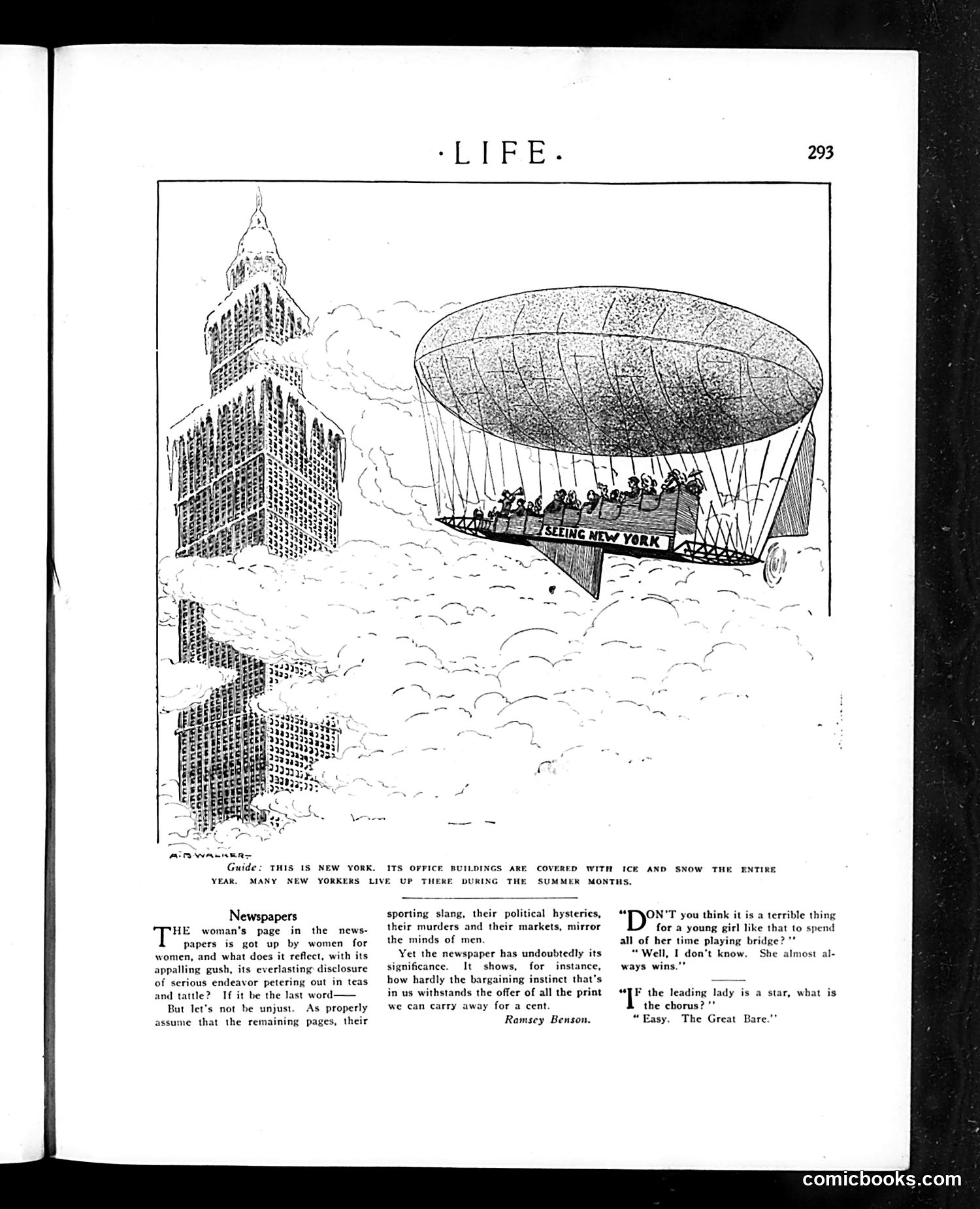
The page contains two main elements: **The Cartoon:** A satirical illustration showing New York's skyscrapers so tall they're covered in ice and snow year-round, with a tourist airship labeled "SEEING NEW YORK" floating past. The joke mocks New York's extreme height and harsh climate—the buildings are absurdly tall enough to reach perpetually frozen altitudes. **The "Newspapers" Essay:** Critiques the gender divide in newspaper content. The author acknowledges that women's pages reflect women's interests (fashion, social events, gossip), but argues this triviality mirrors how men's pages—with their "sporting slang," "political hysterics," "murders and markets"—reflect men's minds equally poorly. The satire suggests both sexes deserve criticism for their reading choices. **The Dialogue Jokes:** Two brief exchanges mocking bridge-playing and theater terminology among the social elite. The overall tone is urbane social satire targeting early 20th-century American upper-class preoccupations and gender stereotypes.
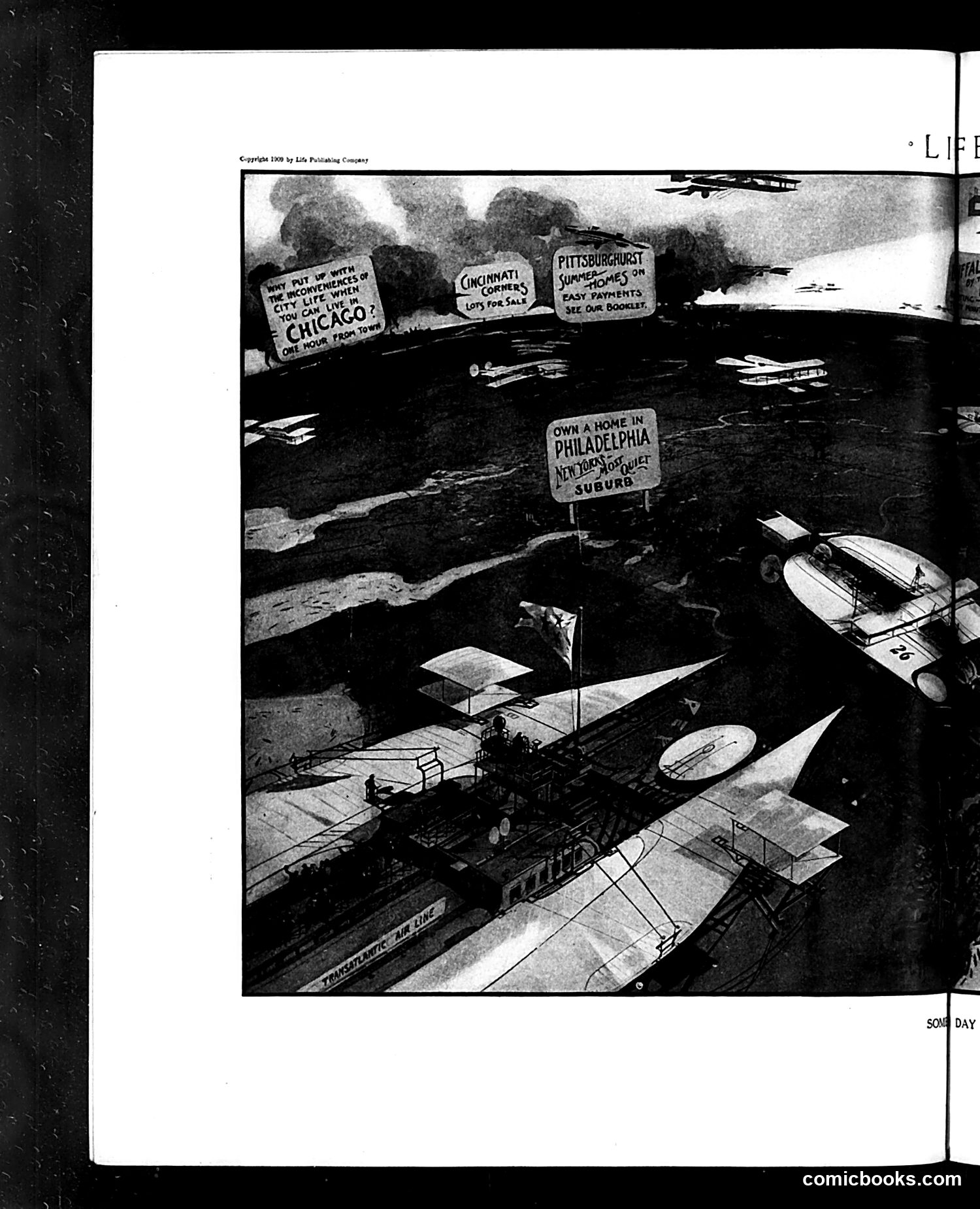
This is an aerial illustration of an airfield or aviation facility with multiple billboards advertising real estate developments to potential homebuyers. The signs promote properties in Chicago, Cincinnati, Pittsburgh, and Philadelphia, each highlighting suburban living opportunities ("easy payments," "see our booklet," "new all-outlet suburb"). The satire appears to target 1920s real estate speculation and suburban expansion—these advertisements are strategically placed where airplane passengers would see them, suggesting aggressive marketing of distant suburban developments. The joke likely mocks the era's real estate boom and speculative fever, where developers were eagerly promoting outlying areas to commuters. The juxtaposition of modern aviation technology with old-fashioned billboard advertising underscores the clash between progress and opportunistic commerce during this period of American growth.
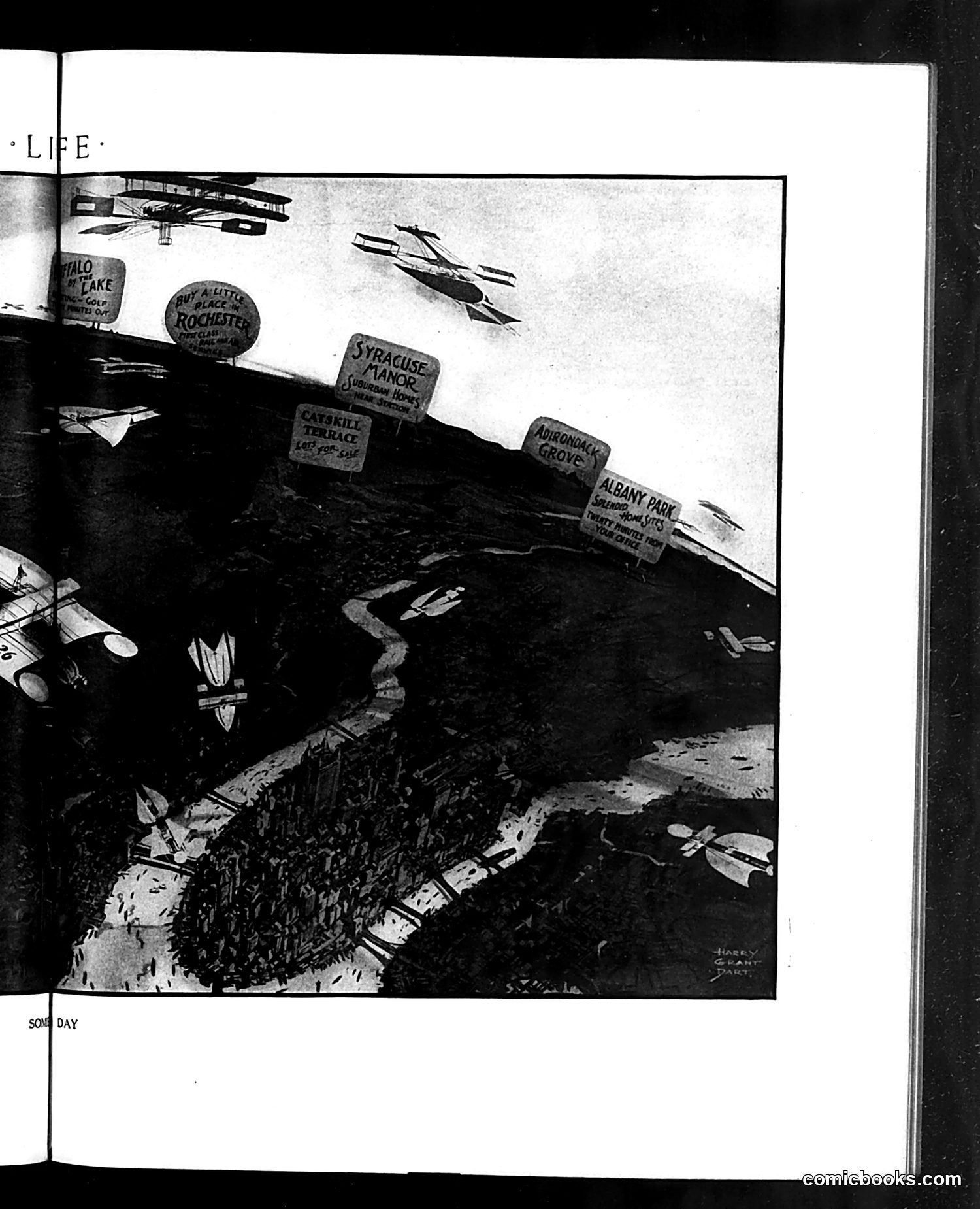
This appears to be a diorama or display from Life magazine showing model airplanes in flight above a landscape with labeled locations. The visible signs reference New York State regions: Rochester, Syracuse, Catskill Terrace, Adirondack Grove, and Albany Park. The image likely depicts early aviation routes or destinations popular during the pioneering era of American flight. The small model aircraft suspended above suggest this was a visual representation of air travel possibilities—perhaps showing how aviation was opening up previously distant locations within New York State to tourism or transportation. The "SOMEDAY" caption at bottom suggests this depicts aspirational future travel scenarios. Without additional context, the specific satirical point remains unclear, though it may reference early enthusiasm about aviation's transformative potential for regional connectivity.
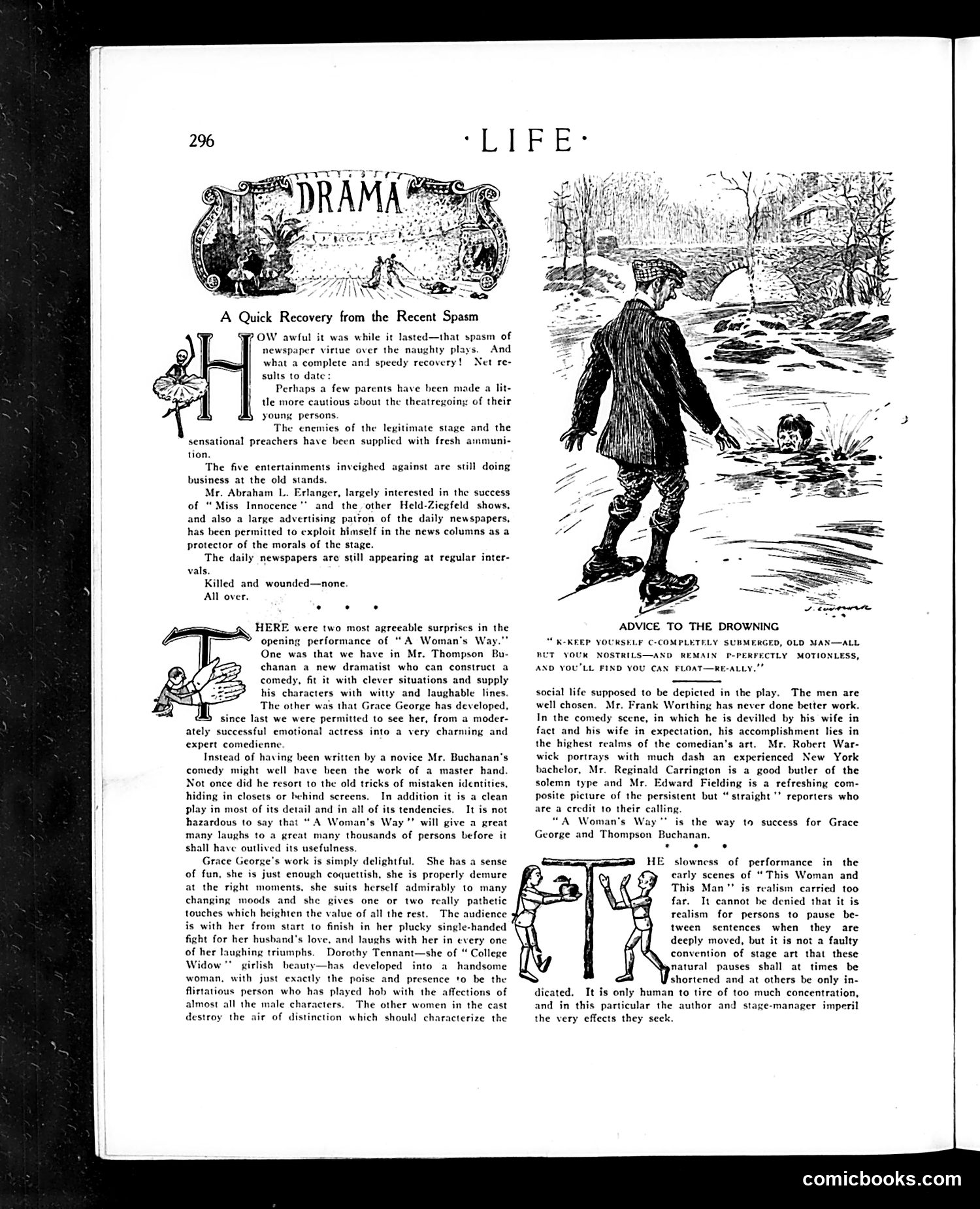
This *Life* magazine page satirizes a recent moral panic about "naughty plays" on the American stage. The opening section, "A Quick Recovery from the Recent Spasm," mocks newspaper and preacher outrage over theatrical immorality that proved entirely ineffectual. The satire's point: despite the moral crusade, nothing actually changed—the five condemned entertainments still run, newspapers continue publishing, and theater owner Abraham L. Erlanger even exploited the controversy for publicity. The "results": zero casualties in the culture war. The page then pivots to genuinely praising the play "A Woman's Way," featuring Grace George and newcomer Thompson Buchanan, as wholesome comedy that proves legitimate theater needs no moral policing. The cartoon "Advice to the Drowning" appears to be darkly humorous commentary on absurd or counterintuitive guidance—possibly alluding metaphorically to the ineffectual "rescue" attempts of moral reformers flailing about ineffectively.
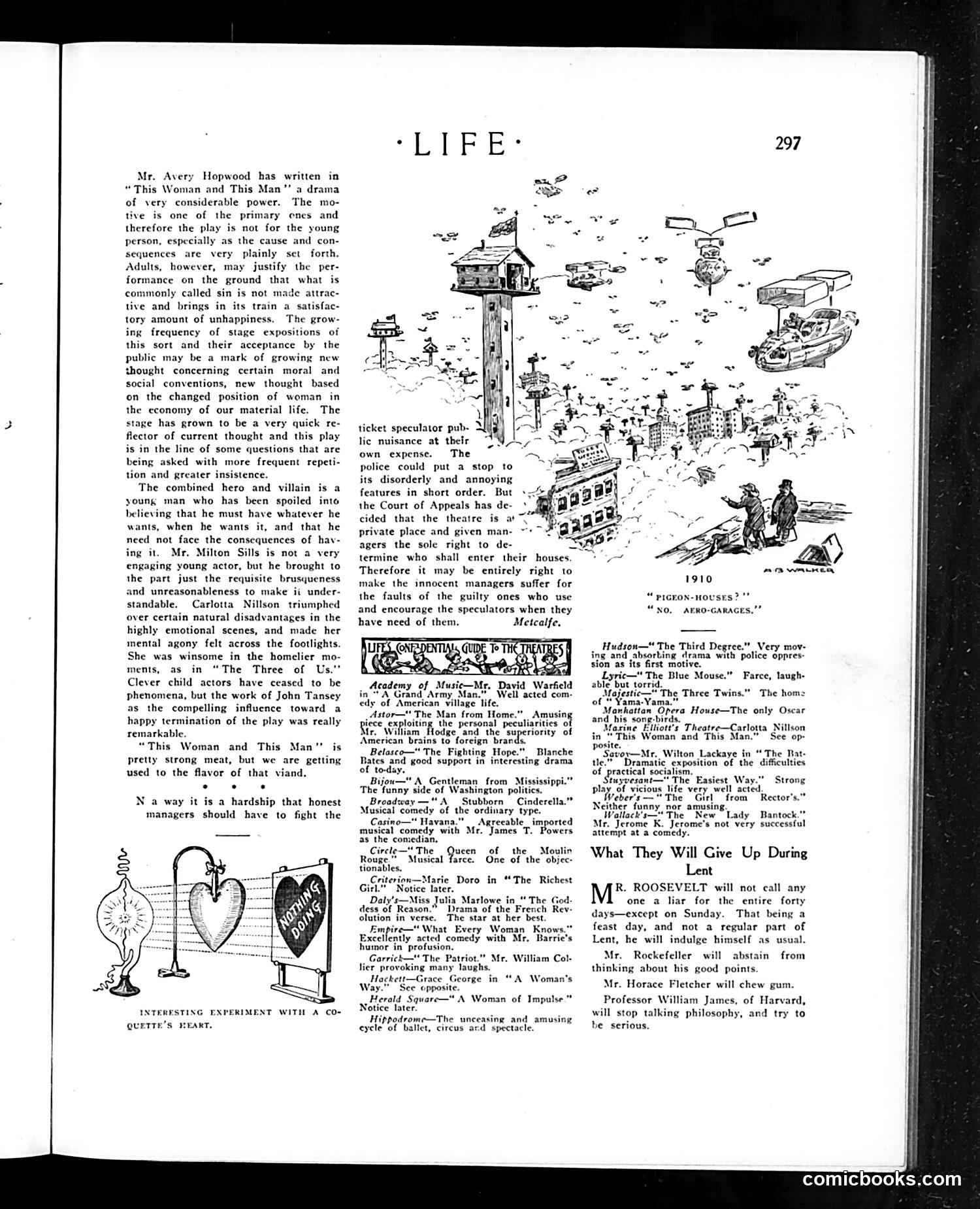
This page from *Life* magazine contains theater reviews and commentary on contemporary Broadway productions (circa 1910s based on styling). The main cartoon—"Interesting Experiment with a Coquette's Heart"—shows a scientific apparatus measuring or testing a woman's heart, depicted as an organ. This satirizes contemporary anxieties about women's changing social roles and morality. The image suggests skepticism about efforts to quantify or understand female emotional/sexual nature scientifically. The lengthy review discusses Avery Hopwood's play "This Woman and This Man," which deals frankly with sexual morality and infidelity—scandalous subjects for the era. The critic defends the play's adult audience and suggests its popularity reflects "new thought" about women's economic independence and changing social conventions. A secondary commentary by "Metcalfe" criticizes ticket scalpers, arguing theaters shouldn't suffer financially for speculators' practices. The remaining space lists Broadway productions with brief critical notes, representing typical entertainment journalism of the period.
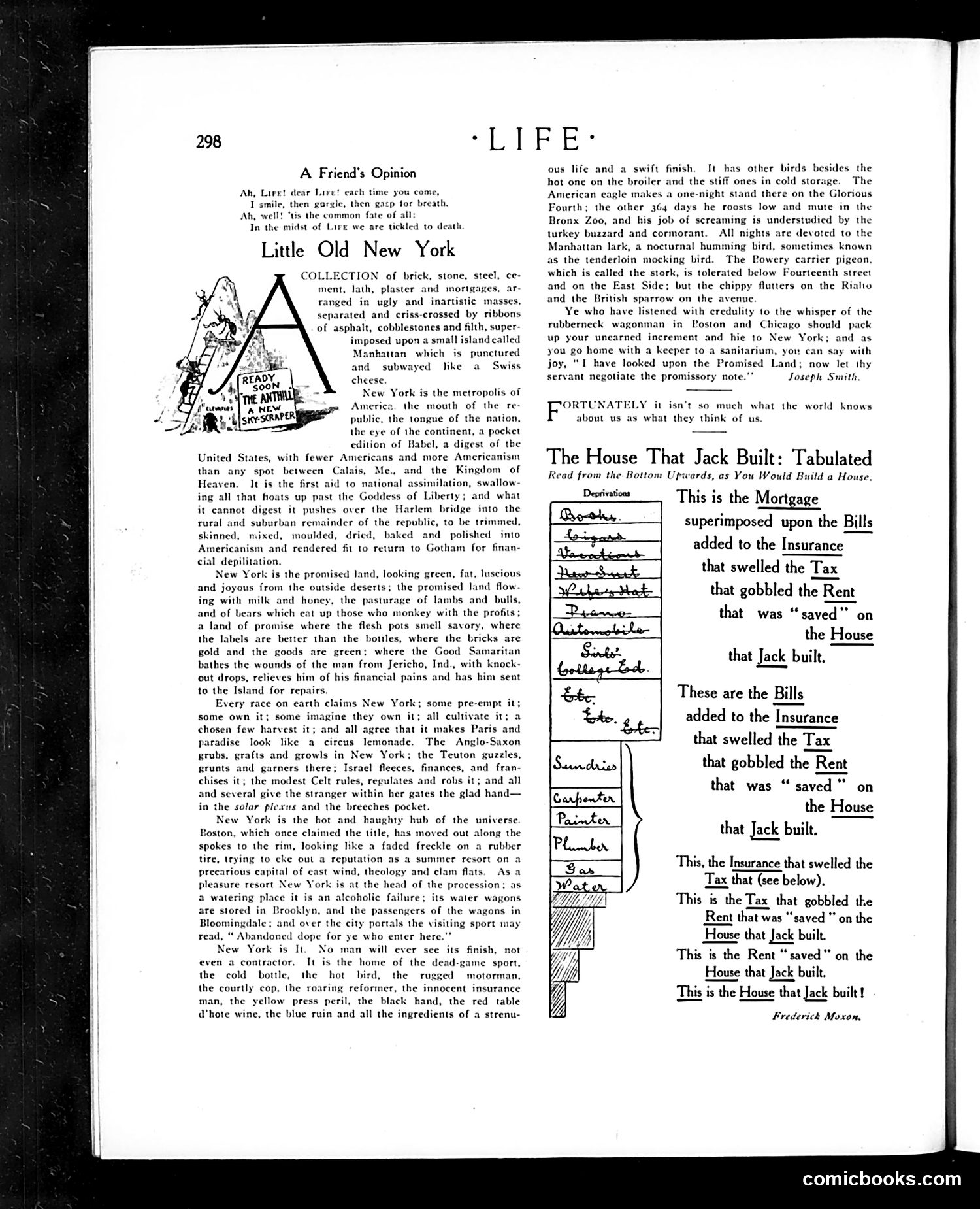
This page contains two satirical pieces about New York City from *Life* magazine. **"A Friend's Opinion"** (top) is a brief, humorous poem mocking the magazine itself—suggesting that reading *Life* is both pleasurable and exhausting ("tickled to death"). **"Little Old New York"** (main article) is a biting critique of New York City presented as a mock-definition. The satire targets: - **The city's physical ugliness**: described as a chaotic collection of "brick, stone, steel, cement" arranged in "ugly and inartistic mass," punctured by subways like Swiss cheese - **Ethnic and class stereotypes**: Anglo-Saxons "grub, graft and growl"; Germans "guzzle"; Jewish people "fleece, finance, and franchise"; Irish people "rule, regulate and rob" - **Predatory capitalism**: New York extracts wealth from visitors and outsiders, sends them to "the Island" (likely Blackwell's Island prison/asylum) for "repairs" - **Moral corruption**: described as a den of crime, vice, and scandal The piece sarcastically compares New York to the "Promised Land" while depicting it as exploitative, chaotic, and morally bankrupt—a hub of American excess and greed.
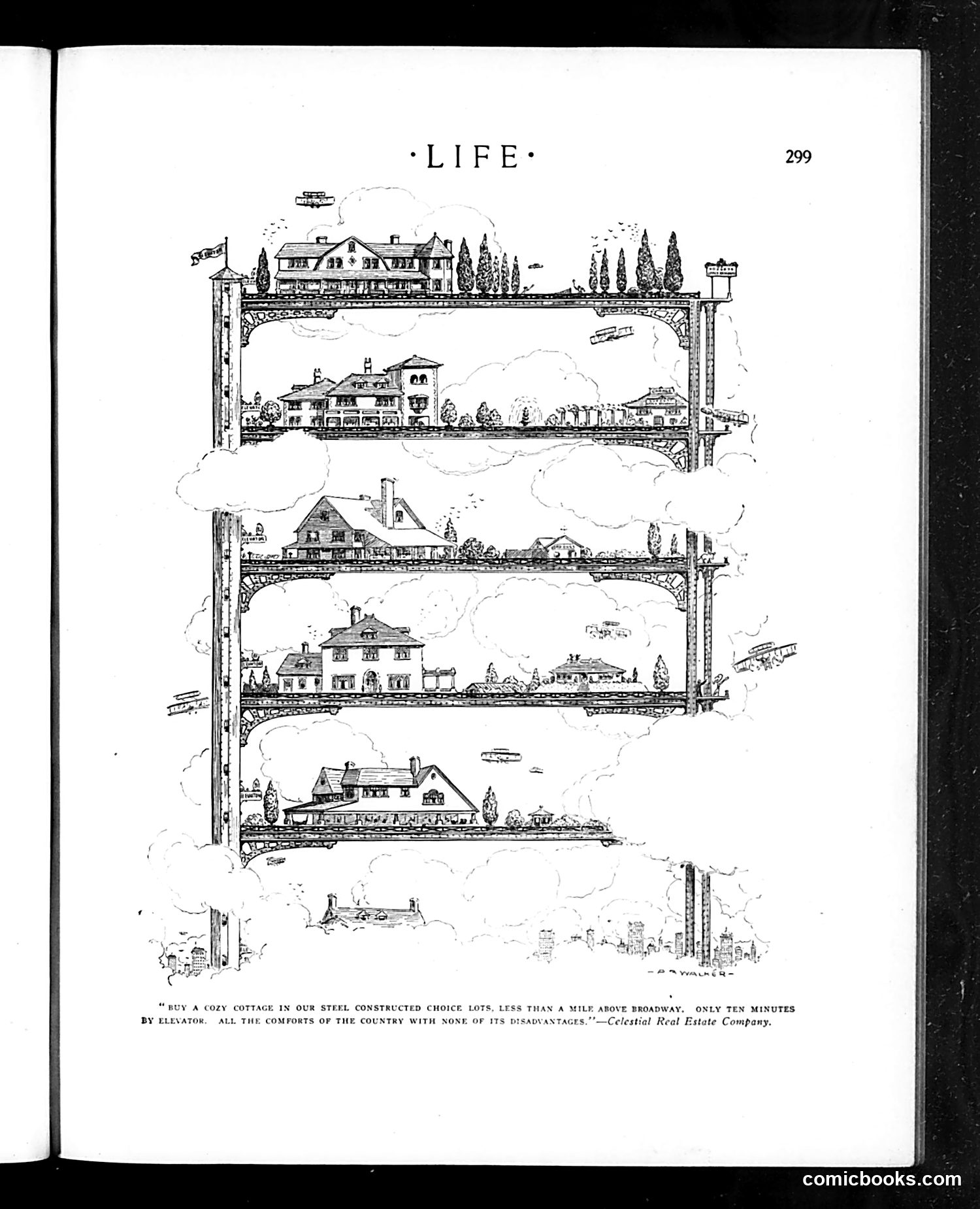
This is a satirical advertisement from Life magazine mocking speculative real estate marketing. The image shows six stacked residential levels suspended in clouds, connected by an elevator shaft—a visual joke about the impossibility of the sales pitch. The satire targets the "Celestial Real Estate Company's" absurd promise: they're advertising homes "less than a mile above Broadway" (Manhattan's commercial heart) with "country comforts" accessible by elevator in "only ten minutes." The stacked-in-the-sky imagery literalizes the ridiculous claim, suggesting these homes exist only in heaven—hence "Celestial." This mocks contemporary real estate hucksterism, where developers made implausible promises to lure buyers. The joke is that the only way such an impossible offer could work is if these cottages were literally in the heavens. It's a commentary on fraudulent or wildly exaggerated property advertising common in early 20th-century America.
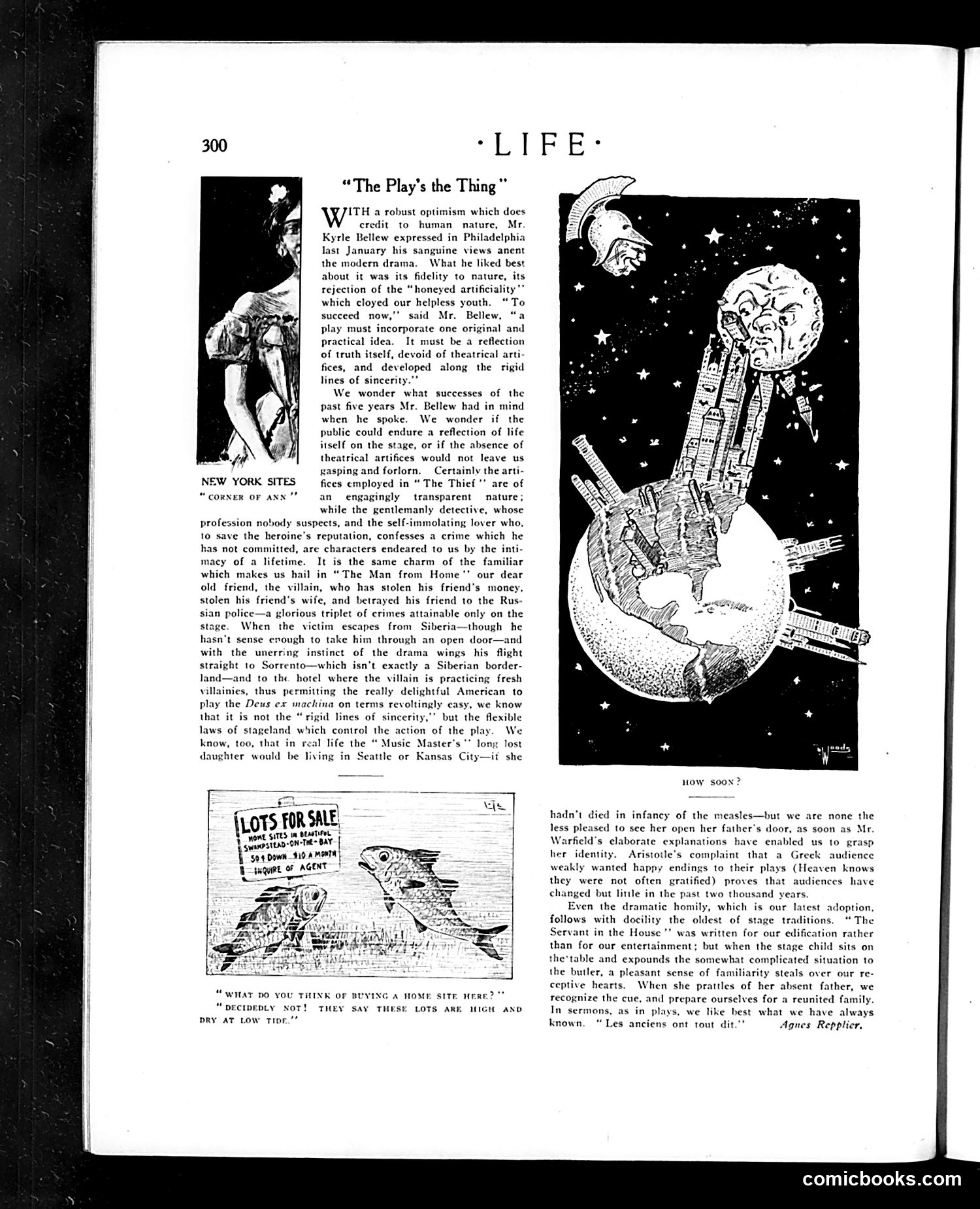
This page critiques actor Kyrle Bellew's stated philosophy that modern drama should reject theatrical artifice and reflect life truthfully. Life's columnist (Agnes Repplier) argues the opposite—audiences actually *crave* familiar theatrical conventions, not realism. The article mocks three contemporary plays: "The Thief," "The Man from Home," and "The Servant in the House." Each exemplifies absurd stagecraft—implausible coincidences, melodramatic villains, convenient plot devices—yet audiences embrace them because they're comfortably predictable. The sidebar cartoon satirizes New York real estate speculation, depicting a fish-like creature recoiling from waterfront "lots for sale," skeptical of their dubious claims. The overall point: theater doesn't need truth; it needs familiar formulas. Audiences haven't changed since ancient Greece—they want reassurance through convention, not challenging realism.
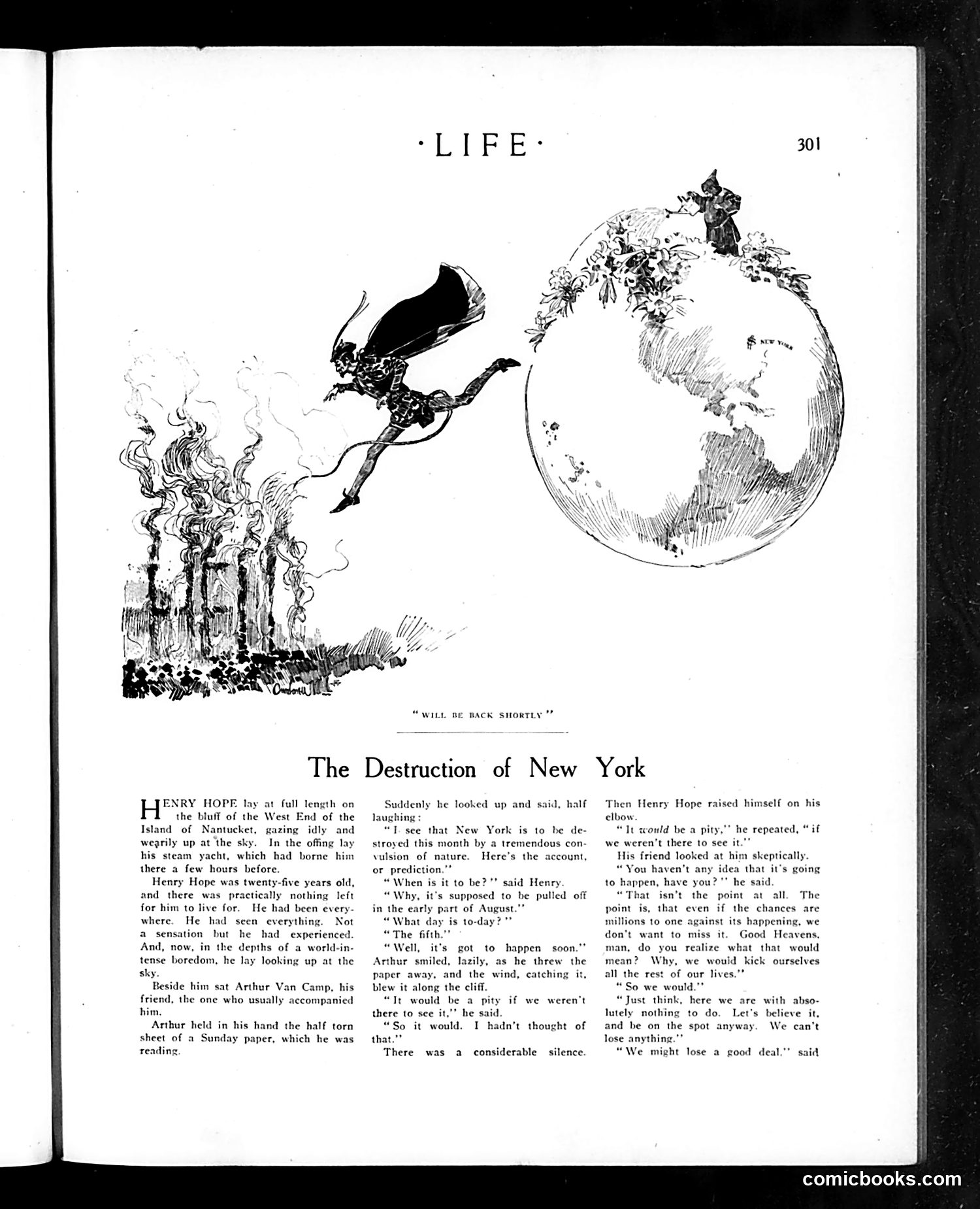
This is a fictional story satirizing **extreme ennui and wealthy idleness**. Two bored wealthy men—Henry Hope and Arthur Van Camp—read a newspaper prediction that New York will be destroyed by a natural catastrophe in early August. Rather than dismiss it, they decide to travel to witness the destruction, reasoning they have nothing to lose and can't afford to miss such a spectacle. The satire targets the **moral bankruptcy of the ultra-wealthy leisure class**: these men are so depleted of purpose that a rumored apocalypse becomes merely entertainment—a thrilling diversion from their pointless existence. The cartoon shows a demonic figure escaping New York (depicted as a globe), with the caption "Will Be Back Shortly," suggesting inevitable destruction. The joke is that their willingness to witness catastrophe reveals how disconnected they are from normal human concerns—they view even mass destruction as an amusing curiosity rather than tragedy.
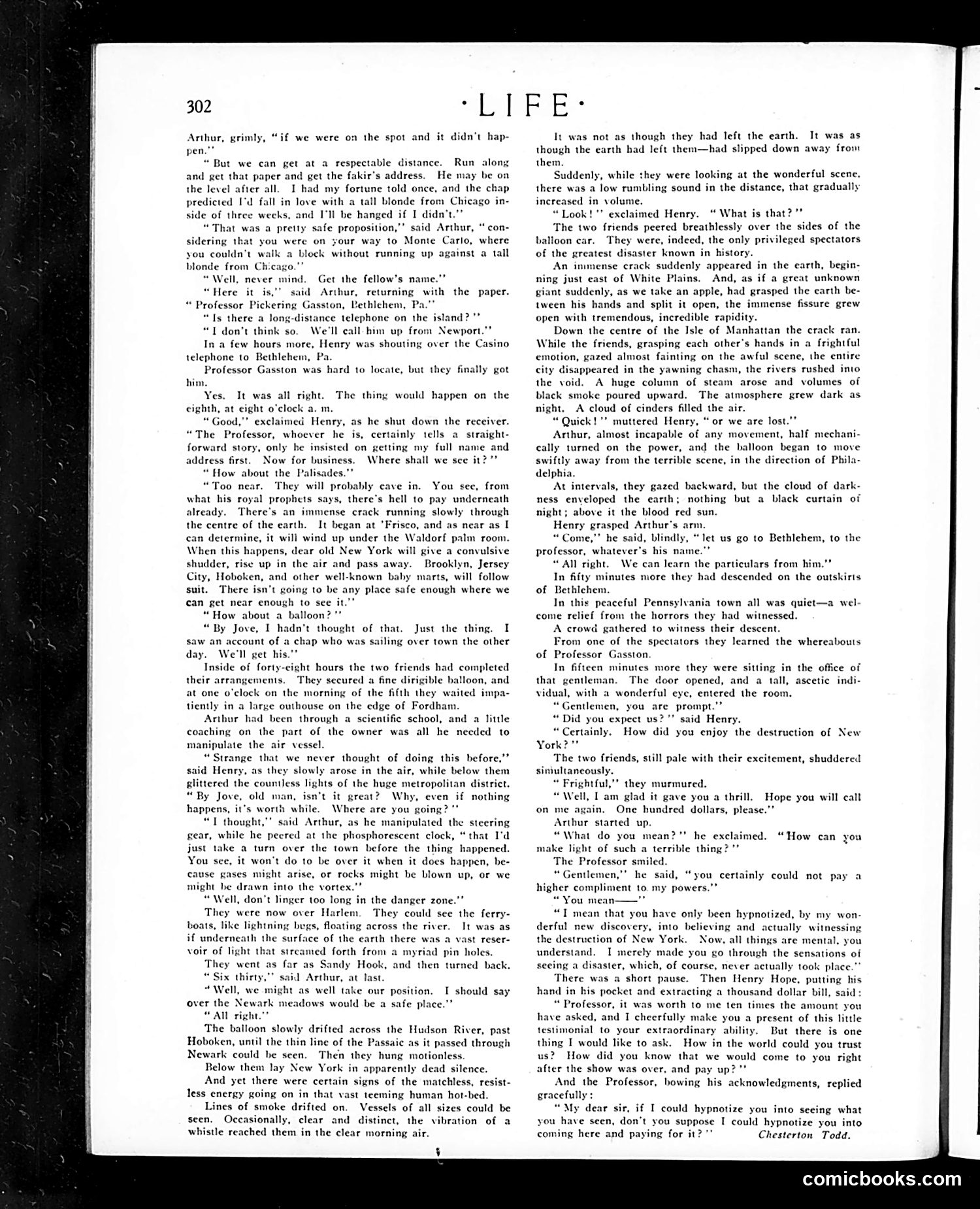
This is a humorous fiction story satirizing fortune-telling fraud and apocalyptic panic. Two wealthy men consult a fake "Professor Gasston" from Pennsylvania who predicts a massive earthquake will destroy New York City on a specific date and time. Taking him seriously, they rent a dirigible balloon to witness the "destruction" from above, carefully positioning themselves over Newark to avoid danger. The satire targets gullible rich people who believe obvious charlatans, and the era's susceptibility to doomsday prophecies. The story mocks both the "professor's" transparent con (he conveniently requires their full names and addresses) and the protagonists' credulity—particularly Arthur's "proof" that fortune-telling works because a vague prediction about meeting a tall blonde came true while he was traveling to Monte Carlo, where such meetings were statistically inevitable. The implicit joke: nothing will happen on the eighth.
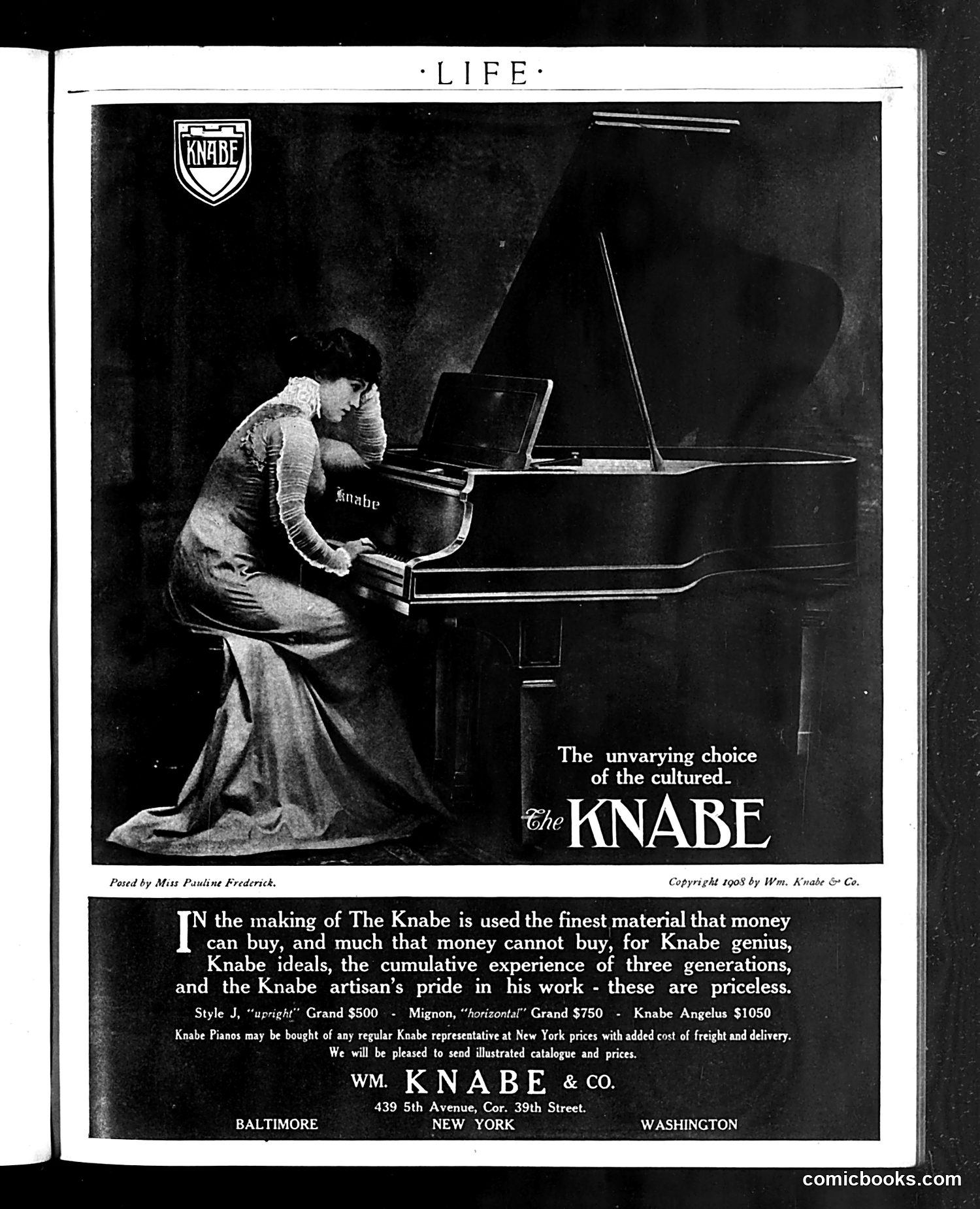
This is a **piano advertisement**, not political satire. It features actress Pauline Frederick posed at a Knabe grand piano, positioned as an endorsement of luxury and refinement. The ad's appeal targets wealthy, cultured consumers by associating the piano with high society and artistic sophistication. The tagline—"The unvarying choice of the cultured"—claims that refined people consistently choose Knabe pianos. Pricing ($500-$1,050) positioned these as premium instruments for the affluent. The copy emphasizes intangible qualities ("Knabe genius," "artisan's pride") alongside material excellence, a common luxury marketing strategy. The use of a recognizable actress (Frederick was a stage and early film performer) leveraged celebrity endorsement to signal status. For modern readers, this represents early 20th-century advertising that equated consumer goods with social class and cultural refinement.
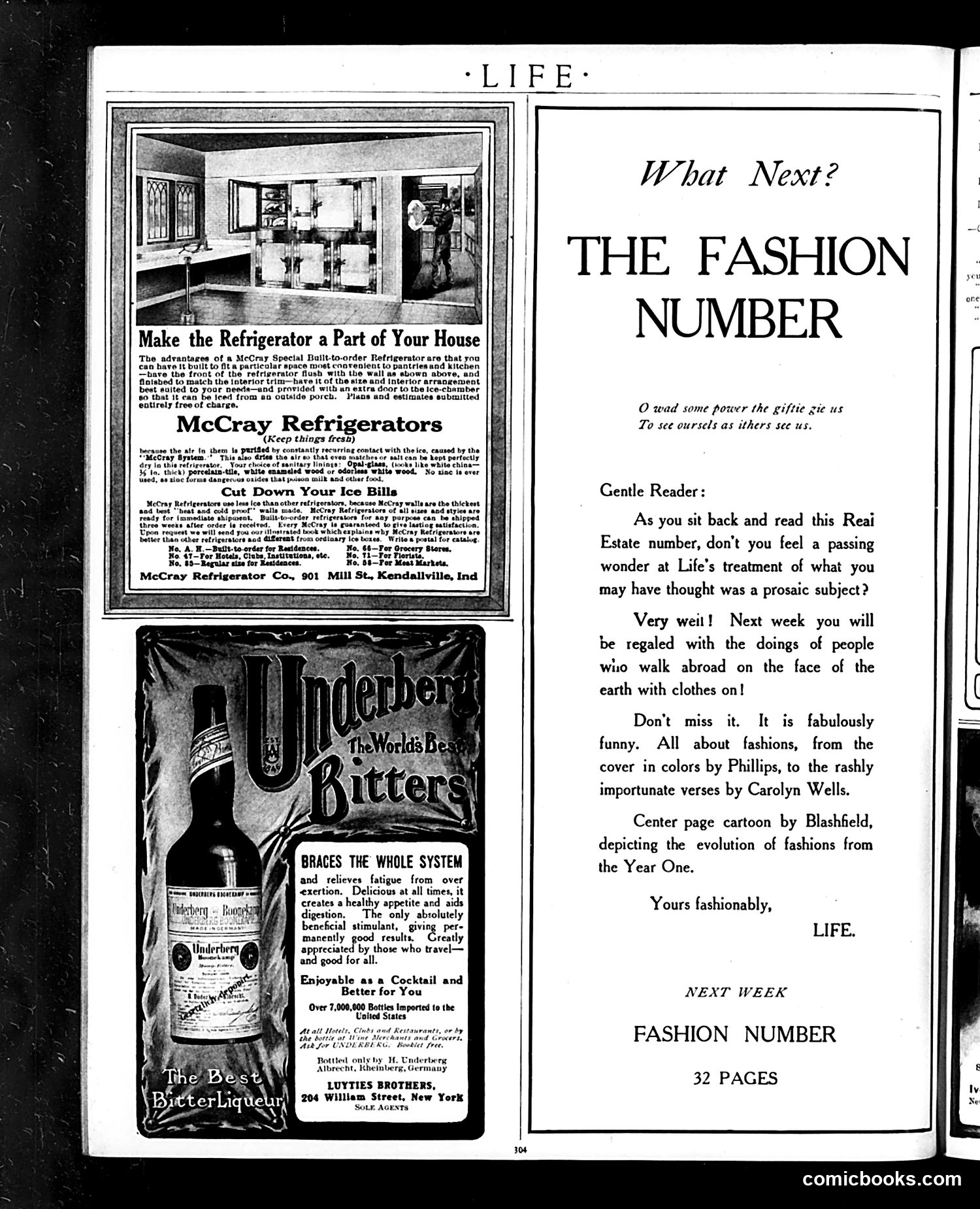
This page is primarily **advertisements and editorial promotion** rather than satirical content. The left side contains two product ads: McCray Refrigerators (emphasizing built-in convenience and ice efficiency) and Underberg Bitters (claiming digestive and stimulant benefits). The right side is Life's promotional text for next week's "Fashion Number." The editorial adopts mock-serious tone, addressing readers as "Gentle Reader" and playfully suggesting that a fashion issue—about people "who walk abroad on the face of the earth with clothes on!"—is unexpectedly entertaining rather than "prosaic." The quoted epigraph (from Robert Burns) about seeing ourselves as others see us sets up the fashion theme. The text promises 32 pages including a Phillips-illustrated color cover, verses by Carolyn Wells, and a center-page cartoon by Blashfeld depicting fashion evolution "from the Year One." **No political satire is evident**—this is simply Life magazine marketing its upcoming issue to contemporary readers.
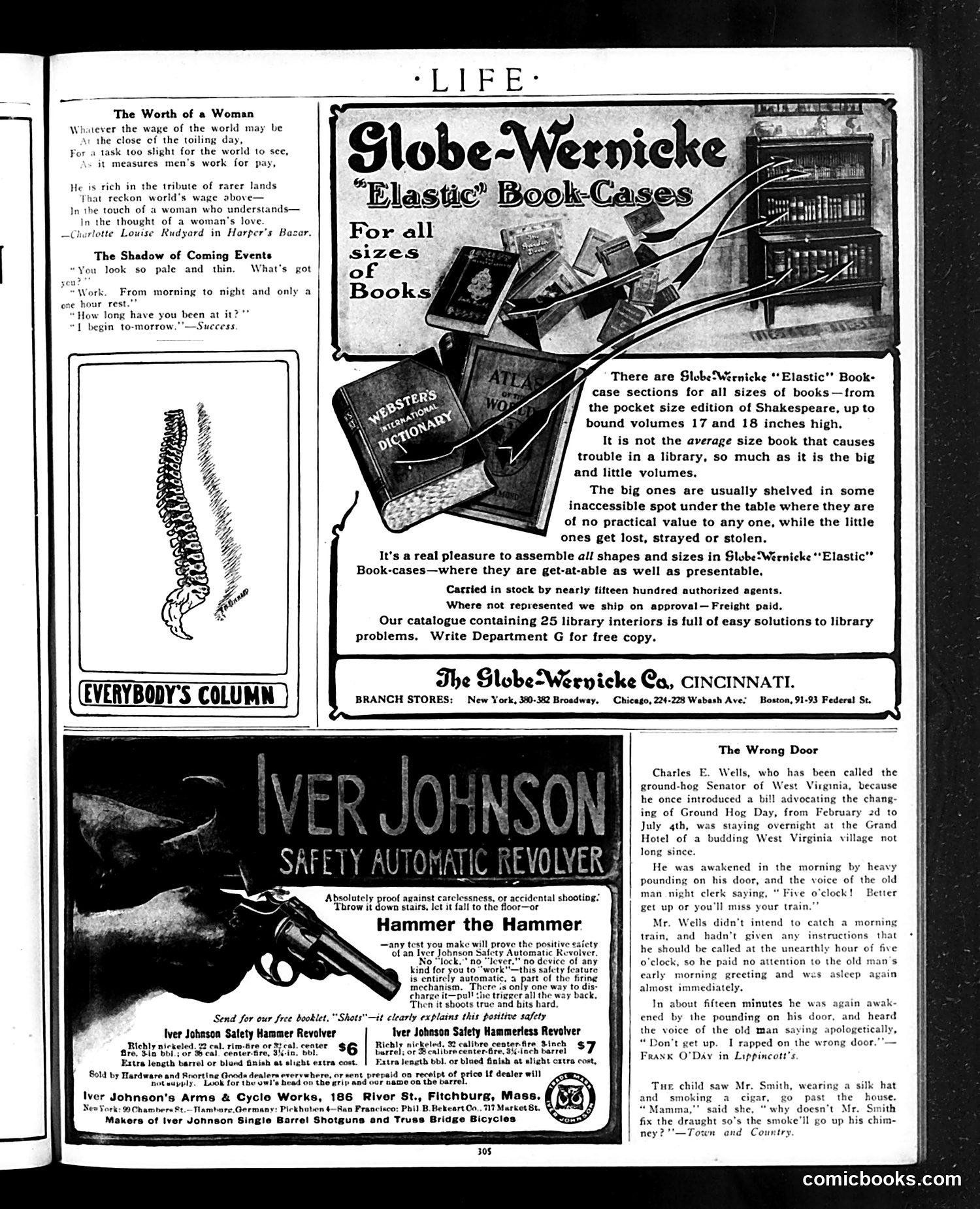
This page contains primarily **advertisements and humorous anecdotes** rather than political cartoons. **"The Worth of a Woman"** and **"The Shadow of Coming Events"** are brief satirical poems/jokes poking fun at gender roles and work expectations—typical early 20th-century humor mocking women's domestic labor and workplace exhaustion. **"The Wrong Door"** is a comedic anecdote about Senator Charles E. Wells of West Virginia, famous for introducing an absurd bill to change Groundhog Day from February to July. The humor comes from a hotel clerk accidentally pounding on the wrong guest's door at 5 a.m., then apologizing—a mild situational comedy that relies on the senator's already-established reputation for eccentricity. The page is dominated by **product advertisements**: Globe-Wernicke elastic bookcases and Iver Johnson Safety revolvers, featuring safety claims and product specifications. These ads, not satirical content, occupy most of the page's real estate.
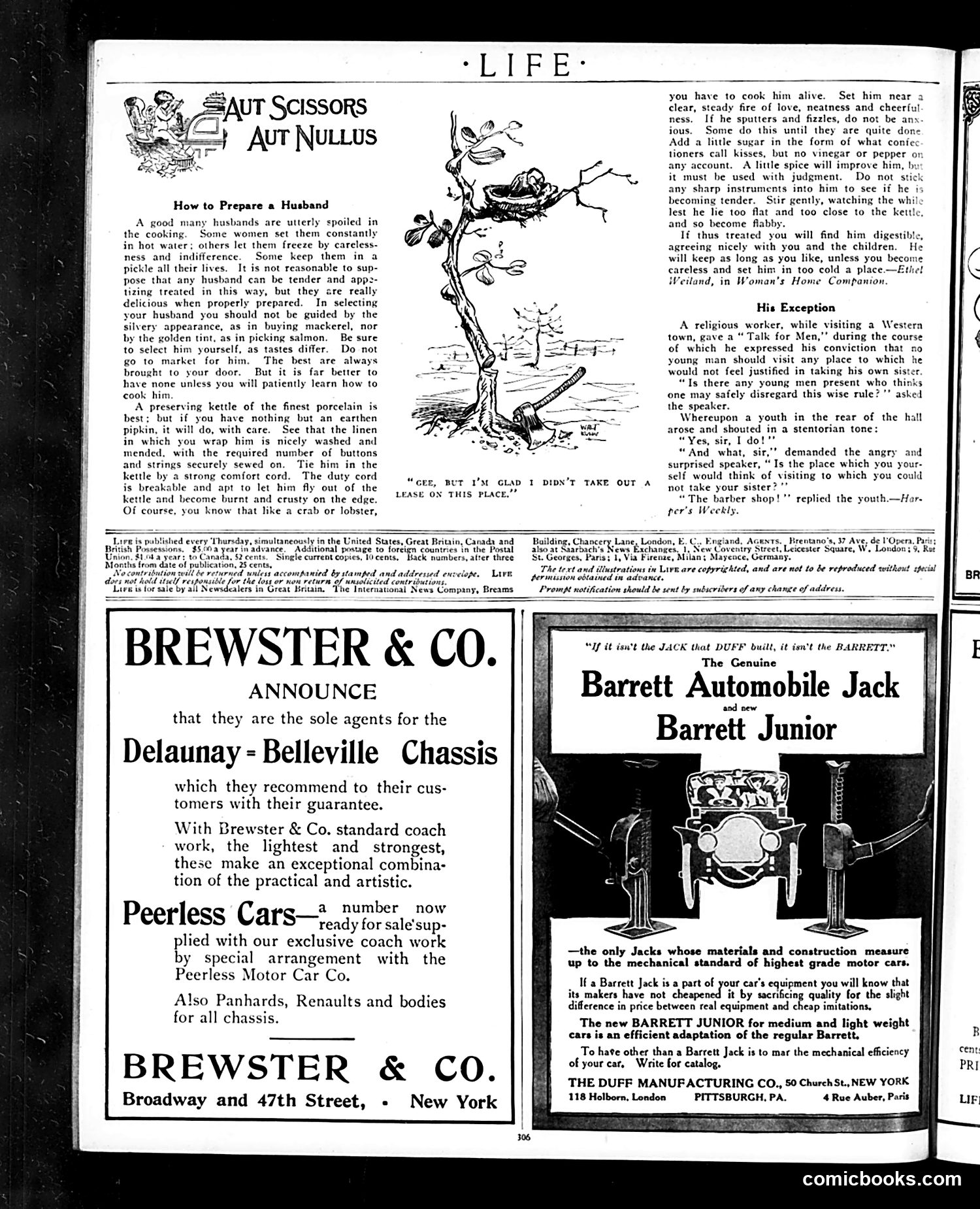
This page contains two satirical pieces typical of early 20th-century humor: **"How to Prepare a Husband"** uses an extended cooking metaphor to mock both domestic advice literature and traditional marriage dynamics. The piece instructs women to "cook" husbands like meat—selecting, wrapping, and heating them with "love, neatness and cheerfulness" rather than vinegar or pepper. The satire targets prescriptive women's magazines that reduced husbands to objects requiring proper domestic management, while simultaneously mocking the assumption that wives should endlessly tolerate and reform their spouses. **"His Exception"** is a brief joke about a religious speaker's moral rule that young men shouldn't visit places they wouldn't take their sisters. When challenged, a youth claims the "barber shop" is the exception—the punchline being that barber shops were known as male-only spaces for gossip and leisure, socially inappropriate for women of the era. Both pieces satirize rigid social conventions and gender roles of the period through absurdist humor.
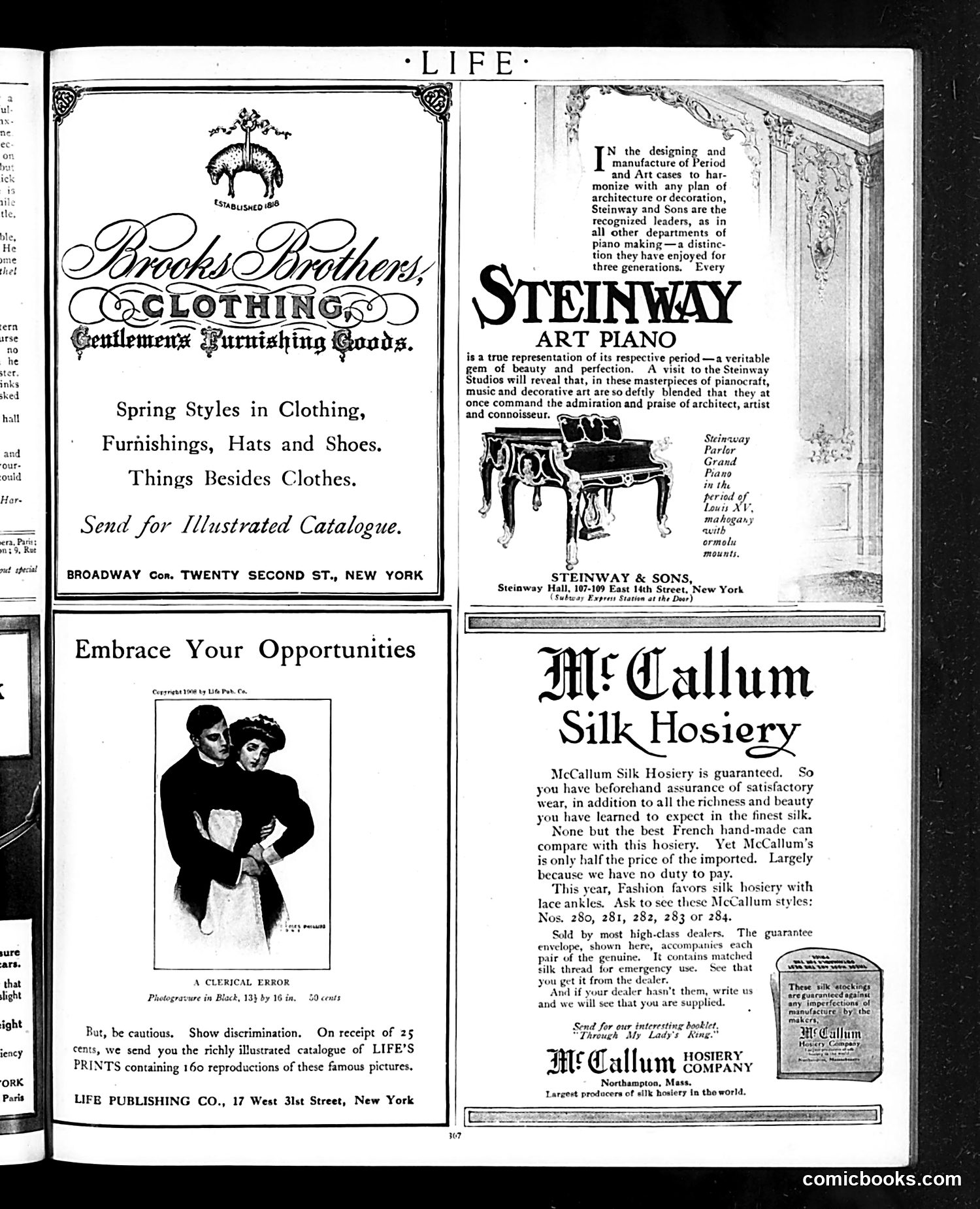
This is primarily an **advertising page** from Life magazine, circa 1908, featuring four commercial ads with minimal satirical content. The one cartoon present is titled "A Clerical Error," showing a well-dressed man presenting a baby to a woman, apparently depicting a mistaken delivery or mix-up. The caption suggests this is a humorous commentary on bureaucratic mistakes—likely playing on the everyday confusion of formal paperwork and record-keeping in the early 1900s. The remaining content consists of straightforward period advertisements: Brooks Brothers clothing, Steinway pianos (marketed as artistic "Period" furniture), Life Publishing's art prints, and McCallum silk hosiery (emphasizing quality and price advantage). These ads reflect upper-class consumer goods and the magazine's affluent readership. The page demonstrates how Life balanced satirical humor with revenue-generating advertisements aimed at wealthy, cultured audiences.
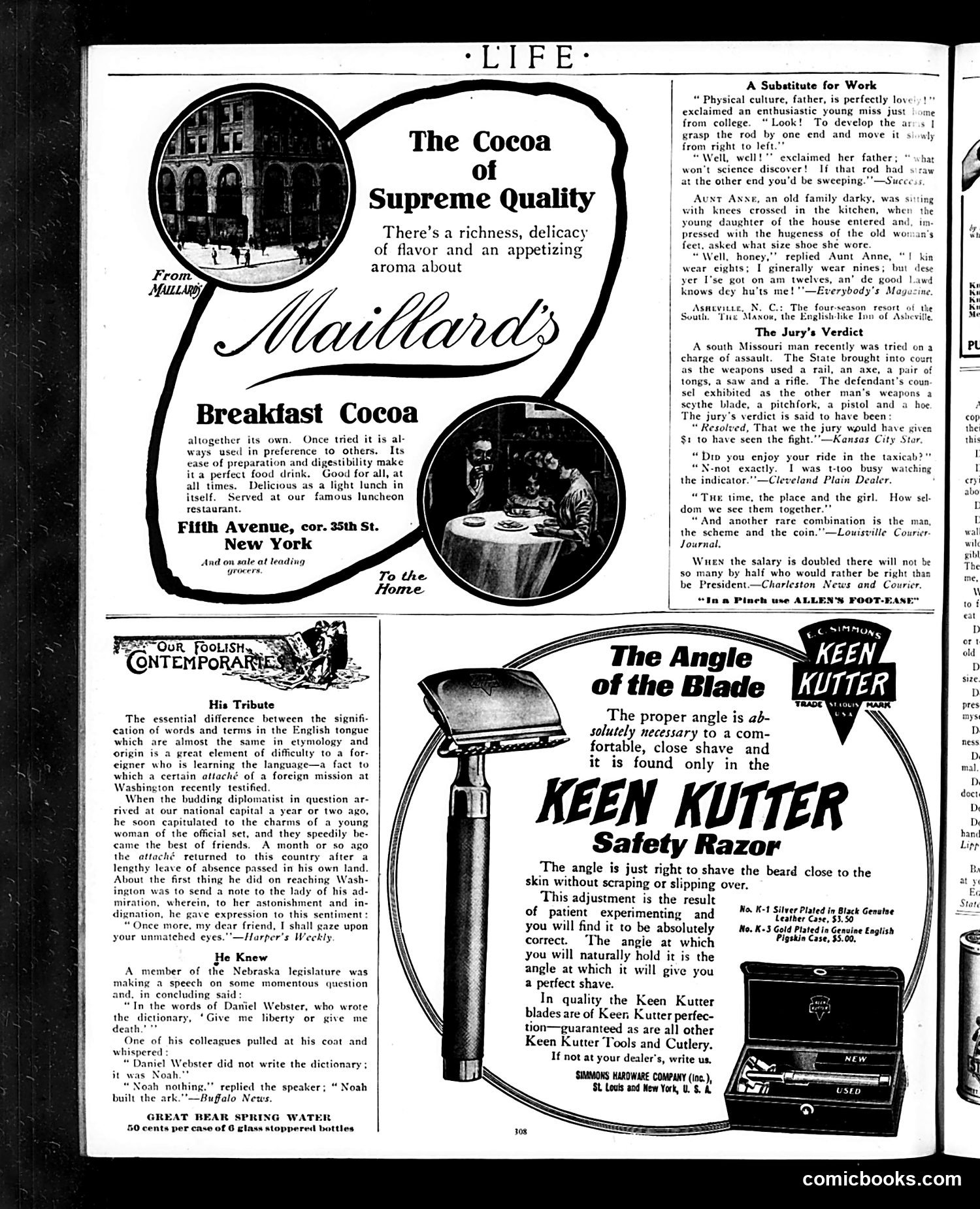
This page contains **primarily advertisements** interspersed with short humorous anecdotes rather than political cartoons. The main satirical content includes brief comedic stories: 1. **"A Substitute for Work"**: A joke about a college-educated young woman enthusiastically describing physical exercise movements to her father, who quips that if the rod had a broom attached, she'd be doing actual housework—satirizing both women's education and physical culture fads of the era. 2. **"His Tribute"** and **"He Knew"**: Wordplay jokes about diplomatic misunderstandings and biblical knowledge, typical of period humor. 3. Various short anecdotes about race, rural violence, and courtship reflecting contemporary attitudes. The **advertisements** promote Mallard's Breakfast Cocoa and Keen Kutter Safety Razors with period-typical marketing language emphasizing quality and convenience. The humor reflects early 20th-century concerns: women's education, rural violence, and romantic miscommunication—none requiring specialized political knowledge to understand broadly, though the social attitudes expressed would strike modern readers as dated.
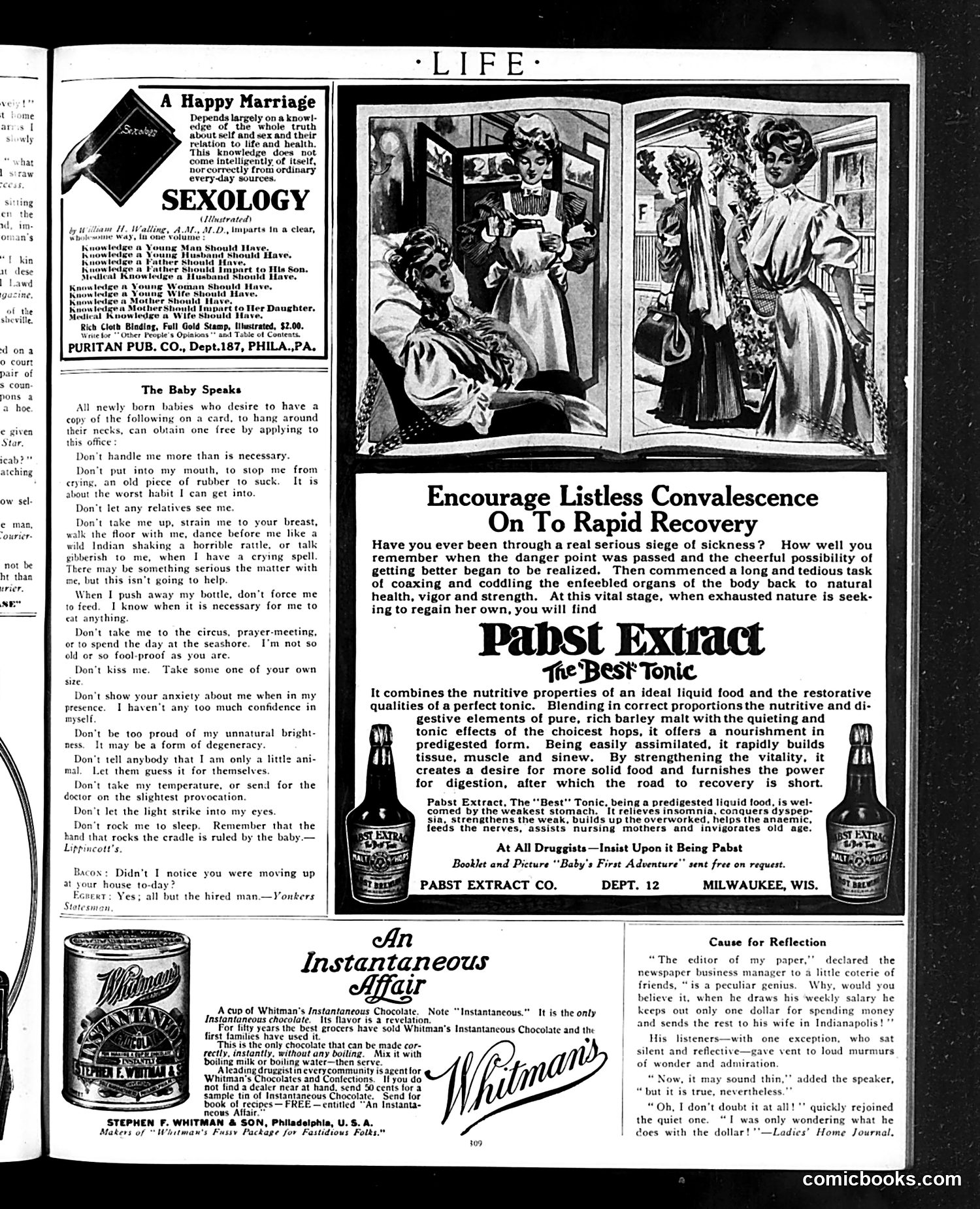
This page comprises three main elements: **advertisements and advice columns**, not political satire. The **"Sexology" book ad** addresses marital education—a progressive but controversial topic for the era, reflecting early 20th-century debates about sexual knowledge in marriage. **"The Baby Speaks"** is satirical advice *from an infant's perspective*, mocking contemporary parenting practices. It ridicules over-coddling (excessive rocking, kissing, circus trips) and medical paranoia (taking temperatures), advocating instead for restraint and trusting the baby's natural signals. This reflects tension between emerging child-rearing expertise and traditional intuitive parenting. The illustrated panels show domestic scenes—likely supporting the convalescence advertisement below. **"Pabst Extract"** is a patent medicine advertisement claiming restorative properties for recovery from illness, typical of early 1900s marketing that made unsubstantiated health claims. The page reflects period anxieties: proper marriage, modern child-rearing, and medical remedies—not political commentary.
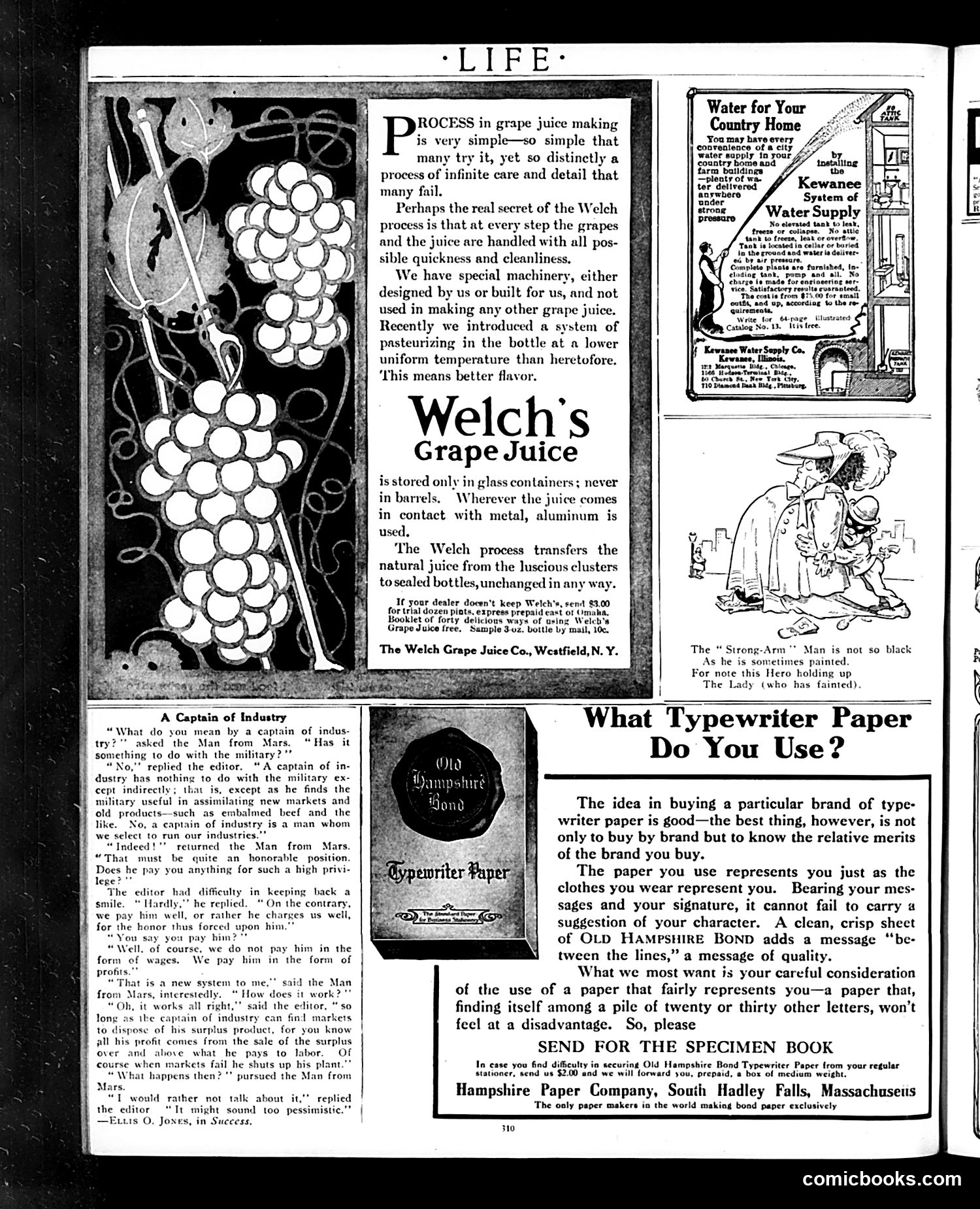
This page contains **primarily advertisements** interspersed with satirical content. **The Main Cartoon** ("A Captain of Industry"): A Man from Mars naively asks what a "captain of industry" means. The editor explains it's someone who finds military useful for "assimilating new markets" and selling old products like "embalmed beef." The satire mocks industrial capitalism and war profiteering—suggesting captains of industry exploit military conflicts for profit rather than serving honorable purposes. **Secondary Cartoon** (lower right): A "Strong-Arm Man" holds up a fainting lady, captioned that he's "not so black as he is sometimes painted." This appears to defend or rehabilitate the reputation of strongmen or forceful industrial figures, perhaps ironically given the preceding critique. **Advertisements**: Welch's Grape Juice (emphasizing purity and special process), Hampshire Bond Typewriter Paper (quality representation), and Kewanee Water Supply systems dominate the page. The satire criticizes industrial monopolists and their association with military interests while advertisements peddle wholesome domesticity.
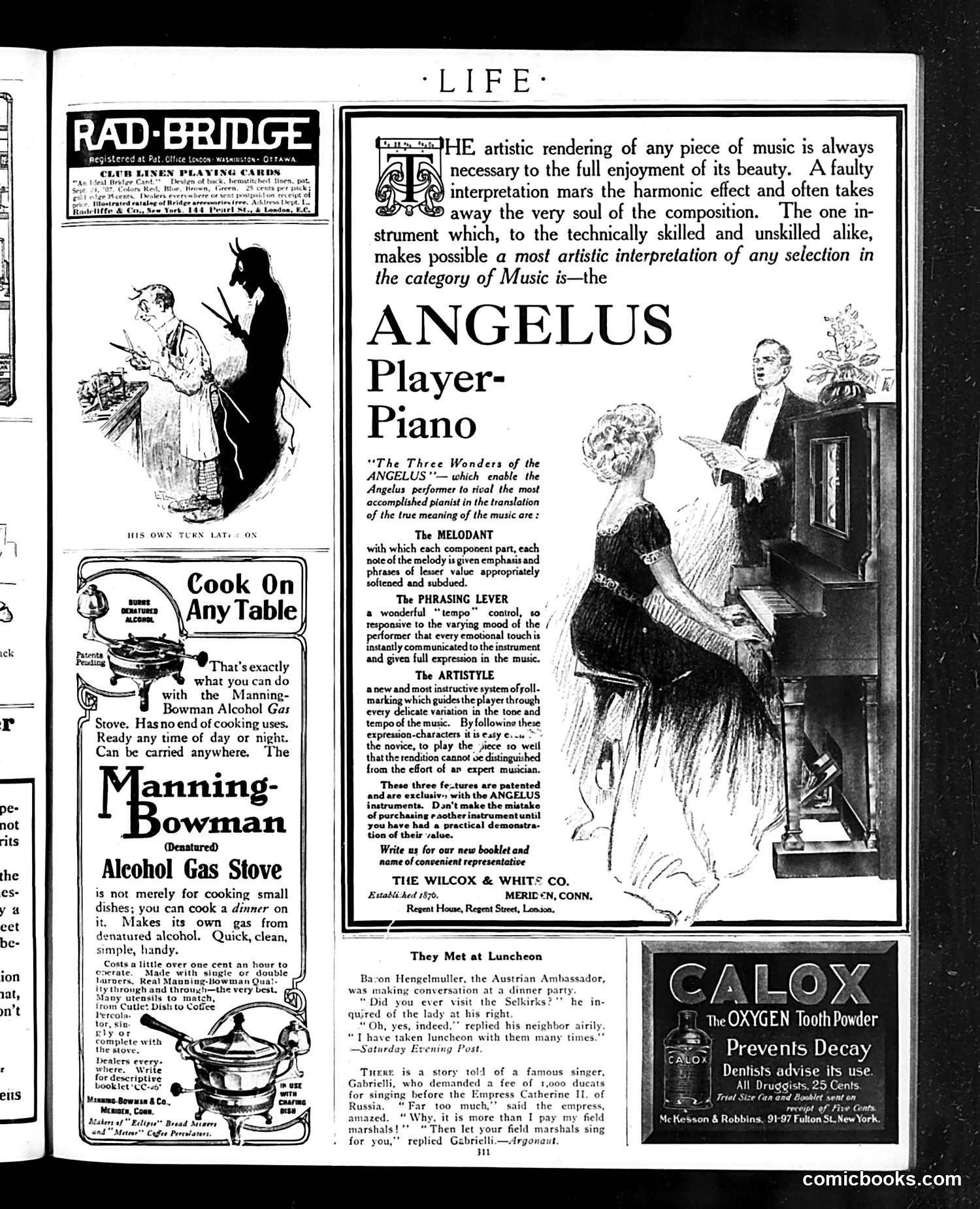
This page contains **advertisements and brief humor pieces**, not political satire. **The cartoon** (top left, captioned "HIS OWN TURN LAT ON") shows a silhouetted devil figure with a woman holding flowers—likely illustrating a cautionary tale about temptation or moral danger, though the specific reference is unclear without more context. **The main content** comprises product advertisements: - **Manning-Bowman Alcohol Gas Stove**: marketed as portable, economical cooking equipment - **Angelus Player-Piano**: promotes a mechanical piano with special features ("Melodant," "Phrasing Lever," "Artistyle") that supposedly lets non-experts play like accomplished pianists - **Calox Tooth Powder**: advertises decay prevention **The humor pieces** ("They Met at Luncheon") are light anecdotes—one involving an Austrian ambassador's confusion about "the Selkirks," another about a famous singer (Gabrielli) negotiating fees with Empress Catherine II. The page reflects early 20th-century consumer culture and upper-class social comedy rather than political commentary.
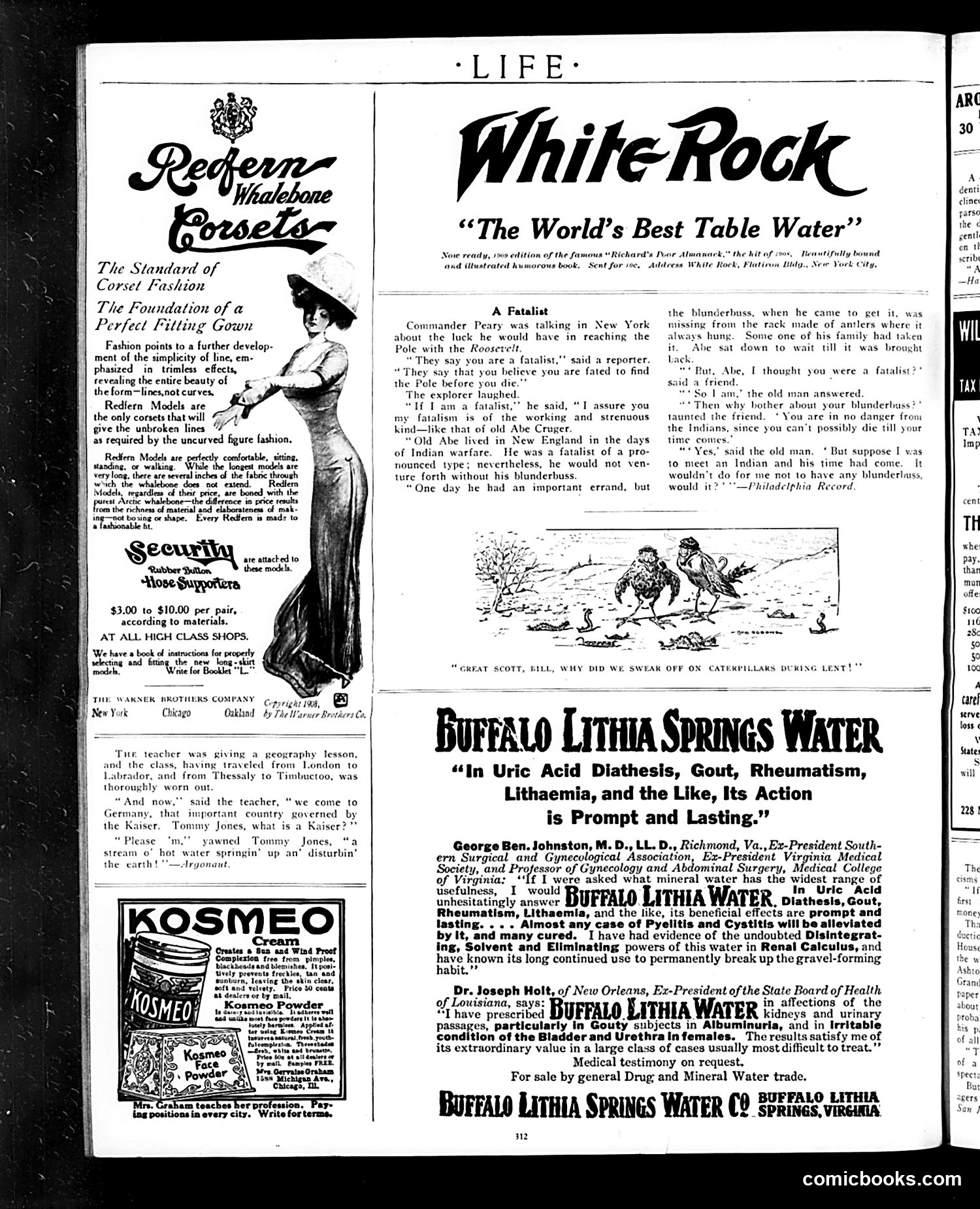
This page is primarily **advertising**, not political satire. It contains: **Left side:** Redfern corset ads emphasizing "perfect fitting" through innovative design, plus Security brand rubber heels and Kosmeo face cream. **Center:** "A Fatalist" — a humorous anecdote about Commander Peary (Arctic explorer) debating fatalism with a friend. The joke hinges on absurd logic: an old man named Abe believes in fatalism yet insists on carrying his blunderbuss, reasoning that if Indians were destined to kill him, he must *have* the gun or fate couldn't work properly. The humor comes from this contradictory reasoning. **Right side:** White Rock mineral water and Buffalo Lithia Springs Water advertisements claiming medicinal properties for gout, rheumatism, and urinary ailments, featuring testimonials from doctors. A small cartoon shows two men discussing caterpillars during Lent—a minor religious/dietary humor reference. The page reflects early 1900s advertising culture and period-appropriate health claims for mineral water.
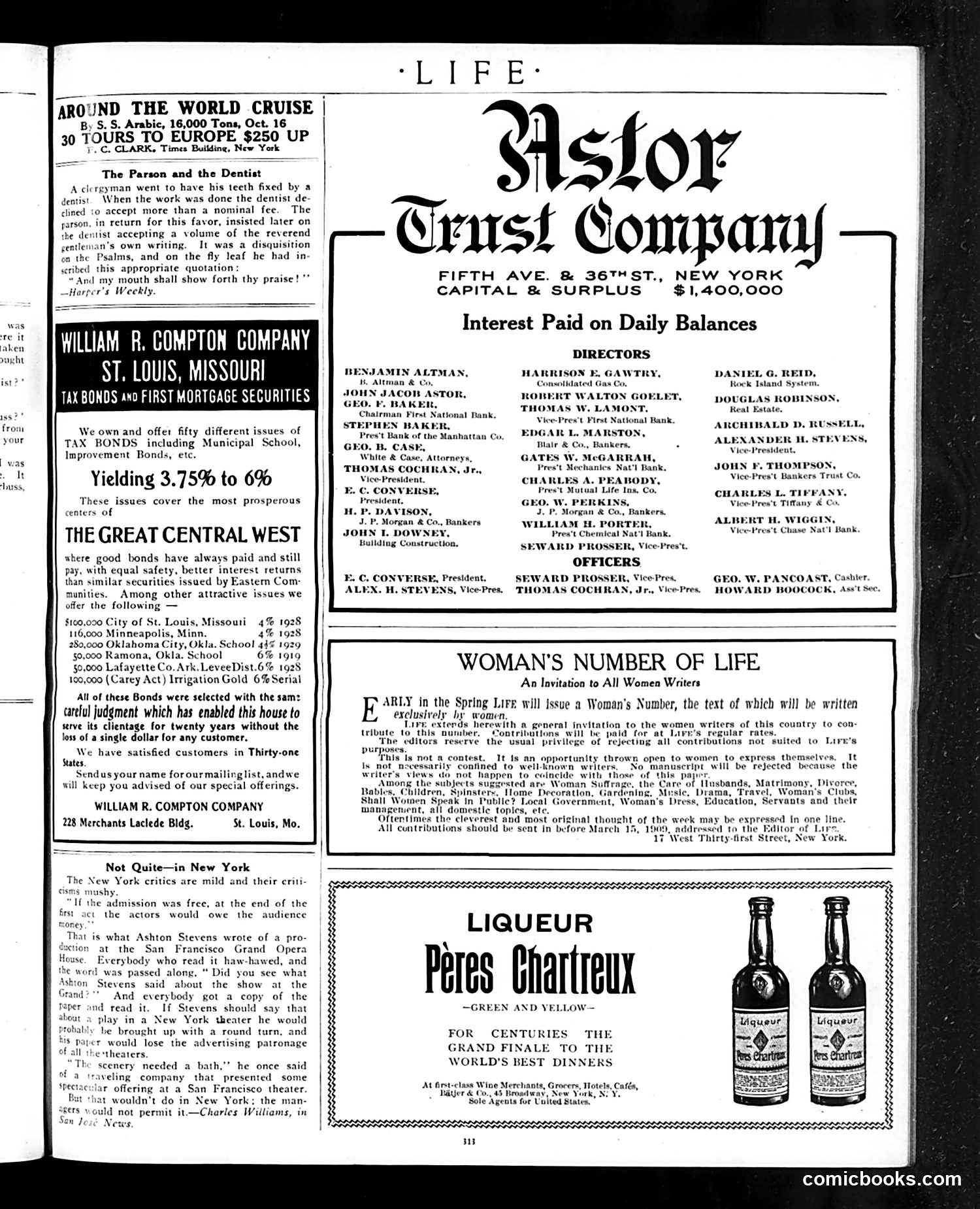
This page is primarily **advertising and announcements**, not satirical content. The major elements are: 1. **Astor Trust Company ad** (center): Lists prominent New York financial leaders and directors, emphasizing the bank's capital and interest rates—typical banking advertisement. 2. **William R. Compton Company ad** (left): Promotes tax bonds and mortgages from the American Midwest, appealing to investors seeking safe returns. 3. **Woman's Number announcement** (bottom): Life magazine invites women writers to contribute to an upcoming special issue, paying standard rates. Topics suggested include women's suffrage, marriage, homemaking—reflecting early 20th-century women's interests during the suffrage era. 4. **Peres Chartreux liqueur ad** (bottom right): French liqueur advertisement. The only potential humor is the opening anecdote about "The Parson and the Dentist"—a gentle joke about a clergyman gifting his written sermons as payment, with a Biblical quote about praising God through one's mouth. This appears to be a **business/financial page** from approximately 1912-1915, not a satirical section.
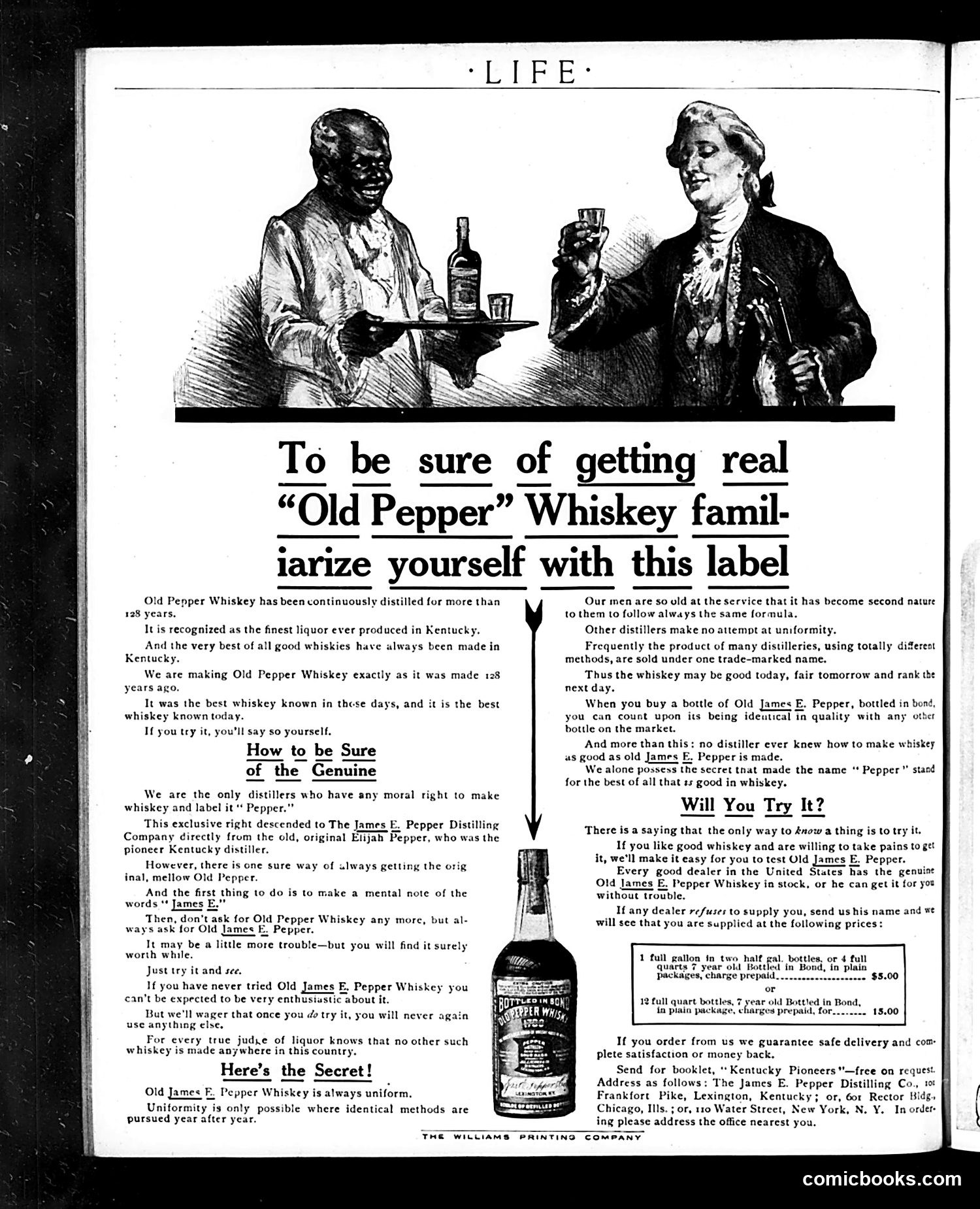
This is primarily a **whiskey advertisement**, not satirical content. The illustration shows a server presenting a bottle to a well-dressed customer, emphasizing brand authenticity. The "satire" is subtle: the ad mocks **counterfeit spirits and market fraud**—widespread problems during Prohibition-era America. The James E. Pepper company claims exclusive rights to the "Pepper" name, warning consumers that competitors use identical methods and trade-marked names while selling inferior products that vary in quality "good today, fair tomorrow." The ad targets consumer anxiety about product substitution and deception. The repeated emphasis on "uniformity," the bottle label as proof of authenticity, and warnings against imitations reflect real marketplace concerns: distillers were indeed mixing products from multiple sources under single brand names. The "secret" revealed is merely consistent production methods—positioning James E. Pepper as the only trustworthy source of genuine whiskey in a market rife with adulterants and fakes.
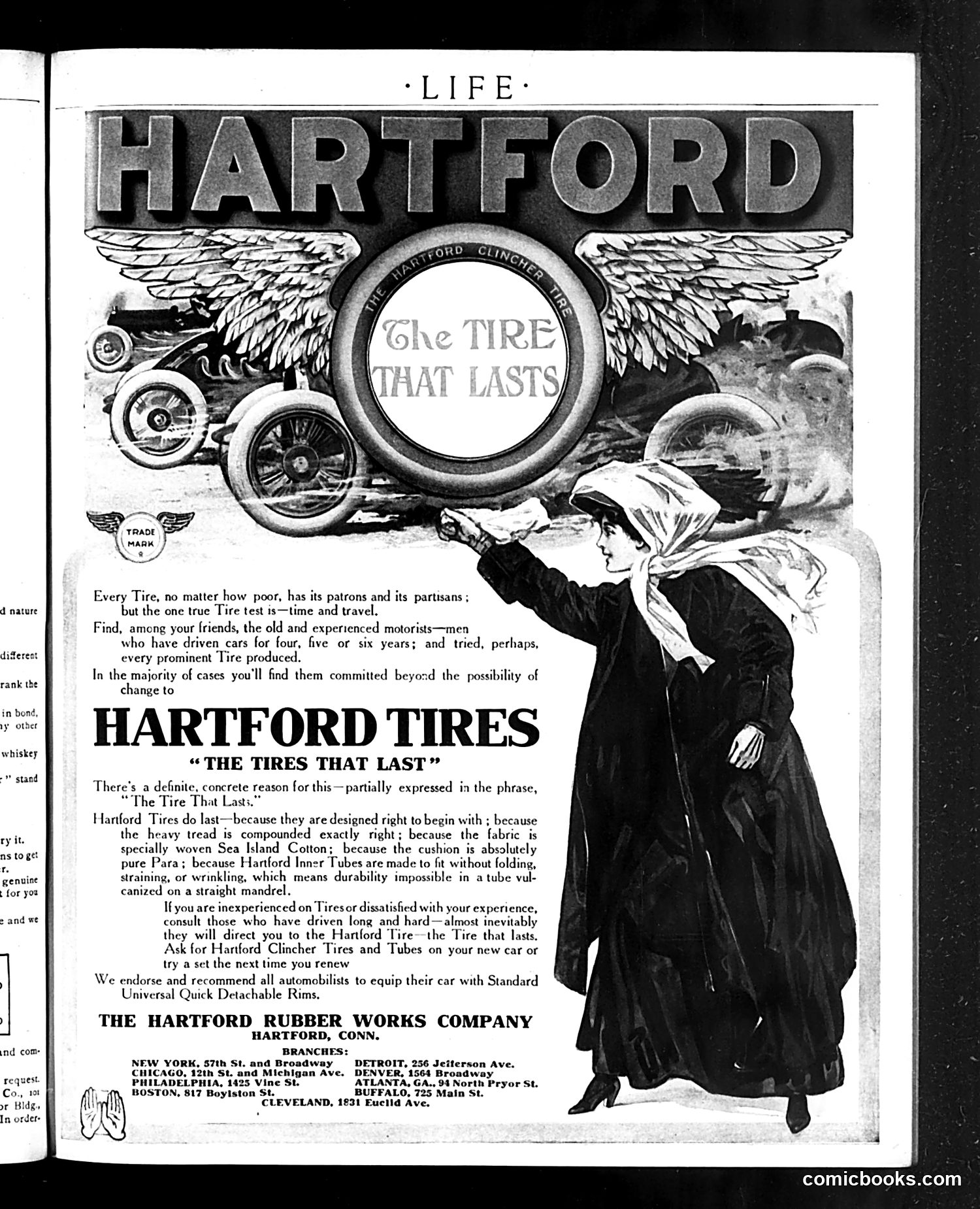
This is a **full-page tire advertisement**, not satire or political commentary. The image shows a well-dressed woman in early 1900s attire pointing toward Hartford automobile tires displayed with winged imagery and vintage cars. The advertisement's pitch targets motorists through testimonial marketing: find experienced drivers who've tested multiple tire brands over years of use, and they'll recommend Hartford. The copy emphasizes technical superiority—Sea Island Cotton fabric, pure Para rubber cushioning, and precise manufacturing—as proof that "Hartford Tires do last." The winged logo and classical imagery suggest durability and reliability. The well-dressed female figure was a common advertising device of the era to convey respectability and aspirational lifestyle. This represents early automotive-era marketing before modern consumer testing, relying instead on word-of-mouth endorsement from established motorists as credibility.
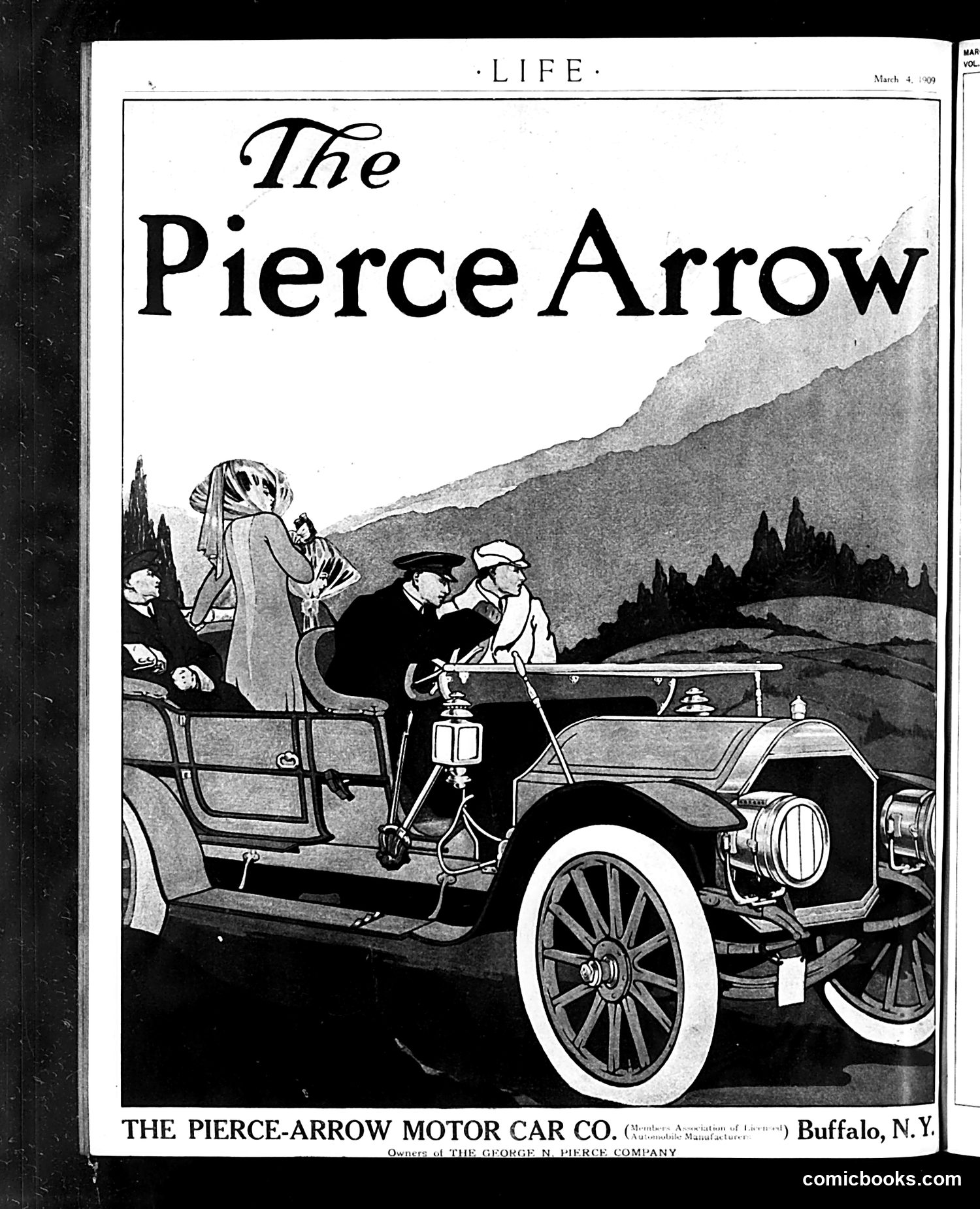
This is primarily an **advertisement**, not political satire. It appears from *Life* magazine (dated March 4, 1909) promoting the Pierce-Arrow Motor Car Company of Buffalo, New York. The illustration depicts an early automobile with well-dressed passengers in fashionable 1909 attire—men in suits and caps, a woman in an elaborate feathered hat and coat. The scenic background with mountains and forest suggests leisure travel and adventure. The ad appeals to wealthy consumers by associating the Pierce-Arrow with sophistication, elegance, and outdoor recreation. The composition emphasizes the car's prominence and modern engineering as a status symbol for the affluent class of the era. No political commentary or satire is evident—this is straightforward commercial promotion targeting *Life*'s affluent readership.