
Life, 1909-03-04 · page 28 of 44
Life — March 4, 1909 — page 28: what you’re looking at
What you’re looking at
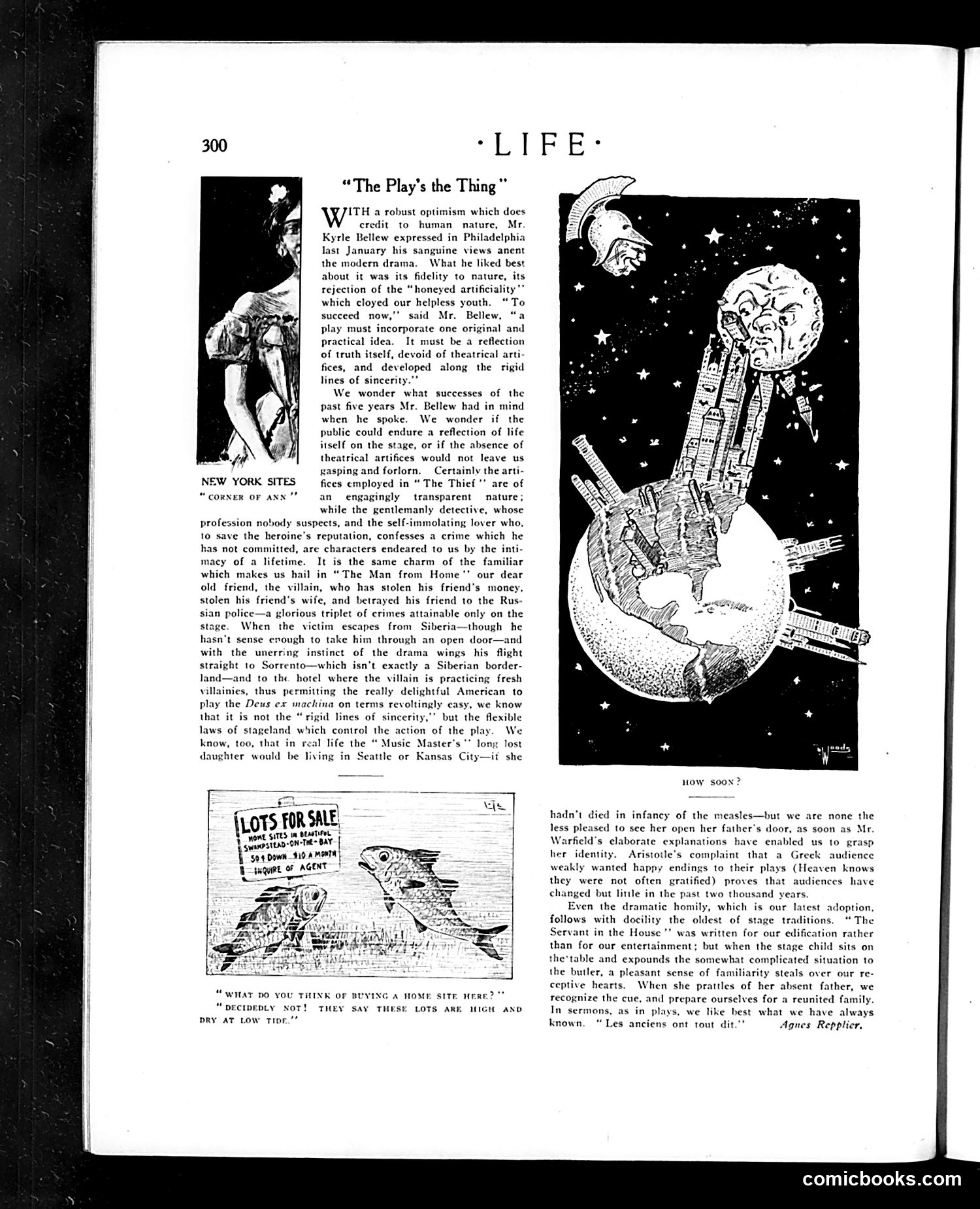
This page critiques actor Kyrle Bellew's stated philosophy that modern drama should reject theatrical artifice and reflect life truthfully. Life's columnist (Agnes Repplier) argues the opposite—audiences actually *crave* familiar theatrical conventions, not realism. The article mocks three contemporary plays: "The Thief," "The Man from Home," and "The Servant in the House." Each exemplifies absurd stagecraft—implausible coincidences, melodramatic villains, convenient plot devices—yet audiences embrace them because they're comfortably predictable. The sidebar cartoon satirizes New York real estate speculation, depicting a fish-like creature recoiling from waterfront "lots for sale," skeptical of their dubious claims. The overall point: theater doesn't need truth; it needs familiar formulas. Audiences haven't changed since ancient Greece—they want reassurance through convention, not challenging realism.
📄 Transcribed text from this page (OCR, searchable)
Machine-transcribed from the original scan — historical spelling and the odd misread are preserved.
“LIFE: “The Play’s the Thing" ITH a robust optimism which does credit to human nature, Mr Kyrle Bellew expressed in Philadelphia last January his sanguine views anent the modern drama. What he liked best about it was its fidelity to nature, its rejection of the “honeyed artificiality” which cloyed our helpless youth. “To succeed now,” said Mr. Bellew, “a play must incorporate one original and practical idea. It must be a reflection of truth itself, devoid of theatrical arti- fices, and developed along the rigid lines of sincerity.”” We wonder what successes of the past five years Mr. Bellew had in mind when he spoke. We wonder if the public could endure a reflection of life itself on the stage, or if the absence of theatrical artifices would not leave us gasping and forlorn. Certainly the arti- fices employed in “ The Thief" are of an engagingly transparent nature; while the gentlemanly detective, whose profession nobody suspects, and the self-immolating lover who, to save the heroine's reputation, confesses a crime which he has not committed, are characters endeared to us by the inti- macy of a lifetime. It is the same charm of the familiar which makes us hail in “The Man from Home" our dear old friend, the villain, who has stolen his friend’s money, stolen his friend’s wife, and betrayed his friend to the Rus- sian police—a glorious triplet of crimes attainable only on the stage. When the victim escapes from Siberia—though he hasn't sense crough to take him through an open door—and with the unerring instinct of the drama wings his flight straight to Sorrento—which isn't exactly a Siberian border- land—and to the hotel where the villain is practicing fresh villainies, thus permitting the really delightful American to play the Deus ex machina on terms revoltingly easy, we know that it is not the “rigid lines of sincerity,” but the flexible laws of stageland which control the action of the play. We know, too, that in real life the “ Music Master's"? long lost daughter would be living in Seattle or Kansas City—it she NEW YORK SITES CORNER OF ANN — on f LOTS FOR SALE, ‘504 Down 910 A MeMTAY, quire OF AGENT “WHAT DO YOU THINK OF BUVING A HOME SITE WERE?" “DECIDEDLY NOT! THEY SAY THESE LOTS ARE MGM AND DRY AT Low TroF.’” Mow SooN? hadn't died in infancy of the measles—but we are none the less pleased to see her open her father’s door, as soon as Mr Warfield’s elaborate explanations have enabled us to grasp her identity. Aristotle's complaint that a Greek audience weakly wanted happy endings to their plays (Heaven knows they were not often gratified) proves that audiences have changed but little in the past two thousand years. Even the dramatic homily, which is our latest adoption, follows with docility the oldest of stage traditions, “The ervant in the House" was written for our edification rather than for our entertainment; but when the stage child sits on the'table and expounds the somewhat complicated situation to the butler, a pleasant sense of familiarity steals over our re- ceptive hearts. When she prattles of her absent father, we recognize the cue, and prepare ourselves for a reunited family. In sermons, as in plays, we like best what we have always known. “Les anciens ont tout dit.’” Agnes Repplier. comicbooks.com