
Life, 1909-03-04 · page 13 of 44
Life — March 4, 1909 — page 13: what you’re looking at
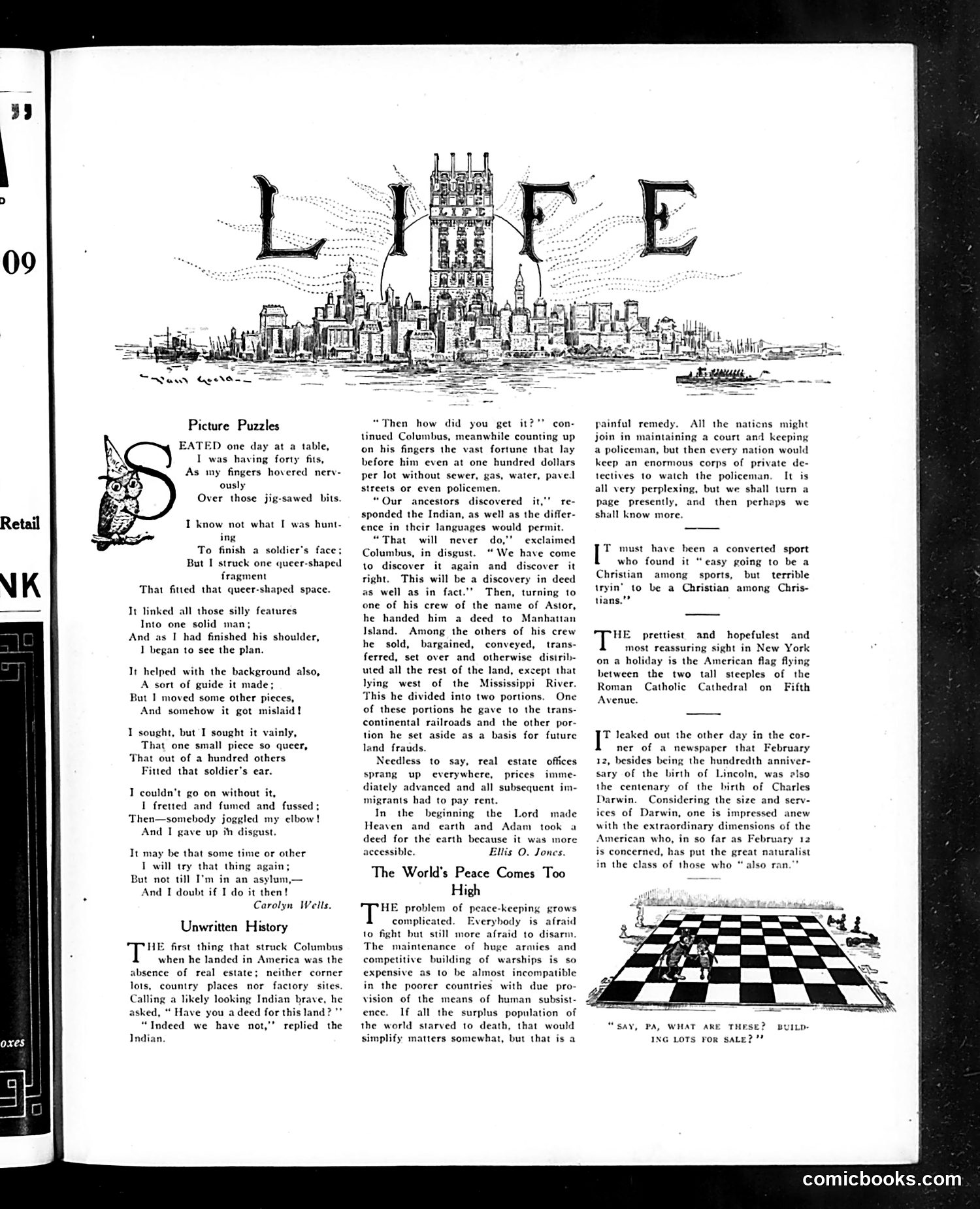
What you’re looking at
This page contains several distinct pieces: a "Picture Puzzles" section featuring an owl mascot and poetry about discovering Manhattan's real estate value; an "Unwritten History" anecdote about Columbus and Native Americans negotiating land sales; and an article titled "The World's Peace Comes Too High" discussing military spending and warships in poorer nations. The satirical thrust appears to be **critiquing American capitalism and imperialism**: the Columbus piece ironically frames land appropriation as commercial transaction, while the peace article questions whether massive military expenditures are truly necessary or sustainable for developing nations. The overall message suggests concern about how wealth and commerce dominate even fundamental geopolitical questions.
📄 Transcribed text from this page (OCR, searchable)
Machine-transcribed from the original scan — historical spelling and the odd misread are preserved.
SNe Geete-L = Picture Puzzles EATED one day at a table, I was having forty fit As my fingers hovered nerv- ously Over those jig-sawed bits. I know not what I was hunt- ing To finish a soldier's face; But I struck one queer-shaped fragment That fitted that queer-shaped space. It linked all those silly features Into one solid man; And as I had finished his shoulder, 1 began to see the plan. It helped with the background also, A sort of guide it made; But I moved some other pieces, And somehow it got mislaid! I sought, but I sought it vainly, That one small piece so queer, That out of a hundred others Fitted that soldier's ear. I couldn't go on without it, I fretted and fumed and fussed; Then—somebody joggled my elbow! And I gave up ih disgust. It may be that some time or other I will try that thing again; But not till I'm in an asylum And I doubt if I do it then! Carolyn Wells. Unwritten History HE first thing that struck Columbus when he landed in America was the absence of real estate; neither corner lots, country places nor factory sites Calling a likely looking Indian brave, he asked, “ Have you a deed for this land?" “Indeed we have not,’? replied the Indian. “Then how did you get it?’ con- tinued Columbus, meanwhile counting up on his fingers the vast fortune that lay before him even at one hundred dolla per lot without sewer, gas, water, paved streets or even policemen. “Our ancestors discovered it,” re- sponded the Indian, as well as the differ- ence in their languages would permit. “That will never do,’ exclaimed Columbus, in disgust. “We have come to discover it again and discover it right. This will be a discovery in deed as well as in fact.” Then, turning to one of his crew of the name of Astor, he handed him a deed to Manhattan Island. Among the others of his crew he sold, bargained, conveyed, trans- ferred, set over and otherwise distrib- uted all the rest of the land, except that lying west of the Mississippi River. This he divided into two portions. One of these portions he gave to the trans- continental railroads and the other por- tion he set aside as a basis for future land frauds. Needless to say, real estate offices sprang up everywhere, prices imme- diately advanced and all subsequent im- ants had to pay rent. the beginning the Lord made Heaven and earth and Adam took a deed for the earth because it was more accessible. Ellis O. Jones. The World's Peace Comes Too High HE problem of peace-keeping grows complicated. Everybody is afraid to fight but still more afraid to disarm The maintenance of huge armies and competitive building of warships is so expensive as to be almost incompatible the poorer countries with due pro- vision of the means of human subsist- ence. If all the surplus population of the world starved to death, that would simplify matters somewhat, but that is a painful remedy. All the nations might join in maintaining a court and keeping a policeman, but then every nation would keep an enormous corps of private de- tectives to watch the policeman. It is all very perplexing, but we shall turn a page presently, and then perhaps we shall know more. [" must have been a converted sport who found it “easy going to be a Christian among sports, but terrible tryin’ to be a Christian among Chris- tians, T" prettiest. and hopefulest and most reassuring sight in New York on a holiday is the American flag flying between the two tall steeples of the Roman Catholic Cathedral on Fifth Avenue. T leaked out the other day in the cor- ner of a newspaper that February 12, besides being the hundredth anniver- sary of the birth of Lincoln, was elso the centenary of the birth of Charles Darwin. Considering the size and serv- ices of Darwin, one is impressed anew with the extraordinary dimensions of the American who, in so far as February 12 is concerned, has put the great naturalist in the class of those who “also ran.” “SAY, PA, WHAT ARE THESE? ING LOTS FOR SALE??? BUILD- comicbooks.com