
Life, 1909-03-04 · page 25 of 44
Life — March 4, 1909 — page 25: what you’re looking at
What you’re looking at
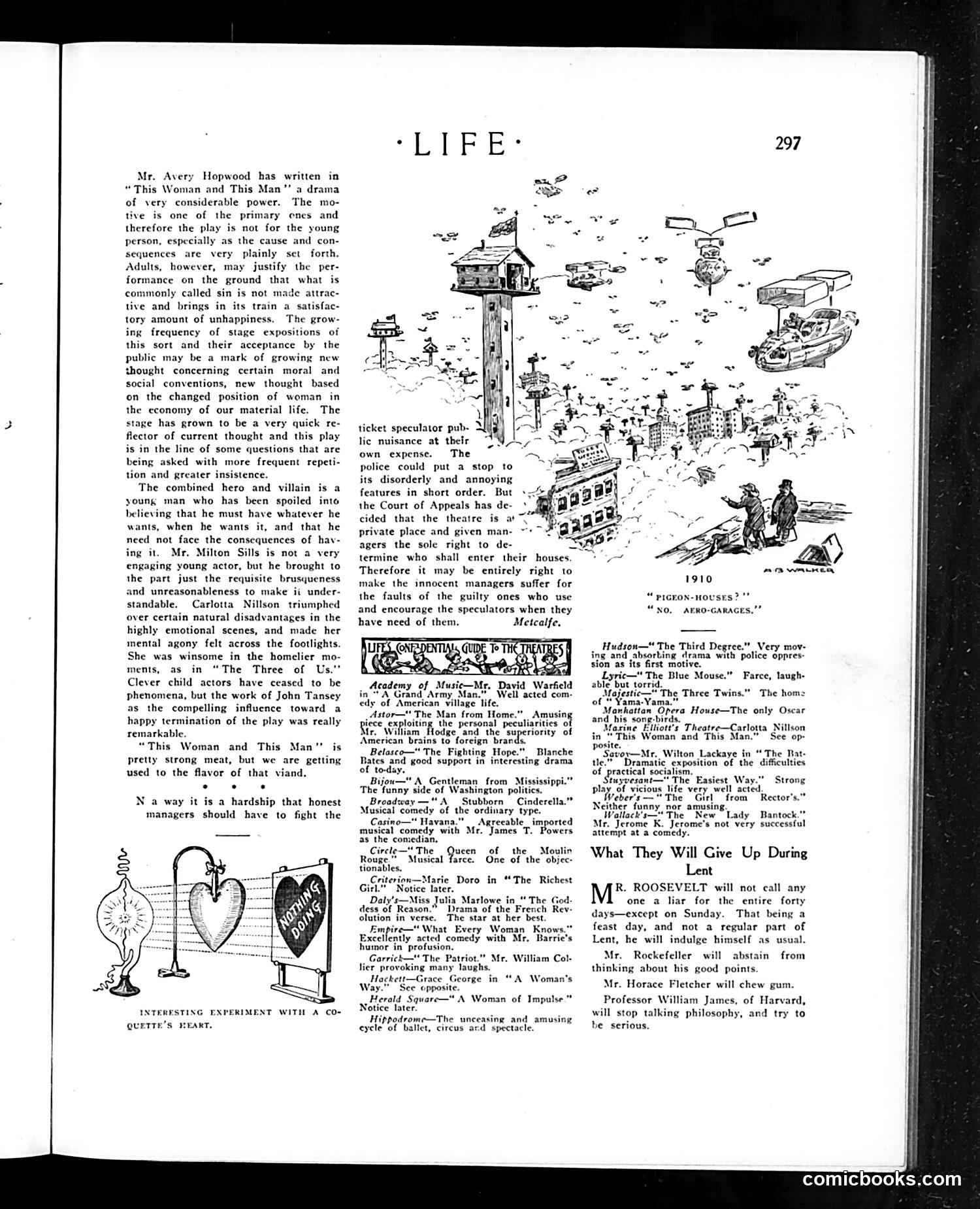
This page from *Life* magazine contains theater reviews and commentary on contemporary Broadway productions (circa 1910s based on styling). The main cartoon—"Interesting Experiment with a Coquette's Heart"—shows a scientific apparatus measuring or testing a woman's heart, depicted as an organ. This satirizes contemporary anxieties about women's changing social roles and morality. The image suggests skepticism about efforts to quantify or understand female emotional/sexual nature scientifically. The lengthy review discusses Avery Hopwood's play "This Woman and This Man," which deals frankly with sexual morality and infidelity—scandalous subjects for the era. The critic defends the play's adult audience and suggests its popularity reflects "new thought" about women's economic independence and changing social conventions. A secondary commentary by "Metcalfe" criticizes ticket scalpers, arguing theaters shouldn't suffer financially for speculators' practices. The remaining space lists Broadway productions with brief critical notes, representing typical entertainment journalism of the period.
📄 Transcribed text from this page (OCR, searchable)
Machine-transcribed from the original scan — historical spelling and the odd misread are preserved.
Mr. Avery Hopwood has written in “This Woman and This Man”? a drama of very considerable power. The mo- tive is one of the primary ones and therefore the play is not for the young person, especially as the cause and con- sequences are very plainly set forth. Adults, however, may justify the per- formance on the ground that what is commonly called sin is not made attrac- tive and brings in its train a satisfac- tory amount of unhappiness. The grow- & frequency of stage expositions of this sort and their acceptance by the public may be a mark of growing new thought concerning certain moral and social conventions, new thought based on the changed position of woman in the economy of our material life. The stage has grown to be a very quick re- flector of current thought and this play is in the line of some questions that are being asked with more frequent repeti- tion and greater insistence. The combined hero and villain is a young man who has been spoiled into believing that he must have whatever he wants, when he wants it, and that he need not face the consequences of hav- ing it. Mr. Milton Sills is not a very engaging young actor, but he brought to the part just the requisite brusqueness and unreasonableness to make ii under- standable. Carlotta Nillson_ triumphed over certain natural disadvantages in the highly emotional scenes, and made her mental agony felt across the footlights. She was winsome in the homelier mi ments, as in “The Three of Us. Clever child actors have ceased to be phenomena, but the work of John Tansey as the compelling influence toward a happy termination of the play was really remarkable. “This Woman and This Man’? is pretty strong meat, but we are getting used to the flavor of that viand. o 8 N a way it is a hardship that honest managers should have to fight the INTERESTING EXPERIM QUETTE’S HEART. T WITH A Co- ticket speculator pub- > lic nuisance at their own expense. The police could put a stop to its disorderly and annoying features in short order. But the Court of Appeals has de- cided that the theatre is at private place and given man- agers the sole right to de- termine who shall enter their houses. Therefore it may be entirely right to make the innocent managers suffer for the faults of the guilty ones who use and encourage the speculators when they have need of them. Metcalfe, _ Academy of Music—Mr. David Warfield in A Grand Army Man.”" Well acted com- edy of American village life. _Astor—"The Man from Home.” Amusinj Pisce exploiting the personal peculiarities o Mr. William Hodge, and the ‘superionty of American brains to foreign brands. Belasco—" The Fighting Hope.” Blanche Bates and good support in interesting drama of tod Bijou—" A Gentleman from Mississippi.” The funny side of Washington politics, Broadway—“'A Stubborn Cinderella.” Musical comedy of the ordinary type. Casino—" Havana.” | Agrecable_ imported musical comedy with Mr. James T. Powers as the com een of the Moulin Rouge.” Musical farce. One of the objec- tionables, Criterion—Marie Doro in Girl.”" Notice later. Daly's—Miss J The Richest Marlowe in The God- dess of Reason.” Drama of the French Rev- olution in verse. The star at her best. Empire—" What Every Woman Knows."* Excellently acted comedy with Mr. Barrie’s humor in profusion. Garrick—"* The Patriot.” Mr. William Col- lier provoking many laughs. Hackett—Grace George in Way." See epposite. Herald Square—" A Woman of Impulse” Notice later. Hippodrome—The unceasing and amusing cycle of ballet, circus ard spectacle. “A Woman's “ picroN-nousEs? "" “NO, AERO-GARAGES.”” Hudson— The Third Degree.” Very mov- ing and absorbing drama with police oppres- sion as its first motive. Lyric—" The Blue Mouse." able but torri . Majestic—" The Three Twins.” of “Yama-Yama. Manhattan Opera House—The only Oscar and his song-birds. farine Elliott's Theatre—Carlotta Nillson “This Woman and This Man.” See op- Farce, laugh- ‘The hom: y." Strong of vicious life very well acted. Weber's—-“ The Girl from Rector's.” Neither funny, nor amusing. Wallack's—" The New Lady Bantock.”” Mr. Jerome K. Jerome's not very successful attenipt at a comedy. What They Will Give Up During Lent R. ROOSEVELT will not call any one a liar for the entire forty days—except on Sunday. That being a feast day, and not a regular part of Lent, he will indulge himself as usual. Mr. Rockefeller will abstain thinking about his good points. from Mr. Horace Fletcher will chew gum. Professor William James, of Harvard, will stop talking philosophy, and try to be serious. comicbooks.com