
Life, 1909-03-04 · page 14 of 44
Life — March 4, 1909 — page 14: what you’re looking at
What you’re looking at
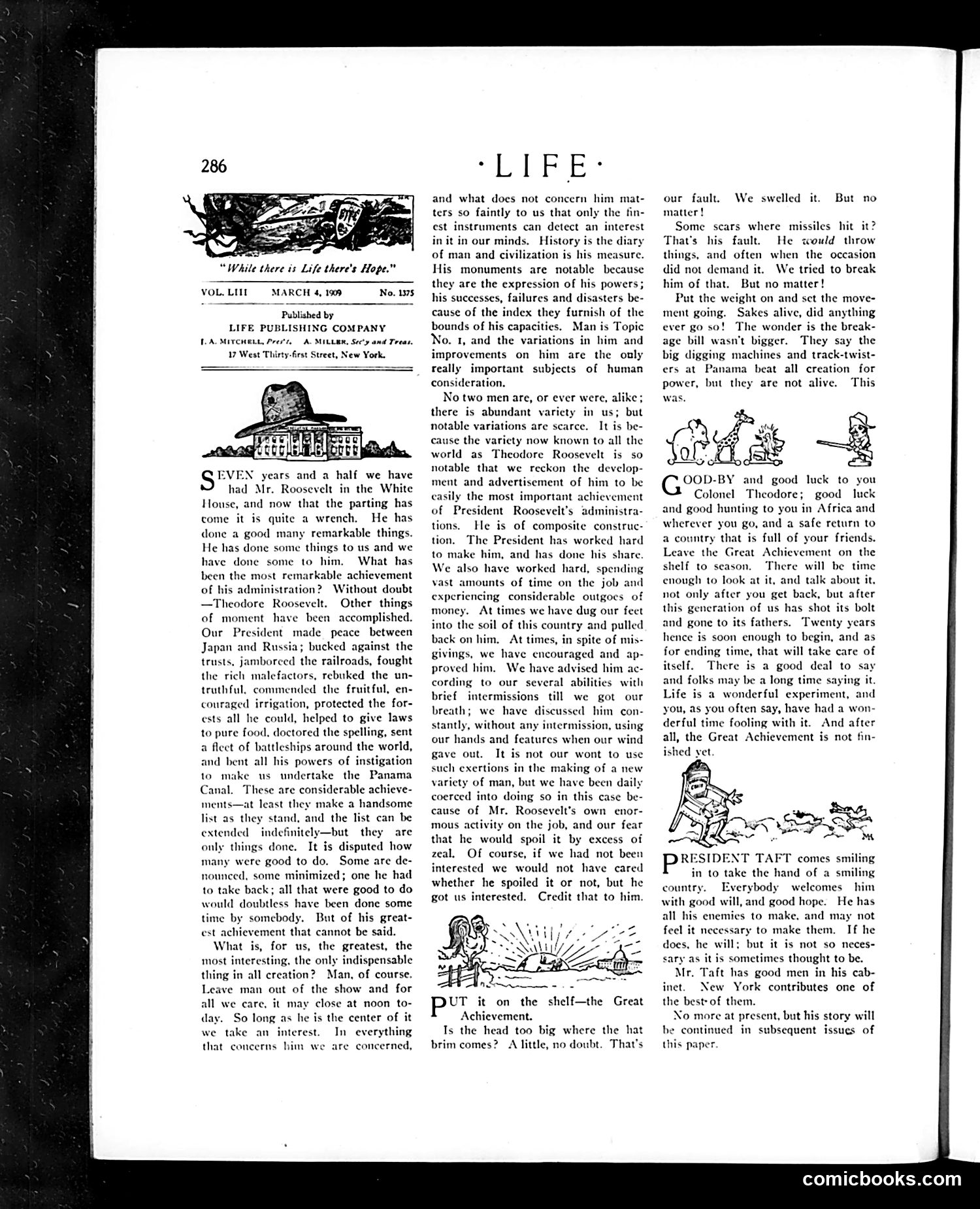
This is a farewell editorial on President Theodore Roosevelt's administration, published as he left office. The text argues Roosevelt's greatest achievement wasn't specific policies (peace with Japan, trust-busting, Panama Canal) but rather the development of his own distinctive personality and public image. The author claims Roosevelt himself—as a novel "variety of man"—is the most important product of his presidency. Life magazine boasts of its role in shaping and scrutinizing Roosevelt, describing how they've "worked hard" influencing him through constant discussion and advice, sometimes restraining his excessive zeal. The editorial reflects the magazine's self-importance as a cultural arbiter while offering a backhanded compliment: Roosevelt's real legacy is Roosevelt himself, not his accomplishments. The cartoon illustrations (barely visible) likely reinforce this focus on the president's personality rather than policy.
📄 Transcribed text from this page (OCR, searchable)
Machine-transcribed from the original scan — historical spelling and the odd misread are preserved.
“While there is Life there's Hope.” MARCH 4, 199 No. 175 Published by LIFE PUBLISHING COMPANY LA MITCHELL, Pres, A. MILLER, Sec’y and Treas. 17 West Thirty-first Street, New York, VOL. LIT years and a half we have had Mr. Roosevelt in the White House, and now that the parting has come it is quite a wrench, He has done a good many remarkable thin; He has done some things to us and we have done some to him, What has been the most remarkable achievement of his administration? Without doubt —Theodore Roosevelt. Other things of moment have been accomplished. Our President made peace between Japan and Russia; bucked against the trusts, jamborced the railroads, fought the rich malefactors, rebuked the un- truthful, commended the fruitful, en- couraged irrigation, protected the for- ests all he could, helped to give laws to pure food, doctored the spelling, sent a flcet of battleships around the world, and bent all his powers of instigation to make us undertake the Panama Canal. These are considerable achieve- ments—at least they make a handsome list as they stand, and the list can be extended indefinitely—but they are only things done. It is disputed how many were good to do. Some are de- nounced, some minimized; one he had to take back; all that were good to do would doubtless have been done some time by somebody, But of his great- est achievement that cannot be said. What is, for us, the greatest, the most interesting, the only indispensable thing in all creation? Man, of course. Leave man out of the show and for all we care, it may close at noon to- day. So long as he is the center of it we take an interest. In everything that concerns him we are concerned, *“LIFE* and what does not concern him mat- ters so faintly to us that only the fin- est instruments can detect an interest in it in our minds. History is the diary of man and civilization is his measure. His monuments are notable because they are the expression of his powers; his successes, failures and disasters be- cause of the index they furnish of the bounds of his capacities. Man is Topic No. 1, and the variations in him and improvements on him are the only really important subjects of human consideration, No two men are, or ever were, alike; there abundant varicty in notable variations are scarce. cause the variety now known to all the world as Theodore Roosevelt is so notable that we reckon the develop- ment and advertisement of him to be casily the most important achievement of President Roosevelt's administra- tions. He is of composite construc- tion. The President has worked hard to make him, and has done his share. We also have worked hard, spending vast amounts of time on the job and experiencing considerable outgoes of money. At times we have dug our fect into the soil of this country and pulled back on him, At times, in spite of mis- givings, we have encouraged and ap- proved him. We have advised him ac- cording to our several abilities with brief intermissions till we got our breath; we have discussed him con- stantly, without any intermission, using our hands and features when our wind gave out. It is not our wont to use stich exertions in the making of a new variety of man, but we have been daily coerced into doing so in this case be- cause of Mr. Roosevelt's own enor- mous activity on the job, and our fear that he would spoil it by excess of zeal. Of course, if we had not been interested we would not have cared whether he spoiled it or not, but he got us interested. Credit that to him. UT it on the shelf—the Great Achievement. Is the head too big where the hat brim comes? A little, no doubt. That's our fault. We swelled it. But no matter! Some scars where missiles hit it? That's his fault. He would throw things, and often when the occasion did not demand it. We tried to break him of that. But no matter! Put the weight on and set the move- ment going. Sakes alive, did anything ever go so! The wonder is the break- age bill wasn't bigger. They say the big digging machines and track-twist- ers at Panama beat all creation for power, but they are not alive. This OOD-BY and good luck to you Colonel Theodore; good luck and good hunting to you in Africa and wherever you go, and a safe return to a country that is full of your friends. Leave the Great Achievement on the shelf to season, There will be time enough to look at it, and talk about it, not only after you get back, but after this generation of us has shot its bolt and gone to its fathers. Twenty years hence is soon enough to begin, and as for ending time, that will take care of itself. There is a good deal to say and folks may be a long time saying it. Life is a wonderful experiment, and you, as you often say, have had a won- derful time fooling with it. And after all, the Great Achievement is not fin- ished yet RESIDENT TAFT comes smiling in to take the hand of a smiling country. Everybody welcomes him with good will, and good hope. He has all his enemies to make, and may not feel it necessary to make them. If he does, he will; but it is not so neces- sary as it is sometimes thought to be. Mr. Taft has good men in his cab- inet. New York contributes one of the best-of them. No more at present, but his story will be continued in subsequent issues of this paper comicbooks.com