
A complete issue · 28 pages · 1909
Life — January 14, 1909
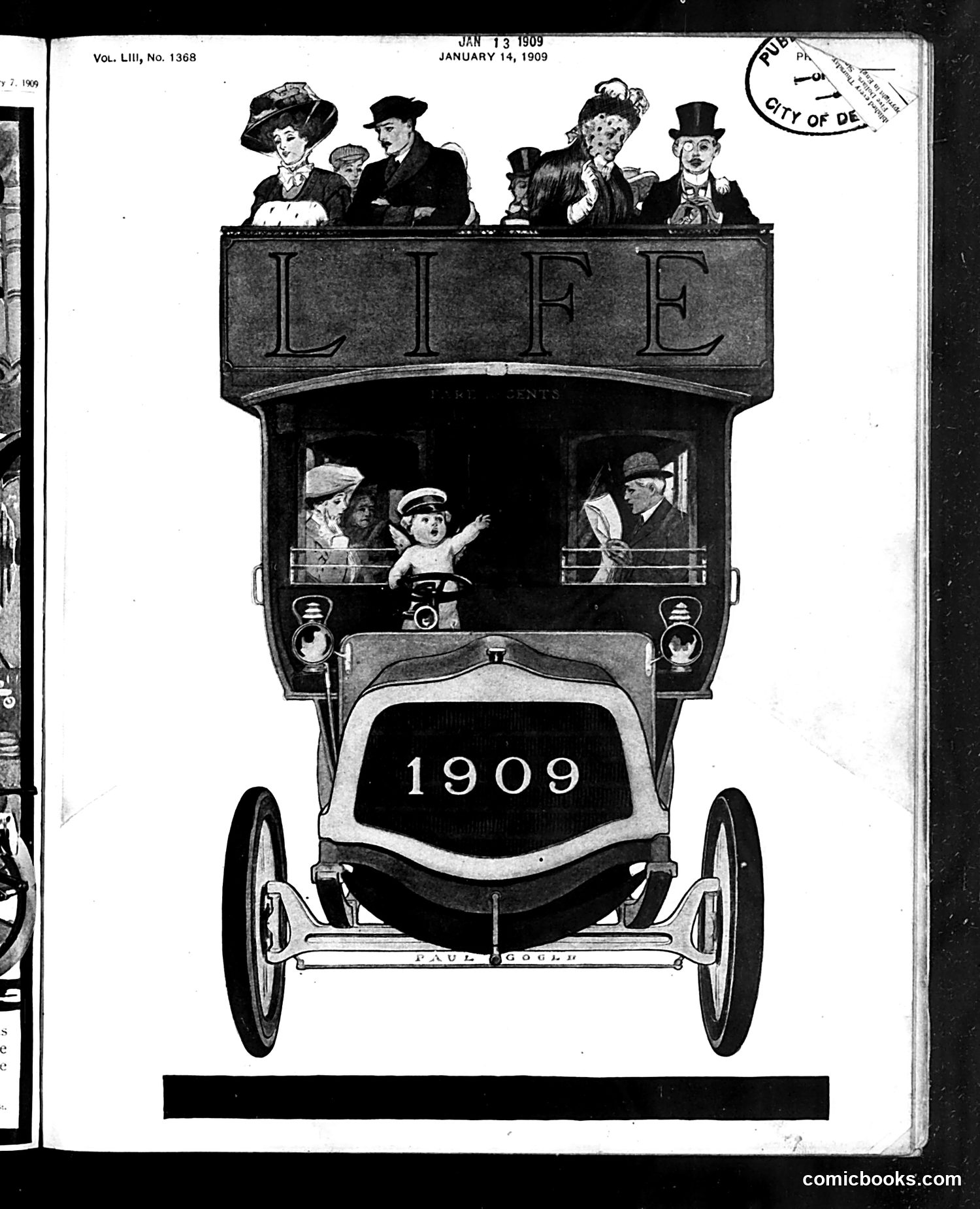
This cover depicts a double-decker automobile representing "Life" itself in 1909. The upper deck shows four well-dressed figures observing from above, while the lower deck contains passengers including what appears to be a central figure driving. The car is labeled "1909" and credited to "PAUL GOULD." The satire likely comments on **modern life and social hierarchy** — the well-to-do observing from above while ordinary people occupy the lower levels. This reflects early-1900s anxieties about class division and rapid industrialization. The automobile itself, still a novelty in 1909, symbolizes progress and modernity. The structure itself becomes a metaphor: Life as a vehicle with distinct social tiers, moving forward but maintaining class stratification even as society modernizes.
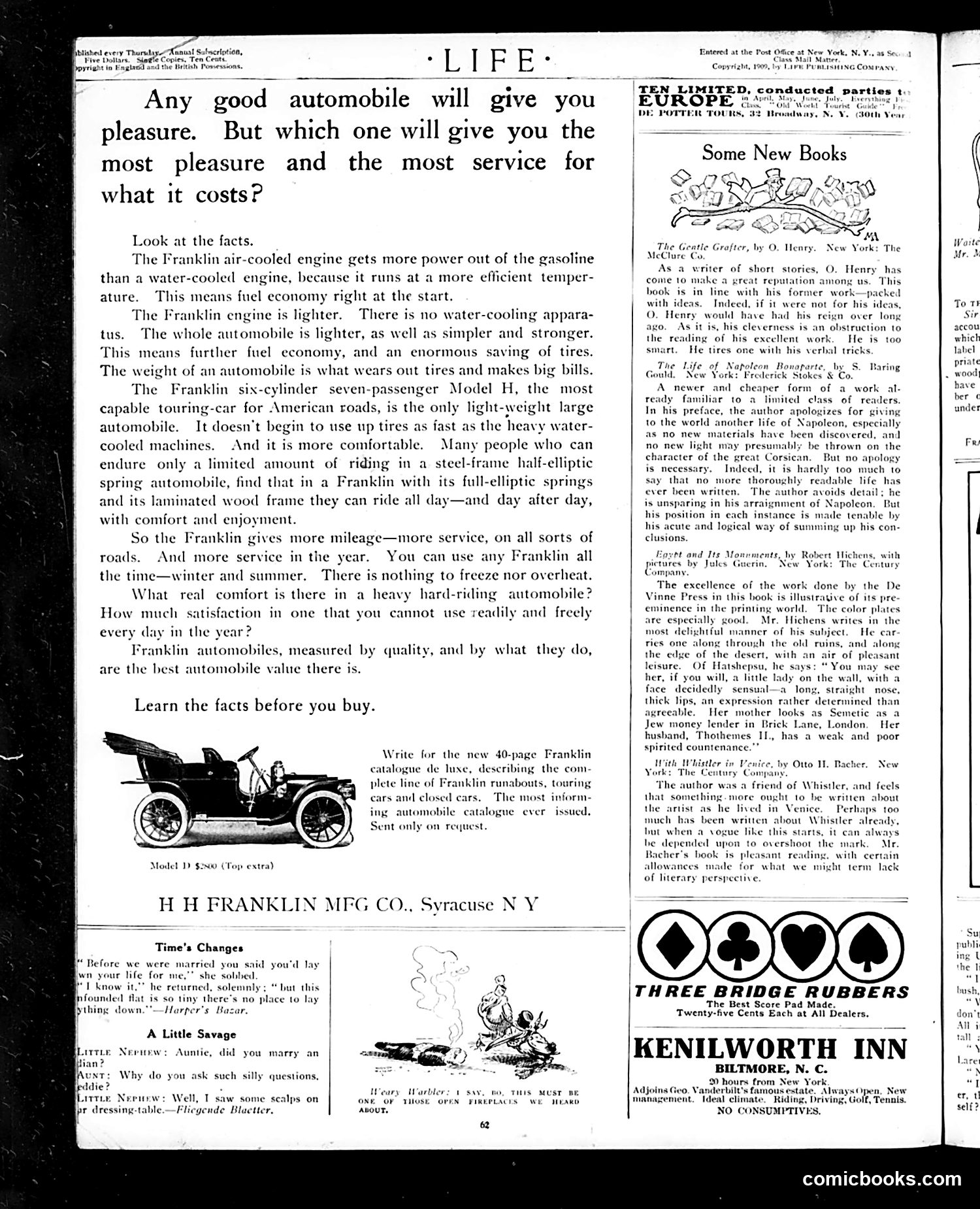
This page is primarily **advertising content** with minimal editorial cartoons. The main feature is a Franklin automobile advertisement emphasizing the air-cooled engine's efficiency and lighter weight compared to water-cooled competitors. Below the ad appears a small cartoon titled "A Little Savage" showing a domestic scene with minimal satirical content—likely a mild joke about marriage or child-rearing based on the dialogue mentioning "scalps on a dressing table." The remainder of the page contains **product advertisements** for "Three Bridge Rubbers" playing cards and Kenilworth Inn in Biltmore, North Carolina. This represents typical early-20th-century magazine layout: commercial advertising dominating editorial space, with humor secondary to business promotion.
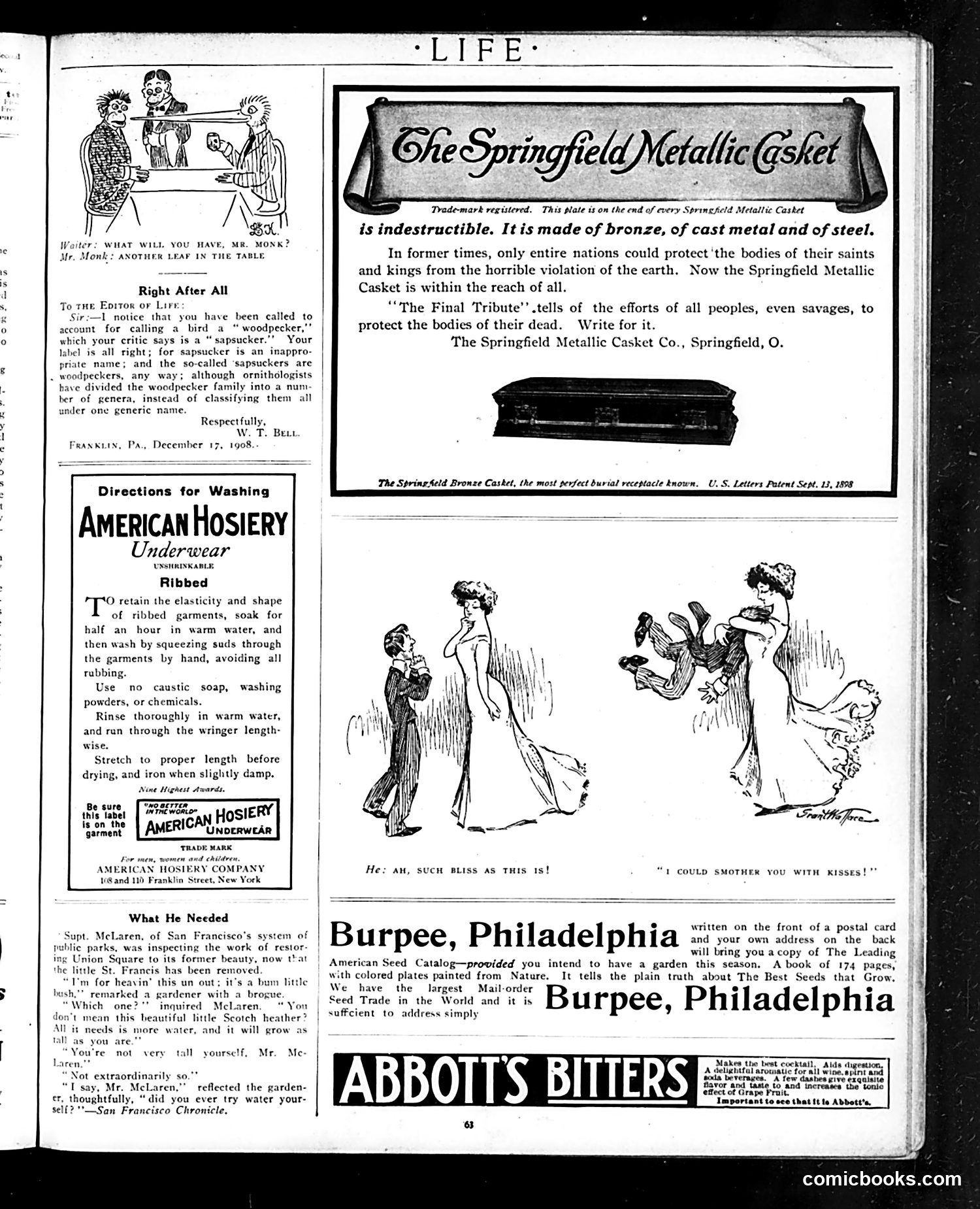
This LIFE magazine page is primarily **advertising and light social content** rather than political satire. The top cartoon titled "Right After All" appears to be a gentle humor piece about a waiter correcting a diner's ornithological terminology—the joke being that precise scientific classification matters more than casual speech. The main content consists of **advertisements**: American Hosiery underwear (with washing instructions), Springfield Metallic Caskets (an indestructible burial container), Burpee Philadelphia seeds, and Abbott's Bitters. The bottom illustration byFred Maitze shows a romantic scene with the caption "He: Ah, such bliss as this is!" and "I could smother you with kisses!"—typical sentimental humor of the era. No significant political satire is evident on this page.
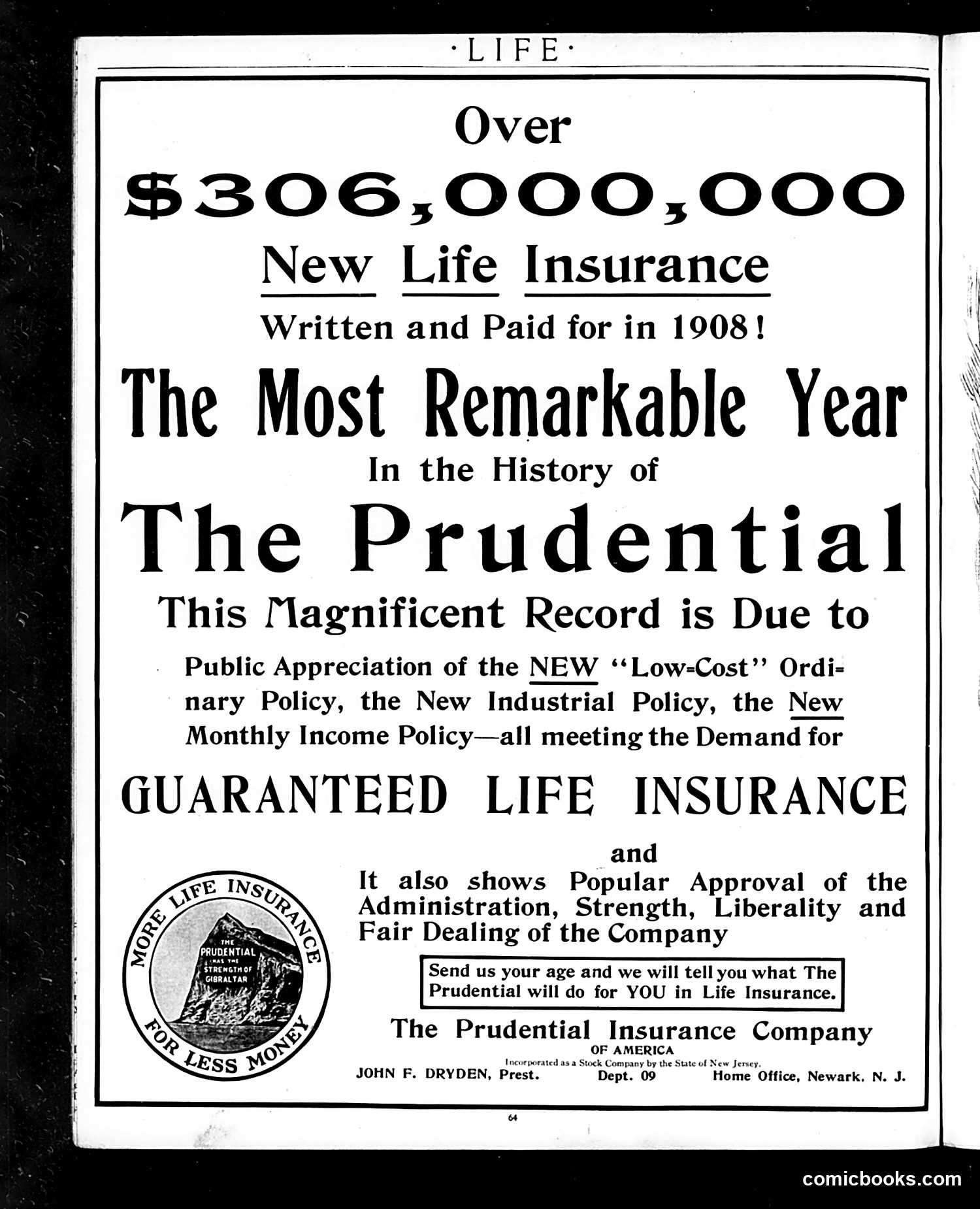
This page is **not a cartoon or satire** — it's a straightforward **advertisement** for The Prudential Insurance Company of America, published in Life magazine around 1908. The ad celebrates a business milestone: over $306 million in new life insurance written and paid for in 1908, which the company claims is "the most remarkable year" in Prudential's history. The ad attributes this success to public appreciation for their new affordable policies: a "Low-Cost" ordinary policy, an industrial policy, and a monthly income policy — all marketed as providing "guaranteed life insurance." The company's logo features a rock (the "Rock of Gibraltar," Prudential's iconic symbol) and the motto "More Life Insurance for Less Money." The ad is from the company's Newark, New Jersey headquarters.
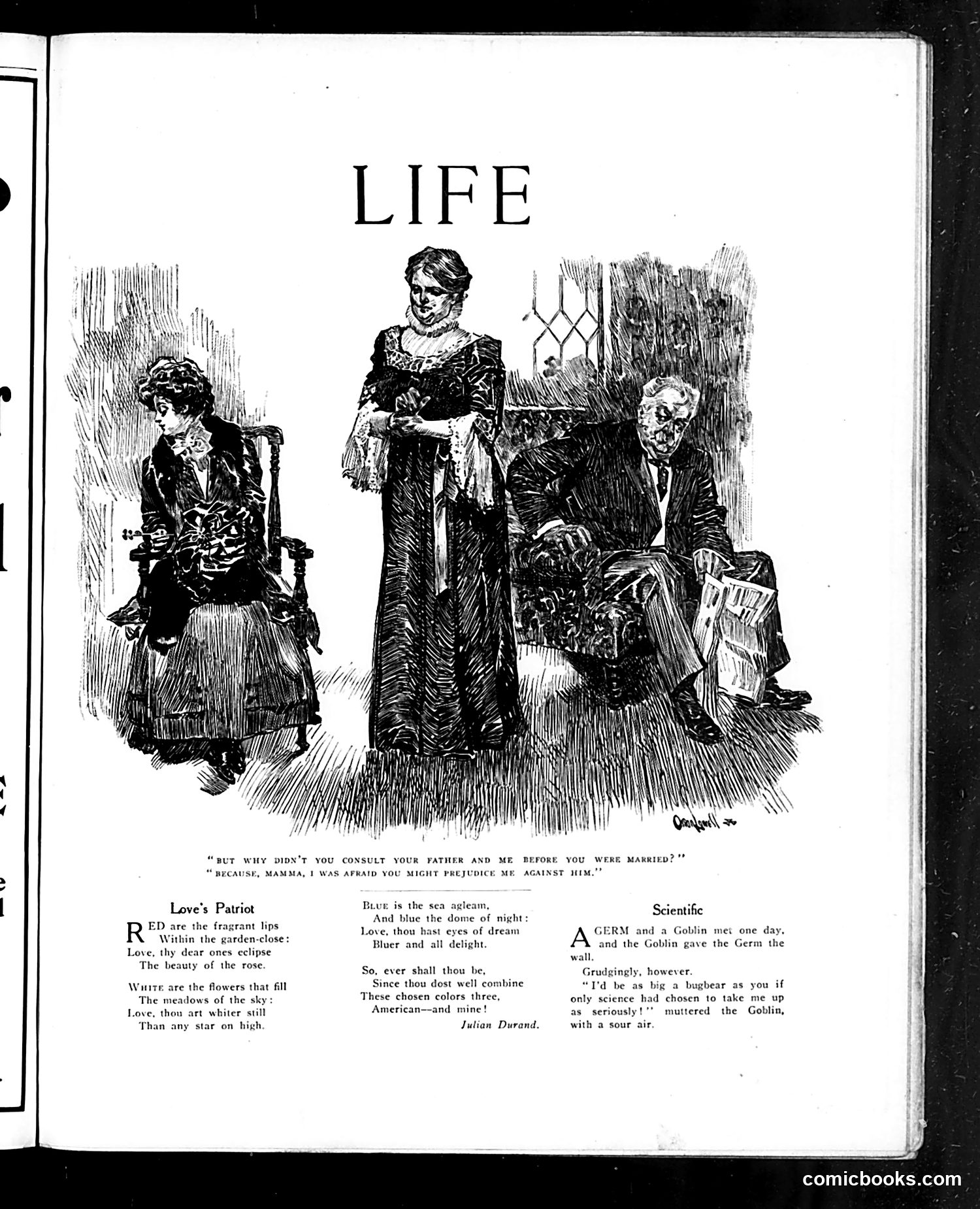
This page features a satirical cartoon and poetry about courtship and marriage. The illustration depicts a domestic scene where a woman appears to confront a man about consulting her father before proposing. The caption quotes her saying she feared he might prejudice her father against him. The three poems below—"Love's Patriot," "Blue is the Sea Agleam" (attributed to Julian Durand), and "Scientific"—offer commentary on romantic love and relationships. The "Scientific" piece presents a cynical dialogue between a "Germ" and "Goblin," mocking pretentious scientific attitudes toward romance. The overall content satirizes late 19th/early 20th-century courtship conventions, particularly the tension between romantic idealism and practical family concerns about suitors' worthiness.
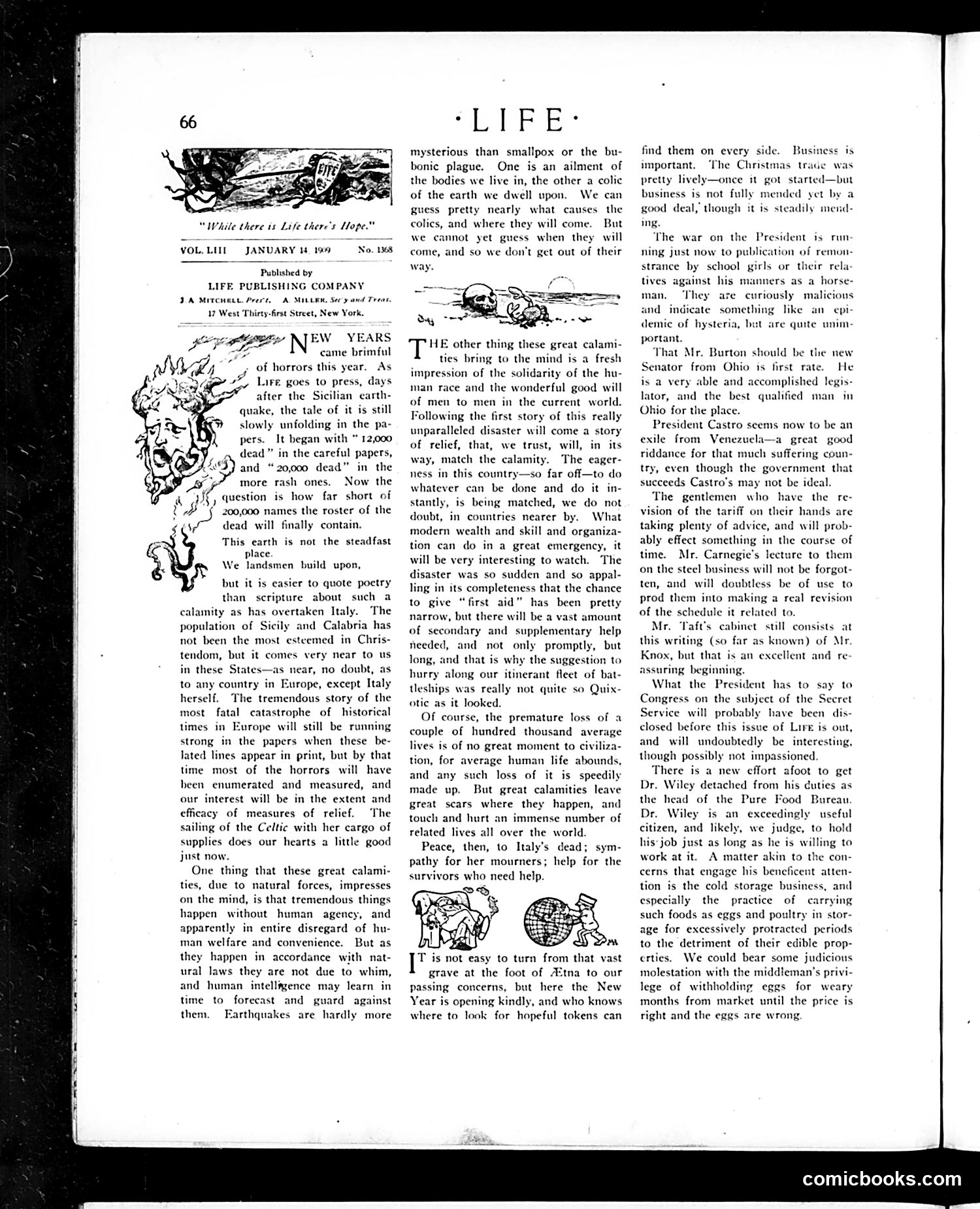
The page contains editorial commentary rather than political cartoons. The text addresses several 1909 events: **Italian Earthquake Relief**: The opening discusses calamities affecting Sicily and Calabria, likely referencing the devastating 1908 Messina earthquake. The writer argues that while human agencies cannot prevent such disasters, relief efforts demonstrate civilization's moral progress. **Political Commentary**: References include criticism of President Castro (Venezuela), praise for Ohio politician Mr. Burton as Senate material, and discussion of President Taft's cabinet appointments—particularly the "secret service" controversy that apparently was just published. **Social Commentary**: The final section critiques cold-storage practices for eggs and poultry, arguing middlemen wrongly withhold supplies to inflate prices. The tone is typical Progressive Era moralizing mixed with practical policy critique.
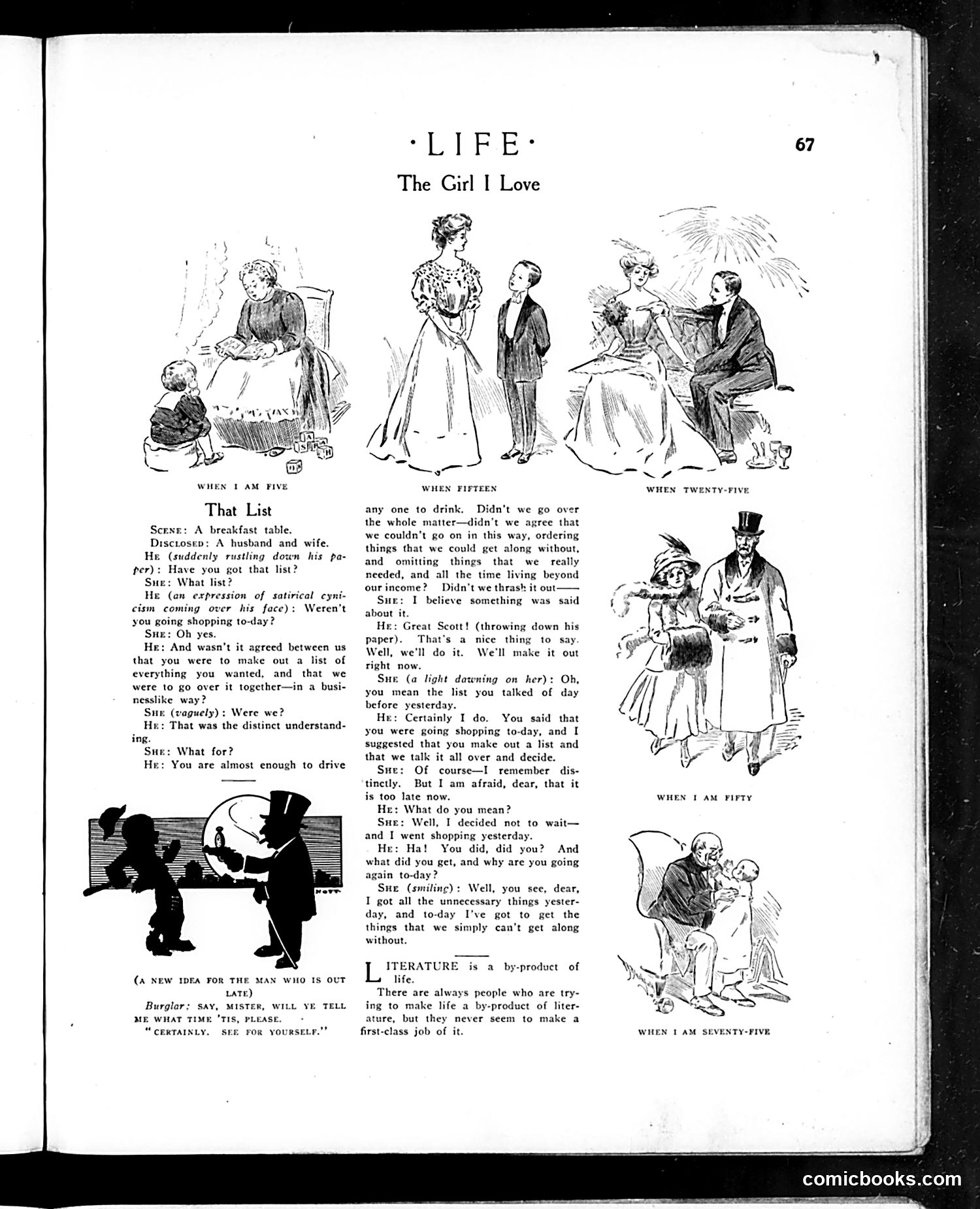
This satirical piece contrasts a woman's attitudes toward shopping and budgeting across different life stages. At age five, she's innocent; at fifteen, she's concerned about finances with a young man; at twenty-five, she's fashionably dressed and carefree with a gentleman caller. The central dialogue mocks marital dynamics: a husband and wife argue over a shopping list. She initially agrees to economize, then secretly shops anyway, justifying unnecessary purchases as essentials. His exasperated response—"You are almost enough to drive a man to drink"—suggests wives' spending habits were a common satirical target. The final note about literature being a "by-product of life" is unclear in context but appears to be editorial commentary. The humor relies on period stereotypes about women's irresponsible spending and marital conflict over finances.
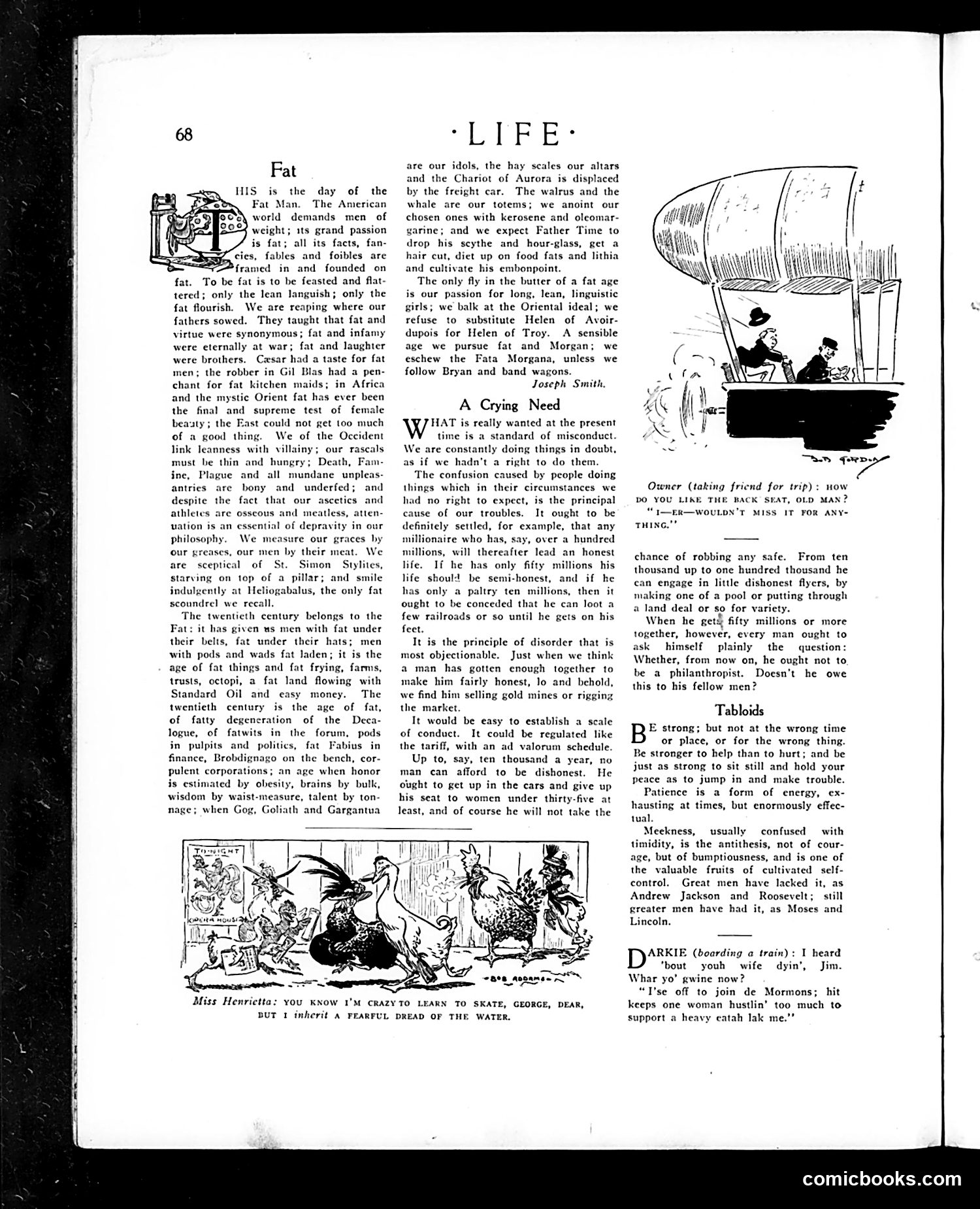
This page contains three distinct pieces of satirical content: **"Fat"** (left column): A lengthy essay mocking society's obsession with weight and fatness, using exaggerated examples of historical and contemporary figures. The tone is ironic, defending fatness while listing disparaging stereotypes. **"A Crying Need"** (center): An article critiquing a "standard of misconduct" where wealthy individuals (those with millions) face minimal consequences while poorer people are more strictly judged. It advocates for clearer ethical standards applied consistently across wealth levels. **"Tabloids"** (right): A brief piece on patience and meekness as virtues, contrasting them with strength, and referencing historical figures like Andrew Jackson and Roosevelt. The cartoons illustrate everyday scenarios with humorous captions about social behaviors and fears.
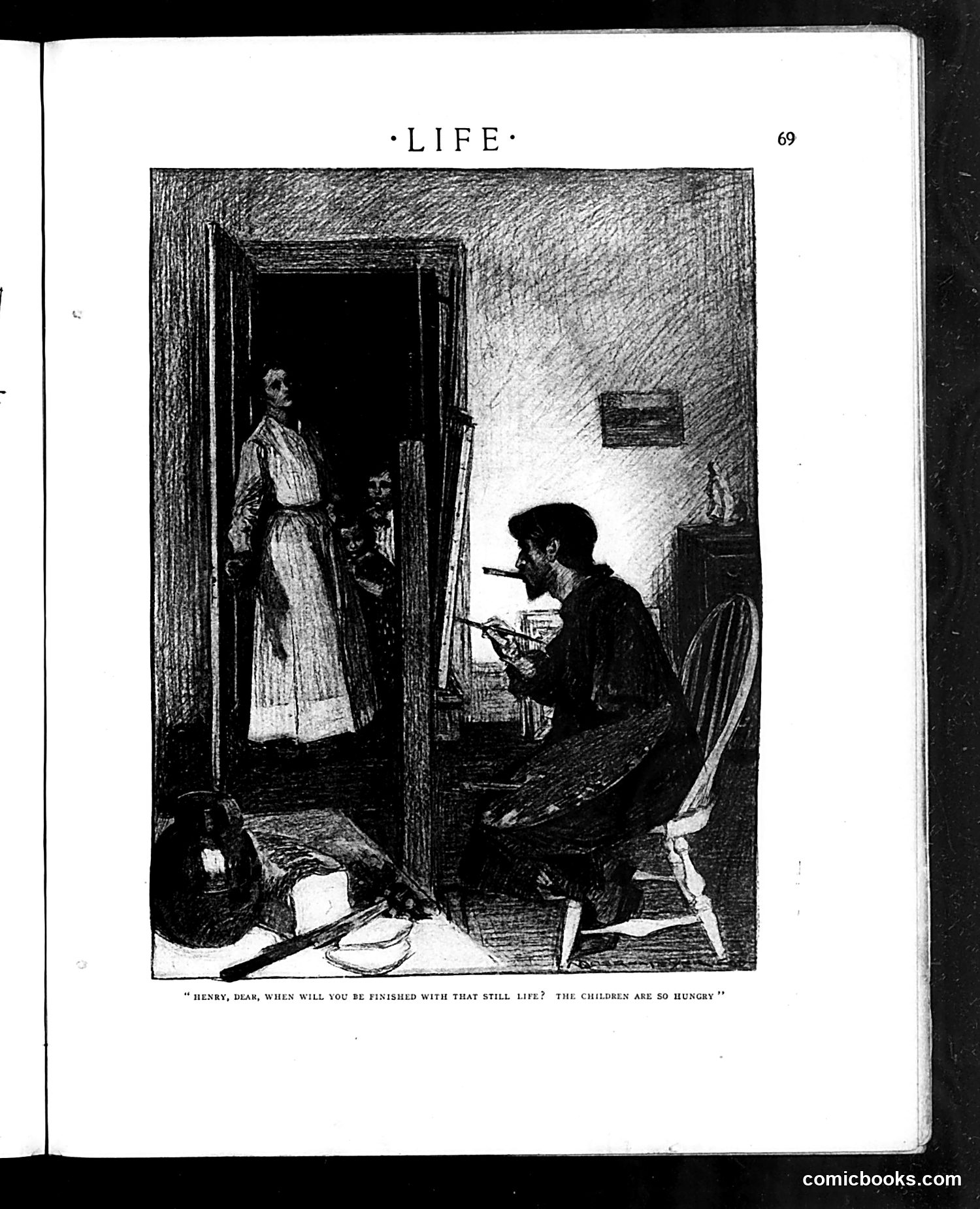
This single-panel cartoon depicts a domestic scene: a man sits painting at an easel while a woman stands in a doorway with children behind her. The caption reads: "Henry, dear, when will you be finished with that still life? The children are so hungry." The satire targets artistic pretension versus domestic responsibility. A "still life" is a traditional fine art subject (typically inanimate objects), here used ironically—the artist is absorbed in creating high art while his family goes hungry. The joke plays on the contrast between the husband's serious artistic ambitions and his neglect of basic family welfare and feeding obligations. This reflects early 20th-century social commentary about struggling artists prioritizing creative pursuits over practical family duties, presented with gentle domestic humor typical of *Life* magazine's satirical tone.
This page contains several editorial pieces rather than political cartoons. The main content includes: 1. **"Taft's Ahoy, and All Aboard!"** - A satirical piece about President Taft's California yacht journey, mocking his need for rest and escape from Washington duties. 2. **"Had a Splendid Time, Anyhow"** - Commentary on Castro's time as Venezuelan President, sarcastically suggesting former leaders enjoyed their positions despite political turmoil. 3. **"Public Schools and Their Cost"** - A serious editorial about education funding and the importance of investing in schools and child development. 4. **"To Protect the Shores of the Hudson River"** - Details about an upcoming Hudson-Fulton celebration commemorating Henry Hudson and Robert Fulton's explorations. 5. **"A New School"** - Discussion of a Philadelphia gymnasium program for girls. The page appears primarily editorial/satirical commentary rather than visual cartooning.
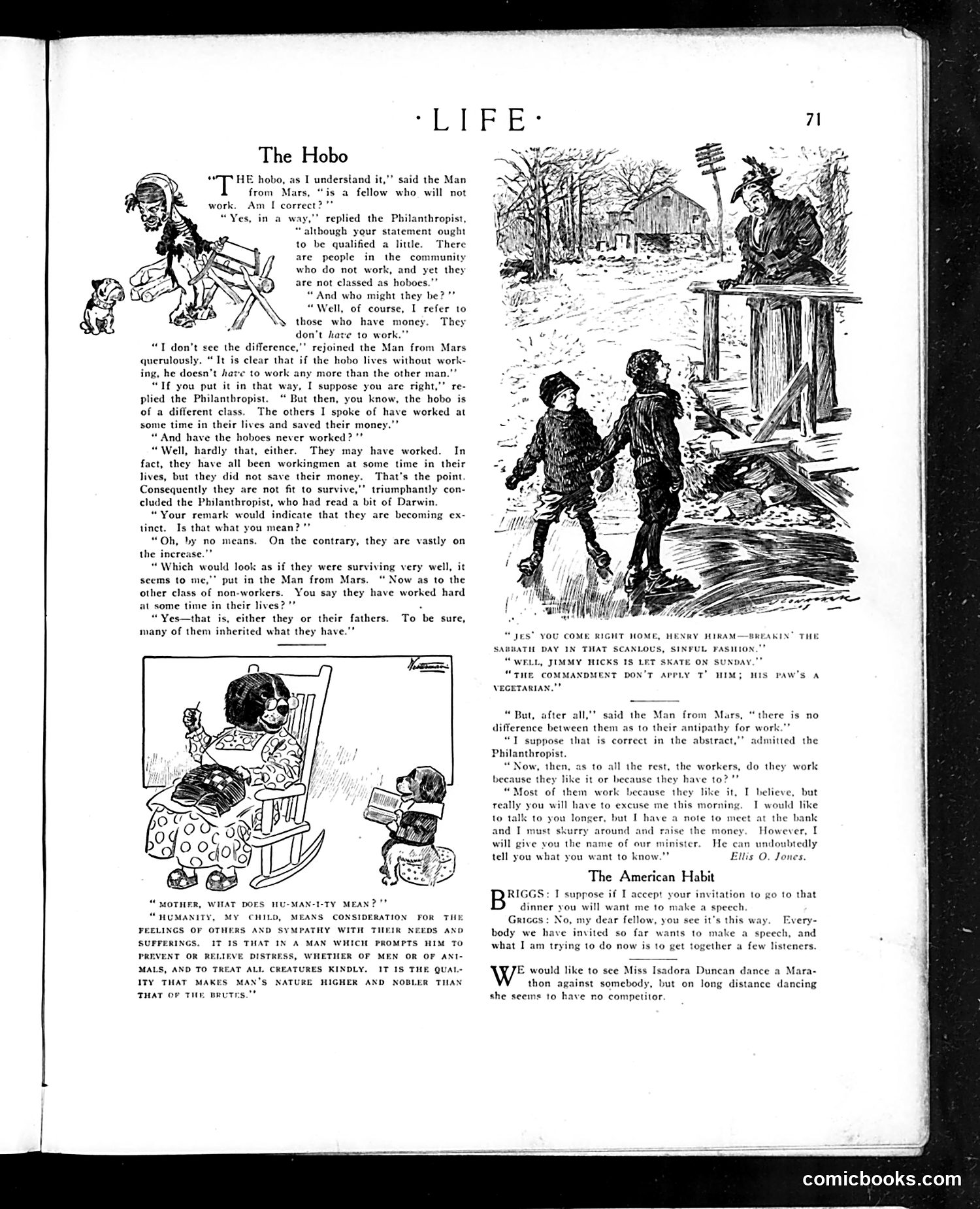
This page presents a satirical debate between a "Man from Mars" and a "Philanthropist" about hobos and work. The dialogue critiques class assumptions: the Martian observes that hobos don't work, while the Philanthropist argues they're different from lazier non-workers because they *have* worked and saved money—making them "fit to survive" by Darwinian logic. The accompanying illustrations show impoverished figures and a domestic scene. The satire targets upper-class philanthropic attitudes, suggesting that moralizing about the poor's work ethic misses economic realities. By using an alien perspective, the author highlights how arbitrary these social judgments appear. The page also includes "The American Habit," a brief humorous note about social obligations and dancing.
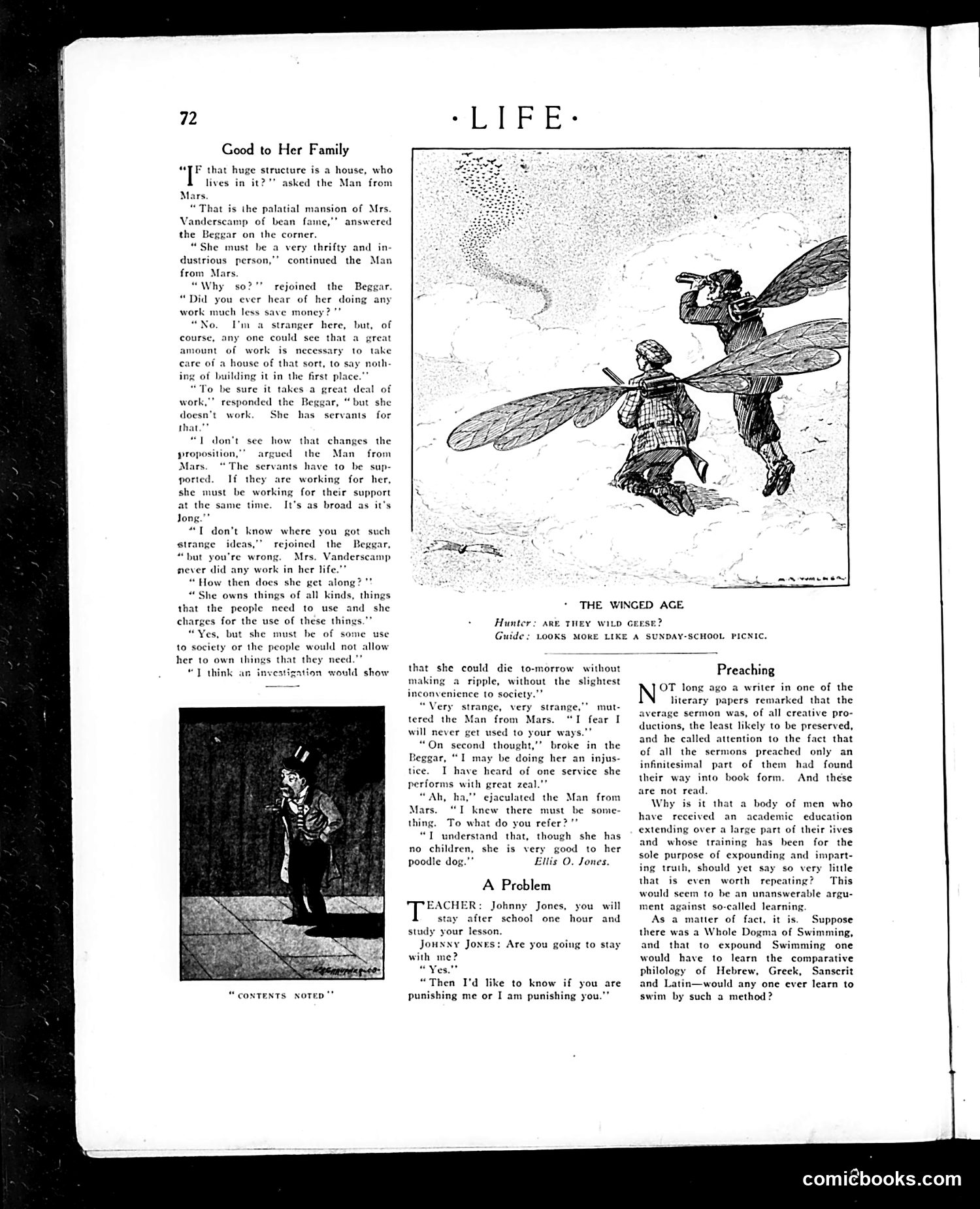
This illustration depicts two figures with large insect-like wings, appearing to be engaged in playful or competitive flight. The caption reads "THE WINGED AGE" with dialogue: "Hunter: ARE THEY WILD GEESE? / Guide: LOOKS MORE LIKE A SUNDAY-SCHOOL PICNIC." The satire appears to mock modern invention and progress. The "winged age" likely references early aviation enthusiasm of the early 20th century. The joke seems to suggest that even ordinary Sunday-school children now possess wings—mocking either how accessible/commonplace the technology is becoming, or satirizing society's obsession with mechanical innovation. The hunter and guide's confusion suggests these winged humans have become so normal they're mistaken for wildlife.
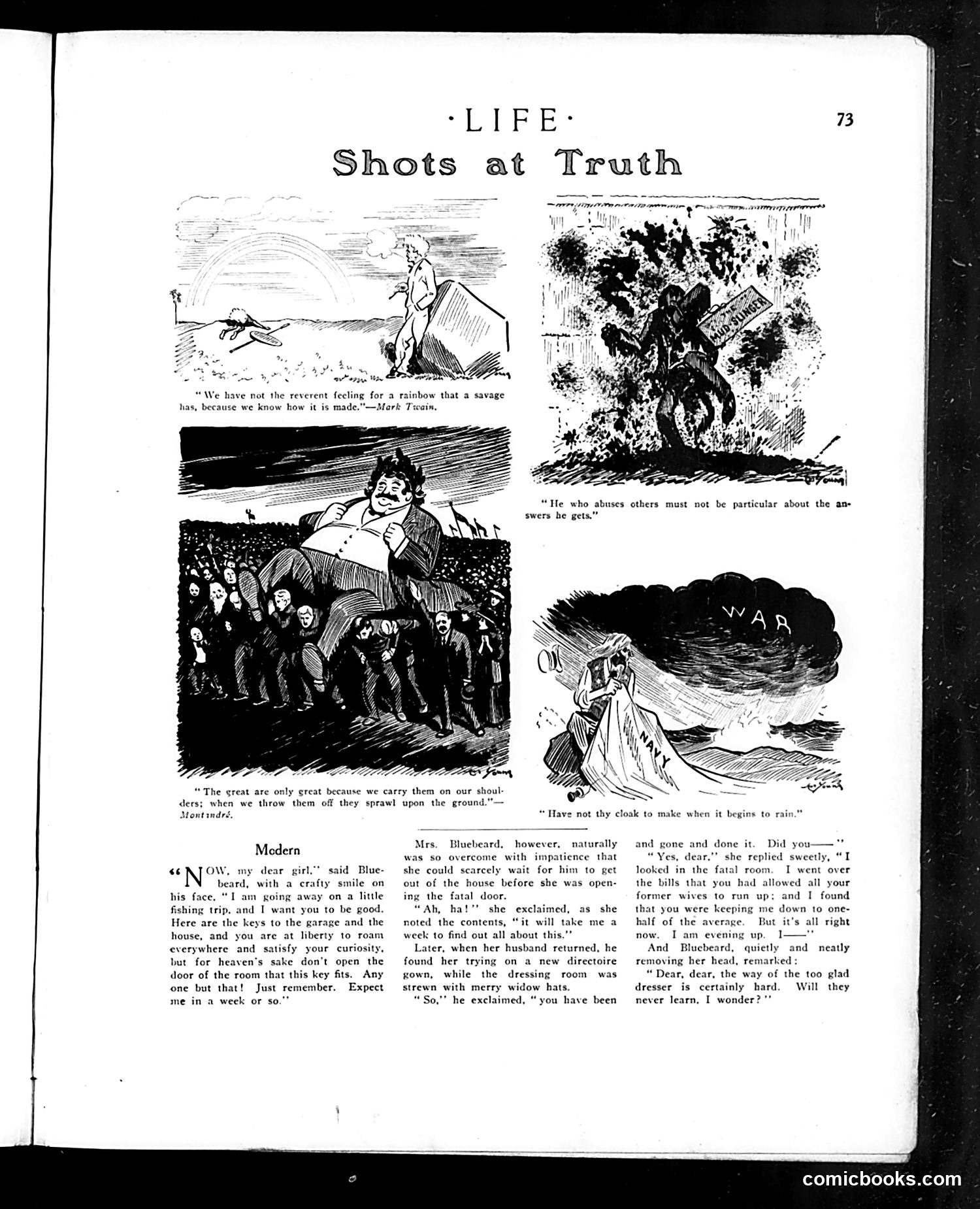
This page contains multiple cartoons satirizing various social hypocrisies. The top cartoon references Mark Twain's quote about rainbows being "made," suggesting artificial sentimentality. The large central cartoon depicts a giant figure surrounded by small people, illustrating the quote: "The great are only great because we carry them on our shoulders; when we throw them off they sprawl upon the ground"—attributed to Montaindre. This critiques how society artificially elevates leaders. Another cartoon shows "War" as a cloaked figure, with the caption "Have not thy cloak to make when it begins to rain"—suggesting war's unpredictable chaos. The "Modern" story below satirizes marital pretense, depicting a wife finding her husband's infidelity. The satire targets bourgeois hypocrisy and the gap between public propriety and private behavior.
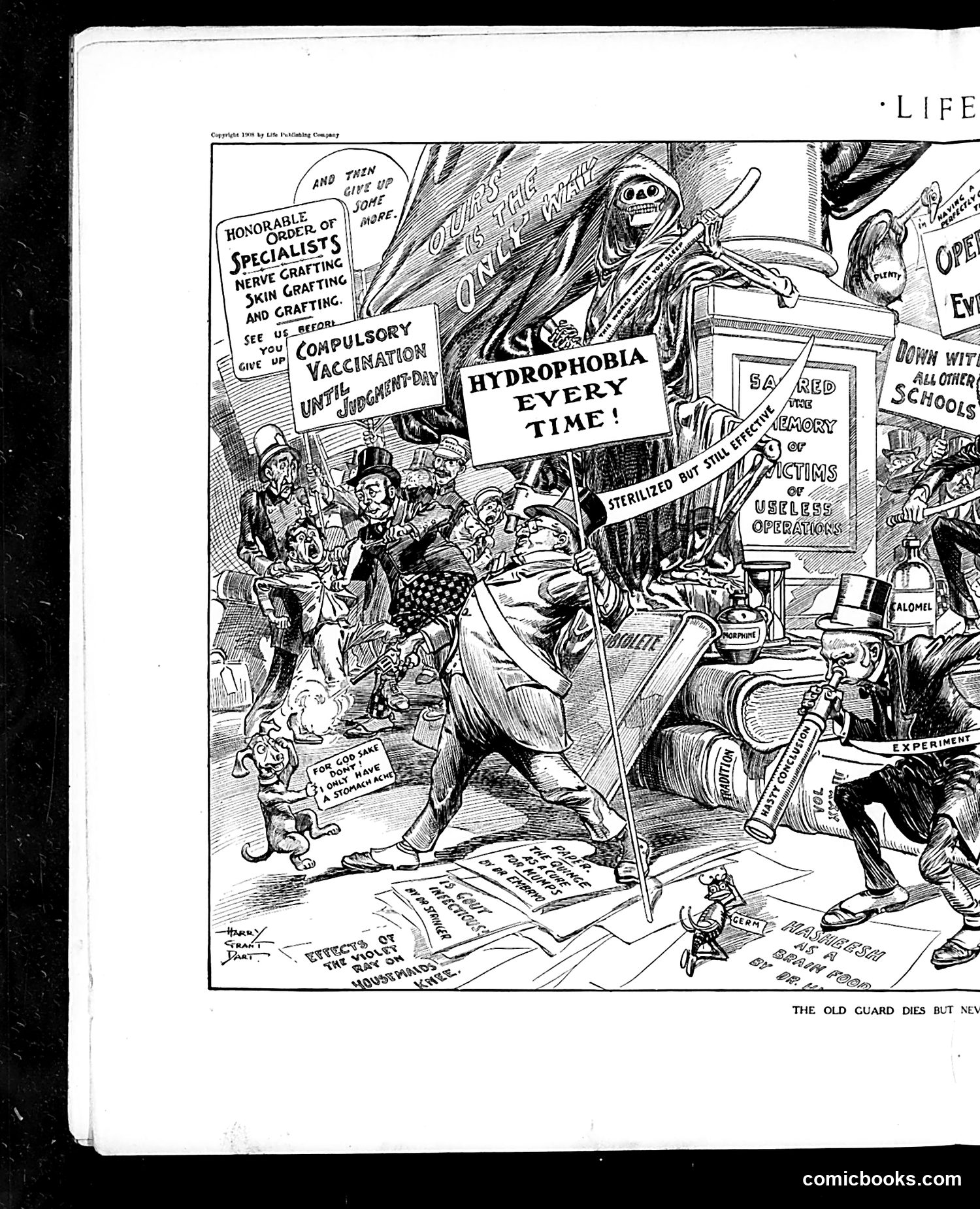
This is a satirical cartoon attacking anti-vaccination sentiment and medical quackery. Death (depicted as a skeletal reaper) looms over a crowd of figures representing organized opposition to public health measures. Visible signs read "COMPULSORY VACCINATION UNTIL MIDNIGHT," "HYDROPHOBIA EVERY TIME," and references to "nerve grafting" and "skin grafting"—indicating the cartoon mocks alternative medical claims as dangerous nonsense. The scene suggests establishment figures (top-hatted men, likely representing conservative institutions or "the old guard") resist modern vaccination despite its proven benefits. The cartoon's message: outdated medical skepticism enables preventable disease. The caption "THE OLD GUARD DIES BUT NEVER" implies entrenched opposition to progress persists even as it proves fatal.
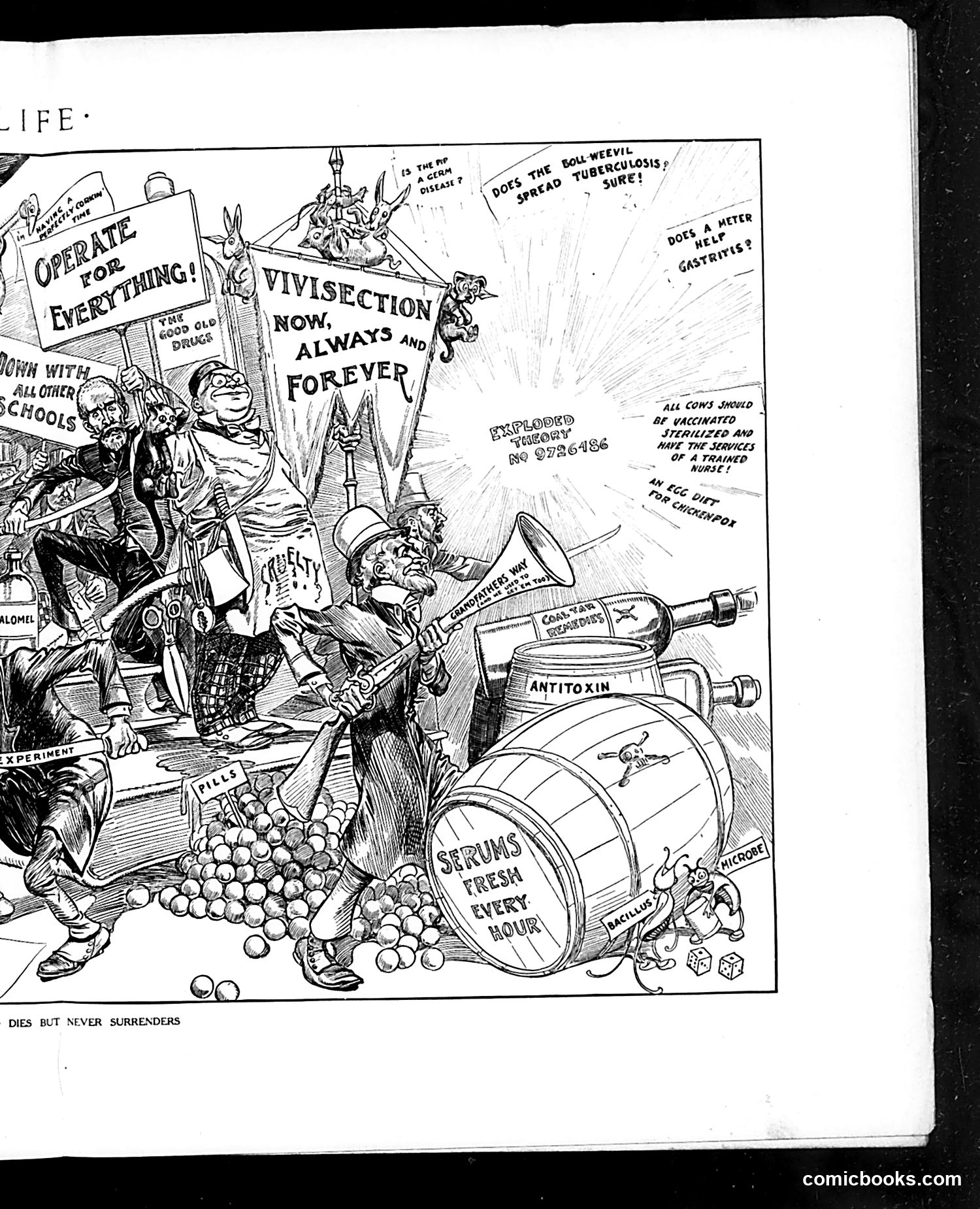
This satirical cartoon depicts "Vivisection"—a contentious early-20th-century medical practice where live animals were used for experimental research. The central figure appears to be a caricatured scientist or medical authority ("Vivisectionist") directing various experimental procedures on animals. The speech bubbles mock excessive medical intervention: questions like "Does the boll weevil spread tuberculosis?" and "Does a meter cure gastritis?" satirize overly ambitious or absurd scientific claims. The barrel labeled "Serums Fresh Every Hour" and containers of "Antitoxin" suggest mass production of experimental treatments. The cartoon criticizes both animal experimentation and the era's aggressive promotion of new medical interventions—including vaccines and antitoxins—as cure-alls. The caption "Dies but never surrenders" suggests resigned acceptance of these practices despite their victims. This reflects genuine public debate about animal welfare and medical ethics during this period.
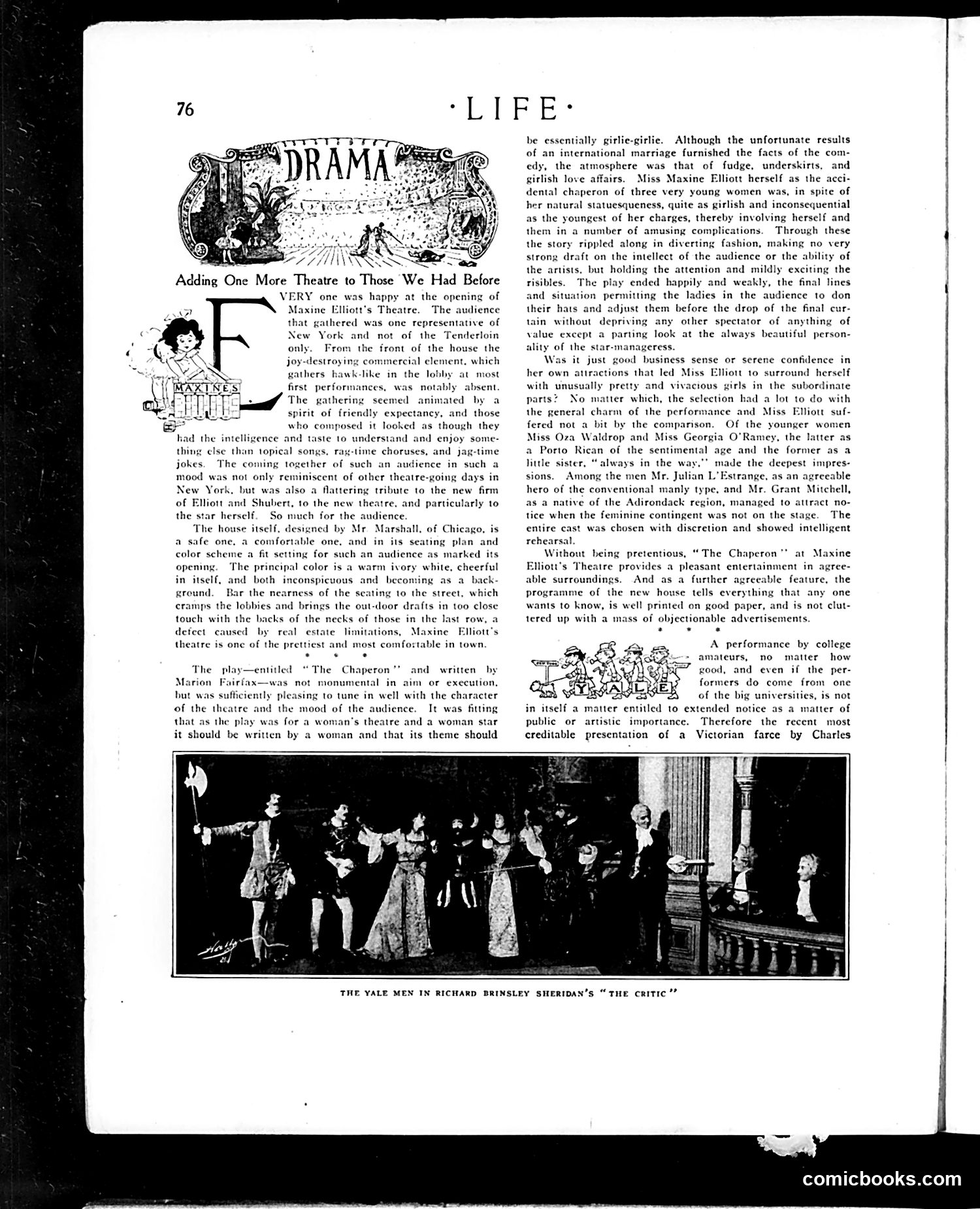
This page reviews the opening of **Maxine Elliott's Theatre**, a new playhouse designed by a Chicago architect. The review praises both the elegant, comfortable venue and the play—"The Chaperon," written by Marion Fairfax specifically for Elliott, the star-manager and actress. The critic notes the audience was unusually refined and cultured, notably absent of the "commercial element" and "Tenderloin" crowds typical of theater openings. The play itself is described as light entertainment—"girlie-girlie"—involving complications around a woman chaperoning three young women, with international marriage providing plot complications. The review credits Elliott's beauty and judgment in casting with attractive supporting actresses and conventional male leads. The overall tone is favorable but somewhat dismissive of the play's intellectual demands, treating it as pleasant frivolous entertainment suited to its female star and audience. The photograph shows a theatrical scene from Richard Brinsley Sheridan's "The Critic" performed by Yale students.
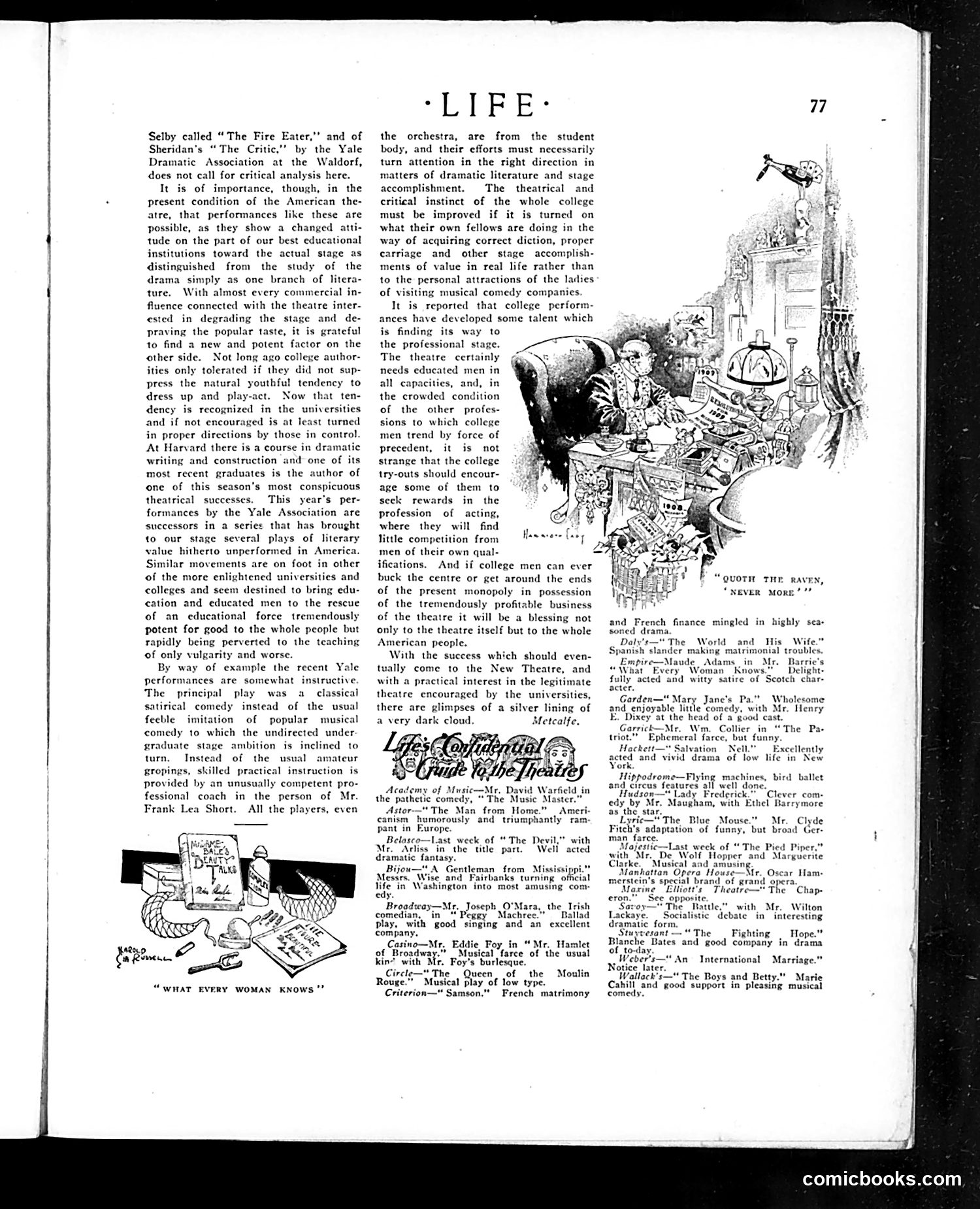
This page discusses the positive impact of university theatrical productions, particularly Yale's performances of classical plays like Sheridan's "The Critic." The main satirical point critiques the commercialized American theater of the era, which the author argues has degraded into "vulgarity and worse"—likely referring to popular musical comedies and lowbrow entertainment dominating stages. The cartoons support this critique: "What Every Woman Knows" (bottom left) appears to satirize commercial theater's appeal to female audiences through spectacle rather than substance. The top illustration, captioned "Quoth the Raven, 'Never More,'" likely references Poe, connecting serious literary drama to cultural elevation. The author celebrates universities as educational forces promoting legitimate theater through trained instruction and classical material, positioning educated college men as potential competition against the entertainment industry's "monopoly," thereby improving American theatrical standards overall.
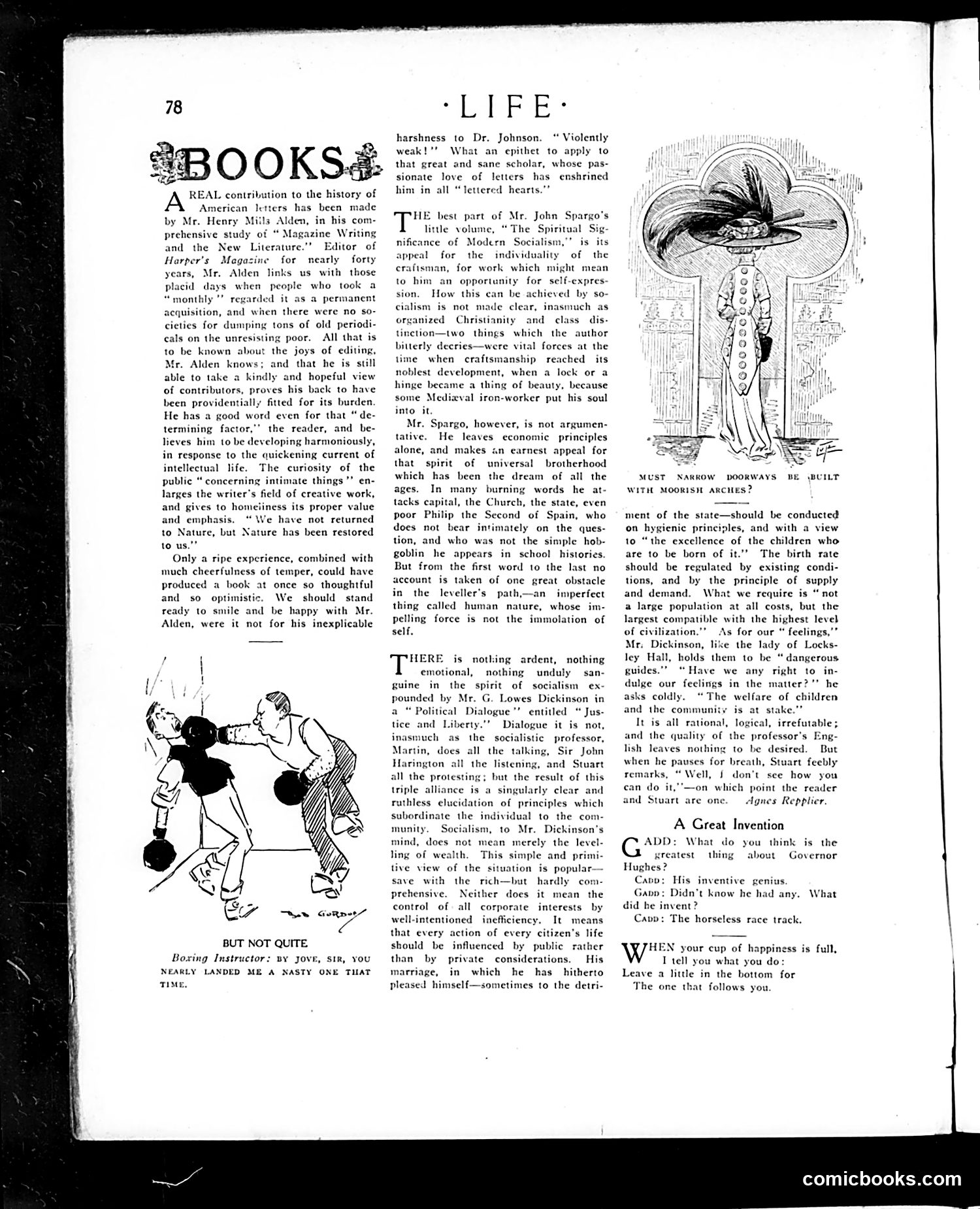
This page contains book reviews and a political cartoon. The cartoon, titled "But Not Quite," depicts a boxing instructor speaking to a student, with the caption: "By Jove, sir, you nearly landed me a nasty one that time." The joke appears to satirize boxing instruction itself—the irony being that a boxing instructor complains about receiving a hard punch, which is precisely what boxing is supposed to involve. It's gentle satire on the absurdity of the situation. The page's main content reviews three socialist-leaning books by Spargo, Dickinson, and others, critiquing their idealistic visions while noting they overlook human nature's complications. The reviews reflect early 20th-century debates about socialism, craftsmanship, and social reform—topics that engaged educated American readers of *Life* magazine during this era.
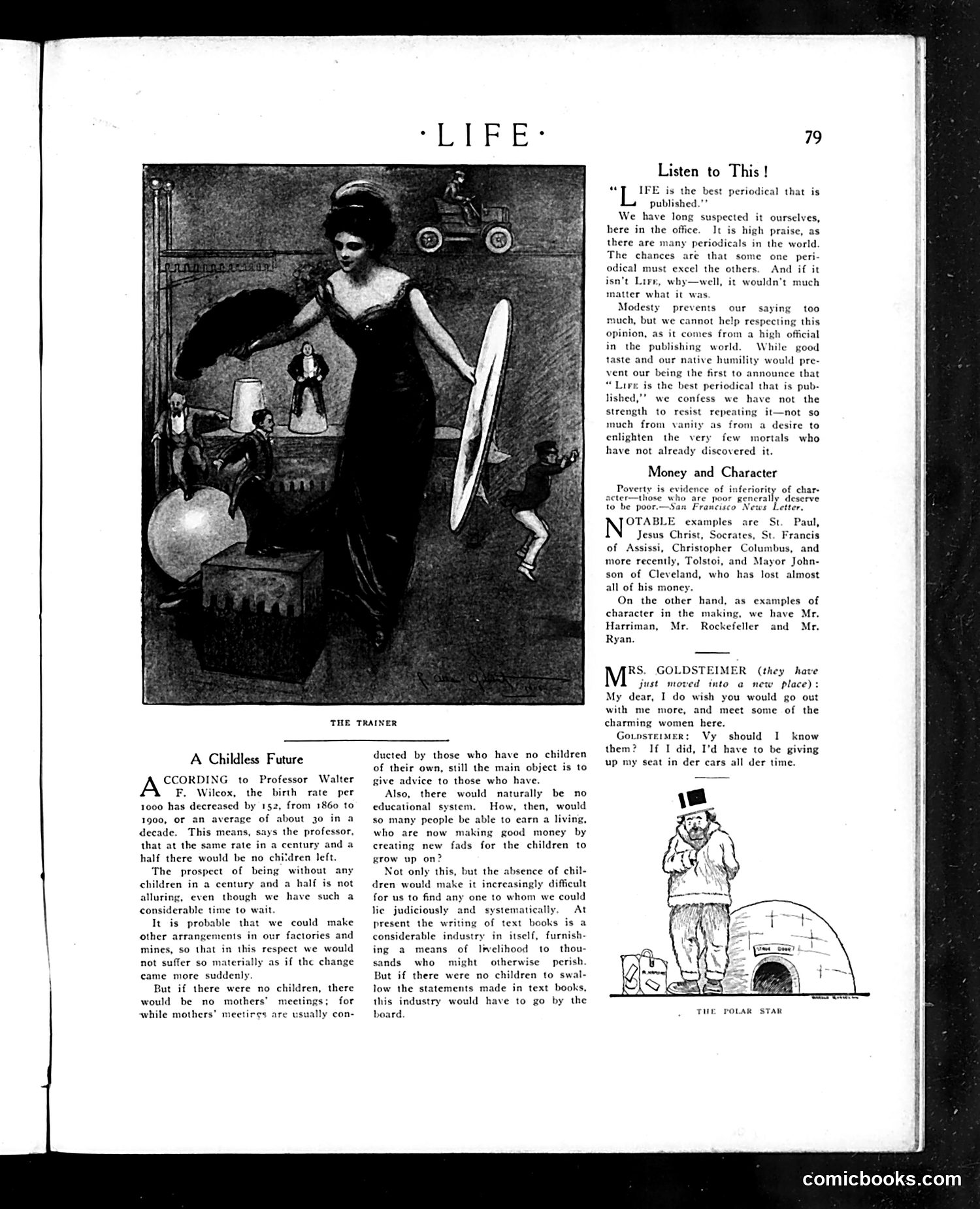
This piece satirizes anxieties about declining American birth rates (which the text cites as dropping significantly between 1860-1900). Professor Wilcox projects that if the decline continues, there would eventually be no children. The satire's genius lies in its **reductio ad absurdum**: the author mockingly lists the economic and social consequences of a childless society—no mothers' meetings, no schools, no textbook industry, no one to deceive with false information. By presenting these as genuine losses, the piece ridicules how much of contemporary society depends on children as consumers and subjects of manipulation. The accompanying cartoon "The Trainer" appears to illustrate how children are shaped by adults for commercial purposes, reinforcing the satirical point that society's investment in children isn't purely altruistic. The secondary piece sarcastically quotes a claim that *Life* is "the best periodical," and juxtaposes poverty with moral inferiority—then absurdly lists wealthy industrialists (Harriman, Rockefeller, Ryan) as examples of "character in the making," mocking the era's conflation of wealth with virtue.
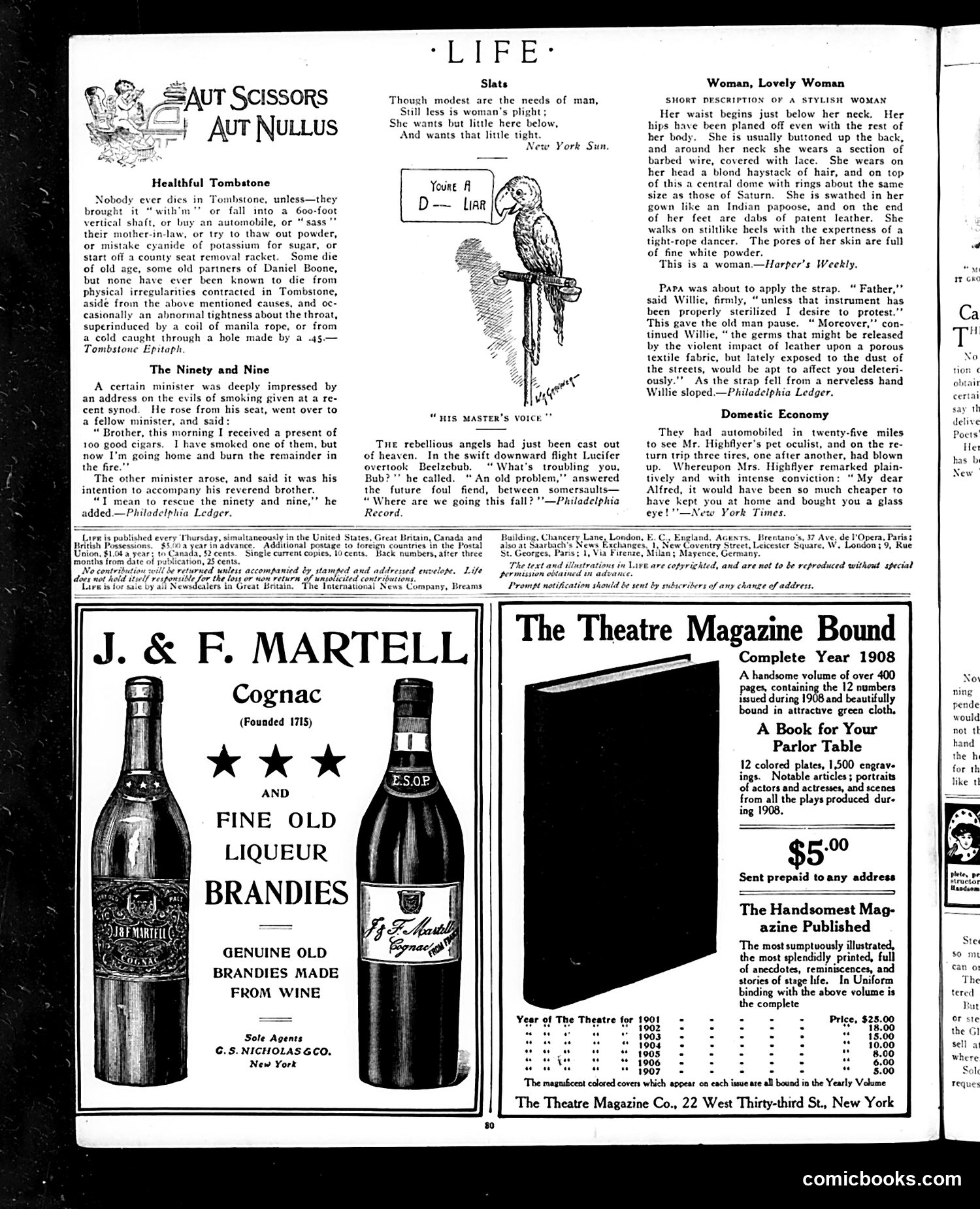
This page contains several humorous pieces typical of early 1900s satire: **"Healthful Tombstone"** mocks the Wild West town's reputation for violence, ironically listing all the ways people die there—gunshot wounds, lynching, automobile accidents—while claiming they don't die from "physical irregularities." **"The Ninety and Nine"** satirizes ministerial hypocrisy: a minister, moved by an anti-smoking speech, announces he'll burn 99 cigars given as a gift. His colleague rushes to join him—presumably to rescue the "sinful" cigars. **"Woman, Lovely Woman"** ridicules contemporary female fashion with exaggerated description: impossibly tight corsets ("barbed wire"), enormous Gibson Girl hairstyles ("blond haystack"), and tottering heels—capturing turn-of-century satirical critique of women's impractical, restrictive dress. The remaining anecdotes mock pretentious parenting, angelic logic, and marital economics. The page is primarily satirical content with period advertising (cognac, theatrical magazine bindings).
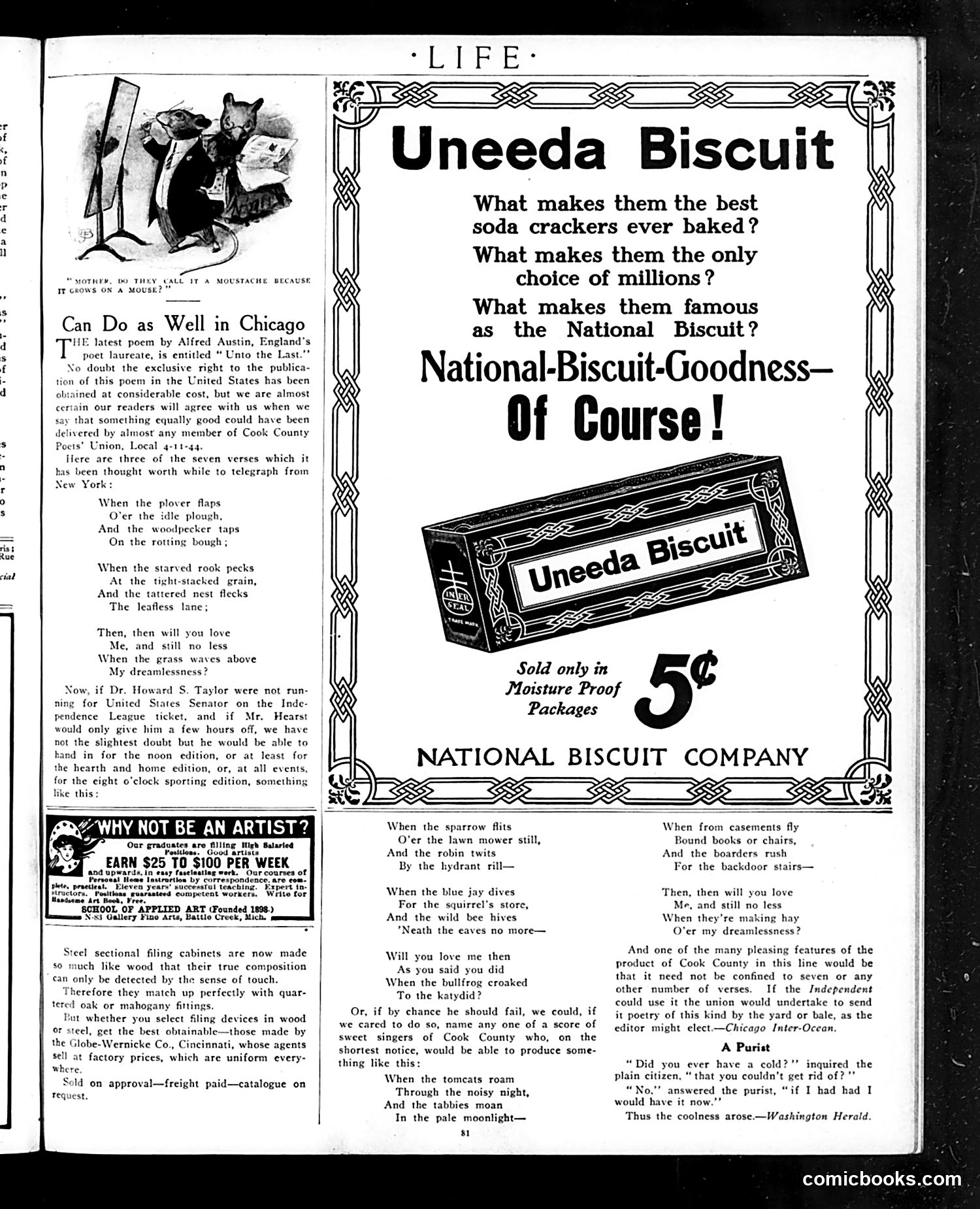
This page contains satirical commentary mocking poet laureate Alfred Austin's romantic poem "Unto the Last." Life magazine jokes that Chicago's "Cook County Poets' Union" could produce equally vapid sentimental verse—and proves it by parodying Austin's flowery nature imagery with deliberately crude alternatives (tomcats roaming, boarders fleeing flying furniture). The satire targets: (1) the expense of obtaining exclusive U.S. publication rights to Austin's work; (2) the pretentiousness of romantic poetry divorced from real life; (3) local Chicago politics, referencing Dr. Howard S. Taylor's senatorial campaign and William Randolph Hearst's media empire. The cartoon (top left) shows a mouse asking why a mousetrap is called a "moustache"—a simple visual pun unrelated to the main satire. The page also contains period advertisements (Uneeda Biscuits, art school, filing cabinets) typical of Life's revenue model.
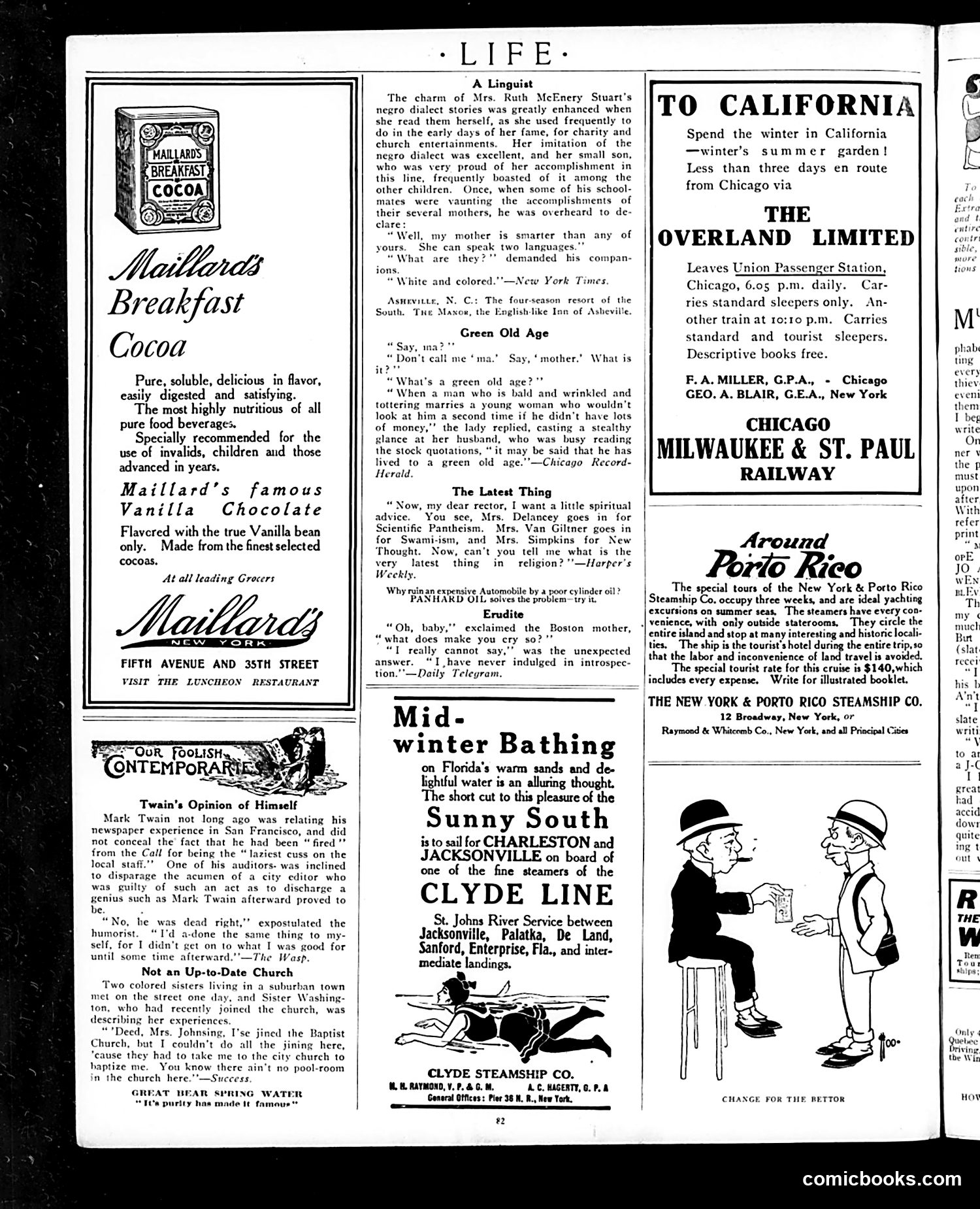
This page is primarily **advertising and humor content** rather than political satire. The main elements include: **Advertisements**: Maillard's Breakfast Cocoa, the Overland Limited train, Clyde Steamship Line, and other consumer products dominate the layout. **Humorous anecdotes**: Brief comedic stories, including: - Mark Twain's recollection of being fired from a newspaper - A joke about a Black woman joining a Baptist church but needing to go to the city for baptism (because the church lacks a pool) - A child boasting his mother speaks "two languages" (white and colored dialects) because she performs Negro dialect stories - Social commentary on marriage, religion trends, and Boston intellectualism **The cartoon** labeled "Change for the Better" (bottom right) shows two figures exchanging money—likely commenting on financial transactions or commerce, though specifics are unclear. The overall tone reflects early 20th-century American magazine humor: domesticated, often relying on racial stereotypes and class-based jokes now considered offensive.
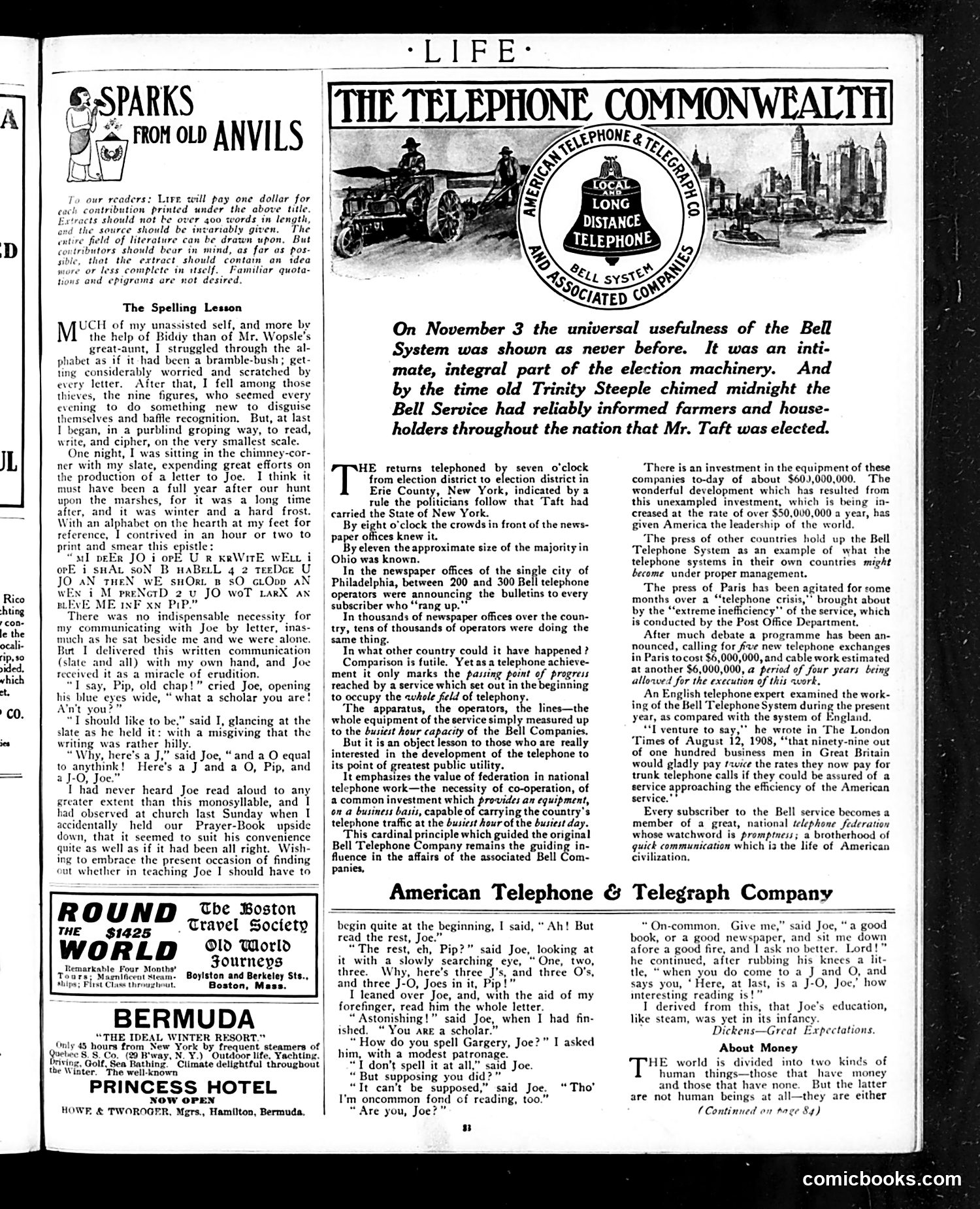
This is a full-page advertisement for American Telephone & Telegraph, celebrating the Bell System's role in the 1908 U.S. presidential election (William Howard Taft's victory). The ad demonstrates how telephone infrastructure enabled rapid election-result transmission across the nation on November 3rd—from Erie County, New York to newspaper offices to farmers and householders by midnight. The accompanying text emphasizes the telephone's "universal usefulness" as essential infrastructure for democracy and national commerce, arguing that such coordinated communication demonstrates America's technological superiority. It contrasts this with other nations' telephone systems, suggesting the Bell System's efficiency reflects American achievement. The page also includes unrelated content: "Sparks from Old Anvils" (literary excerpts), travel advertisements, and a passage from Dickens's *Great Expectations*—typical Life magazine miscellany of the era.
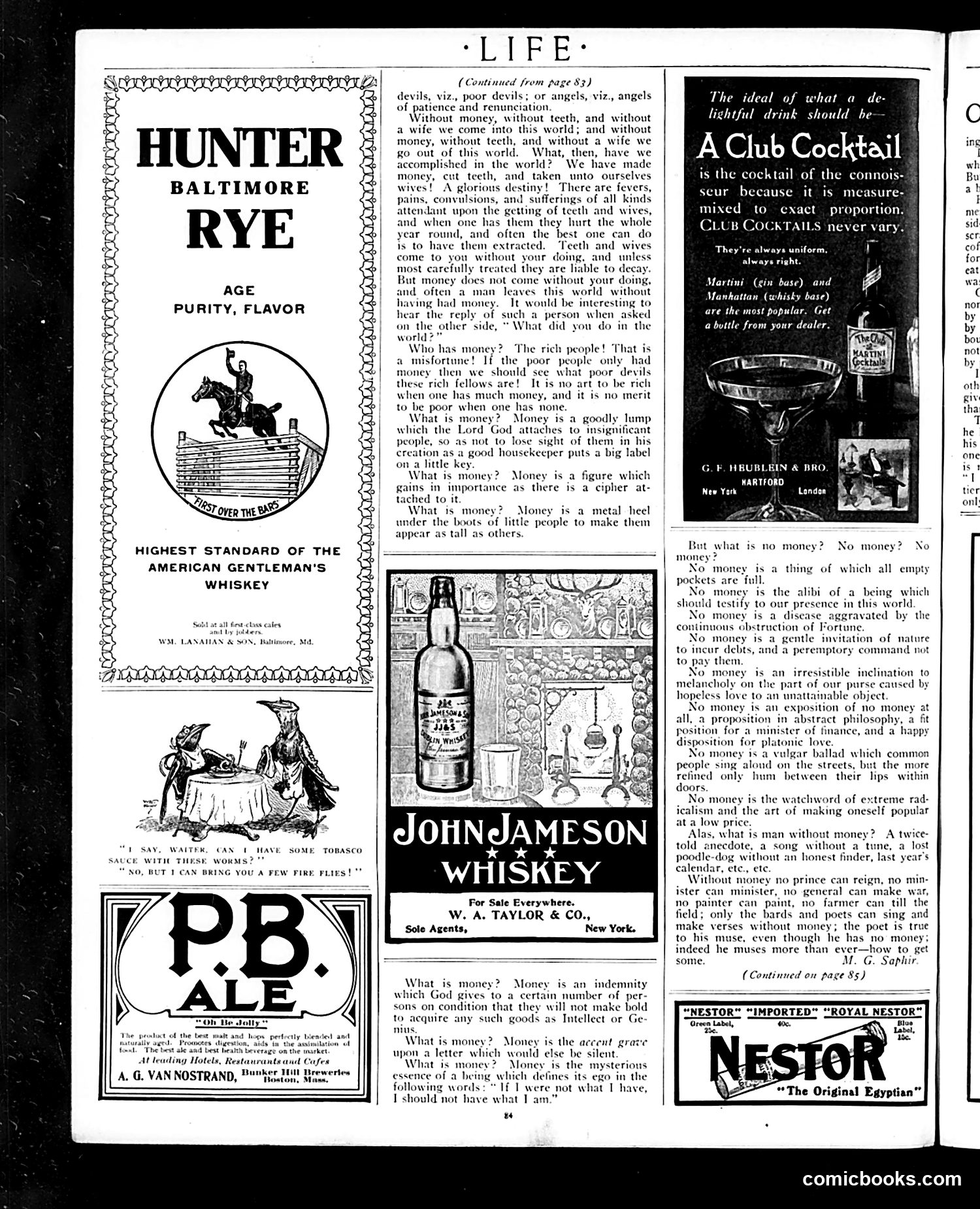
This page is primarily **advertising with philosophical filler text**. The main content consists of liquor and beverage advertisements (Hunter Baltimore Rye, P.B. Ale, John Jameson Whiskey, Nestor, and Club Cocktail), typical of early 20th-century Life magazine. The only cartoon appears in the lower left: a waiter responding to a diner's request for tobasco sauce by offering "fire flies" instead—a mild visual joke playing on the idea that fireflies might be spicy or provide heat like hot sauce. The lengthy text block titled "What is money?" is philosophical essay-filler, repeating variations on the theme that money is essential yet problematic to human existence. This satirical meditation on wealth and poverty was apparently continued from a previous page. The page reflects Life's dual nature as both satirical publication and advertising vehicle during the pre-Prohibition era.
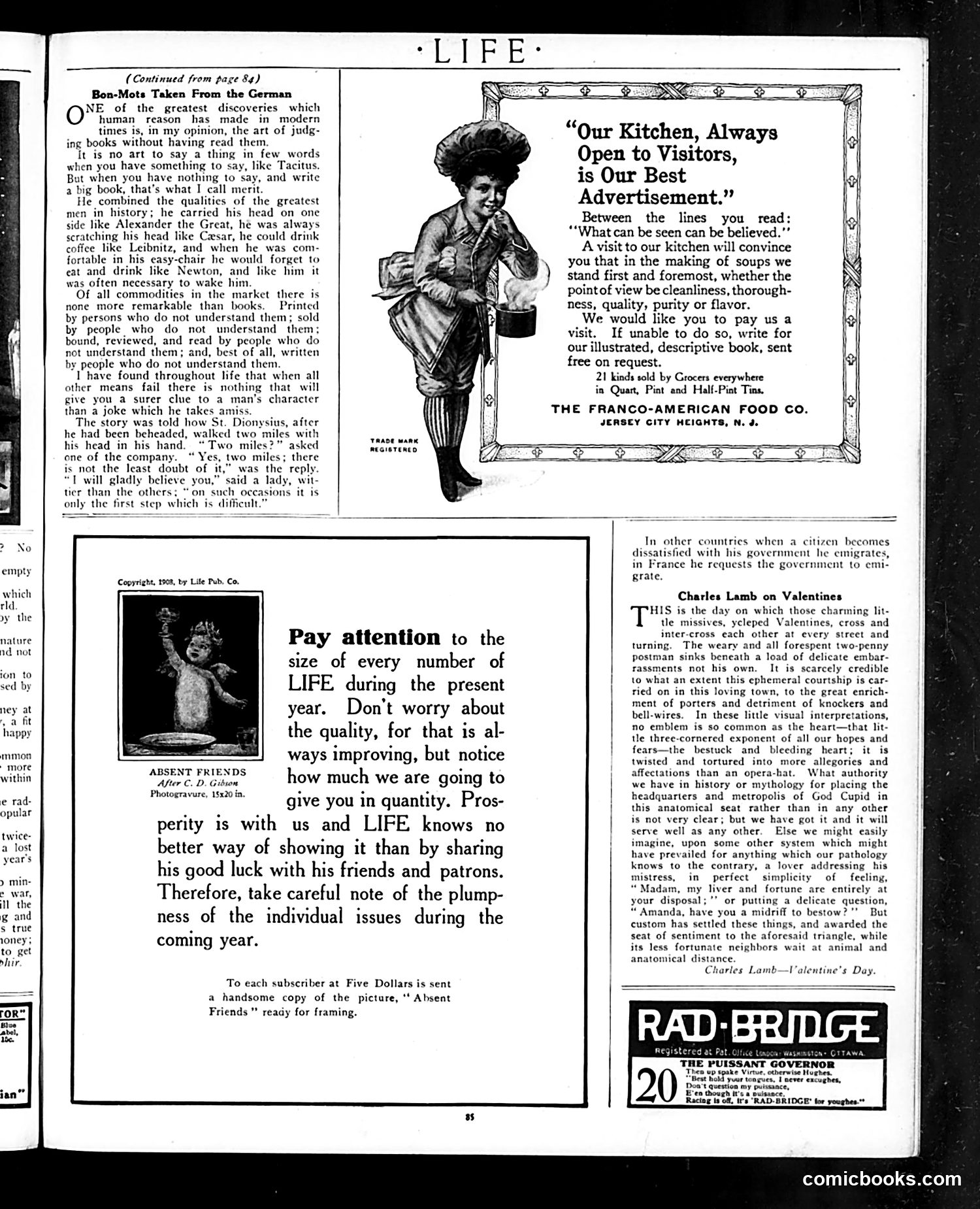
This page from *Life* magazine (copyright 1908) contains mostly **advertising and literary content** rather than political satire. The main content includes: 1. **"Bon-Mots Taken from the German"** — a humorous essay about the art of judging books without reading them, featuring witty observations about human nature and a anecdote about Saint Dionysius walking two miles after beheading. 2. **Franco-American Food Company advertisement** — featuring an illustrated woman carrying soup, promoting factory tours as proof of quality. 3. **Charles Lamb essay on Valentines** — a nostalgic, literary piece about Valentine's Day customs in England, focusing on the romantic symbolism of hearts. The illustration shows a Victorian-era woman in period dress holding a pot, representing domestic cooking. This page exemplifies *Life*'s mix of satirical humor, classical literary references, and commercial advertising typical of early 20th-century American magazines. No clear political satire or caricature of identifiable public figures appears on this particular page.
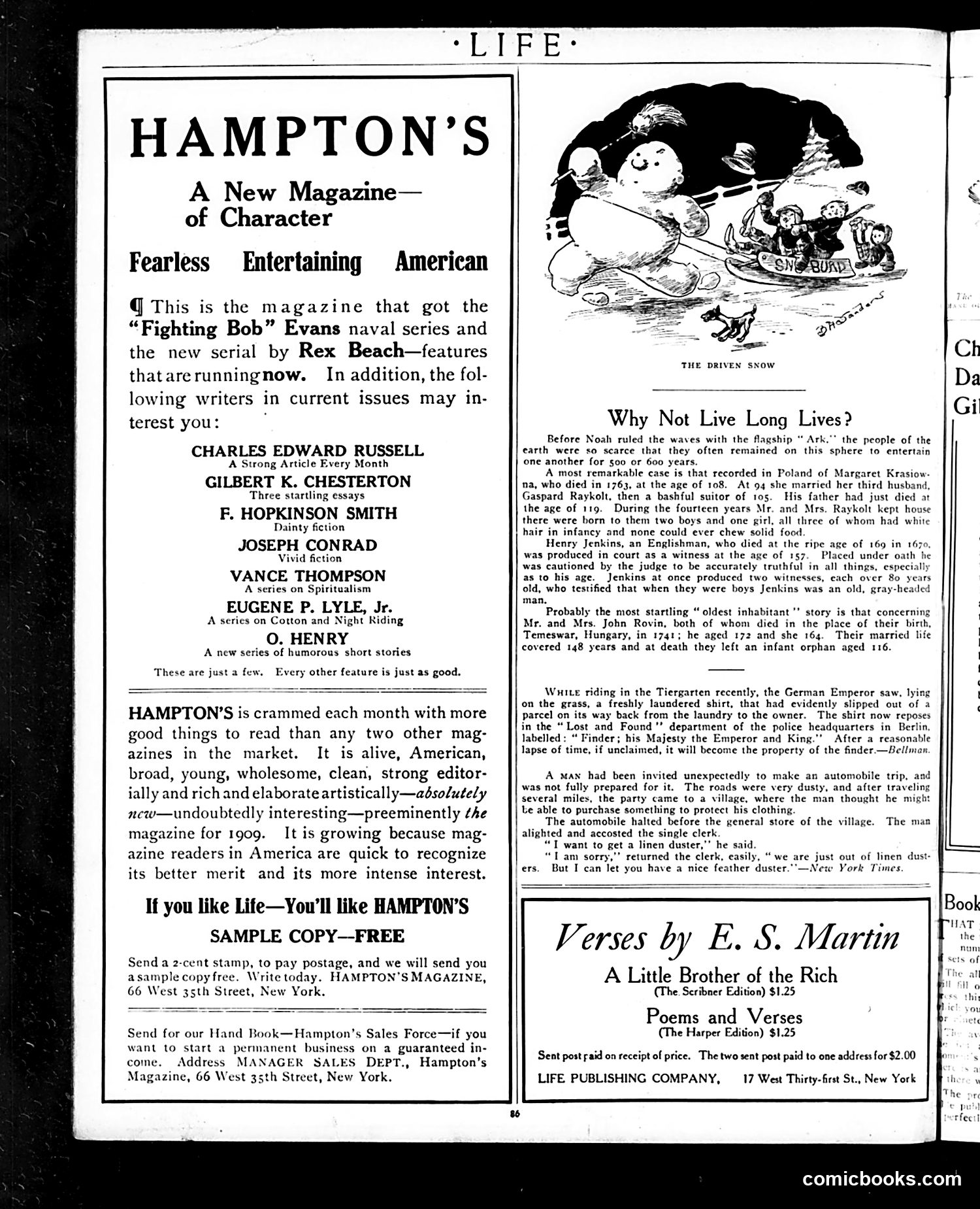
This is primarily an **advertisement page** for Hampton's Magazine, a rival publication to Life itself. The ad emphasizes Hampton's editorial quality by listing prominent writers including Joseph Conrad, O. Henry, and Gilbert K. Chesterton. The single cartoon, titled "The Driven Snow," appears to be humorous filler content rather than political satire. It depicts a snowman and children, illustrating accompanying text about longevity that includes tall tales (a man living to 169, couples married 148 years). The joke seems to be mild whimsy about exaggerated lifespans. Below the cartoon is an anecdote about the German Emperor finding a lost laundry shirt, and a separate brief story about a man seeking "linen duster" clothing before an automobile trip—early 20th-century motoring humor, as dust was a real problem for car travelers. The page reflects early 1900s magazine competition and advertising strategies rather than containing substantive political commentary.
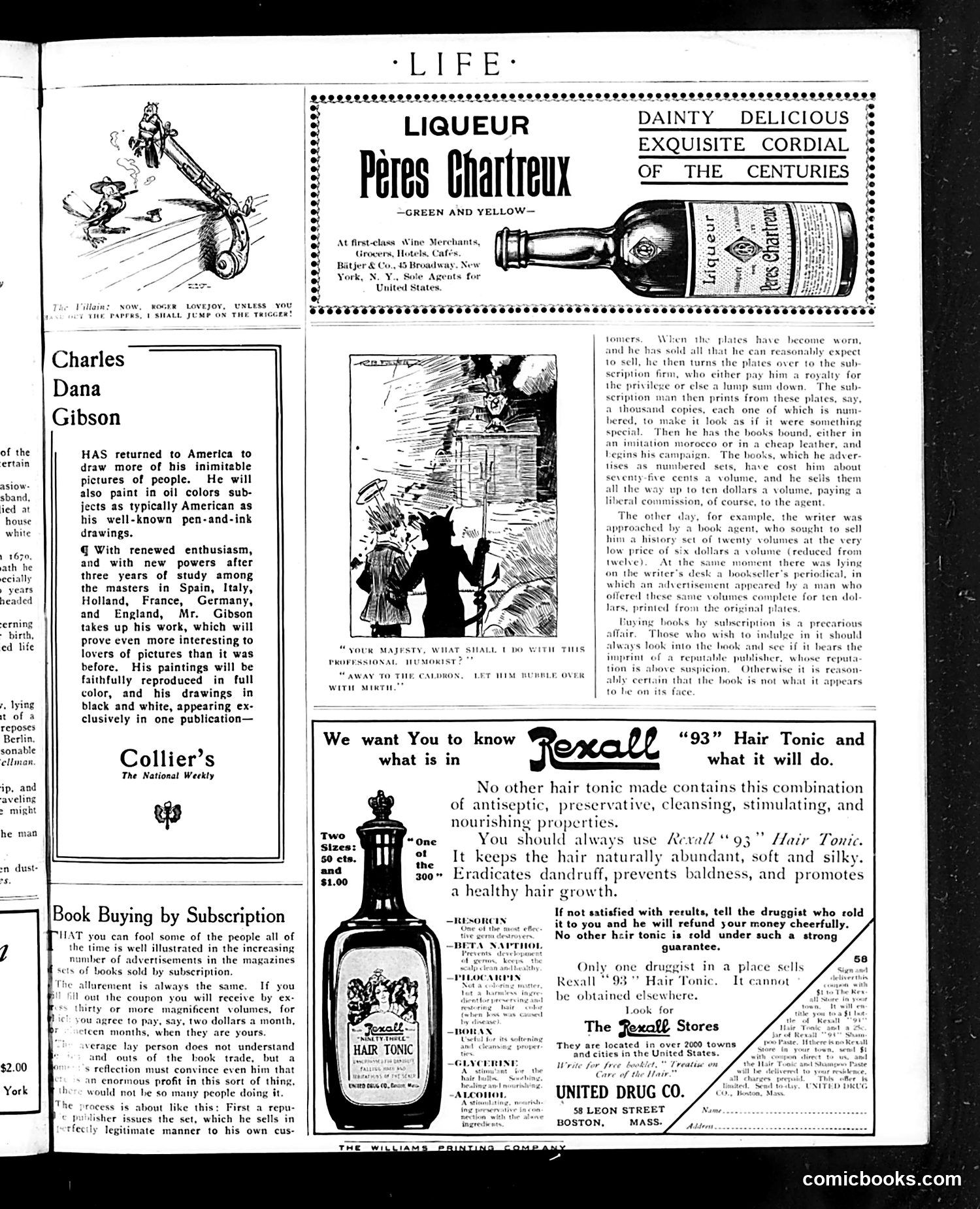
This page contains **two distinct cartoon sequences** by Charles Dana Gibson (noted in the accompanying article as returning to America after three years of European study). **Top cartoon**: Shows a villain threatening someone named Roger Lovejoy, demanding papers while threatening to "jump on the trigger." This appears to be a melodramatic scene—likely satirizing pulp fiction or stage melodramas popular at the time, with exaggerated villainy and threat-making for comedic effect. **Bottom cartoon**: Depicts "Your Majesty" asking what to do with a "poor-wretched Austrian"—the text mentions sending him "away to the Cauldron" with bubble-over mirth. This likely references contemporary European political intrigue or military conflicts, though the specific context is unclear without additional historical knowledge. The remaining page content consists primarily of **advertisements** (Peres Chartreaux liqueur, Rexall "93" Hair Tonic) and articles about book subscription services and Gibson's artistic career—typical magazine filler of the era.
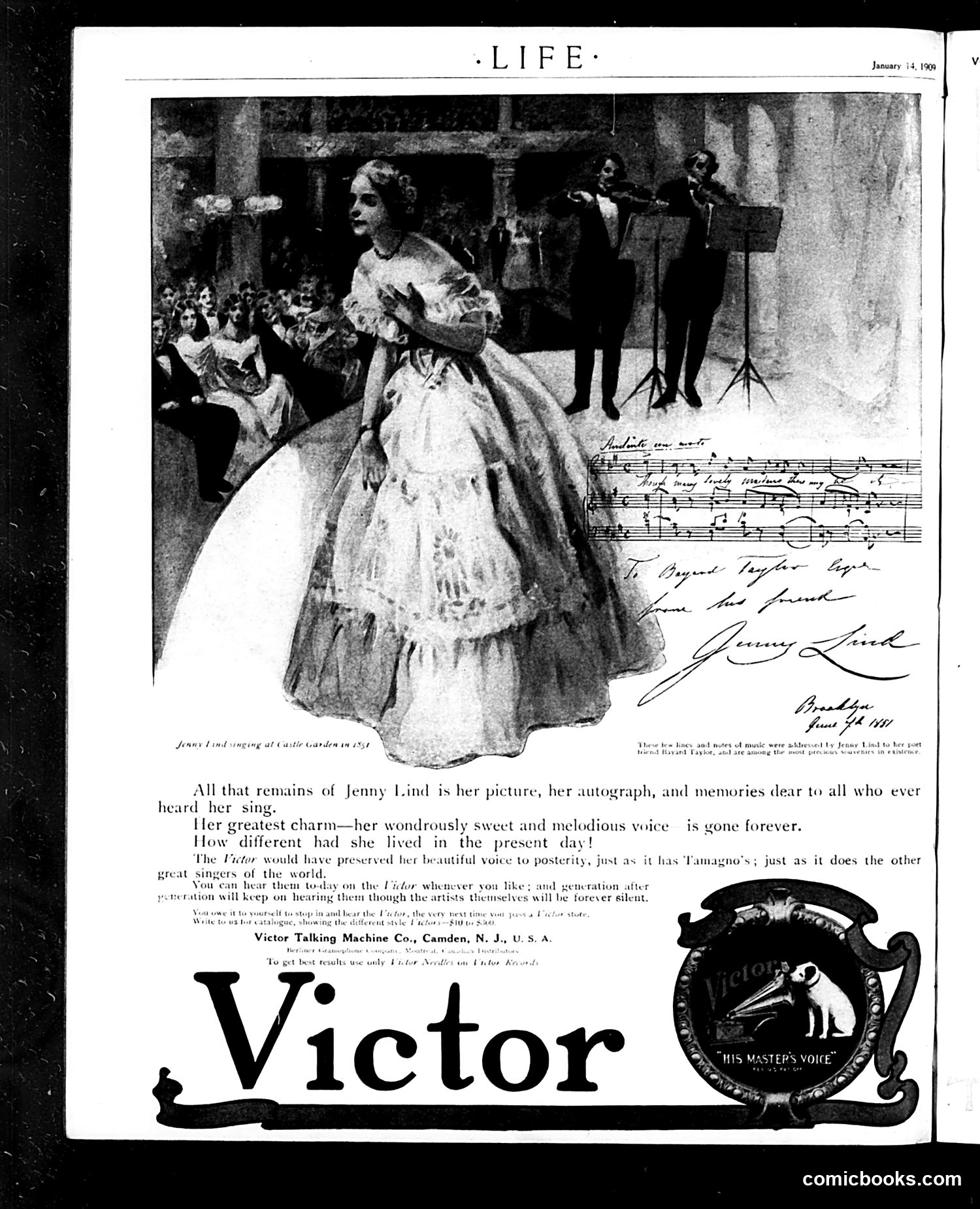
This is primarily a **Victor Talking Machine Company advertisement**, not a political cartoon. It uses Jenny Lind, the famous 19th-century Swedish opera singer, as a historical example to sell phonographs. The ad's argument: Jenny Lind's beautiful voice is now lost forever because she lived before recording technology existed. If she had lived "in the present day" (1909), the Victor phonograph would have preserved her voice for posterity, just as it now preserves other great singers like Tamagno. The image shows Lind performing at Castle Garden in 1851. The ad includes her autograph and musical notation to establish authenticity and emotional appeal. **The sales pitch**: Buy a Victor phonograph so you can hear great singers whenever you want—their artistry becomes immortal through recording, unlike in pre-phonograph eras when performances disappeared forever. This reflects early 20th-century advertising that positioned new technology as culturally valuable, not merely commercial.