
Life, 1909-01-14 · page 18 of 28
Life — January 14, 1909 — page 18: what you’re looking at
What you’re looking at
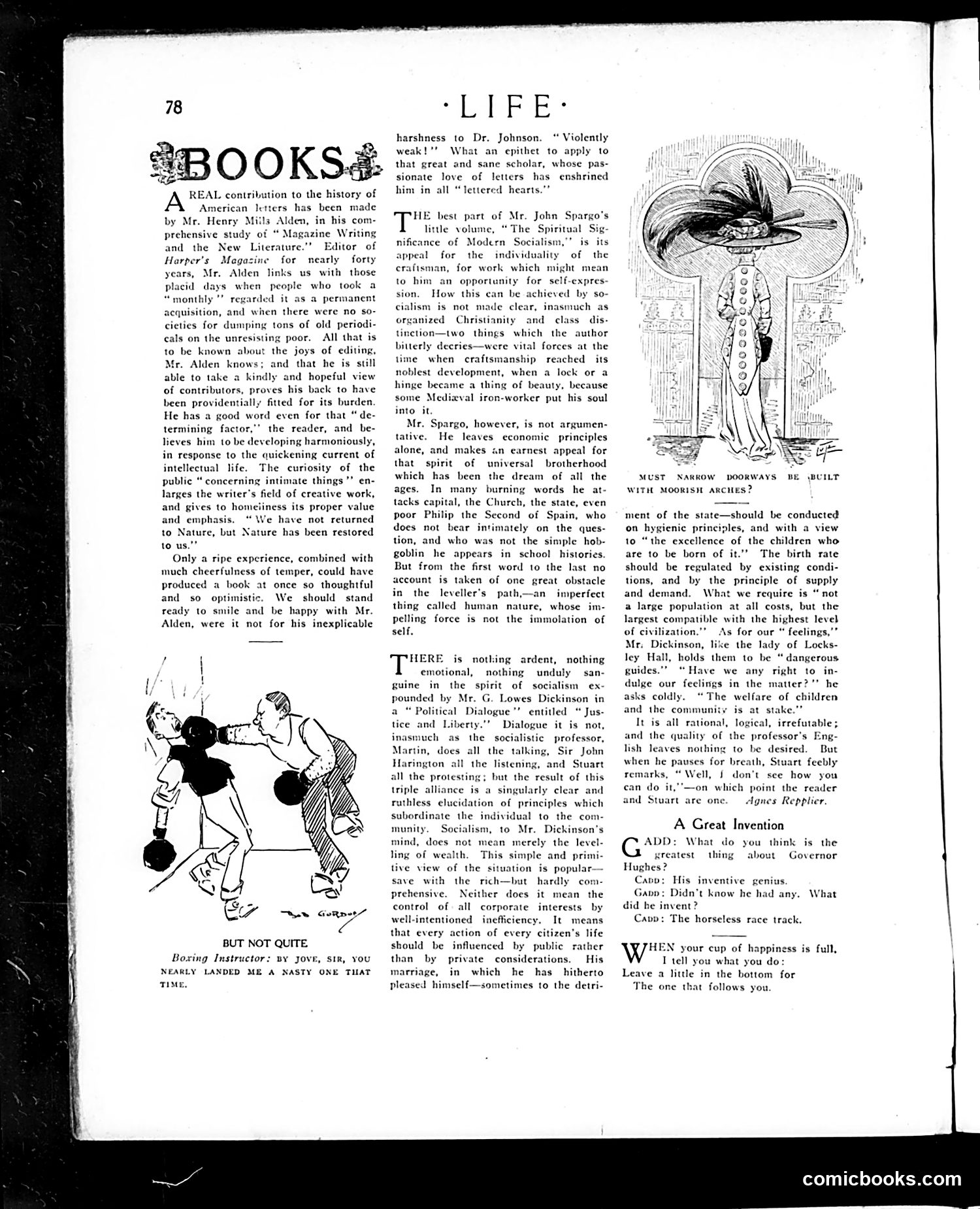
This page contains book reviews and a political cartoon. The cartoon, titled "But Not Quite," depicts a boxing instructor speaking to a student, with the caption: "By Jove, sir, you nearly landed me a nasty one that time." The joke appears to satirize boxing instruction itself—the irony being that a boxing instructor complains about receiving a hard punch, which is precisely what boxing is supposed to involve. It's gentle satire on the absurdity of the situation. The page's main content reviews three socialist-leaning books by Spargo, Dickinson, and others, critiquing their idealistic visions while noting they overlook human nature's complications. The reviews reflect early 20th-century debates about socialism, craftsmanship, and social reform—topics that engaged educated American readers of *Life* magazine during this era.
📄 Transcribed text from this page (OCR, searchable)
Machine-transcribed from the original scan — historical spelling and the odd misread are preserved.
78 BOOK REAL contribution to the history of A American letters has been made by Mr. Henry Mills Alden, in his com- prehensive study of “ Magazine Writing and the New Literature.” Editor of Harper's Magazine for forty Mr. Alden links us with those placid days when who took a “monthly” regarded it as a permanent acquisition, and when there were no so- cicties for dumping tons of old periodi- cals on the unresisting poor. All that is to be known about the joys of editing, Mr. Alden knows; and that he is still able to take a kindly and hopeful view of contributors, proves his back to have been providentially fitted for its burden He has a good word even for that “de- termining factor,’ the reader, and be- lieves him to be developing harmoniously, in response to the quickening current of intellectual life. The curiosity of the public “ concerning intimate things"? en- larges the writer's field of creative work, and gives to homeiiness its proper value and emphasis. “We have not returned Nature, but Nature has been restored nearly years, people a ripe experience, combined with much cheerfulness of temper, could have produced a book at once so thoughtful optimistic. We should stand ready to smile and be happy with Mr. Alden, were it not for his inexplicable and so BUT NOT QUITE Boxing Instructor: by Jove, sir, you NEARLY LANDED ME A NASTY ONE THAT Time. ‘PPE harshness to Dr. Johnson. * Violently weak!" What an epithet to apply to that great and sane scholar, whose pas- sionate love of has enshrined him in all “lettered hearts.’" letters best part of Mr. John Spargo’s le volume, “The Spiritual Sig nificance of Modern Socialism,’* is its appeal for the individuality of the crafisman, for work which might mean to him an for self-expres- sion. How this cialism is not made clear, inasmuch as Christianity and class dis- tinction—two things which the author bitterly decries—were vital forces at the time when craftsmanship reached its noblest development, when a lock or a hinge became a thing of beauty, because some Medixval iron-worker put his soul into it. Mr. Spargo, however, is not argumen- tative. He leaves economic principles alone, and makes sn earnest appeal for that spirit’ of universal brotherhood which has been the dream of all the ages. In many burning words he at- tacks capital, the Church, the state, even poor Philip the Second of Spain, who does not bear intimately on the ques- tion, and who was not the simple hob- goblin he appears in school histories. But from the first word to the last no account is taken of one great obstacle in the leveller’s path,—an_ imperfect thing called human nature, whose im- pelling force is not the immolation of self. opportunity an be achieved by so- organized HERE is nothing ardent, nothing emotional, nothing unduly san- guine in the spirit of socialism ea pounded by Mr. G. Lowes Dickinson in a “Political Dialogue’? entitled “ Jus- tice and Liberty.’ Dialogue it is not, nasmuch as the socialistic professor, , does all the talking, Sir John Harington all the listening, and Stuart all the protesting; but the result of this triple alliance is a singularly clear and ruthless elucidation of principles which subordinate the individual to the com Socialism, to Mr. Dickinson's ind, does not mean merely the level- ling of wealth. This simple and primi- tive view of the situation is popular- with the rich—but hardly com- prehensive. Neither does it mean the control of all corporate interests by well-intentioned inefficiency. It means that every action of every citizen’s life should be influenced by public rather than by private considerations. His marriage, in which he has hitherto pleased himself—sometimes to the detri- munity save NARKOW DOORWAYS BE (BUILT > Must WITH MOORISH ARCH. ment of the state—should be conducted on hygienic principles, and with a view to “the excellence of the children who are to be born of it.” The birth rate should be regulated by existing condi- tions, and by the principle of supply and demand. What we require is “not a large population at all costs, but the largest compatible with the highest level of civilization.” As for our “ feelings,’” Mr. Dickinson, like the lady of Locks- Jey Hall, holds th to be “ dangerous guides.” “Have we any right to in- dulge our feelings in the matter?’” he “The welfare of children and the community is at stake."” It is all rational, logical, irrefutable; and the quality of the professor's Eng- lish leaves nothing to be desired. But when he pauses for breath, Stuart feebly remarks, “Well, J don’t see how you can do it,"’"—on which point the reader Agnes Repplier. asks coldly. and Stuart are one. A Great Invention ADD: What do you think is the xreatest thing about Governor Hughes? Capp: His inventive genius. Gavp: Didn't know he had any. What did he invent? Capp: The horseless race track. Ww? =N your cup of happiness is full, I tell you what you do: Leave a little in the bottom for The one that follows you. comicbooks.com