
Life, 1909-01-14 · page 11 of 28
Life — January 14, 1909 — page 11: what you’re looking at
What you’re looking at
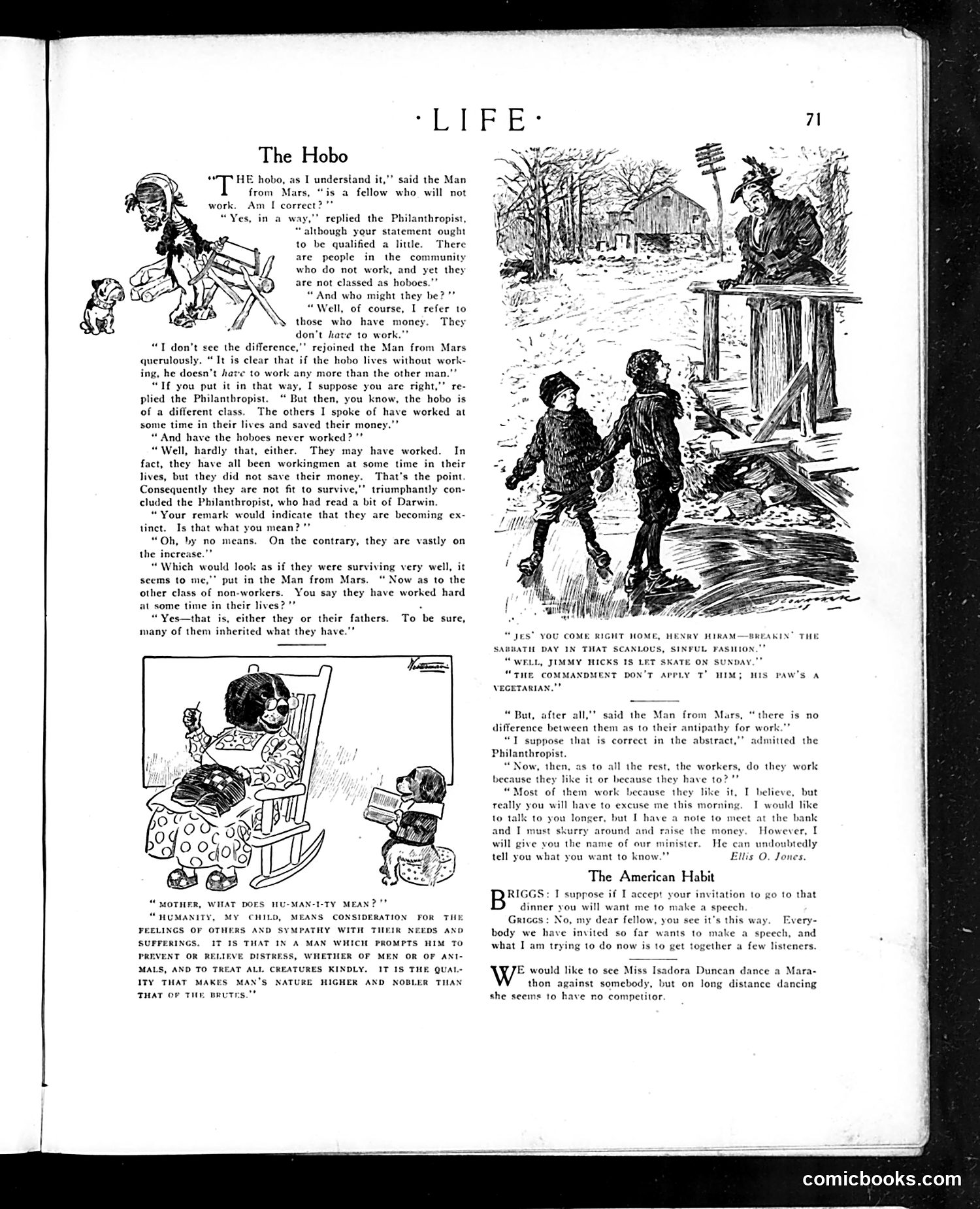
This page presents a satirical debate between a "Man from Mars" and a "Philanthropist" about hobos and work. The dialogue critiques class assumptions: the Martian observes that hobos don't work, while the Philanthropist argues they're different from lazier non-workers because they *have* worked and saved money—making them "fit to survive" by Darwinian logic. The accompanying illustrations show impoverished figures and a domestic scene. The satire targets upper-class philanthropic attitudes, suggesting that moralizing about the poor's work ethic misses economic realities. By using an alien perspective, the author highlights how arbitrary these social judgments appear. The page also includes "The American Habit," a brief humorous note about social obligations and dancing.
📄 Transcribed text from this page (OCR, searchable)
Machine-transcribed from the original scan — historical spelling and the odd misread are preserved.
“THE hobo, as I understand it,”” said the Man from Mars, “is a fellow who will not work. Am [ correct? "* Yes, in a way,” replied the Philanthropist, “although your statement ought to be qualified a little. There are people in the community who do not work, and yet they are not classed as hoboes.”* . “And who might they be?” \ “Well, of course, I refer to those who have money. They don't have to work. “I don't sce the difference,’ rejoined the Man from Mars querulously. “It is clear that if the hobo lives without work- ing, he doesn’t have to work any more than the other man. “If you put it in that way, I suppose you are right,’” re- plied the Philanthropist. “ But then, you know, the hobo is of a different class. The others I spoke of have worked at some time in their lives and saved their money.”’ nd have the hoboes never worked?" “Well, hardly that, either. They may have worked. In fact, they have all been workingmen at some time in their lives, but they did not save their money. That’s the point Consequently they are not fit to survive,’’ triumphantly con- cluded the Philanthropist, who had read a bit of Darwin. “Your remark would indicate that they are becoming ex- ct. Is that what you mean? "’ Oh, by no means. On the contrary, they are vastly on the increase.”” “Which would look as if they were surviving very well, it seems to me," put in the Man from Mars. “ Now as to the other class of non-workers. You say they have worked hard at some time in their lives?” “Yes—that is, either they or their fathers. many of them inherited what they have.”” To be sure, “MOTHER, WHAT DOES HU: “MUMANITY, MY CHIL FEELINGS OF OTHERS AND SYMPATHY WITH THEIR SUPFERINGS. 1T 1S THAT IN A MAN WHICH PROMPTS HIM TO PREVENT OR RELIEVE DISTRESS, WHETHER OF MEN OR OF ANI- MALS, AND TO TREAT ALI. CREATURES KINDLY, IT 1S THE QUAL: ITY THAT MAKES MAN'S NATURE HIGHER AND NOBLER THAN THAT oF THE BRUTES.”* MEANS CONSIDERATION FOR THE SEEDS AND “ Jes’ YOU COME RIGHT HOME, HENRY HIRAM—BREAKIN’ THE SABBATIL DAY IN THAT SCANLOUS, SINFUL FASIION."? “WELL, JIMMY HICKS IS LET SKATE ON SUNDAY."" “THE COMMANDMENT DON'T APPLY T' WIM; MIS PAW'S A VEGETARIAN."* “But, after all,” said the Man from Mars, “there is no difference between them as to their antipathy for work.”’ “T suppose that is correct in the abstract,’ admitted the Philanthropist. “Now, then, as to all the rest, the workers, do they work because they like it or hecause they have to?” “Most of them work because they like it, I believe, but I would like to talk to you longer, but [ have a note 10 meet at the bank really you will have to excuse me this mornin However, I » undoubtedly llis O. Jones. and I must skurry around and raise the money will give you the name of our minister. He tell you what you want to know The American Habit RIGGS: I suppose if I accept your invitation to go to that dinner you will want me to make a speech Gaiccs: No, my dear fellow, you see it’s this way. Every body we have invited so far wants to make a speech, and what Iam trying to do now is to get together a few listeners. E would like to sce Miss Isadora Duncan dance a Mar: thon against somebody, but on long distance dancing she seems to have no competitor. comicbooks.com