
Life, 1909-01-14 · page 6 of 28
Life — January 14, 1909 — page 6: what you’re looking at
What you’re looking at
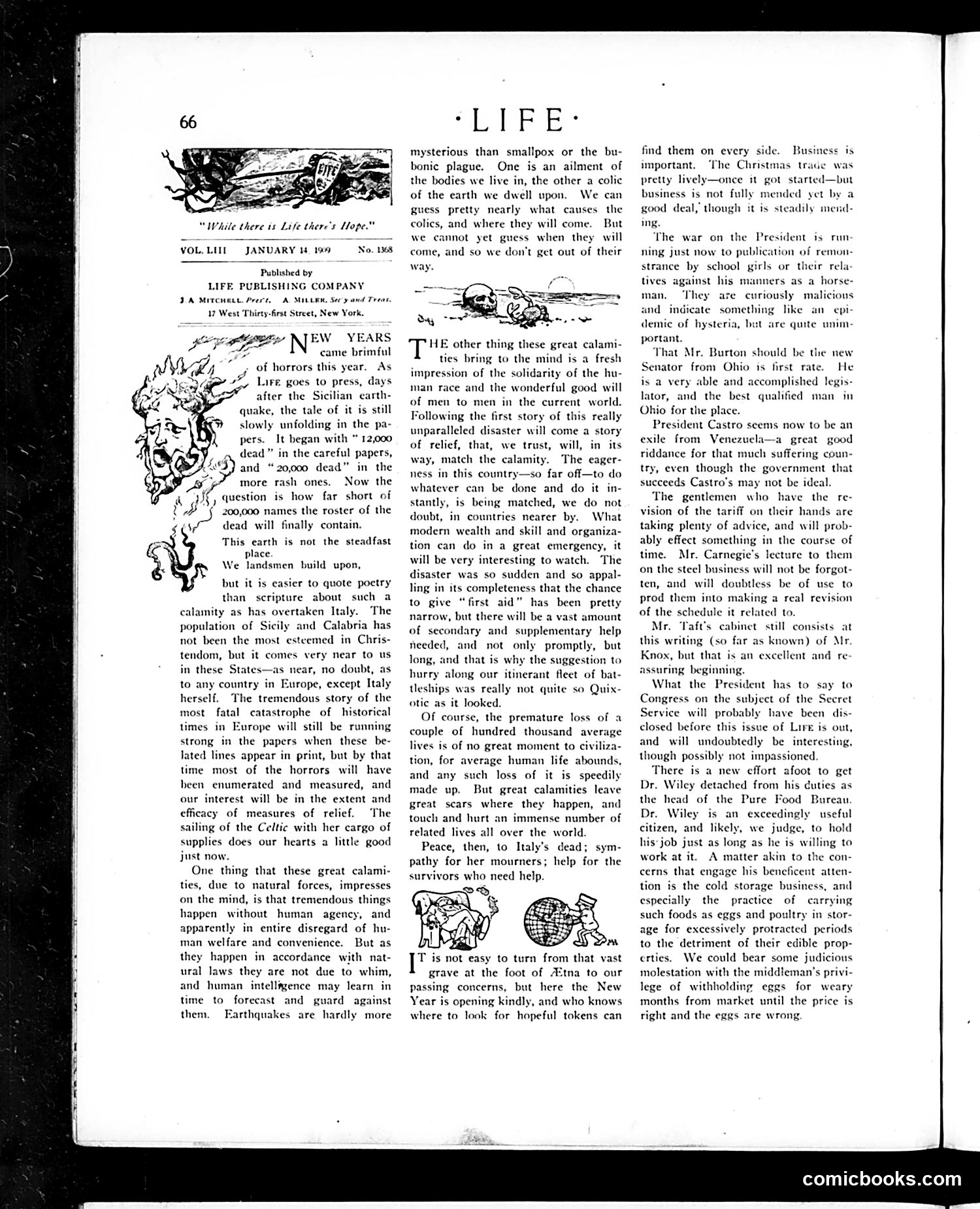
The page contains editorial commentary rather than political cartoons. The text addresses several 1909 events: **Italian Earthquake Relief**: The opening discusses calamities affecting Sicily and Calabria, likely referencing the devastating 1908 Messina earthquake. The writer argues that while human agencies cannot prevent such disasters, relief efforts demonstrate civilization's moral progress. **Political Commentary**: References include criticism of President Castro (Venezuela), praise for Ohio politician Mr. Burton as Senate material, and discussion of President Taft's cabinet appointments—particularly the "secret service" controversy that apparently was just published. **Social Commentary**: The final section critiques cold-storage practices for eggs and poultry, arguing middlemen wrongly withhold supplies to inflate prices. The tone is typical Progressive Era moralizing mixed with practical policy critique.
📄 Transcribed text from this page (OCR, searchable)
Machine-transcribed from the original scan — historical spelling and the odd misread are preserved.
pee "While there ts Life there's Hope.” JANUARY 14 199 No. 13468 Published by LIFE PUBLISHING COMPANY A MILLER, Sey ant 7 VOL. LU DA MITCHELL Prove, 17 West Thirty-first Street, New York. DOF ety EW YEARS on came brimful of horrors this year. As +2, Lave goes to press, days Ca after the Sicilian carth- quake, the tale of it is still slowly unfolding in the pa- pers. It began with * 12,000 dead” in the careful papers, and “20,000 dead” in the more rash ones. Now the ) question is how far short of 200,000 names the roster of the dead will finally contain. This earth is not the steadfast place. We landsmen build upon, but it is easier to quote poetry than scripture about such a calamity as has overtaken Italy. The population of Sicily and Calabria has not been the most esteemed in Chris- tendom, but it comes very near to us in these States—as near, no doubt, to any country in Europe, except Italy herself. The tremendous story of the most fatal catastrophe of historical times in Europe will still be running strong in the papers when these be- lated lines appear in print, but by that time most of the horrors will have been enumerated and measured, and our interest will be in the extent and efficacy of measures of relief. The sailing of the Celtic with her cargo of supplies does our hearts a little good just now. One thing that these great calami- ties, due to natural forces, impresses on the mind, is that tremendous things happen without human agency, and apparently in entire disregard of hu- man welfare and convenience. But as they happen in accordance with nat- ural laws they are not due to whim, and human intellagence may learn in time to forecast and guard against them. Earthquakes are hardly more LIPE mysterious than smallpox or the bu- bonic plague. One is an ailment of the bodies we live in, the other a colic of the earth we dwell upon. We can guess pretty nearly what causes the colics, and where they will come. But we cannot yet guess when they will come, and so we don't get out of their way. HE other thing these great calami- ties bring to the mind is a fresh impression of the solidarity of the hu- man race and the wonderful good will of men to men in the current world. Following the first story of this really unparalleled disaster will come a story of relief, that, we trust, will, in its way, match the calamity. The eager- ness in this country—so far off—to do whatever can be done and do it in- stantly, is being matched, we do not doubt, in countries nearer by. What modern wealth and skill and organiz tion can do in a great emergency, it will be very interesting to watch. The disaster was so sudden and so appal- ling in its completeness that the chance to give “first aid” has been pretty narrow, but there will be a vast amount of secondary and supplementary help feeded, and not only promptly, but long, and that is why the suggestion to hurry along our itinerant fleet of bat- tleships was really not quite so Quix- otic as it looked. Of course, the premature loss of a couple of hundred thousand average lives is of no great moment to civiliza- tion, for average human life abounds, and any such loss of it is speedily made up. But great calamities leave great scars where they happen, and touch and hurt an immense number of related lives all over the world. Peace, then, to Italy's dead; sym- pathy for her mourners; help for the survivors who need help. T is not easy to turn from that vast grave at the foot of Etna to our passing concerns, but here the New Year is opening kindly, and who knows where to look for hopeful tokens can find them on every side. Business important. The Christmas traue w: pretty lively—once it got started—but business is not fully mended yet by a good deal, though it is steadily mend- ing. The war on the President is run ning just now to publication of remon- strance by school girls or their rela tives against his manners as a horse- They are curiously and indicate something like an epi- demic of hysteria, but are quite unim- portant. That Mr. Burton should be the new Senator from Ohio is first rate. He man. malicious is a very able and accomplished legis- lator, and the best qualified man in Ohio for the place. President Castro scems now to be an exile from Venezuela—a great good riddance for that much suffering coun- try, even though the government that succeeds Castro's may not be ideal The gentlemen who have the re- vision of the tariff on their hands are taking plenty of advice, and will prob- ably effect something in the course of time. Mr. Carnegie’s lecture to them on the steel business will not be forgot- ten, and will doubtless be of use to prod them into making a real revision of the schedule it related to. Mr. Taft's cabinet still this writing (so far as known) of Mr. Knox, but that is an excellent and re: assuring beginning. What the President has to say to Congress on the subject of the Sceret Service will probably have been dis- closed before this issue of Lire is out, and will undoubtedly be interesting, though possibly not impassioned There is a new effort afoot to get Dr. Wiley detached from his cuties as the head of the Pure Food Bureau. Dr. Wiley is an exceedingly useful citizen, and likely, we judge, to hold his:job just as long as he is willing to work at it. A matter akin to the con- cerns that engage his beneficent atten- tion is the cold storage business, and especially the practice of carrying such foods as eggs and poultry in stor- age for excessively protracted periods to the detriment of their edible prop- erties. We could bear some judicious molestation with the middleman’s privi- lege of withholding eggs for weary months from market until the price is right and the eggs are wrong. consists at comicbooks.com