
Life, 1909-01-14 · page 17 of 28
Life — January 14, 1909 — page 17: what you’re looking at
What you’re looking at
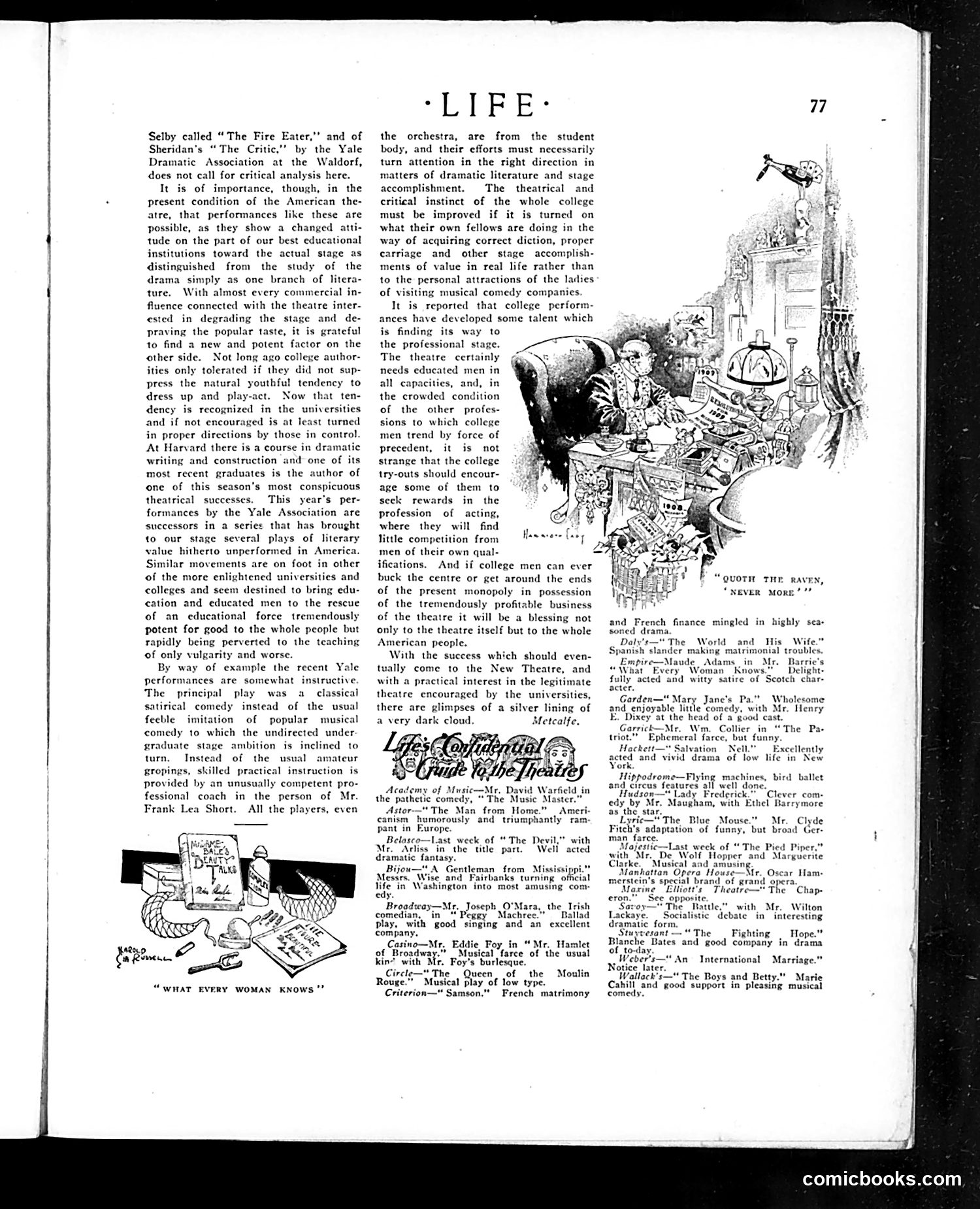
This page discusses the positive impact of university theatrical productions, particularly Yale's performances of classical plays like Sheridan's "The Critic." The main satirical point critiques the commercialized American theater of the era, which the author argues has degraded into "vulgarity and worse"—likely referring to popular musical comedies and lowbrow entertainment dominating stages. The cartoons support this critique: "What Every Woman Knows" (bottom left) appears to satirize commercial theater's appeal to female audiences through spectacle rather than substance. The top illustration, captioned "Quoth the Raven, 'Never More,'" likely references Poe, connecting serious literary drama to cultural elevation. The author celebrates universities as educational forces promoting legitimate theater through trained instruction and classical material, positioning educated college men as potential competition against the entertainment industry's "monopoly," thereby improving American theatrical standards overall.
📄 Transcribed text from this page (OCR, searchable)
Machine-transcribed from the original scan — historical spelling and the odd misread are preserved.
Selby called “The Fire Eater,"’ and of Sheridan's “The Critic,” by the Yale Dramatic Association at the Waldorf, does not call for critical analysis here. It is of importance, though, in the present condition of the American the- atre, that performances like these are possible, as they show a changed atti- tude on the part of our best educational institutions toward the actual stage as distinguished from the study of the drama simply as one branch of litera- ture. With almost every commercial in- fluence connected with the theatre inter- ested in degrading the stage and de- praving the popular taste, it is grateful to find a new and potent factor on the other side. Not long ago college author- ities only tolerated if they did not sup- press the natural youthful tendency to dress up and play-act. Now that ten- deney is recognized in the universities and if not encouraged is at least turned in proper directions by those in control. At Harvard there is a course in dramatic writing and construction and one of its most recent graduates is the author of ‘one of this season's most conspicuous theatrical successes, This year’s per- formances by the Yale Association are successors in a series that has brought to our stage several plays of literary value hitherto unperformed in America. Similar movements are on foot in other of the more enlightened universities and colleges and scem destined to bring edu- cation and educated men to the rescue of an educational force tremendously potent for good to the whole people but rapidly being perverted to the teaching of only vulgarity and worse. By way of example the recent Yale performances are somewhat instructive The principal play was a classical satirical comedy instead of the usual feeble imitation of popular musical comedy to which the undirected under graduate stage ambition is inclined to turn, Instead of the usual amateur gropings, skilled practical instruction is provided by an unusually competent pro- fessional coach in the person of Mr. Frank Lea Short. All the players, even "LIFE: the orchestra, are from the student body, and their efforts must necessarily turn attention in the right direction in matters of dramatic literature and stage accomplishment. The theatrical and critical instinct of the whole college must be improved if it is turned on what their own fellows are doing in the way of acquiring correct diction, proper carriage and other stage accomplish ments of value in real life rather than to the personal attractions of the ladies of visiting musical comedy companies. It is reported that college perform- ances have developed some talent which is finding its way to the professional stage. The theatre certainly needs educated men in all capacities, and, in the crowded condition of the other profes- sions to which college men trend by force of precedent, it is not strange that the college try-outs should encour- age some of them to seck rewards in the profession of acting, where they will find little competition from men of their own qual- ifications. And if college men can ever buck the centre or get around the ends of the present monopoly in possession of the tremendously profitable business of the theatre it will be a blessing not only to the theatre itself but to the whole American people, With the success which should even- tually come to the New Theatre, and with a practical interest in the legitimate theatre encouraged by the universities, there are glimpses of a silver lining of a very dark cloud. fetcalfe, [hea Academy of Music—Mr. David Warfield, in the pathetic comedy, “The Music M Astor—""The Man from Home.” canism humorously and trium pant in Europe. Belasco—Last week of “The Devil," with Mr. Arliss in the title part. Well acted dramatic fantasy. Bijow—""A Gentleman from Mississippi." Messrs. Wise and Fairbanks turning official life in Washington into most amusing com- edy. Broadway—Mr. Joseph O'Mara, the Trish comedian, in ‘Peggy Machree.” Ballad play, with good singing and an excellent company, Casino—Mr, Eddie Foy in “Mr. Hamlet of Broadway.” Musical farce of the usual kin? with Mr. Foy's burlesque. Circle—" The Queen of the Moulin Rouge." Musical play of low type. Criterion—" Samson." French matrimony ‘NEVER Mone’ ’? and French finance mingled in highly sea- soned dram: Daly's—" The World and His Wife." Spanish slander making matrimonial troub ipire—Maude 7 in Mr. Barrie “What Every Wor Knows.” Delight- fully acted and witty satire of Scotch char- acter. Garden—" Mary Jane's Pa.” Wholesome and enjoyable little ‘comedy, with Mr. Henry E. Dixey at the head of a good cast. Garrick—Mr. Wm. Collier in “The Pa- triot.” Ephemeral farce, but funny. Hackett—" Salvation Nell.” Excellently acted and vivid drama of low life in New York. Hippodrome—Flying machines, bird ballet and circus features well done. Hudson—" Lady Frederick.” Clever com: edy by Mr, Maugham, with Ethel Barrymore as the, sta _Lyrie—"The Blue Mouse.” Mr. Clyde Fitch's adaptation of funny, but broad Ger- man farce. Majestic—Last week of “The Pied Piper ith Mr. De Wolf Hopper and Marguerite Clarke. Musical and amusing. tan Opera House—Mr. Oscar Ham: n’s special brand of grand opera. ¢ Elliott's Theatre—" The Chap See opposite Savoy—" The Rattle," with Mr. Wilton jocialistic debate in interesting dramatic form. Stuyvesant —-“The | Fighting _ Hope."” Blanche Bates and good company in drama of to-day. Weber's— Notice later. Wallack's— The Boys and Betty. Cahill and good support in pleasing m comedy. An International Marriage.” comicbooks.com