
Life, 1909-01-14 · page 16 of 28
Life — January 14, 1909 — page 16: what you’re looking at
What you’re looking at
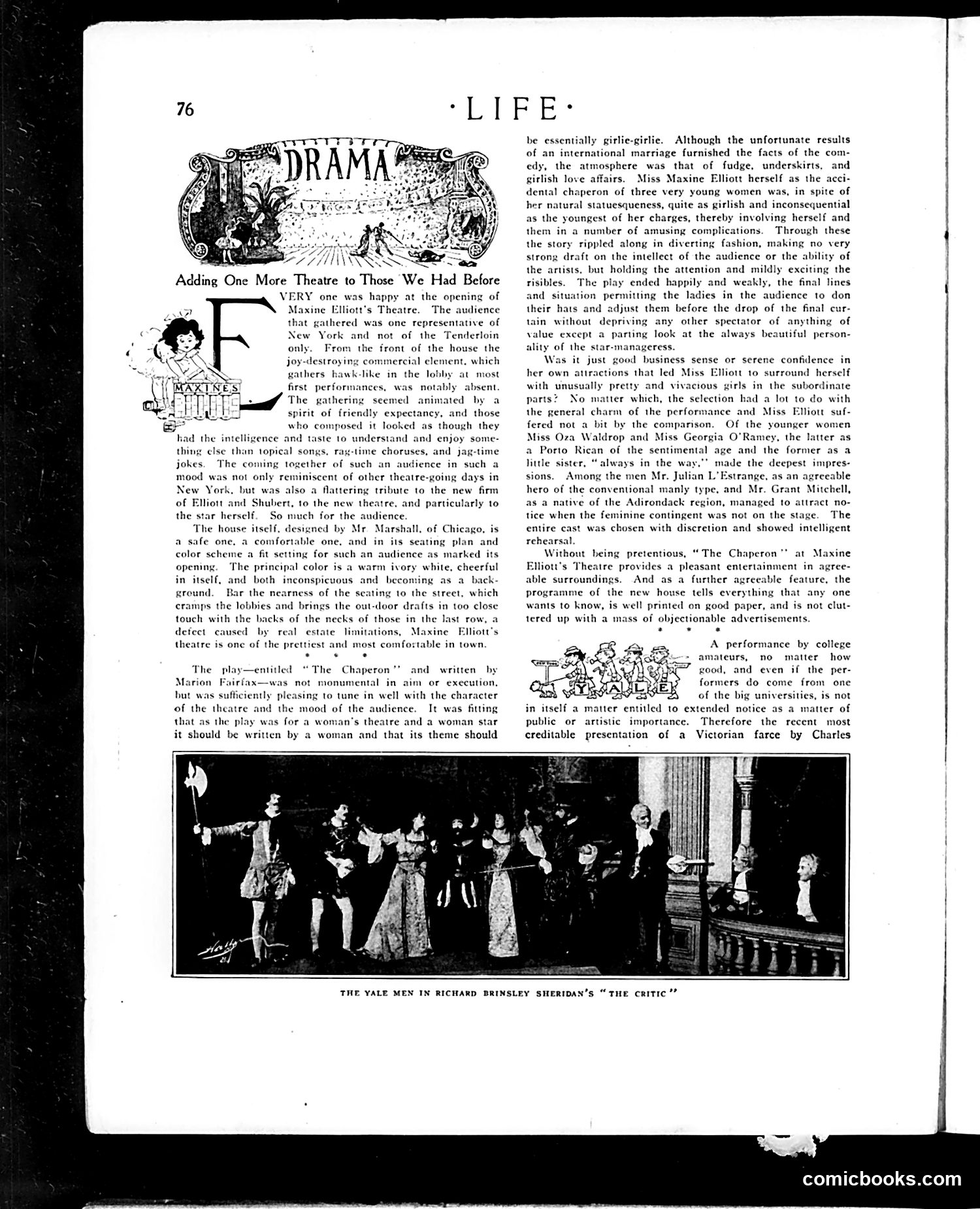
This page reviews the opening of **Maxine Elliott's Theatre**, a new playhouse designed by a Chicago architect. The review praises both the elegant, comfortable venue and the play—"The Chaperon," written by Marion Fairfax specifically for Elliott, the star-manager and actress. The critic notes the audience was unusually refined and cultured, notably absent of the "commercial element" and "Tenderloin" crowds typical of theater openings. The play itself is described as light entertainment—"girlie-girlie"—involving complications around a woman chaperoning three young women, with international marriage providing plot complications. The review credits Elliott's beauty and judgment in casting with attractive supporting actresses and conventional male leads. The overall tone is favorable but somewhat dismissive of the play's intellectual demands, treating it as pleasant frivolous entertainment suited to its female star and audience. The photograph shows a theatrical scene from Richard Brinsley Sheridan's "The Critic" performed by Yale students.
📄 Transcribed text from this page (OCR, searchable)
Machine-transcribed from the original scan — historical spelling and the odd misread are preserved.
ZZ INS Adding ‘One More Theatre to Those We Had Before y SRY one was happy at the opening of Maxine Elliott's Theatre. The audience that gathered was one representative of New York and ne of the Tenderloin only. From the front of the house the joy-destroying commercial clement, which gathers hawk-like in the lobhy at most i first. performances, was notably absent. Fe] Jf The gathering seemed animated by a | spirit of friendly expectancy, and those posed it looked as though they telligence and taste to understand and enjoy som thing else than topical songs, rag-time choruses, and jag-time jokes. The coming together of such an audience in such a mood was not only reminiscent of other theatre-going days in New York, but was also a flattering tribute to the new firm of Elliott and Shubert, to the new theatre, and particularly 10 the star herself. So much for the audience. The house itself, designed by Mr Marshall, of Chicago, is a safe one, a comfortable one, and in its seating plan and color scheme a fit setting for such an audience as marked its opening. ‘The princip color is a warm ivory white, cheerful back in itself, and both inconspicuous and becoming as ground. Bar the nearness of the seating to the stree the out-door drafts in too close touch with the backs of the necks of those in the last row, a liott’s cramps the lobbies and bring defect caused by real estate itations, Maxine E| theatre is one of the prettiest and most comfortable in town. The p Marion Fairfax—was not monumental in aim or execution, but was sufficiently pleasing to tune in well with the character of the theatre and the mood of the audience. It was fitting that as the play was for a woman's theatre and a woman star it should be written by a woman and that its theme should m1 tled “The Chaperon’’ and written by ria LIFE be essentially girlie-girlie. Although the unfortunate results of an international marriage furnished the facts of the com- edy, the atmosphere was that of fudge, underskirts, and girlish love affairs. Miss Maxine Elliott herself as the acci- dental chaperon of three very young women was, in spite of r natural statuesqueness, quite as girlish and inconsequential s the youngest of her charges, thereby involving herself and them in a number of amusing complications. Through these the story rippled along in diverting fashion, making no very strong draft on the intellect of the audience or the ability of the artists, but holding the attention and mildly exciting the risibles. The play ended happily and weakly, the final lines and situation permitting the ladies in the audience to don their hats and adjust them before the drop of the final cur- tain without depriving any other spectator of anything of value except a parting look at the always beautiful person- ality of the star-manageress. Was it just good business sense or serene confidence in her own attractions that led Miss Elliott to surround herself with unusually pretty and vivacious parts? No matter which, the selection had a lot to do with the general charm of the performance and Miss Elliott suf- fered not a bit by the comparison. Of the younger women Miss Oza Waldrop and Miss Georgia O’Ramey, the latter as a Porto Rican of the sentimental age and the former as a little sister, “always in the way," made the deepest impres- sions. Among the men Mr. Julian L’Estrange, as an agreeable hero of the conventional manly type, and Mr. Grant Mitchell, as a native of the Adirondack region, managed to attract no- tice when the feminine contingent was not on the stage. The entire cast was chosen with discretion and showed intelligent rehearsa Without being pretentious, “The Chaperon* at Maxine Elliott's Theatre provides a pleasant entertainment in agree- able surroundings. And as a further agreeable feature, the programme of the new house tells everything that any one wants to know, is well printed on good paper, and is not clut- tered up with a mass of objectionable advertisements. irls in the subordinate A performance by college = amateurs, no matter how good, and even if the per- formers do come from one of the big universities, is not in itself a matter entitled to extended notice as a matter of public or artistic importance. Therefore the recent’ most creditable presentation of a Victorian farce by Charles THE YALE MEN IN RICHARD BRINSLEY SHERIDAN’: “THE CRITIC comicbooks.com