
Life, 1909-01-14 · page 19 of 28
Life — January 14, 1909 — page 19: what you’re looking at
What you’re looking at
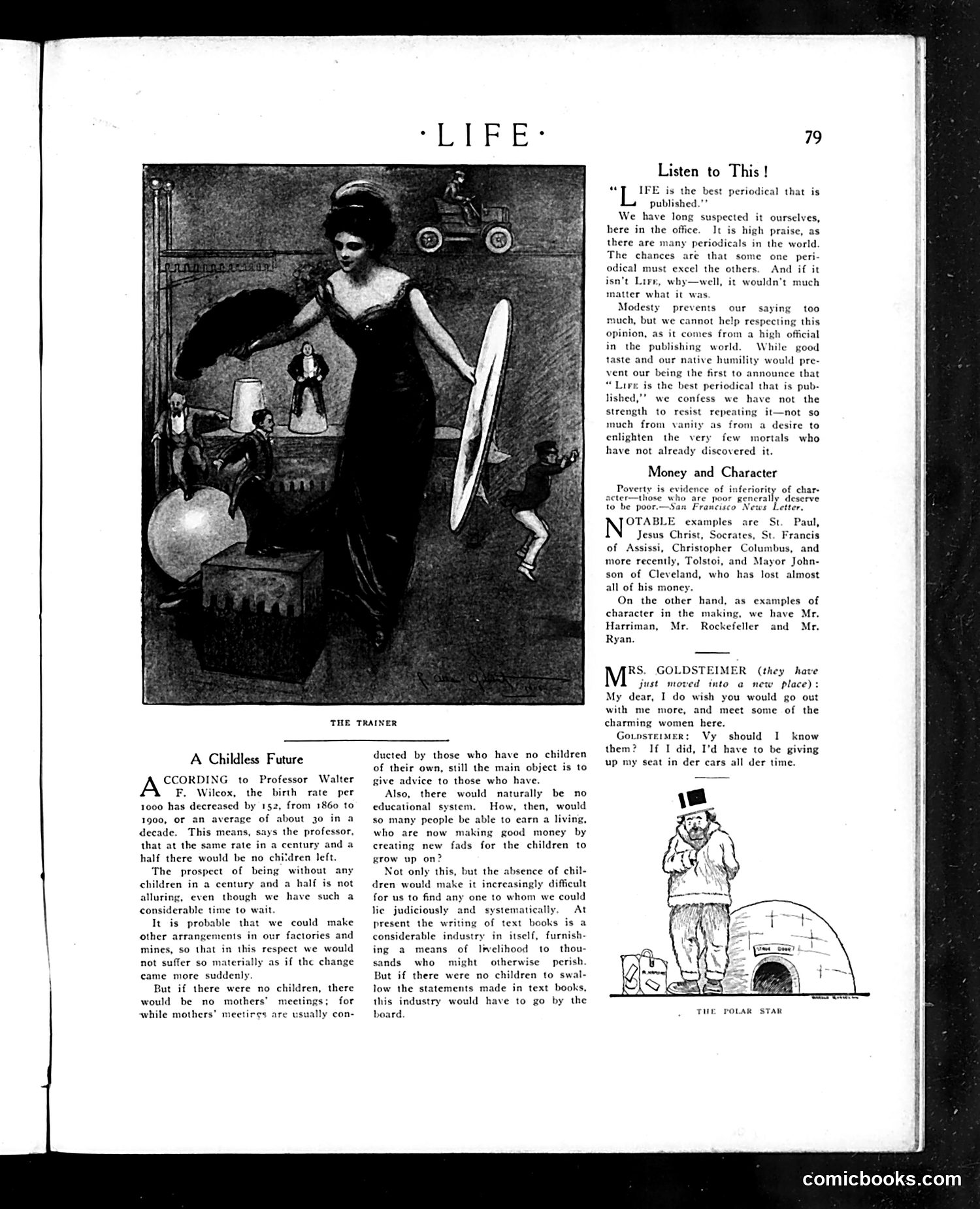
This piece satirizes anxieties about declining American birth rates (which the text cites as dropping significantly between 1860-1900). Professor Wilcox projects that if the decline continues, there would eventually be no children. The satire's genius lies in its **reductio ad absurdum**: the author mockingly lists the economic and social consequences of a childless society—no mothers' meetings, no schools, no textbook industry, no one to deceive with false information. By presenting these as genuine losses, the piece ridicules how much of contemporary society depends on children as consumers and subjects of manipulation. The accompanying cartoon "The Trainer" appears to illustrate how children are shaped by adults for commercial purposes, reinforcing the satirical point that society's investment in children isn't purely altruistic. The secondary piece sarcastically quotes a claim that *Life* is "the best periodical," and juxtaposes poverty with moral inferiority—then absurdly lists wealthy industrialists (Harriman, Rockefeller, Ryan) as examples of "character in the making," mocking the era's conflation of wealth with virtue.
📄 Transcribed text from this page (OCR, searchable)
Machine-transcribed from the original scan — historical spelling and the odd misread are preserved.
THE TRAINER A Childless Future CCORDING to Professor Walter F. Wilcox, the birth rate per 1000 has decreased by 152, from 1860 to 1900, or an average of about 30 in a decade. This means, says the professor, that at the same rate in a century and a half there would be no chitdren left. The prospect of being without any children in a century and a half is not alluring, even though we have such a considerable time to wait. It is probable that we could make other arrangements in our factories and mines, so that in this respect we would not suffer so materially as if the change came more suddenly But if there were no children, there would be no mothers’ meetings; for while mothers’ meetires are usually con- ducted by those who have no children of their own, still the main object is to give advice to those who have. Also, there would naturally be no educational system. How, then, would so many people be able to earn a living, who are now making good money by creating new fads for the children to grow up on? Not only this, but the absence of chil- dren would make it increasingly difficult for us to find any one to whom we could lie judiciously and systematically. At present the writing of text books is a considerable industry in itself, furnish- ing a means of livelihood to thou- sands who might otherwise _ perish: But if there were no children to swal- low the statements made in text books. this industry would have to go by the board. 79 Listen to This ! “J IPE is the best periodical that is published.’ We have long suspected it ourselves, here in the office. It is high praise, as there are many periodicals in the world. The chances are that some one peri- odical must excel the others. And if it isn’t Lire, why—well, it wouldn't much matter what it was Modesty prevents our saying too much, but we cannot help respecting this opinion, as it comes from a high official in the publishing world. While good taste and our native humility would pre- nounce that jodical that is pub- vent our being the first to “ Lire is the best pei lished we have not the strength repeating it—not so much from vanity as from a desire to enlighten the very few mortals who have not already discovered it. we confess to resist Money and Character Poverty is evidence of inferiority of char. acter—those who are poor generally deserve to be poor.—San Francisco News Letter, OTABLE examples are St Jesus Christ, Socrates, St. Francis of Assissi, Christopher Columbus, and more recently, Tolstoi, and Mayor John- son of Cleveland, who has lost almost all of his money. On the other hand, as examples of character in the making, we have Mr. Harriman, Mr. Rockefeller and Mr. Ryan. Paul, RS. GOLDSTEIMER (they have just moved into a new place): My dear, I do wish you would go out with me more, and meet some of the charming women here. Gounsteimer: Vy should 1 know them? If I did, I'd have to be giving up my seat in der cars all der time. TUE POLAK STAR comicbooks.com