
A complete issue · 32 pages · 1907
Life — November 21, 1907
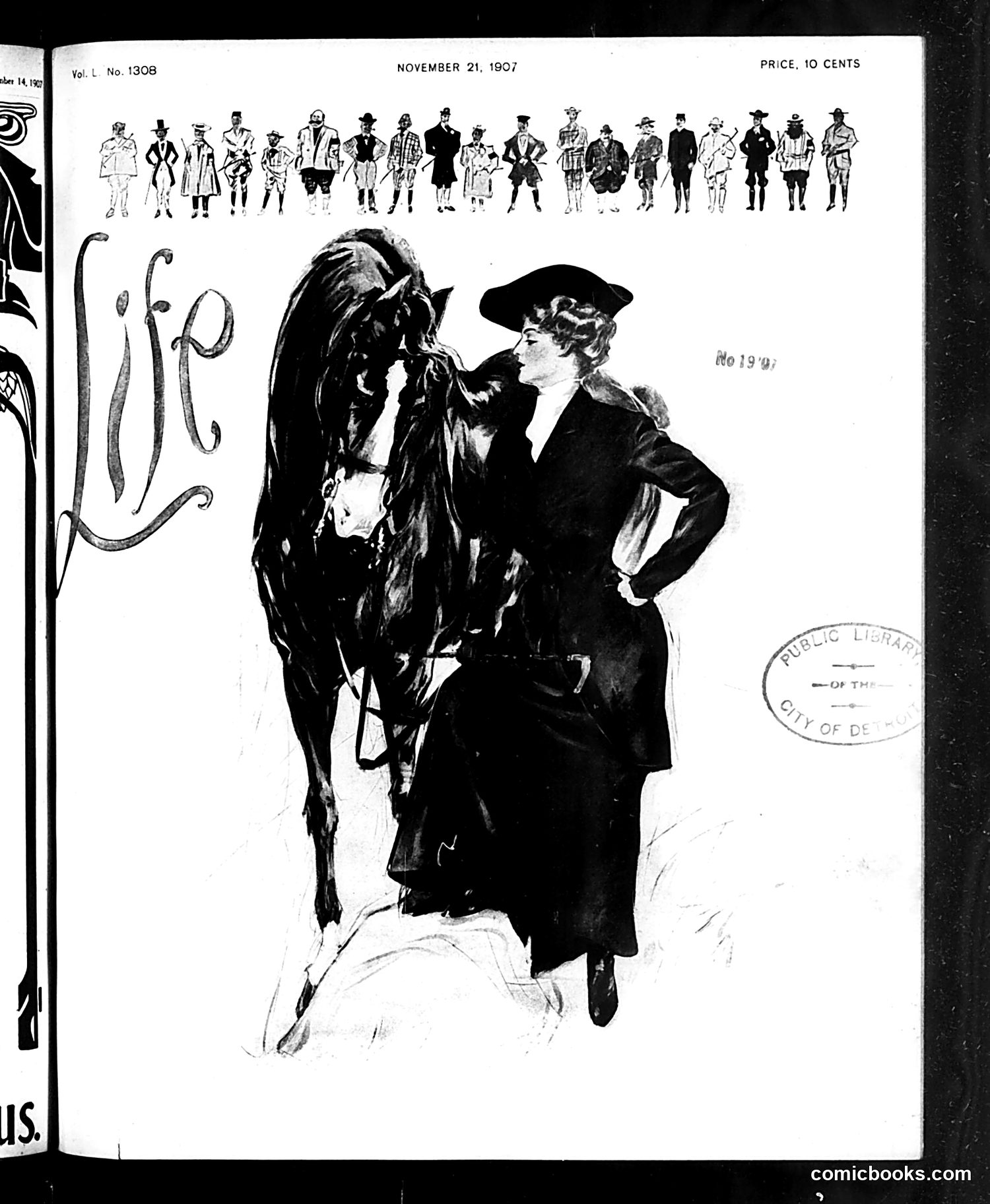
This page features a satirical illustration of a fashionable woman in an elegant dark coat and hat, examining or adjusting a horse's bridle. The top of the page displays a row of small figure sketches showing various clothing styles and social types. The cartoon appears to satirize early 1900s fashion and social pretension—specifically, the contrast between refined urban fashion and practical horsemanship. The woman's stylish attire and affected pose suggest she's more concerned with appearing fashionable than with genuine competence with horses, a common target of Edwardian-era satire about the leisure class. The illustration exemplifies *Life* magazine's typical humor mocking upper-class affectations and the contradictions between polished appearance and actual capability.
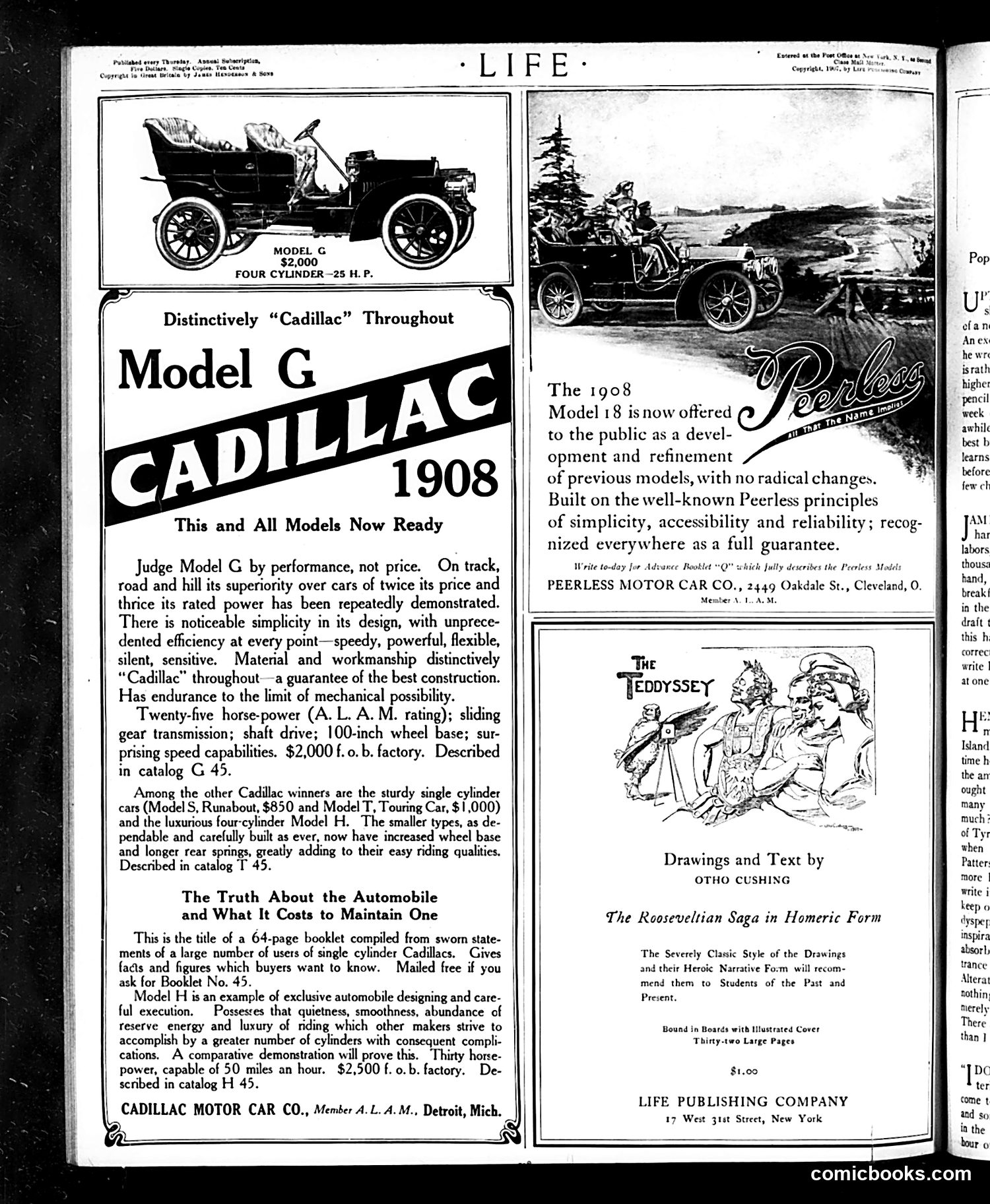
This page is primarily **advertising** for automobiles (Cadillac Model G and Peerless Model 18), not satirical content. The right side features "The Eddyssey," a cartoon series with drawings and text by Otho Cushing subtitled "The Rooseveltian Saga in Homeric Form." The illustration shows three figures in period dress, appearing to reference classical Greek/Homeric imagery applied to contemporary American political figures. However, the specific identities and satirical point are **unclear from the visible image alone**—the actual text content of the cartoon isn't legible enough to determine which contemporary figures are being mocked or what political situation is being referenced through this classical literary parody format.
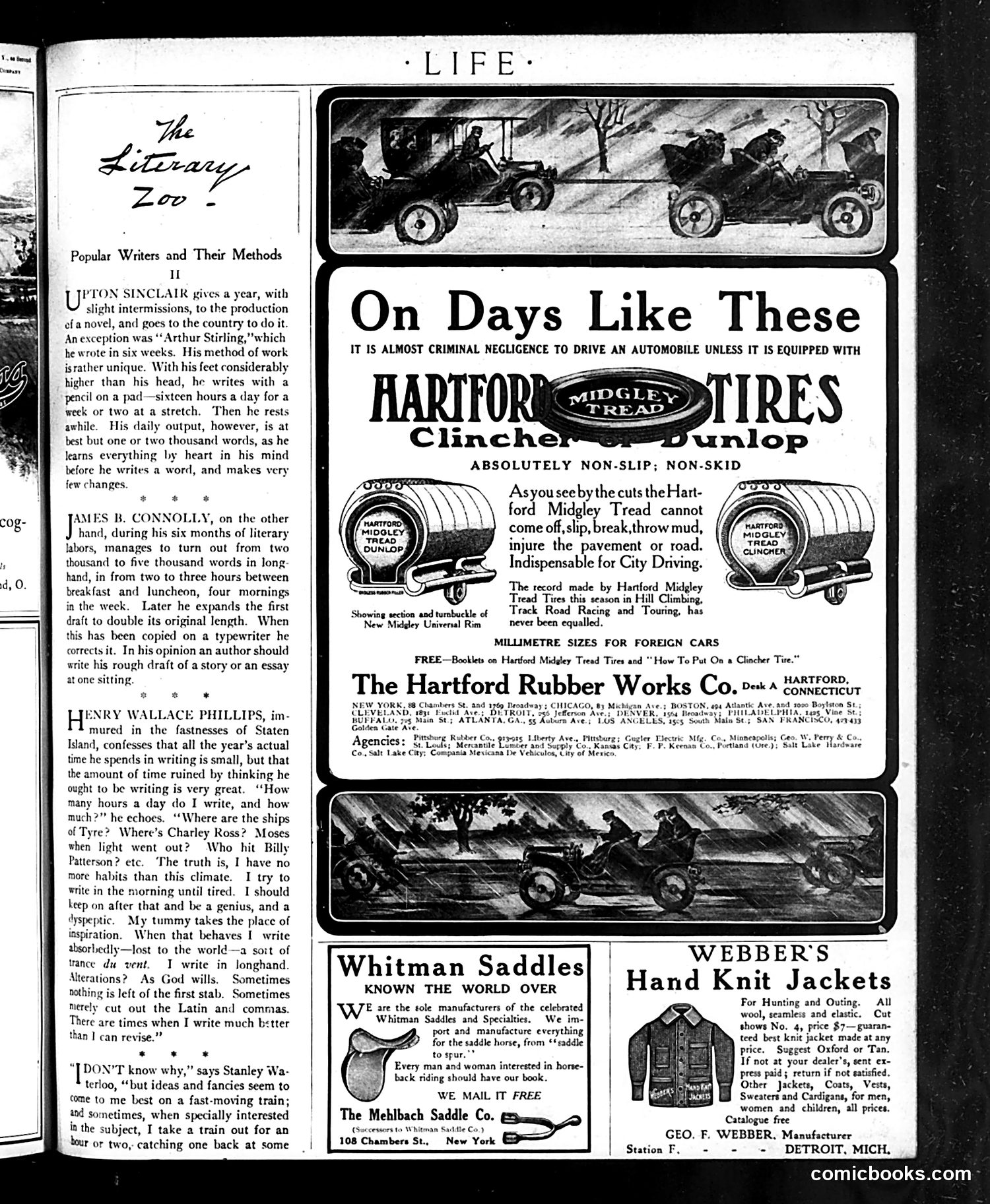
This Life magazine page is primarily **advertising**, not political satire. The content consists of: 1. **Left column**: "The Literary Zoo" — brief profiles of popular writers' working methods (Upton Sinclair, James H. Connolly, Henry Wallace Phillips, Stanley Waterloo). These are straightforward literary commentary, not satire. 2. **Right side**: Full-page advertisements for Hartford Midgley Tread automobile tires, Whitman Saddles, Webber's Hand Knit Jackets, and the Mehlbach Saddle Company. The top image shows early automobiles racing, illustrating the tire advertisement's safety claims. There is **no political cartoon or satirical content** on this page—it's a typical early 20th-century magazine layout mixing editorial content with period product advertising.
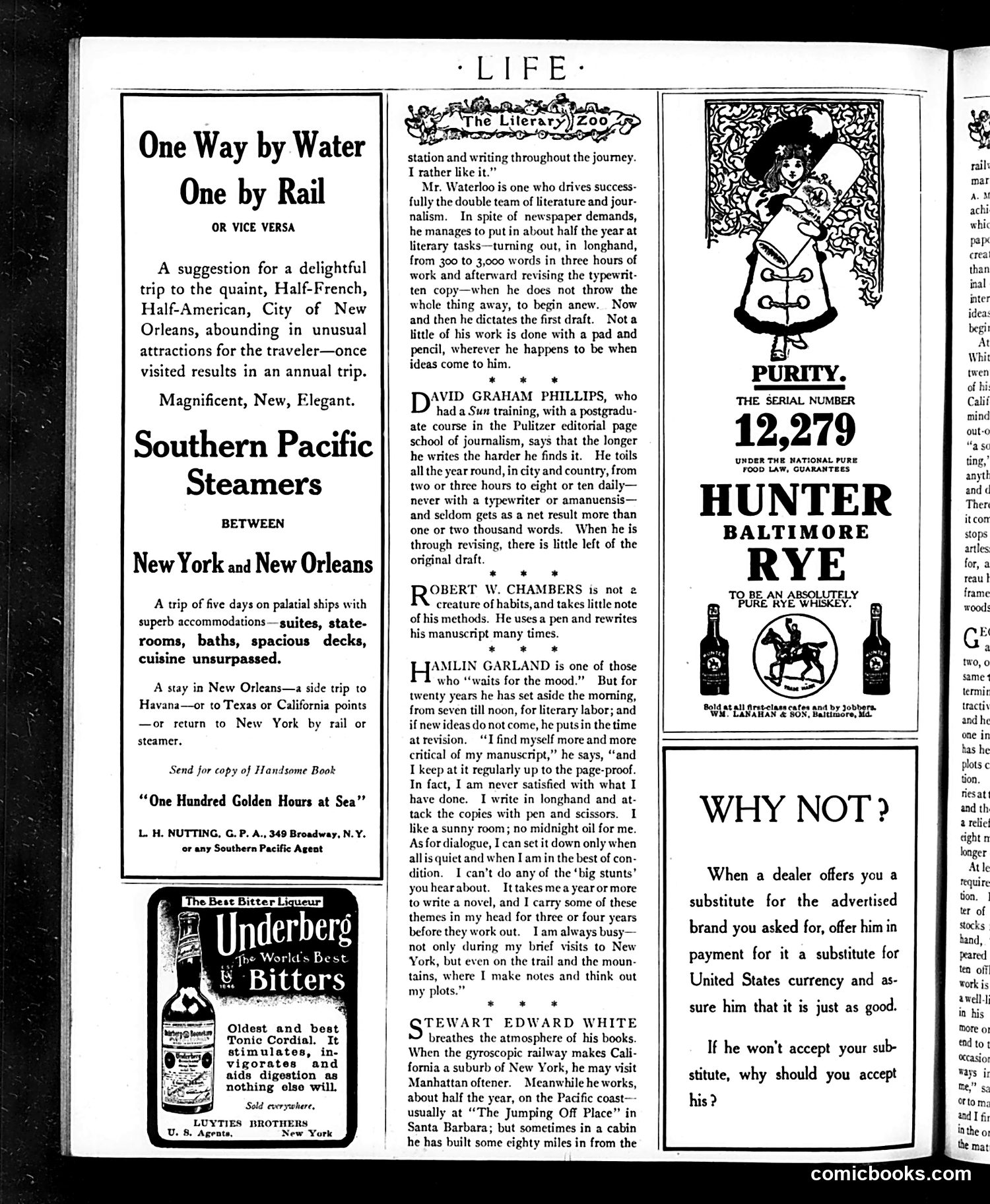
This page is primarily **advertising and literary commentary**, not political satire. The main content features profiles of contemporary writers (Waterloo, Phillips, Chambers, Garland, and White), discussing their writing methods and habits. These appear to be part of a regular "Literary Zoo" column in Life magazine. The cartoon on the right shows a child figure labeled "PURITY" — this is a **product advertisement** for Hunter Baltimore Rye whiskey, using the ironic juxtaposition of "purity" with alcohol (a common marketing technique before Prohibition). The image supports whiskey sales claims. The remaining advertisements cover Southern Pacific steamship travel, Underberg Bitters, and a substitution warning. There is **no political cartoon or satire present** on this page—it's a mix of editorial content and commercial advertisements typical of early 20th-century Life magazine.
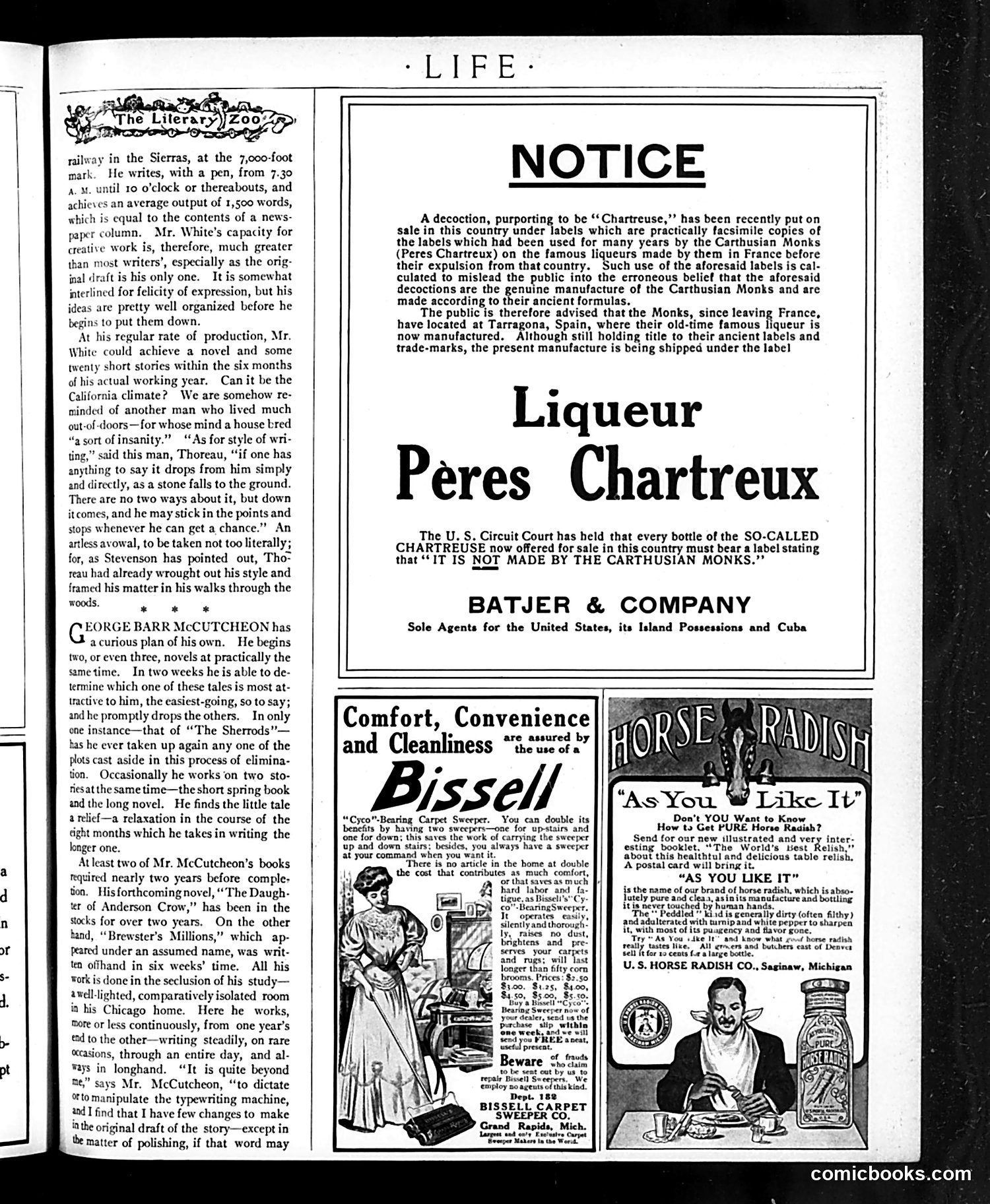
This page is primarily **advertising with minimal editorial content**. The main items are: 1. **Liqueur Pères Chartreux notice** (center): A legal advertisement warning consumers that counterfeit "Chartreuse" liqueur is being sold in America. The genuine product is made by Carthusian Monks in France; imitations now manufactured elsewhere are fraudulent. Batjer & Company is the authorized U.S. distributor. This reflects early 20th-century trademark and trade-dress disputes. 2. **Left column**: Brief literary commentary on writers' working habits. 3. **Bottom ads**: Bissell carpet sweepers and Horse Radish condiment advertisements. No political satire or caricature is present. This is a standard magazine page mixing editorial content with paid advertisements.
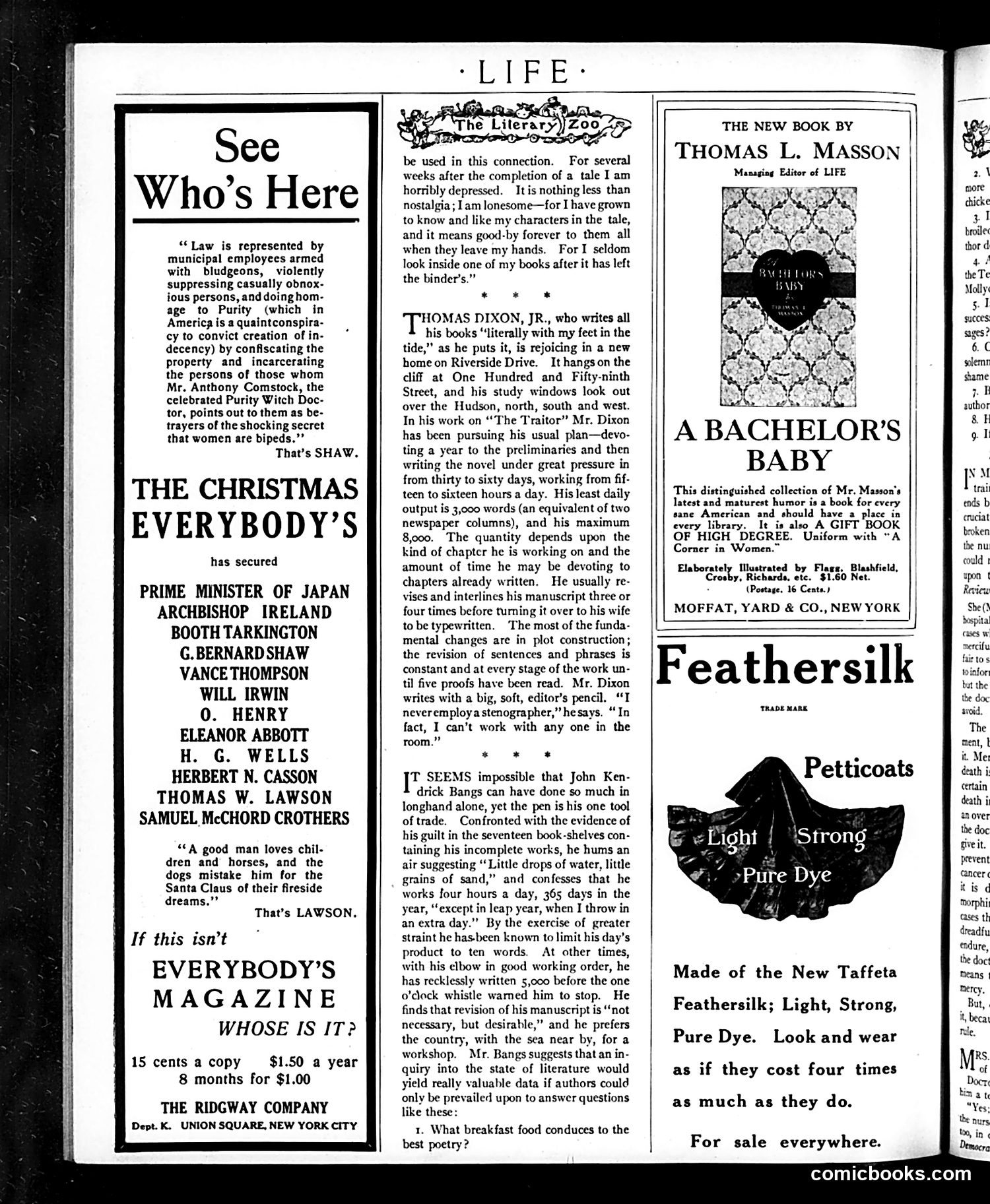
This page is primarily **advertising and literary content** rather than political satire. The left column advertises "Everybody's Magazine" with a quote attributed to "LAWSON" criticizing law enforcement and municipal corruption—a reference to the muckraking journalism era. The list of notable contributors (Wells, Shaw, Abbott, etc.) emphasizes the magazine's literary prestige. The center features biographical notes on writer **Thomas Dixon Jr.**, discussing his prolific output and writing process. The right side advertises **Thomas L. Masson's book "A Bachelor's Baby"** and **Feathersilk petticoats** with the tagline promising they "cost four times as much" but wear like cheaper alternatives. The page reflects early 20th-century magazine culture: serious literary journalism mixed with consumer advertising targeting middle-class readers.
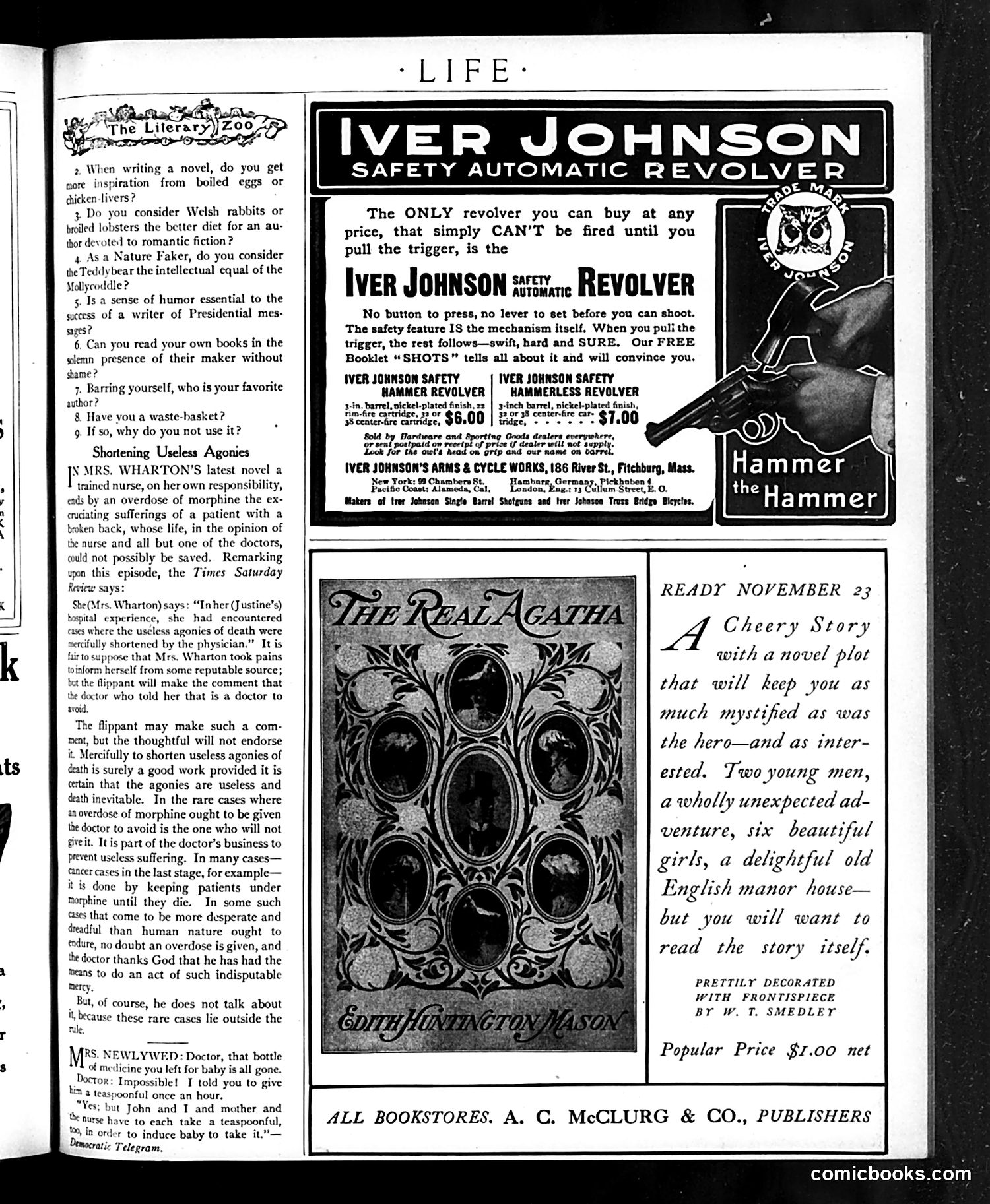
This page is primarily **advertising and book promotion** rather than political satire. The dominant content consists of: 1. **Iver Johnson Revolver advertisement** - A prominent firearms ad emphasizing the gun's safety feature (can't fire until trigger is pulled). This reflects early 20th-century consumer marketing for weapons. 2. **"The Real Agatha" book promotion** - An ornate decorative image advertising a novel by W.T. Smedley, positioned as a mystery story appealing to readers interested in adventure and romance. 3. **Column content** - Left side contains miscellaneous editorial questions and a medical anecdote about nursing care. The page reflects **turn-of-century Life magazine's mixed editorial-advertising model** rather than containing identifiable political cartoons or satire.
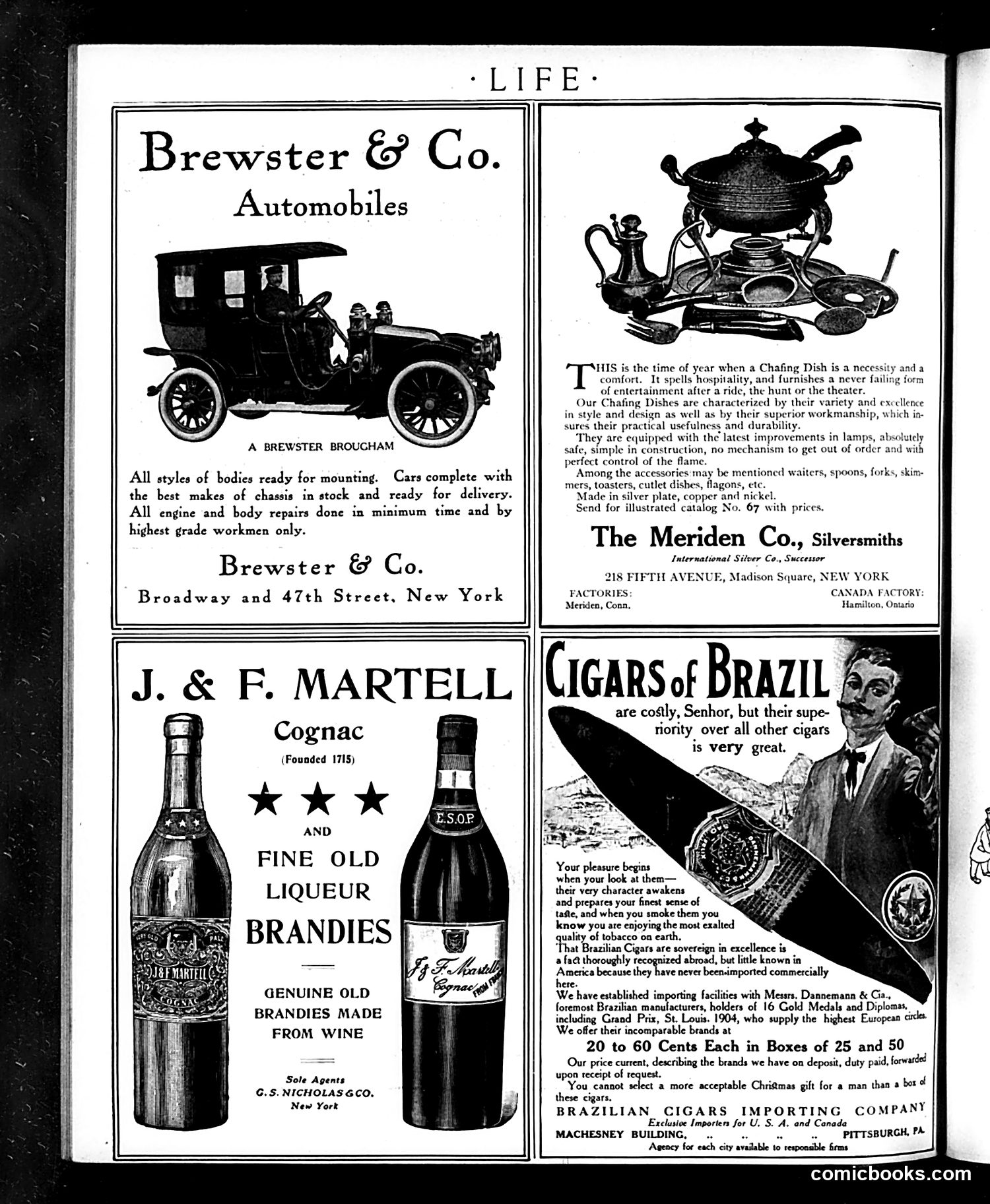
This page is **primarily advertising**, not political satire. It contains four commercial advertisements from the early 1900s: 1. **Brewster & Co. Automobiles** — promoting a "Brougham" model with claims of quality craftsmanship 2. **The Meriden Co. Silversmiths** — advertising Chafing Dishes, noting they're useful for entertaining (a period luxury item) 3. **J. & F. Martell Cognac** — selling French brandy and liqueurs 4. **Brazilian Cigars Importing Company** — marketing imported cigars, with an illustration of a well-dressed man The page reflects early 20th-century consumer culture and luxury goods targeting affluent readers. There is **no political cartoon or satire present** — this is a straightforward advertising section of *Life* magazine.
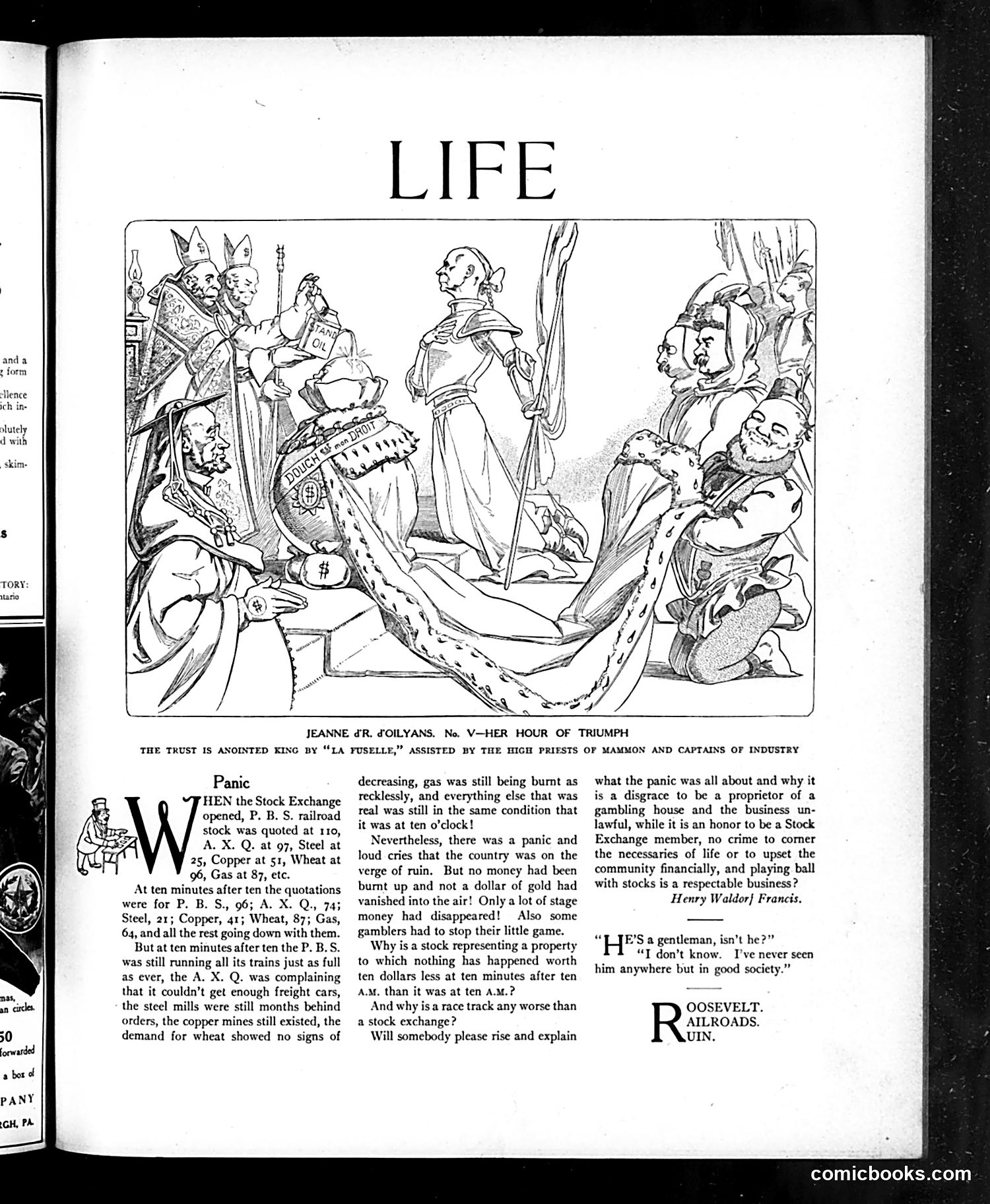
**Main Cartoon:** "Jeanne d'Orleans, No. V—Her Hour of Triumph" depicts a female figure (labeled as representing "La Pucelle") being anointed by religious and industrial leaders. The satire suggests corporate and religious institutions are mythologizing or instrumentalizing a female figure for their purposes. **Text Section "Panic":** Discusses stock market turmoil—P.B.S. railroad stock collapsed, causing panic. The piece satirizes the disconnect between financial catastrophe and society's indifference, noting that while trains couldn't run and copper mines failed, wealthy men continued playing ball with stocks. **Social Critique:** The satire mocks how financial disasters are treated casually by the wealthy elite, contrasting real economic damage with their entertainment and propriety concerns. A sidebar joke about "Roosevelt. Railroads. Ruin" suggests contemporary political blame.
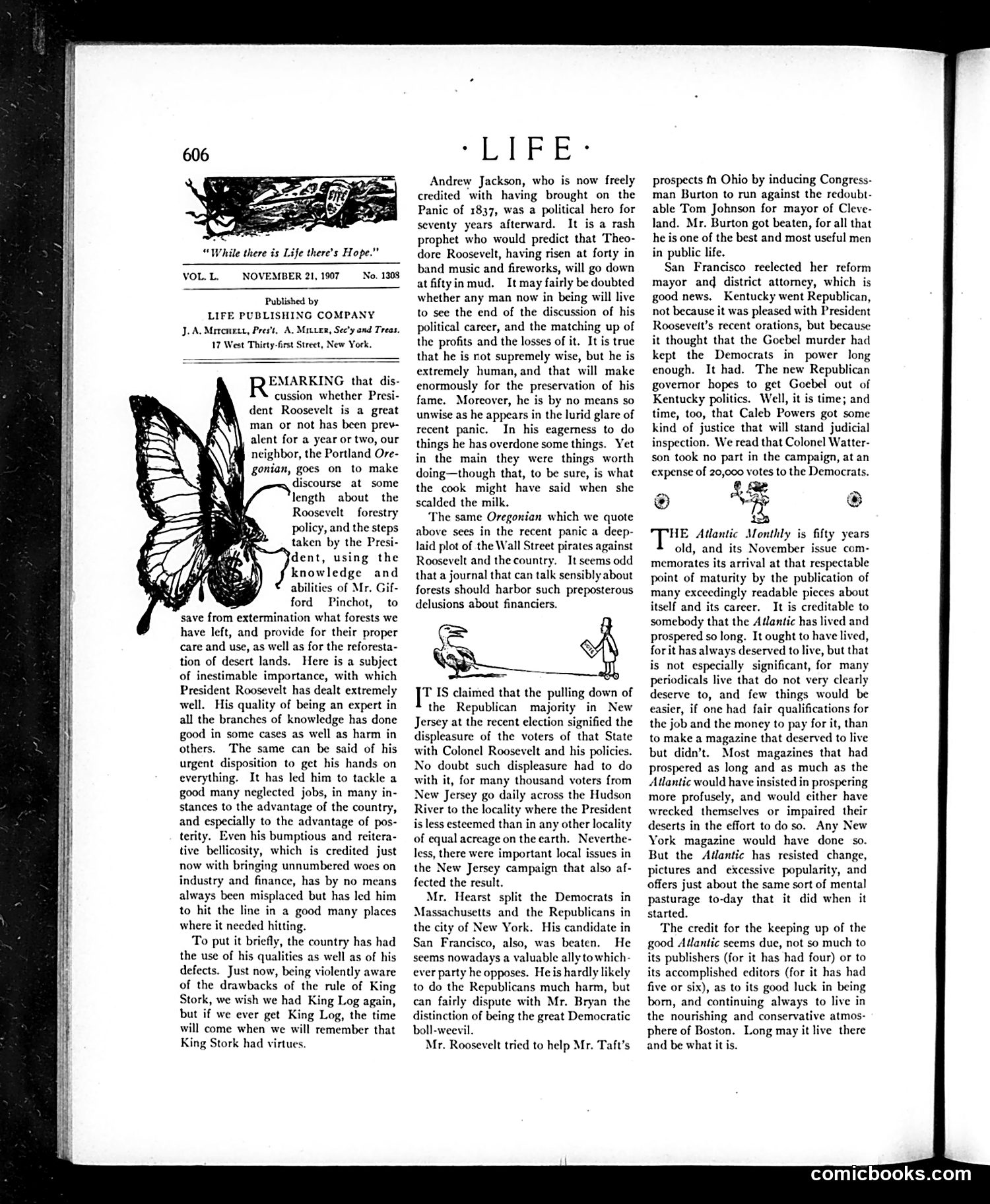
This page contains editorial commentary on President Roosevelt's political record, accompanied by decorative butterfly illustrations. The text discusses Roosevelt's role as a "political hero" and examines whether he has been an adequate president. The main critique focuses on Roosevelt's handling of forestry policy and his recent "panic" response to financial crises—the text suggests he "overdone some things" despite good intentions. The passage references his attempts to aid Secretary Taft and mentions disputes over Roosevelt's policies affecting New Jersey voters and Colonel Roosevelt himself. The piece appears skeptical of Roosevelt's legacy, questioning whether his interventionist approach ultimately helped or harmed the nation, while acknowledging his expertise and good intentions in various policy areas.
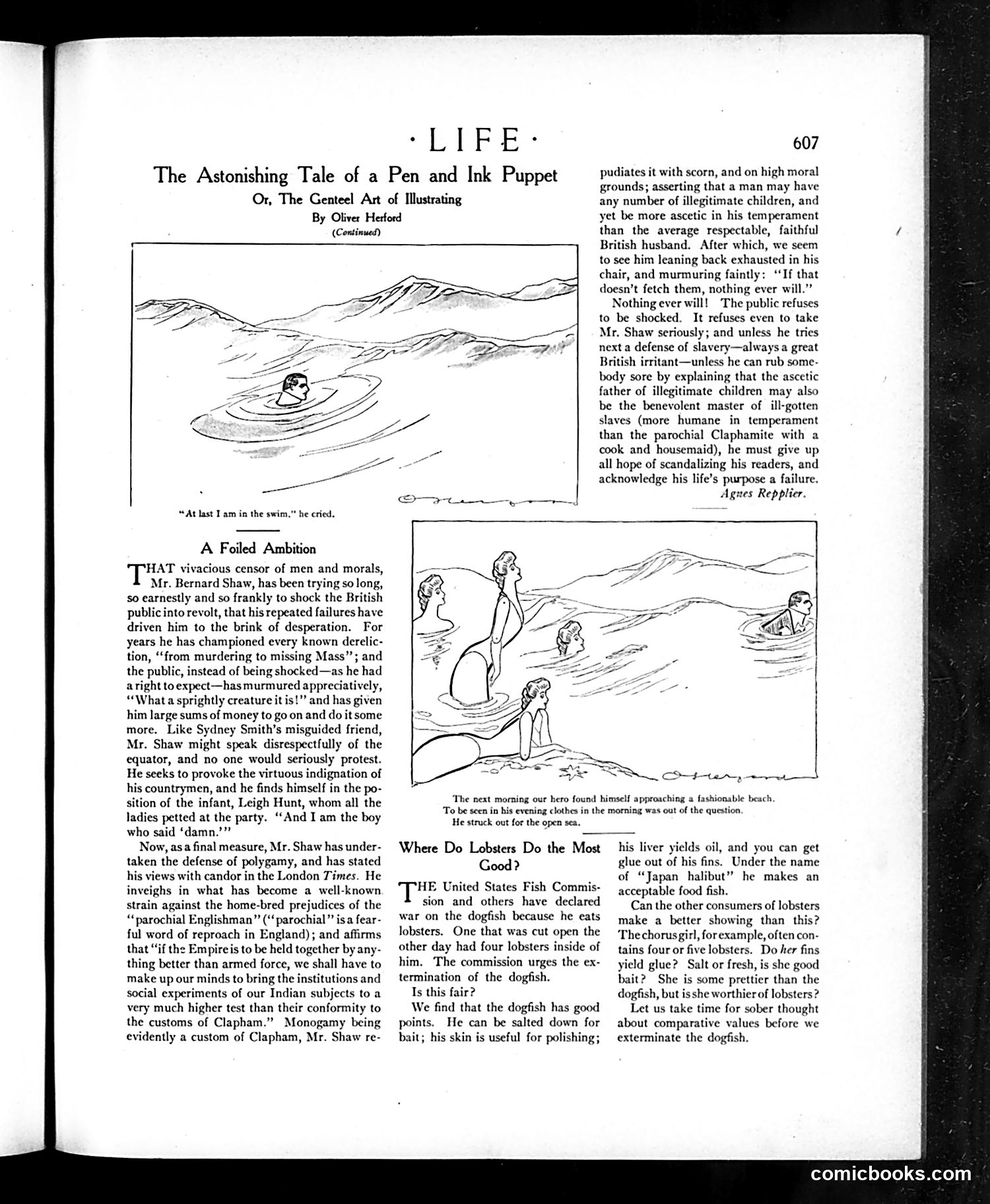
This page contains satirical commentary on Mr. Leonard Shaw, a British moralist and censor who has been publicly campaigning against various social "derelictions" and indecencies. The text criticizes Shaw's hypocrisy: while he publicly scandalized readers by detailing supposed immoral behaviors, he simultaneously defended polygamy in the *London Times* and argued that the British Empire should tolerate practices (like among Indian subjects) that Shaw himself condemned domestically. The accompanying pen-and-ink illustrations humorously depict Shaw's "foiled ambition"—showing a man swimming and discovering himself washed ashore, suggesting his moral crusade has foundered. The page also includes an unrelated section on dogfish consumption, appearing to be separate satirical content.
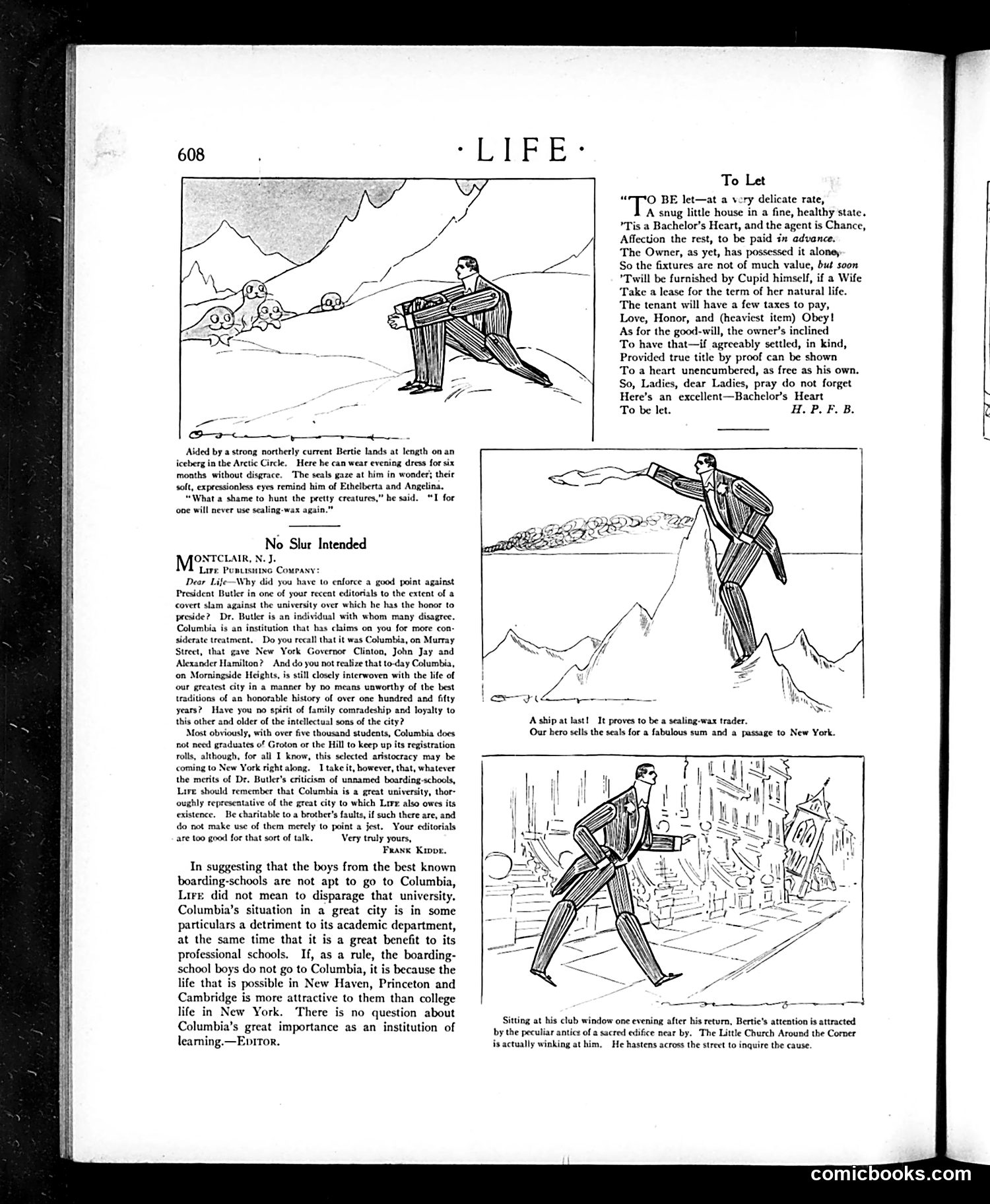
This page contains three illustrated vignettes about a bachelor character named Bertie, presented as humorous domestic scenarios. The top section shows Bertie fishing with cherubs, illustrating a poem "To Let" about renting a bachelor's residence. The middle section, titled "No Slur Intended," is an editorial letter defending Columbia University President Butler against criticism. The editor rebuts suggestions that Columbia's reputation suffers because boarding-school boys prefer Princeton, Yale, and Cambridge for their superior social life in those cities. The bottom illustration shows Bertie at his club window and later on a city street, continuing the bachelor lifestyle narrative. These appear to be ongoing character sketches rather than political satire—commentary on urban bachelor culture and university prestige circa early 20th century.
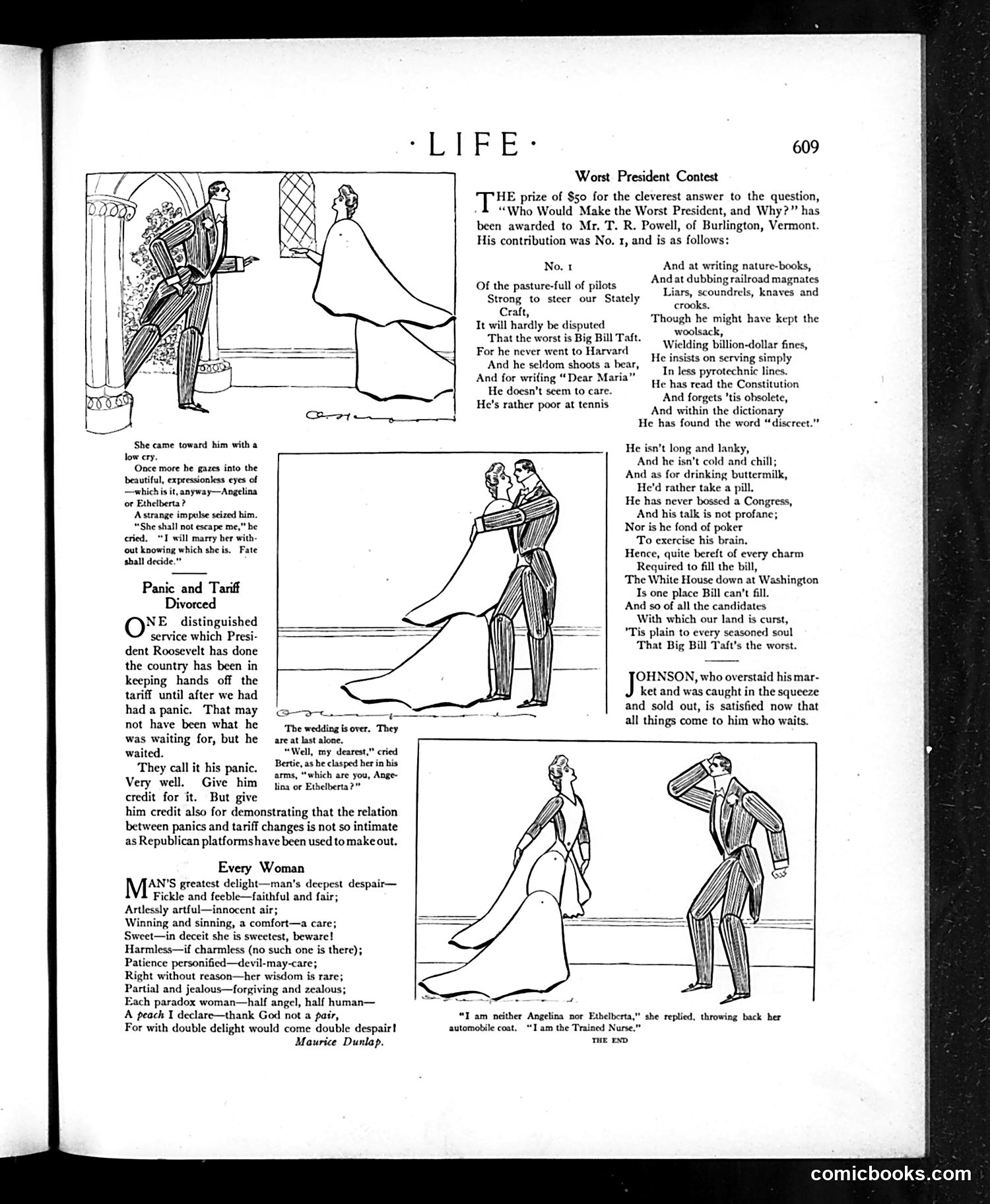
This page contains three distinct pieces of satirical content: 1. **"Worst President Contest"**: A humorous contest result naming "Big Bill Taft" as the worst president. The accompanying poem mocks an unnamed president for various failings—being indecisive, ineffective, and forgettable in office. 2. **"Panic and Tariff Divorced"**: A section crediting President Roosevelt with preventing economic panic by keeping tariff issues under control, satirizing the relationship between economic policy and market stability. 3. **Cartoon illustrations** depicting wedding/marital scenes, likely using the metaphor of marriage dissolution to represent political or economic separation. The page satirizes early 20th-century American politics and presidential competence, though specific historical references require additional context to fully interpret.
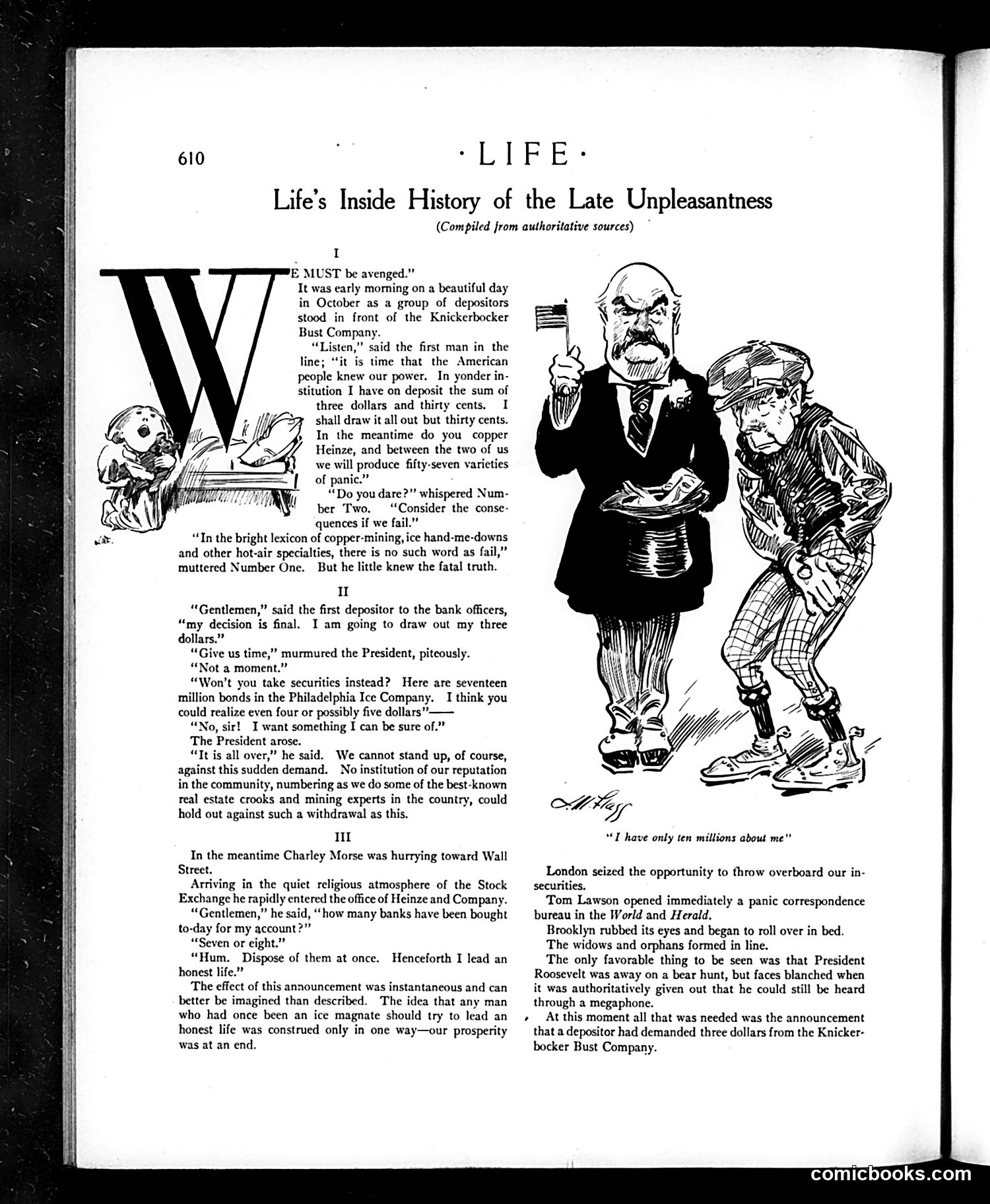
This Life magazine piece satirizes the 1907 financial crisis, specifically the Knickerbocker Bank collapse. The cartoon mocks how panic spreads irrationally through financial markets. The satire targets: **Key figures**: "Charley Morse" (likely Fritz Augustus Heinze, a copper magnate implicated in the panic), and unnamed depositors whose small withdrawals trigger cascading bank failures. **The joke**: A depositor threatens to withdraw just $3.00 from his account, claiming this will cause panic. Meanwhile, Morse's announcement that he'll lead an "honest life" is treated as catastrophic—the financial world *expects* dishonesty from mining speculators and bankers. **The point**: The 1907 panic was irrational herd behavior. Wealthy financiers like Morse could manipulate markets through psychological pressure rather than real economic collapse. The cartoon ridicules both the fragility of the banking system and the moral corruption of financial elites—these are presented as "real estate crooks and mining experts," not legitimate bankers.
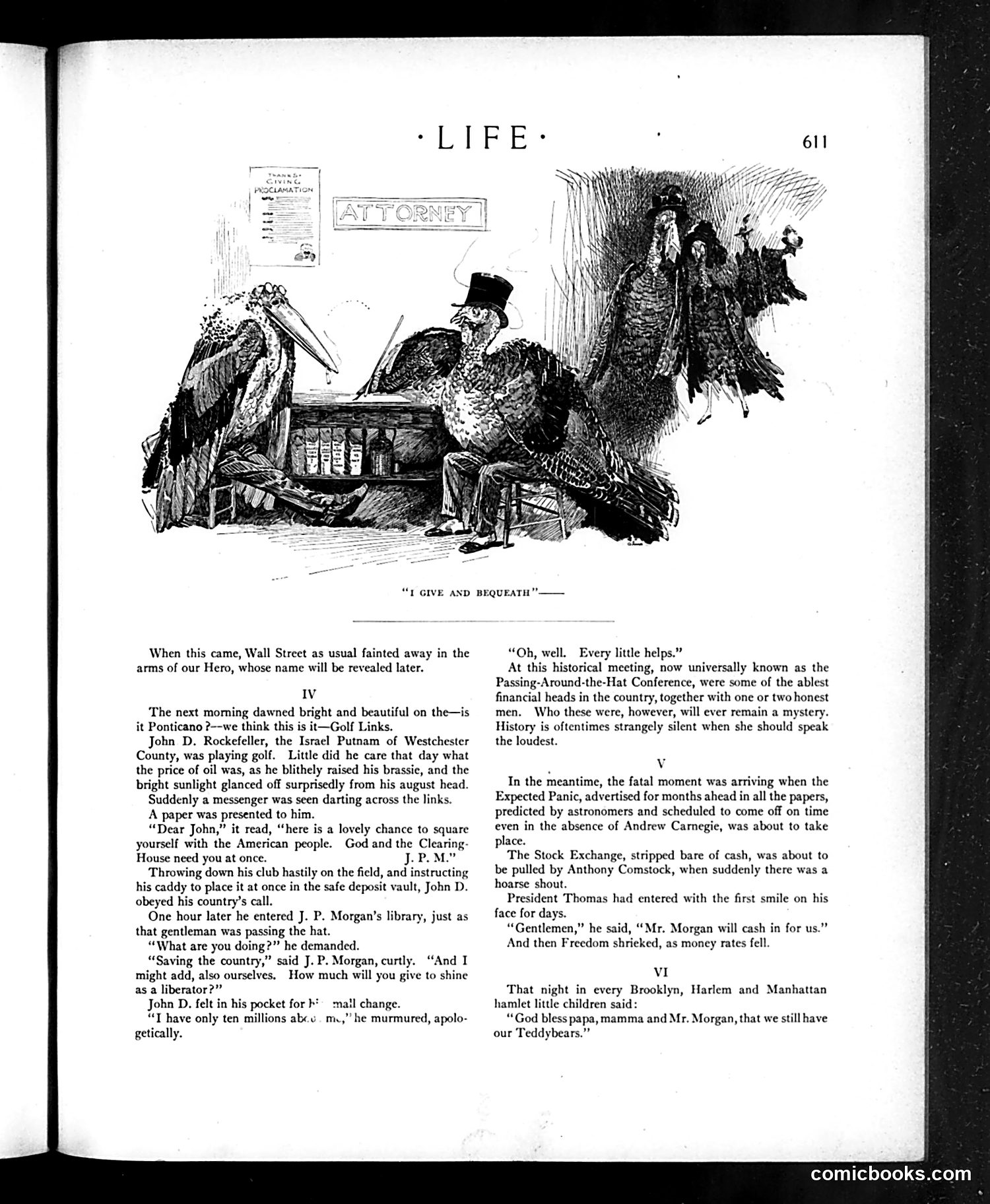
This satirical narrative from *Life* magazine mocks the 1907 financial panic and the role of wealthy industrialists in "saving" the economy. The cartoon depicts J.P. Morgan (identifiable from context as the figure "passing the hat") orchestrating a rescue alongside John D. Rockefeller, characterized as reluctant but dutiful patriots. The satire operates on multiple levels: Morgan and Rockefeller are portrayed as both saviors and self-interested actors; the "Passing-Around-the-Hat Conference" sarcastically suggests wealthy men merely collecting donations rather than genuinely sacrificing. References to President "Thomas" (likely Theodore Roosevelt) and Anthony Comstock add contemporary figures to the critique. The children's prayer thanking "Mr. Morgan" alongside parents exposes the magazine's central irony—that financial elites are publicly celebrated as heroes while the text hints they're primarily protecting their own interests ("also ourselves"). The tone throughout suggests skepticism about who truly benefits from such "rescues."
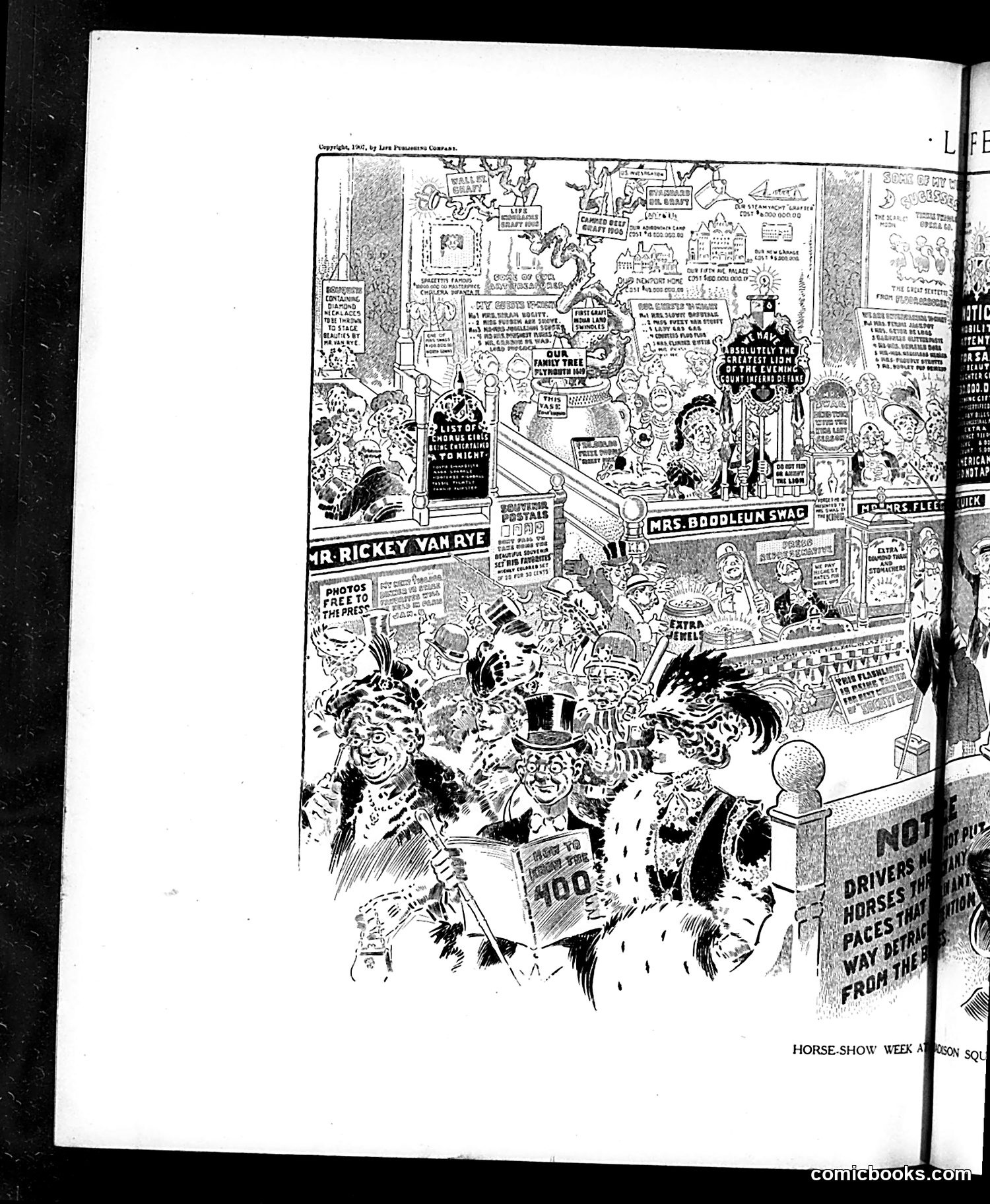
This is a satirical illustration of Manhattan's social elite during Horse Show Week at Madison Square Garden. The cartoon depicts wealthy, fashionably-dressed women and men in elaborate costumes and accessories—featuring exaggerated hairstyles, feathered hats, and ornate clothing typical of early-20th-century high society. The humor targets the pretentious extravagance of the wealthy during this annual event. The crowded, chaotic scene with multiple advertisements and promotional boxes visible in the background buildings suggests the commercialism surrounding the spectacle. References to "Rickey Van Rye" and "Mrs. Boodleun Swag" appear to be invented satirical names mocking wealthy socialites. The cartoon satirizes how Horse Show Week showcased not the horses, but rather the ostentatious display of wealth and fashion by New York's upper class.
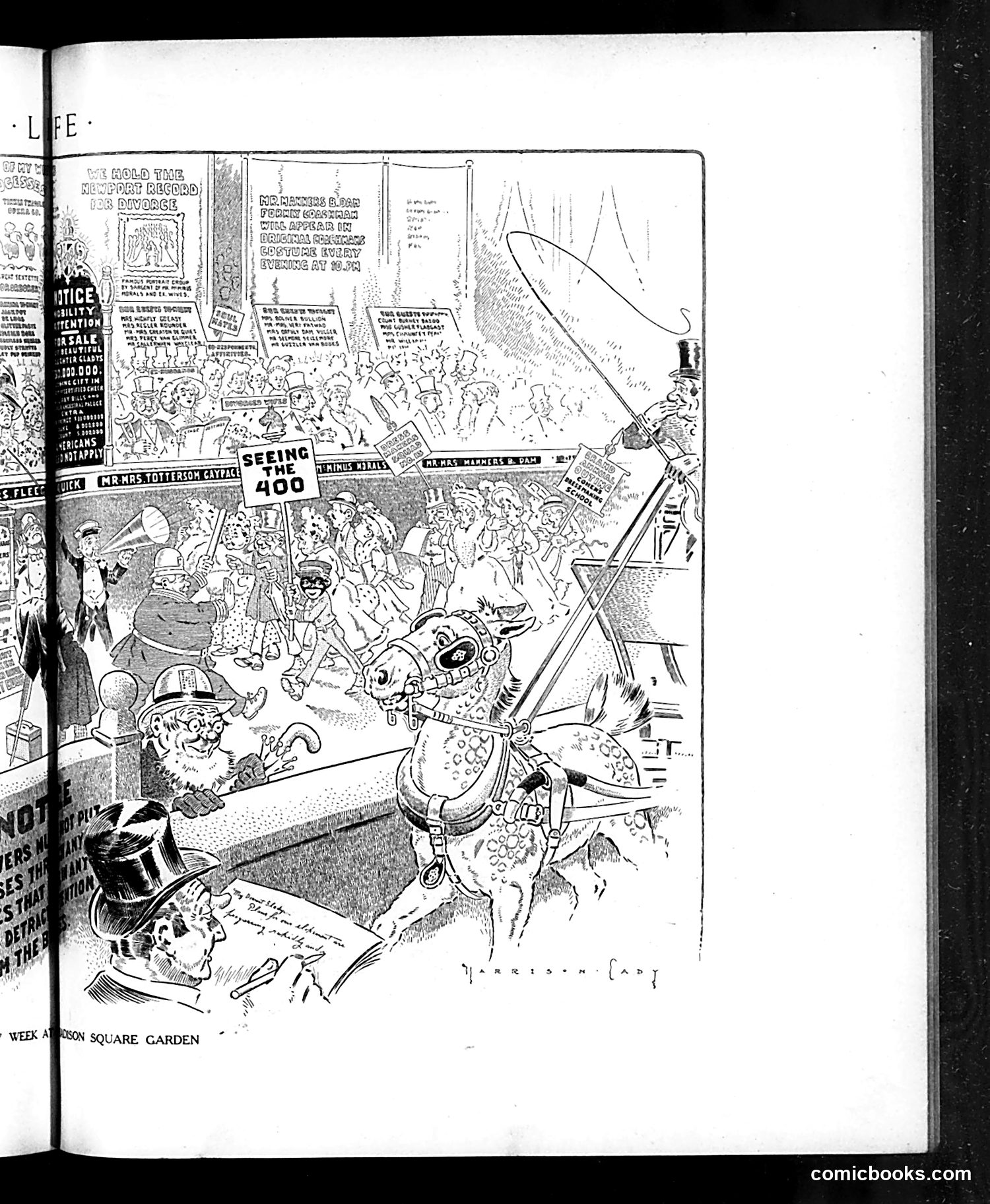
This page features a satirical cartoon labeled "SEEING THE 400," referencing New York's social elite—the "400" families considered part of high society (a concept popularized in the Gilded Age). The cartoon depicts an elaborate social spectacle at Madison Square Garden, with crowds of well-dressed attendees. The imagery appears to mock the pretentiousness and spectacle of high-society events, with exaggerated illustrations of fashionable people engaged in social display. The artistic style and advertising visible on the left margin suggest this is from Life's heyday as a satirical weekly magazine. The cartoon's focus on mocking the affectations of wealthy New Yorkers was typical of Life's editorial approach—using humor to critique class pretension and social hierarchy. Without a visible date, the specific event referenced remains unclear, though the "400" theme was evergreen for satirists of that era.
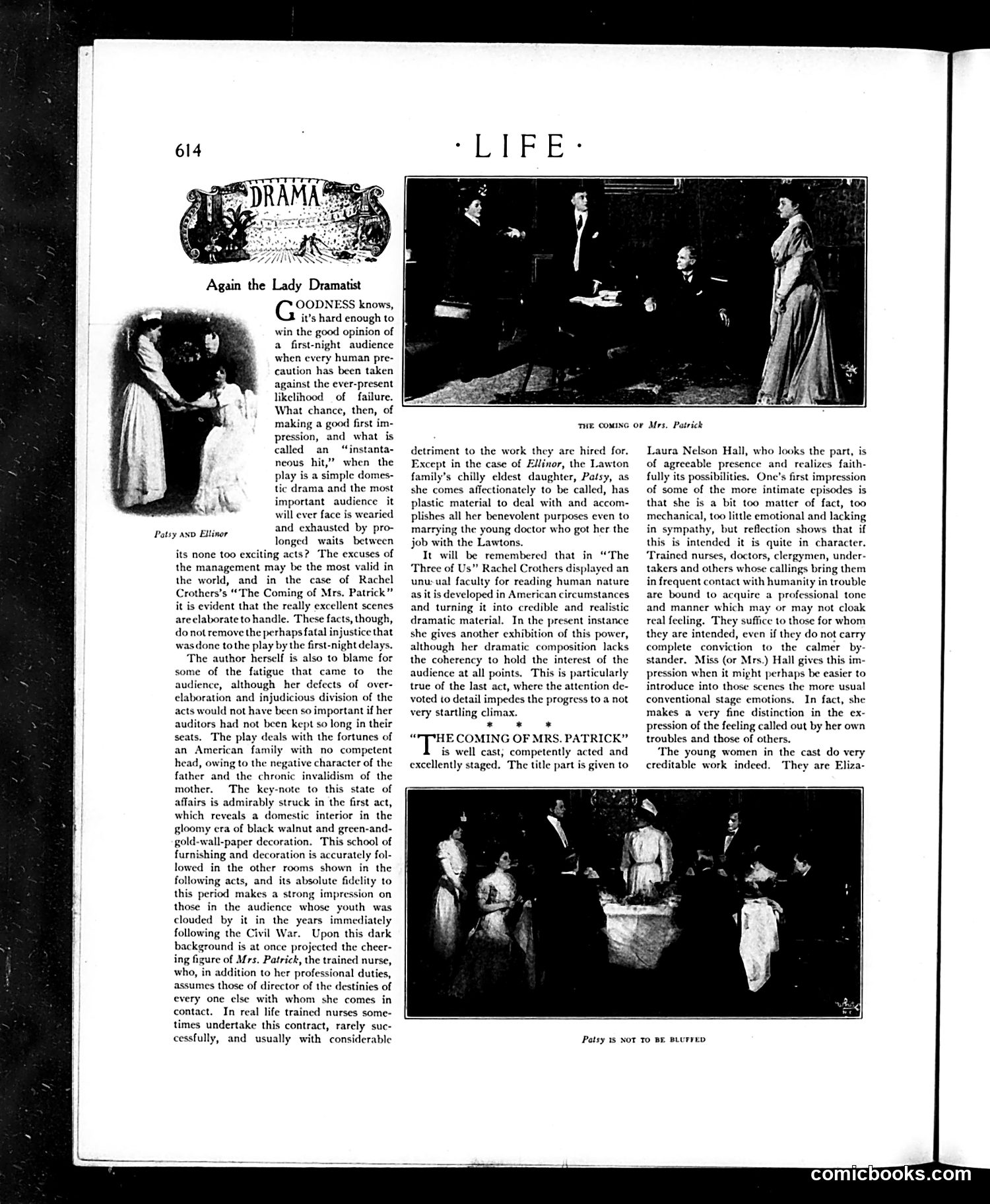
This page reviews Rachel Crothers's play "The Coming of Mrs. Patrick," a domestic drama about an American family lacking strong parental leadership. The title character is a trained nurse who takes charge of the household's affairs, including matchmaking for the eldest daughter, Ellinor. The critic praises Crothers's ability to capture realistic American family dynamics (noting her success in the earlier play "The Three of Us"), but faults the current play for being overly elaborate and poorly paced—lengthy waits between acts fatigued the opening-night audience. Laura Nelson Hall plays the lead role competently but somewhat mechanically. The review suggests this coldness may be intentional characterization. The play reflects post-Civil War domestic aesthetics with period-accurate furnishings, evoking nostalgia for audiences who lived through that era.
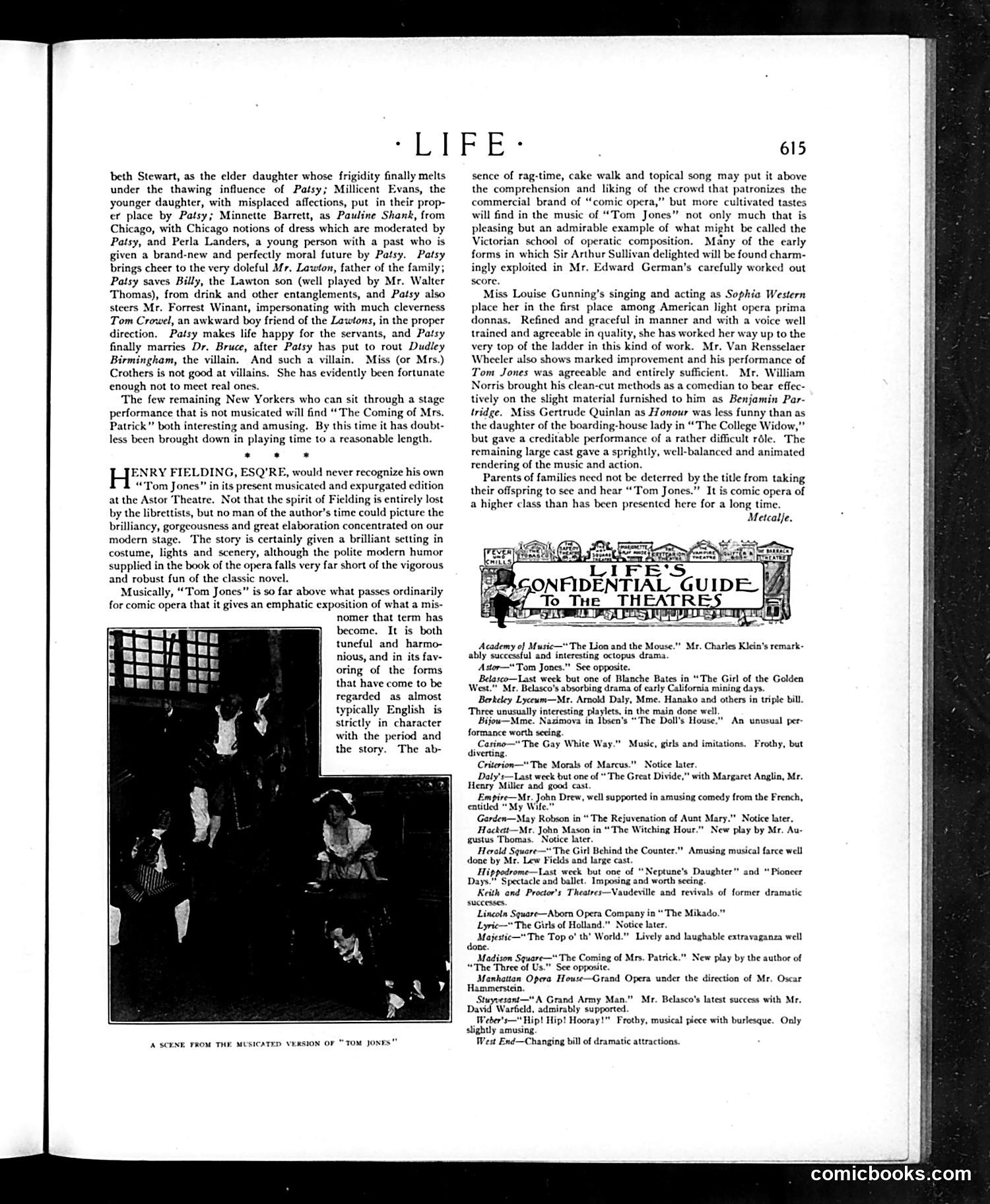
This page contains two theater reviews from Life magazine's drama section. The first review discusses "The Coming of Mrs. Patrick," a non-musical play praised for its wit and character development, particularly the titular character "Patsy" who reforms various family members' moral deficiencies. The second and longer review examines the musical adaptation of Henry Fielding's classic novel "Tom Jones" at the Astor Theatre. The critic argues the musicalization, while beautifully staged and orchestrated, cannot capture Fielding's original robust humor. He praises the score by Edward German for avoiding commercial "rag-time" and "cake walk" conventions, instead adopting a refined "Victorian school" operatic style reminiscent of Arthur Sullivan. The performance features Louise Gunning as Sophia Western, whom the reviewer ranks among America's finest light opera singers. A photograph shows a scene from the "Tom Jones" production.
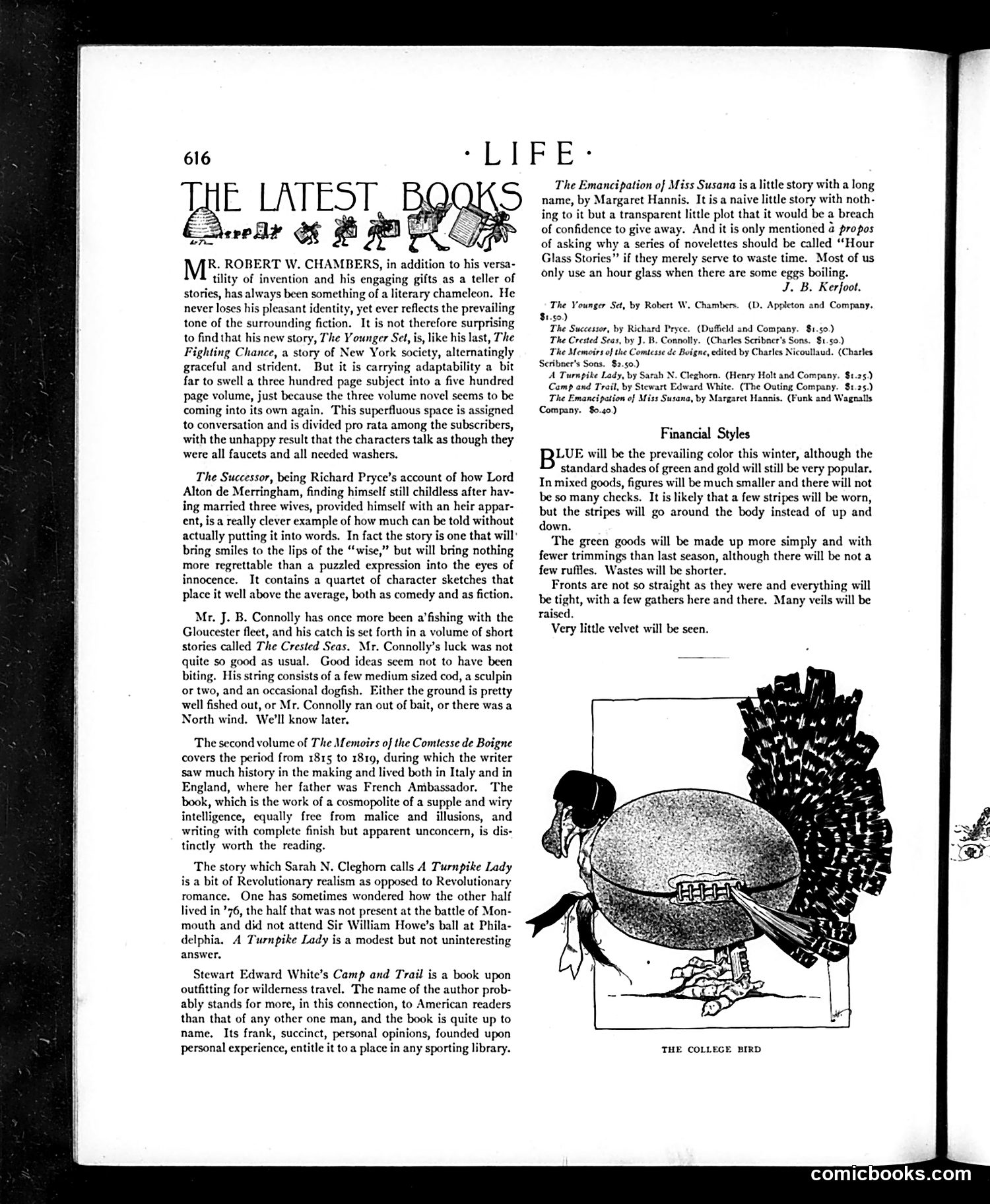
This illustration, titled "The College Bird," depicts a young woman in fashionable 1920s attire—a short skirt, decorative headpiece, and elegant shoes—posed prominently with a peacock. The peacock's elaborate tail feathers dominate the composition, creating a visual pun equating the woman with the vain bird. The satire targets the "flapper" culture emerging in the Jazz Age: young women who embraced modern fashion, shorter hemlines, and social independence. The peacock metaphor suggests these women were primarily concerned with displaying themselves fashionably and attracting attention, much as the bird displays its plumage. The caption's wordplay on "bird" (slang for an attractive young woman) reinforces the comparison. For modern readers, this represents period anxiety about changing gender roles and women's increasing social visibility and autonomy during the 1920s. The cartoon presents this modern femininity as vain and ornamental.
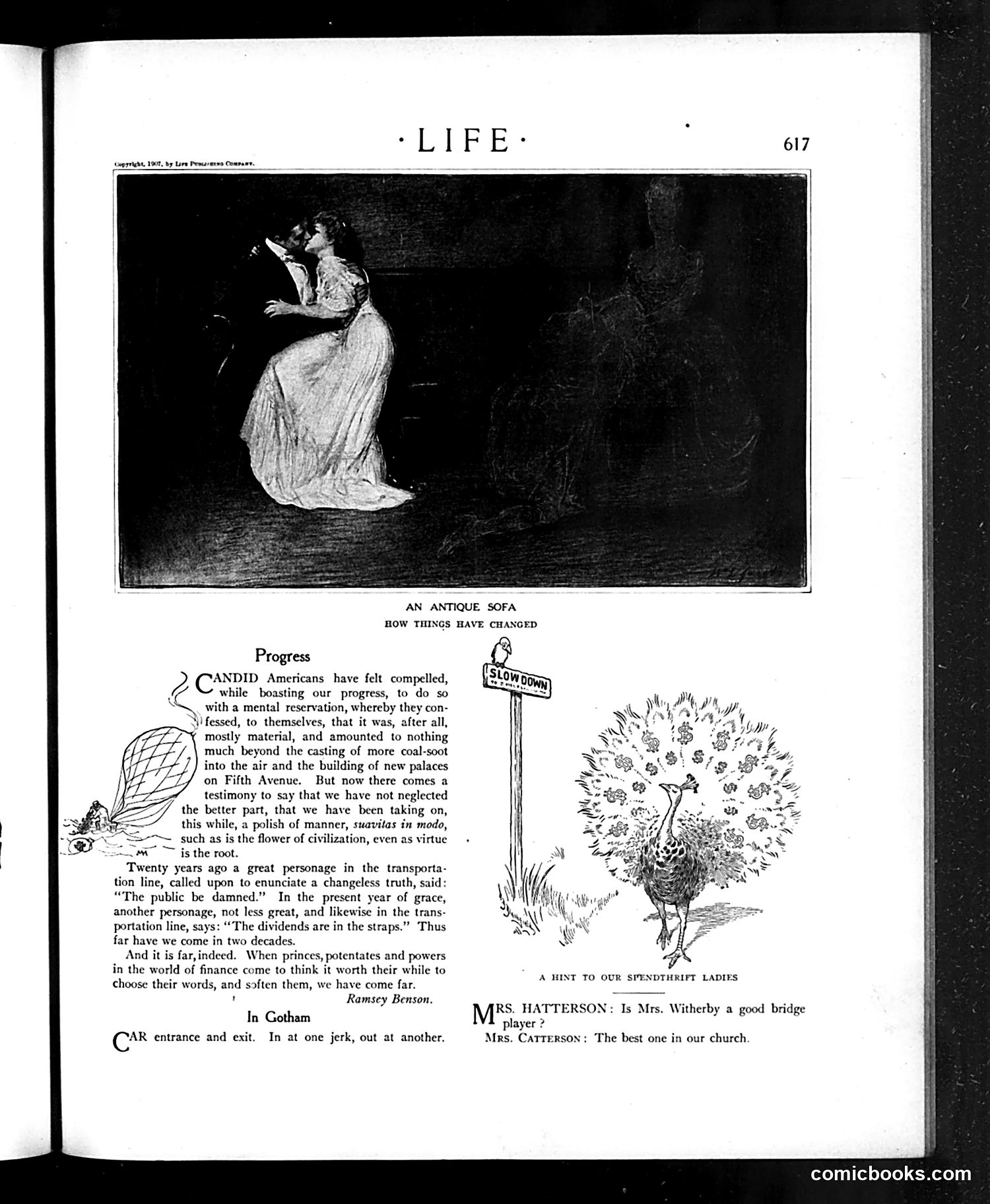
This page satirizes American progress and social manners circa 1907. The main article "Progress" argues that Americans boast material advancement (coal pollution, Fifth Avenue palaces) while ignoring moral refinement. The satire hinges on two quotes from transportation industry magnates: twenty years prior, one infamously declared "The public be damned"; now another says "The dividends are in the straps" (referring to subway handholds). The author claims this linguistic softening proves we've achieved civilized politeness alongside material progress—though the sarcasm is heavy: softening language for profit hardly represents genuine moral improvement. The lower illustration mocks wealthy women's spending habits via a bird with money for plumage—"A hint to our spendthrift ladies." The bridge-player joke reinforces upper-class frivolity. Together, the content suggests American "progress" remains superficial: replacing crude insults with euphemisms, and material greed with genteel manners, changes nothing fundamental.
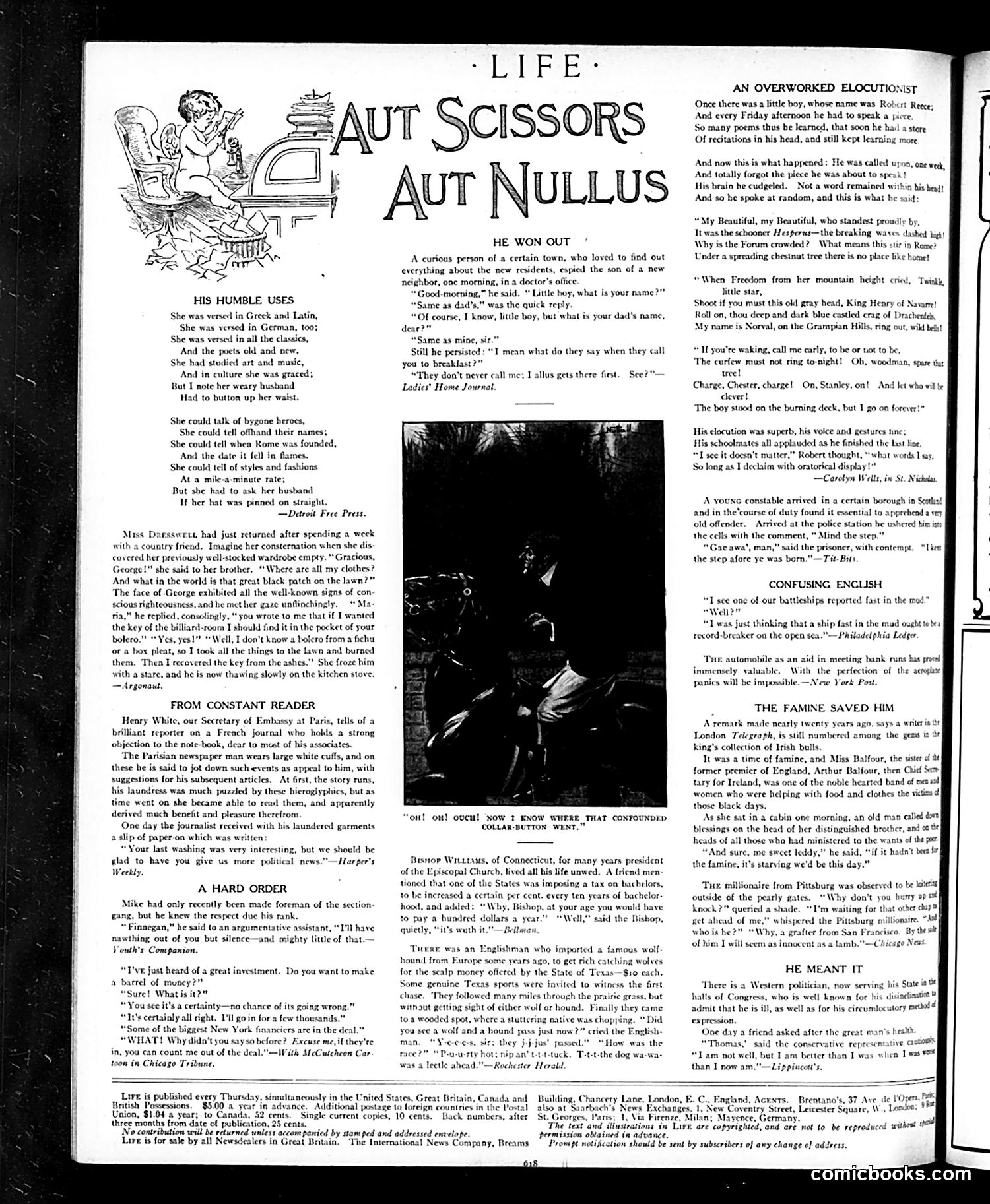
This page from *Life* magazine contains several short humorous stories and cartoons satirizing early 20th-century social conventions, particularly gender roles and domestic life. **"Aut Scissors Aut Nullus"** (the main feature) mocks educated women who are intellectually accomplished but helpless in practical matters. The accompanying verse and anecdotes ridicule women versed in classics and culture who cannot button their own clothes or pin their hats—the implication being that book-learning makes women impractical. One story describes a brother burning his sister's entire wardrobe because he couldn't distinguish clothing types while searching for a key. The other brief pieces ("He Won Out," "From Constant Reader," etc.) similarly joke about domestic mishaps, marital confusion, and social awkwardness—standard satirical fare mocking Victorian propriety and gender confusion of the era. The satire assumes readers will find humor in depicting educated women as simultaneously learned and incompetent, reflecting contemporary anxieties about women's education and changing social roles.
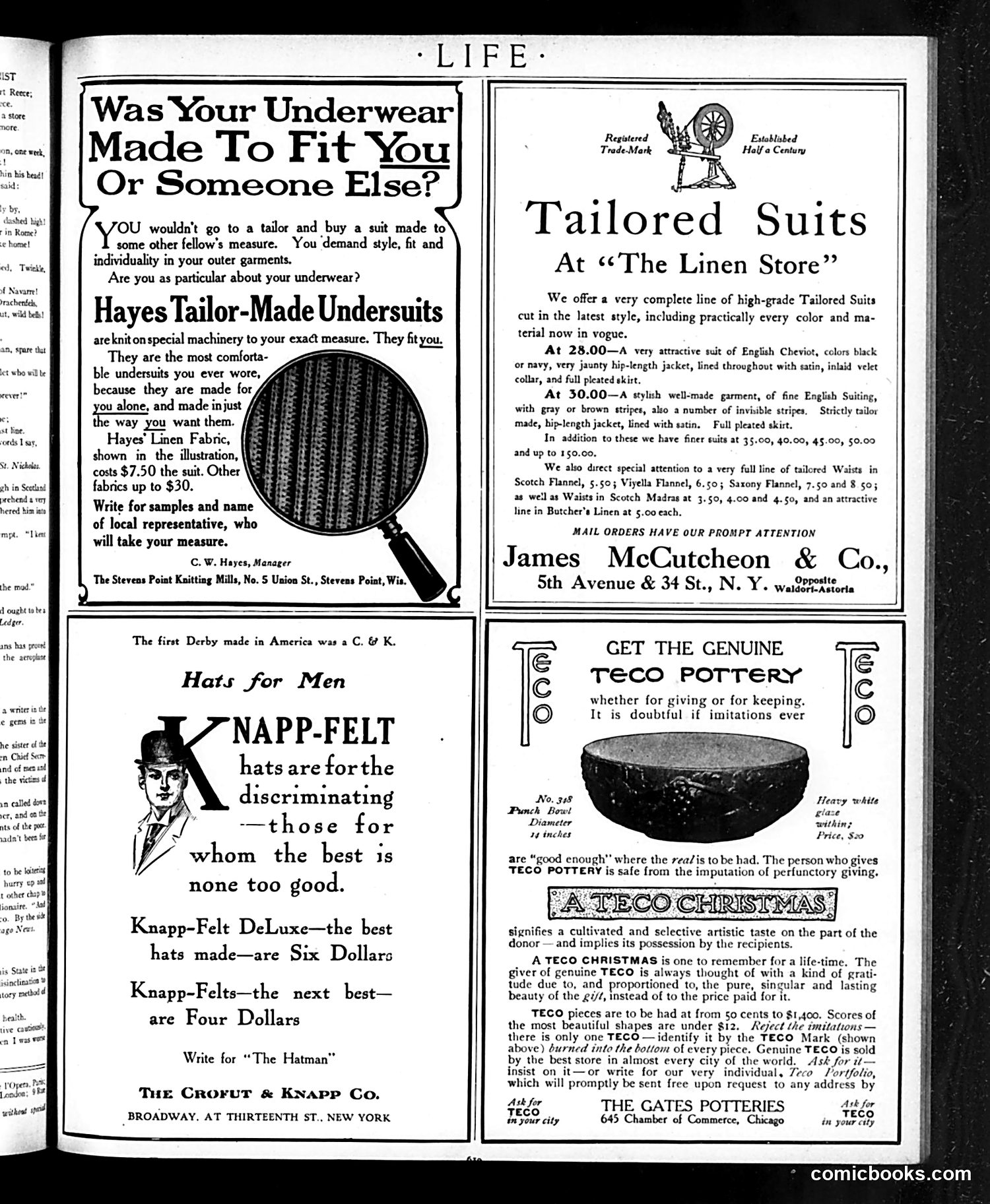
This page is primarily **advertising**, reflecting early 20th-century consumer culture and gender expectations. The dominant ad for Hayes Tailor-Made Undersuits uses a rhetorical question to appeal to male vanity—comparing custom-fitted underwear to tailored suits, suggesting that gentlemen should be as particular about undergarments as outer clothing. This reflects period attitudes about masculine refinement and individuality. The other ads (Knapp-Felt hats, James McCutcheon tailored suits, Teco pottery) similarly target affluent, fashion-conscious consumers, emphasizing exclusivity and quality. The Teco pottery ad notably positions genuine pottery as a marker of "cultivated and selective artistic taste"—suggesting that gift-giving reflects the giver's sophistication and that imitations carry social shame. No specific political satire or cartoon commentary appears on this page; it functions as a window into period consumer values and class consciousness rather than social critique.
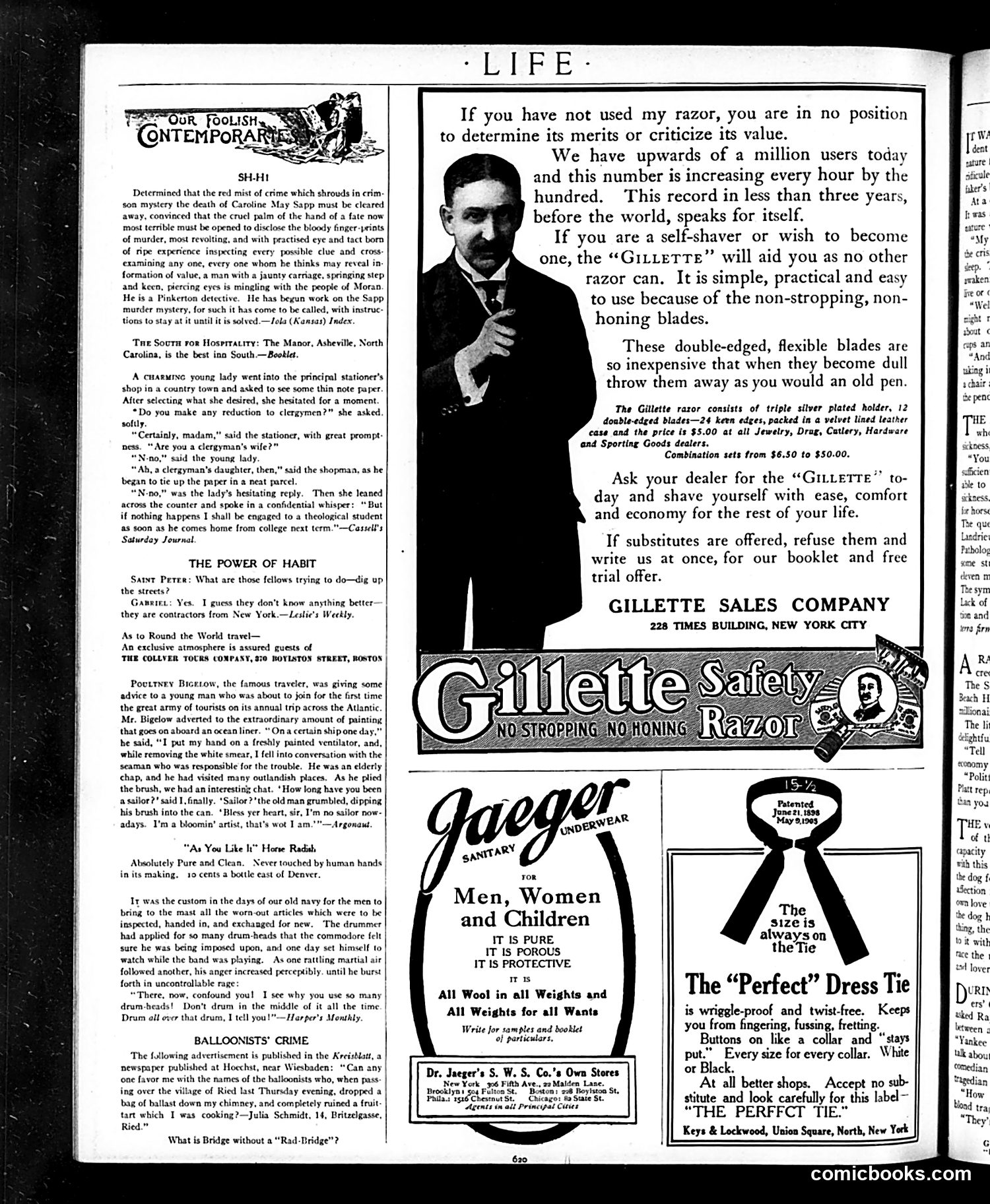
This page combines satirical short stories with period advertisements, typical of early 20th-century Life magazine format. **The Satirical Content:** The page features humorous anecdotes mocking various social pretensions and absurdities: - A Pinkerton detective investigating a murder mystery (Caroline May Sapp case) - A young woman's strategic question about clergy discounts, implying her social aspirations through engagement to a theology student - A traveling anecdote about a ship painter who identifies as an "artist" rather than a sailor—satirizing working-class affectation - A naval commodore's frustration with excessive drum repairs, mocking bureaucratic incompetence **The Advertisements:** Gillette Safety Razor dominates the page, promoting its convenience. Below are ads for Jaeger sanitary underwear and "The Perfect Dress Tie," emphasizing practical consumer goods. **Overall Message:** The page satirizes social climbing, pretension, and the gap between self-perception and reality, wrapped in humorous vignettes typical of Life's editorial voice circa 1900s-1910s.
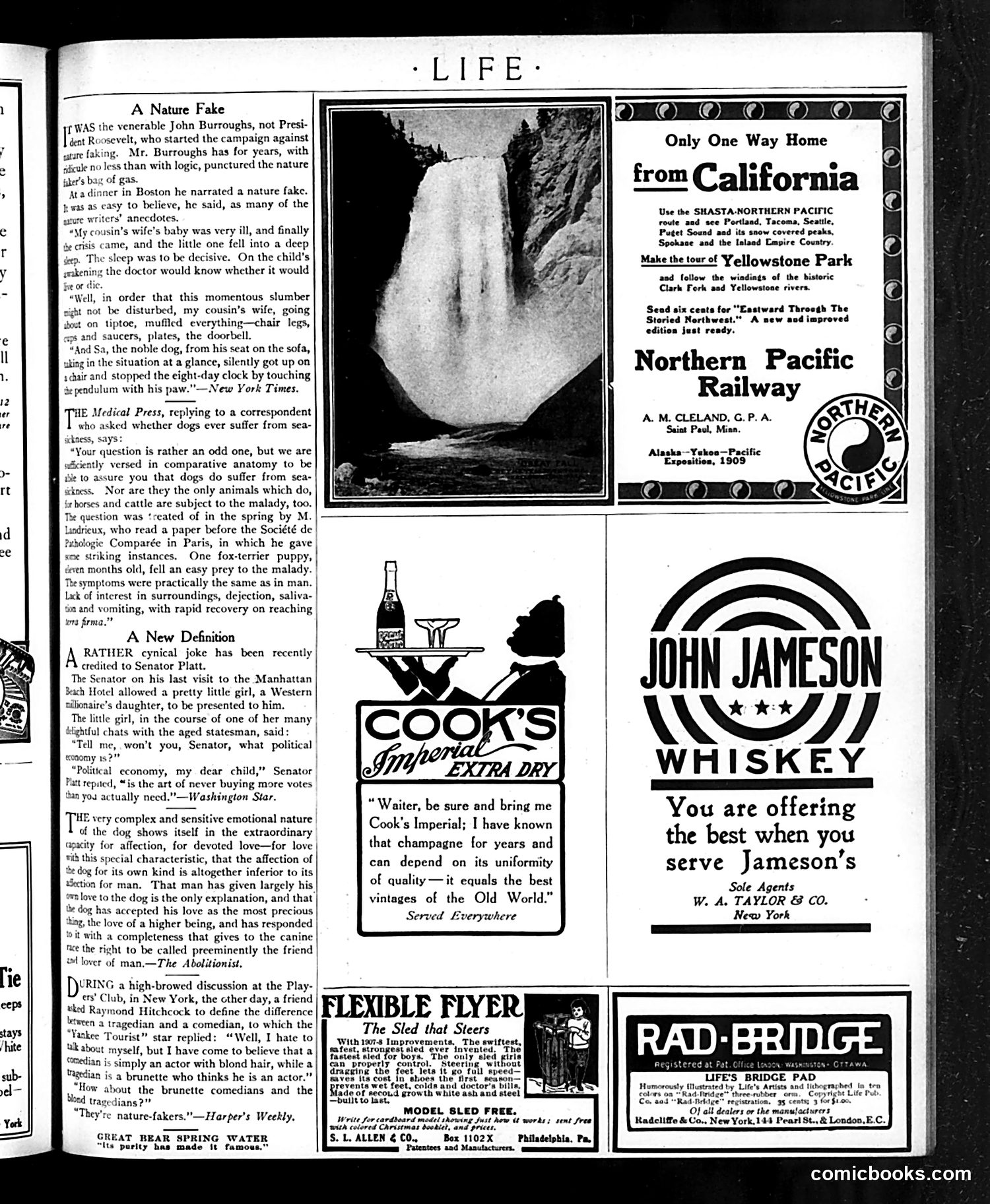
This page contains satirical articles mocking "nature fakes"—exaggerated animal anecdotes popular in early 1900s nature writing. John Burroughs, a naturalist, had launched a campaign against these false stories. The main satire: Burroughs illustrates the absurdity by recounting a supposedly true story about a dog that, understanding a sleeping baby must not be disturbed, silently stops a clock by touching its pendulum. The humor lies in presenting an obviously fabricated tale as genuine while criticizing other writers for doing exactly this. A secondary joke mocks Senator Platt, defining "political economy" as "the art of never buying more votes than you actually need"—a cynical jab at corruption and vote-buying in politics. The page is primarily text-based articles with period advertisements (whiskey, railways, champagne) rather than visual cartoons. The satire targets both nature writers' dishonesty and political corruption of the era.
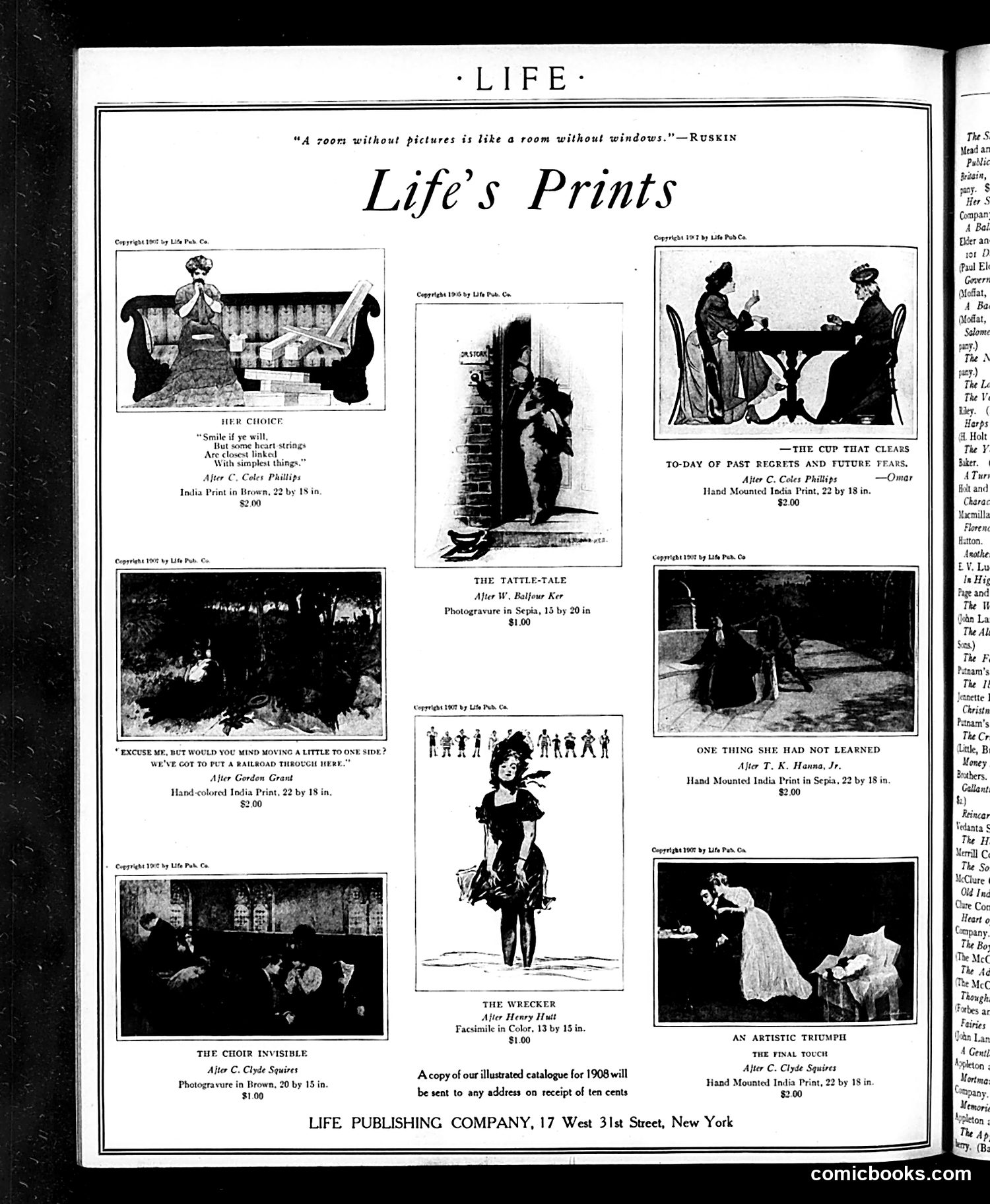
This is primarily a **catalog page advertising art prints** from Life Publishing Company (circa 1907-1908), not political satire. The page showcases eight different prints available for purchase, priced from $1.00 to $2.00. The prints feature sentimental and romantic imagery typical of the era: women in contemplative poses, domestic scenes, and gentle social commentary. Titles like "Her Choice," "The Cup That Clears To-Day of Past Regrets," and "An Artistic Triumph" reflect popular Edwardian taste for melodramatic, emotionally-suggestive subjects. One print, "Excuse Me, But Would You Mind Moving A Little to One Side? We've Got to Put a Railroad Through Here" by Gordon Grant, offers mild social satire about industrial progress displacing traditional life—a relevant early-1900s concern. The artists credited (C. Coles Phillips, Henry Hutt, others) were popular illustrators of the period. This represents Life magazine's commercial art reproduction business, not editorial cartooning.
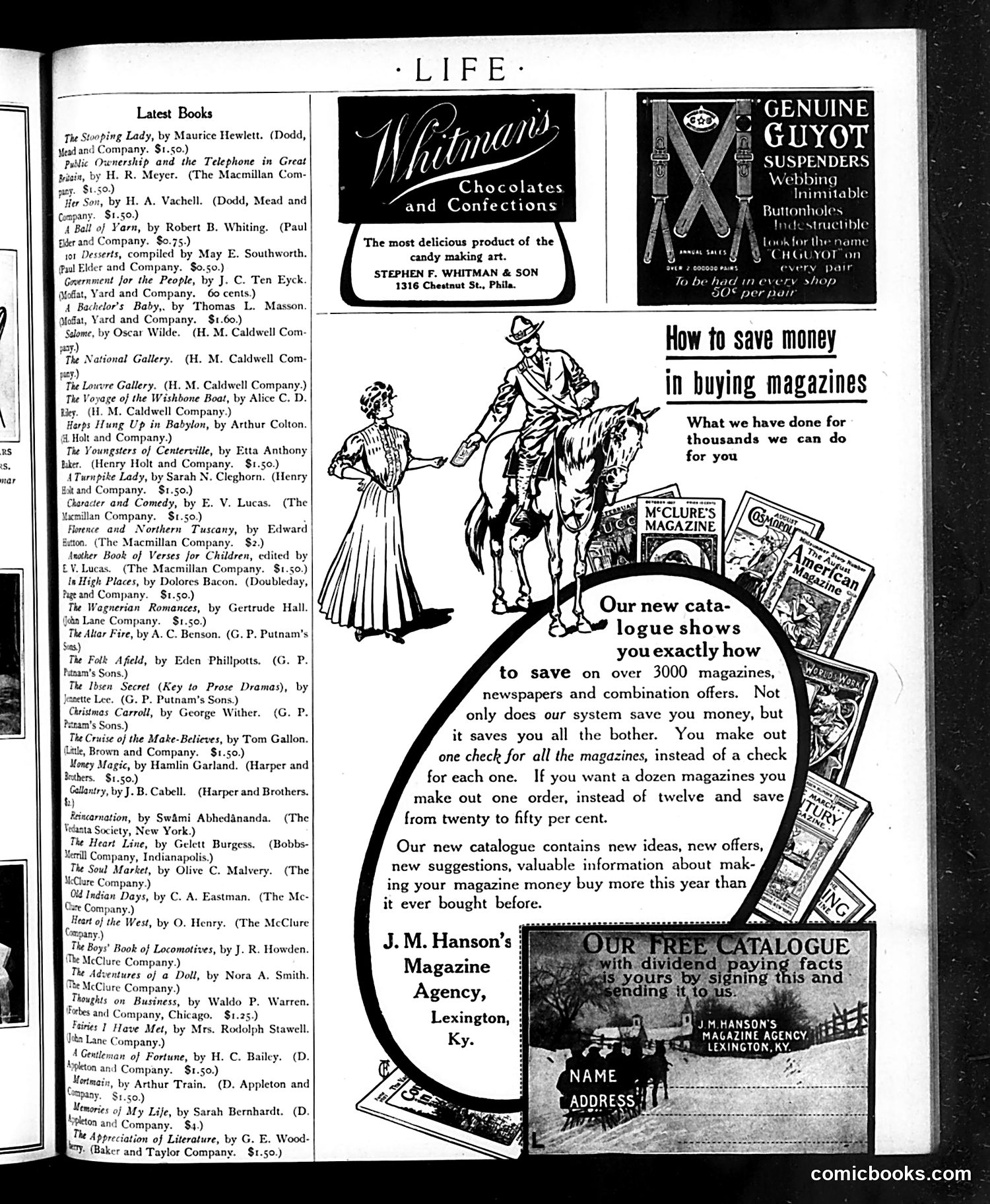
This page is primarily a **book review and advertising section**, not satirical content. The left column lists recent book releases with publishers and prices. The right side features three distinct advertisements: 1. **Whitman's Chocolates** — a straightforward candy advertisement 2. **Guyot Suspenders** — a clothing product ad 3. **J.M. Hanson's Magazine Agency** — the dominant advertisement, featuring an illustration of a cowboy on horseback with a woman, promoting a mail-order magazine subscription service The Hanson's ad emphasizes **convenience and savings**: customers could order multiple magazines through one check and one order (rather than individually) and save 20-50%. This addresses a real problem for early 20th-century readers—managing numerous separate subscriptions. The cowboy imagery suggests efficiency and American practicality. There is **no political satire** on this page. It's a commercial publication demonstrating how Life magazine's pages intermixed editorial content with advertisements to fund publication.
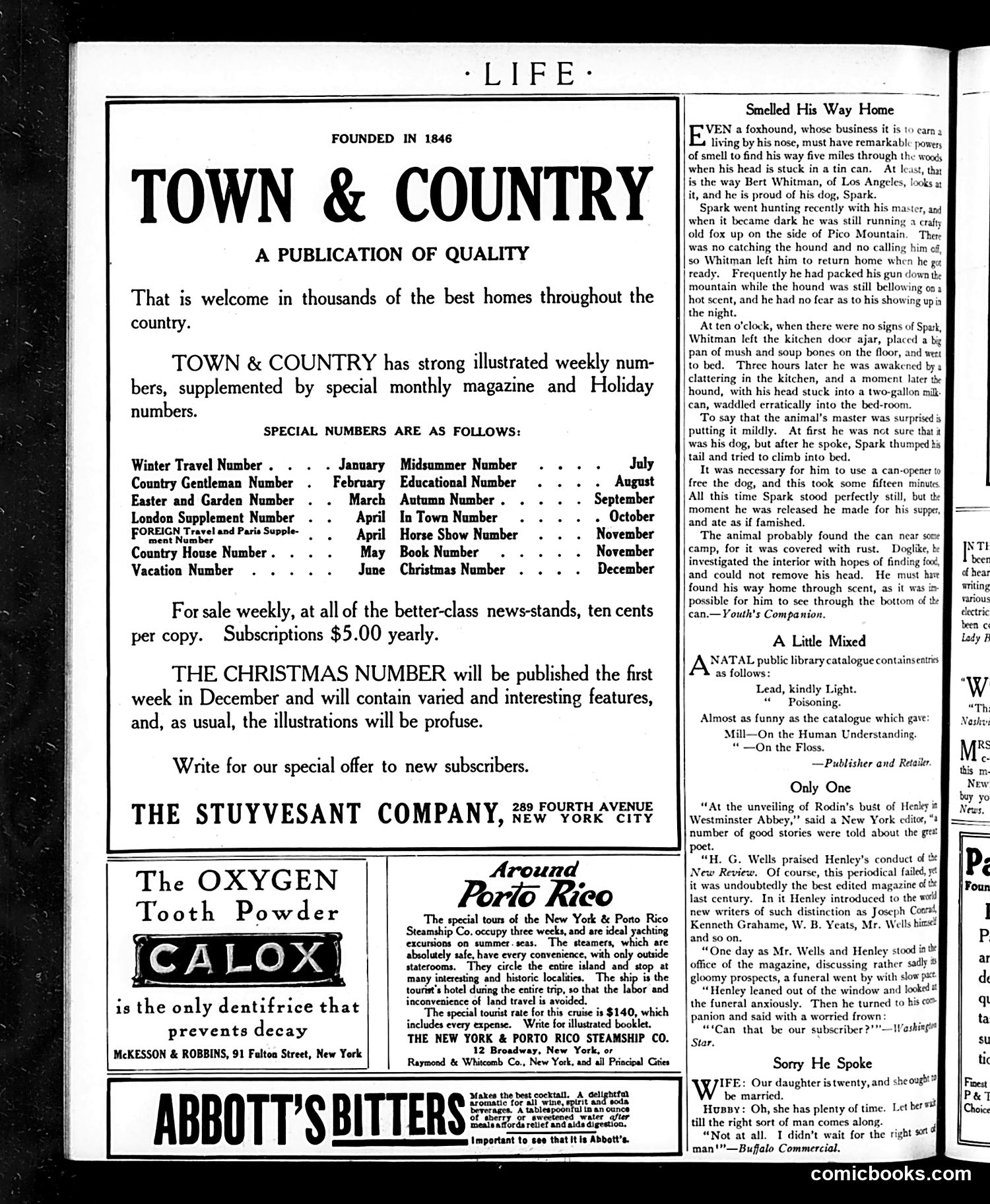
This is primarily a **magazine advertisement and promotional page** for *Town & Country*, a quality publication founded in 1846. There are no political cartoons or satirical content visible. The page promotes the magazine's special themed issues (Winter Travel, Easter and Garden, London Supplement, etc.) and announces subscription rates ($5 yearly). It emphasizes the magazine's presence in "thousands of the best homes throughout the country"—appealing to affluent, refined readers. The right column contains light human-interest stories, including one about a foxhound named Spark who found his way home despite having his head stuck in a tin can, and brief anecdotes about writers H.G. Wells and other literary figures. Below are advertisements for unrelated products: Calox tooth powder, a Porto Rico steamship cruise ($140), and Abbott's Bitters. **This is a table-of-contents/advertising page, not satirical content.**
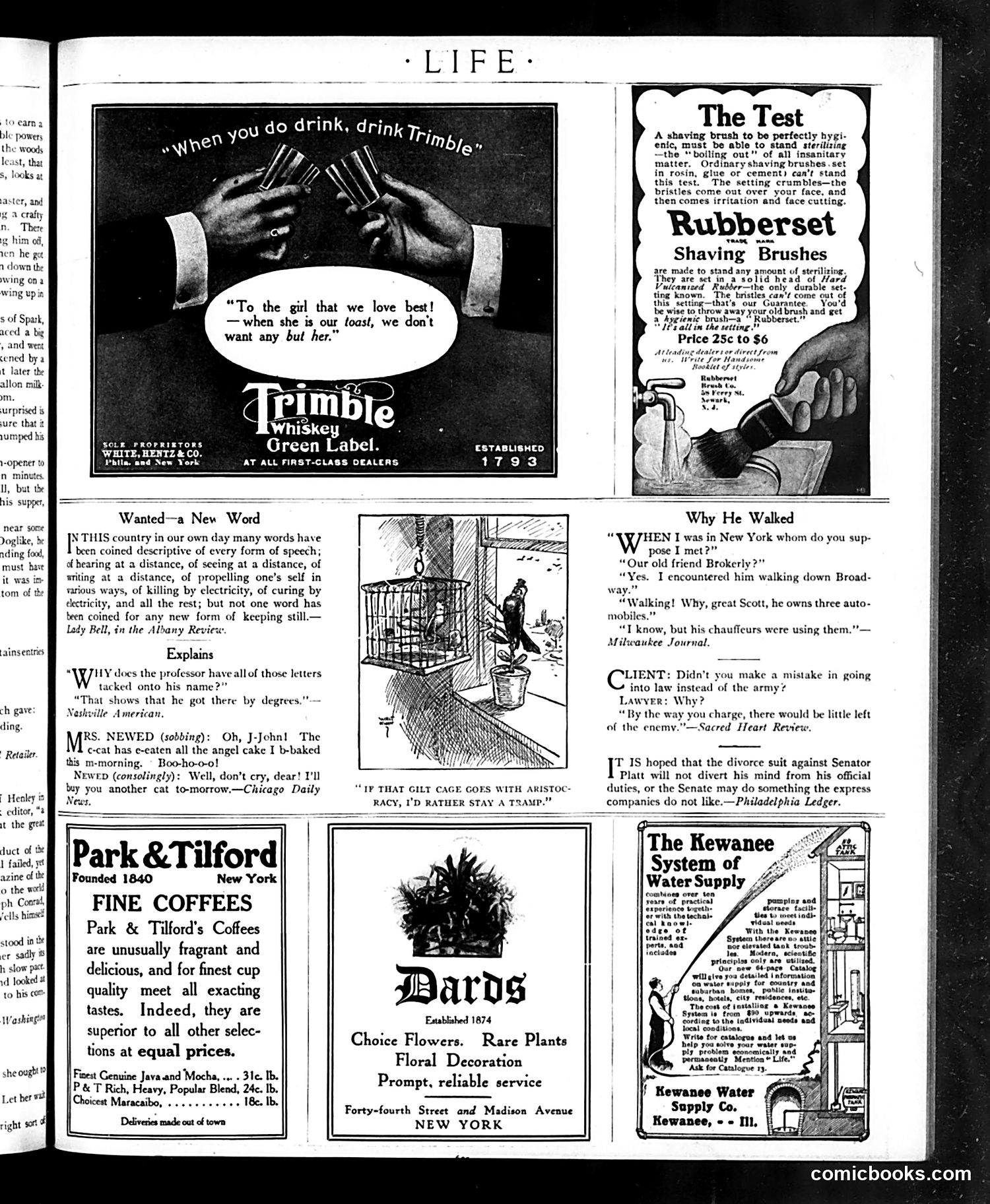
This page is primarily **advertisements and short humor pieces**, not political cartoons. The main content includes: **Trimble Whiskey ad** (top): A sexist advertisement claiming men should drink Trimble because women prefer men who do. Reflects early 20th-century marketing targeting masculine consumption. **Humor bits** (center): Brief jokes from various newspapers—mostly domestic comedy about professors, wives, and everyday absurdities. One jokes about a lawyer's high fees; another mentions Senator Platt's divorce suit, suggesting public figures' personal scandals distracted from Senate duties. **Product advertisements** (bottom): Park & Tilford Fine Coffees, Dards Florist, Rubberset Shaving Brushes (emphasizing hygiene through sterilization—a contemporary concern), and Kewanee water systems. The "Wanted—a New Word" piece notes society has coined terms for new technologies (telephone, electricity) but not for silence—gentle satire on modern noise and communication. Overall: a typical early 1900s Life magazine mix of advertising revenue and light social humor, not serious political commentary.
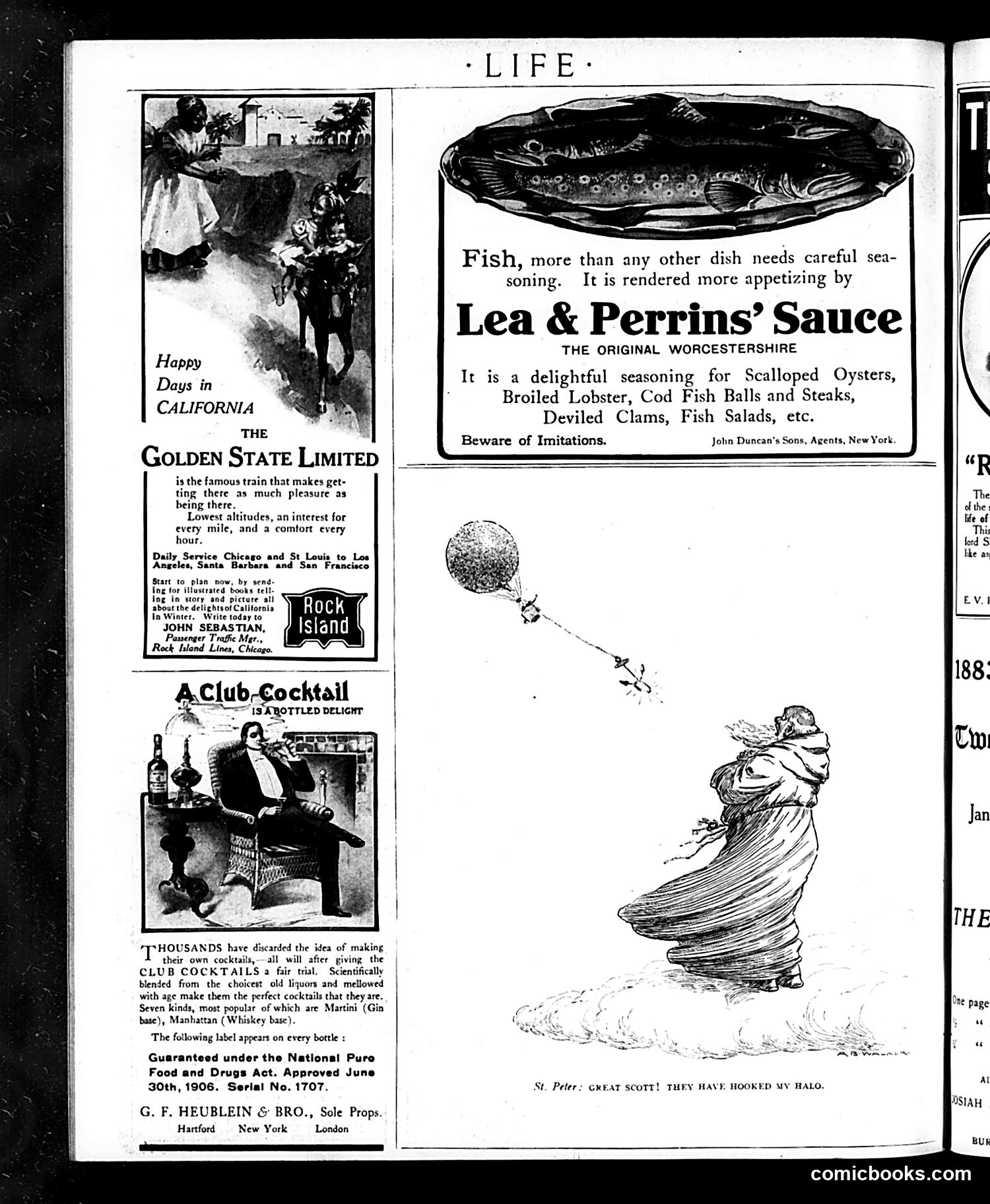
This page is primarily **advertising**, not political satire. It contains four distinct advertisements: 1. **Golden State Limited train** — promoting rail travel to California with promises of comfort and scenic views 2. **Club Cocktails** — a pre-mixed bottled cocktail brand, emphasizing convenience and scientific blending. The ad notes customers no longer need to make their own drinks at home. 3. **Lea & Perrins' Worcestershire Sauce** — featuring a fish illustration, promoting the sauce as essential seasoning for seafood dishes 4. **A cartoon illustration** (bottom right) showing a figure in heavy winter clothing being blown by wind, with the caption "St. Peter: Great Scott! They Have Hooked My Halo." This appears to be humorous filler—a small joke about fishing, perhaps playing on the nearby fish sauce advertisement. The page reflects early 1900s consumer culture and emerging convenience products (bottled cocktails, pre-made sauces).
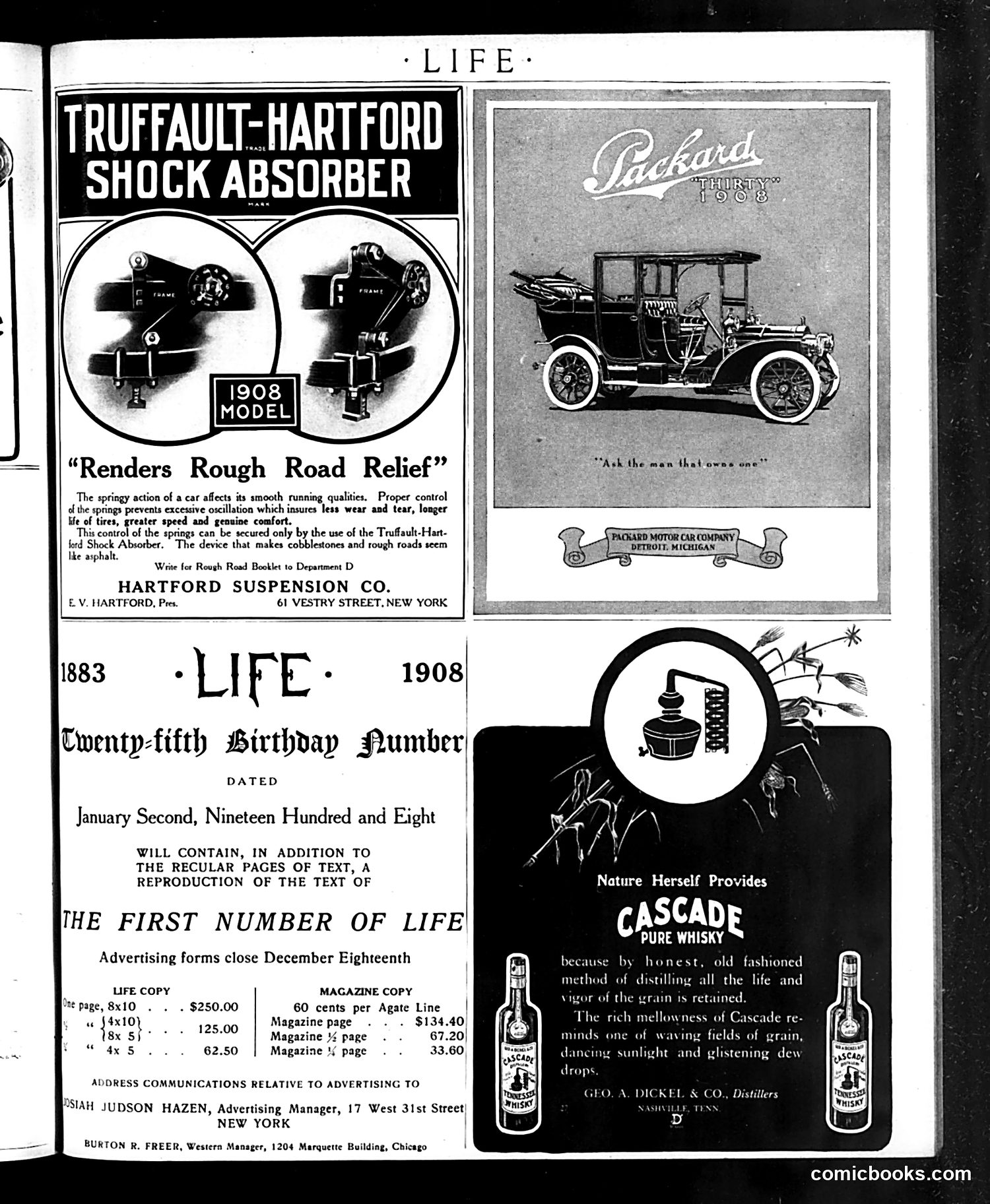
This is primarily a **title/advertising page** for Life's 25th anniversary issue, not a political cartoon page. The page announces that the January 2, 1908 issue will reprint the first number of Life from 1883, celebrating the magazine's quarter-century. Advertising rates and submission deadlines are listed for potential advertisers. The actual advertisements shown are product pitches typical of the era: a Truffault-Hartford shock absorber for automobiles (emphasizing smooth rides on rough roads), a 1908 Packard automobile, and Cascade Pure Whisky. These ads reflect early 1900s consumer goods and emerging automobile technology. There is **no satire or political commentary** visible on this page—it functions as an administrative/commercial announcement for the magazine itself, documenting Life's business operations and advertising rates during this period.
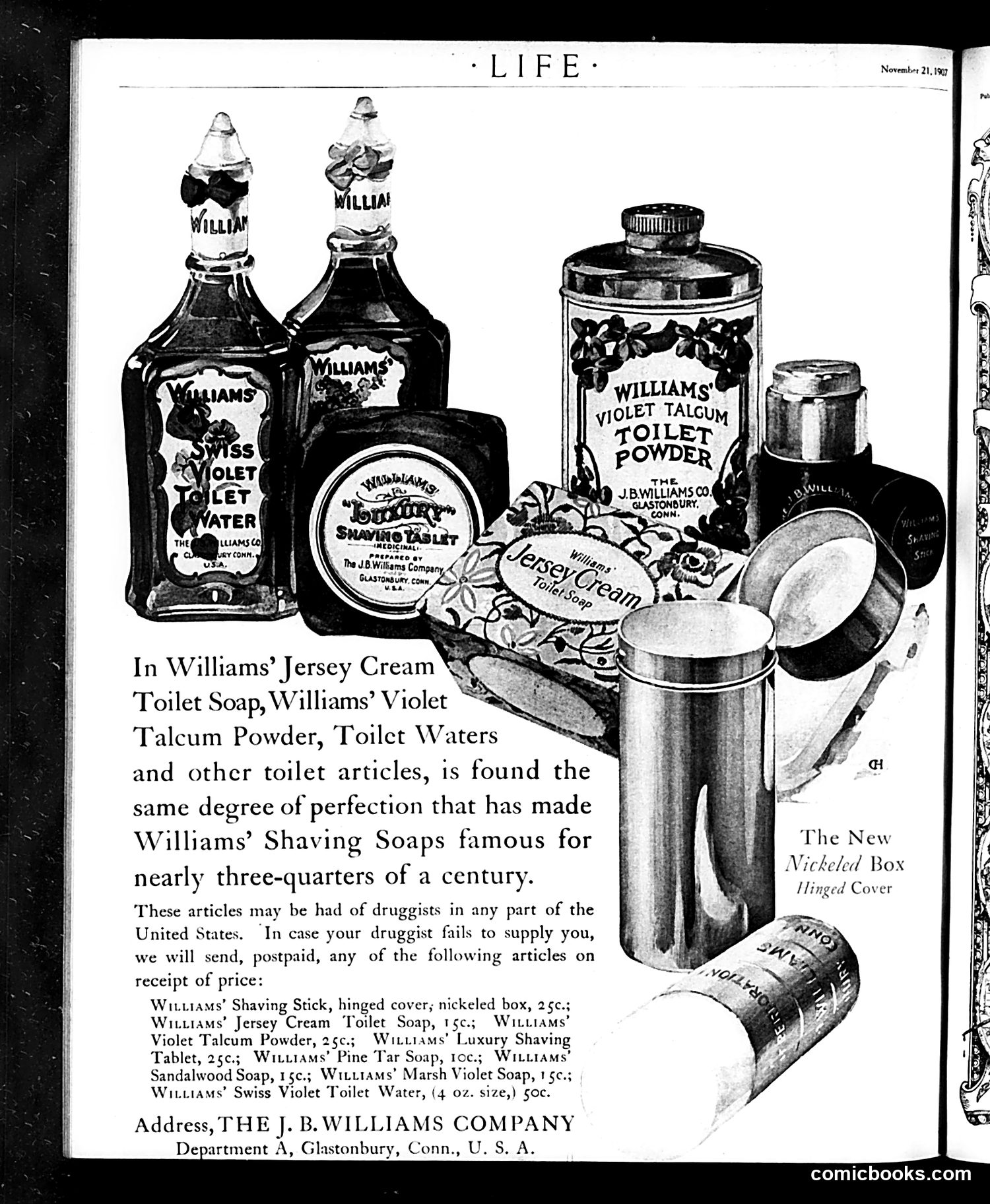
This is **not a political cartoon or satire**—it's a straightforward **product advertisement** for J.B. Williams Company toiletries, published in Life magazine on November 21, 1907. The page displays various toilet articles: two decorative bottles of violet toilet water, a shaving tablet tin, talcum powder containers, toilet soap, and a "new nickeled box with hinged cover." The text claims Williams' toilet products possess the same quality as their famous shaving soaps, which had been popular for "nearly three-quarters of a century." The advertisement offers mail-order purchasing options with specific prices (ranging from 10¢ to 50¢) for readers whose local druggists lack stock. The company address in Glastonbury, Connecticut is provided for orders. This reflects early 1900s marketing conventions: using Life's prestigious editorial space for branded advertising, targeting middle-class consumers with mail-order convenience.