
Life, 1907-11-21 · page 20 of 32
Life — November 21, 1907 — page 20: what you’re looking at
What you’re looking at
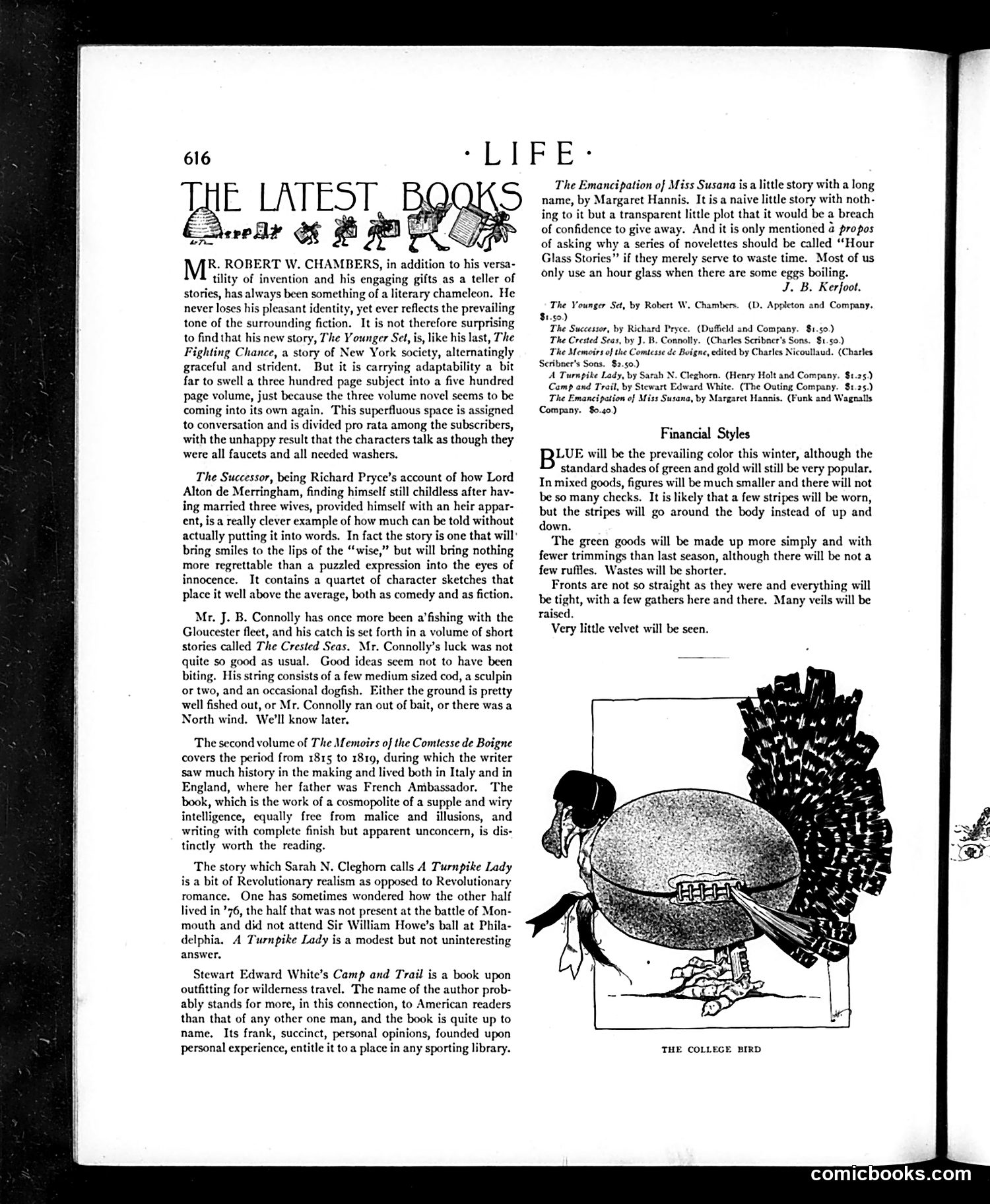
This illustration, titled "The College Bird," depicts a young woman in fashionable 1920s attire—a short skirt, decorative headpiece, and elegant shoes—posed prominently with a peacock. The peacock's elaborate tail feathers dominate the composition, creating a visual pun equating the woman with the vain bird. The satire targets the "flapper" culture emerging in the Jazz Age: young women who embraced modern fashion, shorter hemlines, and social independence. The peacock metaphor suggests these women were primarily concerned with displaying themselves fashionably and attracting attention, much as the bird displays its plumage. The caption's wordplay on "bird" (slang for an attractive young woman) reinforces the comparison. For modern readers, this represents period anxiety about changing gender roles and women's increasing social visibility and autonomy during the 1920s. The cartoon presents this modern femininity as vain and ornamental.
📄 Transcribed text from this page (OCR, searchable)
Machine-transcribed from the original scan — historical spelling and the odd misread are preserved.
616 -LIFE- R. ROBERT W. CHAMBERS, in addition to his versa- tility of invention and his engaging gifts as a teller of storics, has always been something of a literary chameleon. He never loses his pleasant identity, yet ever reflects the prevailing tone of the surrounding fiction. It is not therefore surprising to find that his new story, The Younger Set, is, like his last, The Fighting Chance, a story of New York socicty, alternatingly graceful and strident. But it is carrying adaptability a bit far to swell a three hundred page subject into a five hundred page volume, just because the three volume novel seems to be coming into its own aj This superfluous space is assigned to conversation and is divided pro rata among the subscribers, with the unhappy result that the characters talk as though they were all faucets and all needed washers. The Successor, being Richard Pryce’s account of how Lord Alton de Merringham, finding himself still childless after hav- ing married three wives, provided himself with an heir appar- ent, is a really clever example of how much can be told without actually putting it into words. In fact the story is one that will’ bring smiles to the lips of the “wise,” but will bring nothing more regrettable than a puzzled expression into the eyes of innocence. It contains a quartet of character sketches that place it well above the average, both as comedy and as fiction. Mr. J. B. Connolly has once more been a’fishing with the Gloucester fleet, and his catch is set forth in a volume of short stories called The Crested Seas. Mr. Connolly’s luck was not quite so good as usual. Good ideas seem not to have been biting. His string consists of a few medium sized cod, a sculpin or two, and an occasional dogfish. Either the ground is pretty well fished out, or Mr. Connolly ran out of bait, or there was a North wind. We'll know later. The second volume of The Memoirs of the Comtesse de Boigne covers the period from 1815 to 1819, during which the writer saw much history in the making and lived both in Italy and in England, where her father was French Ambassador, The book, which is the work of a cosmopolite of a supple and wiry intelligence, equally free from malice and illusions, and writing with complete finish but apparent unconcern, is dis- tinctly worth the reading. The story which Sarah N. Cleghom calls A Turnpike Lady is a bit of Revolutionary realism as opposed to Revolutionary romance. One has sometimes wondered how the other half lived in 776, the half that was not present at the battle of Mon- mouth and did not attend Sir William Howe’s ball at Phila- delphia. A Turnpike Lady is a modest but not uninteresting answer, Stewart Edward White’s Camp and Trail is a book upon outfitting for wilderness travel. The name of the author prob- ably stands for more, in this connection, to American readers than that of any other one man, and the book is quite up to name. Its frank, succinct, personal opinions, founded upon personal experience, entitle it to a place in any sporting library. The Emancipation of Miss Susana isa little story with a long name, by Margaret Hannis. It is a naive little story with noth- ing to it but a transparent little plot that it would be a breach of confidence to give away. And it is only mentioned @ propos of asking why a series of novelettes should be called “Hour Glass Stories” if they merely serve to waste time. Most of us only use an hour glass when there are some eggs boiling. J. B. Kerfoot. The Younger Set, by Robert W. Chambers. (D. Appleton and Company. $1.50.) The Successor, by Richard Pryce. (Dufficld and Company. $1.50) The Crested Seas, by J. B. Connolly. (Charles Scribner's Sons. $1.0.) The Memoirs of the Comtesse de Boigne, edited by Charles Nicoullaud. (Charles Scribner's Sons. $2.50.) A Turnpike Lady, by Sarah N. Cleghorn. (Henry Holt and Company. $1.25.) Camp and Trail, by Stewart Edward White. (The Outing Company. $1.25.) The Emancipation of Miss Susana, by Margaret Hannis. (Funk and Wagnalls Company. $0.40) Financial Styles BLUE wilt be the prevailing color this winter, although the standard shades of green and gold will still be very popular. In mixed goods, figures will be much smaller and there will not be so many checks. It is likely that a few stripes will be worn, but the stripes will go around the body instead of up and down. The green goods will be made up more simply and with fewer trimmings than last season, although there will be not a few ruffles. Wastes will be shorter. Fronts are not so straight as they were and everything will be tight, with a few gathers here and there. Many veils will be raised. Very little velvet will be seen. THE COLLEGE BIRD comicbooks.com