
Life, 1907-11-21 · page 10 of 32
Life — November 21, 1907 — page 10: what you’re looking at
What you’re looking at
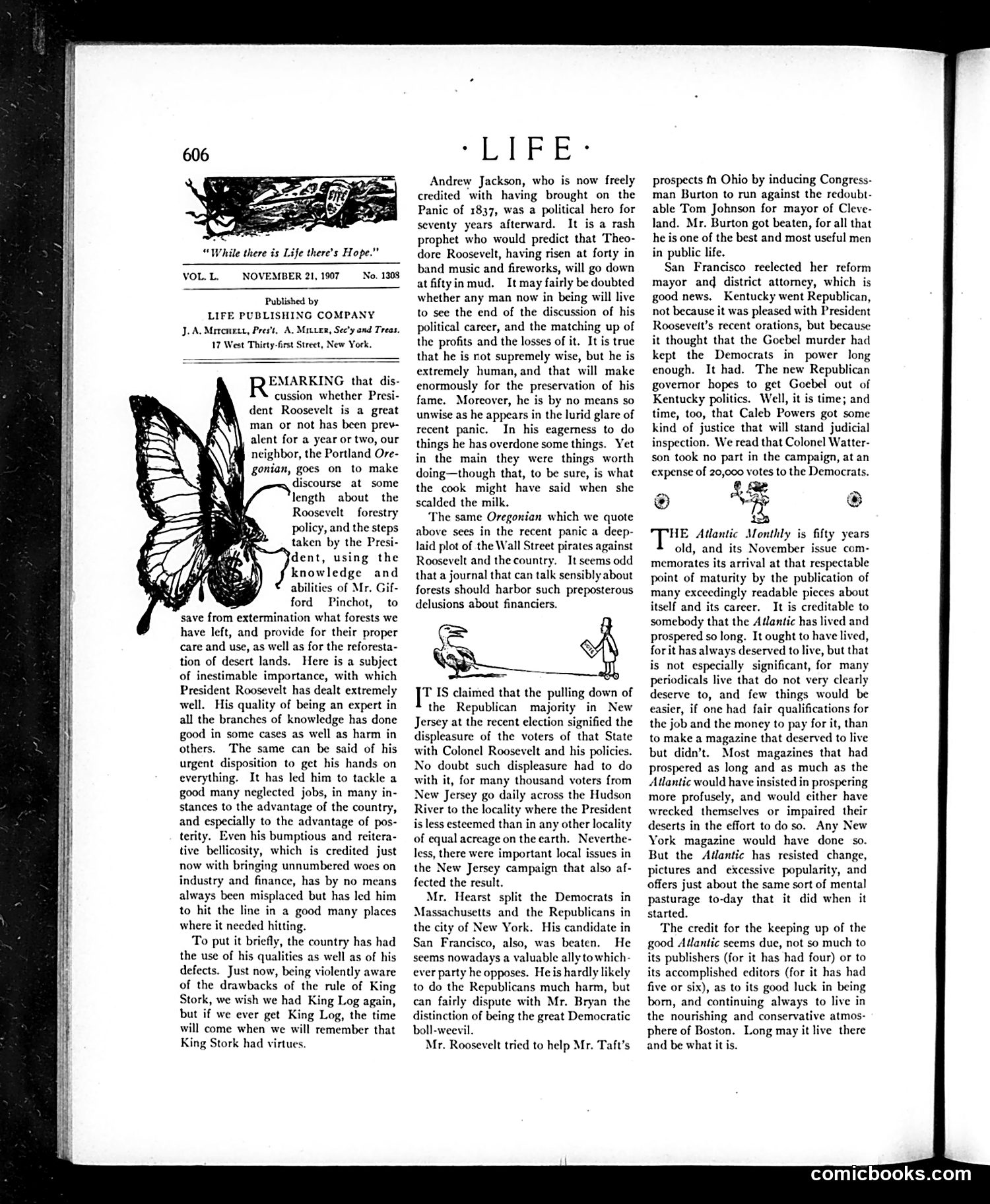
This page contains editorial commentary on President Roosevelt's political record, accompanied by decorative butterfly illustrations. The text discusses Roosevelt's role as a "political hero" and examines whether he has been an adequate president. The main critique focuses on Roosevelt's handling of forestry policy and his recent "panic" response to financial crises—the text suggests he "overdone some things" despite good intentions. The passage references his attempts to aid Secretary Taft and mentions disputes over Roosevelt's policies affecting New Jersey voters and Colonel Roosevelt himself. The piece appears skeptical of Roosevelt's legacy, questioning whether his interventionist approach ultimately helped or harmed the nation, while acknowledging his expertise and good intentions in various policy areas.
📄 Transcribed text from this page (OCR, searchable)
Machine-transcribed from the original scan — historical spelling and the odd misread are preserved.
“While there is Life there's Hope.” VOL.L. NOVEMBER 21,1907 No. 1303 Published by LIFE PUBLISHING COMPANY J. A, Mrrcnmnt, Pres't, A, Minute, Sec'y and Treas. 17 West Thirty-first Street, New York EMARKING that dis- cussion whether Presi- dent Roosevelt is a great man or not has been prev- alent for a year or two, our neighbor, the Portland Ore- gonian, goes on to make discourse at some length about the Roosevelt forestry policy, and the steps , taken by the Presi- dent, using the knowledge and abilities of Mr. Gif- ford Pinchot, to save from extermination what forests we have left, and provide for their proper care and use, as well as for the reforesta- tion of desert lands. Here is a subject of inestimable importance, with which President Roosevelt has dealt extremely well. His quality of being an expert in all the branches of knowledge has done good in some cases as well as harm in others. The same can be said of his urgent disposition to get his hands on everything. It has led him to tackle a good many neglected jobs, in many in- stances to the advantage of the country, and especially to the advantage of pos- terity. Even his bumptious and reitera- tive bellicosity, which is credited just now with bringing unnumbered woes on industry and finance, has by no means always been misplaced but has led him to hit the line in a good many places where it needed hitting. To put it briefly, the country has had the use of his qualities as well as of his defects. Just now, being violently aware of the drawbacks of the rule of King Stork, we wish we had King Log again, but if we ever get King Log, the time will come when we will remember that King Stork had virtues. ‘LIFE Andrew Jackson, who is now freely credited with having brought on the Panic of 1837, was a political hero for seventy years afterward. It is a rash prophet who would predict that Theo- dore Roosevelt, having risen at forty in band music and fireworks, will go down at fiftyinmud. It may fairly be doubted whether any man now in being will live to see the end of the discussion of his political career, and the matching up of the profits and the losses of it. It is true that he is not supremely wise, but he is extremely human, and that will make enormously for the preservation of his fame. Moreover, he is by no means so unwise as he appears in the lurid glare of recent panic. In his eagerness to do things he has overdone some things. Yet in the main they were things worth doing—though that, to be sure, is what the cook might have said when she scalded the milk. ‘The same Oregonian which we quote above sees in the recent panic a deep- laid plot of the Wall Street pirates against Roosevelt and the country. It seems odd that a journal that can talk sensibly about forests should harbor such preposterous delusions about financiers. Gof [73S claimed that the pulling down of the Republican majority in New Jersey at the recent election signified the displeasure of the voters of that State with Colonel Roosevelt and his policies. No doubt such displeasure had to do with it, for many thousand voters from New Jersey go daily across the Hudson River to the locality where the President is less esteemed than in any other locality of equal acreage on the earth. Neverthe- less, there were important local issues in the New Jersey campaign that also af- fected the result. Mr. Hearst split the Democrats in Massachusetts and the Republicans in the city of New York. His candidate in San Francisco, also, was beaten. He seems nowadays a valuable ally towhich- ever party he opposes. He is hardly likely to do the Republicans much harm, but can fairly dispute with Mr. Bryan the distinction of being the great Democratic boll-weevil. Mr. Roosevelt tried to help Mr. Taft’s prospects th Ohio by inducing Congress- man Burton to run against the redoubt- able Tom Johnson for mayor of Cleve- land. Mr. Burton got beaten, for all that he is one of the best and most useful men in public life. San Francisco reelected her reform mayor and district attorney, which is good news. Kentucky went Republican, not because it was pleased with President Rooseveit’s recent orations, but because it thought that the Goebel murder had kept the Democrats in power long enough. It had. The new Republican governor hopes to get Goebel out of Kentucky politics. Well, it is time; and time, too, that Caleb Powers got some kind of justice that will stand judicial inspection. We read that Colonel Watter- son took no part in the campaign, at an expense of 20,000 votes to the Democrats. ; Ae . a HE Atlantic Monthly is fifty years old, and its November issue com- memorates its arrival at that respectable point of maturity by the publication of many exceedingly readable pieces about itself and its career. It is creditable to somebody that the Allantic has lived and prospered so long. It ought to have lived, for it has always deserved to live, but that is not especially significant, for many periodicals live that do not very clearly deserve to, and few things would be easier, if one had fair qualifications for the job and the money to pay for it, than to make a magazine that deserved to live but didn’t. Most magazines that had prospered as long and as much as the Allantic would have insisted in prospering more profusely, and would cither have wrecked themselves or impaired their deserts in the effort to do so. Any New York magazine would have done so. But the Adantic has resisted change, pictures and excessive popularity, and offers just about the same sort of mental pasturage to-day that it did when it started. The credit for the keeping up of the good Atlantic seems due, not so much to its publishers (for it has had four) or to its accomplished editors (for it has had five or six), as to its good luck in being bor, and continuing always to live in the nourishing and conservative atmos- phere of Boston. Long may it live there and be what itis. comicbooks.com