
Life, 1907-11-21 · page 4 of 32
Life — November 21, 1907 — page 4: what you’re looking at
What you’re looking at
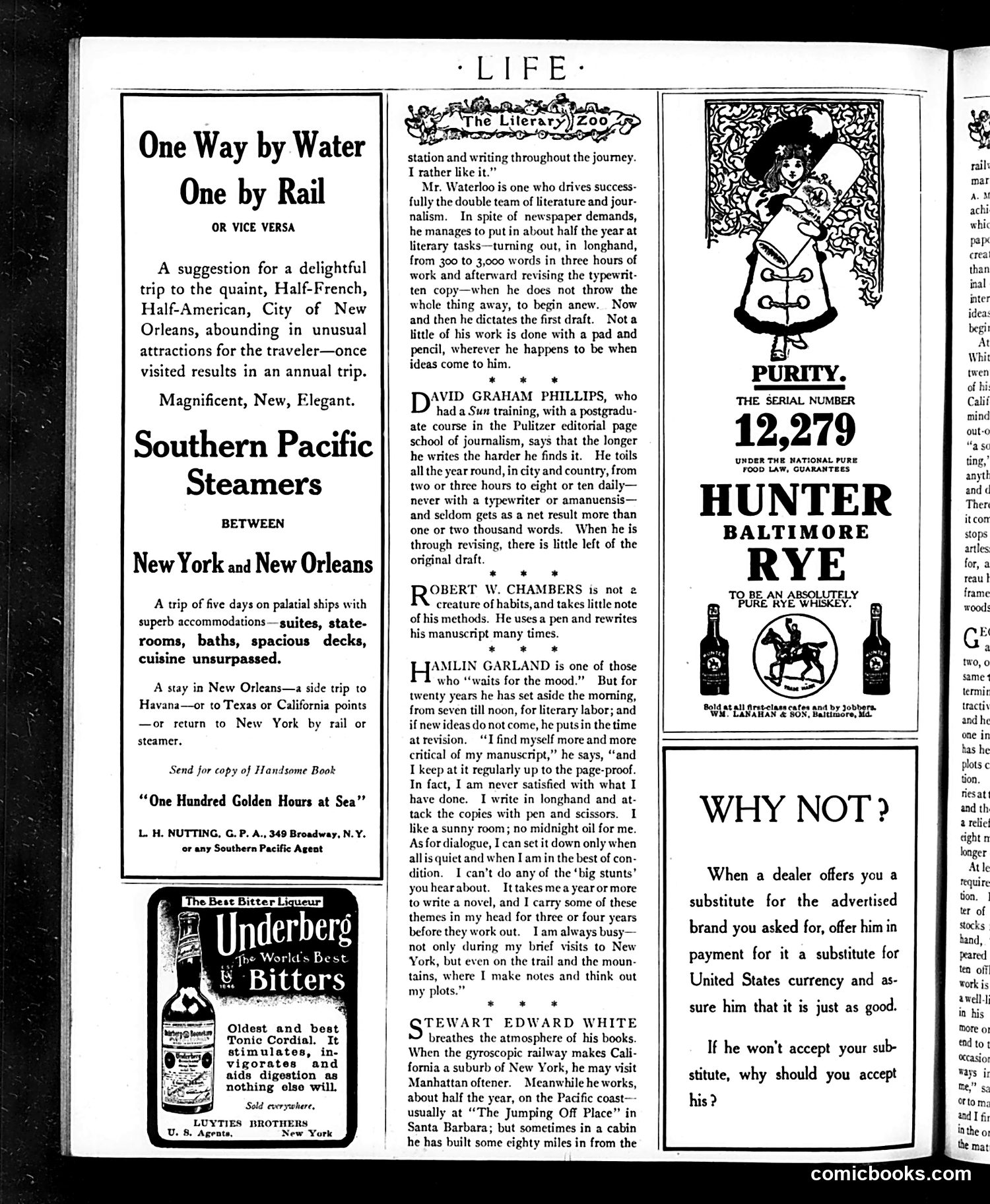
This page is primarily **advertising and literary commentary**, not political satire. The main content features profiles of contemporary writers (Waterloo, Phillips, Chambers, Garland, and White), discussing their writing methods and habits. These appear to be part of a regular "Literary Zoo" column in Life magazine. The cartoon on the right shows a child figure labeled "PURITY" — this is a **product advertisement** for Hunter Baltimore Rye whiskey, using the ironic juxtaposition of "purity" with alcohol (a common marketing technique before Prohibition). The image supports whiskey sales claims. The remaining advertisements cover Southern Pacific steamship travel, Underberg Bitters, and a substitution warning. There is **no political cartoon or satire present** on this page—it's a mix of editorial content and commercial advertisements typical of early 20th-century Life magazine.
📄 Transcribed text from this page (OCR, searchable)
Machine-transcribed from the original scan — historical spelling and the odd misread are preserved.
One Way by Water One by Rail OR VICE VERSA A suggestion for a delightful trip to the quaint, Half-French, Half-American, City of New Orleans, abounding in unusual attractions for the traveler—once visited results in an annual trip. Magnificent, New, Elegant. Southern Pacific Steamers BETWEEN New York ana New Orleans A tip of five days on palatial ships with superb accommodations—guites, state- rooms, baths, spacious decks, cuisine unsurpassed. A stay in New Orleans—a side trip to Havana—or to Texas or California points —or return to New York by rail or steamer. Send for copy of Handsome Book “One Hundred Golden Hours at Sea” L. H. NUTTING, G. P. A., 349 Broadway, N.Y. or any Southern Pacific Agent uP World's Best ES g . Bitters Oldest and best Tonic Cordial. It stimulates, in- vigorates and aids digestion as nothing else will. Sold everywhere, LUYTIES BROTHERS U. 8 Agente, New York station and writing throughout the journey. I rather like it.” Mr. Waterloo is one who drives success- fully the double team of literature and jour- nalism. In spite of newspaper demands, he manages to put in about half the year at literary tasks—turning out, in longhand, from 300 to 3,000 words in three hours of work and afterward revising the typewrit- ten copy—when he does not throw the whole thing away, to begin anew. Now and then he dictates the first draft. Nota little of his work is done with a pad and pencil, wherever he happens to be when ideas come to him. * * * D‘v> GRAHAM PHILLIPS, who had a Sun training, with a postgradu- ate course in the Pulitzer editorial page school of journalism, says that the longer he writes the harder he finds it. He toils all the year round, in city and country, from two or three hours to eight or ten daily— never with a typewriter or amanucnsis— and seldom gets as a net result more than one or two thousand words. When he is through revising, there is little left of the original draft. * * * OBERT W. CHAMBERS is not 2 creature of habits, and takes little note of his methods. He uses a pen and rewrites his manuscript many times. * * * Hass GARLAND is one of those who ‘‘waits for the mood.” But for twenty years he has set aside the morning, from seven till noon, for literary labor; and if new ideas do not come, he putsin the time atrevision. “I find myself more and more critical of my manuscript,” he says, “and I keep at it regularly up to the page-proof. In fact, I am never satisfied with what I have done. I write in longhand and at- tack the copies with pen and scissors. I like a sunny room; no midnight oil for me. As for dialogue, Ian set it down only when allis quiet and when I am in the best of con- dition. I can’t do any of the ‘big stunts’ youhearabout. It takes mea year or more to write a novel, and I carry some of these themes in my head for three or four years before they work out. I am always busy— not only during my brief visits to New York, but even on the trail and the moun- tains, where I make notes and think out my plots.” * * TEWART EDWARD WHITE breathes the atmosphere of his books. When the gyroscopic railway makes Cali- fornia a suburb of New York, he may visit Manhattan oftener. Meanwhile he works, about half the year, on the Pacific coast— usually at “The Jumping Off Place” in Santa Barbara; but sometimes in a cabin he has built some eighty miles in from the ———s ‘THE SERIAL NUMBER 12,279 UNDER THE NATIONAL PURE FOOD LAW, GUARANTEES HUNTER BALTIMORE RYE TO BE_AN ABSOLUTELY A PURE RYE RU PISKEY. s) | sRtby oddone WHY NOT? When a dealer offers you a substitute for the advertised brand you asked for, offer him in payment for it a substitute for United States currency and as- sure him that it is just as good. If he won't accept your sub- stitute, why should you accept his? rails mar AM achi whic pap crea’ than inal inter idea: begi At Whit twen of hi: Calif mind out-o “asc ting,’ anyth and ¢ Ther itcon stops artles for, a reau t frame woods CE a two, 0 same 4 termir tractiv and he one in has he plots c tion. Hiesat: and th a reli! eight n longer Atle require tion, | ter of stocks band, peared ten of work is awell-li in his more of tnd tot &casior ways it comicbooks.com