
Life, 1907-11-21 · page 18 of 32
Life — November 21, 1907 — page 18: what you’re looking at
What you’re looking at
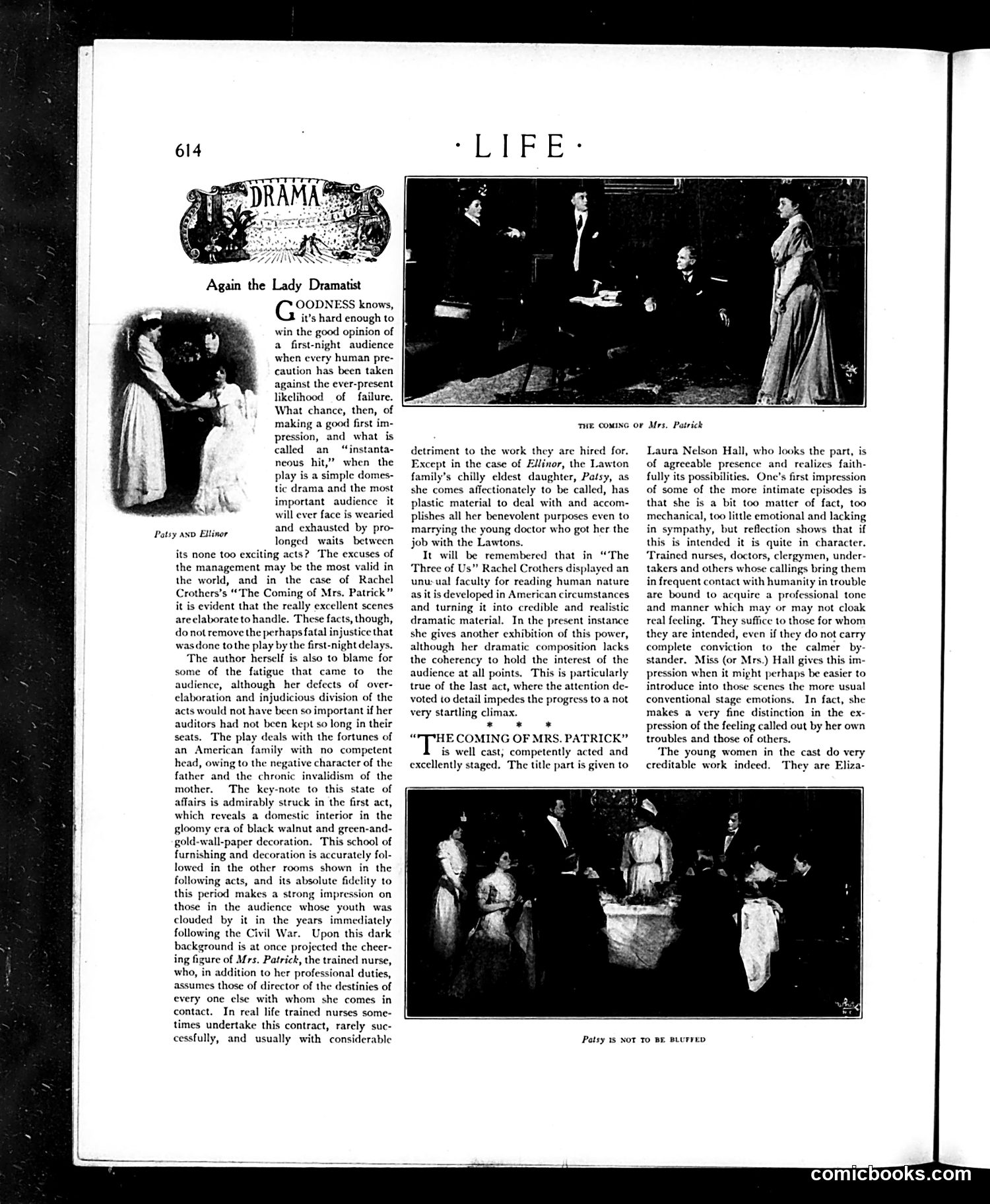
This page reviews Rachel Crothers's play "The Coming of Mrs. Patrick," a domestic drama about an American family lacking strong parental leadership. The title character is a trained nurse who takes charge of the household's affairs, including matchmaking for the eldest daughter, Ellinor. The critic praises Crothers's ability to capture realistic American family dynamics (noting her success in the earlier play "The Three of Us"), but faults the current play for being overly elaborate and poorly paced—lengthy waits between acts fatigued the opening-night audience. Laura Nelson Hall plays the lead role competently but somewhat mechanically. The review suggests this coldness may be intentional characterization. The play reflects post-Civil War domestic aesthetics with period-accurate furnishings, evoking nostalgia for audiences who lived through that era.
📄 Transcribed text from this page (OCR, searchable)
Machine-transcribed from the original scan — historical spelling and the odd misread are preserved.
Patsy axp Ellinor Again the Lady Dramatist OODNESS knows, it’s hard enough to win the good opinion of a first-night audience when every human pre- caution has been taken against the ever-present likelihood of failure. What chance, then, of making a good first im- pression, and what is called an “instanta- neous hit,” when the play is a simple domes- tic drama and the most important audience it will ever face is wearied and exhausted by pro- longed waits between its none too exciting acts? The excuses of the management may be the most valid in the world, and in the case of Rachel Crothers’s “The Coming of Mrs. Patrick” it is evident that the really excellent scenes areelaborate to handle. These facts, though, do not remove the perhaps fatal injustice that wasdone tothe play by the first-night delays. ‘The author herself is also to blame for some of the fatigue that came to the audience, although her defects of over- elaboration and injudicious division of the acts would not have been so important if her auditors had not been kept so long in their seats, The play deals with the fortunes of an American family with no competent head, owing to the negative character of the father and the chronic invalidism of the mother. The key-note to this state of affairs is admirably struck in the first act, which reveals a domestic interior in the gloomy cra of black walnut and green-and- gold-wall-paper decoration. This school of furnishing and decoration is accurately fol- lowed in the other rooms shown in the following acts, and its absolute fidelity to this period makes a strong impression on those in the audience whose youth was clouded by it in the years immediately following the Civil War. Upon this dark background is at once projected the cheer- ing figure of Mrs. Patrick, the trained nurse, who, in addition to her professional duties, assumes those of director of the destinies of every one else with whom she comes in contact. In real life trained nurses some- times undertake this contract, rarely suc- cessfully, and usually with considerable THE COMING or Mrs. Patrick detriment to the work they are hired for. xcept in the case of Ellinor, the Lawton mily’s chilly eldest daughter, Patsy, as she comes affectionately to be called, has plastic material to deal with and accom- plishes all her benevolent purposes even to marrying the young doctor who got her the job with the Lawtons. It will be remembered that in “The ‘Three of Us” Rachel Crothers displayed an unu-ual faculty for reading human nature as it is developed in American circumstances and turning it into credible and realistic dramatic material. In the present instance she gives another exhibition of this power, although her dramatic composition lacks the coherency to hold the interest of the audience at all points, This is particularly true of the last act, where the attention de- voted to detail impedes the progress to a not very startling climax. se “ HE COMING OF MRS. PATRICK” is well cast, competently acted and excellently staged. The title part is given to Laura Nelson Hall, who looks the part, is of agreeable presence and realizes faith- fully its possibilities. One's first impression of some of the more intimate cpisodes is that she is a bit too matter of fact, too mechanical, too little emotional and lacking in sympathy, but reflection shows that if this is intended it is quite in character. ‘Trained nurses, doctors, clergymen, under- takers and others whose callings bring them in frequent contact with humanity in trouble are bound to acquire a professional tone and manner which may or may not cloak real fecling. They suffice to those for whom they are intended, even if they do not carry complete conviction to the calmer by- stander. Miss (or Mrs.) Hall gives this im- pression when it might perhaps be easier to introduce into those scenes the more usual conventional stage emotions. In fact, she makes a very fine distinction in the ex- pression of the feeling called out by her own troubles and those of others. ‘The young women in the cast do very creditable work indeed. ‘They are Eliza- Palsy 18 NOT To BE BLUFYED comicbooks.com