
Life, 1907-11-21 · page 11 of 32
Life — November 21, 1907 — page 11: what you’re looking at
What you’re looking at
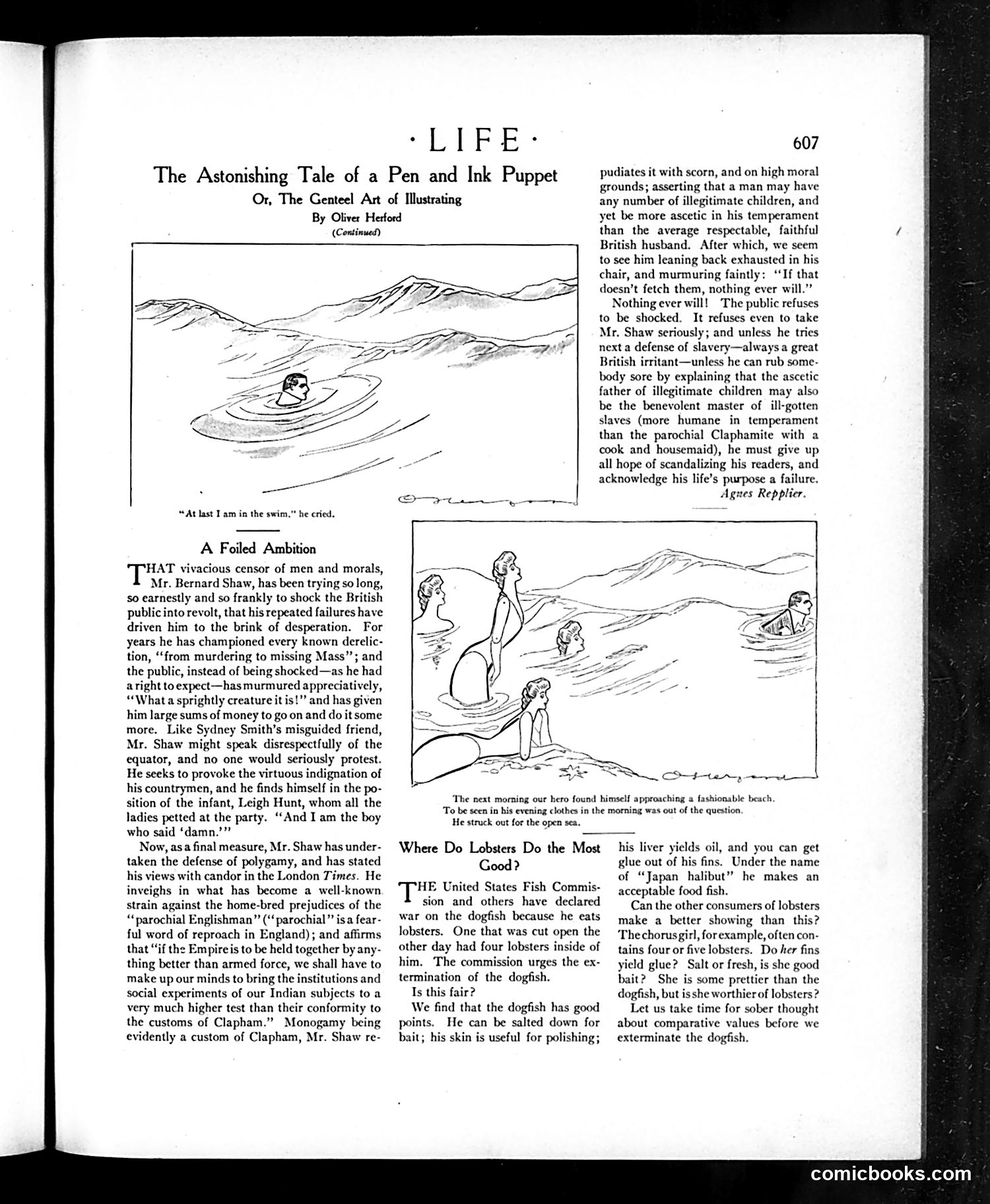
This page contains satirical commentary on Mr. Leonard Shaw, a British moralist and censor who has been publicly campaigning against various social "derelictions" and indecencies. The text criticizes Shaw's hypocrisy: while he publicly scandalized readers by detailing supposed immoral behaviors, he simultaneously defended polygamy in the *London Times* and argued that the British Empire should tolerate practices (like among Indian subjects) that Shaw himself condemned domestically. The accompanying pen-and-ink illustrations humorously depict Shaw's "foiled ambition"—showing a man swimming and discovering himself washed ashore, suggesting his moral crusade has foundered. The page also includes an unrelated section on dogfish consumption, appearing to be separate satirical content.
📄 Transcribed text from this page (OCR, searchable)
Machine-transcribed from the original scan — historical spelling and the odd misread are preserved.
‘LIPS. The Astonishing Tale of a Pen and Ink Puppet Or, The Genteel Art of Illustrating By Oliver Herford (Continued) 607 pudiates it with scorn, and on high moral grounds; asserting that a man may have any number of illegitimate children, and yet be more ascetic in his temperament than the average respectable, faithful British husband. After which, we seem to see him leaning back exhausted in his chair, and murmuring faintly: “If that doesn’t fetch them, nothing ever will.”” Nothing ever will! The public refuses to be shocked. It refuses even to take Mr. Shaw seriously; and unless he tries next a defense of slavery—always a great British irritant—unless he can rub some- body sore by explaining that the ascetic father of illegitimate children may also be the benevolent master of ill-gotten slaves (more humane in temperament than the parochial Claphamite with a cook and housemaid), he must give up all hope of scandalizing his readers, and acknowledge his life’s purpose a failure. Agnes Repplier. “At last Iam in the swim.” he cried. A Foiled Ambition Tes vivacious censor of men and morals, Mr. Bernard Shaw, has been trying so long, so earnestly and so frankly to shock the British public into revolt, that his repeated failures have driven him to the brink of desperation. For years he has championed every known derelic- tion, ‘‘from murdering to missing Mass”; and the public, instead of being shocked—as he had aright toexpect—has murmured appreciatively, “What a sprightly creature it is!” and has given him large sums of money to go on and do it some more. Like Sydney Smith’s misguided friend, Mr. Shaw might speak disrespectfully of the equator, and no one would seriously protest. He seeks to provoke the virtuous indignation of his countrymen, and he finds himself in the po- sition of the infant, Leigh Hunt, whom all the ladies petted at the party. ‘And I am the boy who said ‘damn.’” : ae Otay ene ‘The next morning our hero found himself approaching a fashionable beach. To be scen in his evening clothes in the morning was out of the question. He struck out for the open sea, Now, asa final measure, Mr. Shaw has under- taken the defense of polygamy, and has stated his views with candor in the London Times. He inveighs in what has become a well-known. strain against the home-bred prejudices of the “parochial Englishman” (“ parochial” isa fear- ful word of reproach in England); and affirms that “if the Empireis to be held together by any- thing better than armed force, we shall have to make up our minds to bring the institutions and social experiments of our Indian subjects to a very much higher test than their conformity to the customs of Clapham.” Monogamy being evidently a custom of Clapham, Mr. Shaw re- Where Do Lobsters Do the Most Good ? 'HE United States Fish Commis- sion and others have declared war on the dogfish because he eats lobsters. One that was cut open the other day had four lobsters inside of him, The commission urges the ex- termination of the dogfish. Is this fair? We find that the dogfish has good points. He can be salted down for bait; his skin is useful for polishing; his liver yields oil, and you can get glue out of his fins. Under the name of “Japan halibut” he makes an acceptable food fish. Can the other consumers of lobsters make a better showing than this? Thechorusgirl, forexample, often con- tains four or five lobsters. Do her fins yield glue? Salt or fresh, is she good bait? She is some prettier than the dogfish, but is she worthier of lobsters? Let us take time for sober thought about comparative values before we exterminate the dogfish. comicbooks.com