
Life, 1907-11-21 · page 14 of 32
Life — November 21, 1907 — page 14: what you’re looking at
What you’re looking at
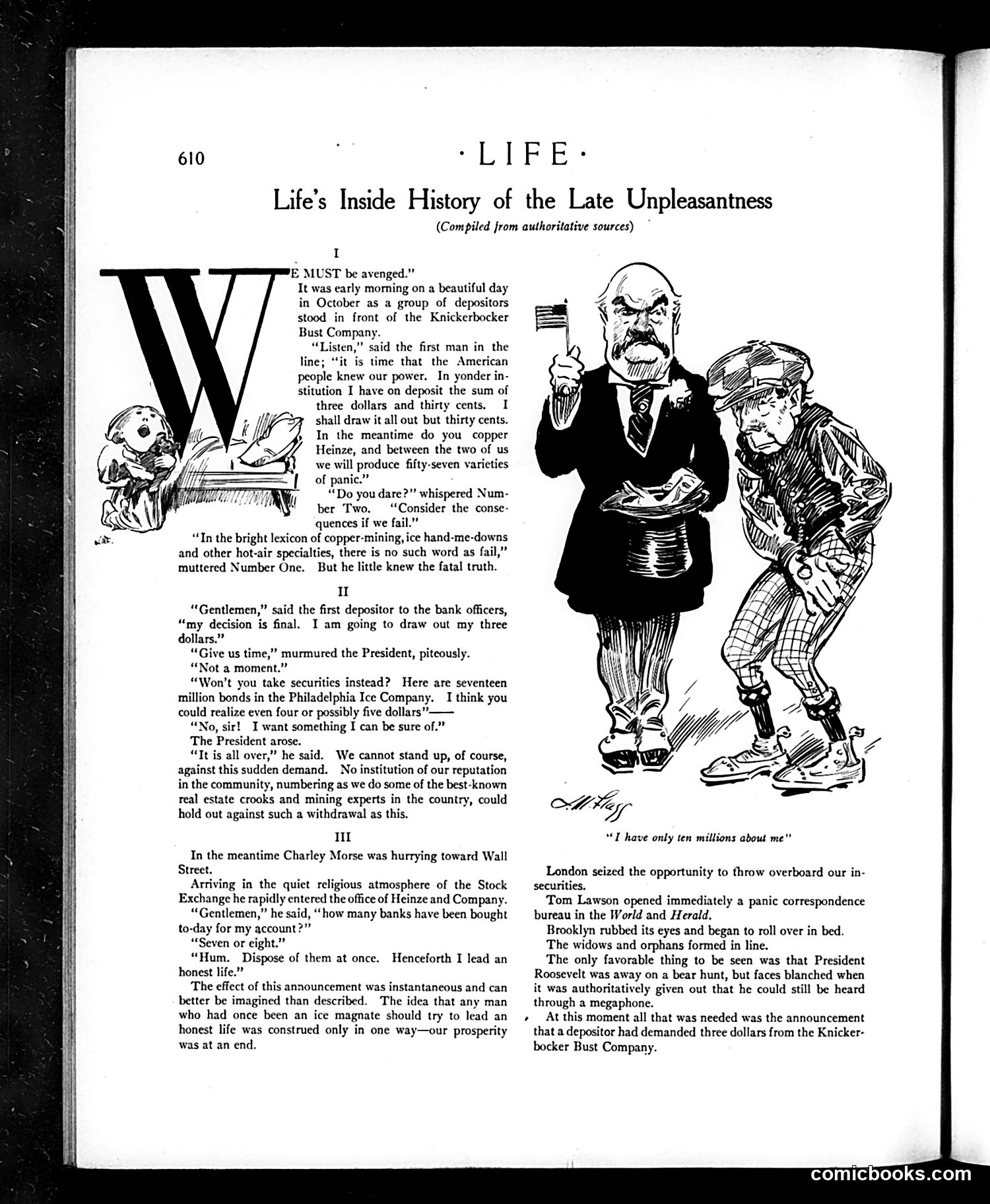
This Life magazine piece satirizes the 1907 financial crisis, specifically the Knickerbocker Bank collapse. The cartoon mocks how panic spreads irrationally through financial markets. The satire targets: **Key figures**: "Charley Morse" (likely Fritz Augustus Heinze, a copper magnate implicated in the panic), and unnamed depositors whose small withdrawals trigger cascading bank failures. **The joke**: A depositor threatens to withdraw just $3.00 from his account, claiming this will cause panic. Meanwhile, Morse's announcement that he'll lead an "honest life" is treated as catastrophic—the financial world *expects* dishonesty from mining speculators and bankers. **The point**: The 1907 panic was irrational herd behavior. Wealthy financiers like Morse could manipulate markets through psychological pressure rather than real economic collapse. The cartoon ridicules both the fragility of the banking system and the moral corruption of financial elites—these are presented as "real estate crooks and mining experts," not legitimate bankers.
📄 Transcribed text from this page (OCR, searchable)
Machine-transcribed from the original scan — historical spelling and the odd misread are preserved.
*“LIFE- Life’s Inside History of the Late Unpleasantness (Compiled from authoritative sources) I E MUST be avenged.” It was early morning on a beautiful day in October as a group of depositors stood in front of the Knickerbocker Bust Company. “Listen,” said the first man in the line; “it is time that the American people knew our power. In yonder in- stitution I have on deposit the sum of three dollars and thirty cents. I shall draw it all out but thirty cents. In the meantime do you copper Heinze, and between the two of us we will produce fifty-seven varieties of panic.” “Do you dare?” whispered Num- ber Two. “Consider the conse- quences if we fail.” “‘In the bright lexicon of copper-mining, ice hand-me-downs and other hot-air specialties, there is no such word as fail,” muttered Number One. But he little knew the fatal truth. II “Gentlemen,” said the first depositor to the bank officers, “my decision is final. I am going to draw out my three dollars.” “Give us time,” murmured the President, piteously. “Not a moment.” “Won't you take securities instead? Here are seventeen million bonds in the Philadelphia Ice Company. I think you could realize even four or possibly five dollars” — “No, sir! I want something I can be sure of.” The President arose. “Tt is all over,” he said. We cannot stand up, of course, against this sudden demand. No institution of our reputation in the community, numbering as we do some of the best-known real estate crooks and mining experts in the country, could hold out against such a withdrawal as this. peg In the meantime Charley Morse was hurrying toward Wall Street. Arriving in the quiet religious atmosphere of the Stock Exchange he rapidly entered the office of Heinze and Company. “Gentlemen,” he said, “‘how many banks have been bought to-day for my account?” “Seven or eight.” “Hum. Dispose of them at once. honest life.” The effect of this announcement was instantaneous and can better be imagined than described. The idea that any man who had once been an ice magnate should try to lead an honest life was construed only in one way—our prosperity was at an end. Henceforth I lead an ’ “I have only ten millions about me” London seized the opportunity to throw overboard our in- securities. Tom Lawson opened immediately a panic correspondence bureau in the World and Herald. Brooklyn rubbed its eyes and began to roll over in bed. The widows and orphans formed in line. The only favorable thing to be seen was that President Roosevelt was away on a bear hunt, but faces blanched when it was authoritatively given out that he could still be heard through a megaphone. At this moment all that was needed was the announcement that a depositor had demanded three dollars from the Knicker- bocker Bust Company. comicbooks.com