
Life, 1907-11-21 · page 15 of 32
Life — November 21, 1907 — page 15: what you’re looking at
What you’re looking at
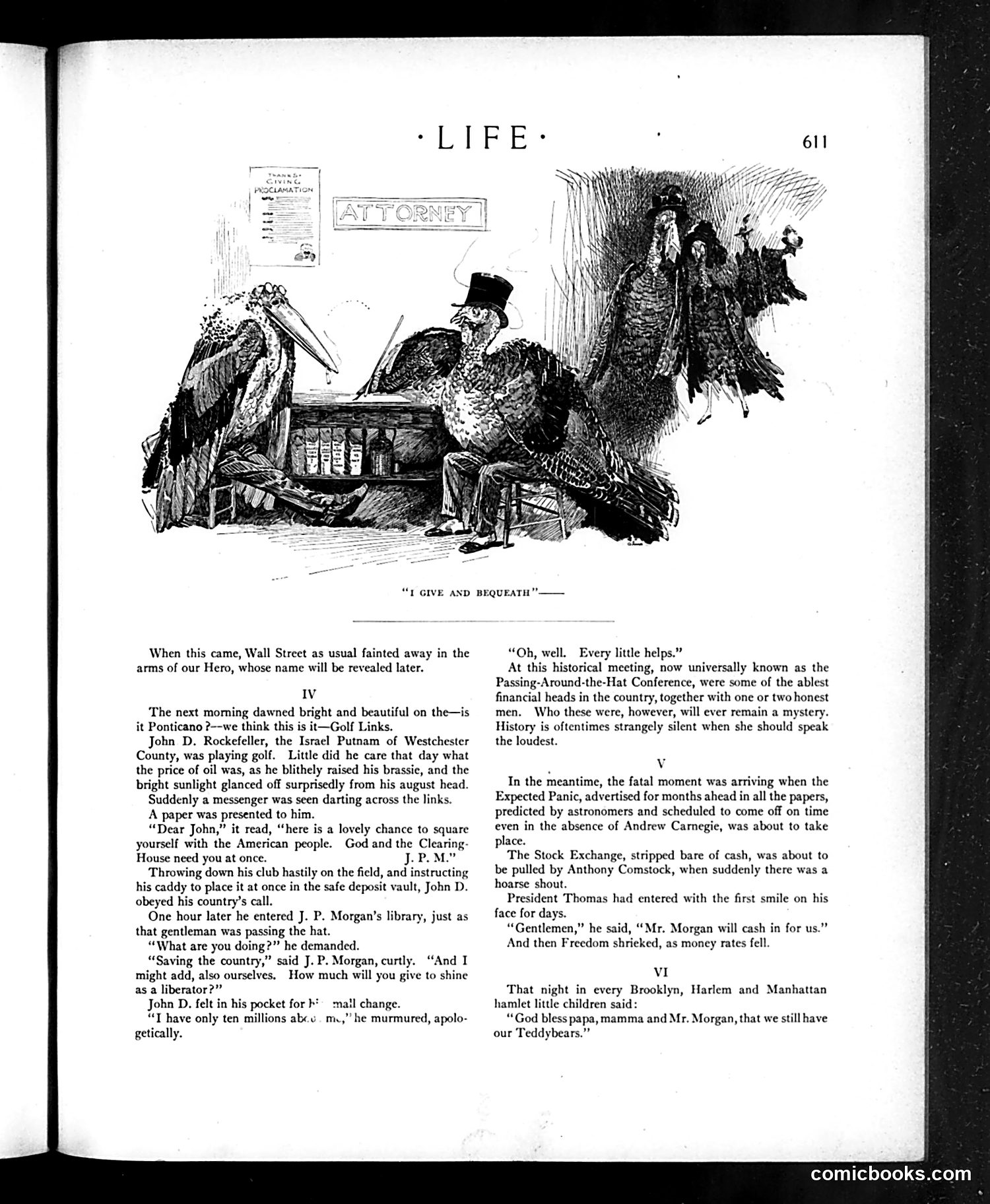
This satirical narrative from *Life* magazine mocks the 1907 financial panic and the role of wealthy industrialists in "saving" the economy. The cartoon depicts J.P. Morgan (identifiable from context as the figure "passing the hat") orchestrating a rescue alongside John D. Rockefeller, characterized as reluctant but dutiful patriots. The satire operates on multiple levels: Morgan and Rockefeller are portrayed as both saviors and self-interested actors; the "Passing-Around-the-Hat Conference" sarcastically suggests wealthy men merely collecting donations rather than genuinely sacrificing. References to President "Thomas" (likely Theodore Roosevelt) and Anthony Comstock add contemporary figures to the critique. The children's prayer thanking "Mr. Morgan" alongside parents exposes the magazine's central irony—that financial elites are publicly celebrated as heroes while the text hints they're primarily protecting their own interests ("also ourselves"). The tone throughout suggests skepticism about who truly benefits from such "rescues."
📄 Transcribed text from this page (OCR, searchable)
Machine-transcribed from the original scan — historical spelling and the odd misread are preserved.
“1 GIVE AND BEQUEATH”—— When this came, Wall Street as usual fainted away in the arms of our Hero, whose name will be revealed later. IV ‘The next moming dawned bright and beautiful on the—is it Ponticano ?--we think this is it—Golf Links. John D. Rockefeller, the Israel Putnam of Westchester County, was playing golf. Little did he care that day what the price of oil was, as he blithely raised his brassic, and the bright sunlight glanced off surprisedly from his august head. Suddenly a messenger was seen darting across the links. A paper was presented to him. “Dear John,” it read, “here is a lovely chance to square yourself with the American people. God and the Clearing- House need you at once. j.P.M.” Throwing down his club hastily on the field, and instructing his caddy to place it at once in the safe deposit vault, John D. obeyed his country’s call. One hour later he entered J. P. Morgan’s library, just as that gentleman was passing the hat. “What are you doing?” he demanded. “Saving the country,” said J. P. Morgan, curtly. “And I might add, also ourselves. How much will you give to shine as a liberator?” John D. felt in his pocket fork! mail change. “T have only ten millions abu m.,” he murmured, apolo- getically. “Oh, well. Every little helps.” At this historical meeting, now universally known as the Passing-Around-the-Hat Conference, were some of the ablest financial heads in the country, together with one or two honest men. Who these were, however, will ever remain a mystery. History is oftentimes strangely silent when she should speak the loudest. v In the meantime, the fatal moment was arriving when the Expected Panic, advertised for months ahead in all the papers, predicted by astronomers and scheduled to come off on time even in the absence of Andrew Carnegie, was about to take lace. P The Stock Exchange, stripped bare of cash, was about to be pulled by Anthony Comstock, when suddenly there was a hoarse shout. President Thomas had entered with the first smile on his face for days. “Gentlemen,” he said, ‘Mr. Morgan will cash in for us.”” And then Freedom shrieked, as money rates fell. VI That night in every Brooklyn, Harlem and Manhattan hamlet little children said: “God bless papa, mamma and Mr. Morgan, that we still have our Teddybears.”” comicbooks.com