
Life, 1907-11-21 · page 19 of 32
Life — November 21, 1907 — page 19: what you’re looking at
What you’re looking at
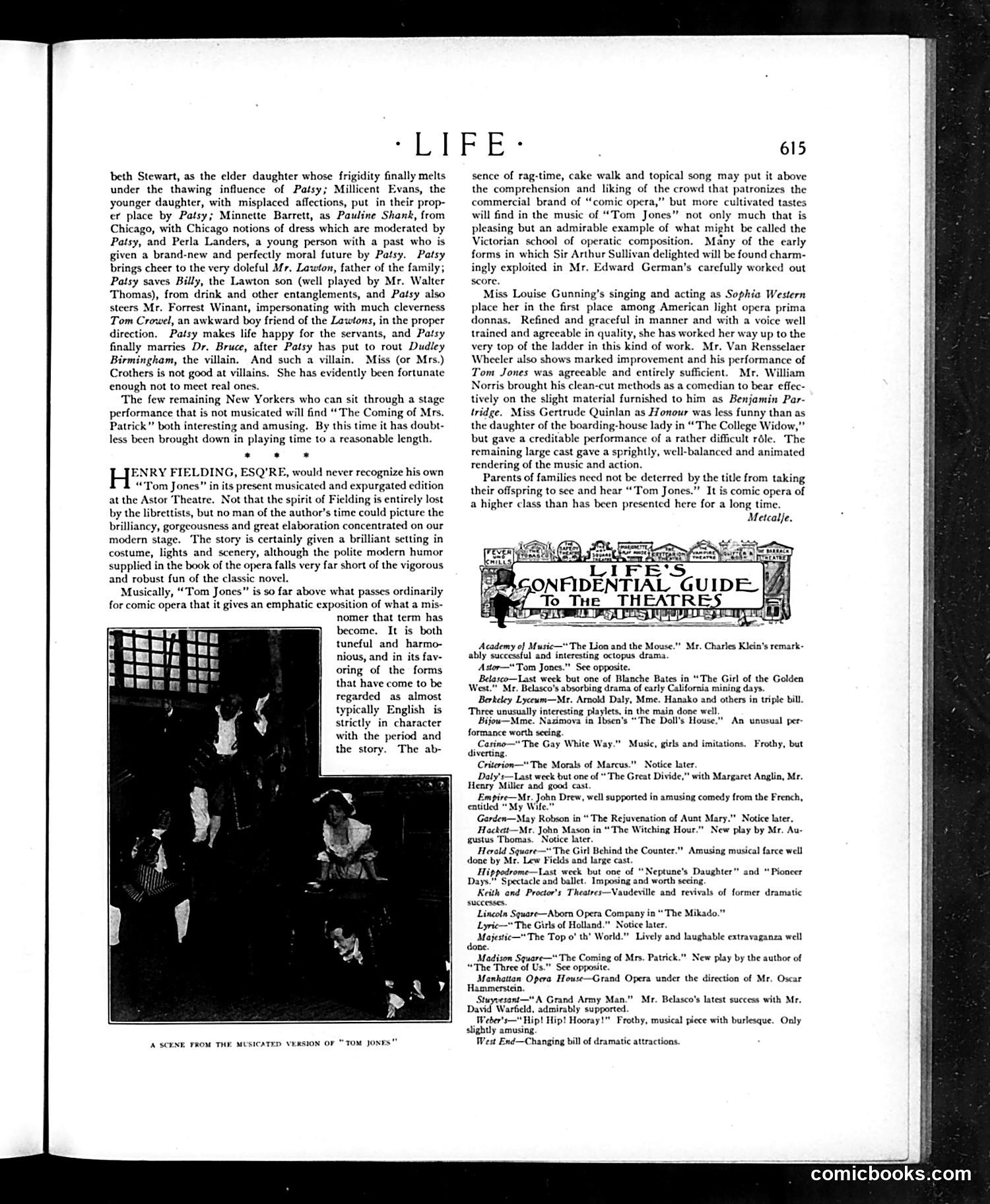
This page contains two theater reviews from Life magazine's drama section. The first review discusses "The Coming of Mrs. Patrick," a non-musical play praised for its wit and character development, particularly the titular character "Patsy" who reforms various family members' moral deficiencies. The second and longer review examines the musical adaptation of Henry Fielding's classic novel "Tom Jones" at the Astor Theatre. The critic argues the musicalization, while beautifully staged and orchestrated, cannot capture Fielding's original robust humor. He praises the score by Edward German for avoiding commercial "rag-time" and "cake walk" conventions, instead adopting a refined "Victorian school" operatic style reminiscent of Arthur Sullivan. The performance features Louise Gunning as Sophia Western, whom the reviewer ranks among America's finest light opera singers. A photograph shows a scene from the "Tom Jones" production.
📄 Transcribed text from this page (OCR, searchable)
Machine-transcribed from the original scan — historical spelling and the odd misread are preserved.
“LIFE: beth Stewart, as the elder daughter whose frigidity finally melts under the thawing influence of Patsy; Millicent Evans, the younger daughter, with misplaced affections, put in their prop- er place by Patsy; Minette Barrett, as Pauline Shank, from Chicago, with Chicago notions of dress which are moderated by Patsy, and Perla Landers, a young person with a past who is given a brand-new and perfectly moral future by Patsy. Patsy brings cheer to the very doleful Mr. Lawton, father of the famil Patsy saves Billy, the Lawton son (well played by Mr. Walter Thomas), from drink and other entanglements, and Patsy also steers Mr. Forrest Winant, impersonating with much cleverness Tom Crowel, an awkward boy friend of the Lawtons, in the proper direction. Patsy makes life happy for the servants, and Patsy finally marries Dr. Bruce, after Patsy has put to rout Dudley Birmingham, the villain. And such a villain, Miss (or Mrs.) Crothers is not good at villains, She has evidently been fortunate enough not to mect real ones. The few remaining New Yorkers who can sit through a stage performance that is not musicated will find “The Coming of Mrs. Patrick” both interesting and amusing. By this time it has doubt- less been brought down in playing time to a reasonable length. s 8 8 H SNRY FIELDING, ESQ'RE, would never recognize his own “Tom Jones” in its present musicated and expurgated edition at the Astor Theatre. Not that the spirit of Fielding is entirely lost by the librettists, but no man of the author’s time could picture the brilliancy, gorgcousness and great elaboration concentrated on our modern stage. ‘The story is certainly given a brilliant setting in costume, lights and scenery, although the polite modern humor supplied in the book of the opera falls very far short of the vigorous and robust fun of the classic novel. Musically, “Tom Jones” is so far above what passes ordinarily for comic opera that it gives an emphatic exposition of what a mis- nomer that term has become. It is both tuneful and harmo- nious, and in its fav- oring of the forms that have come to be regarded as almost typically English is strictly in character with the period and the story. The ab- A-SCENE TROM THE MUSICATED VERSION OF “TOM JONFS" 615 sence of rag-time, cake walk and topical song may put it above the comprehension and liking of the crowd that patronizes the commercial brand of “comic opera,” but more cultivated tastes will find in the music of “Tom Jones” not only much that is pleasing but an admirable example of what might be called the Victorian school of operatic composition. Many of the early forms in which Sir Arthur Sullivan delighted will be found charm- ingly exploited in Mr. Edward German's carefully worked out score, Miss Louise Gunning’s singing and acting as Sophia Western place her in the first place among American light opera prima donnas. Refined and graceful in manner and with a voice well trained and agreeable in quality, she has worked her way up to the very top of the ladder in this kind of work. Mr. Van Rensselaer Wheeler also shows marked improvement and his performance of Tom Jones was agreeable and entirely sufficient. Mr. William Norris brought his clean-cut methods as a comedian to bear effec- tively on the slight material furnished to him as Benjamin Par- tridge. Miss Gertrude Quinlan as Honour was less funny than as the daughter of the boarding-house lady in “The College Widow,” but gave a creditable performance of a rather difficult réle. The remaining large cast gave a sprightly, well-balanced and animated rendering of the music and action. Parents of families need not be deterred by the title from taking their offspring to sce and hear “Tom Jones.” It is comic opera of a higher class than has been presented here for a long time. Metcalfe. Academy of Music—" The Lion and the Mouse.” Mr. Charles Klein's remark- ably successful and interesting octopus drama. Asstor—"Tom Jones.” See opposite. Belasco—Last week but one of Blanche Bates in “The Girl of the Golden West.” Mr. Belasco's absorbing drama of early California mining days. Berkeley Lyceum—Mr. Arnold Daly, Mme. Hanako and others in triple bill. Three unusually interesting playlets, in the main done well. Bijou—Mme. Nazimova in Ibsen's “The Doll's House,” An unusual per- formance worth seeing. Casino—"The Gay White Way.” Music, girls and imitations. Frothy, but diverting. Criterion—"The Morals of Marcus.” Notice later. Daly's—Last week but one of “The Great Divide,” with Margaret Anglin, Mr. Henry Miller and good cast Empire—Mr. John Drew, well supported in amusing comedy from the French, entitled “My Wile.” Garden—May Robson in “ The Rejuvenation of Aunt Mary.” Notice later. Hockat—Mr. John Mason in “The Witching Hour.” New play by Mr. Au- gustus Thomas. Notice later. Herald Square—* The Girl Behind the Counter.” Amusing musical farce well done by Mr. Lew Fields and large cast ippodrome—Last week but one of “Neptune's Daughter” and “Pioneer ‘Spectacle and ballet. Imposing and worth seeing. Keith and Proctor's Theatres—Vaudeville and revivals of former dramatic successes Lincoln Square—Abom Opera Company in “The Mikado.” Lyric—" The Girls of Holland." Notice later. spAlaiestic—""The Top o' th’ World.” Lively and laughable extravaganza well done. Madison Square—“The Coming of Mrs. Patrick." New play by the author of “The Three of Us.” See oppoxite. Manhattan Opera House—Grand Opera under the direction of Mr. Oscar Hammerstein. Stuyvesant—"A Grand Army Man.” Mr. Belasco's latest success with Mr. David Warfield, admirably supported. Weber's—" Hip! Hip! Hooray!" Frothy, musical piece with burlesque. Only slightly amusing. West End—Changing bill of dramatic attractions. ahh comicbooks:com