
A complete issue · 48 pages · 1907
Life — July 4, 1907
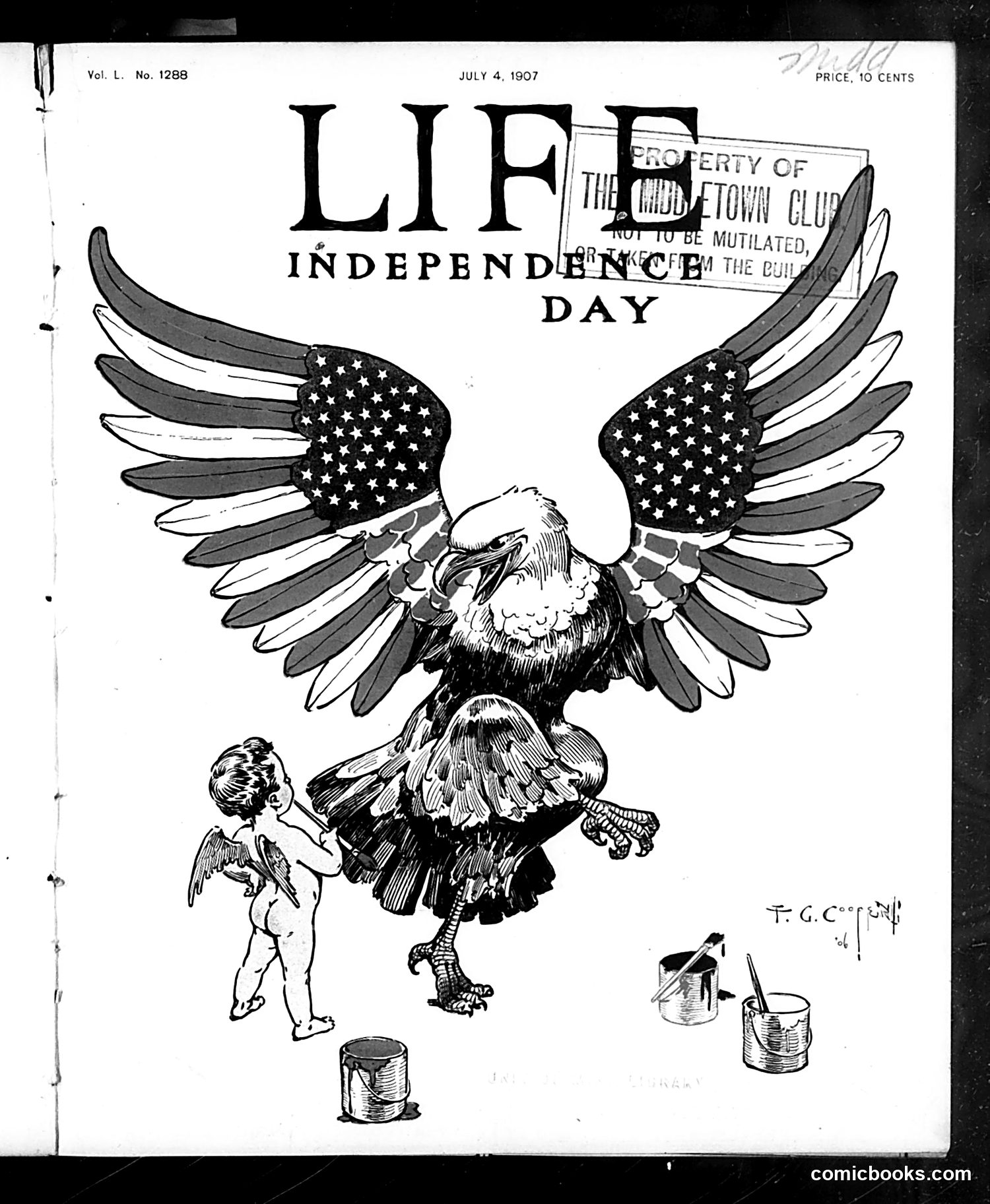
This cover celebrates American Independence Day with a patriotic eagle as the central figure. The eagle displays stars on its wings (representing the American flag) and is attended by a cherub or cupid figure, reinforcing themes of national pride and divine blessing. The paint cans and brushes at the bottom suggest the nation is being "painted" or constructed—likely referencing ongoing American development and progress. The imagery combines classical allegorical symbols (the cherub, the eagle as national emblem) with utilitarian tools, creating a visual metaphor for American industrial and democratic progress. The overall message appears celebratory of American ideals and national achievement, typical of patriotic Independence Day messaging from this era.
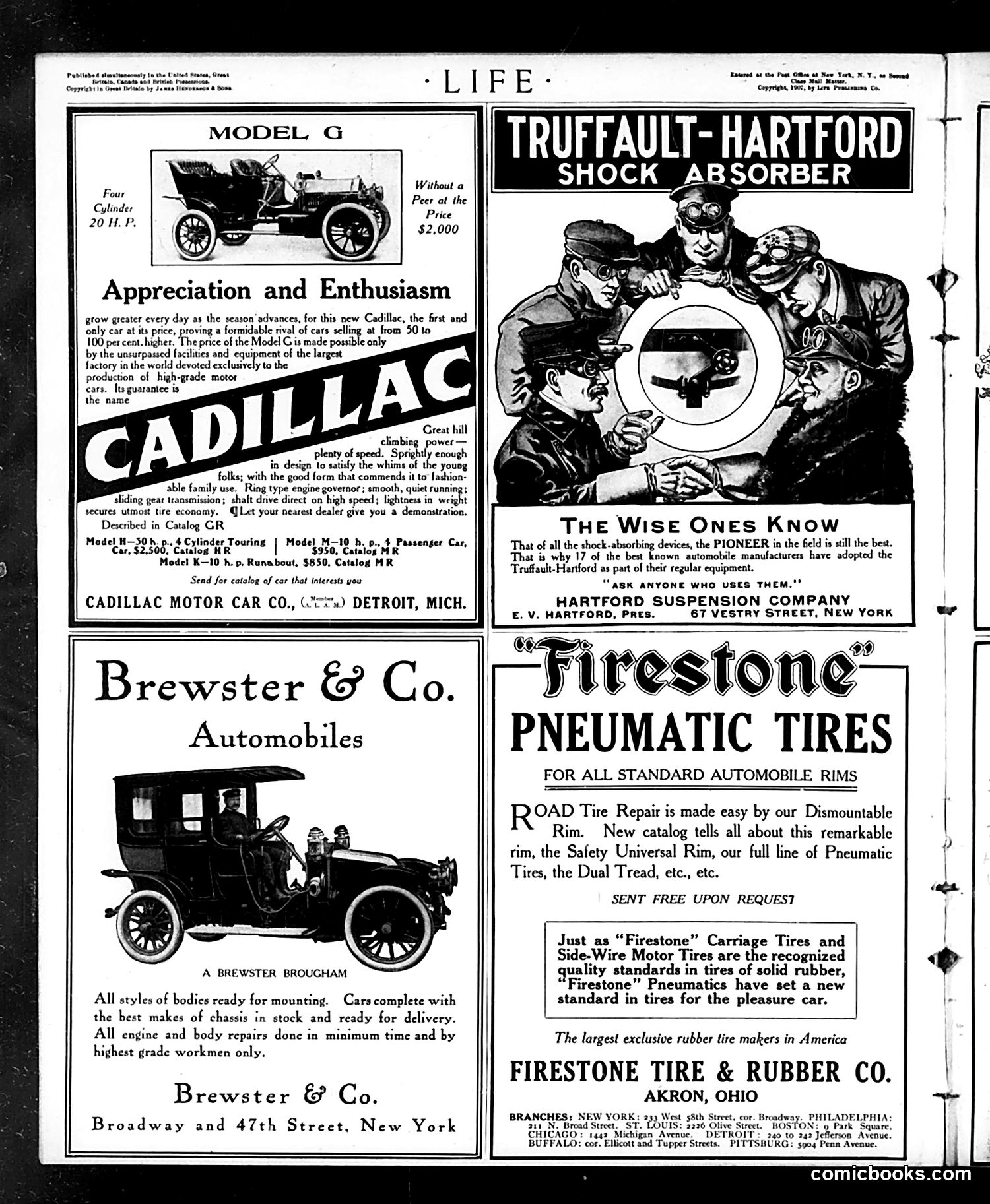
This page is primarily **advertising**, not satire or political commentary. It contains four automobile-related advertisements from the early 1900s: 1. **Cadillac Model G** — emphasizes the car's reliability and value ($2,000), noting it outsells competitors at higher prices. 2. **Truffault-Hartford Shock Absorber** — uses an illustration of five men examining the device, claiming it's the best shock absorber available and adopted by major manufacturers. 3. **Brewster & Co. Automobiles** — advertises custom car bodies and complete vehicles with quality chassis and service. 4. **Firestone Pneumatic Tires** — promotes their tire products and rim technology for automobiles. The page reflects the early automotive industry's competitive marketing and the rapid technological innovations of that era. No political or satirical content is evident.
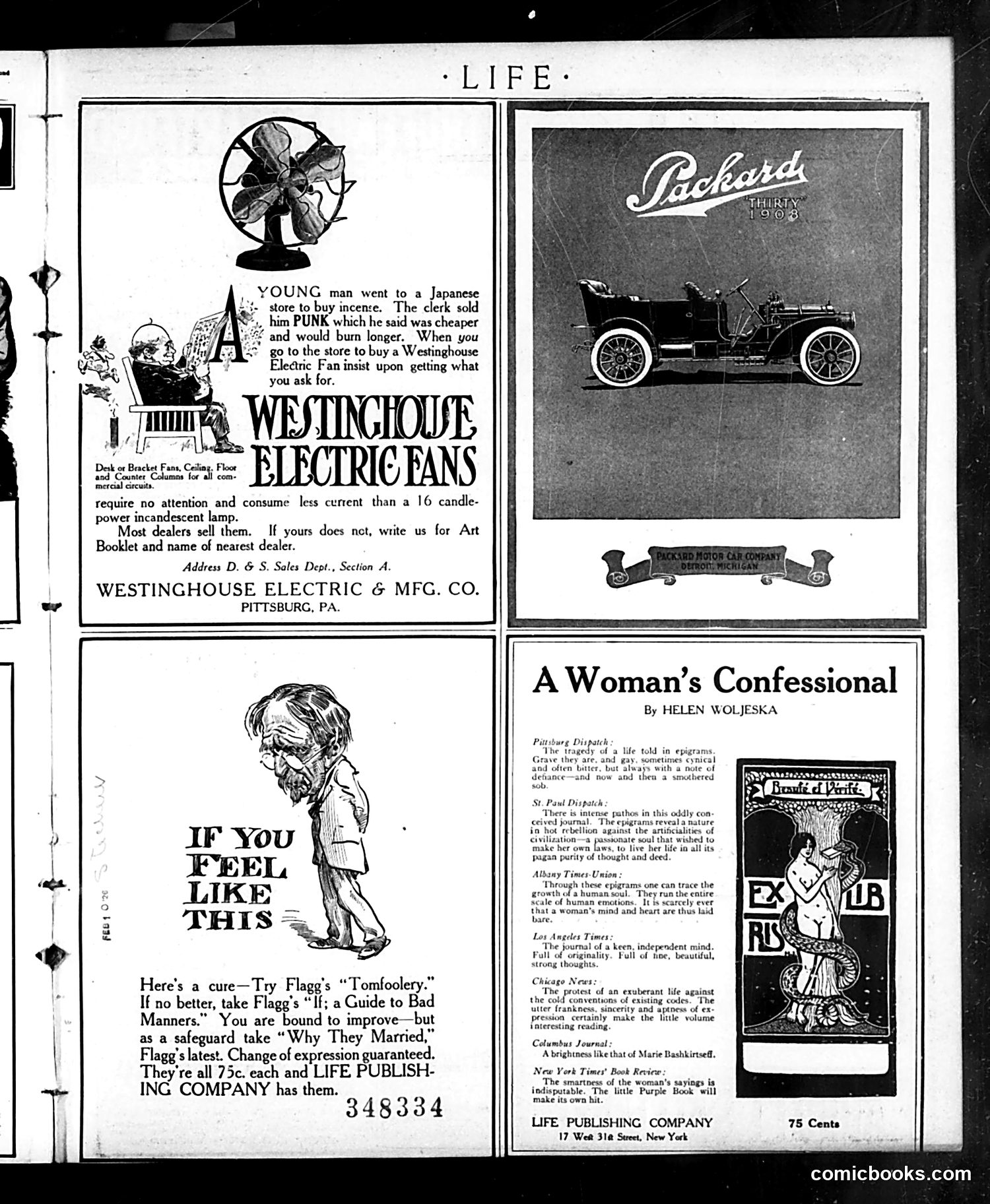
This page contains **advertisements and book promotion rather than political satire**. The top left features a **Westinghouse Electric Fans ad** with a humorous anecdote about a young man buying incense—establishing that Westinghouse fans are a practical, reliable choice versus cheaper alternatives. Top right advertises a **Packard automobile** (1904 model), emphasizing luxury appeal. The bottom left shows a **Flagg's "Tomfoolery" book advertisement**, featuring a caricatured sad/discouraged man's face with text promoting humor books as a cure for melancholy. Bottom right advertises **"A Woman's Confessional" by Helen Woljeska**, published by Life Publishing Company, with excerpts from positive newspaper reviews. This is primarily a **commercial page mixing consumer goods, automobiles, and books**—typical of Life magazine's revenue model rather than satirical political content.
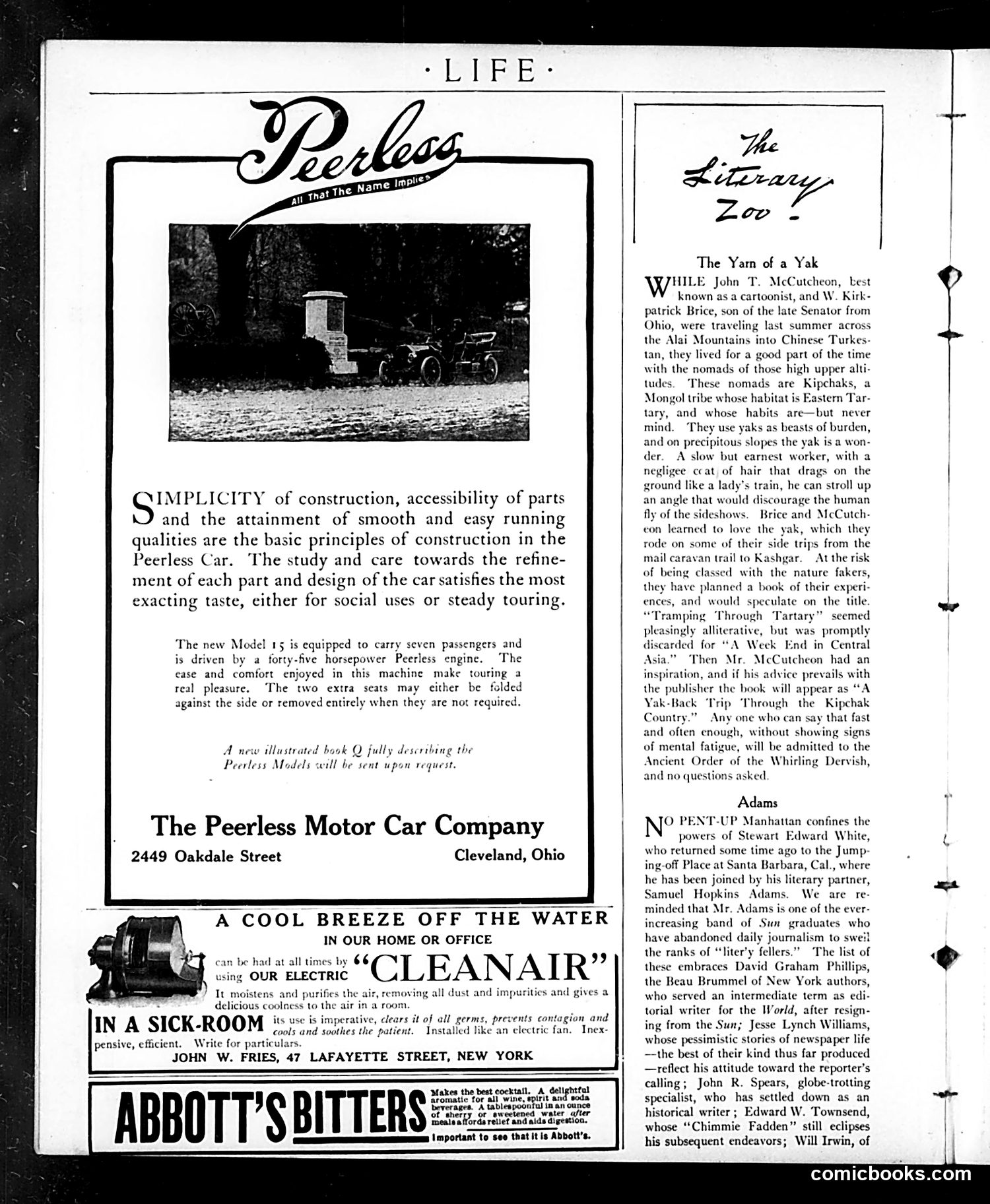
This page contains **no political cartoon or satire**. Instead, it features: 1. **Peerless Motor Car advertisement** (left): Promotes the Model 15 automobile, emphasizing "simplicity of construction" and ease of repair. The ad targets touring enthusiasts. 2. **"The Literary Zoo" column** (right): A gossipy piece about writer John T. McCutcheon and Patrick Brice's travels in Chinese Turkestan, with commentary on various American authors including Samuel Hopkins Adams and David Graham Phillips. The column discusses literary figures and journalist culture. 3. **Additional advertisements**: For Cleanair fans, Abbott's Bitters, and other products. This is primarily an **advertising and entertainment page**, typical of 1910s-era *Life* magazine, mixing commercial promotion with light cultural commentary—not satirical political content.
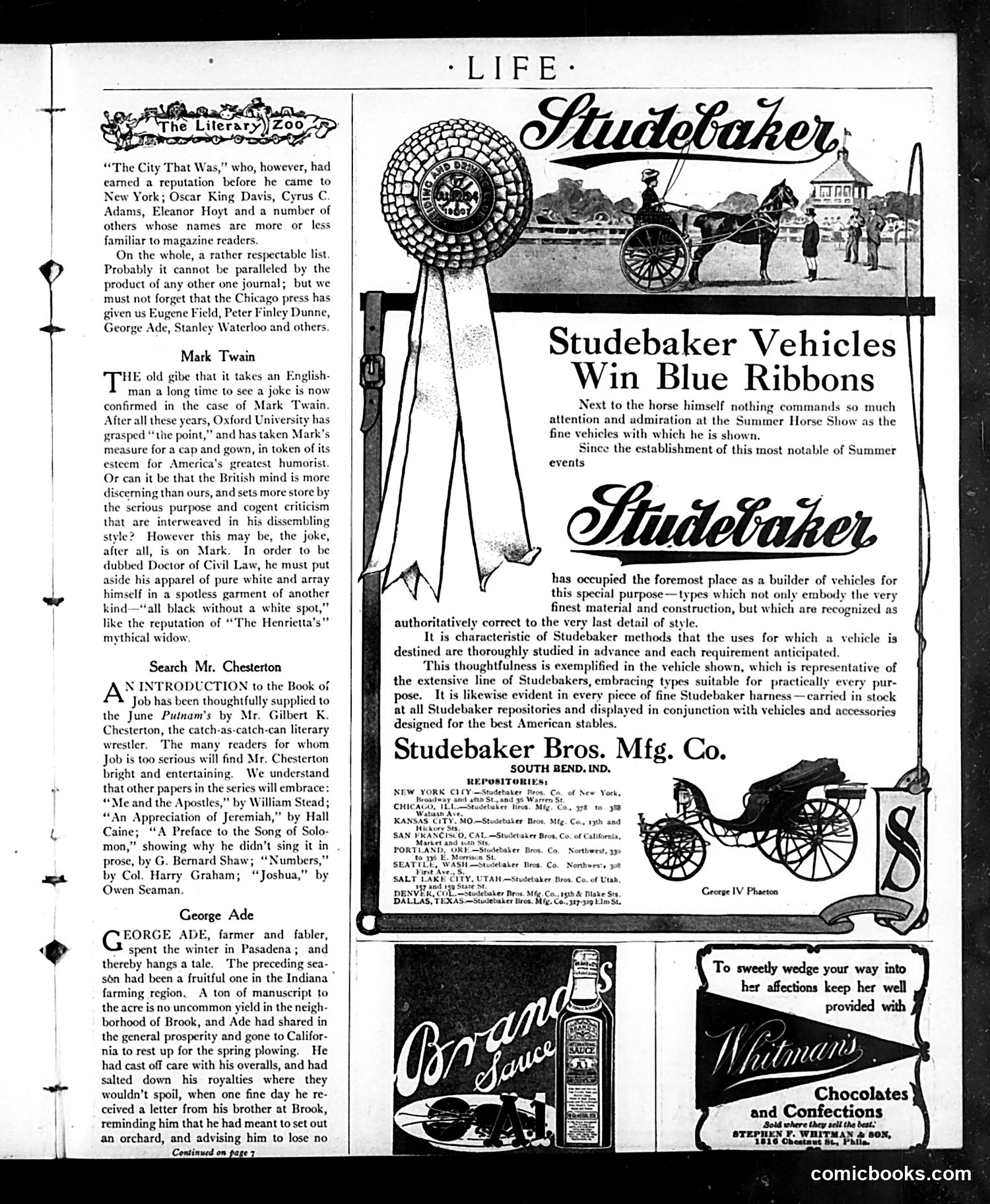
This *Life* magazine page is primarily **advertising and literary content** rather than political satire. The left column contains book reviews and literary criticism, including commentary on Mark Twain and an introduction to a book about Job by Gilbert K. Chesterton. There's also a brief anecdote about George Ade, a farmer and fabulist. The dominant right side features a **Studebaker Vehicles advertisement** highlighting their success at Summer Horse Shows, with images of carriages and horses. The ad emphasizes Studebaker's reputation as a quality vehicle builder. Bottom advertisements include **Borazo Sauce** and **Whitman's Chocolates**. The page reflects early 20th-century magazine layout: serious literary content mixed with commercial advertising for consumer goods—carriages, food products, and confections typical of that era.
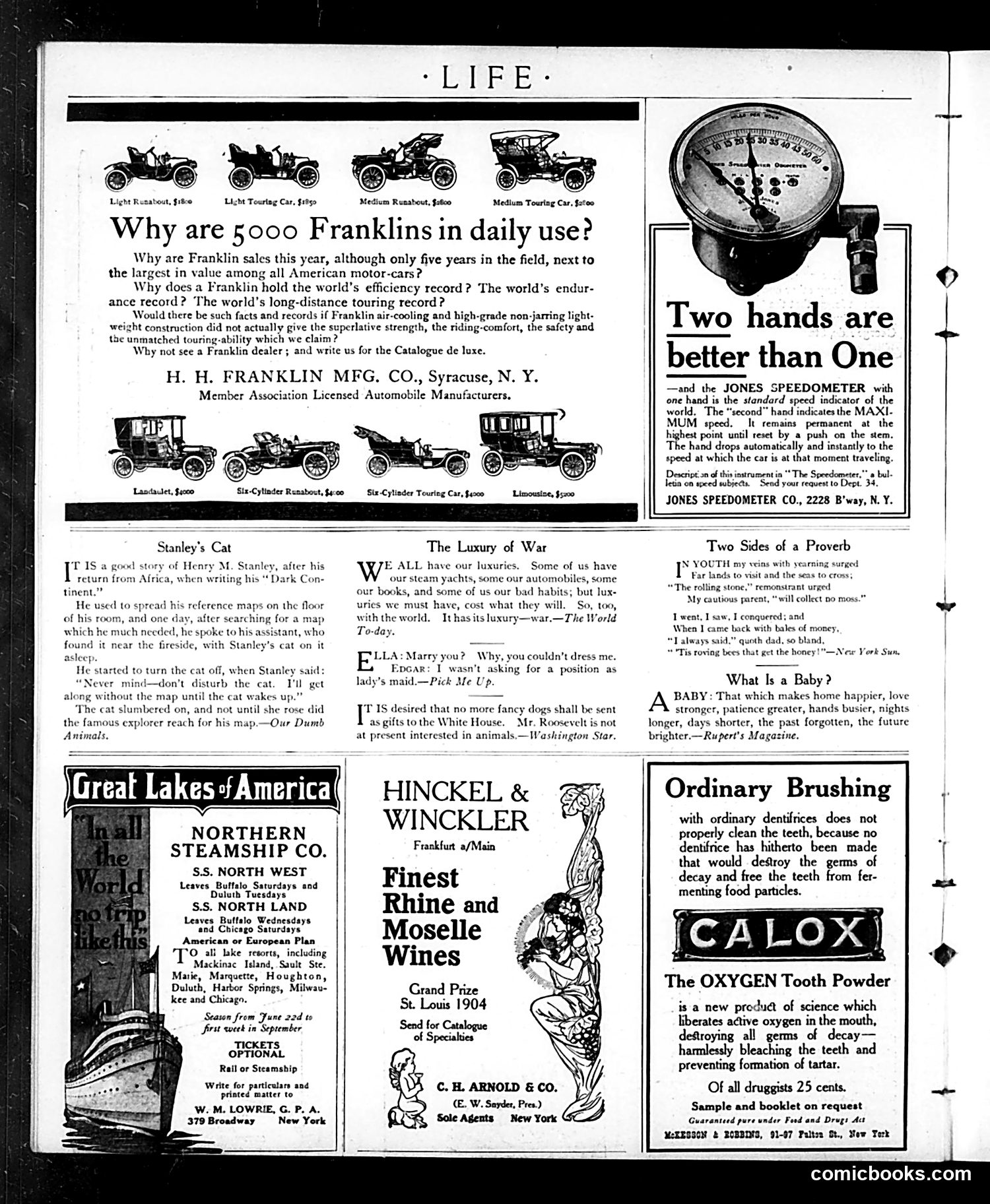
This page is **primarily advertising**, not political satire. The dominant content includes: **Franklin automobiles** (top left): An ad highlighting Franklin car sales and engineering records, emphasizing cooling systems and durability—standard automotive marketing of the era. **Jones Speedometer** (top right): An advertisement for a dual-hand speedometer, presenting the second hand as an innovation for measuring "Maximum" (MUM) speed. **Literary/humorous pieces** (center): Short anecdotal pieces titled "Stanley's Cat," "The Luxury of War," and "Two Sides of a Proverb"—light satirical content typical of *Life* magazine's miscellaneous humor sections. **Various product ads**: Steamship lines, Rhine wines, and Calox tooth powder round out the page. There is **no discernible political cartoon or caricature** on this page. It reflects early 20th-century American consumer advertising and genteel humor rather than political commentary.
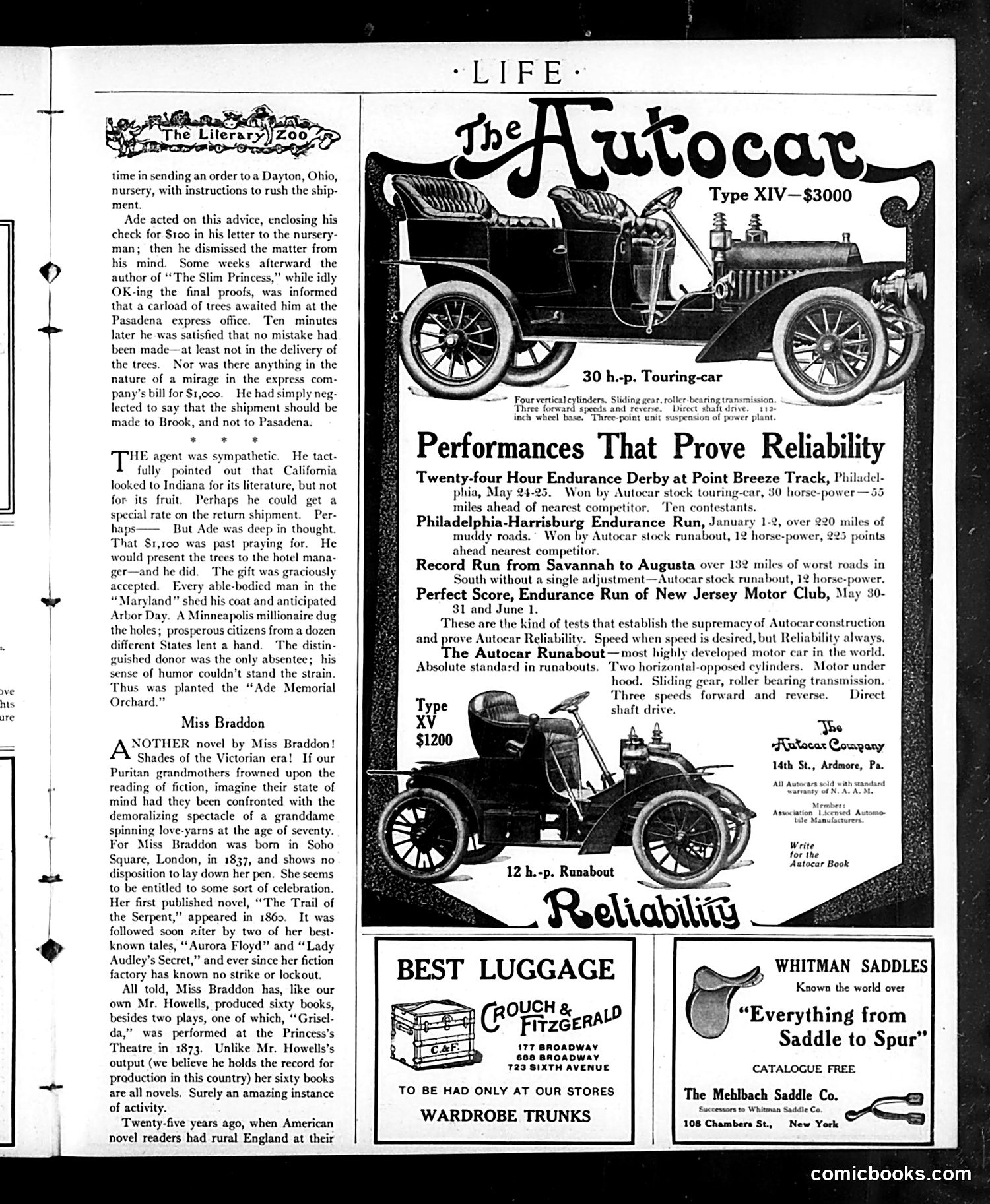
This page is primarily **advertising**, not satire or political commentary. The main content features three ads: 1. **Autocar automobiles** (top, center-right): Promoting their Type XIV touring car ($3000) and Type XV runabout ($1200) by highlighting "Performances That Prove Reliability"—showcasing endurance races and records to establish the brand's superiority. 2. **Crouch & Fitzgerald luggage** (bottom-left): Advertising "wardrobe trunks" available at their Broadway locations. 3. **Whitman Saddles** (bottom-right): Marketing saddles and riding equipment with the tagline "Everything from Saddle to Spur." The left column contains book reviews, notably about Miss Braddon's novels. There is **no political cartoon or satire** on this page—it's a straightforward commercial section of the magazine.
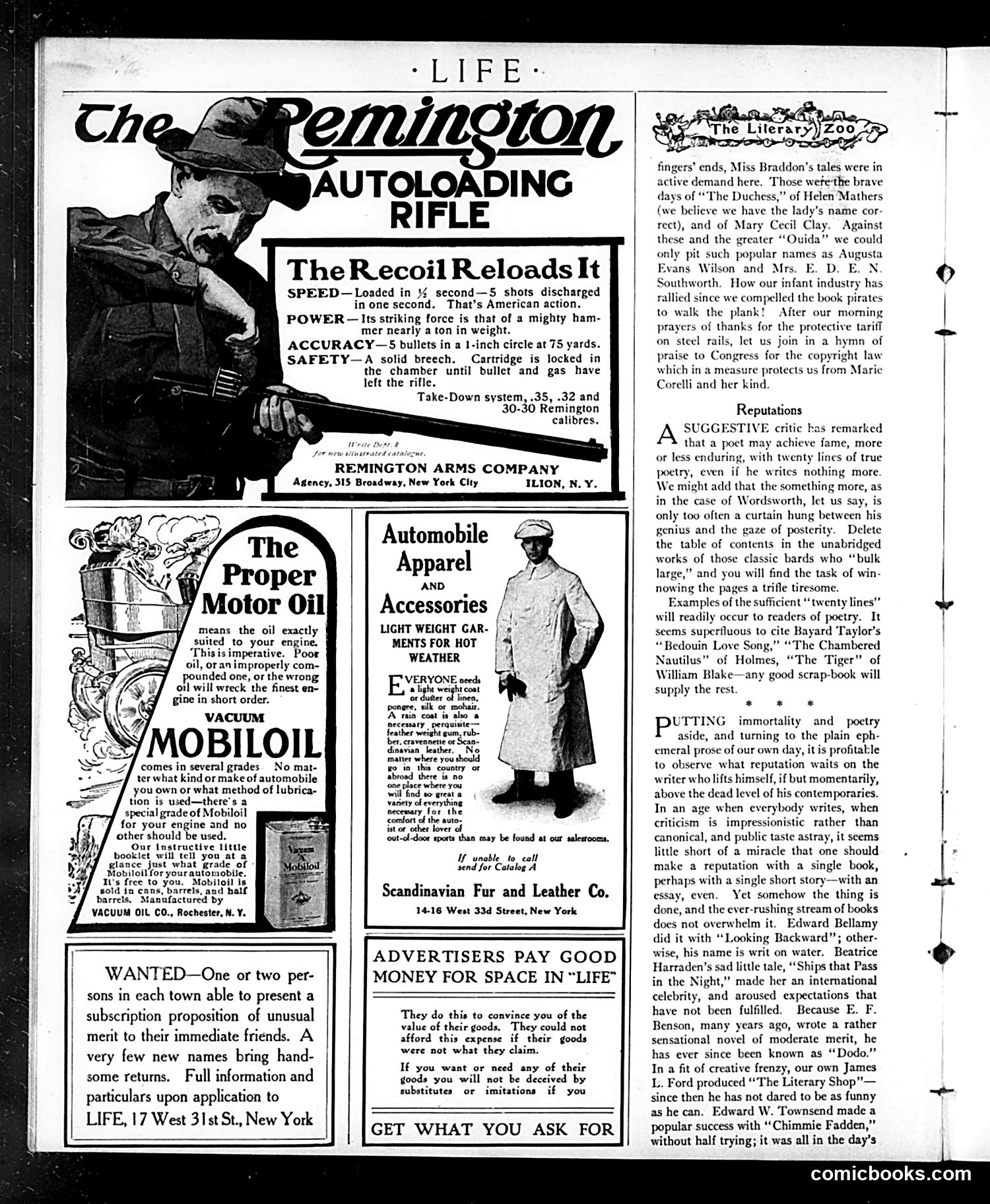
This page is primarily **advertising and literary commentary**, not political satire. The top features a Remington autoloading rifle advertisement emphasizing its speed, power, and accuracy—typical early 20th-century gun marketing. Below are ads for Mobiloil motor oil, automobile apparel, and Scandinavian Fur and Leather Co. The right column contains "The Literary Zoo," a book-review section discussing poets' reputations. The author argues that achieving lasting fame requires more than twenty lines of good poetry, citing examples like Miss Braddon and Mary Cecil Clay. The piece discusses how Edward Bellamy and E.F. Benson achieved fame despite modest literary merit, suggesting reputation depends partly on factors beyond pure artistic quality. This reflects early 20th-century literary criticism and publishing concerns—no political commentary is evident.
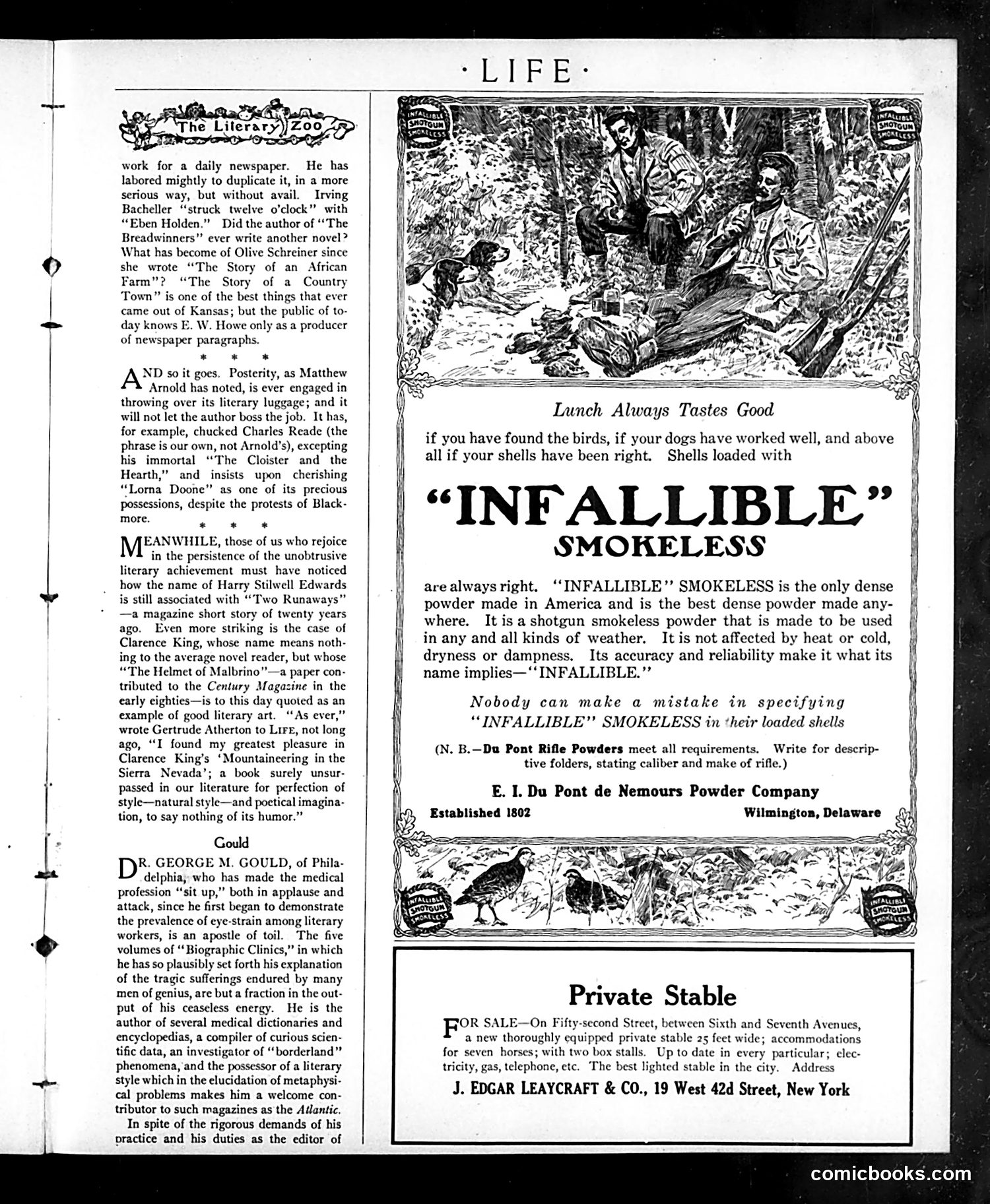
This page is primarily **literary criticism and advertising** rather than political satire. The left column discusses several American authors and literary figures—including references to Irving Batcheller, E.W. Howe, Charles Reade, and Clarence King—evaluating their contributions to American letters. A section on "Dr. George M. Gould" praises his medical and encyclopedic work. The main illustration depicts a **hunting or outdoor scene** with dogs and game birds, accompanying an advertisement for "Infallible" smokeless shotgun powder by E.I. Du Pont de Nemours, established 1802. The ad emphasizes reliability across weather conditions. A small real estate advertisement for a private stable rounds out the page. This is a typical **Life magazine page blending cultural commentary with period advertising**.
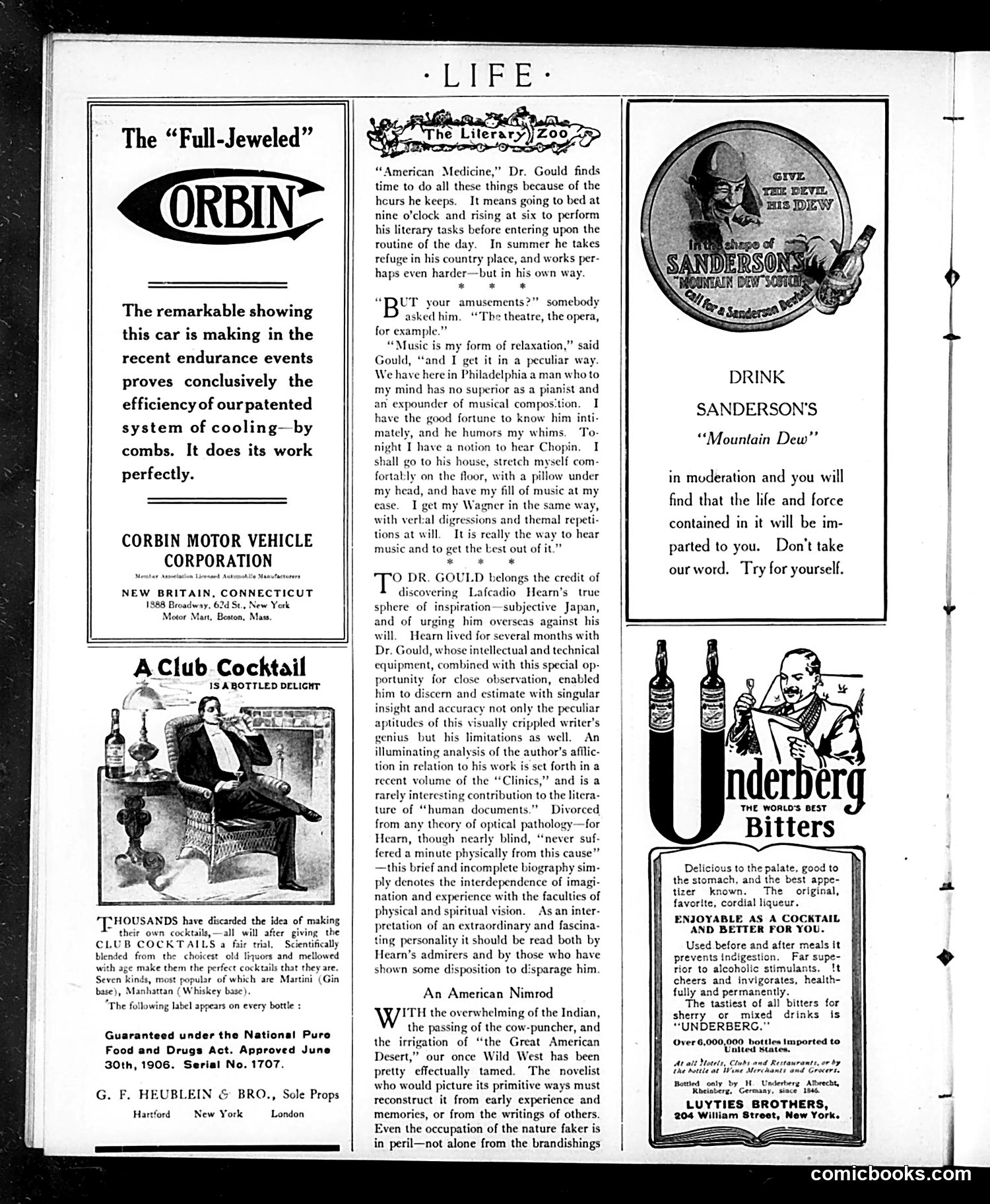
This page is primarily **advertising and lifestyle content** rather than political satire. The main elements are: 1. **Orbin Motor Vehicle advertisement** (top left): Promotes a car's cooling system using "combs," claiming superior efficiency in endurance events. 2. **Club Cocktail advertisement** (bottom left): Markets pre-mixed cocktails, claiming thousands have adopted them for home use. 3. **Central article** discusses Dr. Gould, a writer/physician who balances literary work with leisure activities like theater and music—presented as a profile of an accomplished intellectual. 4. **Sanderson's Mountain Dew advertisement** (right): Promotes a beverage for moderate consumption and health benefits. 5. **Underberg Bitters advertisement** (bottom right): Markets a digestive liqueur as superior to alcohol for health and social occasions. The page reflects early 20th-century consumer culture and leisure pursuits among the educated classes.
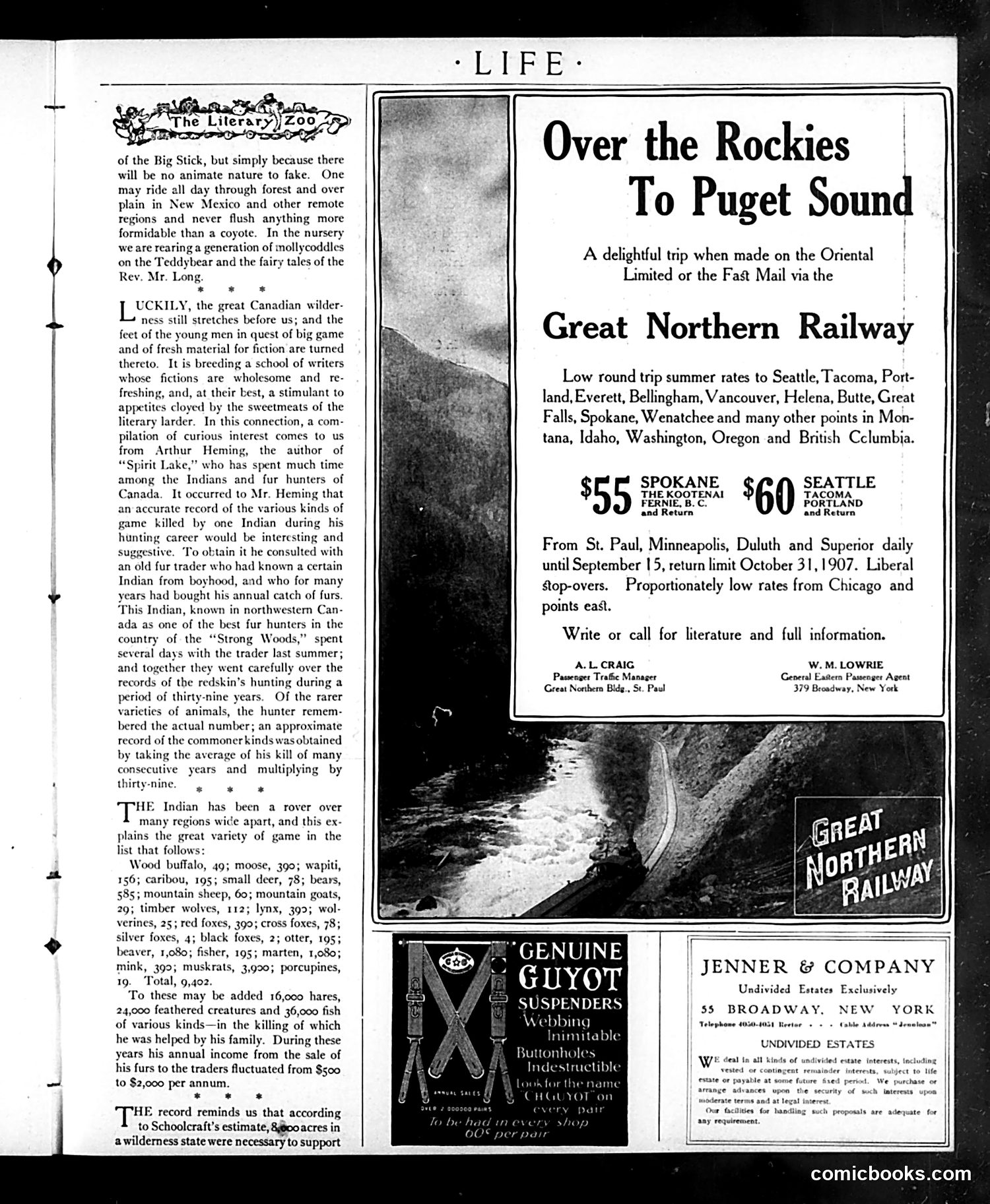
This page is primarily **advertising and travel promotion**, not political satire. The main content is a Great Northern Railway advertisement promoting summer travel to Pacific Northwest destinations (Seattle, Tacoma, Portland, Spokane) at "$55" and "$60" round-trip rates. The left column contains a **literary essay** titled "The Literary Zoo," discussing Canadian wilderness fiction and hunting narratives, particularly referencing Arthur Hemingway's accounts of Indigenous fur traders and game hunting records. Additional advertisements include Genuine Guyot Suspenders and Jenner & Company real estate services. **No political cartoons or satirical commentary appear on this page.** It represents typical early-1900s *Life* magazine content mixing editorial features with commercial advertising.
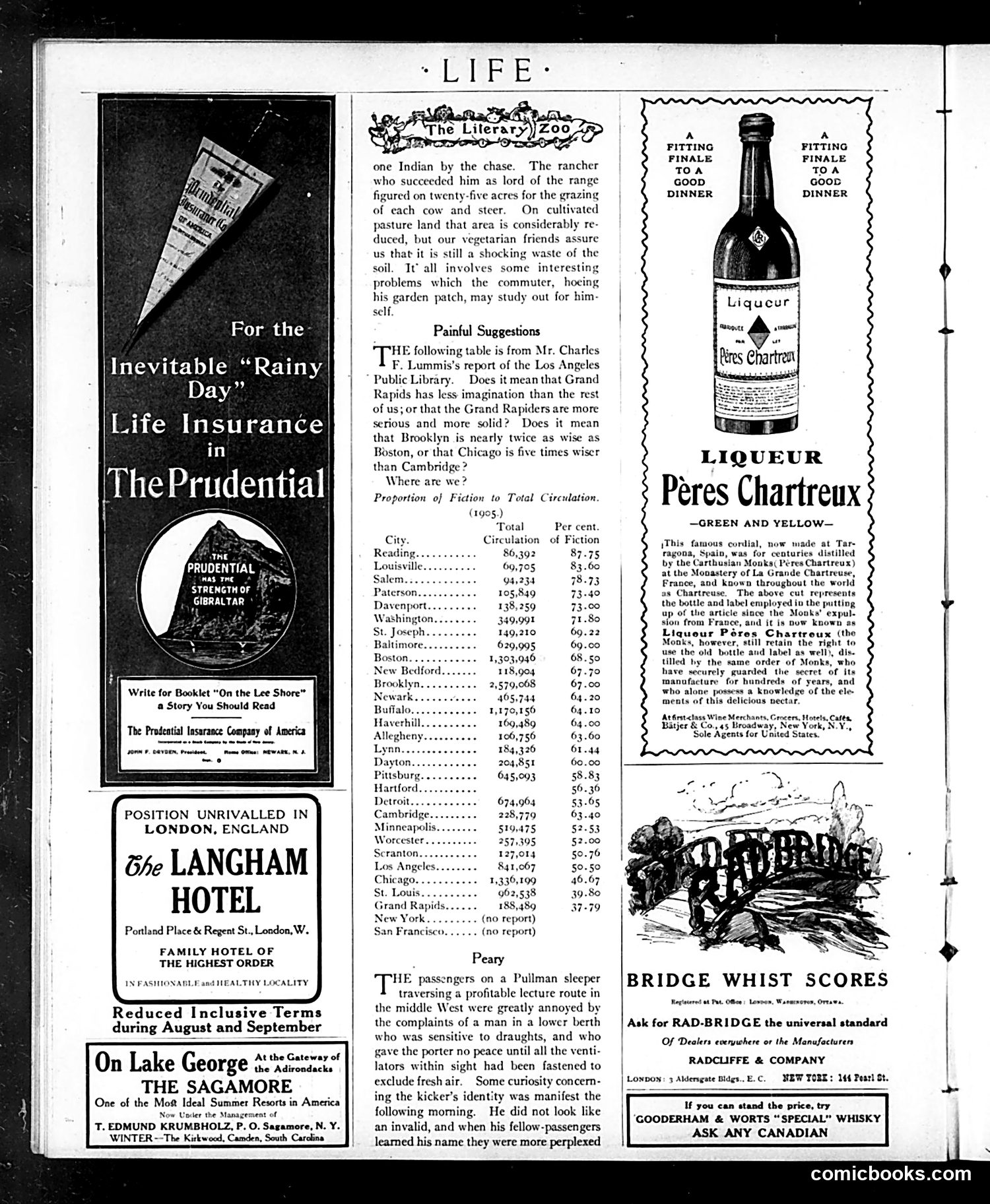
This page is primarily **advertising and miscellaneous content** rather than political satire or comics. It includes: 1. **Life's Literary Zoo** (top center): A brief humorous essay about land use and grazing efficiency, with no clear political target—just general social commentary on resource waste. 2. **Advertisements** dominating the page: Life Insurance (Prudential), The Langham Hotel (London), The Sagamore Resort, Liqueur Pères Chartreux, Bridge Whist Scores, and Gooderham & Worts Whisky. 3. **"Peary" section** (bottom): An anecdote about Pullman sleeper car passengers and a man with sensitive hearing—a gentle, non-political humor piece. No discernible political cartoons, caricatures of public figures, or satirical commentary appears on this page. It reflects Life magazine's mixed content model of humor columns alongside commercial advertisements.
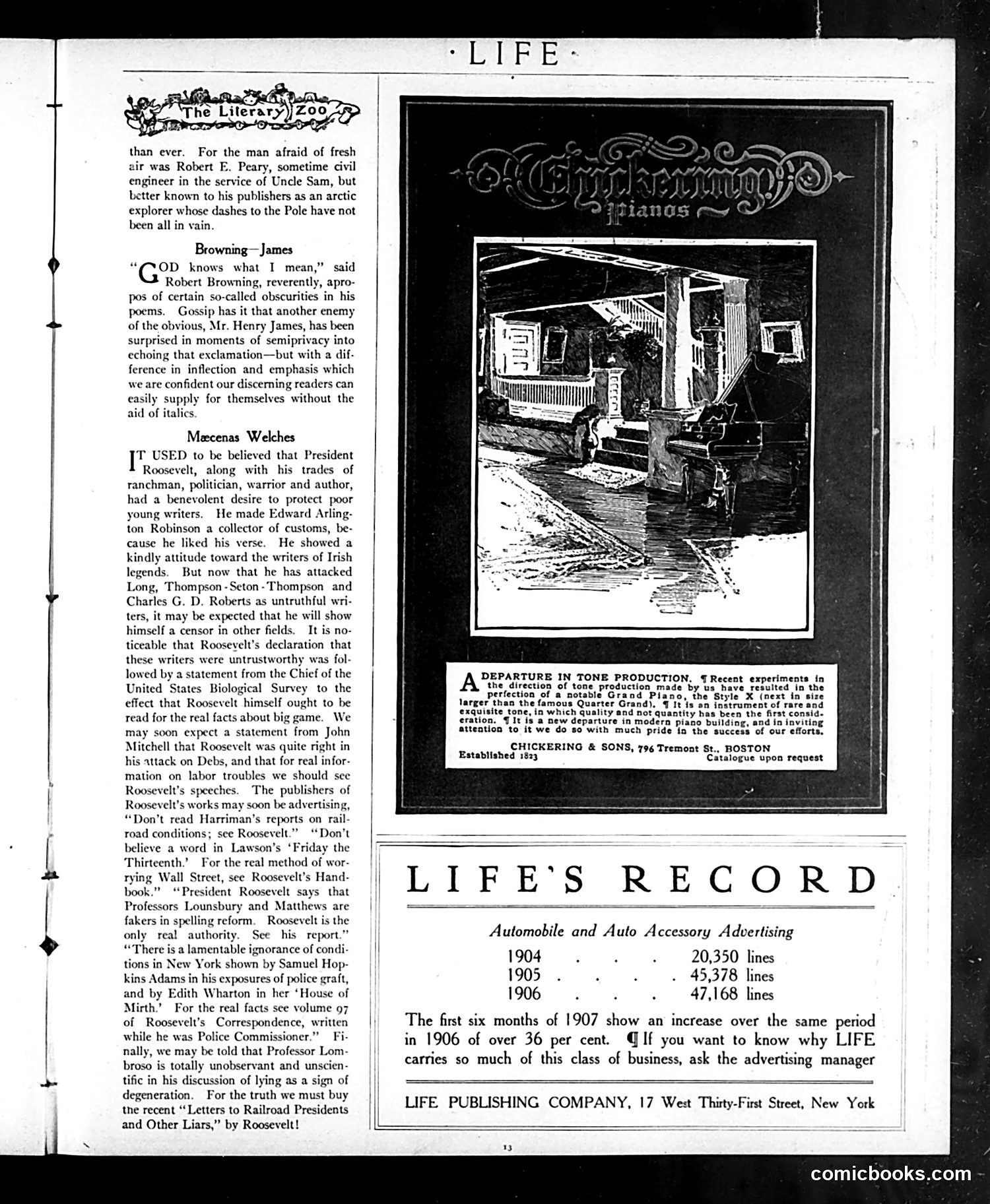
This page from *Life* magazine contains satirical commentary on President Theodore Roosevelt's literary and political judgments. The "Literary Zoo" section critiques Roosevelt for: 1. **Attacking writers**: Roosevelt had publicly criticized authors like Henry James, calling their work obscure and unpatriotic. 2. **Hypocrisy**: The text argues Roosevelt himself should face scrutiny for his own writings and public statements, citing his contradictory positions on labor, police corruption, and railroad practices. 3. **Abuse of authority**: The satire suggests Roosevelt weaponized his presidency to attack writers who displeased him while remaining immune to similar criticism himself. The advertisement for Chickering pianos appears unrelated, typical of period *Life* magazine layout mixing editorial content with commercial advertisements.
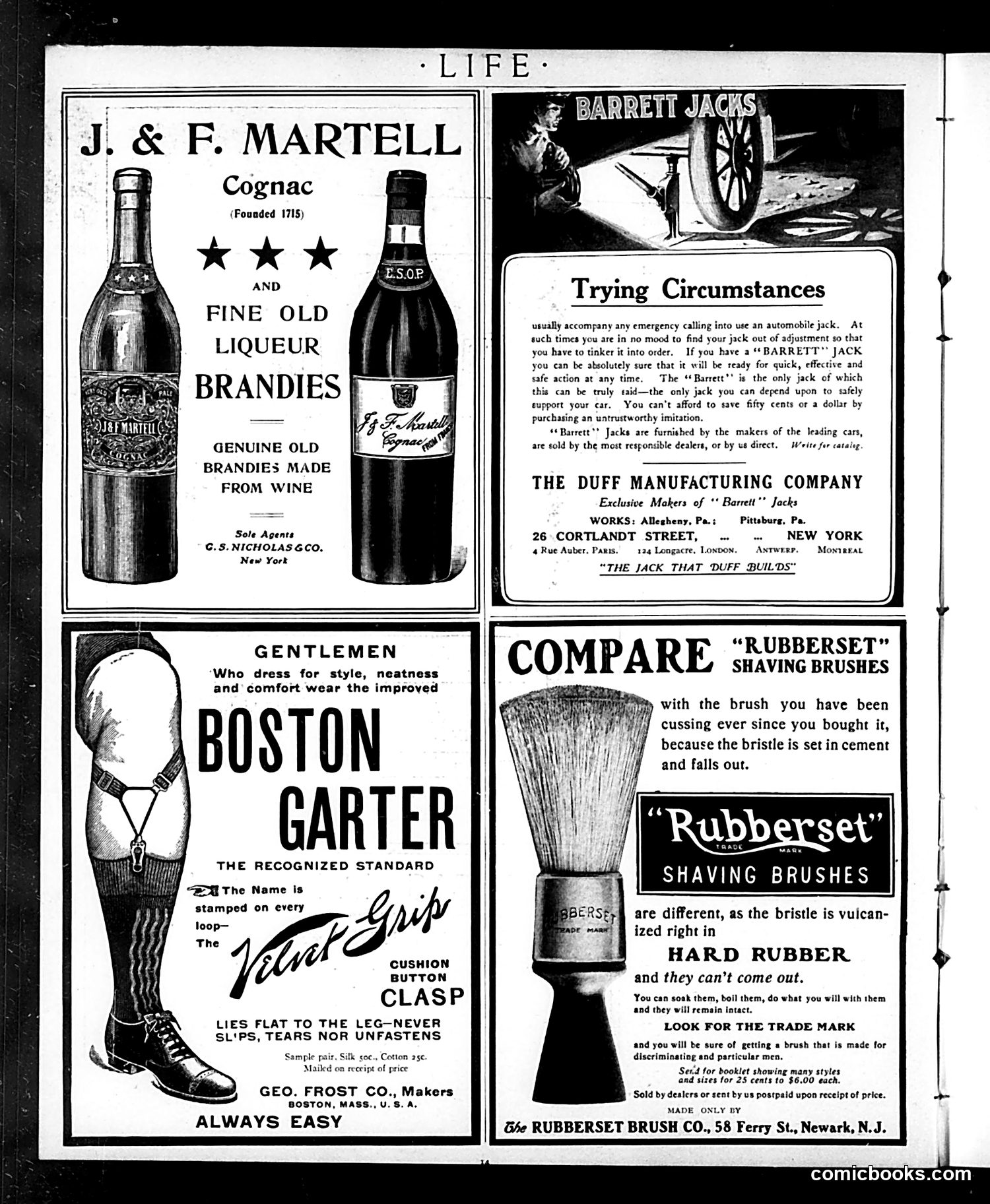
This page is **entirely advertisements**, not satire or political content. It contains four product ads from the early 20th century targeting gentlemen: 1. **J. & F. Martell Cognac** — promotes French brandy through the established distributor G.S. Nicholas & Co. in New York 2. **Barrett Jacks** — automobile jacks marketed as reliable emergency equipment; emphasizes durability and trustworthiness for car owners 3. **Boston Garter** — men's garters with a cushioned button clasp, promising they "lie flat to the leg" and won't slip or tear 4. **Rubberset Shaving Brushes** — compares their vulcanized rubber bristles (set in hard rubber) favorably to competitors' cement-set bristles that fall out; emphasizes durability The ads reflect early automotive culture, grooming standards for "gentlemen," and competitive product marketing. No cartoon, satire, or political commentary is present—this is straightforward period advertising appealing to male consumers.
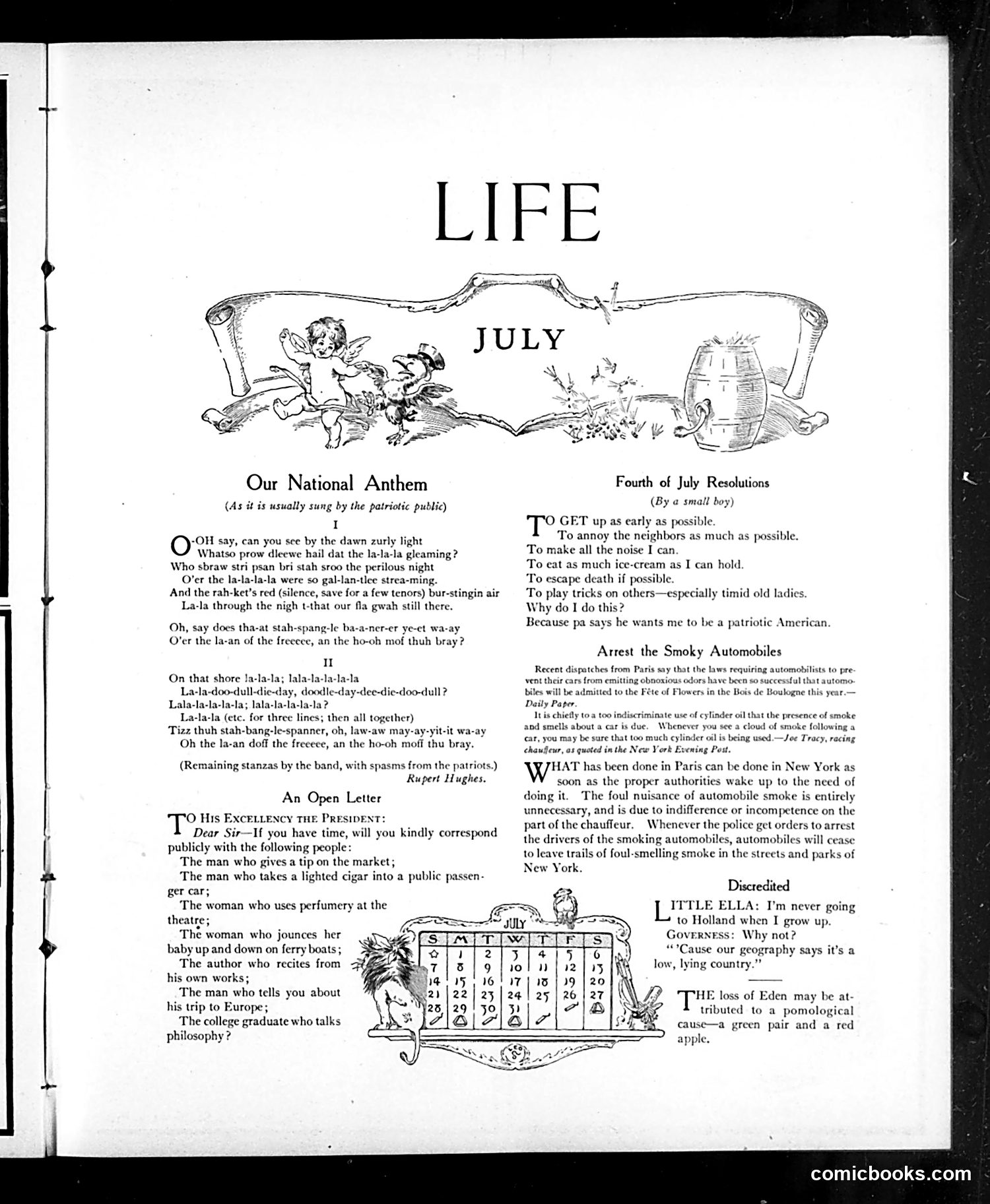
This July 1912 issue of *Life* magazine satirizes American civic behavior through three pieces: **"Our National Anthem"** mocks how the patriotic public actually sings the Star-Spangled Banner—reducing it to nonsensical syllables ("la-la-la," "doo-dull") when they don't know the words, written by Rupert Hughes. **"Fourth of July Resolutions (By a small boy)"** presents a child listing destructive patriotic goals—making noise, annoying neighbors, eating ice cream, playing pranks on elderly women—all justified by his father's demand that he "be a patriotic American." This satirizes how patriotism becomes an excuse for misbehavior. **"An Open Letter to the President"** and related pieces critique social nuisances (cigar smoke in public cars, perfume at theaters, people reciting their own work) and automobile pollution in New York, referencing successful Paris regulations. Throughout, the satire suggests Americans mouth patriotic sentiment while ignoring actual civic responsibility and annoying their fellow citizens.
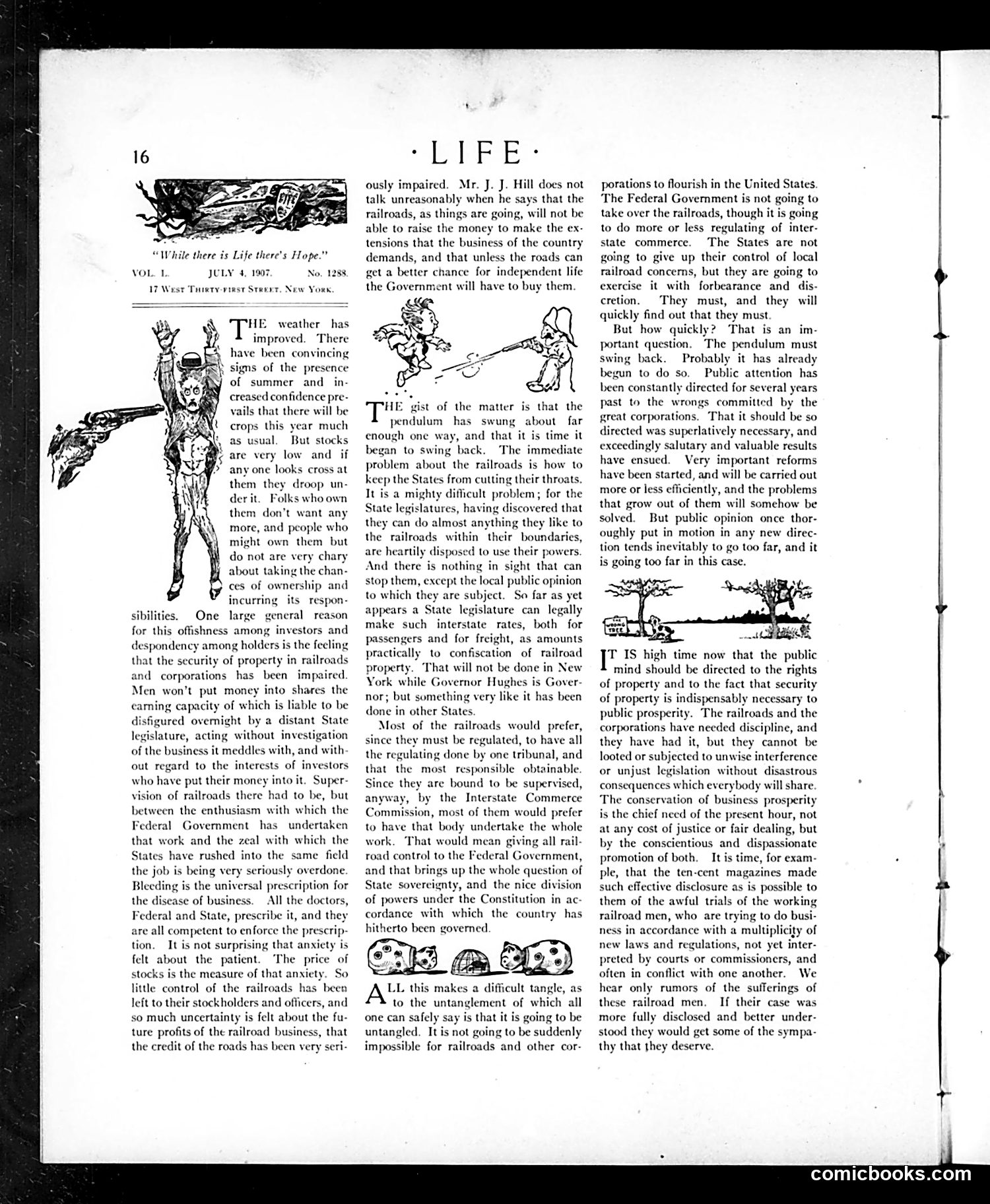
This page contains no single political cartoon but rather editorial commentary on railroad regulation. The decorative vignettes (children playing, rural scenes) are ornamental rather than satirical. The piece criticizes excessive government intervention in railroad business. It references **J.J. Hill** (a prominent railroad magnate), arguing that both Federal and State governments are over-regulating railroads so heavily that they cannot raise capital or operate profitably. The author uses medical metaphor—calling regulation "bleeding" (the universal 19th-century medical treatment)—to satirize how government "doctors" are killing their patient through excessive prescription. The central tension: States are confiscating railroad profits through rate-setting, while railroads prefer Federal regulation under the Interstate Commerce Commission as more predictable. Governor Hughes of New York is mentioned approvingly as restraining state overreach. For modern readers: this reflects Gilded Age anxiety about balancing corporate power against progressive-era government regulation—the pendulum, the author argues, has swung too far toward control.
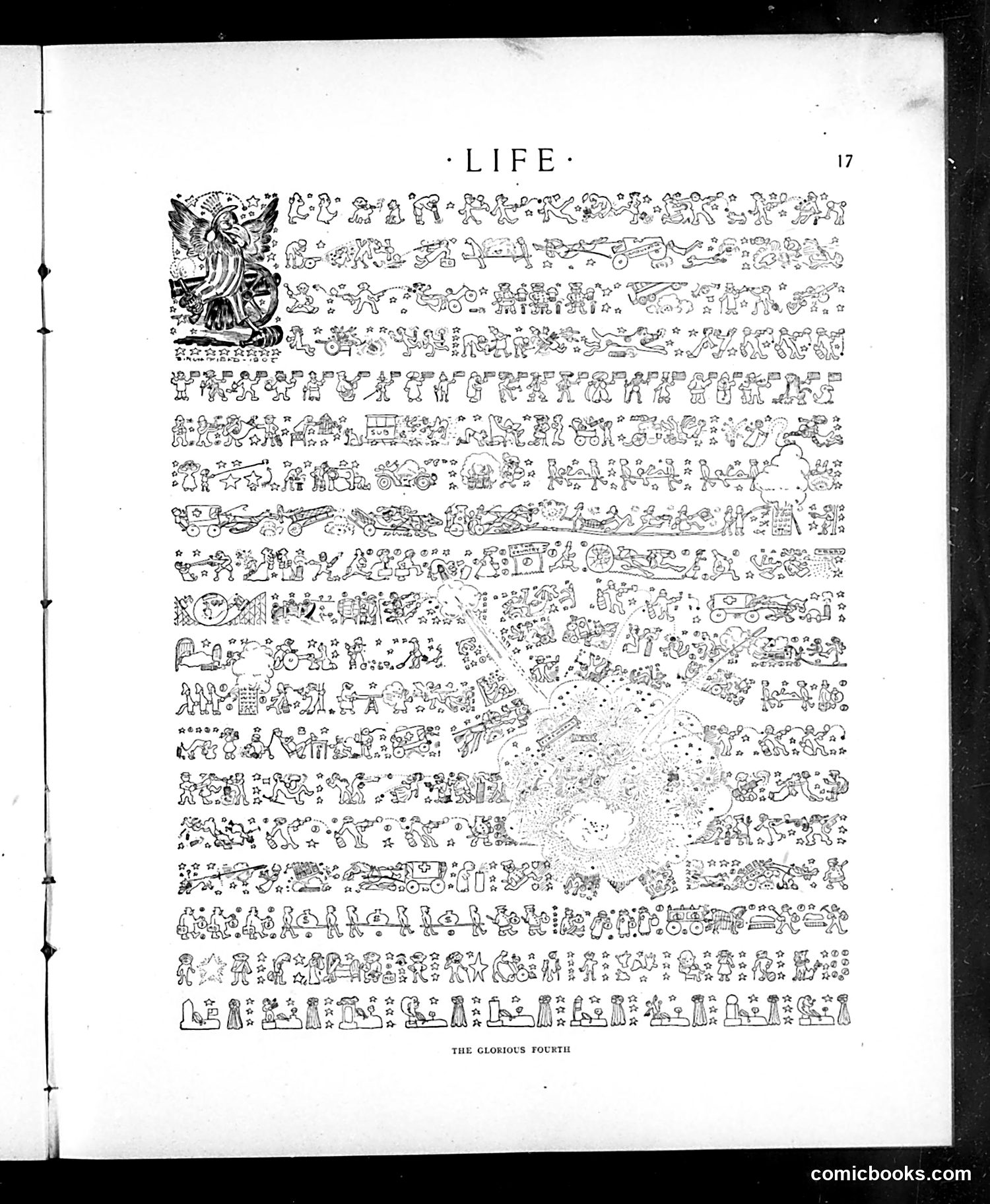
This page presents a visual satire celebrating American Independence Day (July 4th). The composition consists of multiple horizontal bands of tiny illustrated figures and scenes arranged like text, creating a densely packed panoramic narrative. The content appears to depict various aspects of American life and celebration—people engaging in festive activities, parades, fireworks, leisure pursuits, and social gatherings typical of Fourth of July traditions. The style mimics the visual density of newspaper comics or satirical engravings common to Life magazine's era. The specific satire likely comments on American society, values, or contradictions through depicting the chaotic, crowded nature of holiday celebrations. The title "The Glorious Fourth" carries potential irony—celebrating American ideals while the cramped, chaotic imagery may suggest social disorder or critique contemporary American culture. Without clearer OCR text, the precise political targets remain unclear, but the visual approach was typical of Life's satirical commentary on American life.
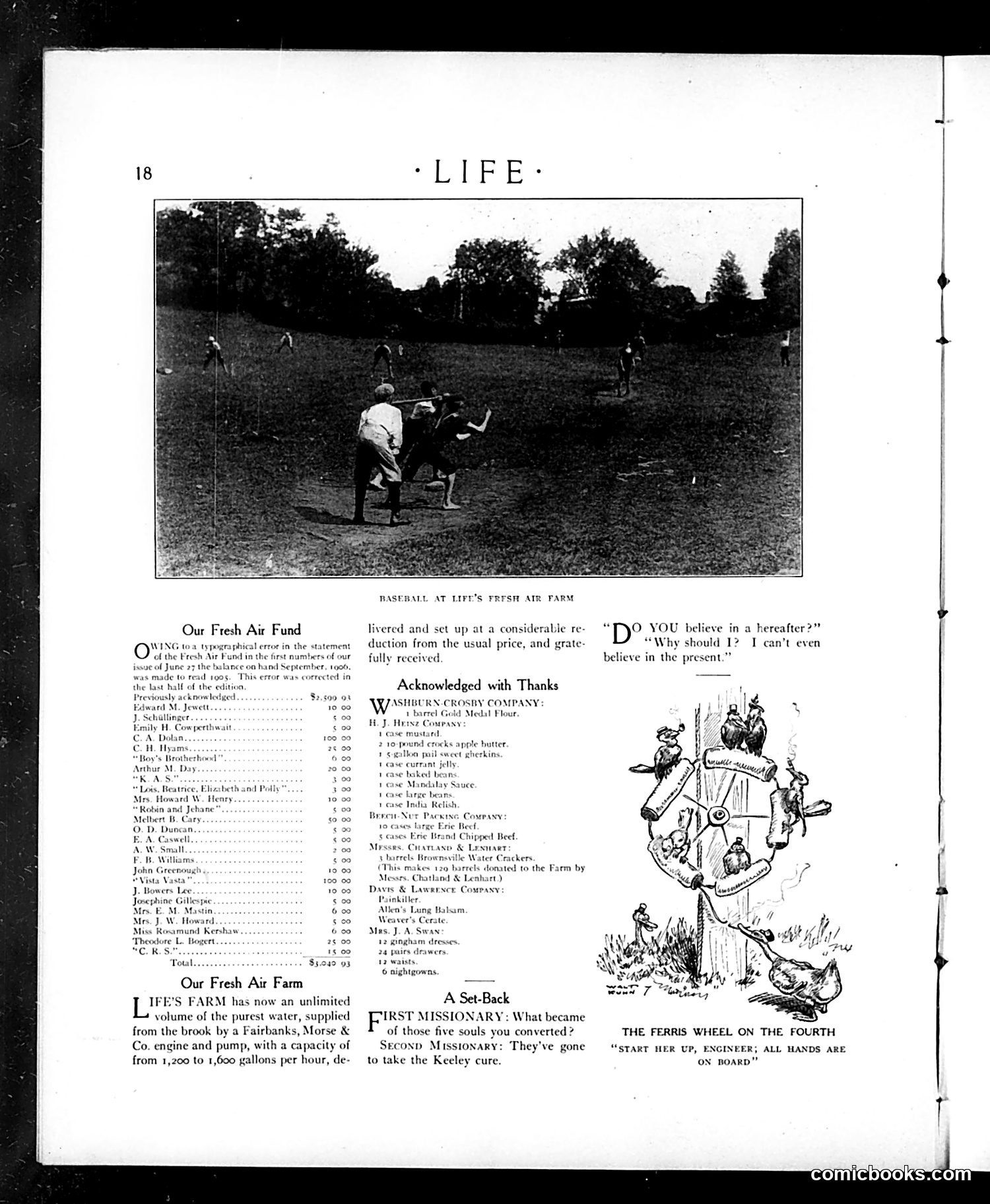
This page documents Life's charitable "Fresh Air Farm," which provided recreational space and pure water to urban populations. The main photograph shows a baseball game at the facility, illustrating its recreational purpose. The page lists donors who contributed supplies (flour, mustard, medicines, clothing) to support the farm's operation. The cartoons below offer social commentary through humor: 1. **"A Set-Back"** jokes about missionary work's failure—converts abandon their new faith to enter the Keeley cure (a contemporary alcoholism treatment), suggesting the converts' moral weakness or the missionaries' ineffectiveness. 2. **"The Ferris Wheel"** appears to satirize overcrowding or safety concerns at public amusements, with the engineer's casual command contrasting with the packed condition ("all hands on board"). These cartoons reflect Progressive Era concerns about public health, morality, and urban recreation that motivated charitable institutions like Life's Fresh Air Farm.
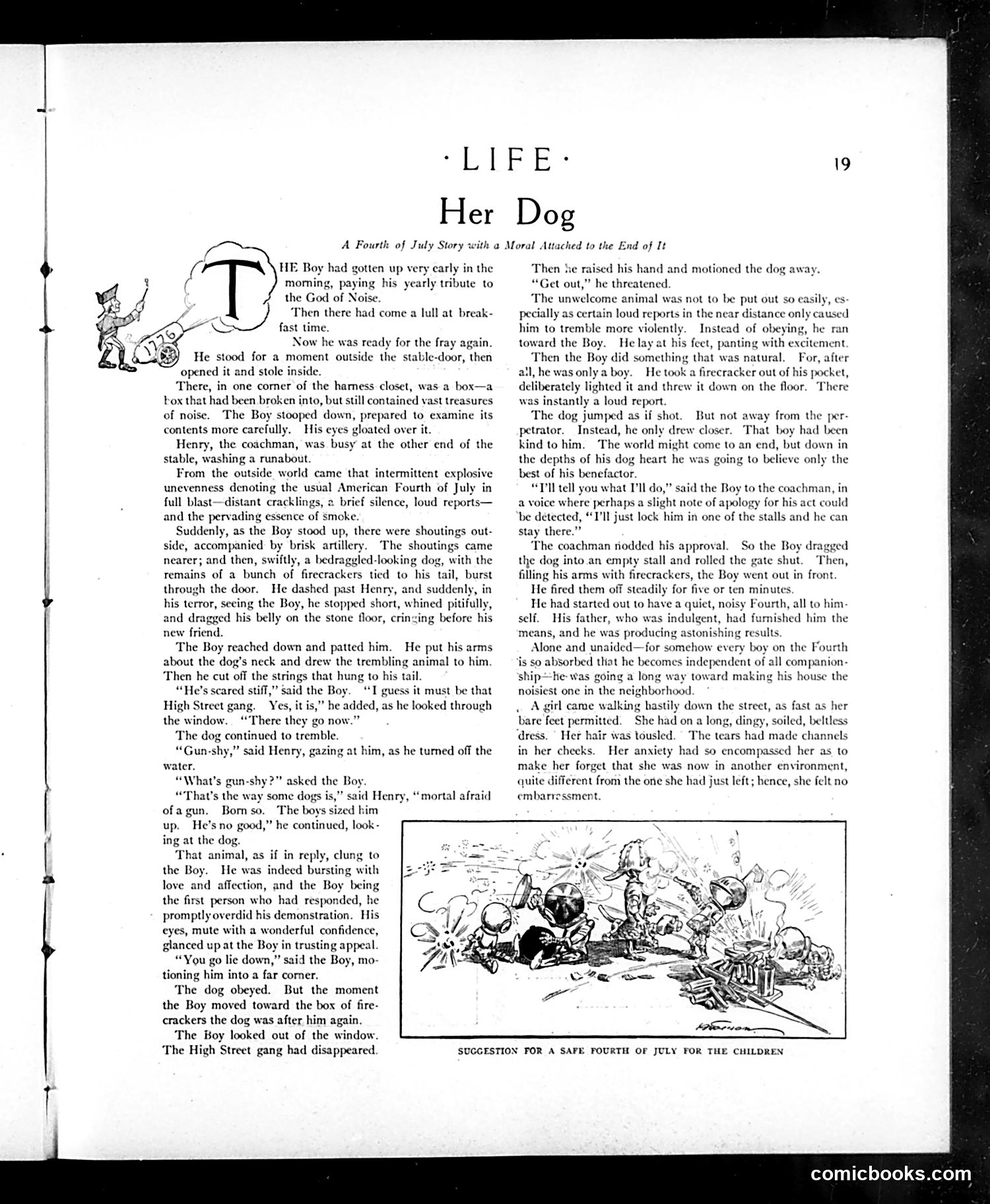
This is a sentimental short story, not political satire, published in *Life* magazine. The narrative concerns a boy who finds a terrified, "gun-shy" dog with firecrackers tied to its tail—victim of neighborhood roughians (the "High Street gang"). The boy shows kindness, removing the strings and comforting the animal. However, he then deliberately sets off a firecracker near the dog to test or torment it, despite the dog's fear. The story's "moral" (per the subtitle) appears to critique casual cruelty masked by earlier kindness: the boy is "only a boy," the text suggests, excusing his behavior while the loyal dog forgives him unconditionally. The illustration shows children celebrating Fourth of July with fireworks. The piece uses the holiday as a framework to explore themes of animal welfare and childhood morality—likely reflecting early-20th-century concern about children's treatment of animals.
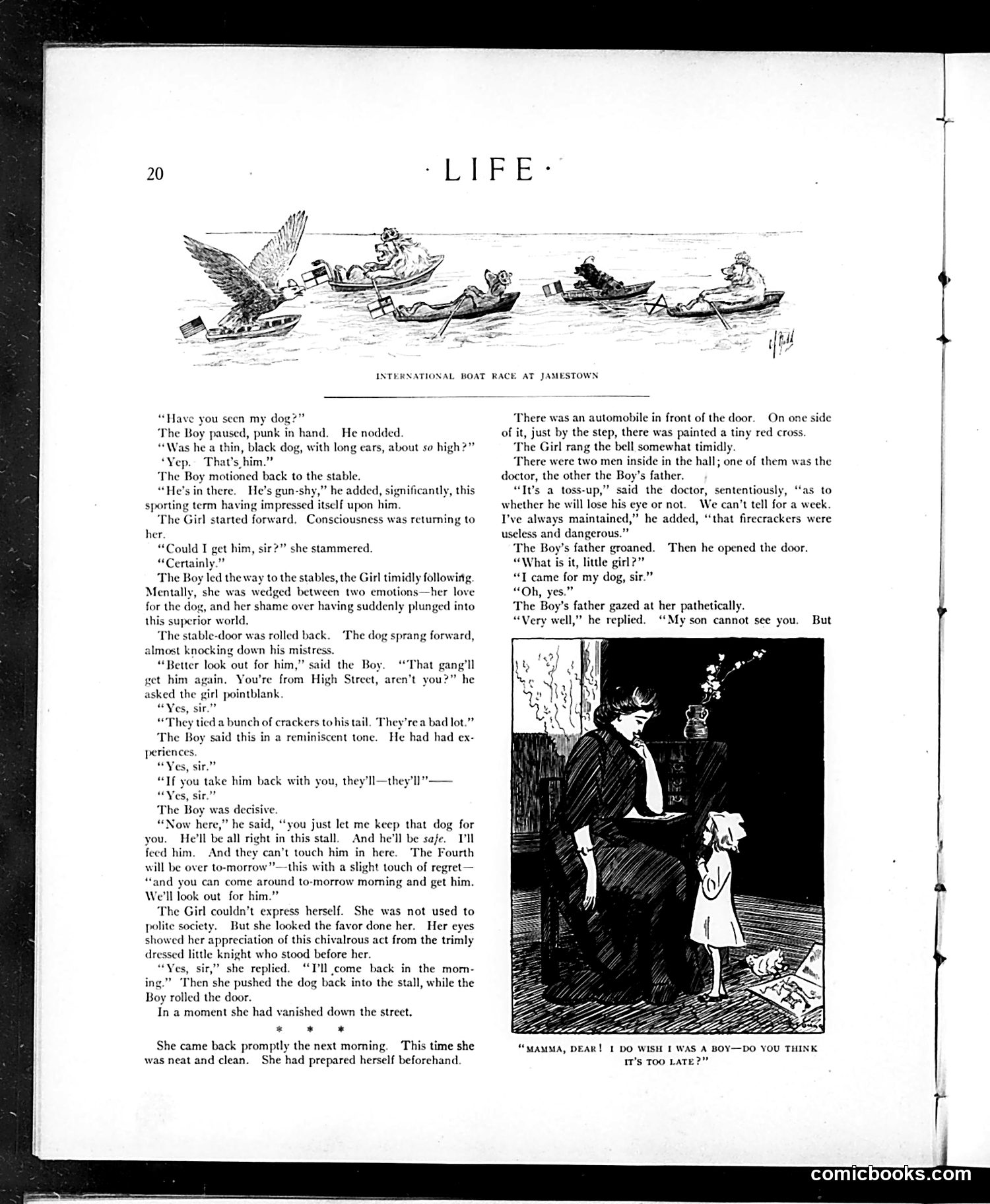
This page presents a sentimental story about class and childhood heroism, centered around **Fourth of July fireworks dangers**—a social concern of the era. **The Setup:** A working-class girl from "High Street" (a poorer neighborhood) loses her dog to street boys who tie firecrackers to its tail—a common, cruel prank. A middle-class boy from a "superior world" offers to protect the dog in his family's stable. **The Tragic Twist:** The boy's protective gesture fails. The story reveals the dog was injured by firecrackers anyway, potentially blinded. A doctor is present, emphasizing that firecrackers are "useless and dangerous." **The Moral Message:** The final panel shows the girl returning, now "neat and clean," having prepared herself—suggesting her gratitude and improved circumstances. The boy's father cryptically states "My son cannot see you," implying the boy himself was blinded by the same firecrackers. **Historical Context:** This critiques Fourth of July fireworks' casual use by children and advocates for safety awareness. The cross-class interaction (rich boy helping poor girl) reflects Progressive Era themes about social responsibility.
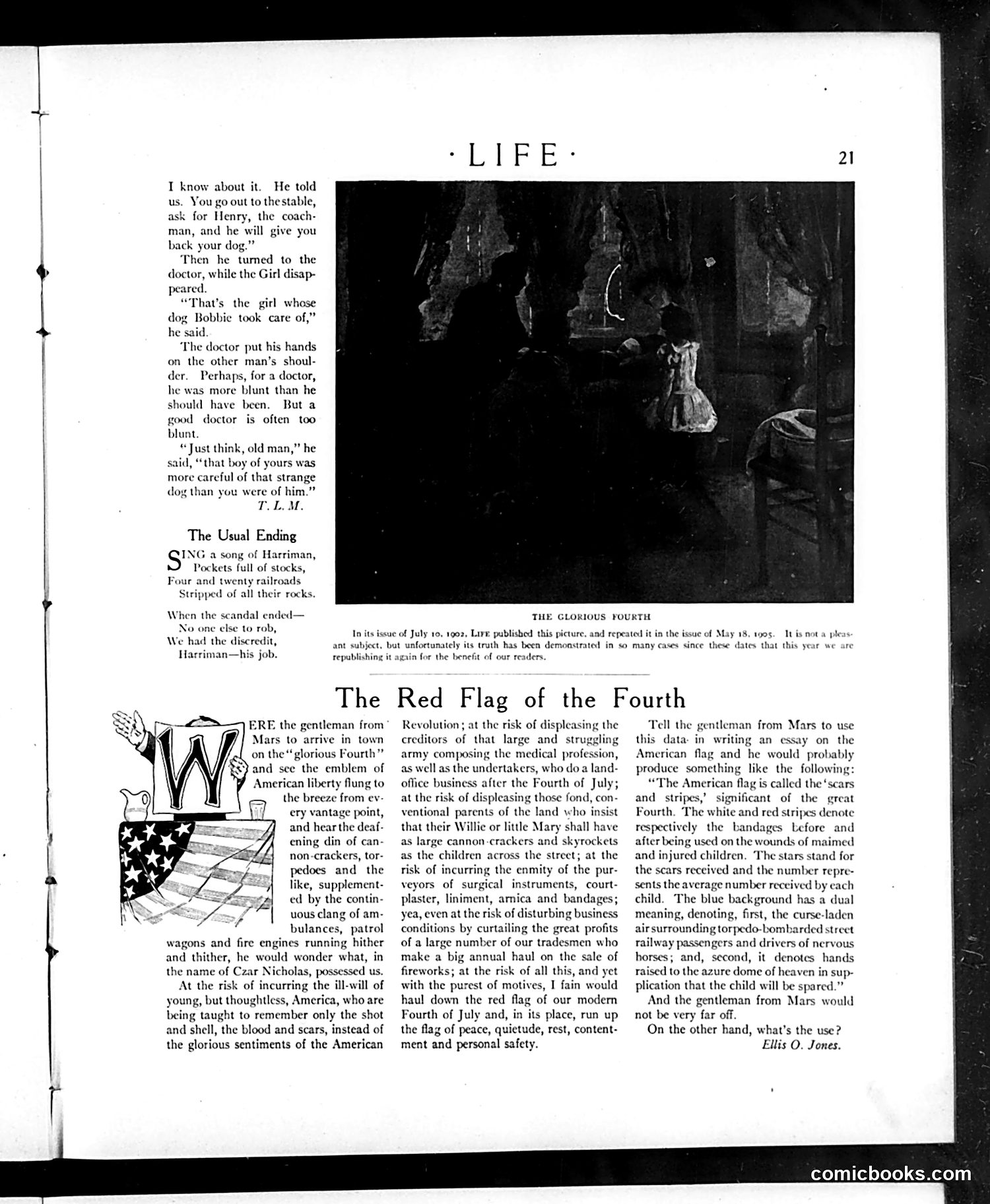
This satirical piece critiques Fourth of July celebrations as dangerous and destructive. The article uses a fictional "gentleman from Mars" as an outsider perspective to highlight the absurdity: Americans wave the flag while fireworks cause mass injuries, deaths, and suffering—particularly to children. Ellis O. Jones sarcastically "redefines" the American flag's symbolism: the red and white stripes represent bandages on wounded children; the stars represent scars; the blue background represents both the smoke from explosions and desperate prayers for safety. The satire targets the hypocrisy of celebrating liberty and independence while ignoring Fourth of July casualties—the medical profession, undertakers, and firecracker manufacturers all profit from preventable injuries. Jones advocates replacing fireworks with peaceful observance but cynically acknowledges Americans won't heed this message. This reflects genuine Progressive Era concerns about holiday violence; the reprinted 1902 article notes its "truth has been demonstrated in so many cases."
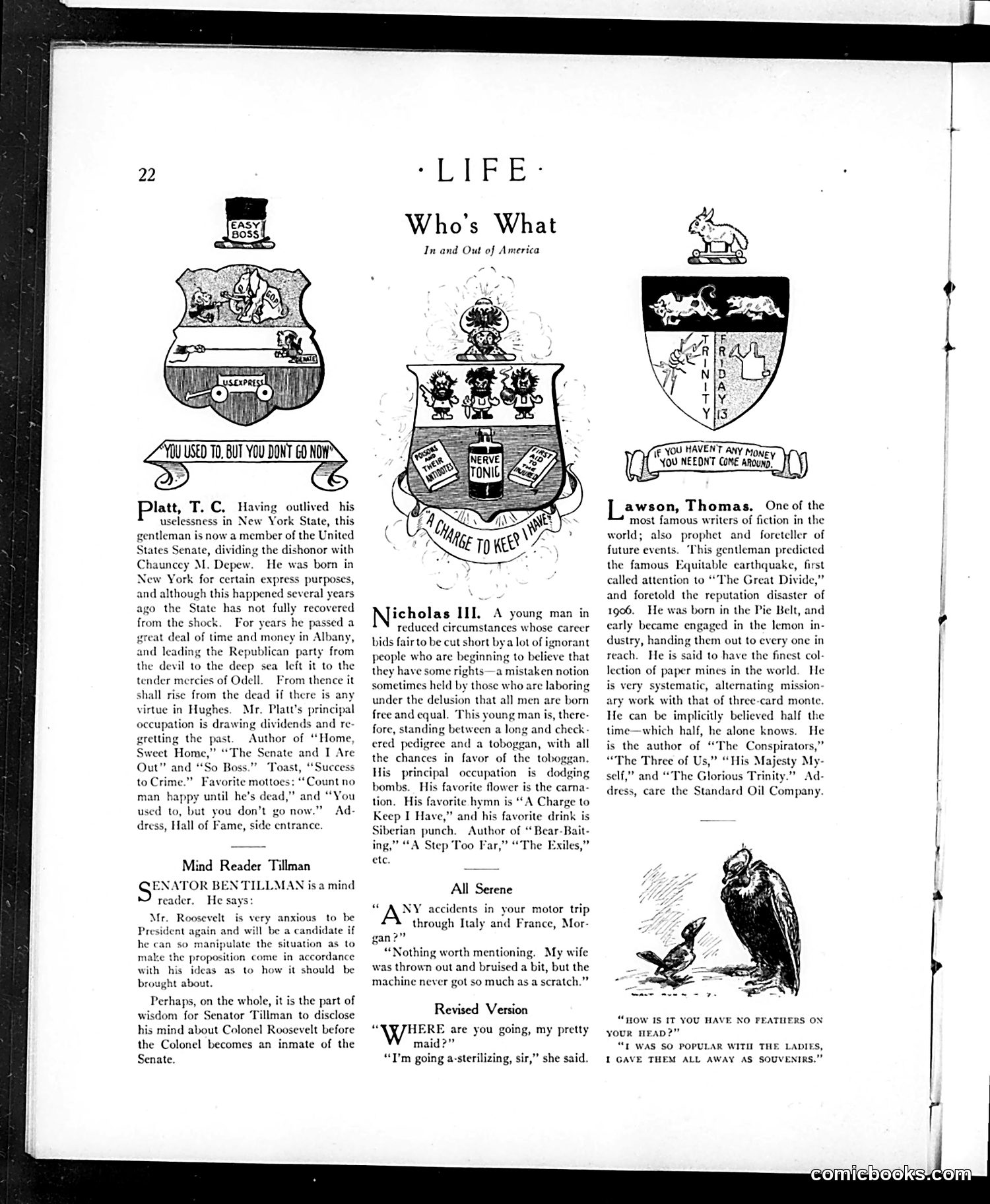
This page from *Life* magazine satirizes prominent American figures and contemporary social issues: **T.C. Platt**: A New York Republican politician ridiculed for outliving his political usefulness. The satire suggests he's now irrelevant, having caused damage to the state Republican party, and is relegated to the "Hall of Fame." **Senator Ben Tillman**: Portrayed as a "mind reader" who should warn Colonel Roosevelt (likely Theodore Roosevelt) against seeking another presidency, implying the senator understands Roosevelt's ambitions better than Roosevelt admits. **Nicholas III**: Appears to reference European royalty facing revolutionary pressure—a wealthy aristocrat whose "reduced circumstances" and danger from people demanding rights suggests anxiety about social upheaval and democratic movements threatening the upper classes. **Minor jokes**: Include satirical takes on wealthy industrialists (Morgan's indifference to his wife's accident), and updated nursery rhyme humor about "sterilizing" (likely Progressive-era social reform commentary). The overall tone mocks political hypocrisy, aristocratic privilege, and wealthy Americans' disconnection from ordinary concerns.
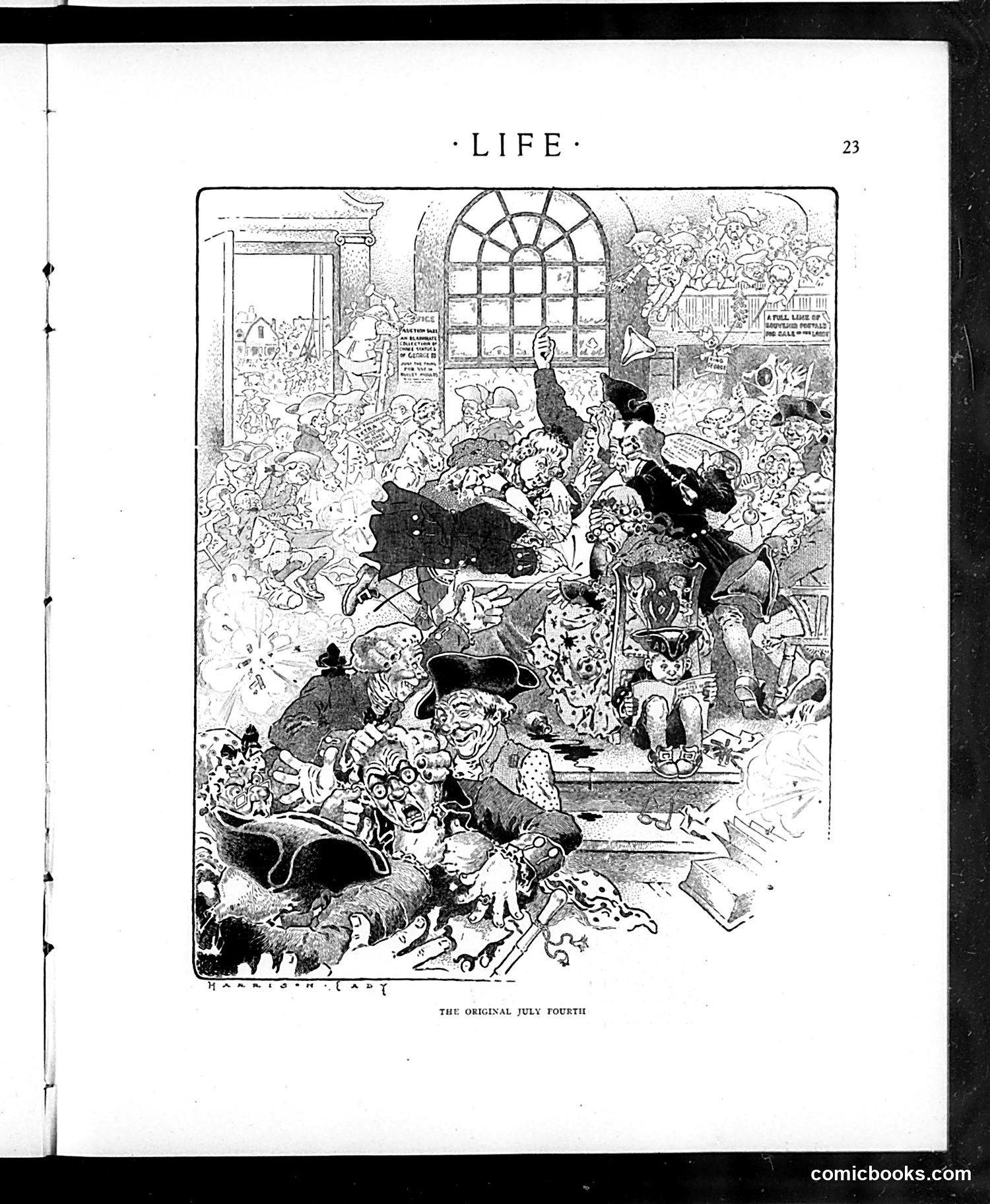
This satirical cartoon depicts a chaotic Revolutionary War scene, likely contrasting the idealized founding narrative with messy historical reality. The crowded composition shows soldiers, civilians, and apparent confusion during what the caption identifies as "the original July Fourth"—presumably depicting the American Revolution's actual events rather than their mythologized version. The artist (Cesare appears to sign it) uses dense, busy linework to convey disorder and cacophony, suggesting the satirist's point: the actual Fourth of July celebration was far messier and less glorious than commemorative tradition suggests. This appears to be social commentary on how Americans sanitize and romanticize their founding history, particularly relevant given Life magazine's role as a vehicle for satirical critique of contemporary American society and values.
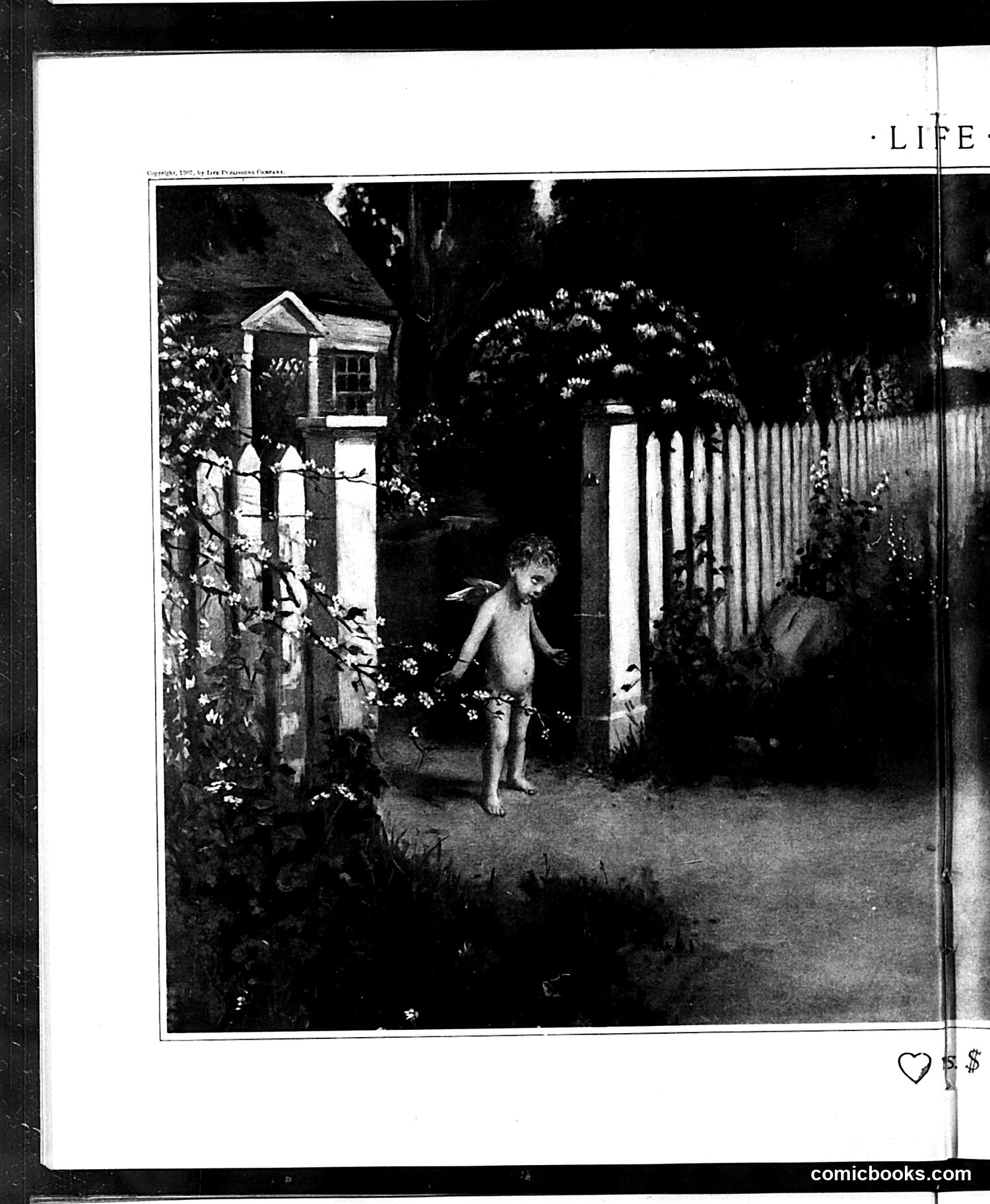
This appears to be a page from *Life* magazine featuring a black and white photograph rather than a cartoon. The image shows a young shirtless boy in a garden setting with white picket fencing, flowering plants, and what appears to be a garden shed or small structure in the background. Another figure is partially visible on the right side. The OCR text is largely corrupted and illegible, making it impossible to determine the specific caption or satirical point. Without readable text or clear identifying markers, I cannot confidently explain what social or political reference this photograph is meant to convey. The domestic garden setting suggests themes of American home life, but the precise satire or commentary remains unclear from the available information.
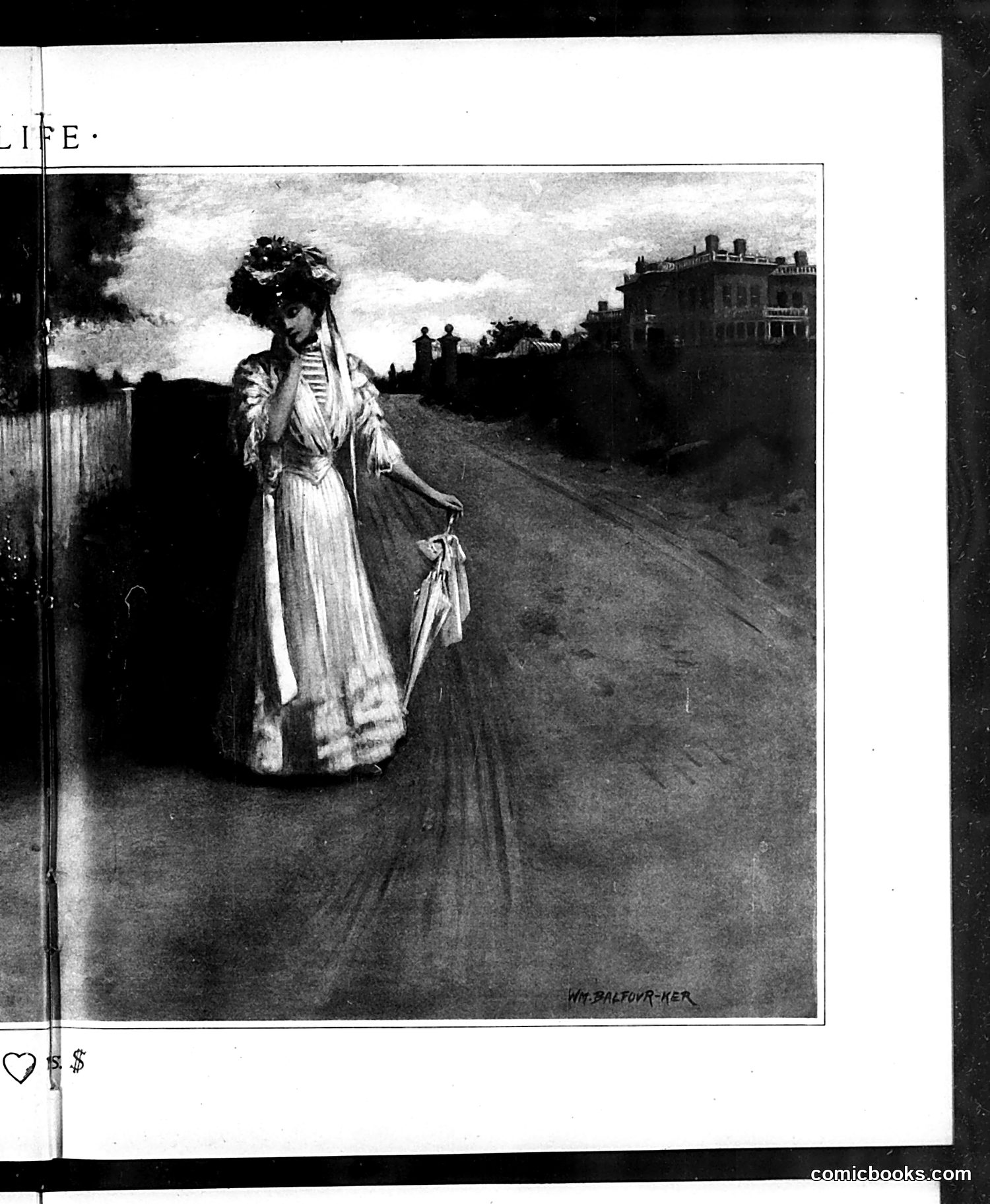
This appears to be an illustration from *Life* magazine showing a woman in early 1900s dress standing alone on a road, gazing toward a grand estate or mansion in the distance. The image is signed "Wm. Balfour-Ker." Without additional OCR text from the accompanying article, the specific satirical point is unclear. However, the composition suggests themes common to *Life's* social satire of that era: perhaps commentary on wealth inequality, romantic aspiration, class divisions, or women's social positioning. The woman's contemplative pose and the distance between her and the estate could imply longing, exclusion, or social critique. The heart and dollar sign symbols in the margin hint at romantic or financial themes, but the precise historical reference and satirical target remain uncertain without the article text.
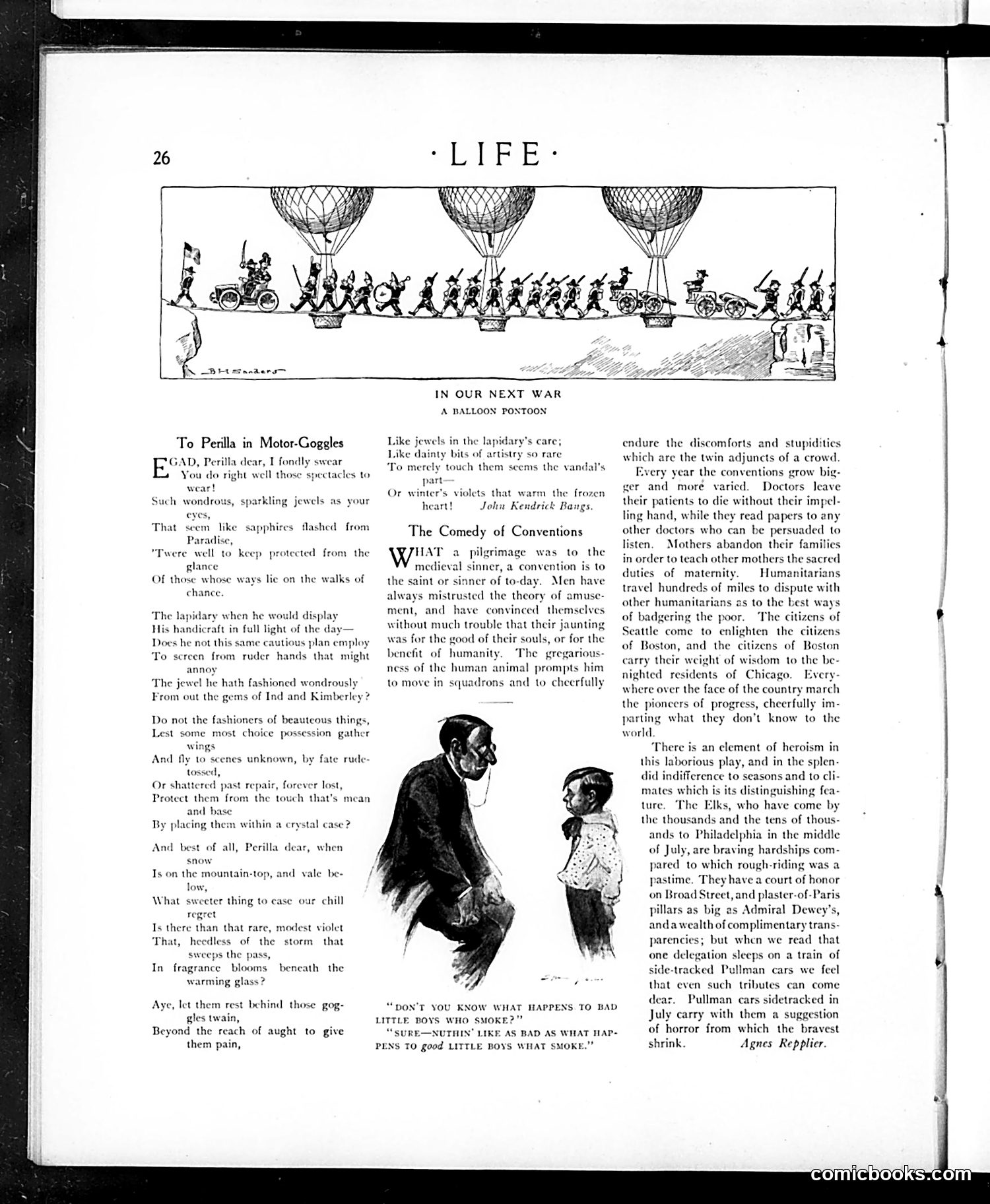
This page contains two distinct pieces of satire: **"To Perilla in Motor-Goggles"** (poem, top left): A romantic poem addressing a woman wearing protective motor goggles, comparing her eyes behind the goggles to precious jewels kept safe in crystal cases. The satire gently mocks the fashion of early automobiling—women wore goggles for protection while driving newfangled motor cars, and the poem treats this practical safety gear as romantic protection of feminine beauty. **"The Comedy of Conventions"** (essay with illustration, right side): Agnes Repplier satirizes the American convention circuit—large organized gatherings where professionals (doctors, mothers, "humanitarians") travel nationwide claiming noble purposes while actually enjoying gregarious socializing. The specific example is the Elks convention in Philadelphia during July heat. The illustration shows a man speaking to a child about smoking, likely referencing the ironic contrast between conventions' stated moral purposes and their actual indulgences. Repplier's point: Americans rationalize self-interested travel as civic duty. **"A Balloon Pontoon"** (top illustration): Shows a military pontoon bridge concept using hot-air balloons, captioned about future warfare.
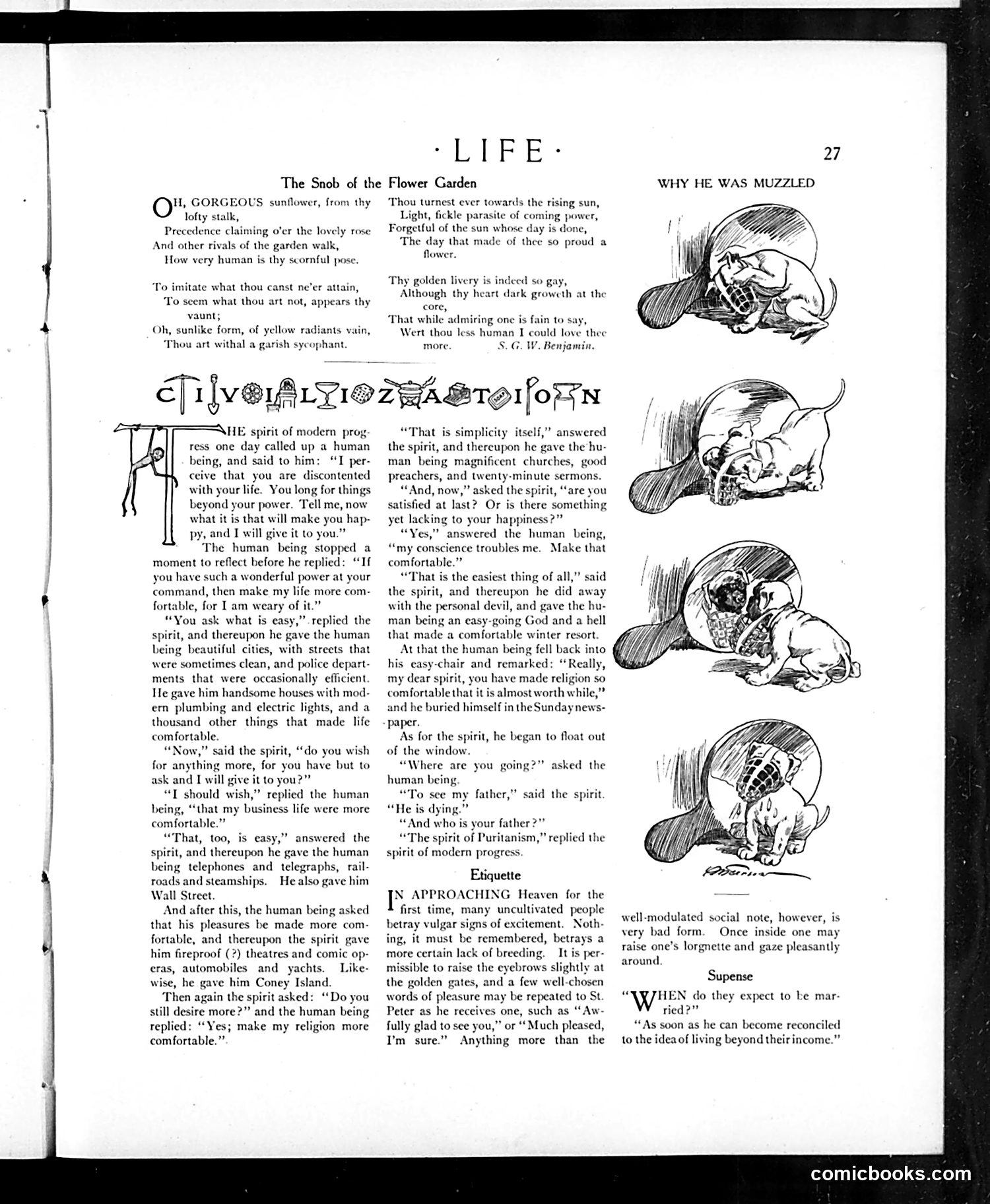
This page contains two satirical pieces critiquing American society's priorities: **"The Snob of the Flower Garden"** (left) is a poem mocking human vanity through the metaphor of a sunflower—beautiful but superficial, chasing power while forgetting its origins. It suggests people abandon loyalty for advancement. **"Civilization"** (center) is the main satire: a spirit of modern progress offers a human increasingly comfortable living conditions—cities, homes, businesses, entertainment (theaters, automobiles, Coney Island). When asked to make religion "comfortable," the spirit removes moral accountability by eliminating the personal devil and offering a "comfortable" hell. The human accepts this spiritual compromise gladly. The spirit then departs to see his dying father: Puritanism—suggesting modern progress has killed traditional morality. **"Etiquette" and "Suspense"** (right) are brief humorous social notes about propriety in Heaven and marriage expectations. The overall message: Americans prioritize material comfort over genuine morality, trading spiritual integrity for convenience.
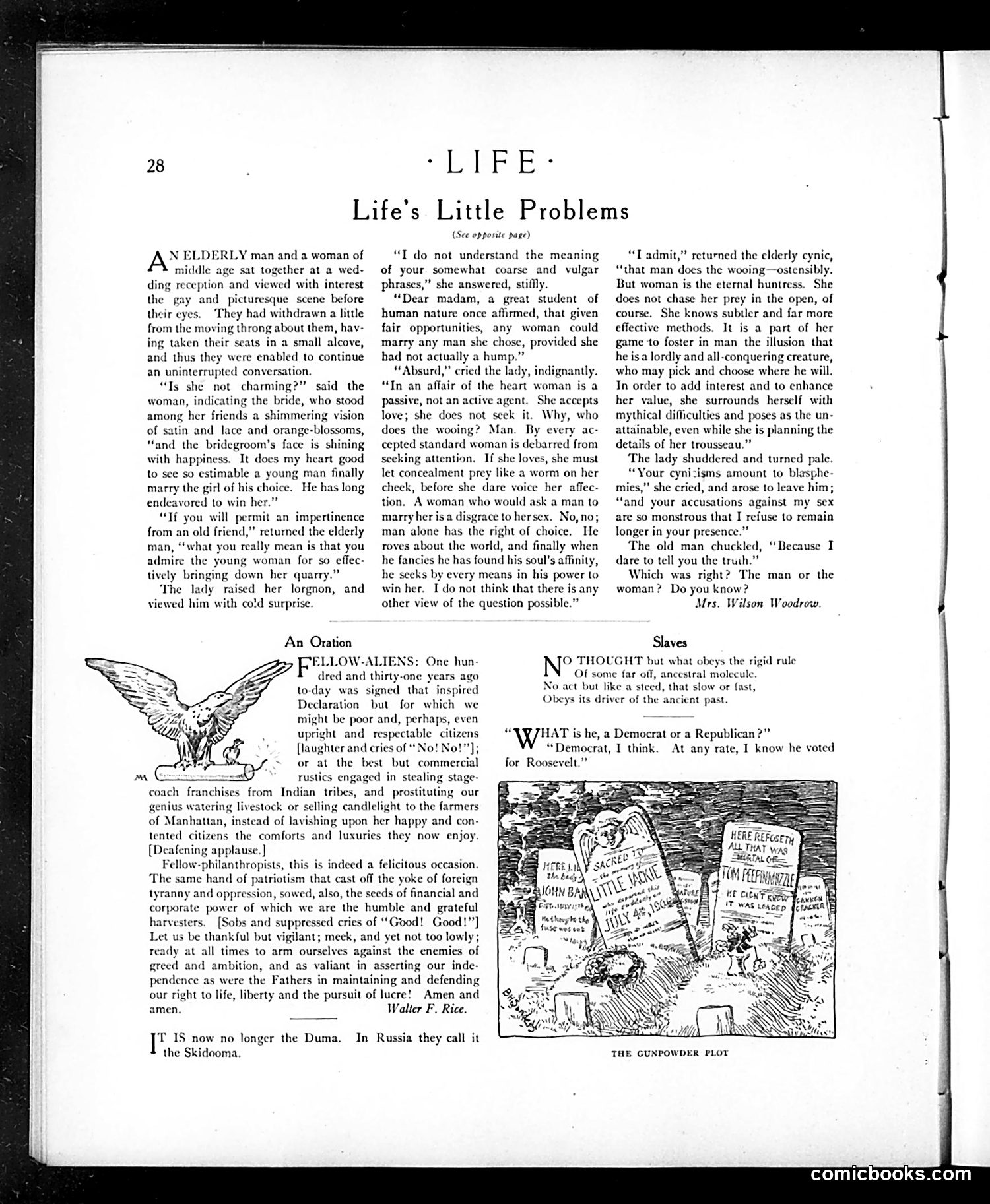
This page contains two distinct pieces of social satire: **"Life's Little Problems"** presents a dialogue between an elderly cynic and a conventional woman at a wedding. Their debate concerns courtship rituals: she insists women are "passive" agents who accept love rather than seek it, while he argues women are actually the "hunters" who strategically foster illusions of male conquest to enhance their value. The satire targets Victorian-era gender role hypocrisy—the gap between stated propriety (women don't pursue men) and actual behavior (women actively manipulate outcomes). The byline credits "Mrs. Wilson Woodrow," possibly a pseudonym. **"The Gunpowder Plot"** cartoon (bottom right) depicts gravestones referencing historical figures—appears to show monuments to Revolutionary and historical American figures, with text mentioning "Roosevelt," likely Theodore Roosevelt. The accompanying "Oration" text criticizes commercial exploitation and corruption of American ideals. Both pieces exemplify *Life* magazine's satirical approach: exposing contradictions between professed values and actual practice in American society.
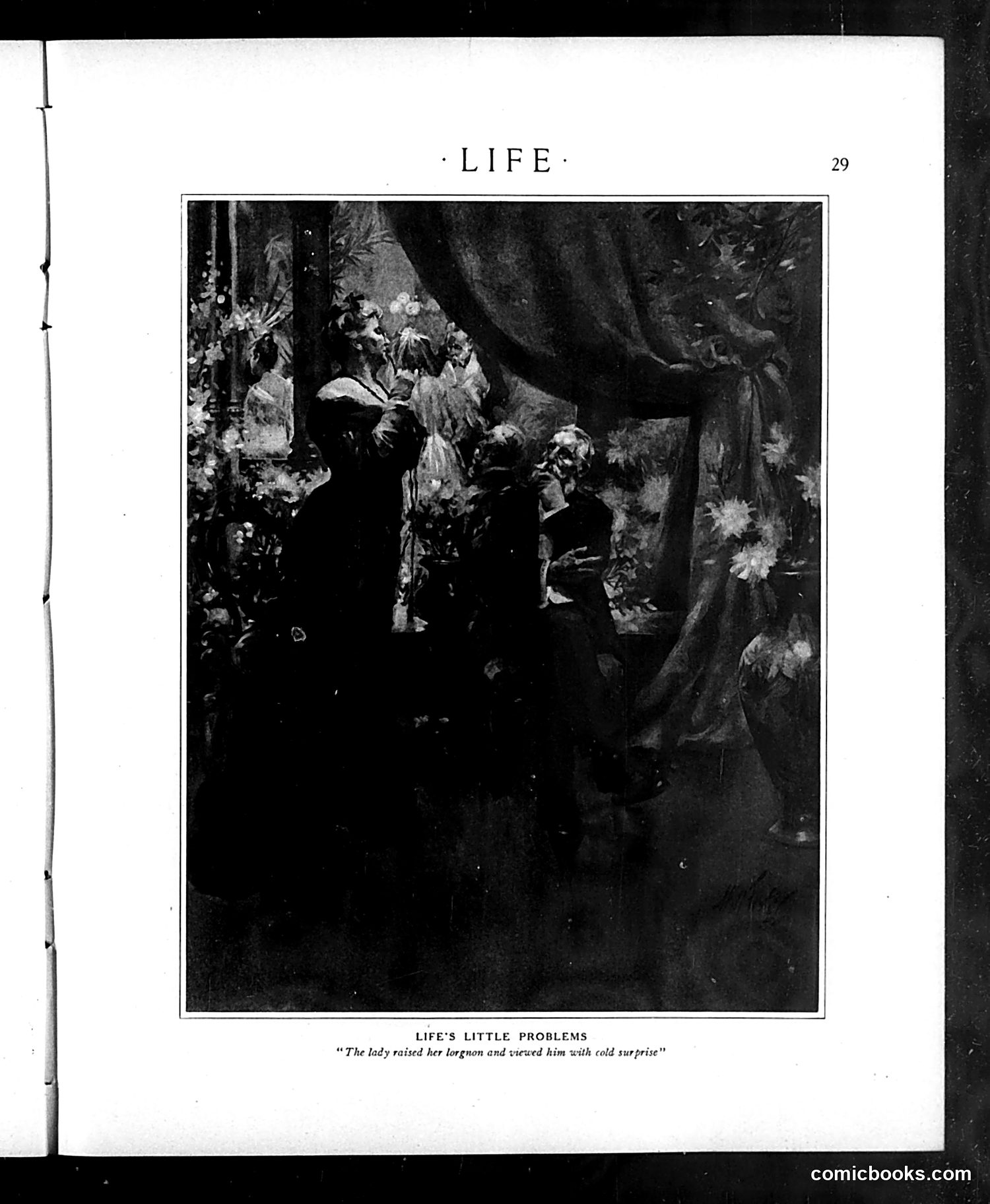
This appears to be a single-panel cartoon illustrating a social embarrassment scenario. The image shows several figures in what looks like an elegant indoor setting with flowering plants and drapery. The caption describes a woman raising a lorgnon (a type of eyeglass accessory on a handle) to view someone with "cold surprise"—suggesting disapproval or disdain. The cartoon likely satirizes upper-class social conventions and the haughty judgment of the wealthy elite toward someone deemed unsuitable or inappropriate for their refined circles. The "Little Problems" series format suggests these were humorous vignettes depicting everyday social predicaments and the awkward moments that arise from rigid social hierarchies and etiquette expectations. The woman's gesture of the lorgnon emphasizes the theatrical condescension typical of satirical commentary on snobbery.
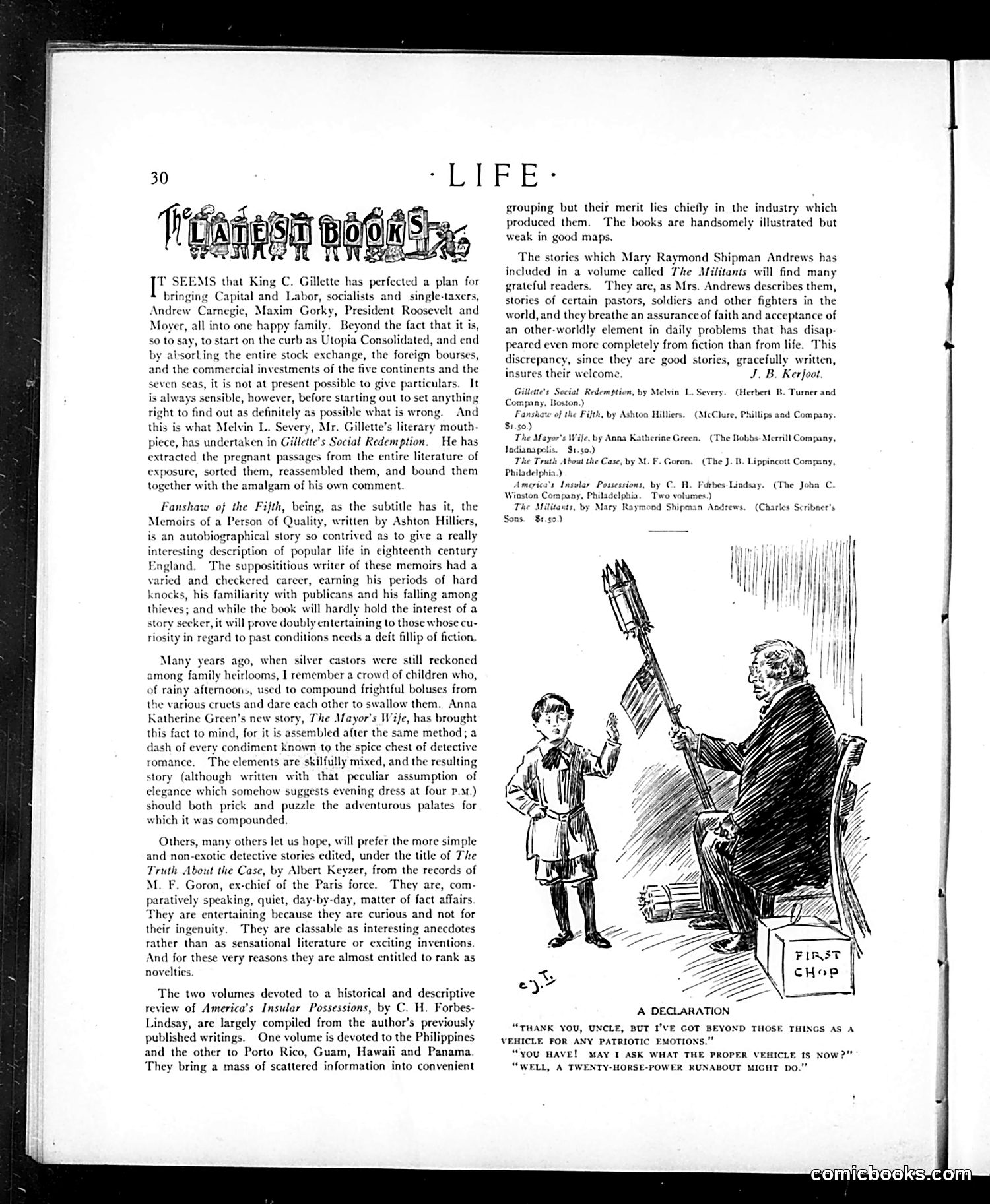
This cartoon mocks inflated patriotic language used to justify frivolous purposes. A small boy presents his uncle with a homemade vehicle (appearing to be a large wooden box on wheels), claiming it as "a vehicle for any patriotic emotions." The uncle responds by asking what "proper vehicle" it is, to which the boy replies: "a twenty-horse-power runabout right do." **The satire**: The cartoon ridicules how Americans invoke patriotism to rationalize or elevate mundane, even silly endeavors. The boy's earnest misuse of grand language—calling a toy wagon a "patriotic" conveyance—mirrors how politicians and businessmen of the era dressed up ordinary commercial ambitions in patriotic rhetoric. The page's surrounding text discusses King C. Gillette's utopian scheme to reconcile capital and labor; this cartoon likely lampoons similar grandiose schemes wrapped in patriotic language but lacking substance.
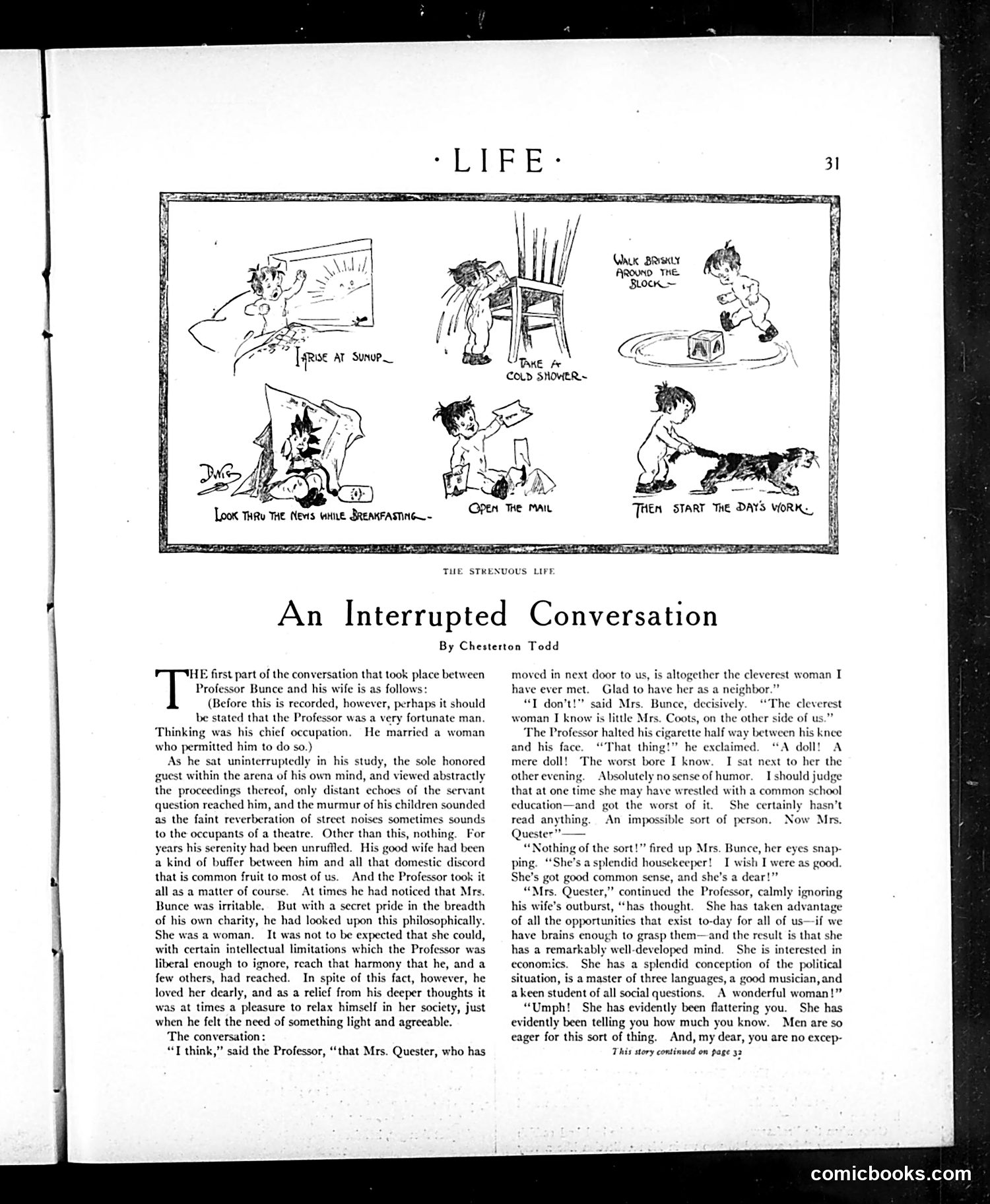
This page combines a humorous illustrated strip at the top titled "The Strenuous Life" with the beginning of a satirical short story by Chesterton Todd. **The Cartoon:** Six small panels depict a man's chaotic morning routine—oversleeping, taking a cold shower, nearly colliding with furniture, walking around the block, and then starting his workday. The humor mocks the ideology of vigorous, "strenuous" living (likely referencing Theodore Roosevelt's philosophy of robust masculinity and activity). **The Story:** "An Interrupted Conversation" satirizes male intellectual vanity and marital dynamics. A self-absorbed Professor, who has enjoyed uninterrupted study time while his wife manages domestic chaos, confidently praises the intellect of a female neighbor (Mrs. Quester) over Mrs. Coots. His wife immediately contradicts him, defending Mrs. Coots as sensible and kind. The satire targets the Professor's obliviousness—he assumes intellectual superiority based on abstract thinking while remaining ignorant of domestic realities. His wife suggests Mrs. Quester is merely flattering his ego. The humor lies in exposing the gap between his self-image as a brilliant thinker and his actual poor judgment about people and his own household.
This story satirizes the impractical intellectual man disconnected from domestic reality. The Professor, absorbed in abstract theories and philosophical debates, has never actually interacted with his household's cook or managed any practical affairs—his capable wife has shielded him from such concerns. The satire centers on his sudden, humiliating helplessness when his wife falls ill and requires hospitalization. Forced to manage dinner, he cannot even identify the cook he's theoretically discussed "the cook question" with Mrs. Quester. The joke: this learned man who intellectualizes everything cannot function in basic household management. His scholarly detachment from real life leaves him utterly dependent and useless in genuine emergencies. The story mocks both absent-minded academic pretension and the era's gender dynamics—the professor's complete reliance on his wife's competent management, which he takes entirely for granted.
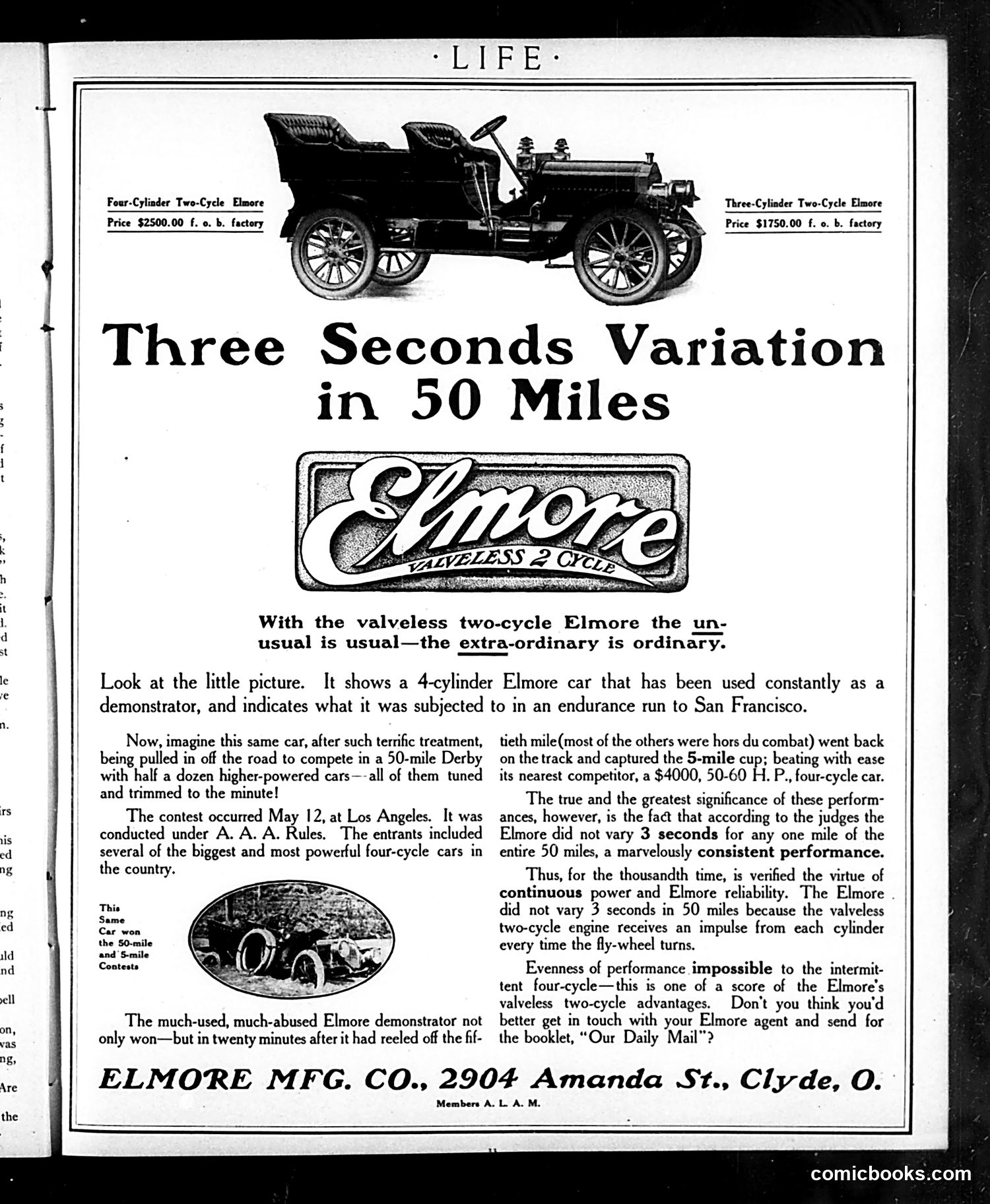
This is **not a cartoon or satire page** — it's a straightforward automobile advertisement from an early 1900s *Life* magazine. The Elmore Manufacturing Company promotes their valveless, two-cycle engines by highlighting an endurance race held May 12 in Los Angeles under American Automobile Association rules. Their argument: a heavily-used demonstrator car competed against larger, more powerful four-cylinder competitors and won both a 50-mile and subsequent 5-mile race. The key marketing claim is consistency — the Elmore maintained such uniform performance that it never varied more than 3 seconds across any mile of the 50-mile course. They attribute this to their two-cycle engine design, which fires every revolution versus competitors' four-cycle engines. The prices listed ($2,500 and $1,750) situate this as premium merchandise. The ad targets buyers seeking proven reliability over raw horsepower — a significant value proposition in early automotive competition.
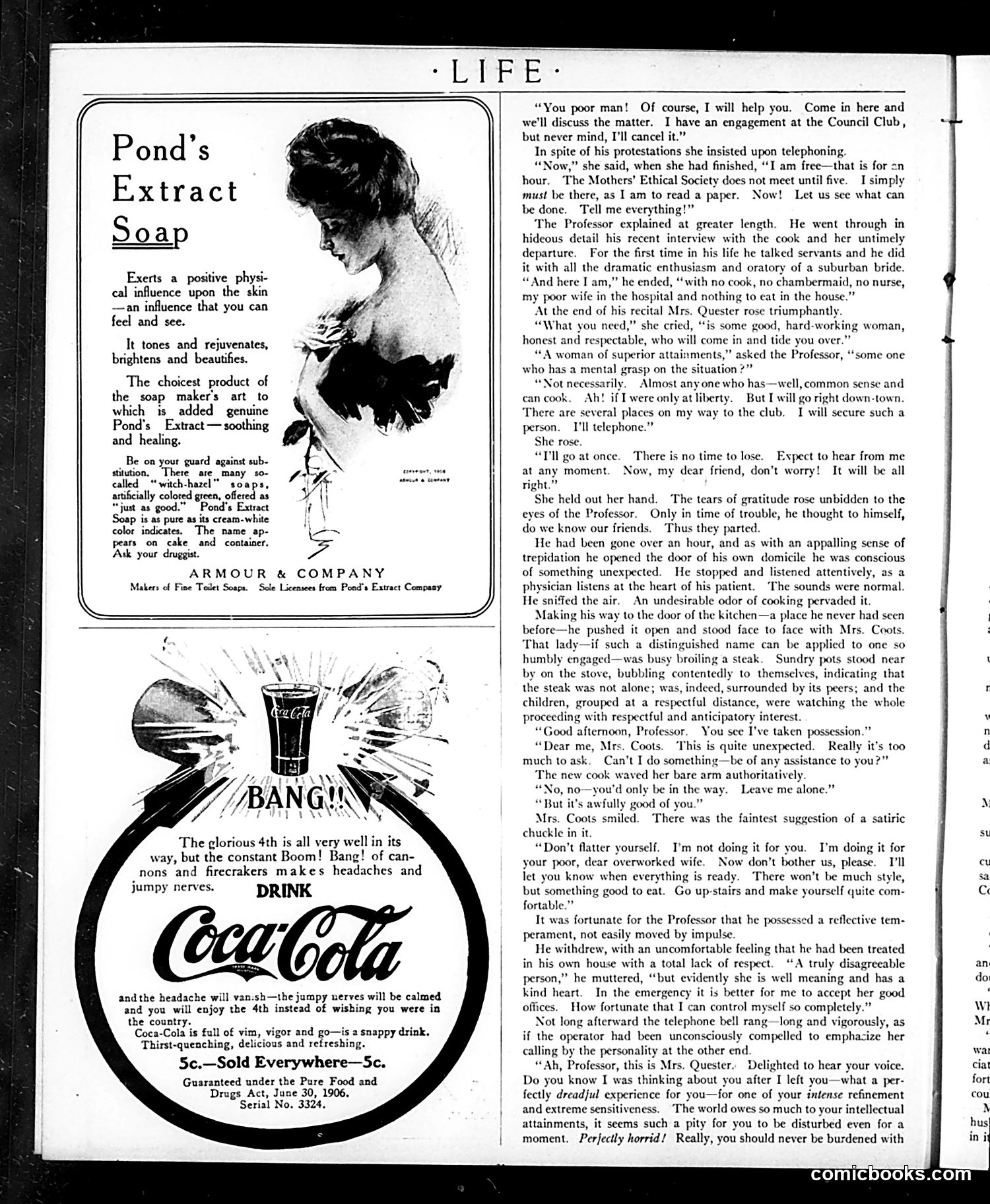
This page contains **two distinct elements**: advertisements for consumer products (Pond's Extract Soap and Coca-Cola) and a serialized fiction story about a Professor in domestic crisis. The story's satire targets **early 20th-century class anxieties and gender dynamics**. A Professor loses his cook and servants, and appeals to Mrs. Quester—a society woman involved in the "Mothers' Ethical Society"—for help. The humor lies in the contrast: Mrs. Quester, despite her social pretensions and constant obligations, manages to locate a replacement (Mrs. Coots) quickly and efficiently, suggesting that practical working-class competence trumps the Professor's intellectual status and helplessness. The advertisements exploit contemporary anxieties about **hygiene and stimulation**: Pond's warns against "witch-hazel" soap substitutes, while Coca-Cola promises relief from Fourth of July fireworks-induced headaches and "jumpy nerves"—reflecting period concerns about modern stress and adulteration of consumer goods.
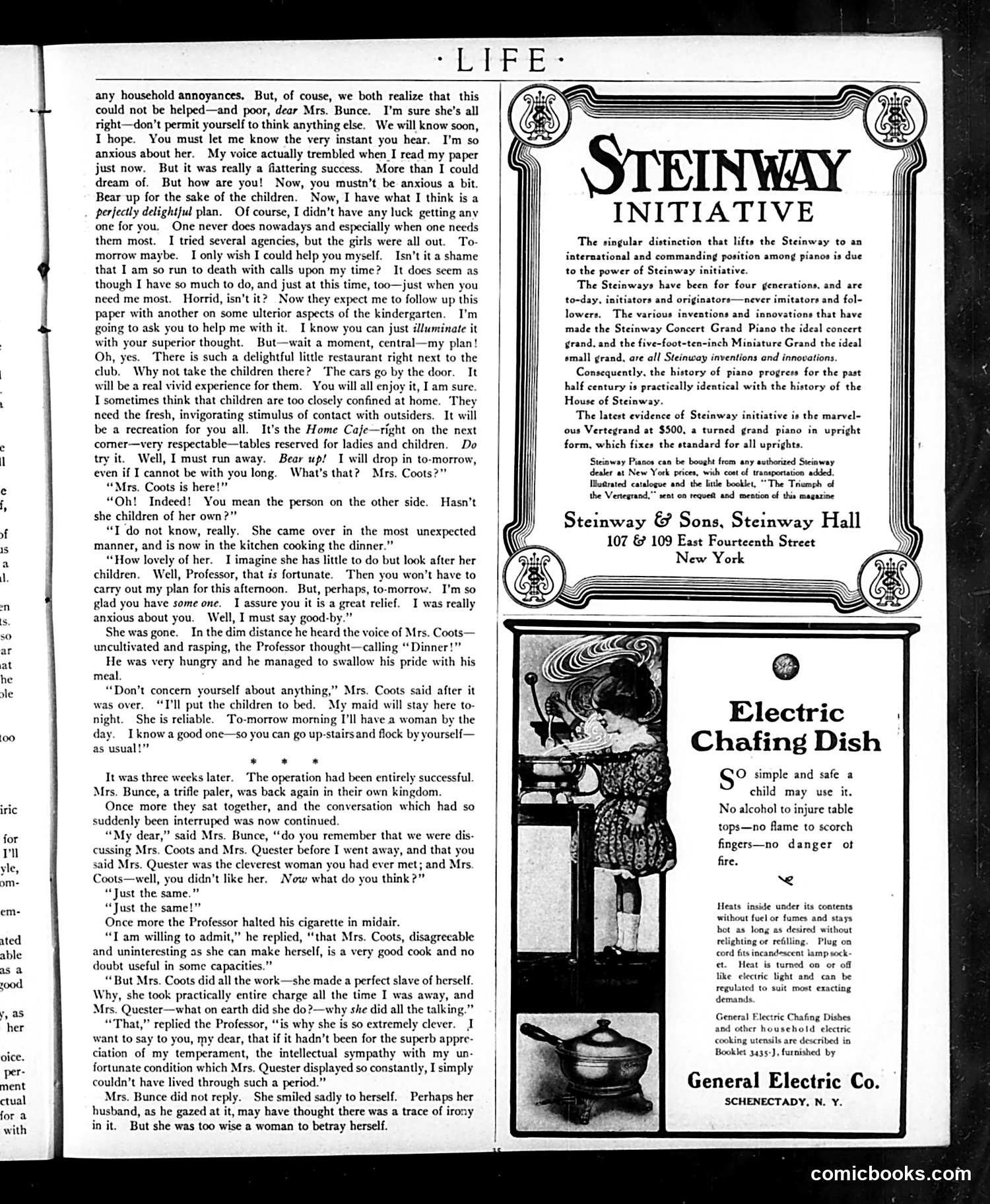
This page contains a serialized story, not a political cartoon. The narrative depicts class commentary through dialogue between characters. **The Setup:** A Professor's wife (Mrs. Bunce) becomes ill and requires surgery. During her absence, two women help care for the household: Mrs. Quester—described as "clever," cultured, and well-connected—and Mrs. Coots, her working-class neighbor with an "uncultivated and rasping" voice. **The Satire's Point:** Mrs. Quester patronizes the Professor with elaborate, self-important advice (suggesting restaurants, offering vague promises of help) while actually doing nothing practical. Mrs. Coots, despite lower social standing, simply *acts*—arranging actual childcare, cooking dinner, hiring household help. **The Joke:** The Professor initially preferred the "clever" Mrs. Quester but must grudgingly admit after three weeks that the "common" Mrs. Coots proved far more valuable. This mocks early 20th-century class prejudice and the gap between performative sophistication and genuine helpfulness.
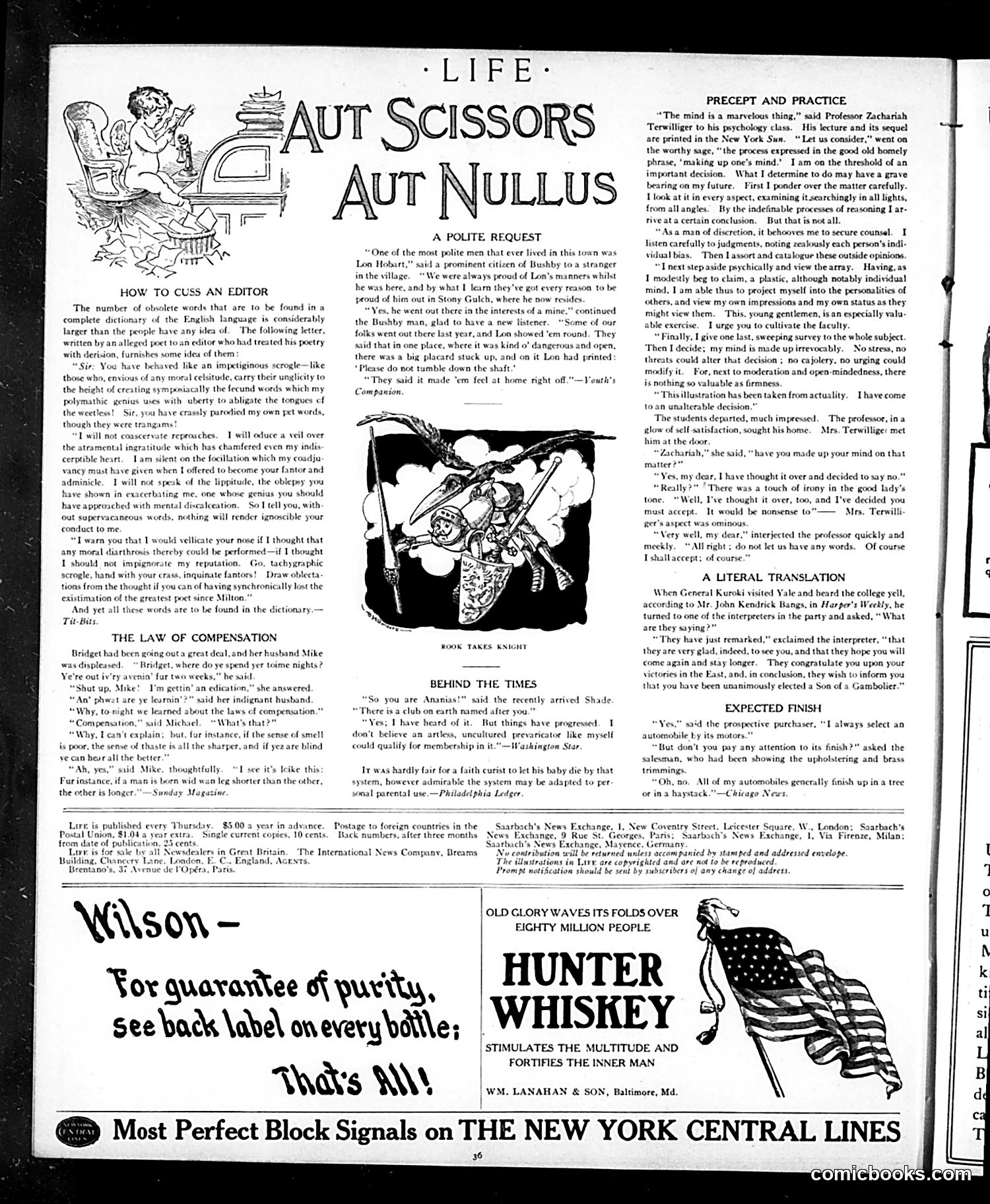
This Life magazine page features three distinct humorous pieces satirizing language, education, and human nature. **"How to Cuss an Editor"** mocks pretentious writers by presenting an irate poet responding to editorial criticism with deliberately obscure, archaic words—most now obsolete. The satire targets inflated literary ego: the poet uses absurdly complex language ("polymathic genius," "impetiginous scrogle") to chastise the editor for not understanding his work. The joke is that verbose self-importance becomes self-defeating. **"The Law of Compensation"** presents working-class Irish immigrants (Bridget and Mike) discussing "compensation"—a concept Bridget misunderstands while attending educational classes. The satirical point: uneducated speakers misconstrue educational concepts, revealing the gap between learning and understanding. **"A Polite Request"** and other brief anecdotes offer gentle social satire on small-town manners and frontier courtesy. The page's title, "Aut Scissors Aut Nullus" (Latin: "scissors or nothing"), suggests sharp editorial cutting. Overall, Life satirizes pretension, misapplied education, and the human tendency toward self-delusion.
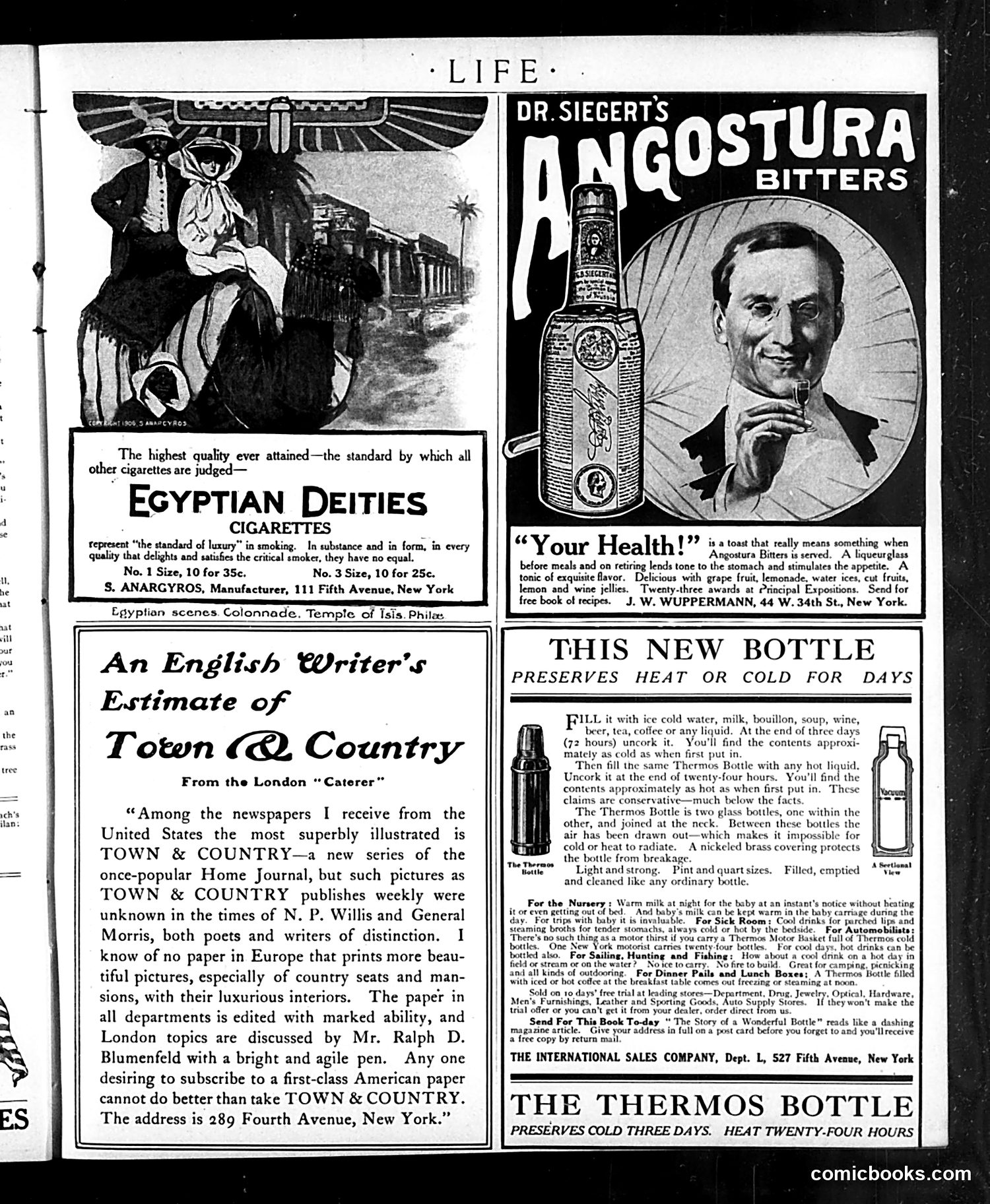
This page is primarily **advertising**, not satire or political commentary. It contains four commercial ads: **Egyptian Deities Cigarettes** (top left): Features an orientalist illustration of a woman in Egyptian dress, capitalizing on early 1900s fascination with "exotic" imagery to market premium cigarettes as luxury goods. **Angostura Bitters** (top right): Shows a well-dressed man endorsing medicinal bitters as a health tonic for digestion and appetite—typical of patent medicines marketed with dubious health claims before FDA regulation. **Town & Country magazine** (bottom left): A glowing editorial-style endorsement praising the magazine's superior illustrations and London society coverage, positioned to attract wealthy American subscribers. **Thermos Bottle** (bottom right): Detailed product advertising emphasizing the new vacuum-bottle technology's practical uses—keeping liquids hot or cold for extended periods—with applications from baby care to automobiles. The page reflects early 1900s consumer culture: orientalism in design, unregulated health claims, class-aspirational marketing, and celebration of modern technology. No political satire is evident.
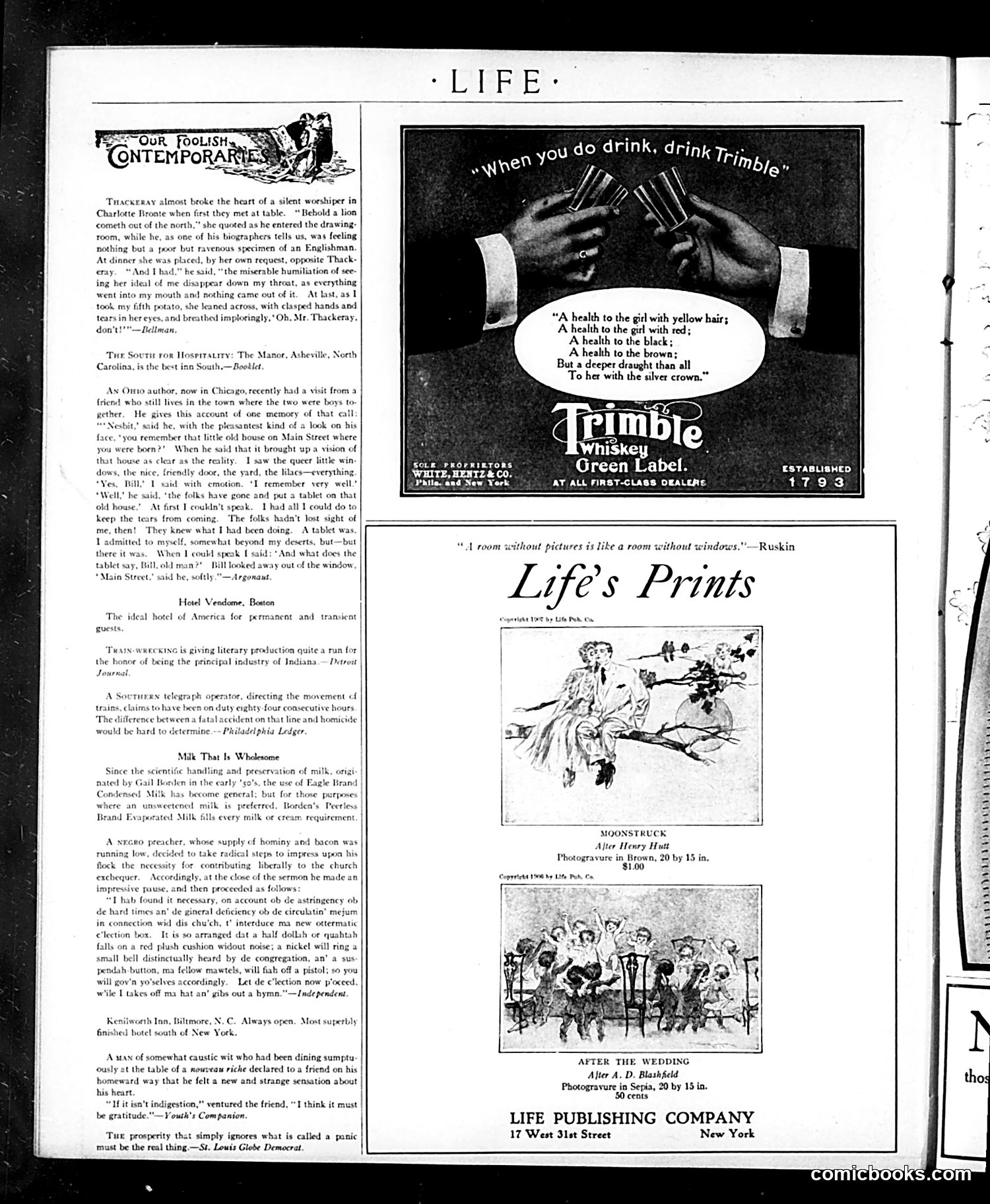
This page from *Life* magazine combines satirical commentary with advertising. The left column presents "Our Foolish Contemporaries"—a recurring feature mocking contemporary absurdities through anecdotes. These include stories about author Thackeray's social awkwardness, a nostalgic hometown memory ending anticlimactically with a plain street sign, and a humorous account of a Black church's creative "automatic collection box" that rings bells for different donation amounts. The right side features a **Trimble Whiskey advertisement** using the popular contemporary toast format, celebrating women of various hair colors before proposing a final "deeper draught" to "her with the silver crown"—likely referencing either a bride or a distinguished woman. The page also advertises "Life's Prints"—photogravure reproductions of artworks for home decoration, reflecting the magazine's role as a cultural arbiter for middle-class Americans seeking tasteful home furnishings.
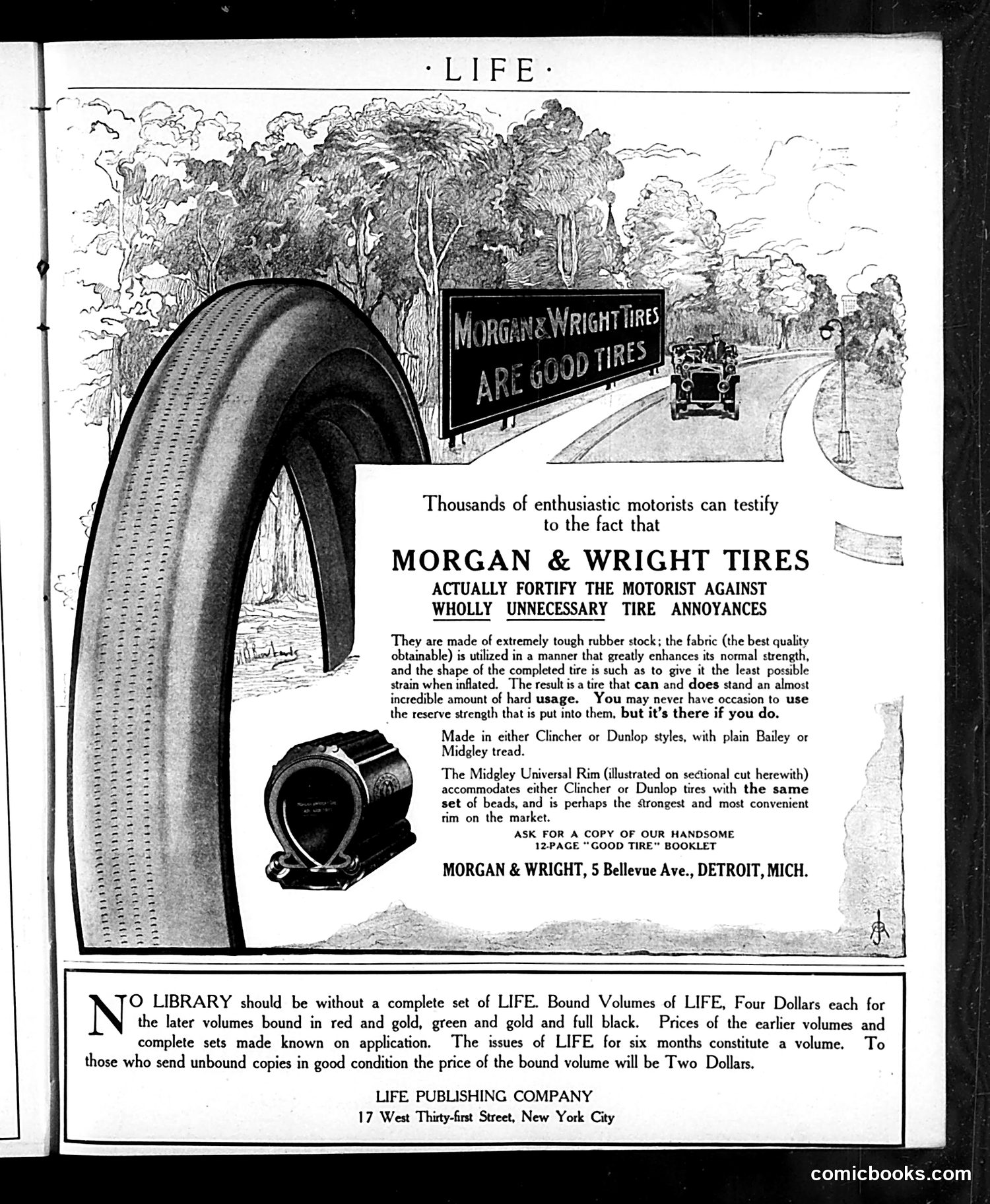
This page is primarily **advertising**, not satire. It contains two distinct ads: 1. **Morgan & Wright Tires** (top two-thirds): A straightforward product advertisement featuring a large tire image and a pastoral driving scene. The ad promotes tire durability and reliability, claiming their tires can withstand "hard usage" and provide "reserve strength." It mentions available styles (Clincher/Dunlop) and the Midgley Universal Rim. The appeal is to motorists seeking dependable automobile tires—a practical concern in the early automotive era. 2. **Life Magazine Subscription** (bottom): An advertisement offering bound volumes of *Life* magazine for library collections at four dollars per volume, with special pricing for unbound copies. There is **no political cartoon or satire present**. This is a commercial page from *Life* magazine using its editorial space for paid advertising, typical of early 20th-century publishing practices. The tire ad's claims about durability would have been genuinely newsworthy when automobiles were still relatively new technology.
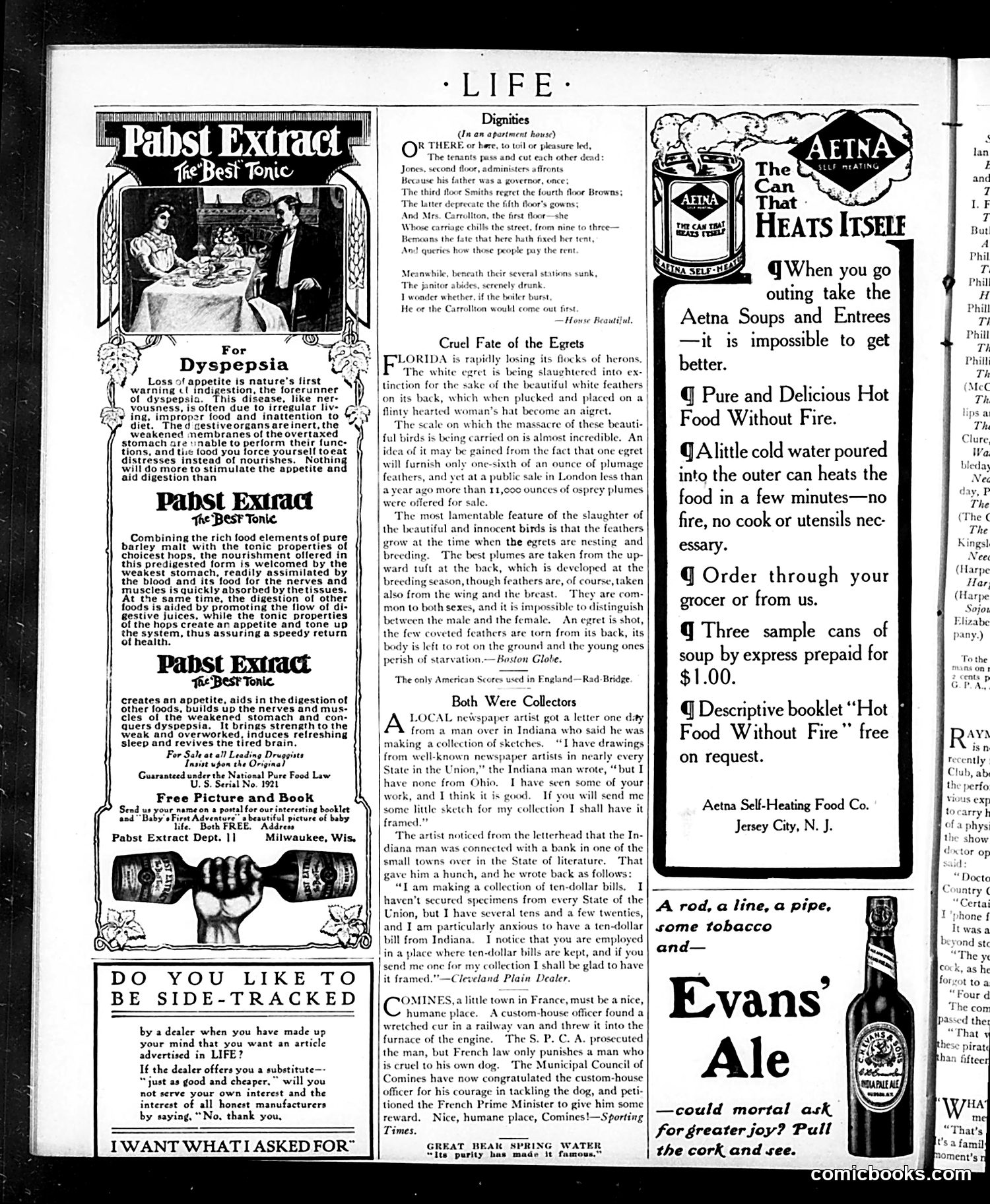
This page is primarily **advertisements** (Pabst Extract tonic, Aetna soups, Evans Ale) interspersed with short satirical pieces typical of *Life* magazine's format. The notable satire is **"Dignities,"** a poem mocking apartment-building social pretension: tenants on different floors snub each other based on their parents' former status or wealth. The janitor watches these neighbors bicker despite their apparent equality—a comment on how arbitrary and petty class consciousness is in urban settings. **"Cruel Fate of the Egrets"** describes the slaughter of Florida herons for women's hat plumes (aigrettes), condemning the massacre: birds are killed for a tiny amount of feather, leaving carcasses to rot while fledglings starve. This reflects early 20th-century conservation concerns and criticism of the fashion industry's ecological damage. Both pieces use gentle satire to critique human vanity and callousness.
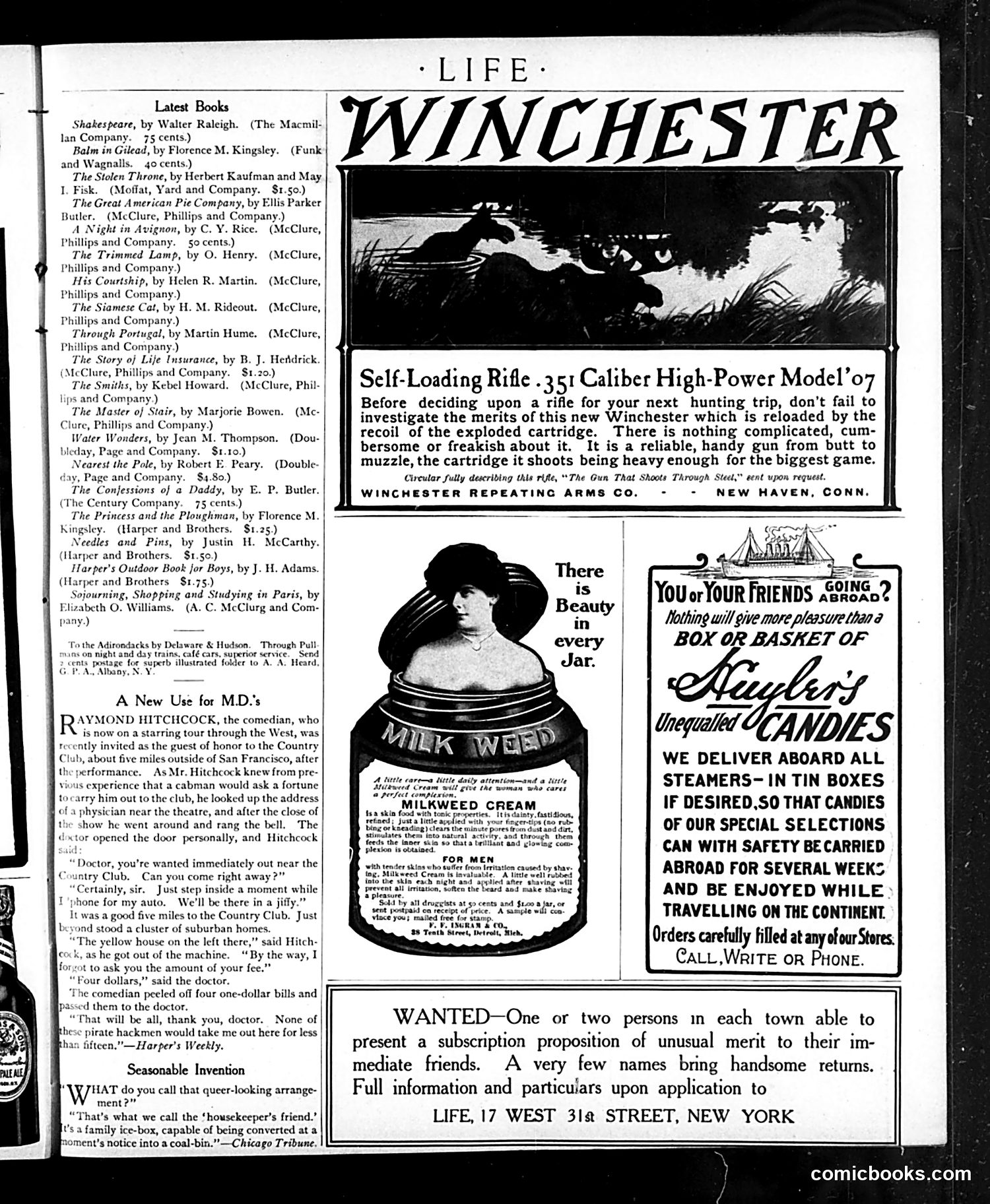
This is primarily an **advertising and literary notices page** from an early 1900s issue of Life magazine, with minimal political or satirical content. The page features: **Main Content:** - Book advertisements and reviews (Shakespeare, O. Henry's *The Trimmed Lamp*, etc.) - Two humorous anecdotes: one about comedian Raymond Hitchcock tricking a doctor into providing free transportation by pretending a medical emergency, and another about a "housekeeper's friend" (convertible ice-box/coal-bin) **Advertisements:** - Winchester rifle ad emphasizing self-loading capability for hunting - Rawleigh's Milkweed Cream product advertisement - Rawleigh's Candies promotion for travelers - Recruitment notice seeking subscription agents The page lacks clear political satire. The Hitchcock anecdote gently mocks both the comedian's cheapness and urban transportation costs. The "Seasonable Invention" is mild wordplay about household equipment. Overall, this represents Life's lighter, commercial side rather than its satirical editorial function.
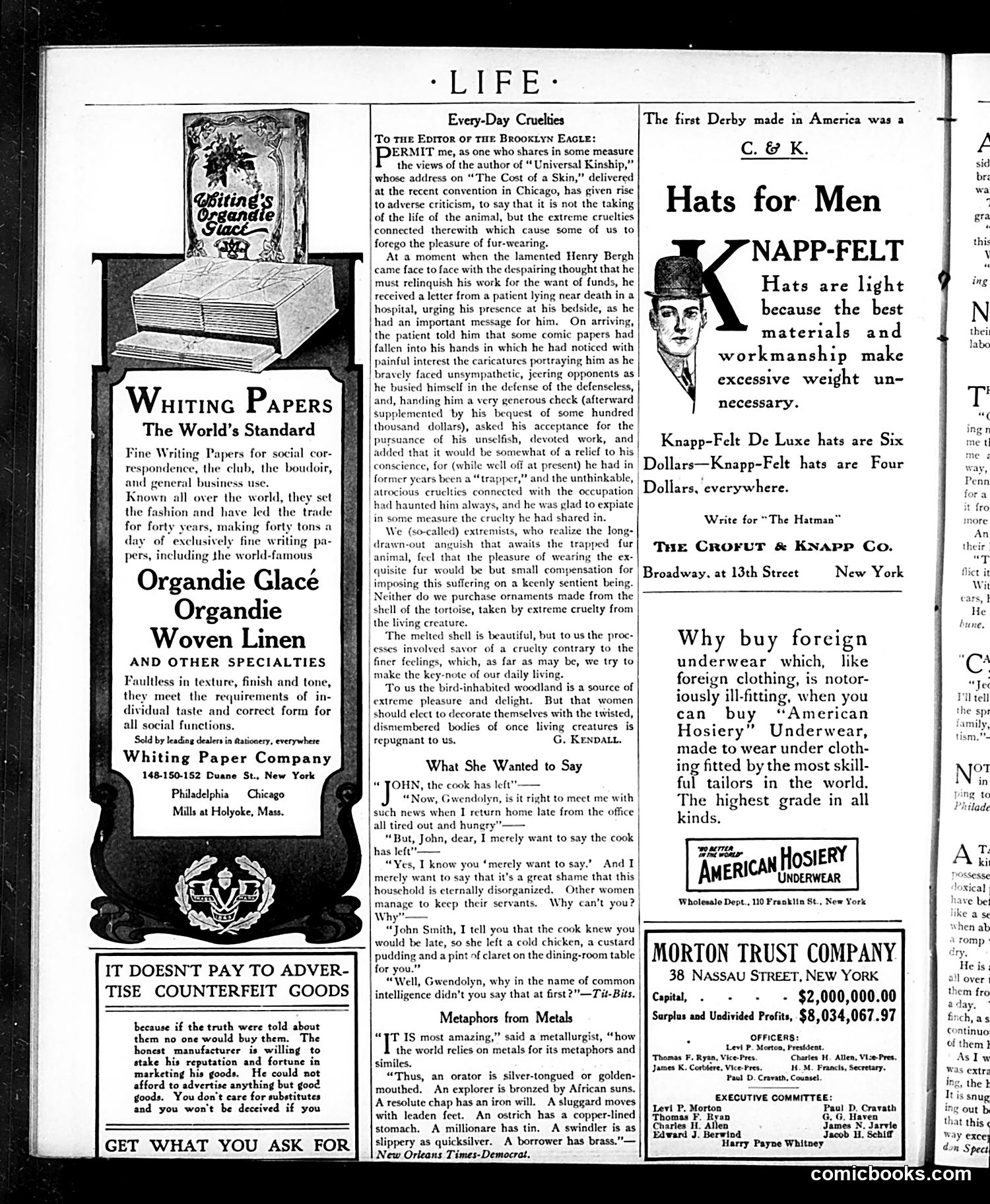
This page is primarily **advertising with one letter to the editor** addressing animal cruelty. The main content is a letter praising Henry Bergh (founder of the ASPCA, though not named here) and his animal welfare work. The writer argues against fur-wearing and ornamental use of animal parts—not because killing animals is wrong, but because of the **extreme cruelties involved in trapping and processing** them (fur animals, tortoise shells, feathered birds). The letter positions the writer among "extremists" who find decorating oneself with "dismembered bodies of once living creatures" morally repugnant. A brief comic sketch titled "What She Wanted to Say" depicts marital miscommunication: a wife attempts to tell her tired husband the cook has quit, but he misinterprets her tone as criticism. The remaining content is **product advertising** for writing papers, hats, hosiery, and financial services—typical of the era's magazine format.
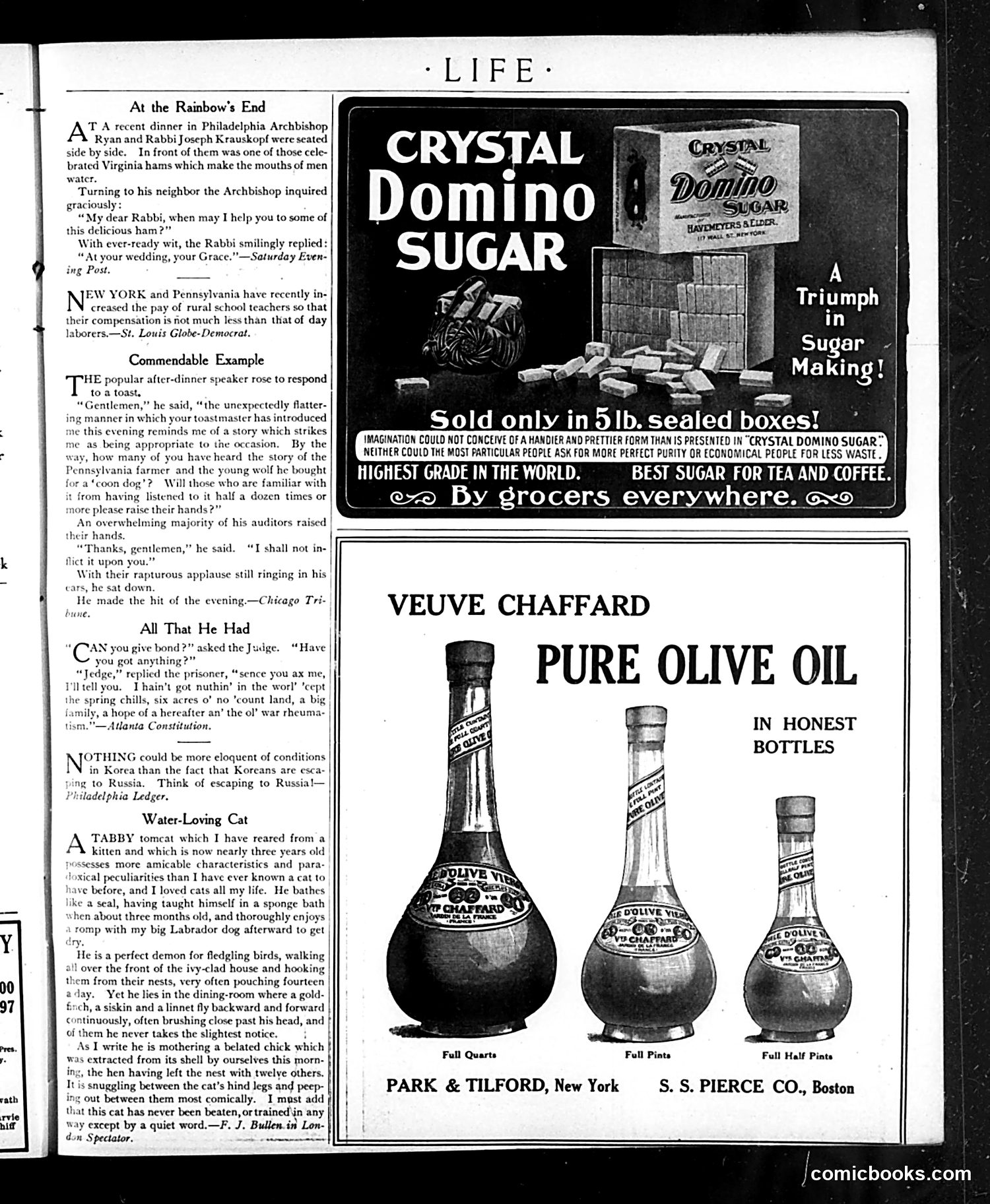
This page consists primarily of **advertisements and brief anecdotes** rather than political cartoons. The main content includes: 1. **"At the Rainbow's End"**: A joke about interfaith relations. Archbishop Ryan offers ham to Rabbi Krauskopf, who replies he'll accept it "at your wedding"—implying priests don't marry, making it a never-happening event. This reflects early 20th-century American humor playing on religious differences. 2. **Social commentary snippets** on teacher pay increases and Korea, noting that Koreans prefer escaping to Russia (likely referencing Russo-Japanese War tensions, circa 1904-05). 3. **"Water-Loving Cat"**: A sentimental anecdote about an unusually bathing tomcat with peculiar behavior—a gentle, observational piece typical of Life's miscellaneous content. The page is **dominated by product advertisements**: Crystal Domino Sugar (emphasizing purity and economy) and Veuve Chaffard Pure Olive Oil (stressing honest bottling). Modern readers should note this represents Life's mixed format—satirical commentary alongside consumer advertising and human-interest stories.
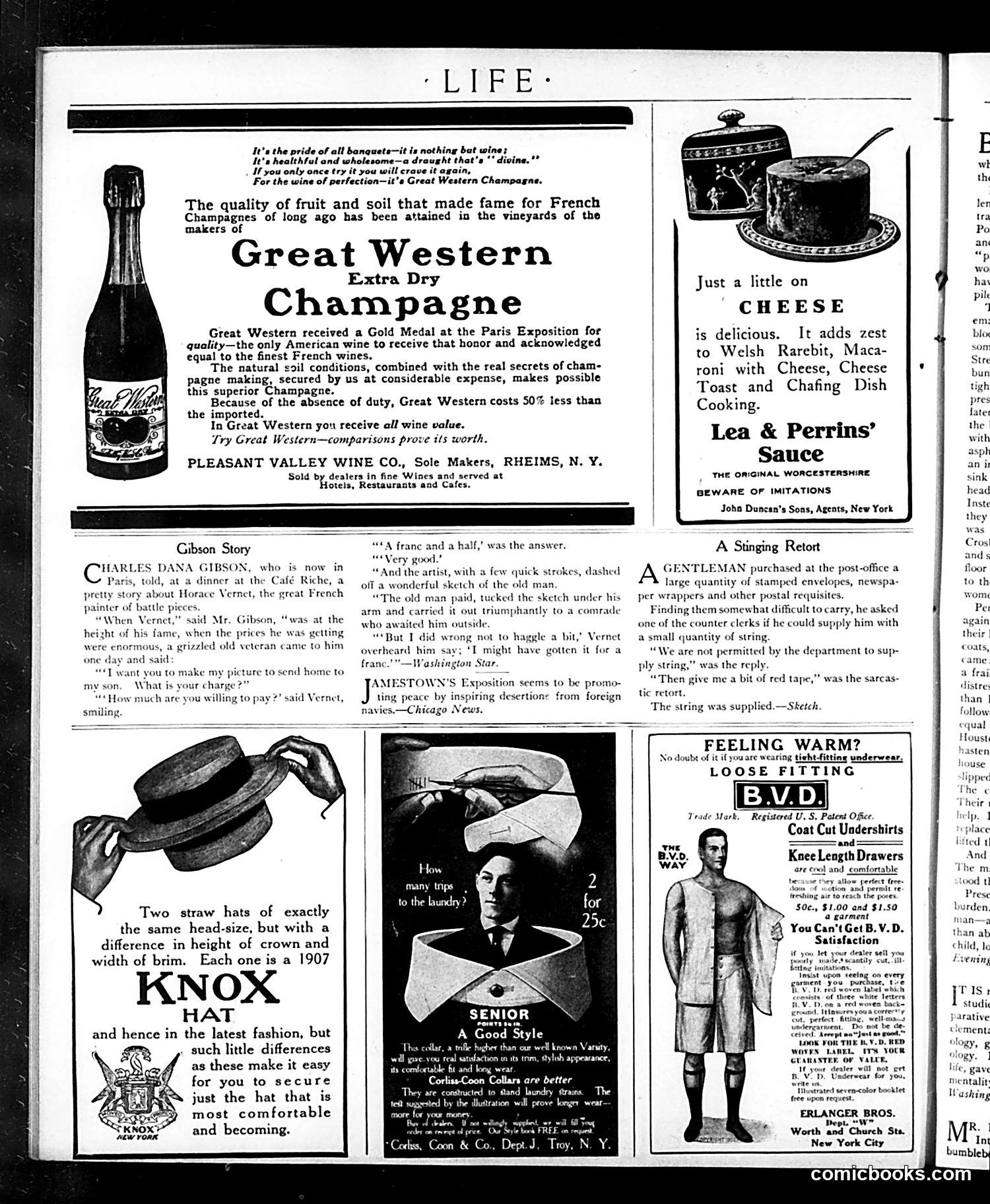
This page is **primarily advertising** from an early 1900s *Life* magazine, interspersed with short humorous stories. The main content includes ads for Great Western Champagne (an American wine competing with French imports), B.V.D. underwear, Knox hats, and other products. The humor pieces are brief anecdotes: "Gibson Story" recounts painter Horace Vernet's encounter with a poor veteran seeking a portrait—Vernet sketches him quickly and gives it free, then the old man sarcastically asks for "a bit of red tape" (bureaucratic assistance) instead. "A Stinging Retort" describes a postal clerk's witty comeback when a customer asks for string to carry packages: denied by departmental rules, the clerk offers "red tape" instead—the same joke. These jokes play on the phrase "red tape" (bureaucratic obstruction), which was already a familiar idiom. The humor is gentle, focused on wordplay rather than satire of specific political figures or events.
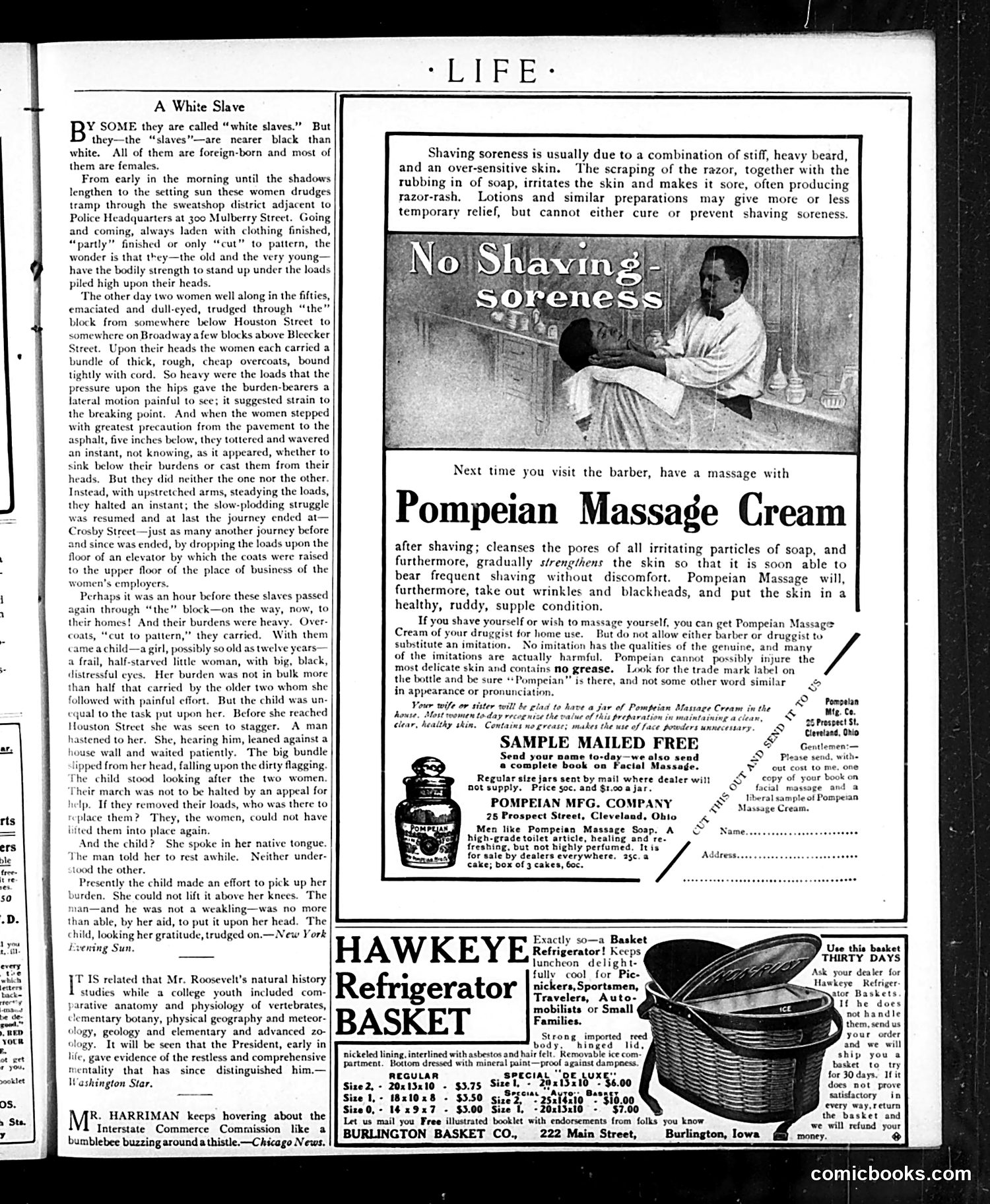
This page contains two distinct elements: **Main Article: "A White Slave"** A social-critique essay describing immigrant women garment workers in early 1900s New York. The term "white slave" was period slang for exploited laborers (not referring to race). The article documents their brutal conditions: carrying impossibly heavy loads of partially-finished clothing on their heads through Manhattan's garment district, working dawn to dusk for minimal wages. It describes two elderly women and a struggling child worker, emphasizing the physical toll of the labor. This reflects Progressive Era concerns about sweatshop exploitation and child labor. **Advertisements** The remainder consists of period product ads: Pompeian Massage Cream (for shaving irritation), Hawkeye Refrigerator Basket, and Burlington Basket Company products—typical early-20th-century magazine advertising. The juxtaposition is notable: serious labor-exploitation journalism alongside beauty and household product marketing, reflecting how *Life* magazine mixed social commentary with commercial content.
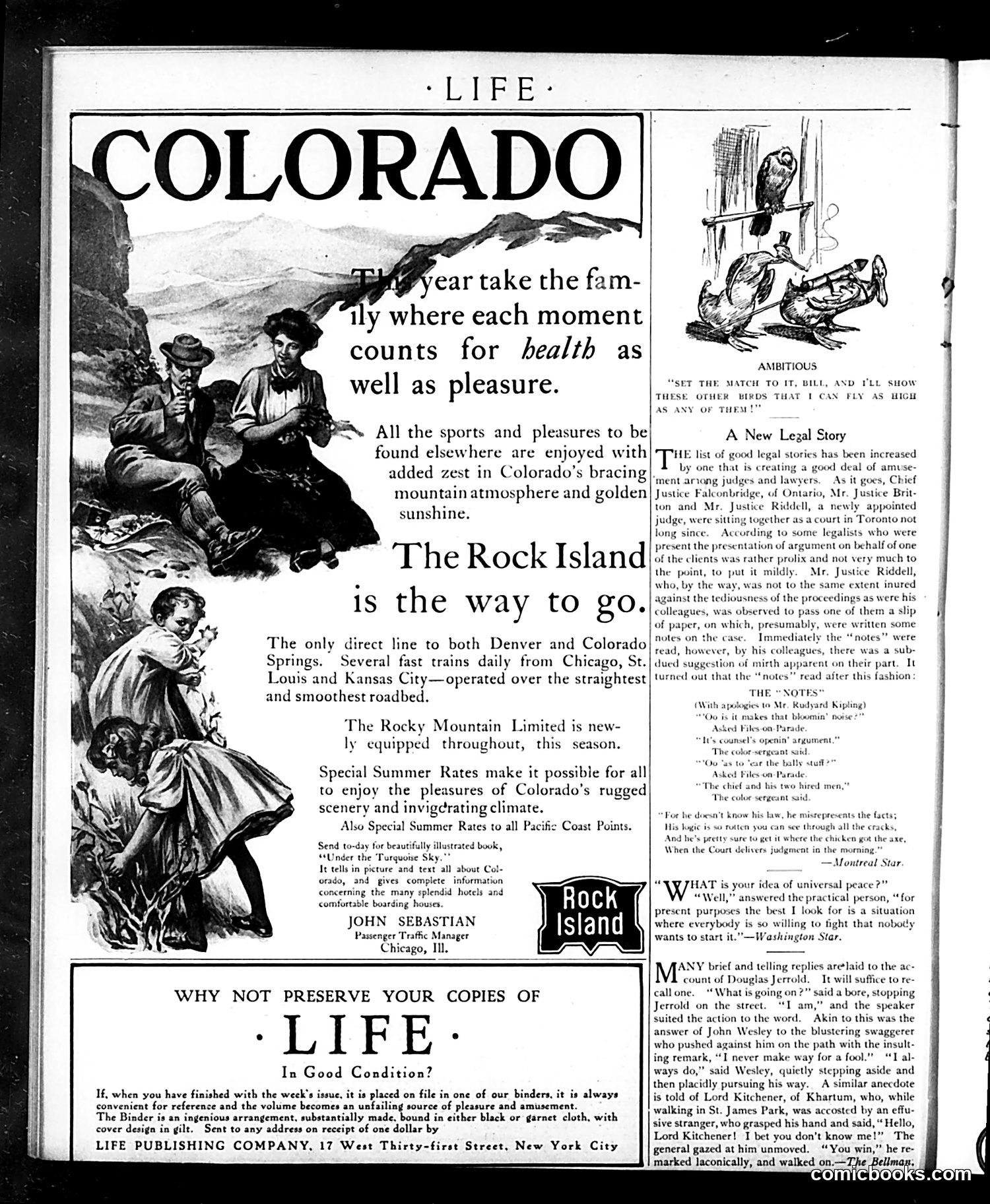
This is primarily a **travel advertisement** for the Rock Island Railroad promoting Colorado tourism, occupying the left two-thirds of the page. The small cartoon at top right titled "AMBITIOUS" shows birds, with one saying it will set a match to something to prove it can fly as high as the others—a visual joke about competitive showmanship. The right column contains three humorous anecdotes: 1. **"A New Legal Story"** mocks a verbose lawyer before Ontario judges. Justice Riddell passes a slip of paper with dismissive "notes" (quoted verse) to mock the lawyer's incompetence. 2. A joke about "universal peace" where someone quips that peace comes when everyone is so eager to fight that nobody actually starts. 3. Anecdotes about Douglas Jerrold and John Wesley responding cleverly to rude encounters—examples of witty comebacks to insults. The bottom promotes binding Life magazine issues for preservation—a subscription service advertisement. **Context:** This represents early 20th-century Life as a humor and leisure magazine mixing travel promotion, legal/social satire, and reprinted witty quotations for educated readers.
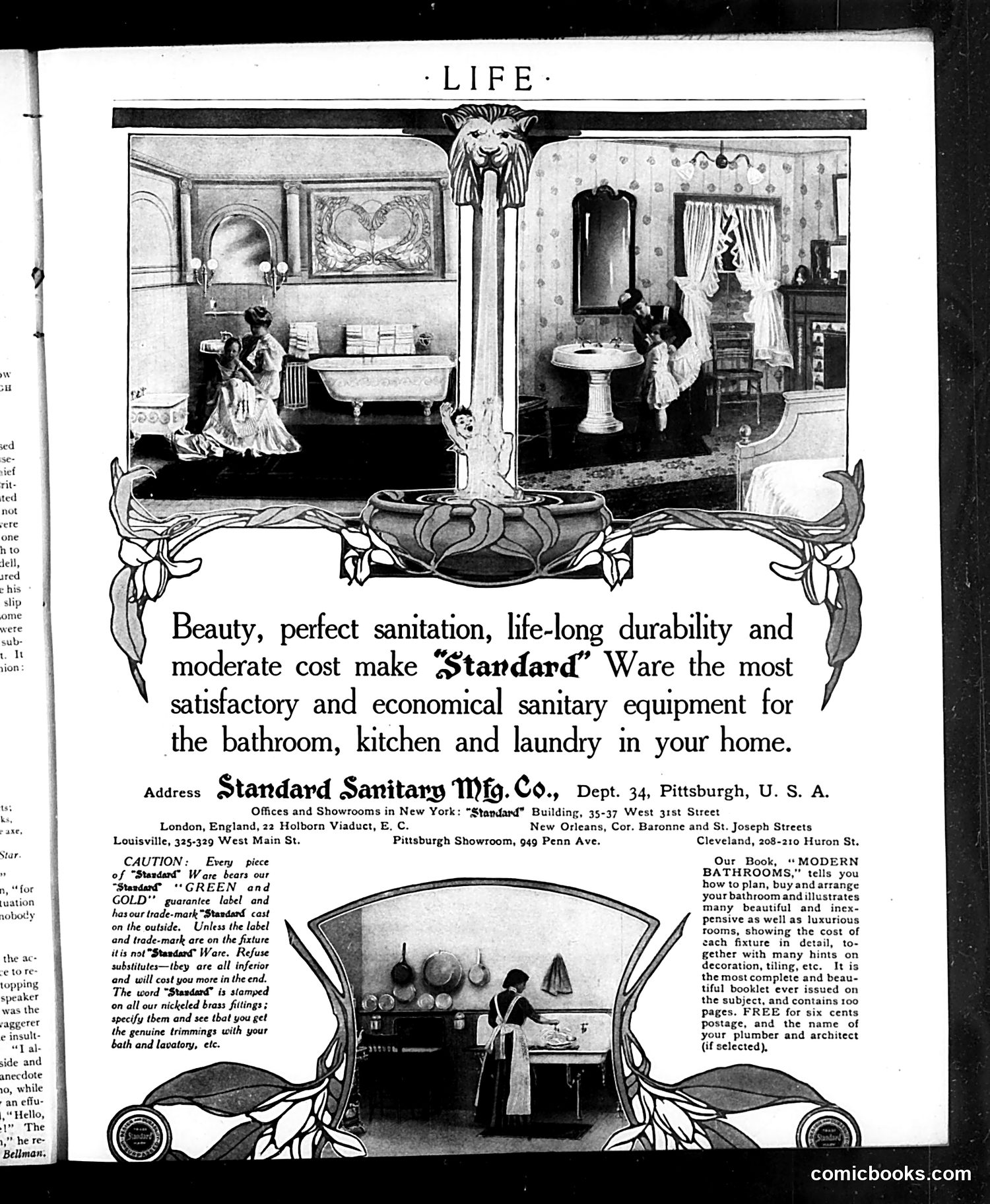
This is **not a political cartoon or satire**—it's a **product advertisement** for Standard Sanitary Manufacturing Company's bathroom fixtures and plumbing equipment. The page shows two illustrated bathroom scenes (top) and a kitchen scene (bottom) depicting idealized domestic spaces with women using the fixtures. The imagery emphasizes cleanliness, modernity, and domestic comfort—selling points for early 20th-century consumers. The text promotes "Standard" brand sanitary ware as offering "beauty, perfect sanitation, life-long durability and moderate cost." A caution section warns consumers to verify authentic products by checking for the company's trademark ("GREEN and GOLD" label) to avoid inferior substitutes. The advertisement includes company contact information across multiple U.S. cities and offers a free 100-page booklet on bathroom design for six cents postage. This represents typical Life magazine content from this era: satirical editorial material mixed with commercial advertising.
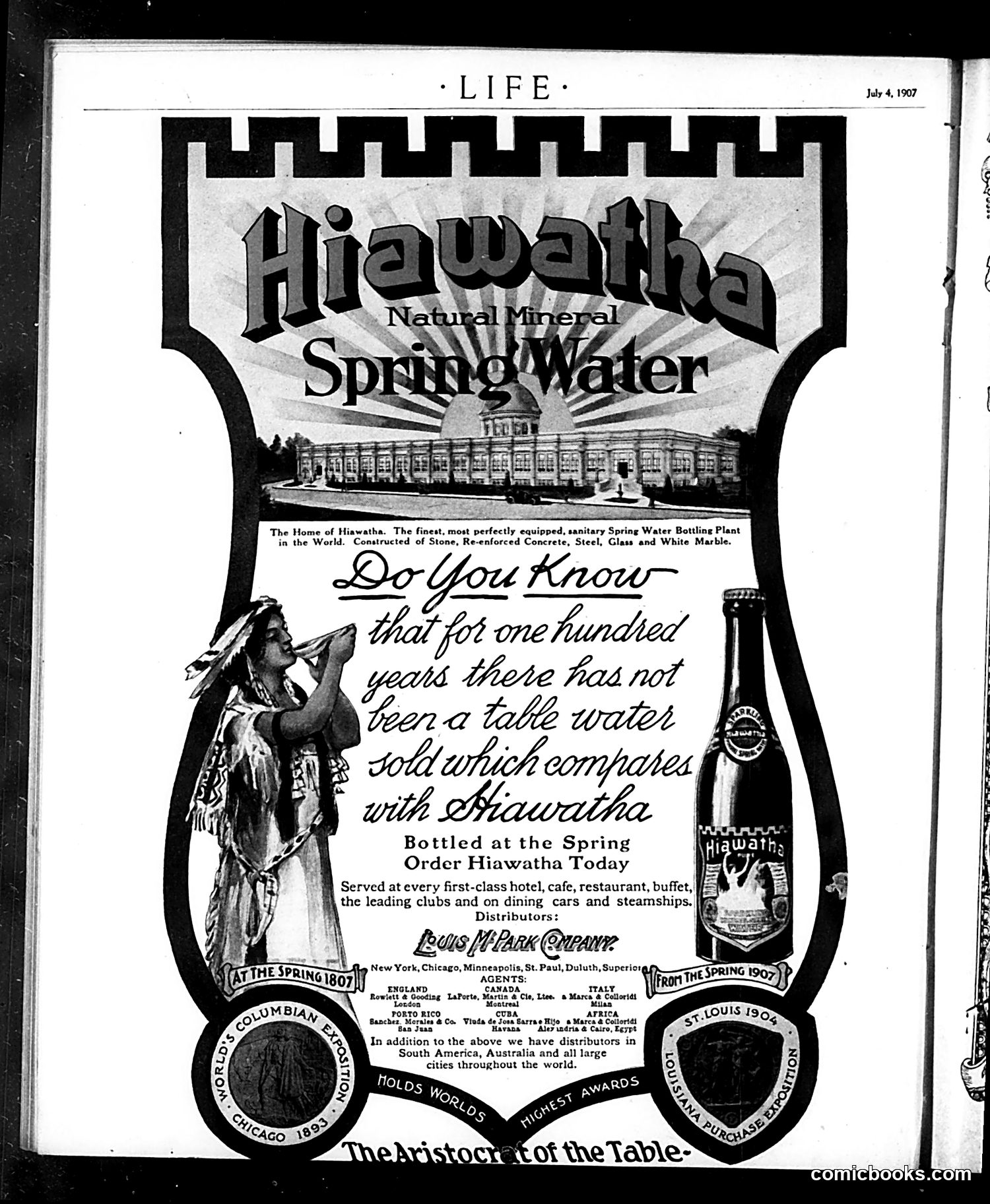
This is a full-page advertisement for Hiawatha Natural Mineral Spring Water, not satire. The ad uses the name and imagery of Native American culture—specifically referencing Longfellow's "Song of Hiawatha" (1855)—to market bottled spring water. The design features a Native American figure in traditional dress alongside bottles, and emphasizes the product's purity and prestige through claims of "one hundred years" of quality. The building shown is described as the "finest, most perfectly equipped" bottling plant. This reflects early 1900s marketing practices where Native American imagery was appropriated to suggest natural origins and authenticity, regardless of actual connection to Native peoples. The ad lists global distributors across major US cities and international locations, positioning Hiawatha as a premium, cosmopolitan beverage served "at every first-class hotel, cafe, restaurant, buffet."