
Life, 1907-07-04 · page 30 of 48
Life — July 4, 1907 — page 30: what you’re looking at
What you’re looking at
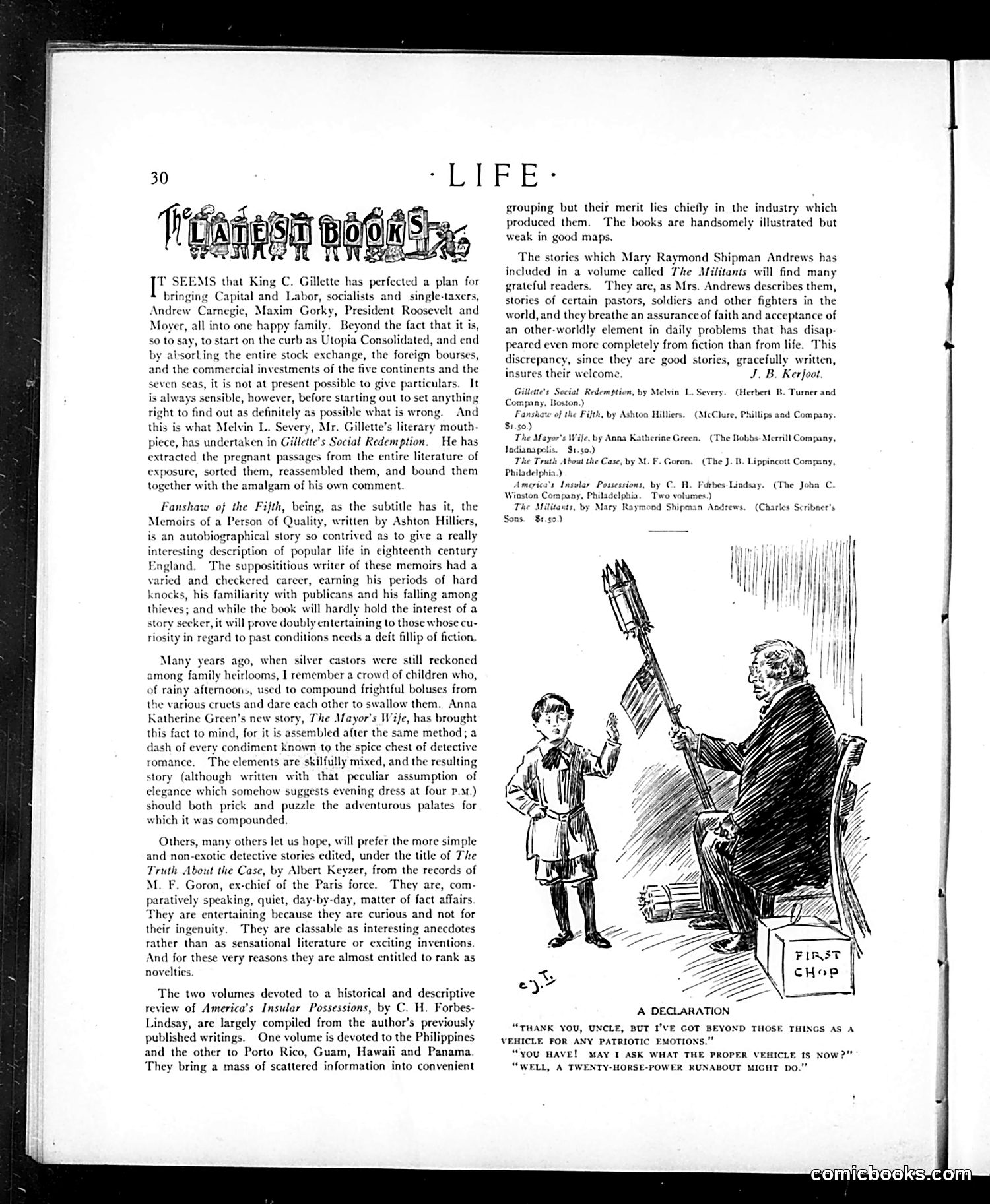
This cartoon mocks inflated patriotic language used to justify frivolous purposes. A small boy presents his uncle with a homemade vehicle (appearing to be a large wooden box on wheels), claiming it as "a vehicle for any patriotic emotions." The uncle responds by asking what "proper vehicle" it is, to which the boy replies: "a twenty-horse-power runabout right do." **The satire**: The cartoon ridicules how Americans invoke patriotism to rationalize or elevate mundane, even silly endeavors. The boy's earnest misuse of grand language—calling a toy wagon a "patriotic" conveyance—mirrors how politicians and businessmen of the era dressed up ordinary commercial ambitions in patriotic rhetoric. The page's surrounding text discusses King C. Gillette's utopian scheme to reconcile capital and labor; this cartoon likely lampoons similar grandiose schemes wrapped in patriotic language but lacking substance.
📄 Transcribed text from this page (OCR, searchable)
Machine-transcribed from the original scan — historical spelling and the odd misread are preserved.
“LIFE * 1S that King C. Gillette has perfected a plan for ing Capital and Labor, socialists and_ single-taxers, Andrew Carnegie, Maxim Gorky, President Roosevelt and Moyer, all into one happy family. Beyond the fact that it is, so to say, to start on the curb as Utopia Consolidated, and end by absorting the entire stock exchange, the foreign bourses, and the commercial investments of the five continents and the seven seas, it is not at present possible to give particulars. It , however, before starting out to set anything right to find out as definit ible what is wrong. And this is what Melvin L lette’s literary mouth- piece, has underta cial Redemption. He has extracted the pregnant passages from the entire literature of exposure, sorted them, reassembled them, and bound them together with the amalgam of his own comment. Fanshaw oj the Fijth, being, as the subtitle has i Memoirs of a Person of Quality, written by Ashton Hilliers, is an autobiographical story so contrived as to give a really interesting description of popular life in eighteenth century Sngland, The supposititious writer of these memoirs had a varied and checkered carcer, earning his periods of hard knocks, his familiarity with publicans and his falling among thieves; and while the book will hardly hold the interest of a story seeker, it will prove doubly entertaining to those whose cu- riosity in regard to past conditions needs a deft fillip of fiction. Many years ago, when silver castors were still reckoned among family heirlooms, I remember a crowd of children who, of rainy afternoons, used to compound frightful boluses from the various cruets and dare cach other to swallow them. Anna Katherine Green’s new story, The Mayor's Wije, has brought this fact to mind, for it is assembled after the same method; a dash of every condiment known to the spice chest of detecti romance. The clements are skilfully mixed, and the resulting story (although written with that peculiar assumption of elegance which somehow suggests evening dress at four P.st.) should both prick and puzzle the adventurous palates for which it was compounded. Others, many others let us hope, will prefer the more simple and non-exotic detective stories edited, under the title of The Truth About the Case, by Albert Keyzer, from the records of M. F. Goron, ¢ f of the Paris force. They are, com- paratively speaking, quiet, day-by-day, matter of fact affairs. They are entertaining because they are curious and not for their ingenuity. They are classable as interesting anecdotes rather than as sensational literature or exciting inventions. And for these very reasons they are almost entitled to rank as novelties. The two volumes devoted to a historical and descriptive review of America’s Insular Possessions, by H. Forbes- Lindsay, are largely compiled from the author’s previously published writings. One volume is devoted to the Philippines and the other to Porto Rico, Guam, Hawaii and Panama They bring a mass of scattered information into convenient grouping but theif merit lies chiefly in the industry which produced them. The books are handsomely illustrated but weak in good maps. The stories which Mary Raymond Shipman Andrews has included in a volume cailed The Militants will find many grateful readers. They are, as Mrs. Andrews describes them, stories of certain pastors, soldiers and other fighters in the world, and they breathe an assurance of faith and acceptance of an other-worldly element in daily problems that has disap- peared even more completely from fiction than from life. ‘This discrepancy, since they are good stories, gracefully written, insures their welcome, J.B. Kerjoot. (Herbert B. Turner aod (McClure, Phillips and Company The Mayor's Wife. by Anna Katherine Green. (The Bobbs-Merrill Company, $1.59.) The Truth Atout the Case, by M.F.Goron. (The J. B. Lippincott Company, Philadelphia.) America's Insular Possessions, by C. H. Forbes Lindsay. (The Joba C Winston Company, Philadelphia. Two volumes.) The Militants, by Mary Raymond Shipman Andrews Sons. $1.50.) (Charles Scribner's A DECLARATION “THANK YOU, UNCLE, BUT I'VE GOT BEYOND THOSE THINGS AS A VEHICLE FOR ANY PATRIOTIC EMOTIONS.” “you HAVE! MAY I ASK WHAT THE PROPER VEHICLE Is Now?" “WELL, A TW! POWER RUNABOUT MIGHT Do.