
Life, 1907-07-04 · page 16 of 48
Life — July 4, 1907 — page 16: what you’re looking at
What you’re looking at
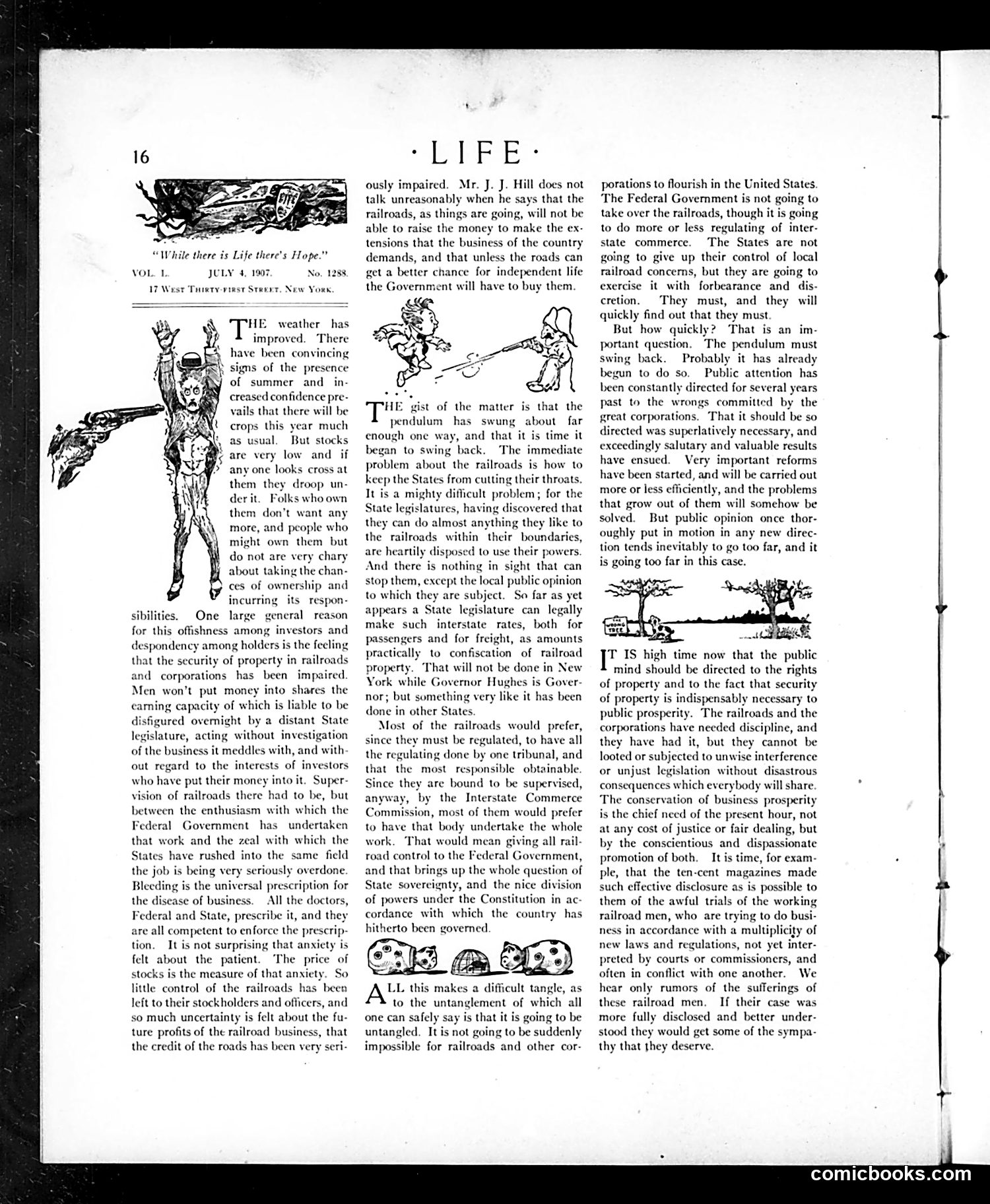
This page contains no single political cartoon but rather editorial commentary on railroad regulation. The decorative vignettes (children playing, rural scenes) are ornamental rather than satirical. The piece criticizes excessive government intervention in railroad business. It references **J.J. Hill** (a prominent railroad magnate), arguing that both Federal and State governments are over-regulating railroads so heavily that they cannot raise capital or operate profitably. The author uses medical metaphor—calling regulation "bleeding" (the universal 19th-century medical treatment)—to satirize how government "doctors" are killing their patient through excessive prescription. The central tension: States are confiscating railroad profits through rate-setting, while railroads prefer Federal regulation under the Interstate Commerce Commission as more predictable. Governor Hughes of New York is mentioned approvingly as restraining state overreach. For modern readers: this reflects Gilded Age anxiety about balancing corporate power against progressive-era government regulation—the pendulum, the author argues, has swung too far toward control.
📄 Transcribed text from this page (OCR, searchable)
Machine-transcribed from the original scan — historical spelling and the odd misread are preserved.
“While there is Life there's Hope.” VoL. 1 JULY 4, 1907. No, 1288, 17 Wes nery-rinst Steext, New Yous. HE weather has improved. ‘There have been convincing jgns of the presence of summer and _in- creased confidence pre- vails that there will be crops this year much as usual. But stock: are very low and ii any one looks cross at them they droop un- der it. Folks who own them don’t want any more, and people who might own them but do not are very chary about taking the chan- ces of ownership and incurring its respon- sibilities. One large general reason for this offishness among investors and despondency among holders is the feeling that the security of property in railroads and corporations has been impaired. Men won't put money into shares the caning capacity of which is liable to be disfigured overnight by a distant State legislature, acting without investigation of the business it meddles with, and with out regard to the interests of investors who have put their money into it. Super- vision of railroads there had to be, but between the enthusiasm with which the Federal Government has undertaken that work and the zeal with which the States have rushed into the same field the job is being very seriously overdone. Bleeding is the universal prescription for the disease of business. All the doctors, Federal and State, prescribe it, and they are all competent to enforce the prescrip- tion. It is not surprising that anxiety is felt about the patient. The price of stocks is the measure of that anxiety. So little control of the railroads has been left to their stockholders and officers, and so much uncertainty is felt about the fu- ture profits of the railroad business, that the credit of the roads has been very s ERE ously impaired. Mr. J. J. Hill does not talk unreasonably when he says that the railroads, as things are going, will not be able to raise the money to make the tensions that the business of the country demands, and that unless the roads can get.a better chance for independent life the Government will have to buy them. HE gist of the matter is that the pendulum has swung about far enough one way, and that it is time it began to swing back. The immediate problem about the railroads is how to keep the States from cutting their throats. It is a mighty dificult problem; for the State legislatures, having discovered that they can do almost anything they like to the railroads within their boundaries, are heartily disposed to use their powers. And there is nothing in sight that can stop them, except the local public opinion to which they are subject. So far as yet appears a State legislature can legally make such interstate rates, both for passengers and for freight, as amounts practically to confiscation of railroad property. ‘That will not be done in New York while Governor Hughes is Gover- nor; but something very like it has been done in other States. Most of the railroads would prefer, since they must be regulated, to have all the regulating done by one tribunal, and that the most responsible obtainable. Since they are bound to be supervised, anyway, by the Interstate Commerce Commission, most of them would prefer to have that body undertake the whole work. That would mean giving all rail- road control to the Federal Government, and that brings up the whole question of State sovereignty, and the nice division of powers under the Constitution in ac cordance with which the country has hitherto been governed. LL this makes a difficult tangle, as to the untanglement of which all one can safely say is that it is going to be untangled. It is not going to be suddenly impossible for railroads and other cor- porations to flourish in the United States. The Federal Government is not going to take over the railroads, though it is going to do more or less regulating of inter- state commerce. The States are not going to give up their control of local railroad concerns, but they are going to exercise it with forbearance and dis- cretion. They must, and they will quickly find out that they must. But how quickly? That is an im- portant question, The pendulum must swing back. Probably it has already begun to do so. Public attention has been constantly directed for several years past to the wrongs committed by the great corporations. That it should be so directed was superlatively necessary, and exceedingly salutary and valuable results have ensued. Very important reforms have been started, and will be carried out more or less efficiently, and the problems that grow out of them will somehow be solved. But public opinion once thor- oughly put in motion in any new dire tion tends inevitably to go too far, and it is going too far in this case. T IS high time now that the public mind should be directed to the rights of property and to the fact that security of property is indispensably necessary to public prosperity. The railroads and the corporations have needed discipline, and they have had it, but they cannot be looted or subjected to unwise interference or unjust legislation without disastrous consequences which everybody will share. The conservation of business prosperity is the chief need of the present hour, not at any cost of justice or fair dealing, but by the conscientious and dispassionate promotion of both. It is time, for exam- ple, that the ten-cent magazines made such effective disclosure as is possible to them of the awful trials of the working railroad men, who are trying to do busi- ness in accordance with a multiplicity of new laws and regulations, not yet inter- preted by courts or commissioners, and often in conflict with one another. We hear only rumors of the sufferings of these railroad men. If their case wi more fully disclosed and better unde: stood they would get some of the sympa- thy that they deserve. comicbooks.com