
Life, 1907-07-04 · page 27 of 48
Life — July 4, 1907 — page 27: what you’re looking at
What you’re looking at
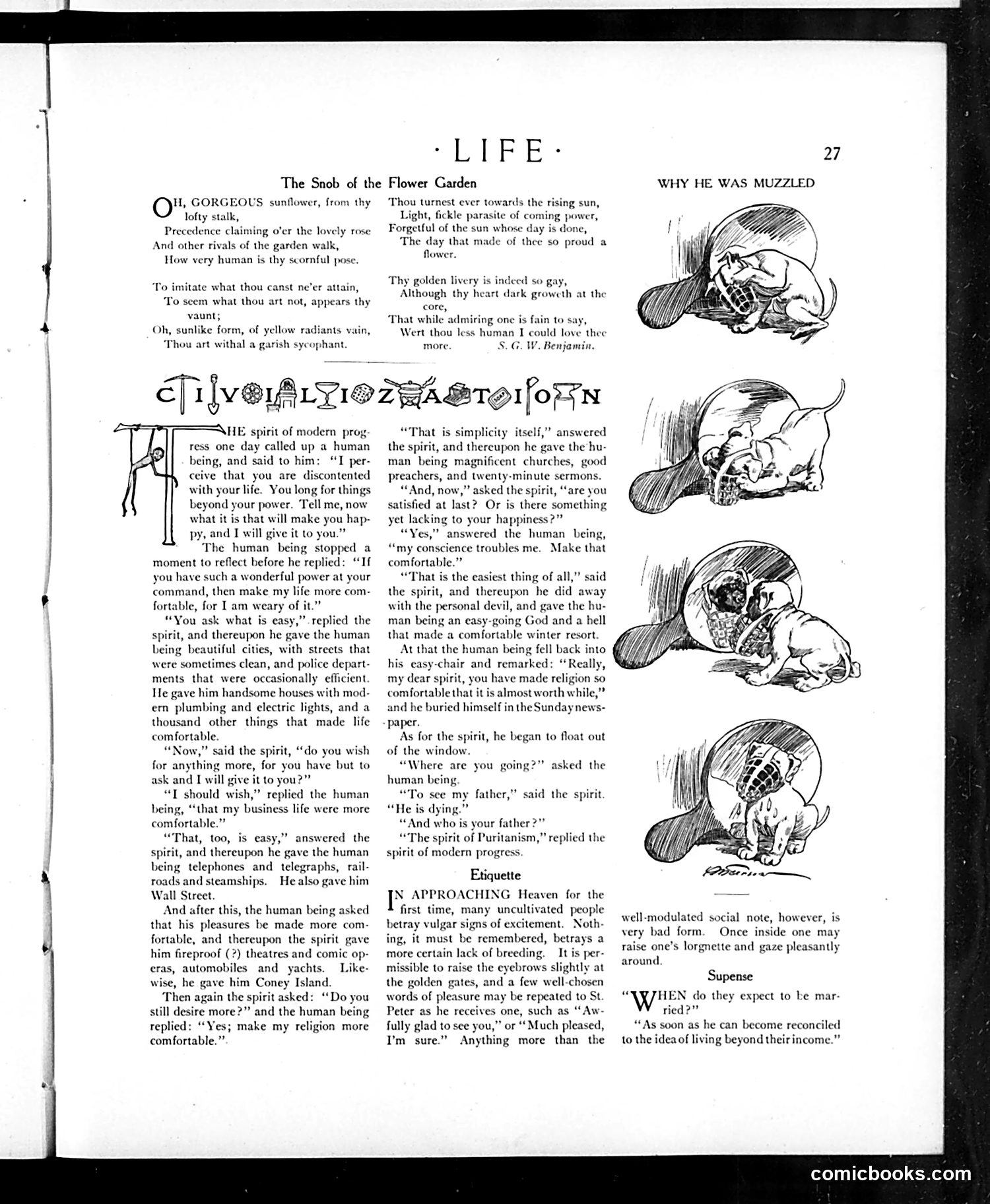
This page contains two satirical pieces critiquing American society's priorities: **"The Snob of the Flower Garden"** (left) is a poem mocking human vanity through the metaphor of a sunflower—beautiful but superficial, chasing power while forgetting its origins. It suggests people abandon loyalty for advancement. **"Civilization"** (center) is the main satire: a spirit of modern progress offers a human increasingly comfortable living conditions—cities, homes, businesses, entertainment (theaters, automobiles, Coney Island). When asked to make religion "comfortable," the spirit removes moral accountability by eliminating the personal devil and offering a "comfortable" hell. The human accepts this spiritual compromise gladly. The spirit then departs to see his dying father: Puritanism—suggesting modern progress has killed traditional morality. **"Etiquette" and "Suspense"** (right) are brief humorous social notes about propriety in Heaven and marriage expectations. The overall message: Americans prioritize material comfort over genuine morality, trading spiritual integrity for convenience.
📄 Transcribed text from this page (OCR, searchable)
Machine-transcribed from the original scan — historical spelling and the odd misread are preserved.
“LIFE - The Snob of the Flower Garden H, GORGEOUS sunflower, from thy lofty stalk Precedenc And other rivals of the garden walk, How very human is thy scornful pose. claiming o'er the lovely rose To imitate what thou canst ne'er att ‘To scem what thou art not, appears thy vaunt; Oh, sunlike form, of yellow radiants vain, ‘Thou art withal a garish sycophant 5 spirit of modern prog. ress one day called up a human being, and said to him: “I per- ceive that you are discontented with your life. You long for things beyond your power. Tell me, now what it is that will make you hap- d I will give it to you.” he human being stopped a moment to reflect before he replied: “If you have such a wonderful power at your command, then make my life more com- fortable, for I am weary of it.” “You ask what is easy,” replied the spirit, and thereupon he gave the human being beautiful cities, with streets that were sometimes clean, and police depart- ments that were occasionally efficient. Ile gave him handsome houses with mod- ern plumbing and electric lights, and a thousand other things that made life comfortable. “Now,” said the spirit, “do you wish for anything more, for you have but to ask and I will give it to you?” “TI should wish,” replied the human being, ‘that my business life were more comfortable.” “That, too, is easy,” answered the spirit, and thereupon he gave the human being telephones and telegraphs, rail- roads and steamships. He also gave him Wall Street. And after this, the human being asked that his pleasures be made more com- fortable, and thereupon the spirit gave him fireproof (?) theatres and comic op- eras, automobiles and yachts. Like- wise, he gave him Coney Island. ‘Then again the spirit asked: “Do you still desire more?” and the human being replied: “Yes; make my religion more comfortable.” ‘Thou turnest ever towards the rising sun, Light, fickle parasite of coming power, Forgetful of the sun whose day is done, The day that made of thee so proud a flow Thy golden livery is indeed so gay, Although thy heart dark groweth at the core, ‘That while admiring one is fain to say, Wert thou less human I could love thee more. S.G.W. Benjamin. simplicity itself,” answered the spirit, and thereupon he gave the hu- man being magnificent churches, good preachers, and twenty-minute sermons. “And, now,” asked the spirit, “are you satisfied at last? Or is there something yet lacking to your happiness?” “Yes,” answered the human being, “my conscience troubles me. Make that comfortable.” “That is the easiest thing of all,” said the spirit, and thereupon he did away with the personal devil, and gave the hu- man being an easy-going God and a hell that made a comfortable winter resort. At that the human being fell back into his easy-chair and remarked: ‘Really, my dear spirit, you have made religion so comfortable that it is almost worth while,” and he buried himself in the Sunday news- paper. As for the spirit, he began to float out of the window. “Where are you going?” asked the human being “To see my father,” said the spirit “He is dying.” “And who is your father?” “The spirit of Puritanism,” replied the spirit of modern progress Etiquette I APPROACHI Heaven for the first time, many uncultivated people betray vulgar signs of excitement. Noth- ing, it must be remembered, betrays a more certain lack of breeding. It is per- missible to raise the eyebrows slightly at the golden gates, and a few well-chosen words of pleasure may be repeated to St. Peter as he receives one, such as “Aw- fully glad to see you,” or “Much pleased, I’m sure.” thing more than the 27 WHY HE WAS MUZZLED well-modulated social note, however, is very bad form. Once inside one may raise one’s lorgnette and gaze pleasantly around Supense “NYJHEN do they ried?” “As soon as he can become reconciled to the idea of living beyond their income.” expect to ke mar- comicbooks.com