
Life, 1907-07-04 · page 35 of 48
Life — July 4, 1907 — page 35: what you’re looking at
What you’re looking at
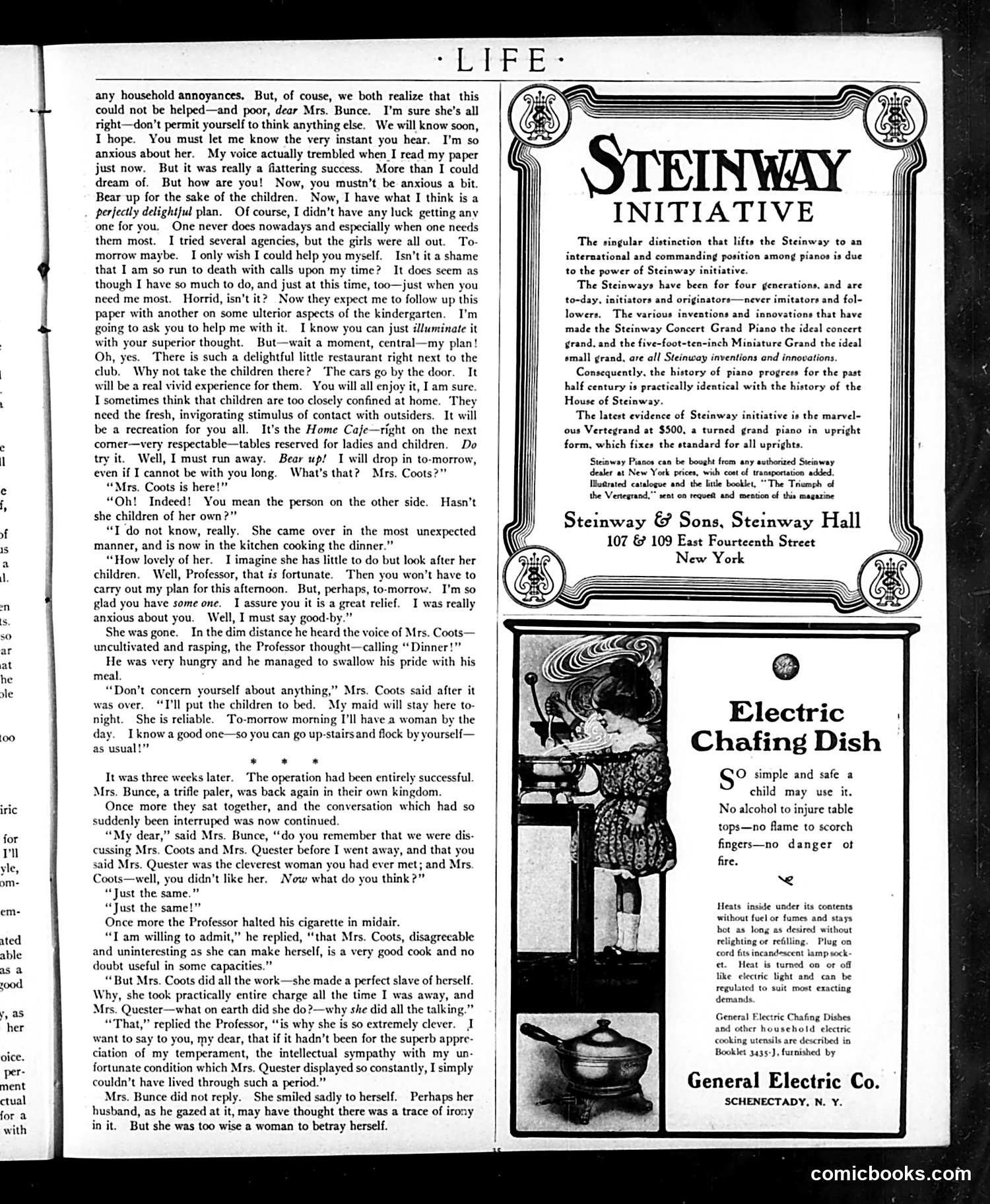
This page contains a serialized story, not a political cartoon. The narrative depicts class commentary through dialogue between characters. **The Setup:** A Professor's wife (Mrs. Bunce) becomes ill and requires surgery. During her absence, two women help care for the household: Mrs. Quester—described as "clever," cultured, and well-connected—and Mrs. Coots, her working-class neighbor with an "uncultivated and rasping" voice. **The Satire's Point:** Mrs. Quester patronizes the Professor with elaborate, self-important advice (suggesting restaurants, offering vague promises of help) while actually doing nothing practical. Mrs. Coots, despite lower social standing, simply *acts*—arranging actual childcare, cooking dinner, hiring household help. **The Joke:** The Professor initially preferred the "clever" Mrs. Quester but must grudgingly admit after three weeks that the "common" Mrs. Coots proved far more valuable. This mocks early 20th-century class prejudice and the gap between performative sophistication and genuine helpfulness.
📄 Transcribed text from this page (OCR, searchable)
Machine-transcribed from the original scan — historical spelling and the odd misread are preserved.
any household annoyances. But, of couse, we both realize that this could not be helped—and poor, dear Mrs. Bunce. I’m sure she’s all right—don’t permit yourself to think anything else. We will know soon, T hope. You must let me know the very instant you hear. I’m so anxious about her. My voice actually trembled when_I read my paper just now. But it was really a fiattering success. More than I could dream of. But how are you! Now, you mustn’t be anxious a bit. Bear up for the sake of the children. Now, I have what I think is a perjectly delightful plan. Of course, I didn’t have any luck getting any one for you. One never docs nowadays and especially when one needs them most. I tried several agencies, but the girls were all out. To- morrow maybe. I only wish I could help you myself. Isn’t it a shame that I am so run to death with calls upon my time? It does seem as though I have so much to do, and just at this time, too—just when you need me most. Horrid, isn’t it? Now they expect me to follow up this paper with another on some ulterior aspects of the kindergarten. I’m going to ask you to help me with it. I know you can just illuminate it with your superior thought. But—wait a moment, central—my plan! Oh, yes. There is such a delightful little restaurant right next to the club. Why not take the children there? The cars go by the door. It will be a real vivid experience for them. You will all enjoy it, I am sure. I sometimes think that children are too closely confined at home. They need the fresh, invigorating stimulus of contact with outsiders. It will be a recreation for you all. It’s the Home Cafe—right on the next comer—very respectable—tables reserved for ladies and children. Do try Well, I must run away. Bear up! I will drop in to-morrow, en if I cannot be with you long. What's that? Mrs. Coots?” “Mrs. Coots is here!” “Oh! Indeed! You mean the person on the other side. Hasn’t she children of her own?” “T do not know, really. She came over in the most unexpected manner, and is now in the kitchen cooking the dinner.” “How lovely of her. I imagine she has little to do but look after her children. Well, Professor, that is fortunate. Then you won’t have to carry out my plan for this afternoon. But, perhaps, to-morrow. I’m so glad you have some one. I assure you it is a great relief. I was really anxious about you. Well, I must say good-by.” She was gone. In the dim distance he heard the voice of Mrs. Coots— uncultivated and rasping, the Professor thought—calling “Dinner!” He was very hungry and he managed to swallow his pride with his meal. “Don’t concern yourself about anything,” Mrs. Coots said after it was over. “I'll put the children to bed. My maid will stay here to- night. She is reliable. ‘To-morrow morning I’ll have a woman by the day. I know a good one—so you can go up-stairsand flock by yourself— as usual!’” * * * It was three weeks later. The operation had been entirely successful Mrs. Bunce, a trifle paler, was back again in their own kingdom. Once more they sat together, and the conversation which had so suddenly been interruped was now continued “My dear,” said Mrs. Bunce, “do you remember that we were dis- cussing Mrs. Coots and Mrs. Quester before I went away, and that you said Mrs. Quester was the cleverest woman you had ever met; and Mrs. Coots—well, you didn't like her. Now what do you think?” “Just the same.” “Just the same!” Once more the Professor halted his cigarette in midair. “Tam willing to admit,” he replied, “that Mrs. Coots, disagreeable and uninteresting as she can make herself, is a very good cook and no doubt useful in some capacities.” “But Mrs. Coots did all the work—she made a perfect slave of herself. Why, she took practically entire charge all the time I was away, and Mrs. Quester—what on earth did she do?—why she did all the talking.” “That,” replied the Professor, ‘is why she is so extremely clever. J want to say to you, my dear, that if it hadn’t been for the superb appre- ciation of my temperament, the intellectual sympathy with my un- fortunate condition which Mrs. Quester displayed so constantly, I simply couldn’t have lived through such a period.” Mrs. Bunce did not reply. She smiled sadly to herself. Perhaps her husband, as he gazed at it, may have thought there was a trace of irony in it. But she was too wise a woman to betray herself. INITIATIVE The singular distinction that lifts the Steinway to an international and commanding position among pianos is due to the power of Steinway initiative. The Steinways have been for four generations, and are to-day, initiators and originators—never imitators and fol- lowers. The various inventions and innovations that have made the Steinway Concert Grand Piano the ideal concert grand, and the five-foot-ten-inch Miniature Grand the ideal small grand. are all Steinway inventions and innovations. Consequently, the history of piano progress for the past half century is practically identical with the history of the House of Steinway. The latest evidence of Steinway initiative is the marvel- ous Vertegrand at $500, a turned grand piano in upright form, which fixes the standard for all uprights. Steinway Pianos can be bought from any authorized Steinway dealer at New York prices, wish cost of transportation added. Mearated catalogue and the little booklet, “The Triumph of the Vertegrand,”* sent on requet and mention of this magazine Steinway & Sons, Steinway Hall 107 & 109 East Fourteenth Street New York Chafing Dish Ss° simple and safe a child may use it. No alcohol to injure table tops—no flame to scorch fingers—no danger ot fire. Ne Heats inside under its contents without fuel or fumes and stays hot as long as desired without relighting of refilling. Plug on cord fits incandescent lamp sock- et. Heat is turned on oF off like electric light and can be regulated to suit most exacting demands. General Electric Chafing Dishes and other household electric cooking utensils are described in Booklet 3435-), furnished by General Electric Co. SCHENECTADY, N. Y. comicbooks.com