
Life, 1907-07-04 · page 21 of 48
Life — July 4, 1907 — page 21: what you’re looking at
What you’re looking at
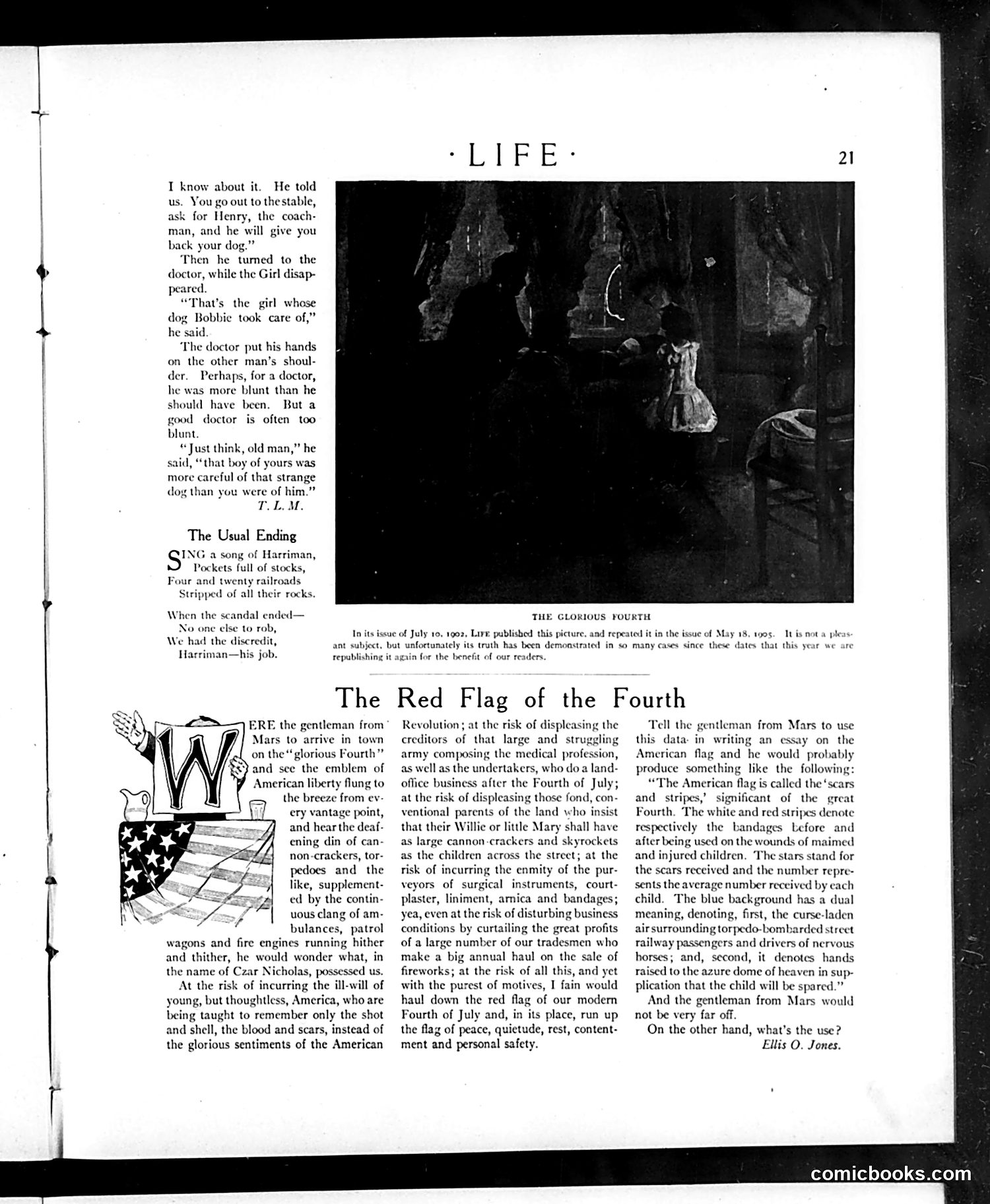
This satirical piece critiques Fourth of July celebrations as dangerous and destructive. The article uses a fictional "gentleman from Mars" as an outsider perspective to highlight the absurdity: Americans wave the flag while fireworks cause mass injuries, deaths, and suffering—particularly to children. Ellis O. Jones sarcastically "redefines" the American flag's symbolism: the red and white stripes represent bandages on wounded children; the stars represent scars; the blue background represents both the smoke from explosions and desperate prayers for safety. The satire targets the hypocrisy of celebrating liberty and independence while ignoring Fourth of July casualties—the medical profession, undertakers, and firecracker manufacturers all profit from preventable injuries. Jones advocates replacing fireworks with peaceful observance but cynically acknowledges Americans won't heed this message. This reflects genuine Progressive Era concerns about holiday violence; the reprinted 1902 article notes its "truth has been demonstrated in so many cases."
📄 Transcribed text from this page (OCR, searchable)
Machine-transcribed from the original scan — historical spelling and the odd misread are preserved.
SEE a dimeieiin” slain I know about it. He told us. You go out to thestable, ask for Henry, the coach- man, and he will give you back your dog.” hen he tumed to the doctor, while the Girl disap- peared. “That's the girl whose dog Bobbie took care of,” he said. ‘The doctor put his hands on the other man’s shoul- der. Perhaps, for a doctor, he was more blunt than he should have been. But a good doctor is often too blunt. Just think, old man,” he aid, “that boy of yours was more careful of that strange dog than you were of him.” T. LM. The Usual Ending a song of Harriman, ih NS) ockets full of stock Four and twenty railroads Stripped of ail their rocks. When the scandal ended— one else to rob, 1 the discredit, In its i We h Harriman—his job. THE GLORIOUS FOURTH of July 10. 1902, Lire: published this pictu for the benefit of our readers and repeated it in the issue of May 18, 1995. It is not a p ant subject, but unfortunately its truth has been demonstrated in so many cases since U republishing it ates that this year we arc The Red Flag of the Fourth Zi ERE the gentleman from Mars to arrive in town on the ‘glorious Fourth” Ss} and see the emblem of American liberty flung to the breeze from ev ery vantage point, and hear the deaf- ening din of can- non-crackers, tor- pedoes and the like, supplement- ed by the contin- uous clang of am- bulances, patrol wagons and fire engines running hither and thither, he would wonder what, in the name of Czar Nicholas, possessed us. At the risk of incurring the ill-will of young, but thoughtless, America, who are being taught to remember only the shot and shell, the blood and scars, instead of the glorious sentiments of the American Revolution; at the risk of displeasing the creditors of that large and struggling army composing the medical profession, as well as the undertakers, who do a land- office business after the Fourth of July; at the risk of displeasing those fond, con- ventional parents of the land who insist that their Willie or little Mary shall have as large cannon-crackers and skyrockets as the children across the street; at the risk of incurring the enmity of the pur- veyors of surgical instruments, court- plaster, liniment, arnica and bandages; yea, even at the risk of disturbing business conditions by curtailing the great profits of a large number of our tradesmen who make a big annual haul on the sale of fireworks; at the risk of all thi nd yet with the purest of motives, I fain would haul down the red flag of our modern Fourth of July and, in its place, run up the flag of peace, quietude, rest, content- ment and personal safety. Tell the gentleman from Mars to use this data. in writing an essay on the American flag and he would probabl produce something like the following: “The American flag is called the ‘scars and stripes,’ significant of the great Fourth. The white and red stripes denote respectively the bandages before and after being used on the wounds of maimed and injured children. The stars stand for the scars received and the number repre- sents the average number received by each child. The blue background has a dual meaning, denoting, first, the curse-laden airsurrounding torpedo-bombarded street railway passengers and drivers of nervous horses; and, second, it denotes hands raised to the azure dome of heaven in sup- plication that the child will be spared.” And the gentleman from Mars would not be very far off. On the other hand, what’s the use? Ellis O. Jones. comicbooks.com