
A complete issue · 28 pages · 1906
Life — October 18, 1906
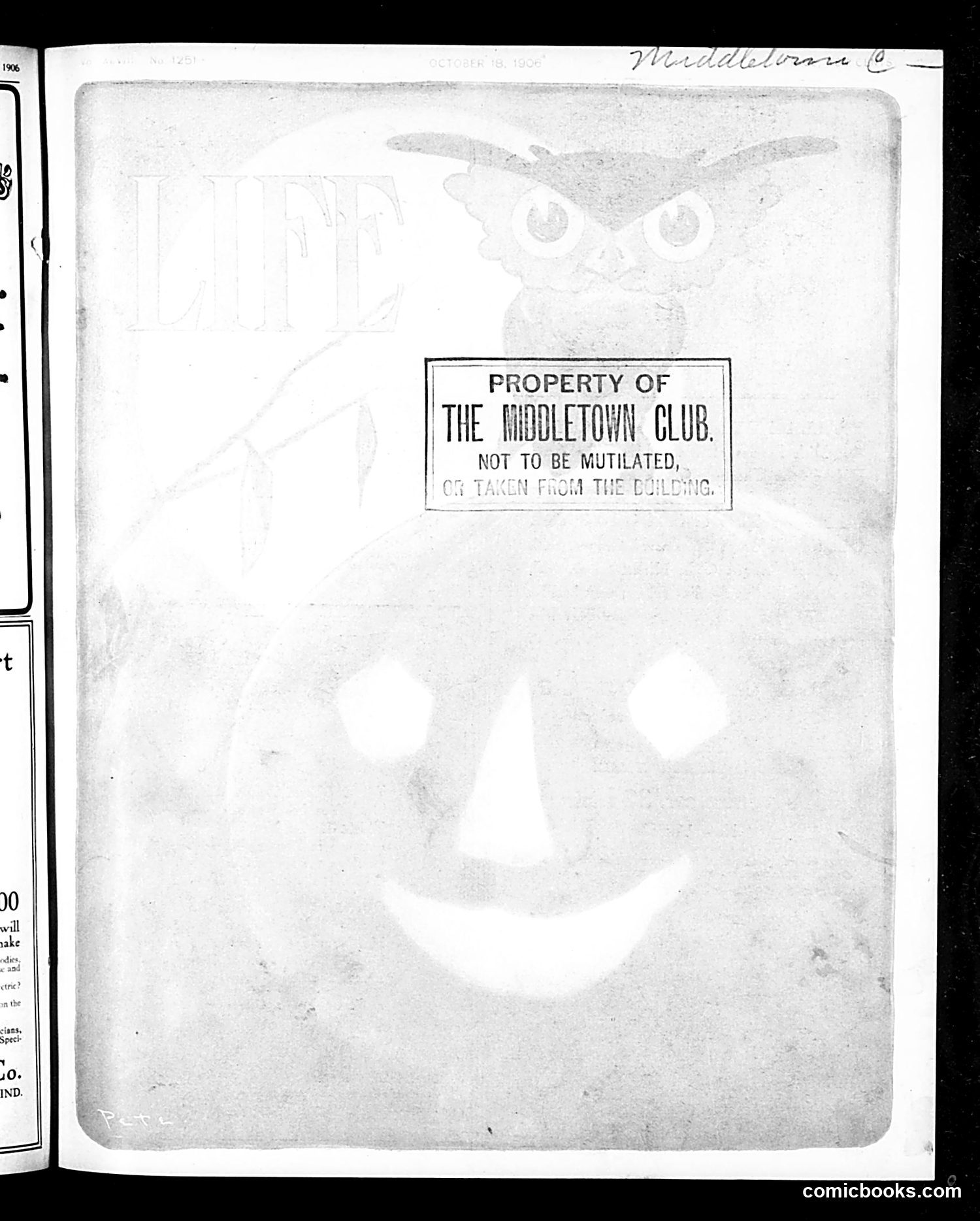
This appears to be the cover or opening page of a *Life* magazine issue from October 18, 1906. The central image is an owl's head with large, round eyes and distinctive ear tufts, rendered in a somewhat grotesque style with an open mouth. The property stamp indicates this copy belonged to "The Middletown Club" and was not to be removed from the building—suggesting it was a club library copy. The owl's exaggerated features and somewhat unsettling expression suggest satirical intent, though without additional context from the magazine's contents, the specific target of the satire is unclear. The owl may represent a political figure, social type, or contemporary event, but I cannot definitively identify which without more supporting evidence from the article text.
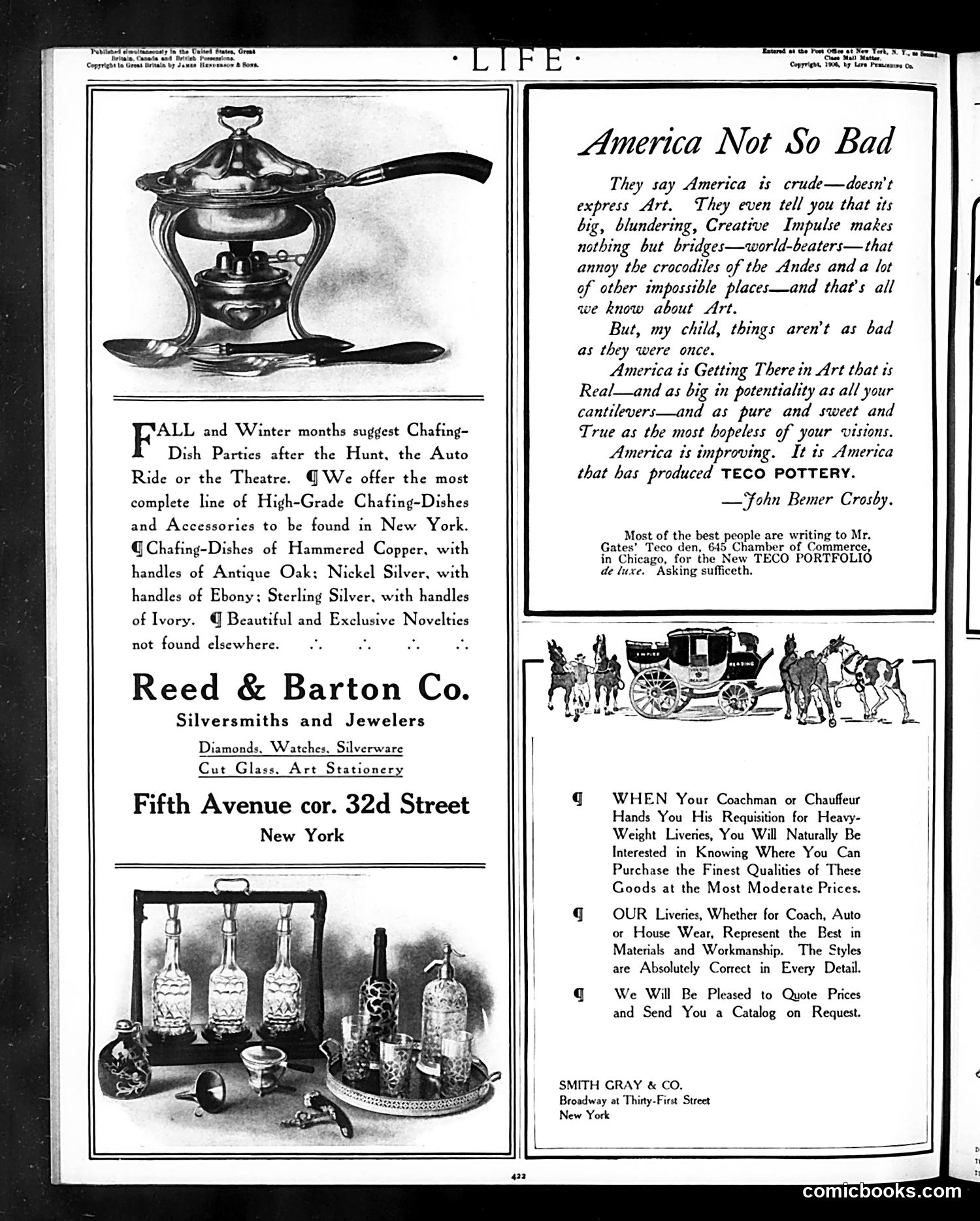
This page consists primarily of **advertisements** rather than political cartoons or satire. The left column shows a Reed & Barton Co. ad for high-end chafing dishes and table accessories, appealing to wealthy New Yorkers for entertaining. The right column features an article titled "America Not So Bad" that defends American art and culture against European criticism. It quotes John Bemer Crosby praising American artistic progress, referencing "Teco Pottery" as evidence. The tone is defensive nationalism—responding to the common early-20th-century European view that America was culturally crude and unsophisticated. Below is an advertisement for Smith Gray & Co., a livery service for coaches and automobiles. The page reflects 1920s American attitudes: wealth-focused consumer culture combined with defensive cultural pride.
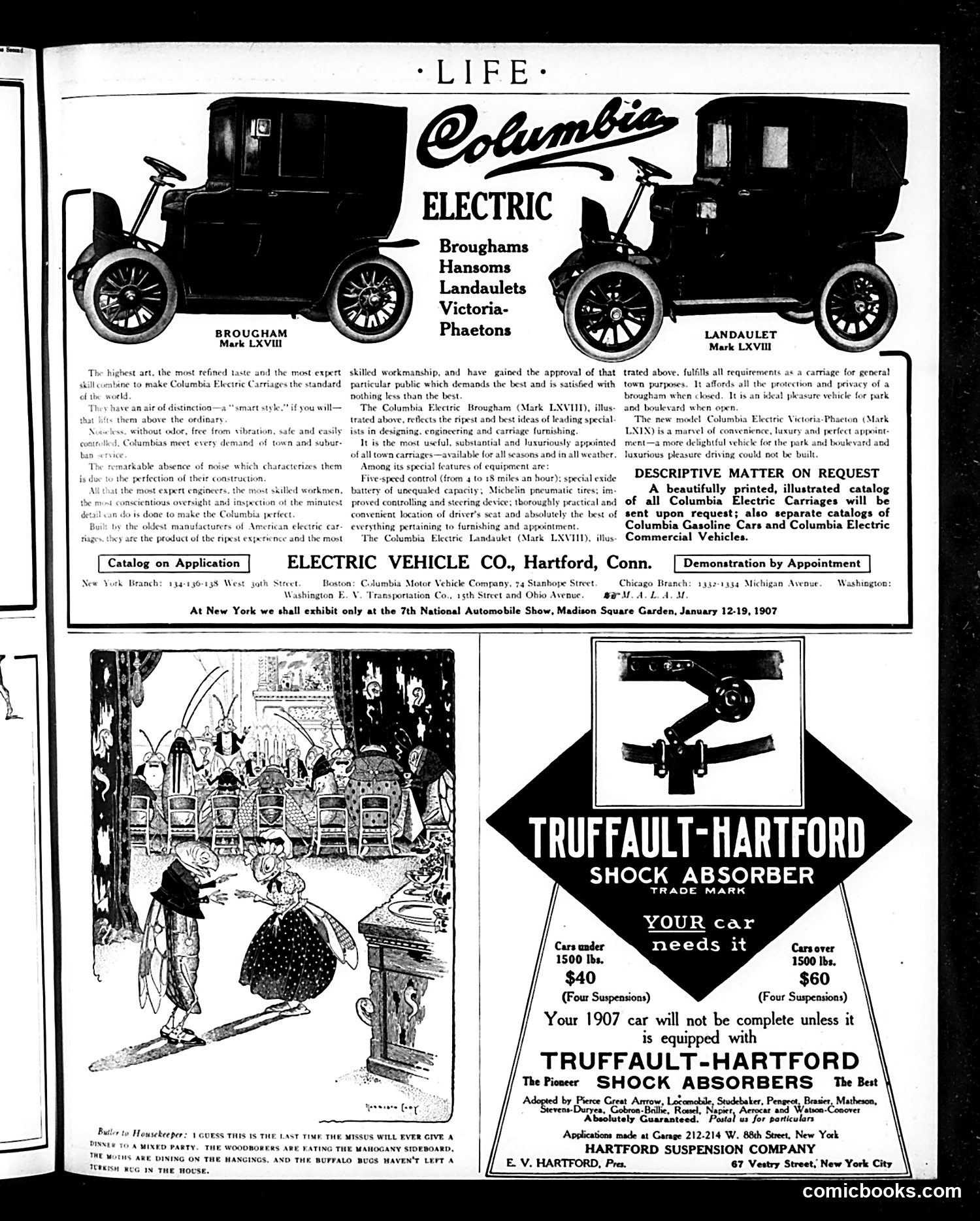
This page is primarily **advertising** rather than satirical content. The top half features Columbia Electric vehicles (Broughams, Hansoms, Landaulets, and Victoria-Phaetons), promoting early electric automobiles as refined, quiet, and reliable transportation. The bottom left contains a **humorous illustration** (artist signature unclear) depicting what appears to be a fancy dinner scene with well-dressed figures, though the OCR text is garbled and difficult to parse clearly. The right side advertises the **Truffault-Hartford Shock Absorber**, a suspension component for 1907 automobiles, targeting wealthy car owners ($40-60 for different vehicle weights). The page reflects the era's novelty: electric vehicles and automobile accessories were cutting-edge luxury goods being marketed to affluent readers.
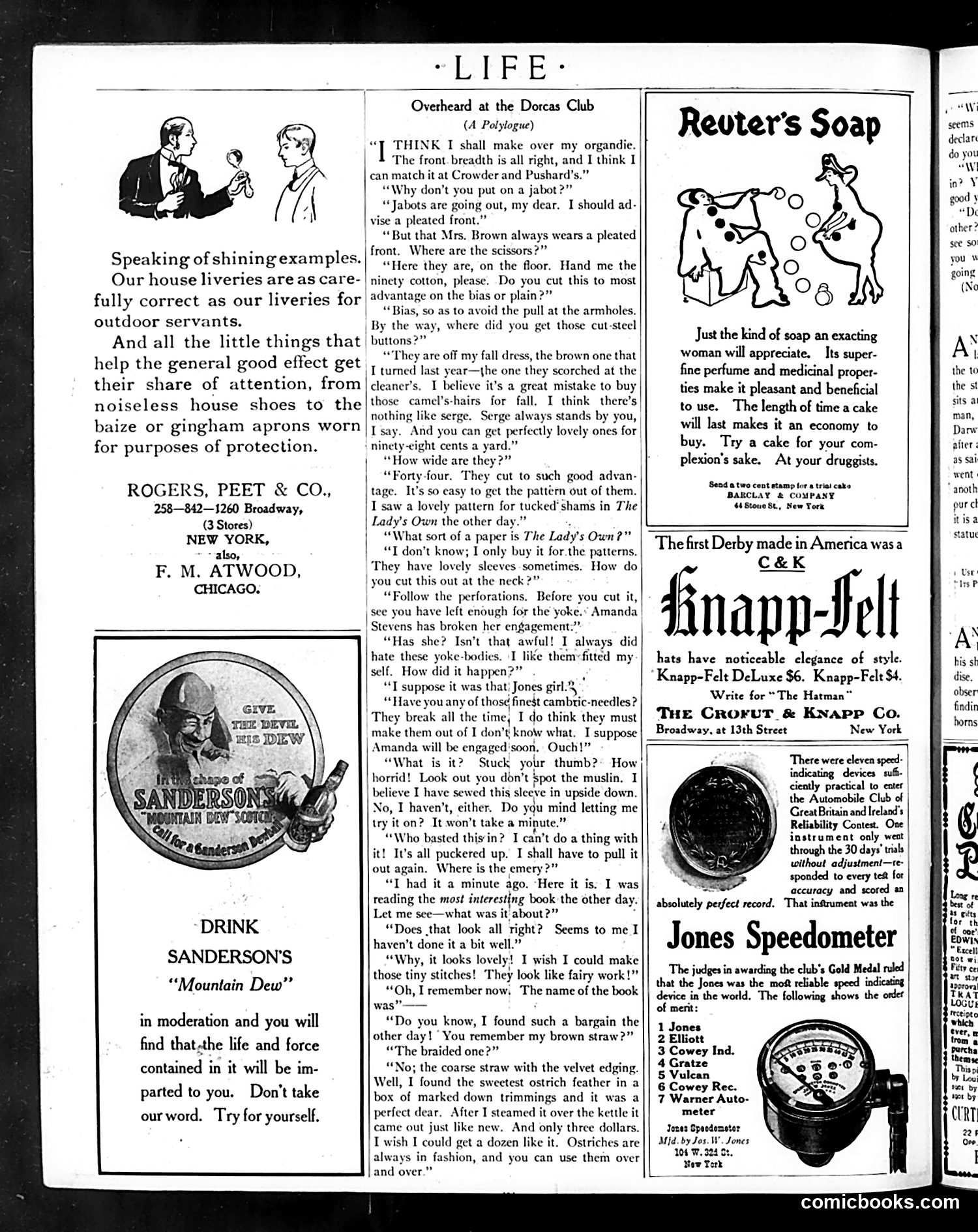
This page is primarily **advertising content** mixed with a brief satirical dialogue and illustrations. The main cartoon, "Overhead at the Dorcas Club (A Polylogue)," depicts two men in conversation about domestic and fashion matters—discussing fabric choices, dress patterns, and household management. The satire appears to mock genteel, upper-class concerns and the minutiae of fashionable society conversation typical of the era. The remainder of the page features vintage advertisements for products including Reuter's Soap, Knapp-Felt hats, Sanderson's Mountain Dew drink, and Jones Speedometer. These ads are representative of early 20th-century consumer goods marketing, emphasizing quality and reliability. The page reflects *Life* magazine's blend of social satire with commercial content rather than substantive political commentary.
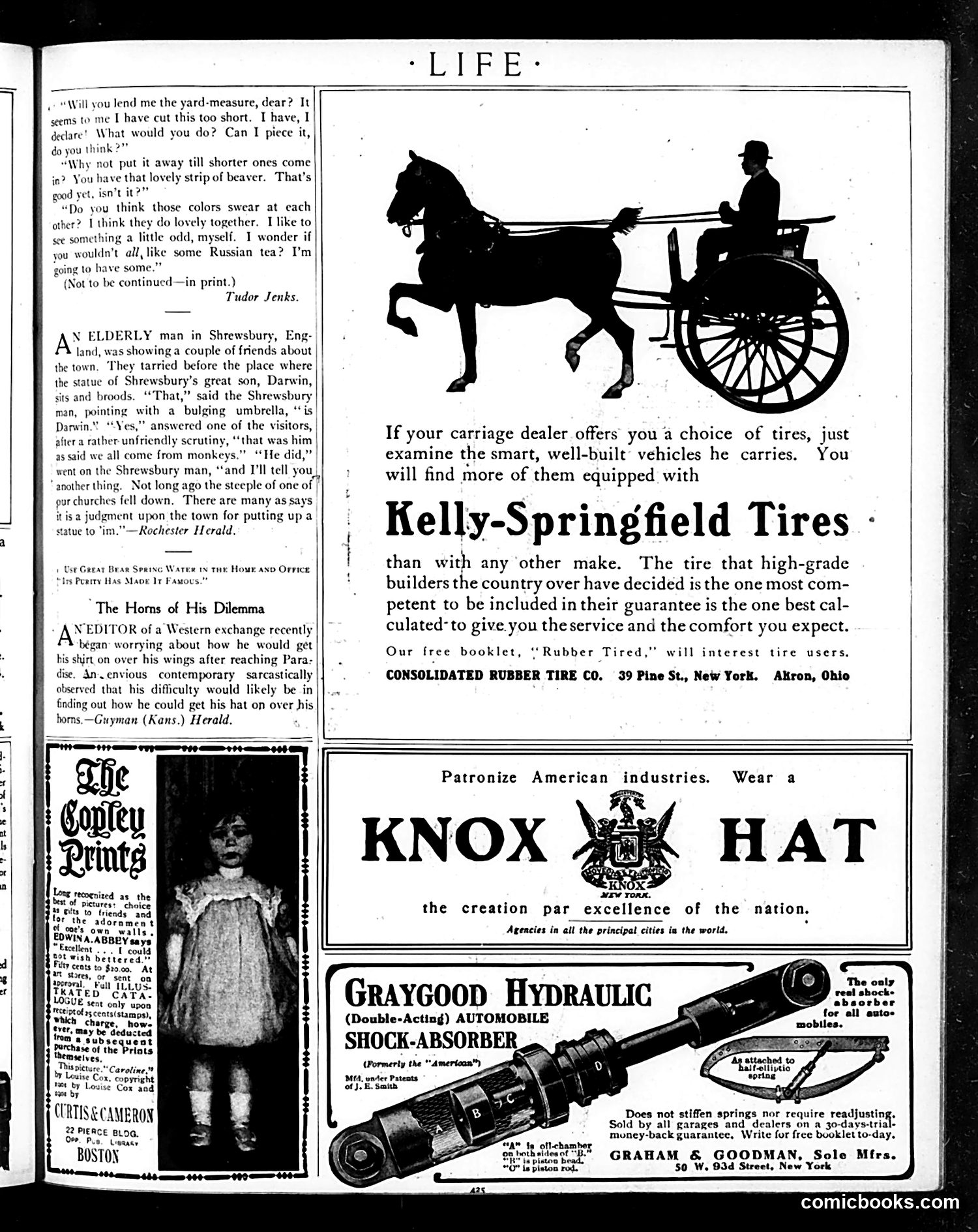
This page is primarily **advertising**, not satirical content. The dominant advertisement promotes **Kelly-Springfield Tires**, featuring an illustration of a man in a horse-drawn carriage. The text argues that smart carriage buyers choose vehicles equipped with these tires. Below that is a **Knox Hat** advertisement claiming it represents "the creation par excellence of the nation." The left side contains brief humorous anecdotes (labeled "LIFE") about an elderly man in Shrewsbury, England confusing Darwin's statue with his son, and an editor's dilemma about his shirt and Paradise. These are light social humor rather than political satire. The bottom advertises the **Graygood Hydraulic Automobile Shock-Absorber**. This page reflects early 20th-century magazine formatting: mixing editorial humor with commercial advertisements for emerging automobile-related products.
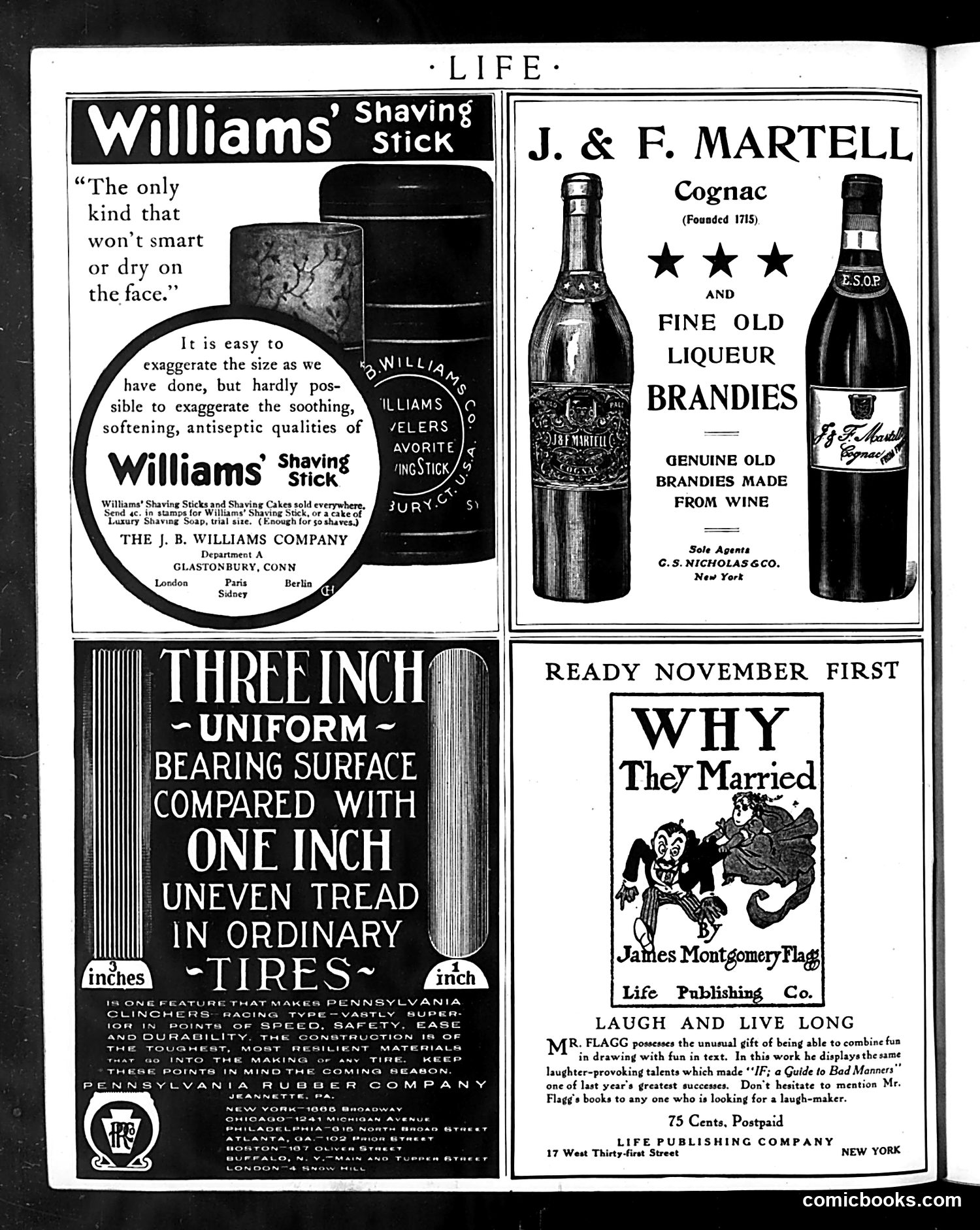
This page is **primarily advertising**, not satirical content. It contains four commercial advertisements: 1. **Williams' Shaving Stick** — promotes a grooming product claiming it won't smart or dry the face 2. **J. & F. Martell Cognac** — advertises French brandy, founded 1715 3. **Pennsylvania Rubber Company Tires** — compares tire tread depth (three inches versus one inch) 4. **"Why They Married"** by James Montgomery Flagg — promotes a humorous book about marriage, published by Life Publishing Company The Flagg book is the only item with comedic intent, described as combining "fun in drawing with fun in text." The page reflects early 20th-century consumer advertising in *Life* magazine, which mixed editorial content with paid promotions.
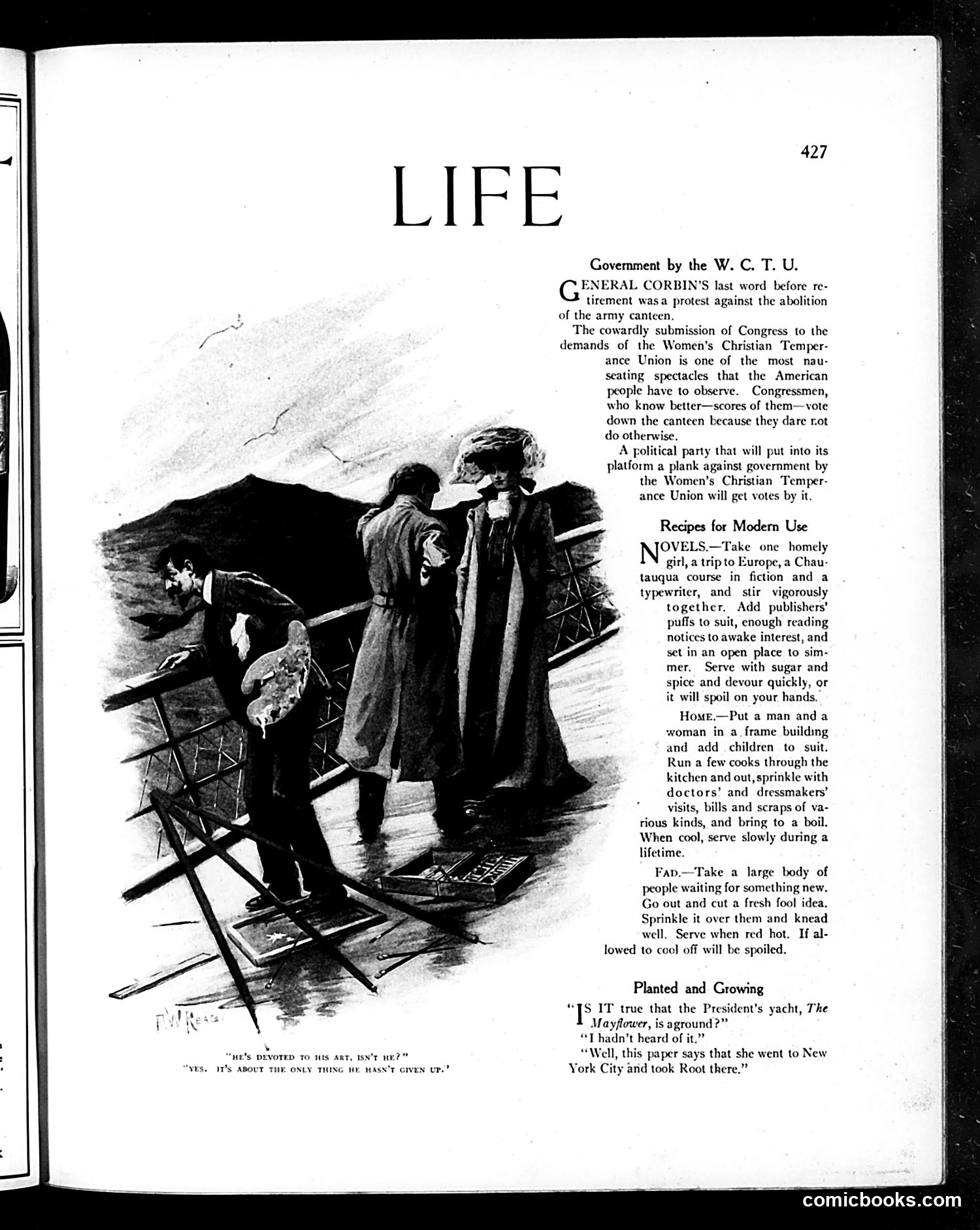
This page contains political commentary and satirical "recipes." The main cartoon depicts a man devoted to his art while others observe him—the caption reads "He's devoted to his art, isn't he?" / "Yes, it's about the only thing he hasn't given up." The accompanying text attacks the Women's Christian Temperance Union (WCTU), mocking their influence over Congress regarding army canteen abolition. The article warns that a political party supporting the WCTU's temperance platform will gain votes from the organization, presenting this as manipulation of democratic processes. The "Recipes for Modern Use" section uses food metaphors to satirize contemporary social institutions—novels, homes, and fads—suggesting they're artificial constructions requiring careful "preparation" for consumption by the public.
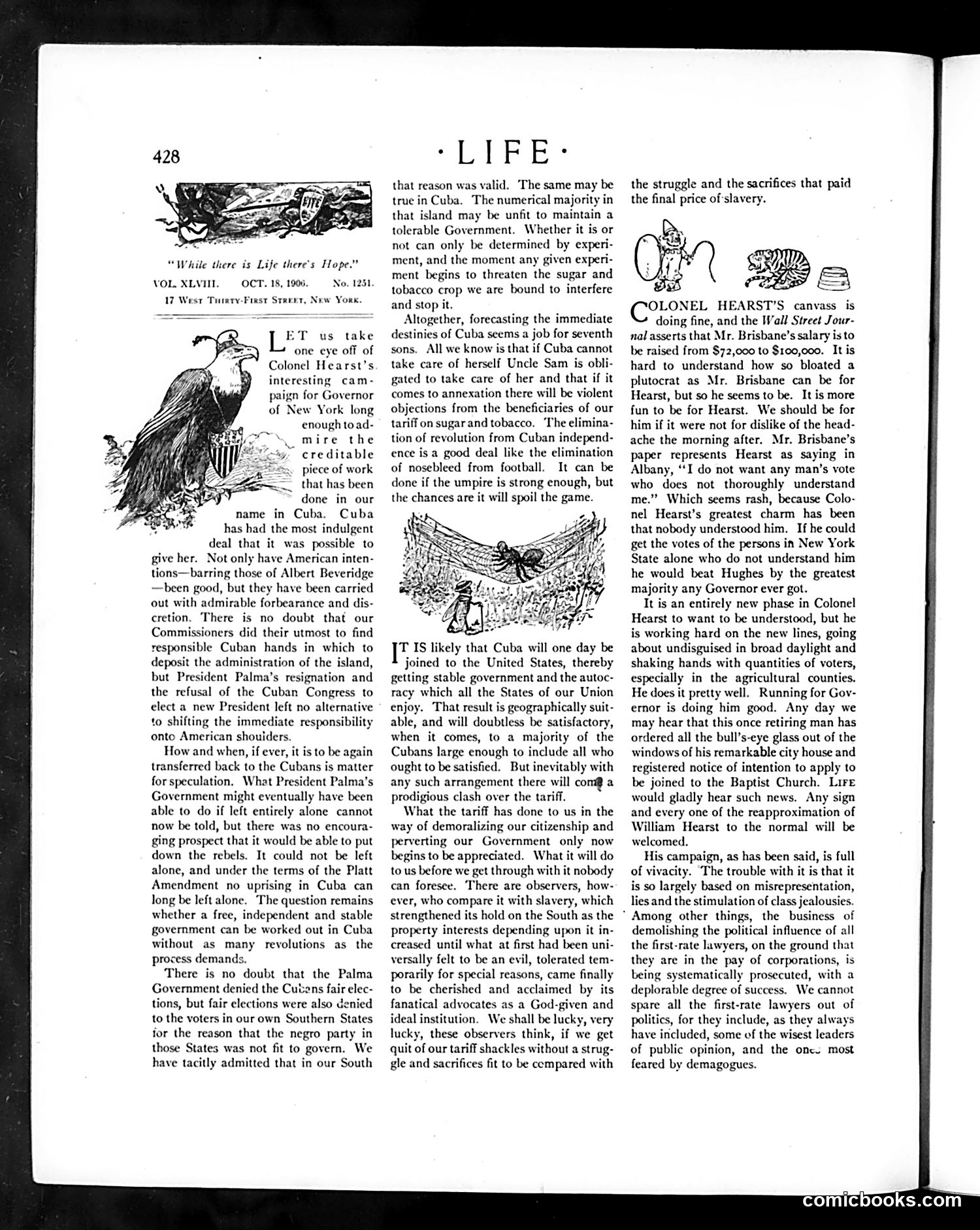
The page features political commentary on Cuba and U.S. intervention. The main cartoon depicts an eagle (representing America) overlooking figures below, illustrating debate over whether the U.S. should annex or control Cuba following political instability there. The text discusses Colonel Hearst's (likely William Randolph Hearst) potential candidacy for New York Governor, contrasting his public image with his actual influence. The article criticizes how Hearst is portrayed in newspapers while questioning whether voters truly understand him. The piece also addresses the tariff debate and its impact on Cuban sugar/tobacco trade, reflecting early 1900s tensions over American imperialism, protectionism, and Cuba's political future following independence from Spain. The overall tone questions American interventionism and political manipulation of public opinion.
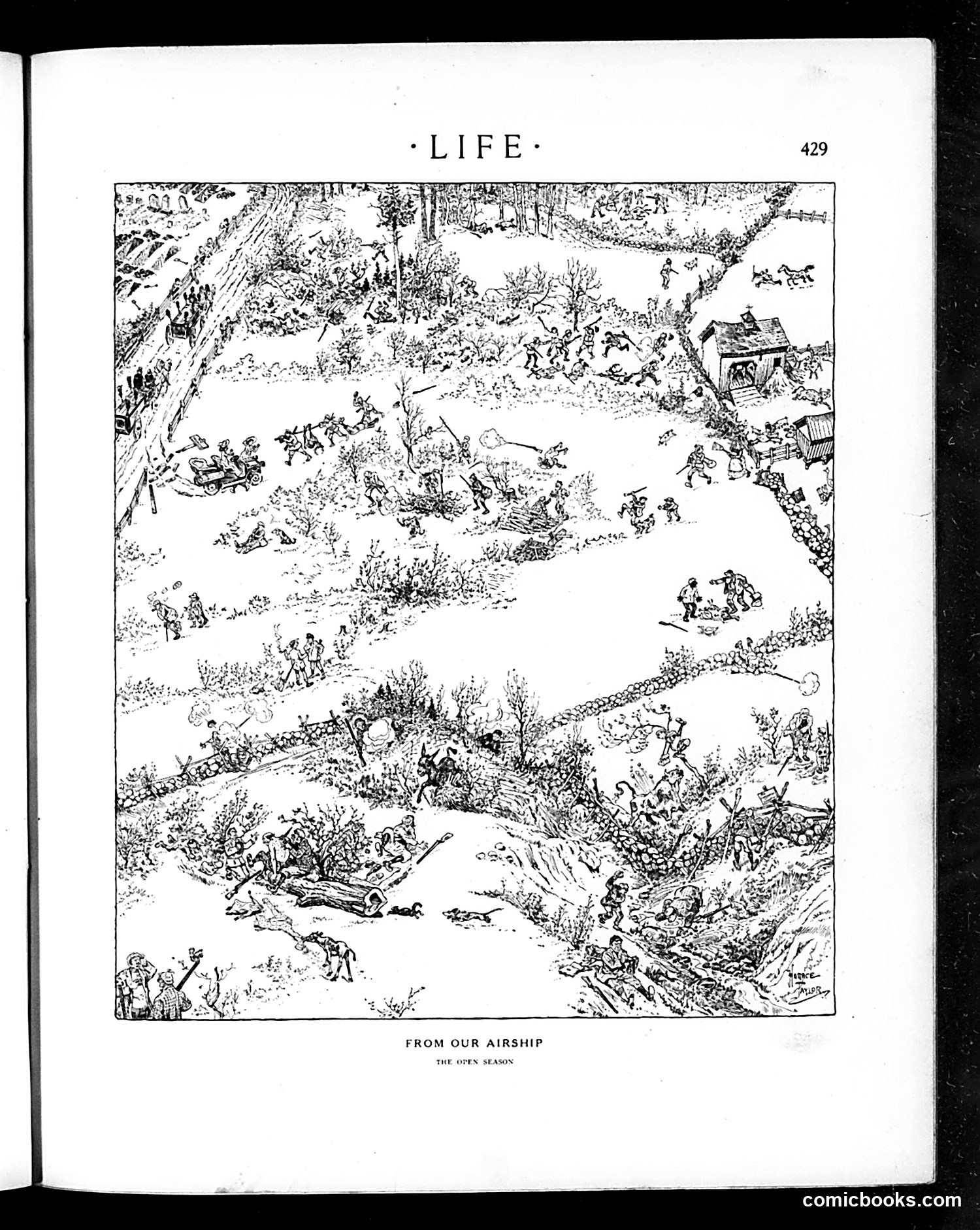
This is a bird's-eye aerial view illustration titled "From Our Airship," depicting an expansive landscape during "The Open Season." The intricate engraving shows numerous small human figures scattered across fields, valleys, and near buildings, engaged in various outdoor activities—hunting, socializing, and recreation. The satire likely comments on the chaos and variety of human behavior when social constraints are relaxed. The aerial perspective emphasizes the ant-like quality of humans pursuing diverse, often contradictory activities simultaneously. "Open season" may reference the hunting season literally, or metaphorically suggest a period when normal rules don't apply—allowing satirical observation of human nature in its unrestrained state. The detailed, crowded composition underscores the complexity and absurdity of unregulated public life.
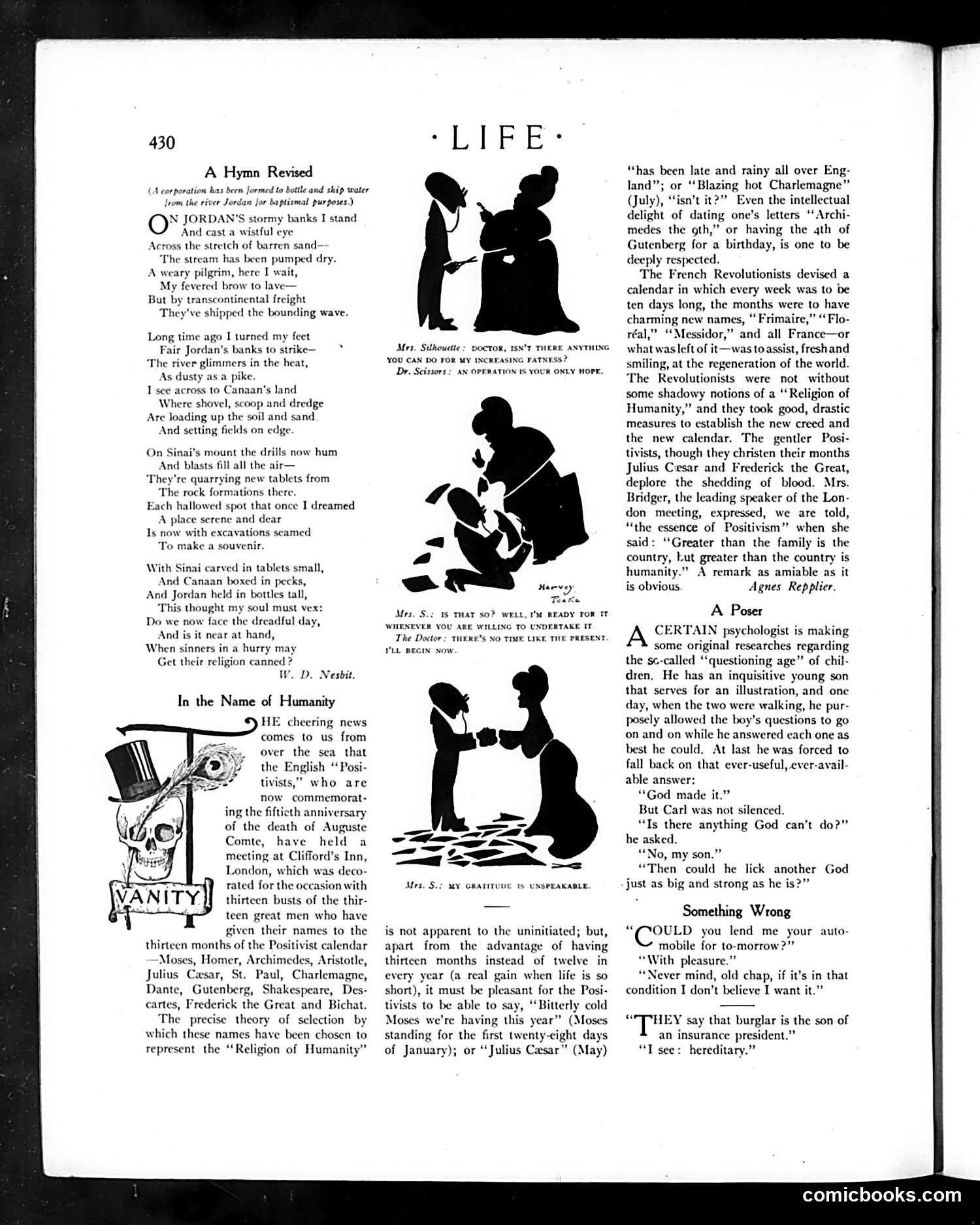
This Life magazine page contains silhouette cartoons mocking the French Revolution's "Religion of Humanity." The top cartoon shows a doctor and scissors-wielding figure labeled as promoting an "operation" as "your only hope"—satirizing radical revolutionaries offering violent solutions. The middle cartoon depicts someone distributing items, with text about "thirteen months" and replacing traditional calendar names (Moses, Homer, Dante) with revolutionary alternatives—mocking the Revolution's attempt to impose a secular calendar with months named after Enlightenment figures. The bottom cartoon shows two figures in dialogue about lending an automobile, captioned "my gratitude is unspeakable"—likely satirizing the Revolution's grandiose rhetoric versus mundane reality. The overall message: the Revolution's idealistic claims masked dangerous extremism and absurd social engineering.
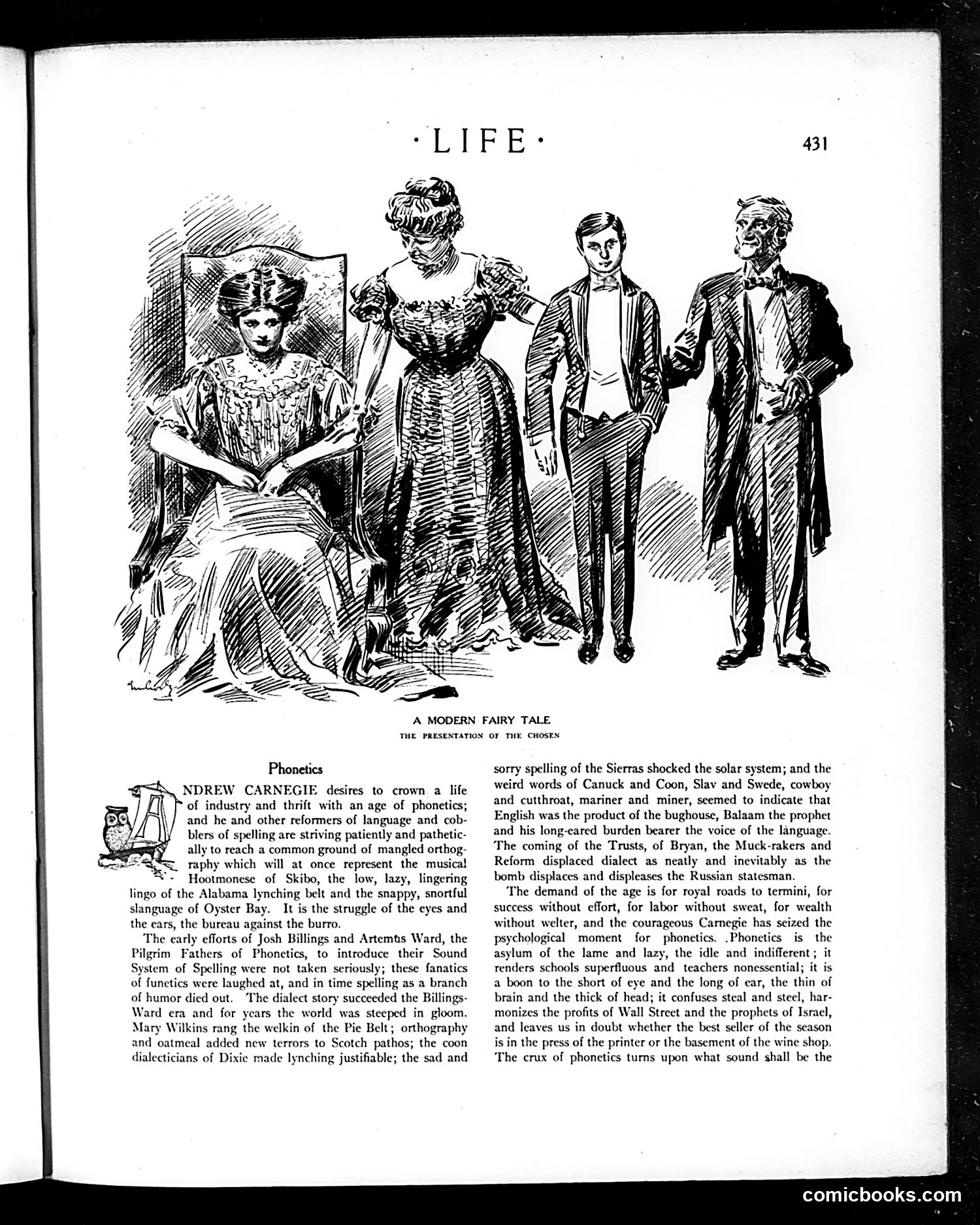
This satirical illustration depicts Andrew Carnegie's efforts to reform English spelling and language. The cartoon shows Carnegie (seated, left) presenting his "chosen" reformers to society—figures representing the phonetic reform movement. The accompanying text mocks Carnegie's ambitions mockingly, referencing his "psychological moment for phonetics" while lampooning the absurdity of the reform agenda. The satire critiques how Carnegie and fellow reformers expected to impose radical spelling changes on English despite widespread resistance. The cartoon's joke: presenting linguistic reform as though introducing debutantes to high society—treating a serious (but ridiculous) campaign as theatrical social pageantry. Life magazine ridicules both Carnegie's wealth-driven reformism and the pretentiousness of attempting to reshape the English language itself.
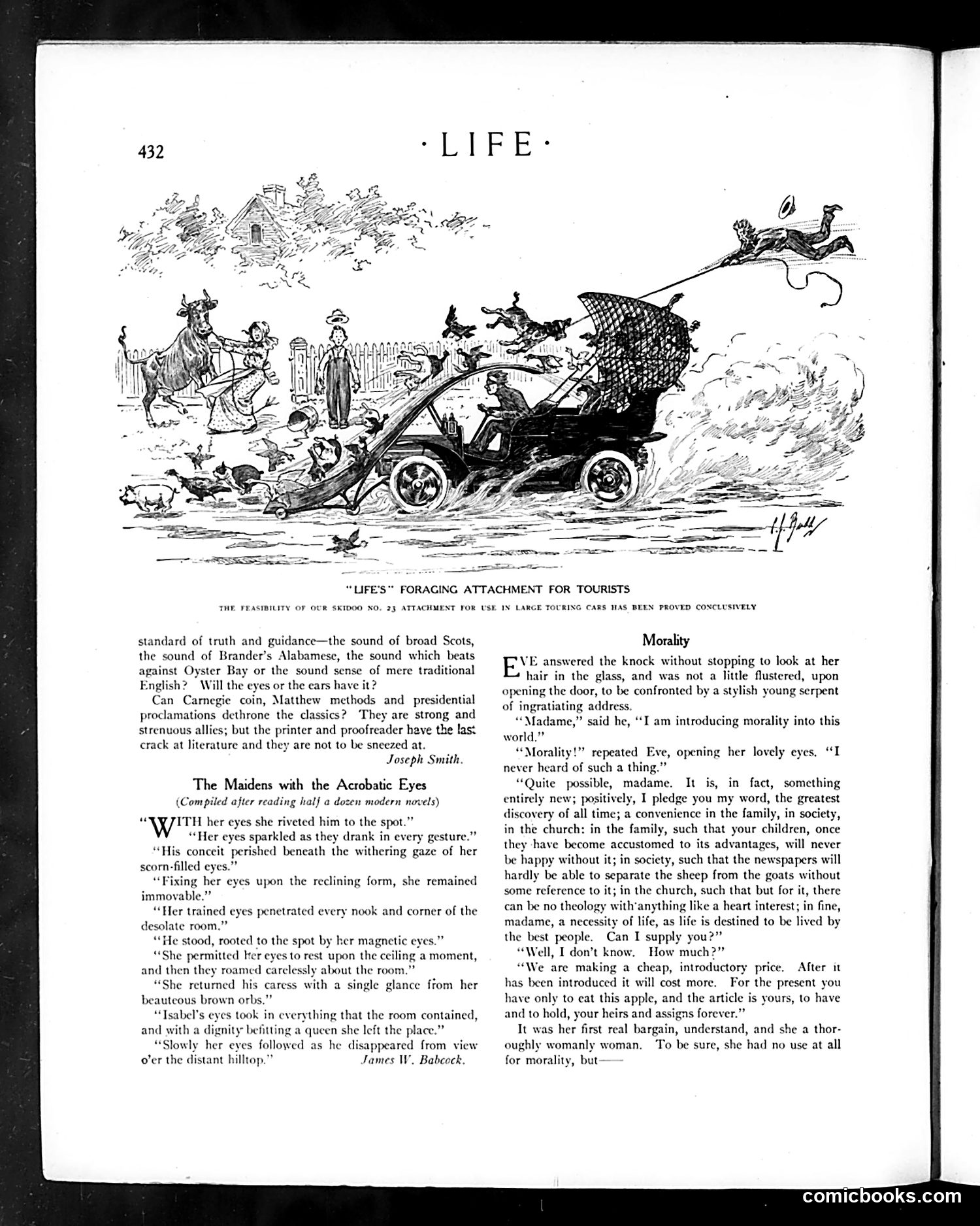
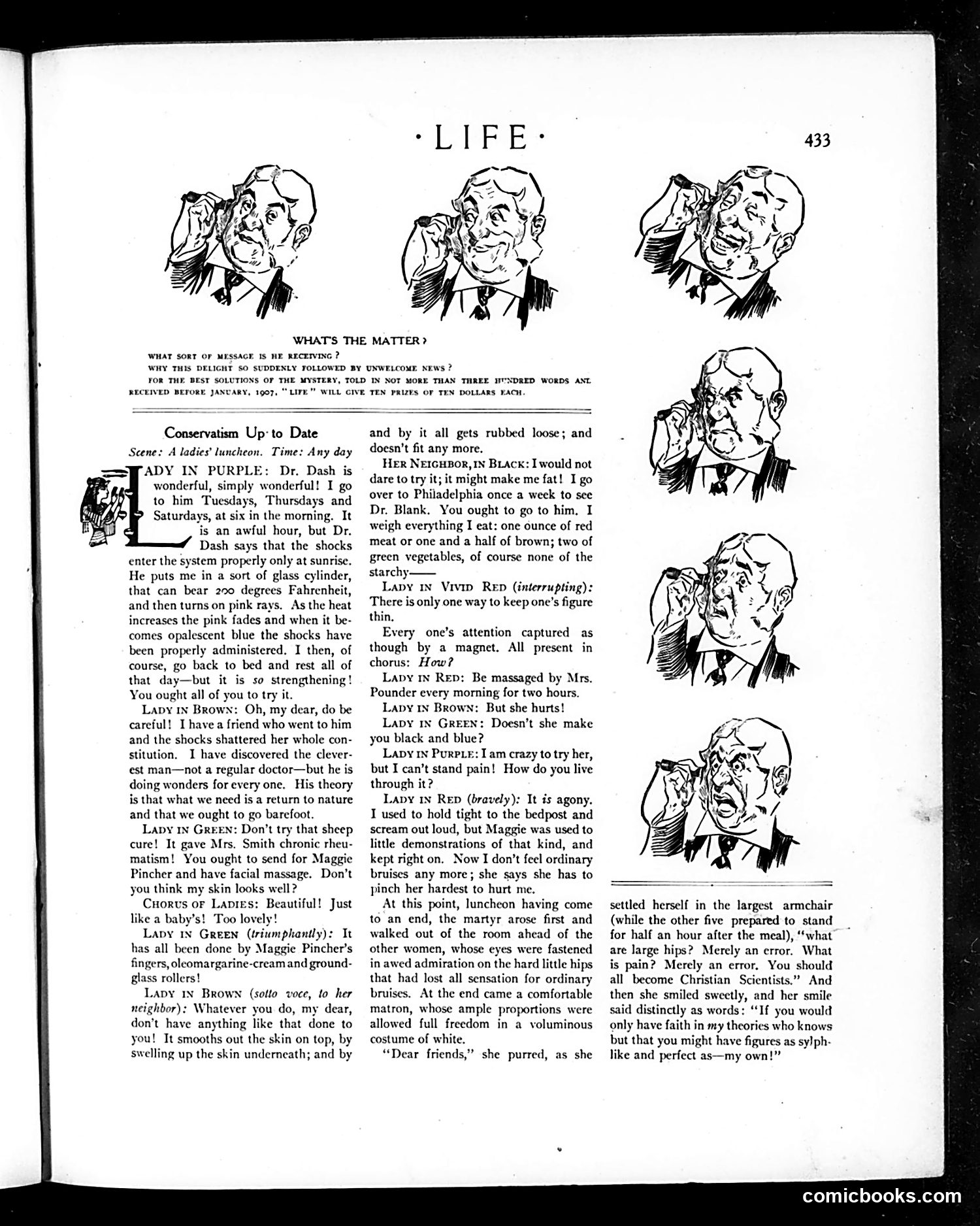
This page satirizes **fad dieting and health obsession** among wealthy women of the early 1900s. The cartoon shows a conversation at a ladies' luncheon where women discuss extreme weight-loss and body-toning methods: Dr. Dash's "shock treatment," massage by "Mrs. Pounder," special diets restricting meat and vegetables, and corseting so tight it causes bruising. The satire targets the **contradiction between health claims and actual harm**—women endure pain and discomfort pursuing fashionable thinness while claiming scientific justification. The title "Conservatism Up to Date" sarcastically labels these supposedly modern, rational health practices. The repeated facial caricatures on the right emphasize the women's obsessive, somewhat crazed expressions, mocking how seriously they take these dubious treatments. The joke: wealthy women will suffer anything for vanity disguised as science.
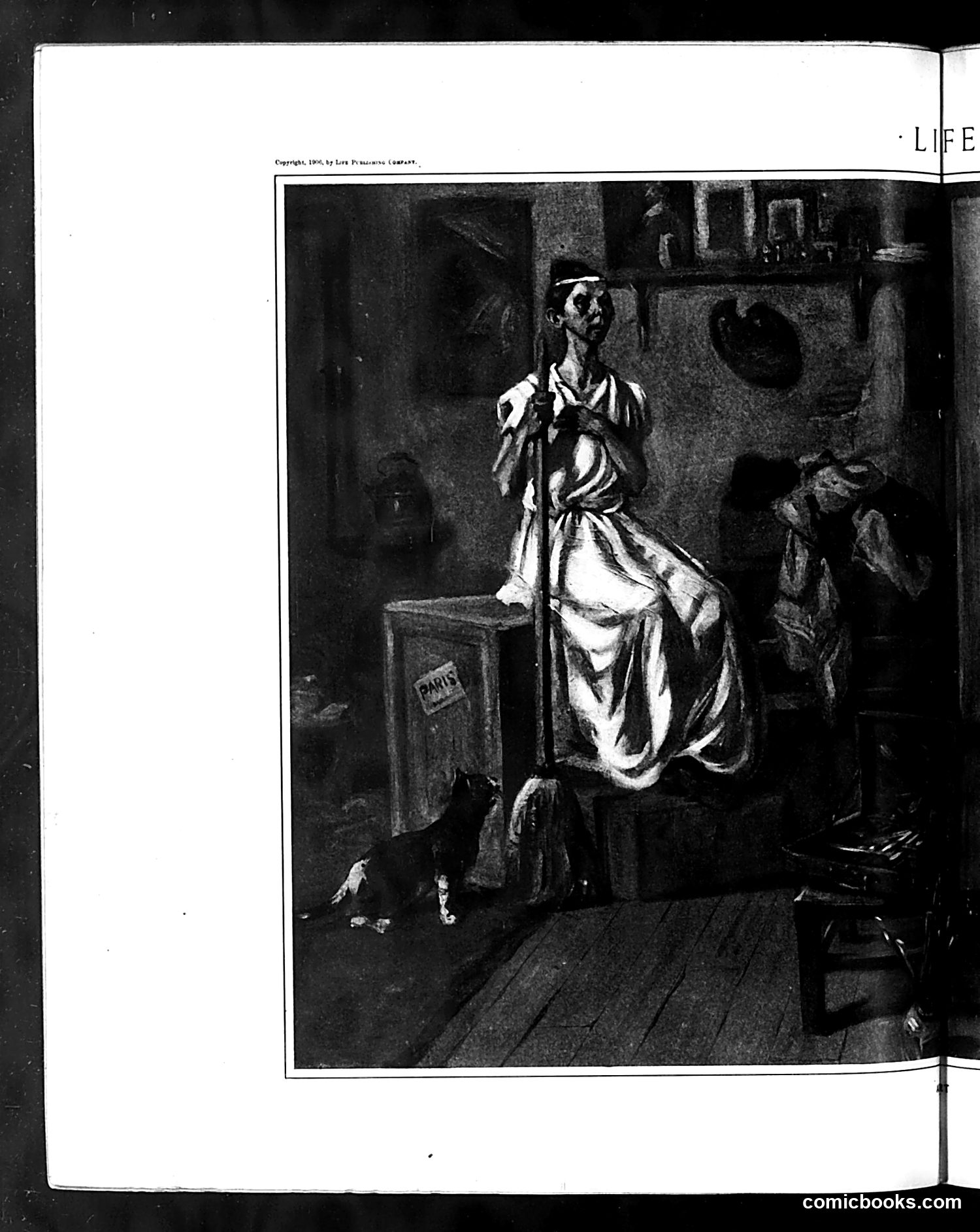
The OCR text is too corrupted to read meaningfully. However, the image shows a black and white illustration depicting what appears to be a theatrical or domestic scene. A figure in classical drapery stands prominently in an interior space with wooden flooring, while other figures are visible in the background. There's a box labeled "PARIS" visible on the left side. Without legible accompanying text, I cannot definitively identify the specific political or social reference, the named figures being caricatured, or the satirical point being made. The classical costume suggests possible commentary on European affairs or artistic pretension, but this remains speculative. The LIFE magazine copyright date at the top is partially visible but not entirely clear. To accurately explain this cartoon's meaning, I would need readable OCR text or clearer publication information.
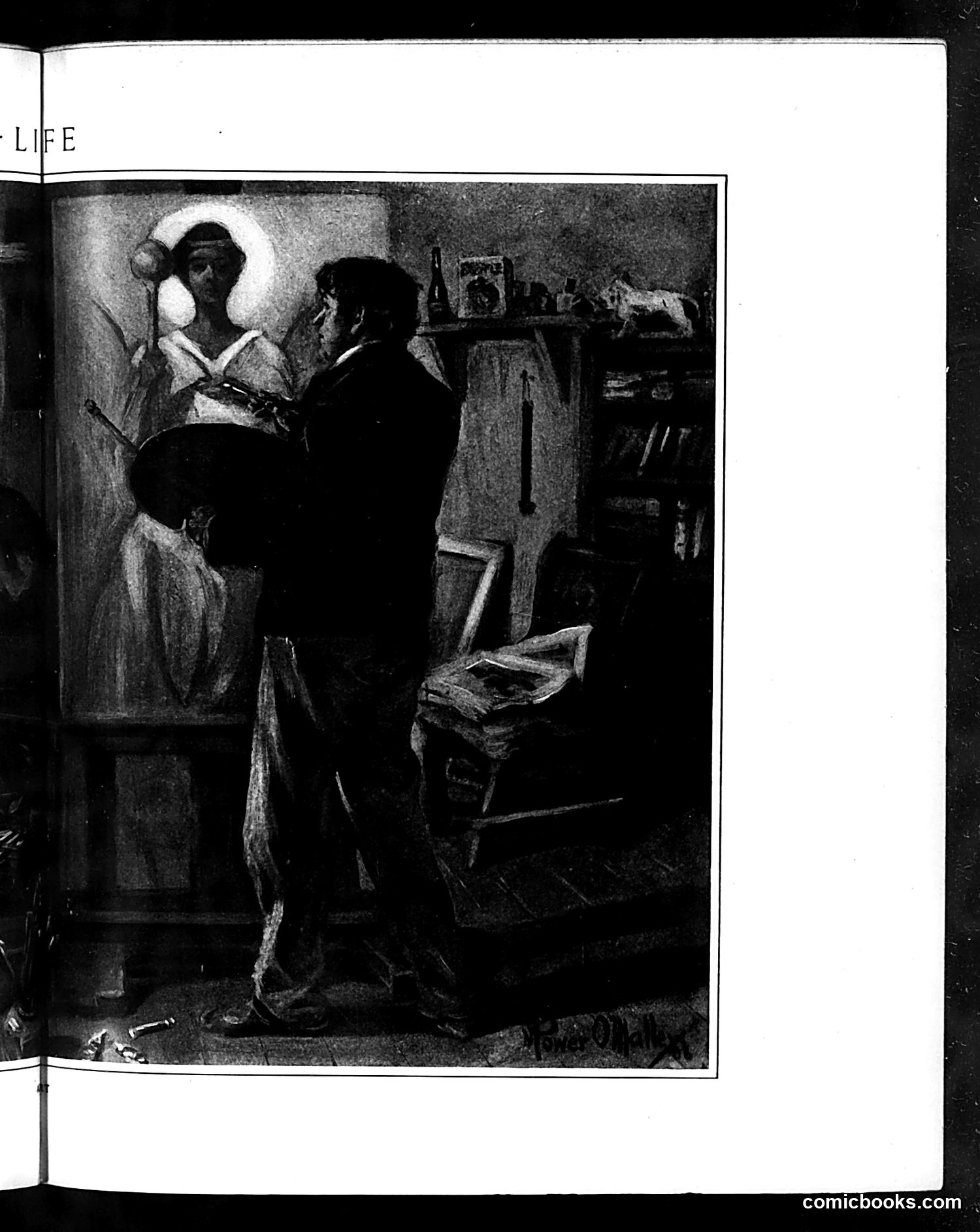
The OCR text appears corrupted and unreadable, so I'm relying on the image alone. This black and white illustration shows a man in formal dress (coat and hat) viewing what appears to be a portrait or artwork on a wall. The figure depicted in the portrait wears distinctive white head coverings or ear muffs and formal attire. Without legible text or caption, I cannot definitively identify the specific figures, historical figures being caricatured, or the satirical point. The scene suggests art criticism or commentary on artistic representation, possibly mocking either the subject of the portrait or the viewer's aesthetic judgment. The prominent head covering on the portrait subject might indicate this references a specific historical or political figure known for distinctive appearance, but I cannot specify which without additional context.
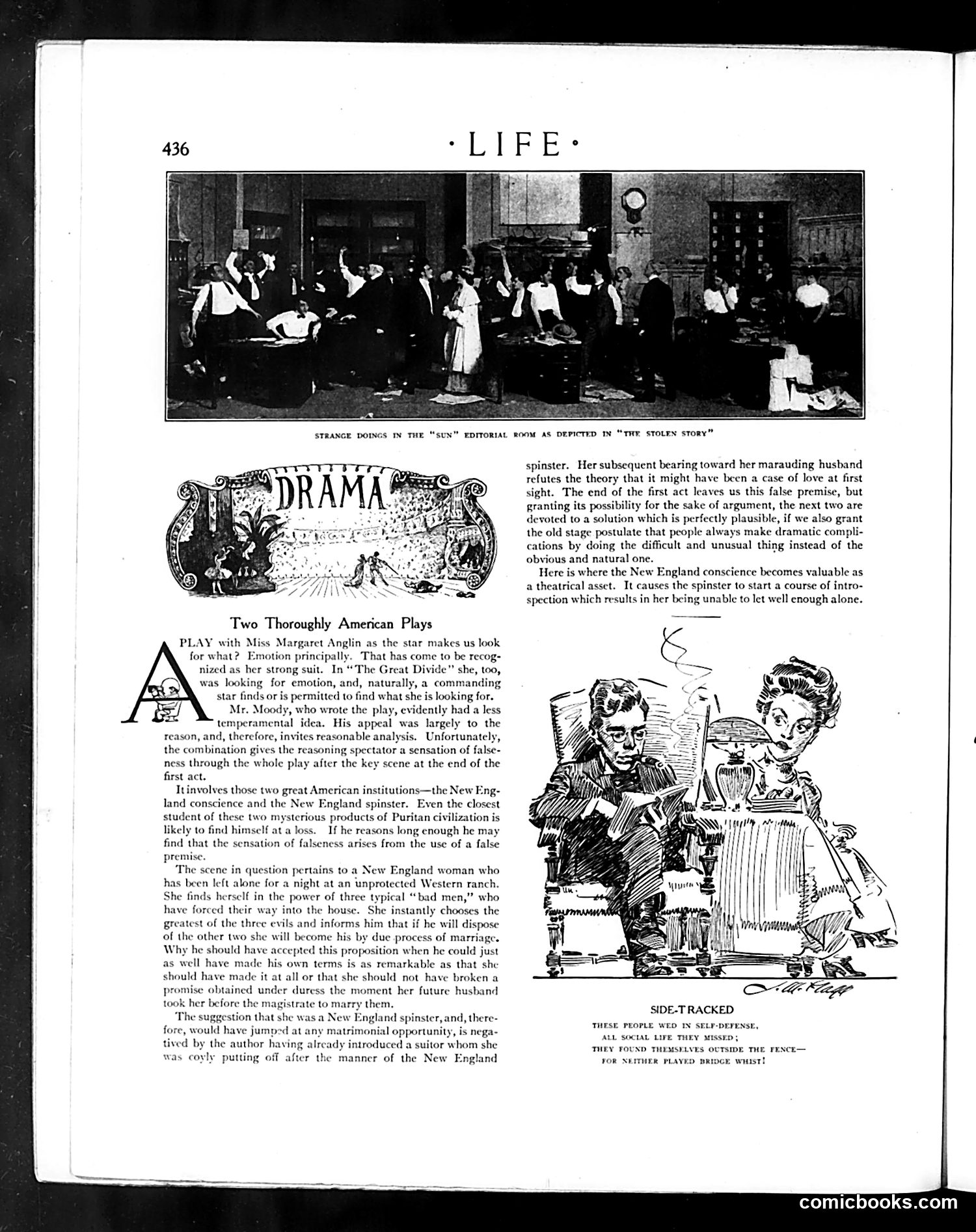
This page reviews two American plays, focusing on one starring actress Margaret Anglin. The top photograph shows a chaotic scene from "The Stolen Story," depicting the editorial room of a newspaper (The Sun). The text critiques a play involving a New England spinster forced into marriage with a "bad man" at a Western ranch. The reviewer argues the plot relies on false premises—specifically that a proper New England woman would jump at marriage opportunistically. This contradicts the author's own characterization of her as coy and reluctant. The satirical point targets theatrical conventions: the complaint that playwrights manufacture artificial dramatic complications rather than letting characters behave naturally. The small cartoon (bottom right) mocks people who marry for social respectability rather than love, finding themselves isolated outsiders anyway—the "fence" representing proper society they sought to rejoin through hasty marriage.
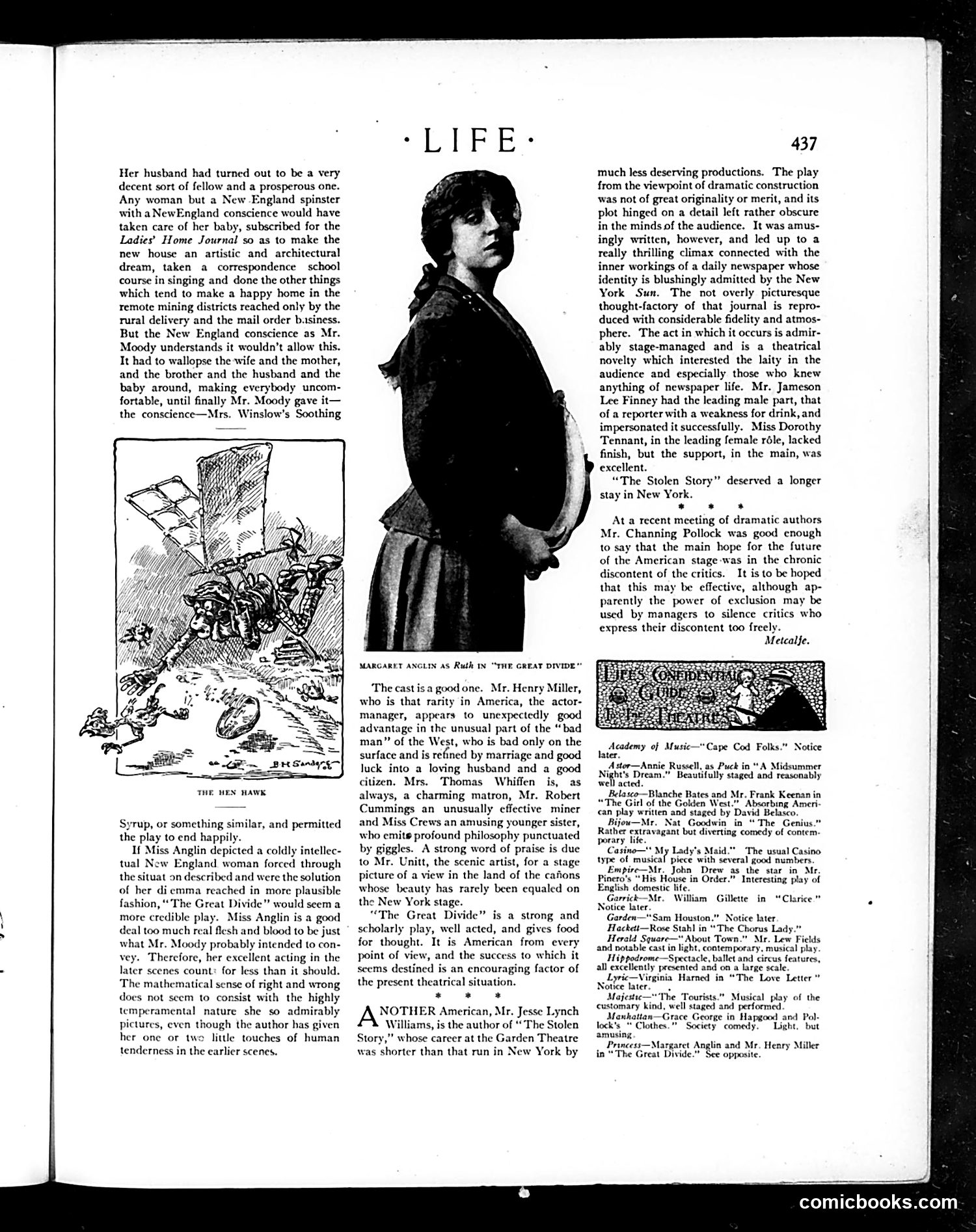
This page reviews two Broadway plays. The main cartoon, "The Hen Hawk," appears to be a crude satirical illustration, though its specific reference is unclear from context. The text critiques "The Great Divide," starring Margaret Anglin (photographed center). The reviewer argues the play's plot—about a refined "bad man" of the West redeemed by marriage—is implausible. The criticism targets the author's heavy-handed moralism: a New England woman's rigid conscience creates conflict until resolved artificially (the reference to "Mrs. Winslow's Soothing Syrup" is satirical). The reviewer suggests Anglin's genuine talent and humanity exceed the shallow character the script demands. A secondary review discusses "The Stolen Story," set in a newspaper office, praised for theatrical novelty despite weak dramatic construction. The page represents turn-of-century theater criticism emphasizing character psychology and dramatic plausibility over sentimentality.
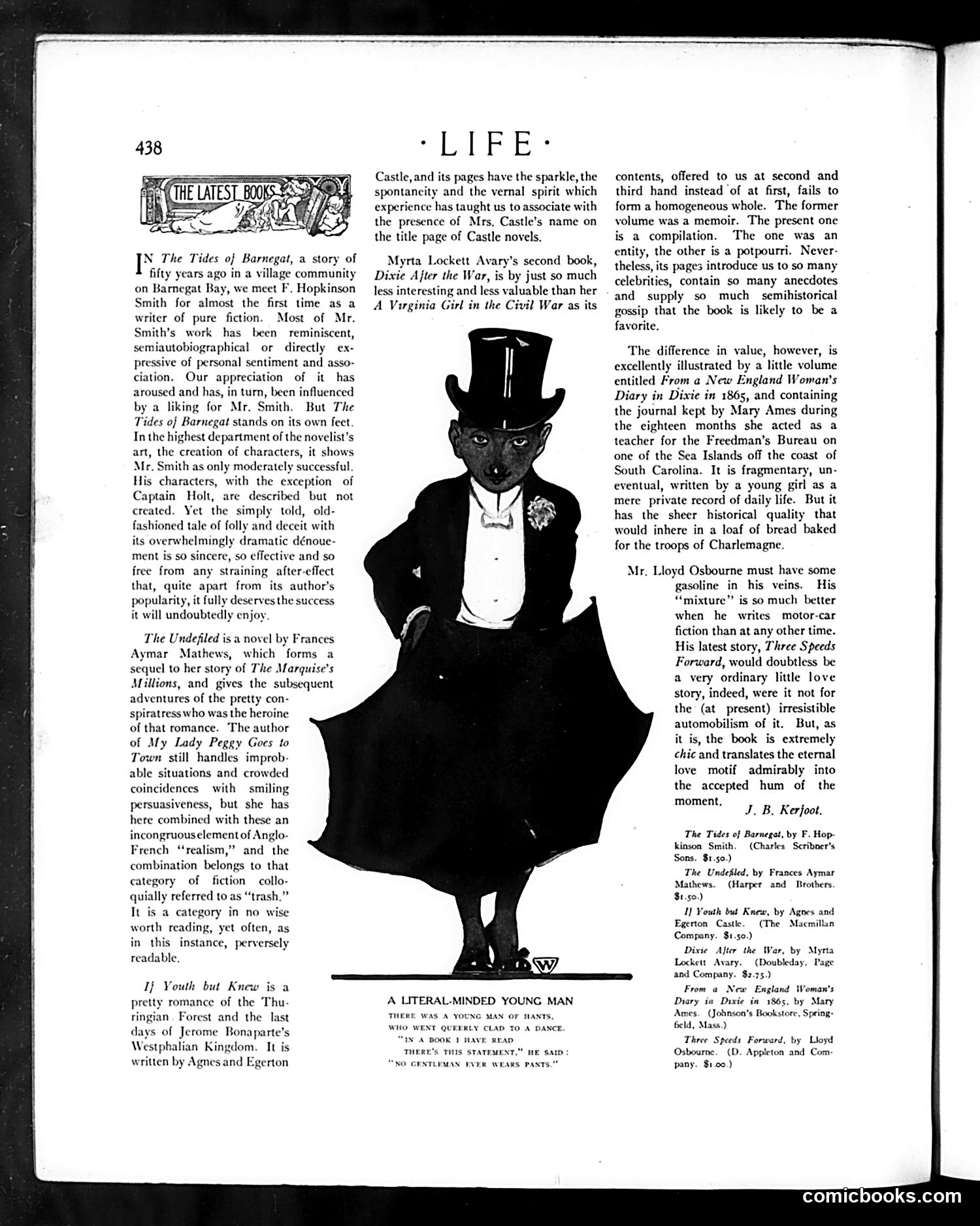
This cartoon illustrates a humorous misinterpretation of a literary statement. A fashionably dressed young man attends a dance wearing an unconventional outfit, justified by a literal reading of a book passage claiming "no gentleman ever wears pants." The joke targets overly literal interpretation of figurative or idiomatic language. The book likely used "pants" colloquially or metaphorically (possibly meaning cowardice or poor behavior), but this "literal-minded" fellow applied it physically to his clothing choices. His exaggerated formal attire—top hat, tuxedo jacket, and visible undergarments—demonstrates the absurd result of taking written advice too seriously without understanding context or intent. The cartoon mocks both pretentious literary affectation and simple-minded literalism, common targets of *Life* magazine's satire during this era.
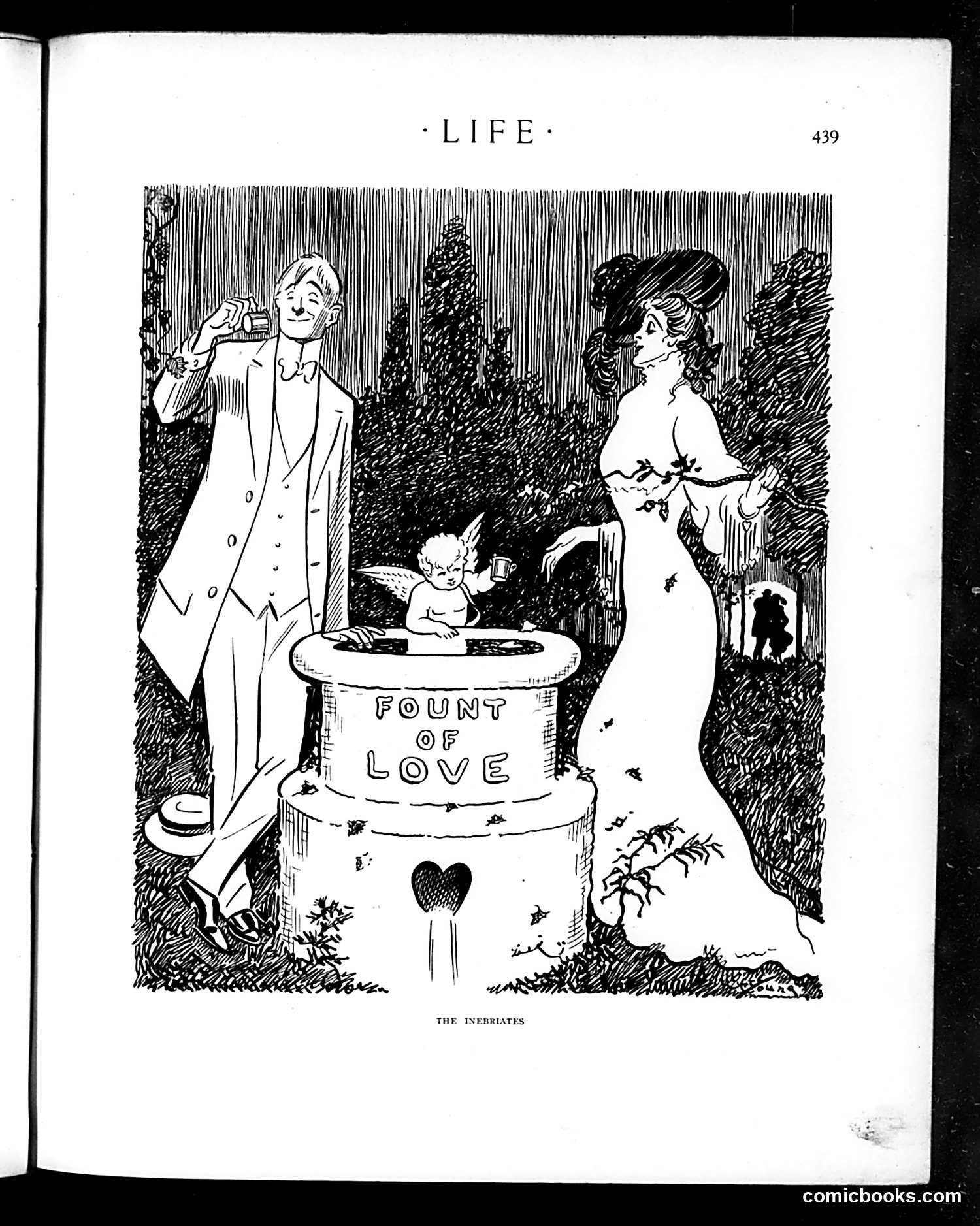
This cartoon satirizes romantic excess and intoxication. A well-dressed man raises a drink in a toast while a woman in an evening gown stands beside him. Between them sits a cherub or cupid figure at a fountain labeled "FOUNT OF LOVE"—a classical reference to romantic idealism. The title "The Inebriates" suggests the couple are drunk on love, playing on the double meaning of "inebriated" (intoxicated with alcohol or emotion). The satirical point appears to be mocking sentimental romanticism and the flowery rhetoric around love—depicting lovers as foolishly intoxicated by their own emotions rather than genuinely connected. This reflects early 20th-century *Life* magazine's characteristic witty deflation of romantic sentimentality through sophisticated visual humor.
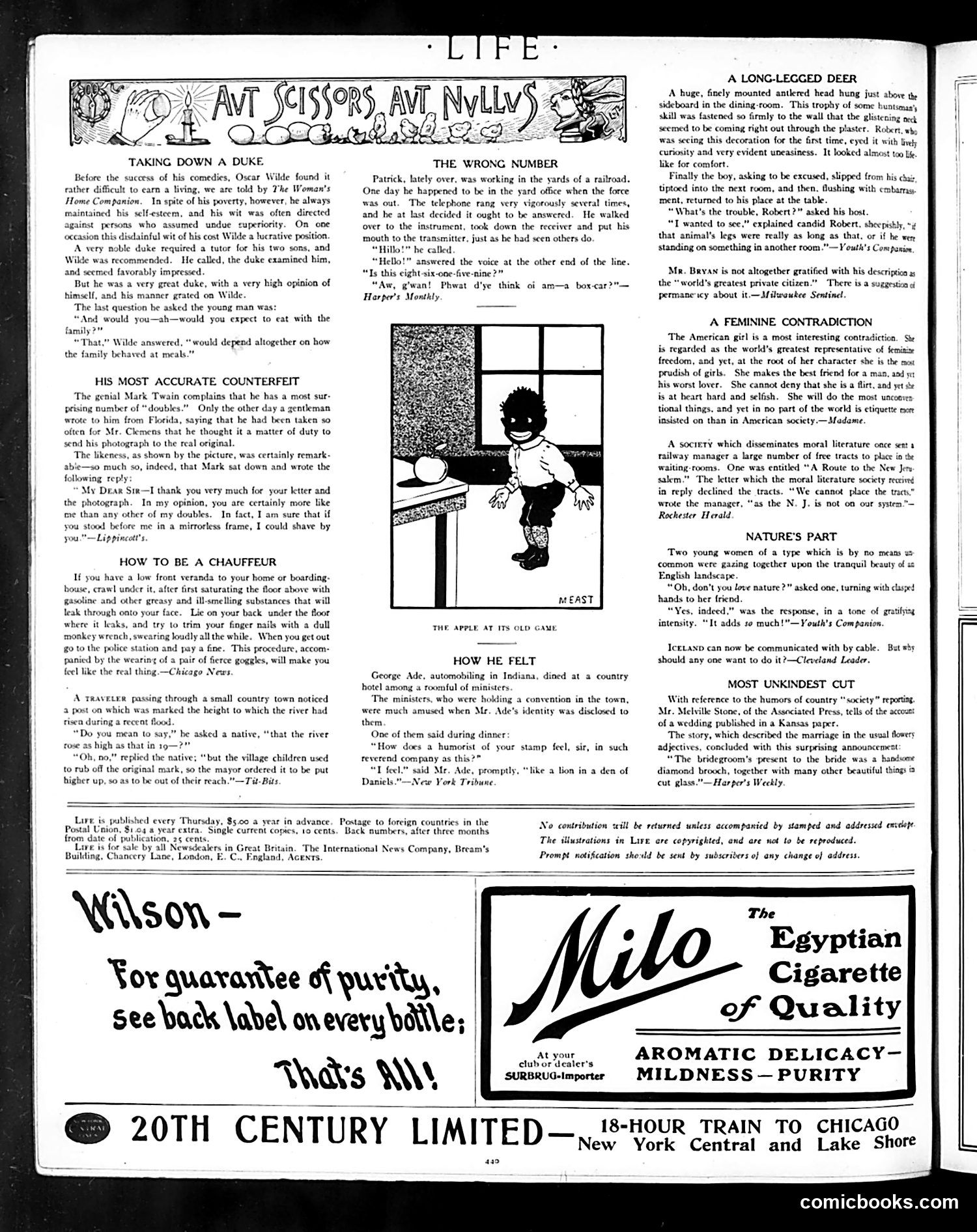
This Life magazine page (date unclear from image) contains several short humorous anecdotes and advertisements: **"Taking Down a Duke"**: A story about Oscar Wilde's wit. When interviewing as a tutor, a haughty duke asks if Wilde would eat with the family. Wilde replies he would, depending on their table manners—a witty insult that likely cost him the job. The satire targets aristocratic snobbery. **"The Wrong Number"**: Patrick, an Irish immigrant railroad worker, answers a phone and responds to a caller's number-checking with "Phwat d'ye think oi am—a box-car?" The humor relies on Irish dialect stereotyping and misunderstanding. **Other brief items** include Mark Twain's encounter with a doppelgänger, instructions on "How to Be a Chauffeur" (satirically depicting the grimy, frustrating work), and anecdotes about small-town life. The page primarily showcases Life's format: brief comedic stories mocking social pretension, immigrant stereotypes, and working-class indignities—typical of early 20th-century American humor magazines.
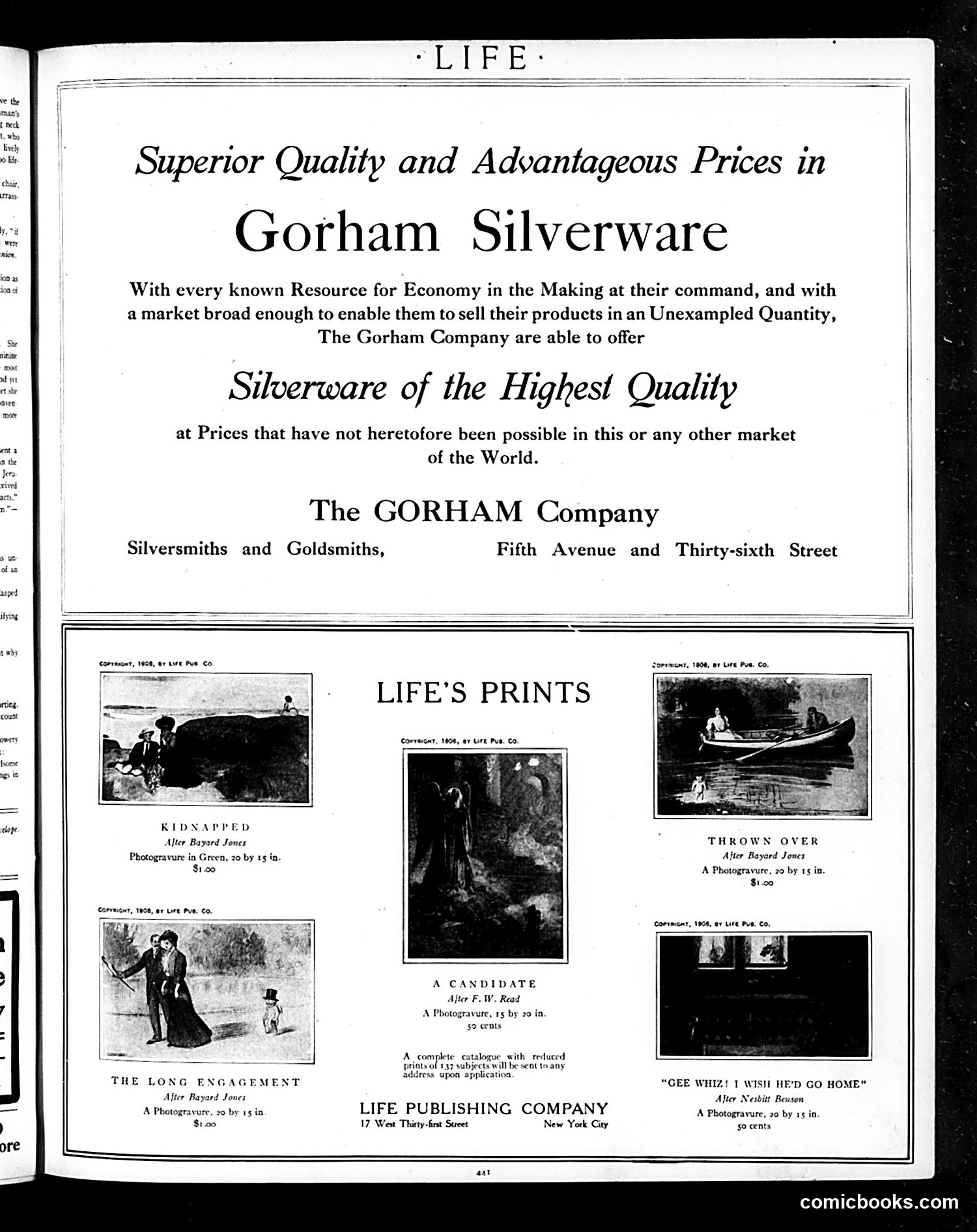
This page is primarily **advertising**, not editorial satire. The upper half promotes Gorham silverware with marketing copy emphasizing quality and low prices. The lower half advertises "Life's Prints"—photogravure reproductions available for purchase from Life Publishing Company. These are narrative genre scenes (likely illustrations or photographs) by artists including Bayard Jones, F.W. Read, and Nesbitt Benson. The titles—"Kidnapped," "Thrown Over," "A Candidate," "The Long Engagement," and "Gee Whiz! I Wish He'd Go Home"—suggest sentimental or melodramatic domestic scenarios popular in early 1900s commercial art. There is **no political satire** on this page. It's a straightforward sales venue for silverware and reproducible artwork, typical of Life magazine's business model at the time.
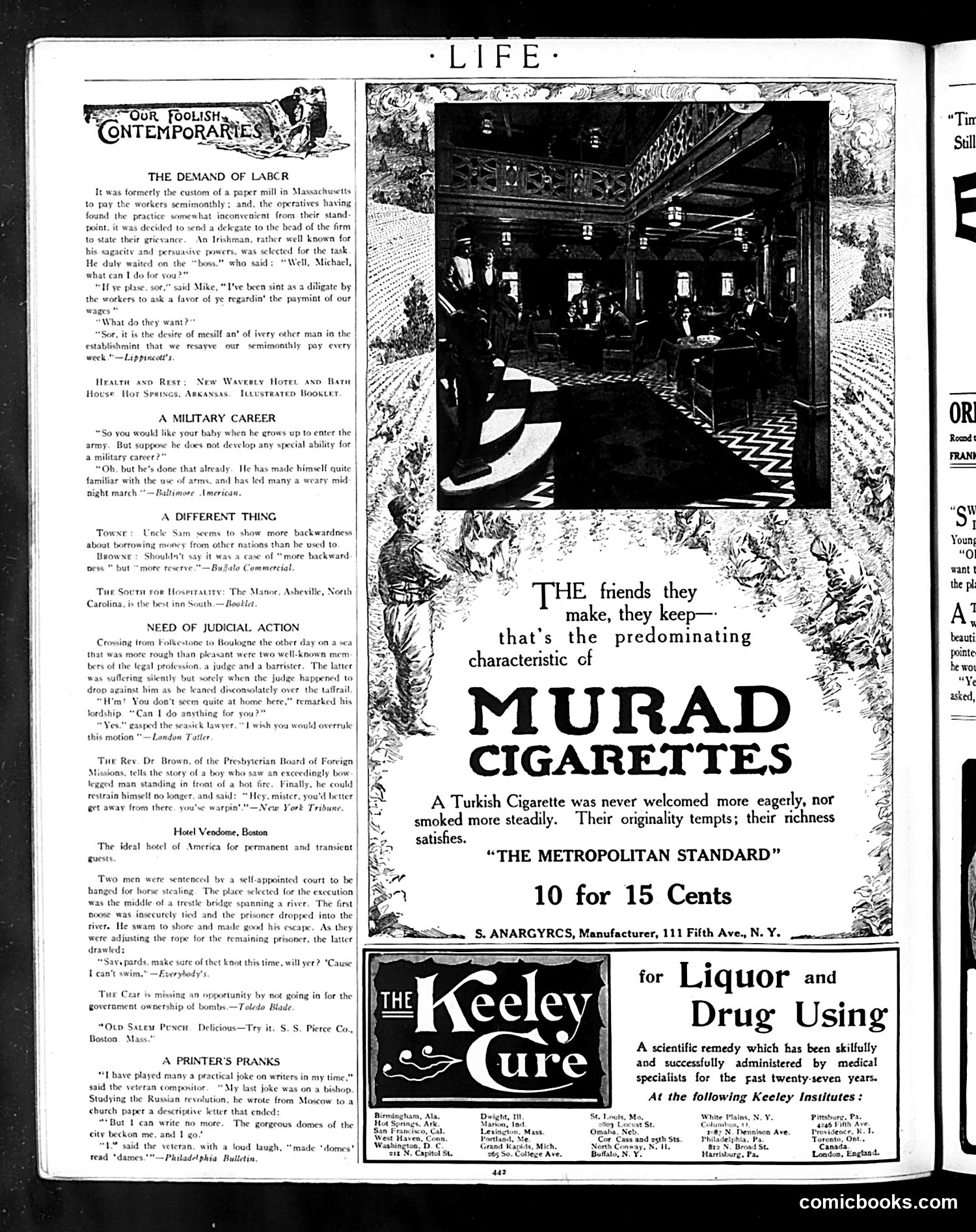
This Life magazine page (circa early 1900s) combines satirical commentary with period advertisements. **The Satirical Content:** The left column presents brief humorous anecdotes labeled "Our Foolish Contemporaries"—short jokes mocking various social situations: labor disputes (workers demanding semi-monthly rather than monthly pay), military career expectations, judicial incompetence, and a printer's prank on a bishop. These are gentle satirical vignettes poking fun at everyday foolishness. **The Advertisements:** The page heavily features two ads: Murad Cigarettes (Turkish brand, marketed as superior quality) and the Keeley Institute (a treatment center for alcohol and drug addiction). **Modern Context:** What's striking today is the juxtaposition: while satirizing contemporary absurdities, Life simultaneously advertises cigarettes and promotes a "cure" for substance abuse—both now recognized as health hazards. This reflects the era's attitudes before widespread understanding of addiction and smoking's dangers. The Keeley Institute was historically legitimate but represents outdated treatment methods. The page demonstrates early 1900s American humor and consumer culture priorities.
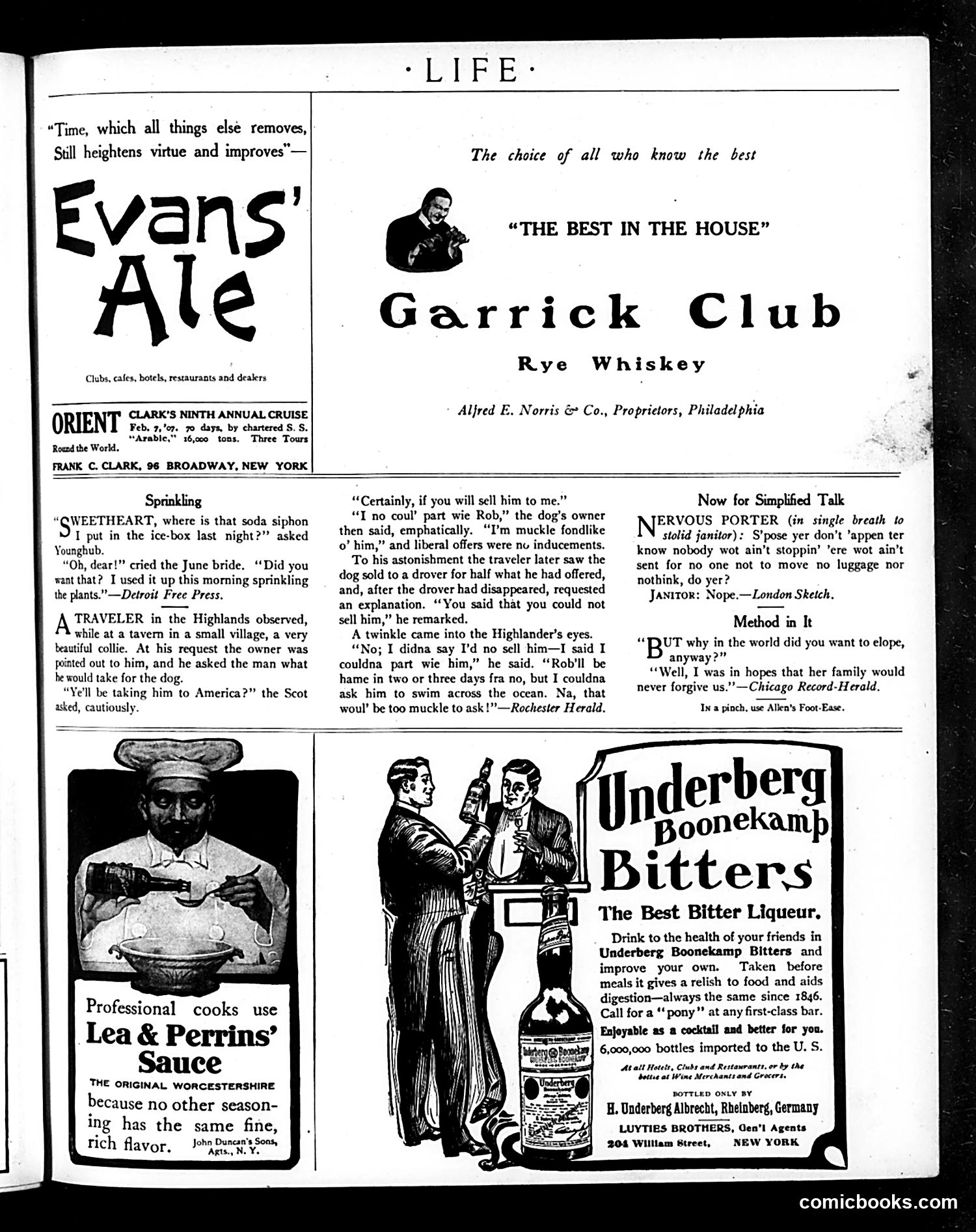
This page is primarily **advertising and light humor**, not political satire. It contains: **Humor Sections:** - Three short jokes about domestic life and Scottish dialect, typical of early 1900s magazines - The "Nervous Porter" and "Method in It" pieces are gentle observational humor **Advertisements:** The page heavily features alcohol and food product ads: - **Evans' Ale** and **Garrick Club Rye Whiskey** (spirits) - **Lea & Perrins' Sauce** (Worcestershire) - **Underberg Boonekamp Bitters** (a digestive liqueur) These ads reflect the pre-Prohibition era (before 1920) when alcohol advertising was commonplace in mainstream publications. The bitters are promoted as a health aid—a common marketing claim for such products. **Frank C. Clark's cruise advertisement** promotes luxury travel. There is no political cartoon or satire here—just typical early-1900s magazine content mixing humor with targeted advertisements for affluent readers.
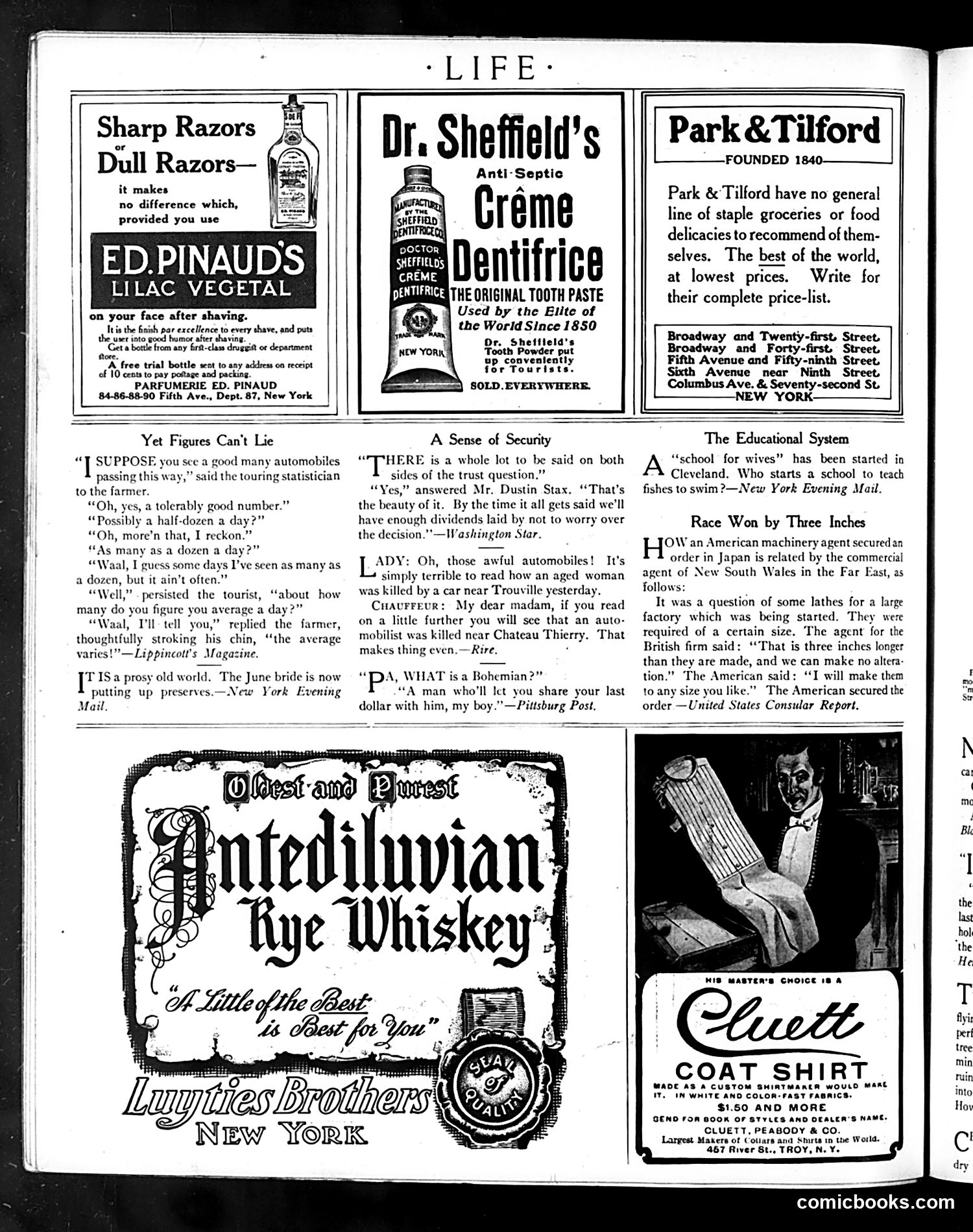
This page from *Life* magazine consists primarily of **advertisements** interspersed with brief satirical humor pieces—typical of the era's magazine format. The humor items mock contemporary American society: - **"Yet Figures Can't Lie"**: A farmer's befuddled logic about automobile traffic—he's seen "as many as a dozen" some days, so "the average varies." The joke satirizes rural confusion about statistics and data. - **"A Sense of Security"**: A capitalist boasts that by the time trust/monopoly debates conclude, he'll have accumulated enough dividends to ignore the outcome. This reflects early-1900s anxieties about corporate power. - **"The Educational System"**: A quip mocking a Cleveland "school for wives"—implying women need instruction just as absurdly as fish need swimming lessons. - **"Race Won by Three Inches"**: American and British manufacturing agents compete for a Japanese order. The American's flexibility wins—reflecting contemporary American industrial confidence versus British rigidity. The advertisements (razors, toothpaste, whiskey, shirts) were the magazine's revenue source.
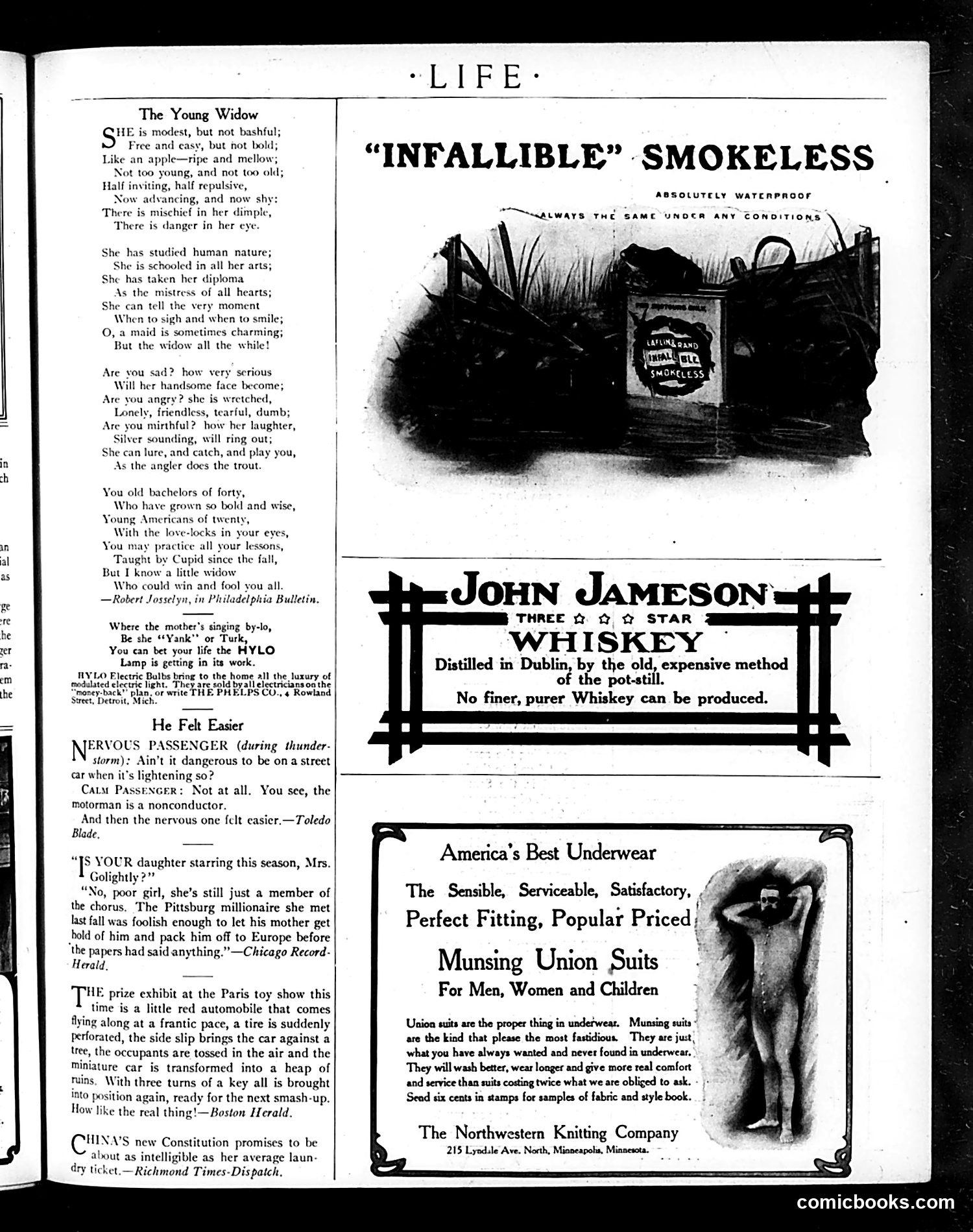
This page combines **satirical poetry and humor with period advertisements**. **"The Young Widow" poem** is a flirtatious character sketch portraying an attractive widow as manipulative and strategically charming—she studies men, knows when to cry or laugh, and can "lure, and catch, and play you, / As the angler does the trout." The satire warns bachelors and young men that despite their romantic education, this widow could outsmart them all. It reflects early 20th-century anxieties about independent women and feminine cunning. **Humor pieces** include jokes about motormen as "nonconductors" during thunderstorms, and mockery of China's new Constitution as incomprehensible as a laundry ticket—reflecting contemporary skepticism toward China's political modernization. **Advertisements** fill the remainder: Irish whiskey, electrical bulbs, and Munsing Union Suits (underwear). The page is primarily **advertising-driven**, typical of Life's revenue model, with satirical content interspersed.
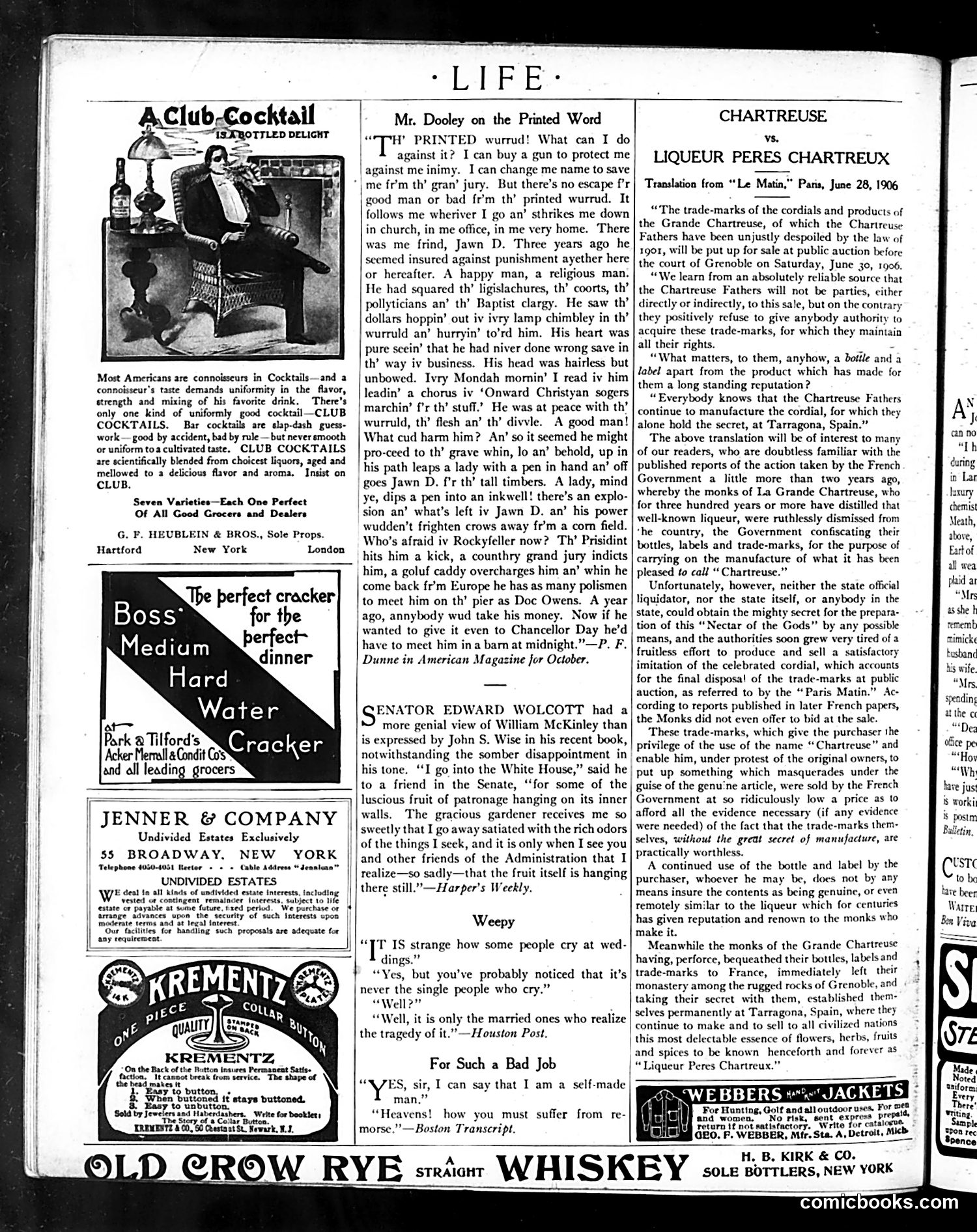
This satirical piece features **Mr. Dooley**, a fictional Irish-American character known for humorous social commentary. The text mocks the power of printed media—particularly newspapers—to destroy reputations regardless of a person's actual morality or wealth. Dooley tells of a respectable friend "Jawn D." who escapes legal consequences through bribery and connections ("squared th' ligislachures, th' coorts"). Yet one woman with a pen destroys him completely. The satire targets: - **Corruption**: The wealthy escape justice through money and influence - **Journalistic power**: The press becomes the real enforcer of consequences, irrespective of the corrupt system - **Hypocrisy**: Good deeds and religiosity cannot protect the guilty The final mention of **President Roosevelt** and **Rockefeller** references contemporary trust-busting efforts, suggesting the executive branch (not courts or legislatures) now holds real power. The joke: you can buy immunity everywhere—except from newspaper exposure.
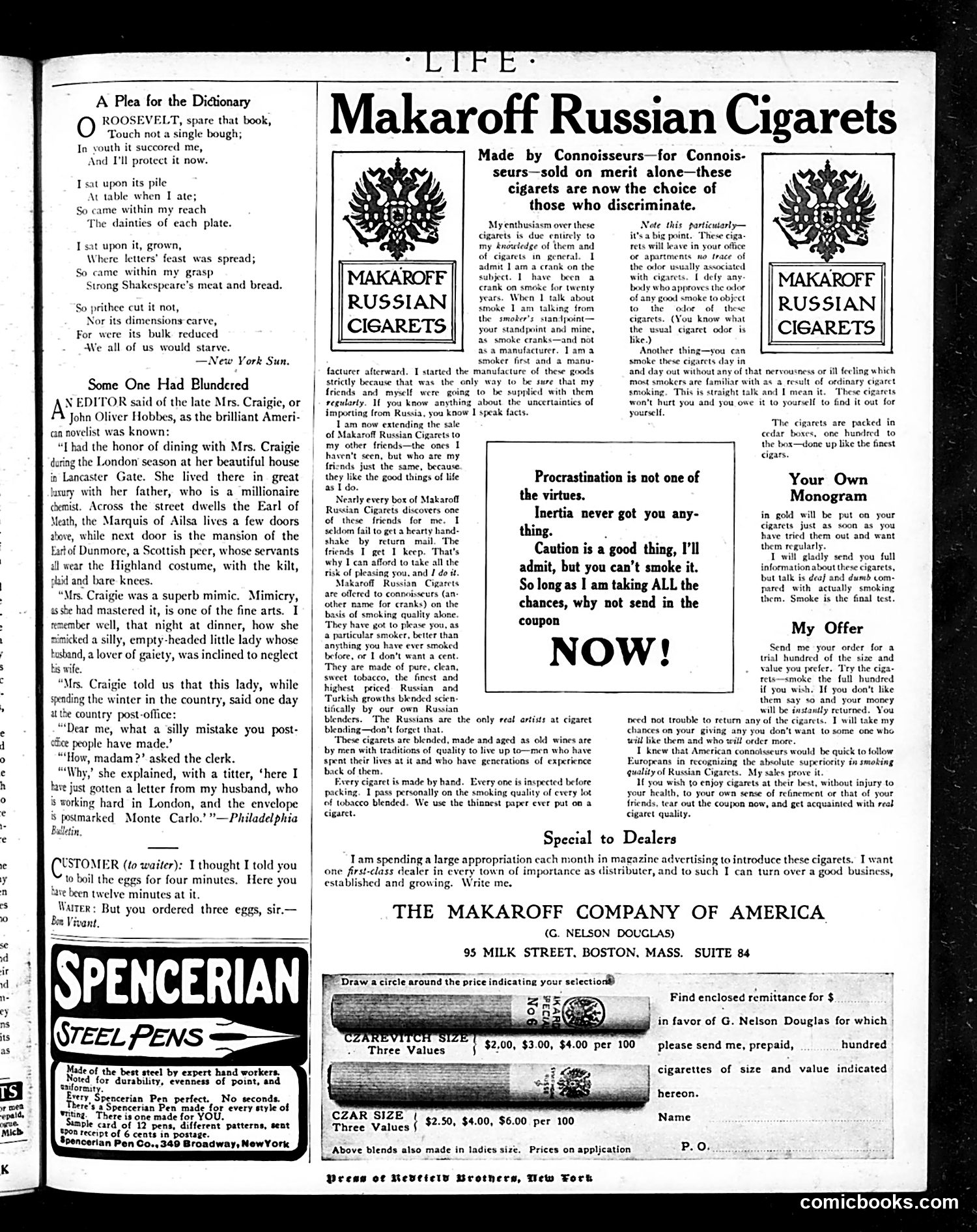
This page contains several distinct elements: **Main Content:** A humorous anecdote about Mrs. Craigie (pen name John Oliver Hobbes), a noted American novelist. An editor recalls her talent for mimicry at a London dinner party. The joke: she recounts a silly aristocratic lady who received a letter from her husband postmarked Monte Carlo—revealing his infidelity while pretending to work in London. **Satire:** The humor targets empty-headed wealthy women and the pretenses of the British aristocracy. **Advertisements:** The page prominently features two product ads—Spencerian Steel Pens and Makaroff Russian Cigarets. The cigarette ad includes an unusually lengthy testimonial claiming these smokes don't irritate the throat or leave odors, distinguishing them from "ordinary" cigarets. **Minor Humor:** A brief joke about boiling eggs for three versus four minutes. The page is primarily **advertising disguised as editorial content**—a common early 20th-century magazine practice blending editorial and commercial material.
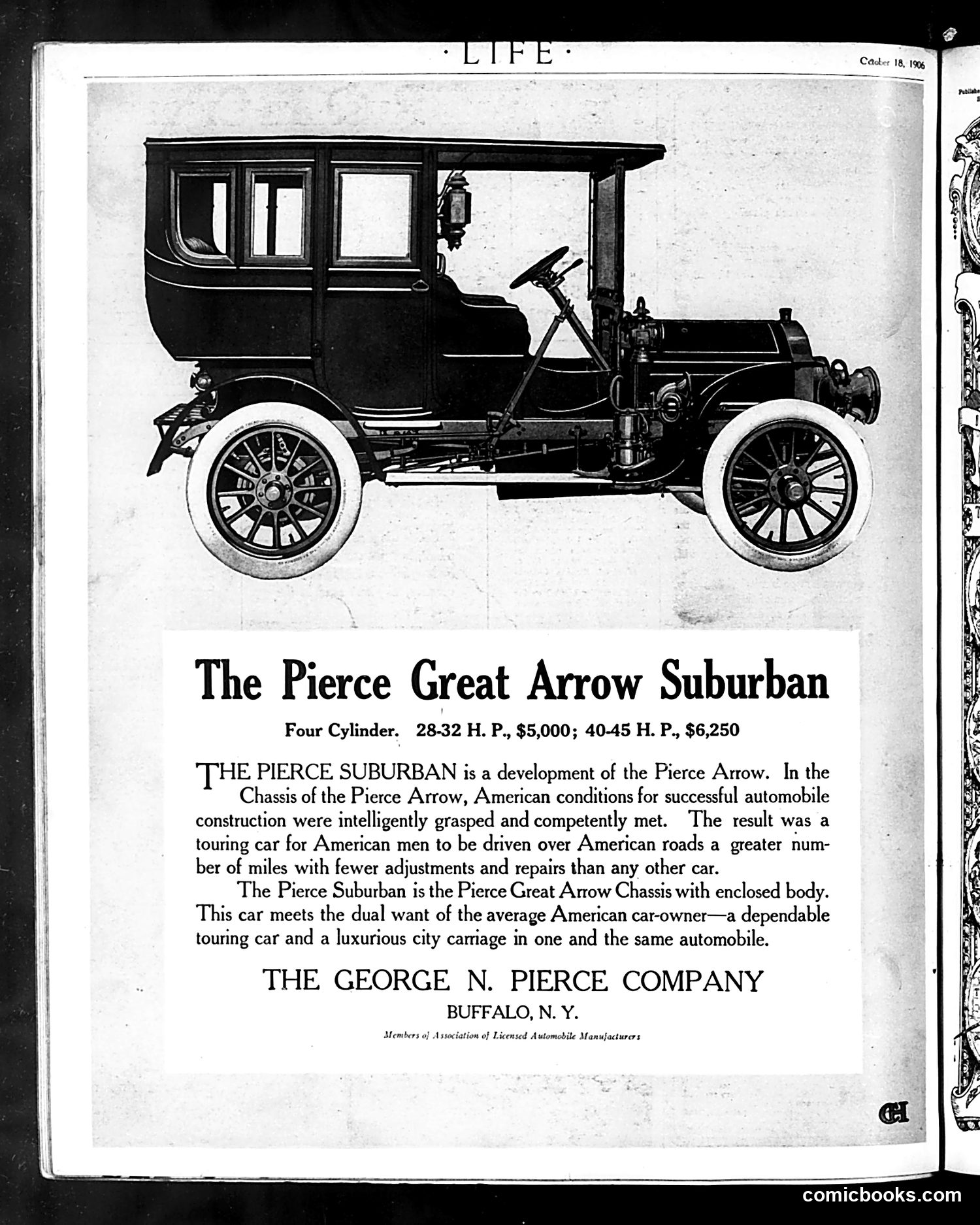
This page is **primarily an automobile advertisement**, not a political cartoon or satire. It appears in *Life* magazine (dated October 18, 1906, based on the visible date). The ad promotes the Pierce Great Arrow Suburban, a luxury automobile manufactured by the George N. Pierce Company of Buffalo, New York. The image shows a side-view technical illustration of an early enclosed automobile with four cylinders, priced between $5,000-$6,250. The marketing copy emphasizes American engineering excellence and durability—claiming the vehicle requires fewer repairs than competitors and serves dual purposes as both a practical touring car and a "luxurious city carriage." This reflects early 1900s automobile marketing, targeting wealthy American men who could afford such luxury vehicles. There is **no apparent political satire or social commentary** on this page—it is straightforward commercial advertising typical of *Life* magazine's content during this period.