
Life, 1906-10-18 · page 18 of 28
Life — October 18, 1906 — page 18: what you’re looking at
What you’re looking at
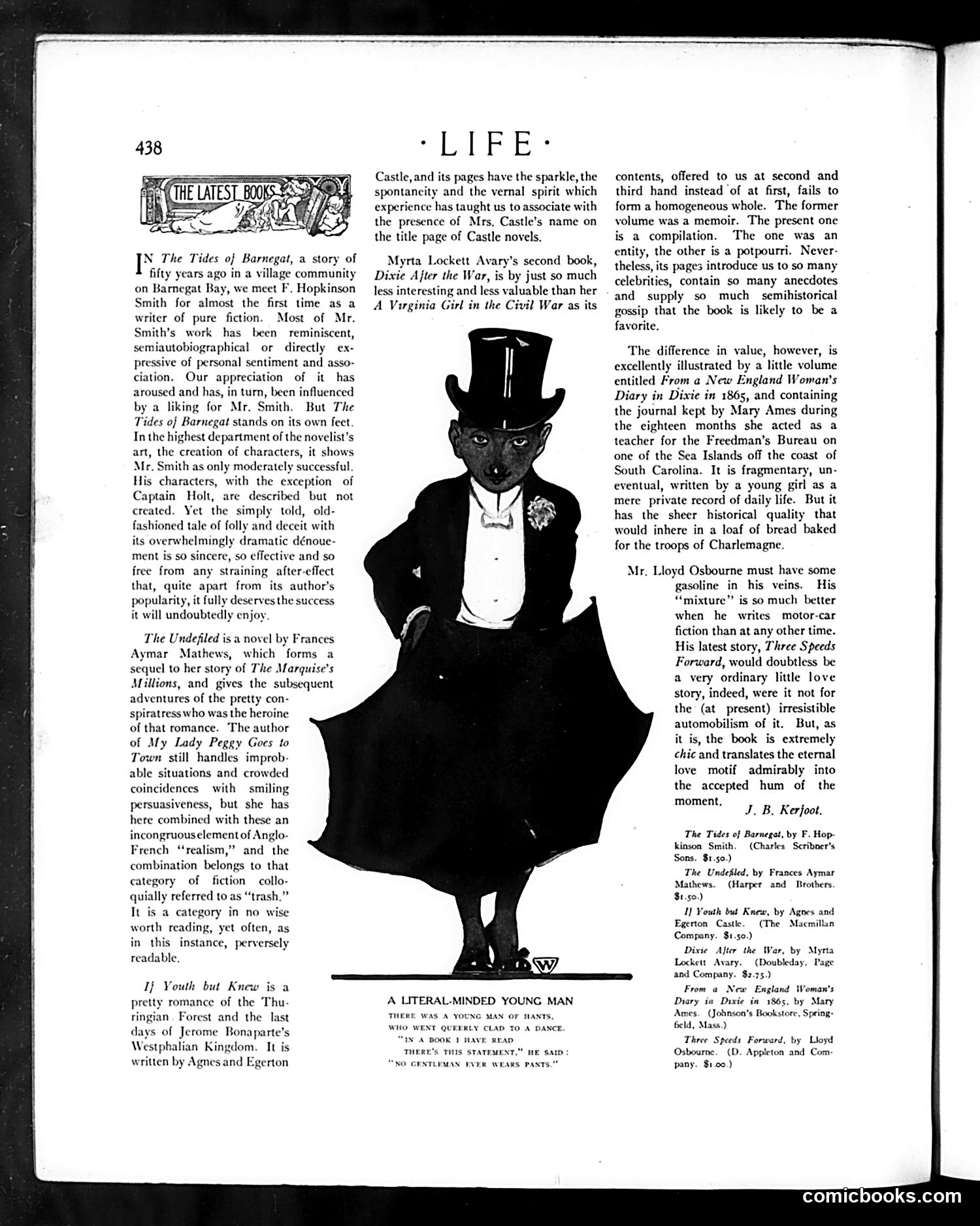
This cartoon illustrates a humorous misinterpretation of a literary statement. A fashionably dressed young man attends a dance wearing an unconventional outfit, justified by a literal reading of a book passage claiming "no gentleman ever wears pants." The joke targets overly literal interpretation of figurative or idiomatic language. The book likely used "pants" colloquially or metaphorically (possibly meaning cowardice or poor behavior), but this "literal-minded" fellow applied it physically to his clothing choices. His exaggerated formal attire—top hat, tuxedo jacket, and visible undergarments—demonstrates the absurd result of taking written advice too seriously without understanding context or intent. The cartoon mocks both pretentious literary affectation and simple-minded literalism, common targets of *Life* magazine's satire during this era.
📄 Transcribed text from this page (OCR, searchable)
Machine-transcribed from the original scan — historical spelling and the odd misread are preserved.
N The Tides of Barnegat, a story of fifty years ago in a village community on Barnegat Bay, we meet F. Hopkinson Smith for almost the first time as a writer of pure fiction. Most of Mr. Smith’s work has been reminiscent, semiautobiographical or directly ex- pressive of personal sentiment and asso- ciation. Our appreciation of it has aroused and has, in turn, been influenced by a liking for Mr. Smith. But The Tides of Barnegat stands on its own feet In the highest department of the nov art, the creation of characters, it Mr. Smith as only moderately successful. His characters, with the exception of Captain Holt, are described but not created. Yet the simply told, old- fashioned tale of folly and deceit with its overwhelmingly dramatic dénoue- ment is so sincere, so effective and so free from any straining after-effect that, quite apart from its author's popularity, it fully deserves the success it will undoubtedly enjoy. The Undefiled is a novel by Frances Aymar Mathews, which forms a sequel to her story of The Marguise’s Millions, and gives the subsequent adventures of the pretty con- spiratress who was the heroine of that romance. The author of My Lady Peggy Goes to Town still handles improb- able situations and crowded coincidences with smiling persuasiveness, but she has here combined with these an incongruouselement of Anglo- French “realism,” and the combination belongs to that category of fiction collo- quially referred to as “trash.” It is a category in no wise worth reading, yet often, as in this instance, perversely lable. I} Youth but Knew is a pretty romance of the Thu- ringian. Forest and the last days of Jerome Bonaparte’s Westphalian Kingdom. It is written by Agnes and Egerton “LIFE: Castle, and its pages have the sparkle, the spontancity and the vernal spirit which experience has taught us to associate with the presence of Mrs, Castle’s name on the title page of Castle novels. Myrta Lockett Avary’s second book, Dixie After the War, is by just so much less interesting and less valuable than her A Virginia Girl in the Civil War as its A LITERAL-MINDED YOUNG MAN. THERE WAS A YOUNG MAN OF HANTS. WHO WENT QUEERLY CLAD TO A DANCE. “AN A BOOK 1 HAVE READ THERE'S THIS STATEMENT.” HE SAID: “NO CENTUPMAN EVIR WEARS PANTS." contents, offered to us at second and third hand instead ‘of at first, fails to form a homogeneous whole. The former yolume was a memoir. The present one is a compilation. The one was an entity, the other is a potpourri. Never- theless, its pages introduce us to so many celebrities, contain so many anecdotes and supply so much semihistorical gossip that the book is likely to be a The difference in value, however, is excellently illustrated by a little volume entitled From a New England Woman's Diary in Dixie in 1865, and containing the journal kept by Mary Ames during the eighteen months she acted as a teacher for the Freedman’s Bureau on one of the Sea Islands off the coast of South Carolina. It is fragmentary, un- eventual, written by a young girl as a mere private record of daily life. But it has the sheer historical quality that would inhere in a loaf of bread baked for the troops of Charlemagne. Mr. Lloyd Osbourne must have some gasoline in his veins. His “mixture” is so much better when he writes motor-car fiction than at any other time. His latest story, Three Speeds Forward, would doubtless be a very ordinary little love story, indeed, were it not for the (at present) irresistible automobilism of it. But, as it is, the book is extremely chic and translates the eternal love motif admirably into the accepted hum of the moment. 7. B, Kerjoot. The Tides of Barnegat, by F. Hop- kinson Smith. (Charles Scribner's Sons. $1.50.) The Undefled, by Frances Aymar Mathews. (Harper and Brothers $1.50.) 1) Youth but Knew, by Agnes and Egerton Castle. (The Macmillan Company. $1.50.) Dixie Ajter the War, by Myrta Lockett Avary. (Doubleday, Page and Company. $2.75.) From a New England Woman's Diary in Dixie in 1865, by Mary Ames. (Johnson's Bookste ing- field, Mass.) Three Speeds Forward, by Lloyd Osbourne. (D. Appleton and Com pany. $1.00.) comicbooks.com