
Life, 1906-10-18 · page 11 of 28
Life — October 18, 1906 — page 11: what you’re looking at
What you’re looking at
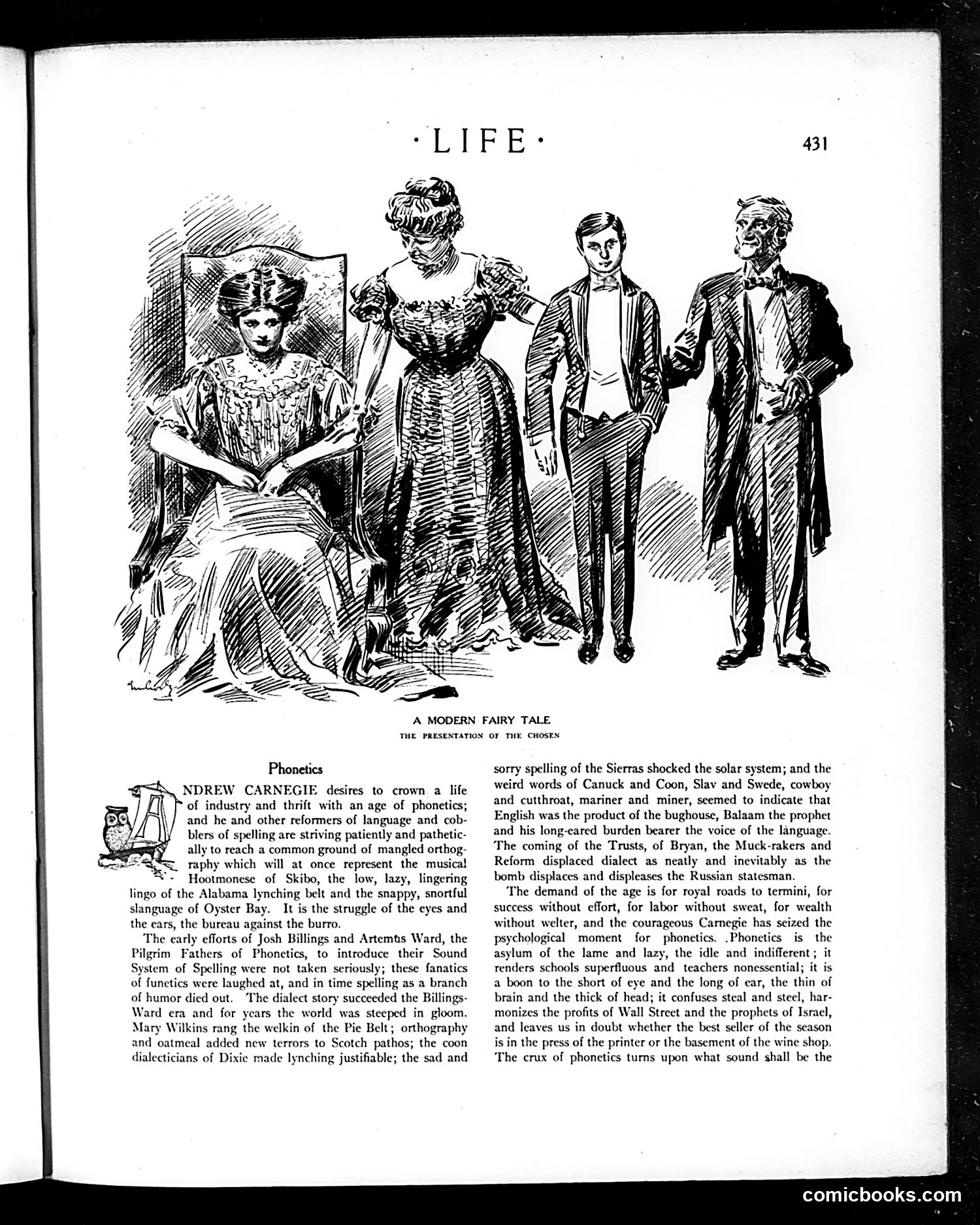
This satirical illustration depicts Andrew Carnegie's efforts to reform English spelling and language. The cartoon shows Carnegie (seated, left) presenting his "chosen" reformers to society—figures representing the phonetic reform movement. The accompanying text mocks Carnegie's ambitions mockingly, referencing his "psychological moment for phonetics" while lampooning the absurdity of the reform agenda. The satire critiques how Carnegie and fellow reformers expected to impose radical spelling changes on English despite widespread resistance. The cartoon's joke: presenting linguistic reform as though introducing debutantes to high society—treating a serious (but ridiculous) campaign as theatrical social pageantry. Life magazine ridicules both Carnegie's wealth-driven reformism and the pretentiousness of attempting to reshape the English language itself.
📄 Transcribed text from this page (OCR, searchable)
Machine-transcribed from the original scan — historical spelling and the odd misread are preserved.
iy \ \ » oe ~ FOS SQ SPS A MODERN FAIRY TALE THE PRESENTATION OF THE CHOSEN Phonetics NDREW CARNEGIE desires to crown a life f* of industry and thrift with an age of phonetics; and he and other reformers of language and cob- blers of spelling are striving patiently and pathetic- ally to reach a common ground of mangled orthog- raphy which will at once represent the musical Hootmonese of Skibo, the low, lazy, lingering lingo of the Alabama lynching belt and the snappy, snortful slanguage of Oyster Bay. It is the struggle of the eyes and the cars, the bureau against the burro. The early efforts of Josh Billings and Artemts Ward, the Pilgrim Fathers of Phonetics, to introduce their Sound System of Spelling were not taken seriously; these fanatics of funetics were laughed at, and in time spelling as a branch of humor died out. ‘The dialect story succeeded the Billings- Ward era and for years the world was steeped in gloom. Mary Wilkins rang the welkin of the Pie Belt; orthography and oatmeal added new terrors to Scotch pathos; the coon dialecticians of Dixie made lynching justifiable; the sad and sorry spelling of the Sierras shocked the solar system; and the weird words of Canuck and Coon, Slav and Swede, cowboy and cutthroat, mariner and miner, seemed to indicate that English was the product of the bughouse, Balaam the prophet and his long-cared burden bearer the voice of the language. The coming of the Trusts, of Bryan, the Muck-rakers and Reform displaced dialect as neatly and inevitably as the bomb displaces and displeases the Russian statesman. The demand of the age is for royal roads to termini, for success without effort, for labor without sweat, for wealth without welter, and the courageous Carnegie has seized the psychological moment for phonetics. .Phonetics is the asylum of the lame and lazy, the idle and indifferent ; it renders schools superfluous and teachers nonessential; it is a boon to the short of eye and the long of ear, the thin of brain and the thick of head; it confuses steal and steel, har- monizes the profits of Wall Street and the prophets of Israel, and leaves us in doubt whether the best seller of the season is in the press of the printer or the basement of the wine shop. ‘The crux of phonetics turns upon what sound shall be the comicbooks.com