
Life, 1906-10-18 · page 16 of 28
Life — October 18, 1906 — page 16: what you’re looking at
What you’re looking at
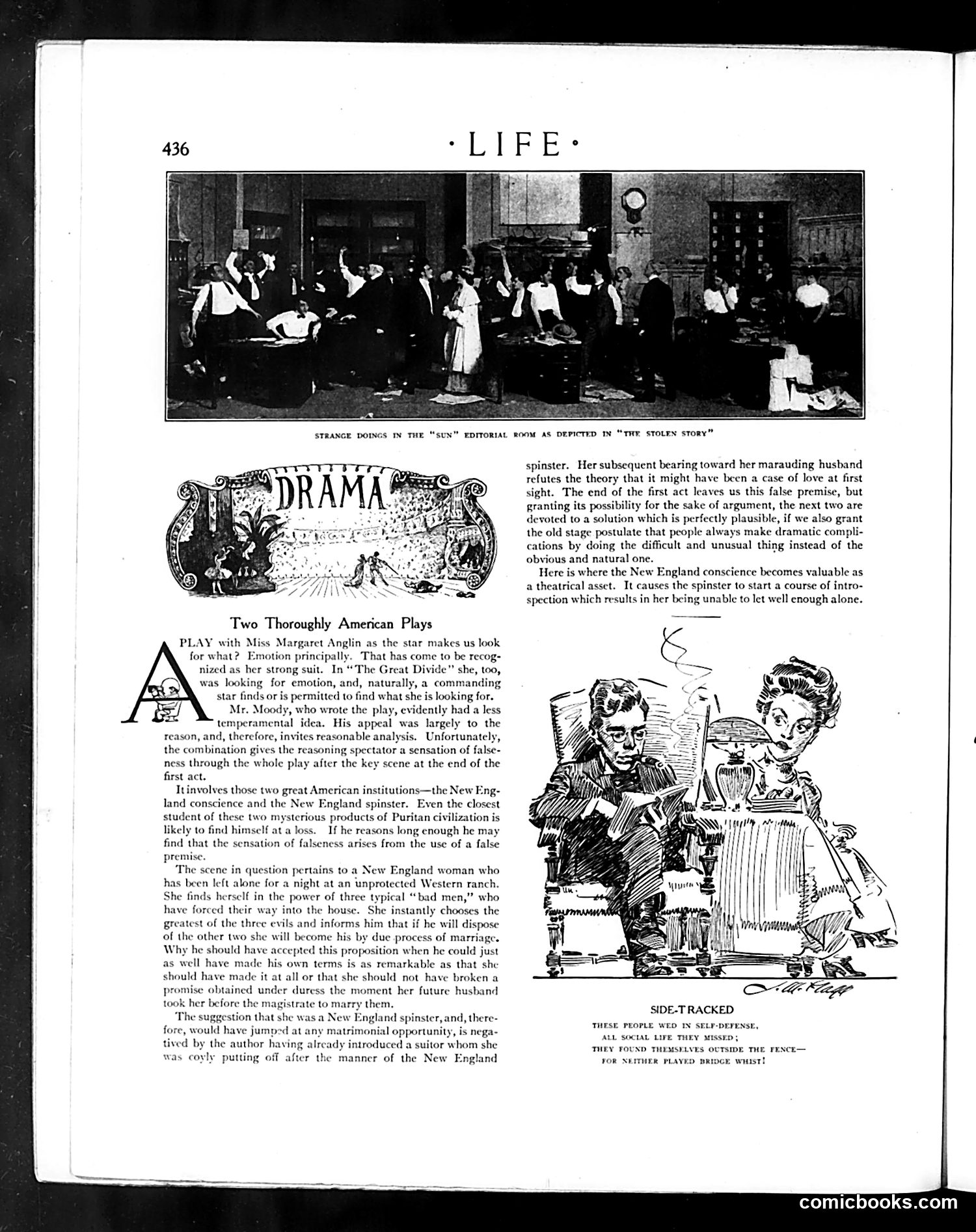
This page reviews two American plays, focusing on one starring actress Margaret Anglin. The top photograph shows a chaotic scene from "The Stolen Story," depicting the editorial room of a newspaper (The Sun). The text critiques a play involving a New England spinster forced into marriage with a "bad man" at a Western ranch. The reviewer argues the plot relies on false premises—specifically that a proper New England woman would jump at marriage opportunistically. This contradicts the author's own characterization of her as coy and reluctant. The satirical point targets theatrical conventions: the complaint that playwrights manufacture artificial dramatic complications rather than letting characters behave naturally. The small cartoon (bottom right) mocks people who marry for social respectability rather than love, finding themselves isolated outsiders anyway—the "fence" representing proper society they sought to rejoin through hasty marriage.
📄 Transcribed text from this page (OCR, searchable)
Machine-transcribed from the original scan — historical spelling and the odd misread are preserved.
STRANGE DOINGS IN THE “SUN” EDITORIAL ROOM AS DEPICTED IN “THY STOLEN story” spinster. Her subsequent bearing toward her marauding husband refutes the theory that it might have been a case of love at first sight. The end of the first act us this false premise, but granting its possibility for the sake of argument, the next two are devoted to a solution which is perfectly plausible, if we also grant the old stage postulate that people always make dramatic compli- cations by doing the difficult and unusual thing instead of the obvious and natural one. Here is where the New England conscience becomes valuable as a theatrical asset. It causes the spinster to start a course of intro- spection which results in her being unable to let well enough alone. Two Thoroughly American Plays PLAY with Miss Margaret Anglin as the star makes us look for what? Emotion principally. ‘That has come to be recog- nized as her strong suit. In “The Great Divide” she, too, was looking for emotion, and, naturally, a commanding star finds or is permitted to find what she is looking for. Mr. Moody, who wrote the play, evidently had a less amental idea. His appeal was largely to the reason, and, therefore, invites reasonable analysis. Unfortunate! the combination gives the reasoning spectator a sensation of f ness through the whole play after the key scene at the end of the first act. Itinvolves those two great American institutions—the New Eng- land conscience and the New England spinstei student of these two mysterious products of Puri likely to find himself at a loss. If he reasons long enough he may find that the sensation of falseness arises from the use of a false premis ‘The scene in question pertains toa New England woman who has been left alone for a night at an unprotected Western ranch. She finds herself in the power of three typical “bad men,” who have forced their way into the house. She instantly chooses the greatest of the three evils and informs him t he will dispose of the other two she will become his by due process of marri Why he should hav pted this proposition when he could just as well have made his own terms is as remarkable as that she should have made it at all or that she should not have broken a promise obtained under duress the moment her future husband took her before the magistrate to marry them, SIDETRACKED The suggestion that she was a New England spinster, and, ther fore, would have jumped at any matrimonial opportunity, is nega- tived by the author having already introduced a suitor whom she was coyly putting off after the manner of the New Engl THESE PEOPLE WED IN SELP-DEFENSE, ALL SOCIAL LIFE THEY AISSED; THEY FOUND THEMSPLVES OUTSIDE THE FENCE— and FOR NEITHER PLAYED pRIDCE wiust! comicbooks.com