
Life, 1906-10-18 · page 17 of 28
Life — October 18, 1906 — page 17: what you’re looking at
What you’re looking at
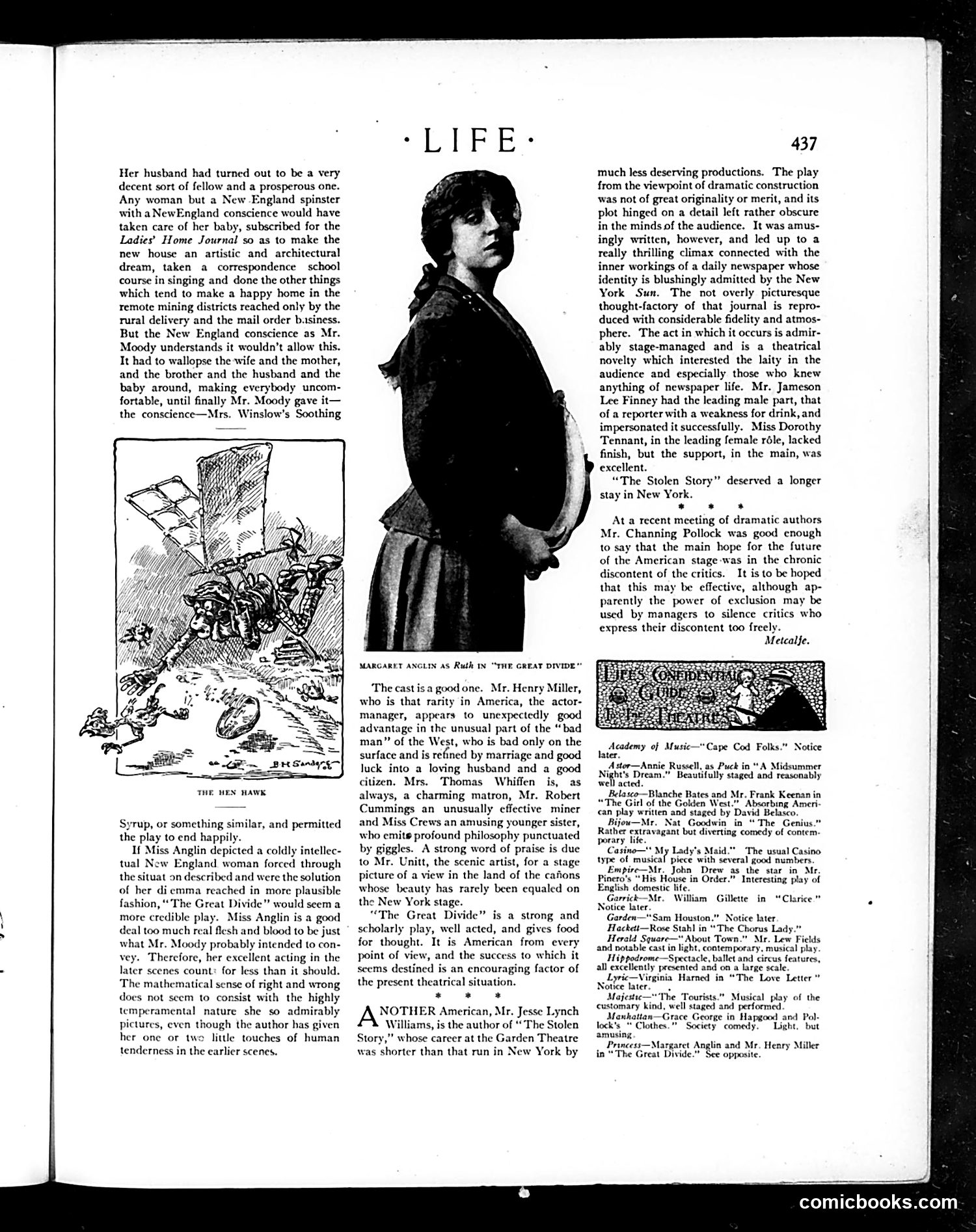
This page reviews two Broadway plays. The main cartoon, "The Hen Hawk," appears to be a crude satirical illustration, though its specific reference is unclear from context. The text critiques "The Great Divide," starring Margaret Anglin (photographed center). The reviewer argues the play's plot—about a refined "bad man" of the West redeemed by marriage—is implausible. The criticism targets the author's heavy-handed moralism: a New England woman's rigid conscience creates conflict until resolved artificially (the reference to "Mrs. Winslow's Soothing Syrup" is satirical). The reviewer suggests Anglin's genuine talent and humanity exceed the shallow character the script demands. A secondary review discusses "The Stolen Story," set in a newspaper office, praised for theatrical novelty despite weak dramatic construction. The page represents turn-of-century theater criticism emphasizing character psychology and dramatic plausibility over sentimentality.
📄 Transcribed text from this page (OCR, searchable)
Machine-transcribed from the original scan — historical spelling and the odd misread are preserved.
Her husband had turned out to be a very decent sort of fellow and a prosperous one. Any woman but a New England spinster with aNewEngland conscience would have taken care of her baby, subscribed for the Ladies’ Home Journal so as to make the new house an artistic and architectural dream, taken a correspondence school course in singing and done the other things which tend to make a happy home in the remote mining districts reached only by the rural delivery and the mail order basiness. But the New England conscience as Mr. Moody understands it wouldn’t allow this. It had to wallopse the wife and the mother, and the brother and the husband and the baby around, making everybody uncom- fortable, until finally Mr. Moody gave it— the conscience—Mrs. Winslow's Soothing Syrup, or something similar, and permitted the play to end happi If Miss Anglin depicted a coldly intellec- tual New England woman forced through the situat on described and were the solution of her diemma reached in more plausible fashion, “The Great Divide” would seem a more credible play. Miss Anglin is a good deal too much real flesh and blood to be just what Mr. Moody probably intended to con- vey. Therefore, her excellent acting in the later scenes count: for less than it should. The mathematical sense of right and wrong does not seem to consist with the highly temperamental nature she so admirably pictures, even though the author has given her one or two little touches of human tenderness in the earlier scenes. MARGARET ANGLIN AS Ruth IN “THE GREAT DIVIDE” ‘The cast isa good one. Mr. Henry Miller, who is that rarity in America, the actor- manager, appears to unexpectedly good advantage in the unusual part of the “bad man” of the West, who is bad only on the surface and is refined by marriage and good luck into a loving husband and a good citizen, Mrs. Thomas Whiffen is, as always, a charming matron, Mr. Robert Cummings an unusually effective miner and Miss Crews an amusing younger sister, who emits profound philosophy punctuated by giggles. A strong word of praise is due to Mr. Unitt, the scenic artist, for a s picture of a view in the land of the cafions whose beauty has rarely been equaled on ¢ New York stage. “The Great Divide” is a strong and scholarly play, well acted, and gives food for thought. It is American from every point of view, and the success to which it seems destined is an encouraging factor of the present theatrical situation. * * 8 OTHER American, Mr. Jesse Lynch Williams, is the author of “The Stolen Story,” whose career at the Garden Theatre was shorter than that run in New York by 437 much less deserving productions. The play from the viewpoint of dramatic construction was not of great originality or merit, and its plot hinged on a detail left rather obscure in the minds of the audience. It was amus- ingly written, however, and led up to a really thrilling climax connected with the inner workings of a daily newspaper whose identity is blushingly admitted by the New York Sun. The not overly picturesque thought-factory of that journal is repro- duced with considerable fidelity and atmos- phere. The act in which it occurs is admir- ably stage-managed and is a theatrical novelty which interested the laity in the audience and especially those who knew anything of newspaper life. Mr. Jameson Lee Finney had the leading male part, that of a reporter with a weakness for drink, and impersonated it successfully. Miss Dorothy ‘Tennant, in the leading female réle, lacked finish, but the support, in the main, was excellent. “The Stolen Story” deserved a longer | stay in New York. * 8 8 Ata recent meeting of dramatic authors Mr. Channing Pollock was good cnough to say that the main hope for the future of the American stage-was in the chronic discontent of the cr: It is to be hoped that this may be effective, although ap- parently the power of exclusion may be used by managers to silence critics who express their discontent too freely. Metcalje. Beck es Pea Oe Academy of Music—“Cape Cod Folks.” > later. | _Astor—Annie Russell, as Puck in “A Midsummer Night's Dream.” Beautifully staged and reasonably well acted. Belasco—Blanche Bates and Mr. Frank Keenan in “The Girl of the Golden West.” Absorbing Ameri- can play written and staged by David Belasco. Bijow—Mr. Nat Goodwin in “The Genius.” Rather extravagant but diverting comedy of contem- porary life. Casino—* My Lady's Maid." The usual Casino type of musical piece with several good numbers. Empire—Mr. John Drew as the star in Mr. Pinero’s “His House in Order.” Interesting play of English domestic life. Garrick—Mr. William Notice later. Garden—"Sam Houston.” Notice later Hackett—Rose Stahl in “The Chorus Lady.” Herald Square—" About Town.” Mr. Lew Fields and potable cast in light, contemporary, musical play. Hippodrome—Spectacle, ballet and circus features, all excellently presented and on a large scale. Lyric—Virginia Harned in “The Love Letter” Notice later Majestue— Tourists." Musical play of the customary kind, well staged and performed Wtan—Grace George in Hapgood and Pol- othes."" Society comedy. Light, but Gillette in “Clarice amusing Prancess—Margaret Anglin and Mr. Henry Miller in “The Great Divide.” See opposite. comicbooks.com