
A complete issue · 28 pages · 1906
Life — September 20, 1906
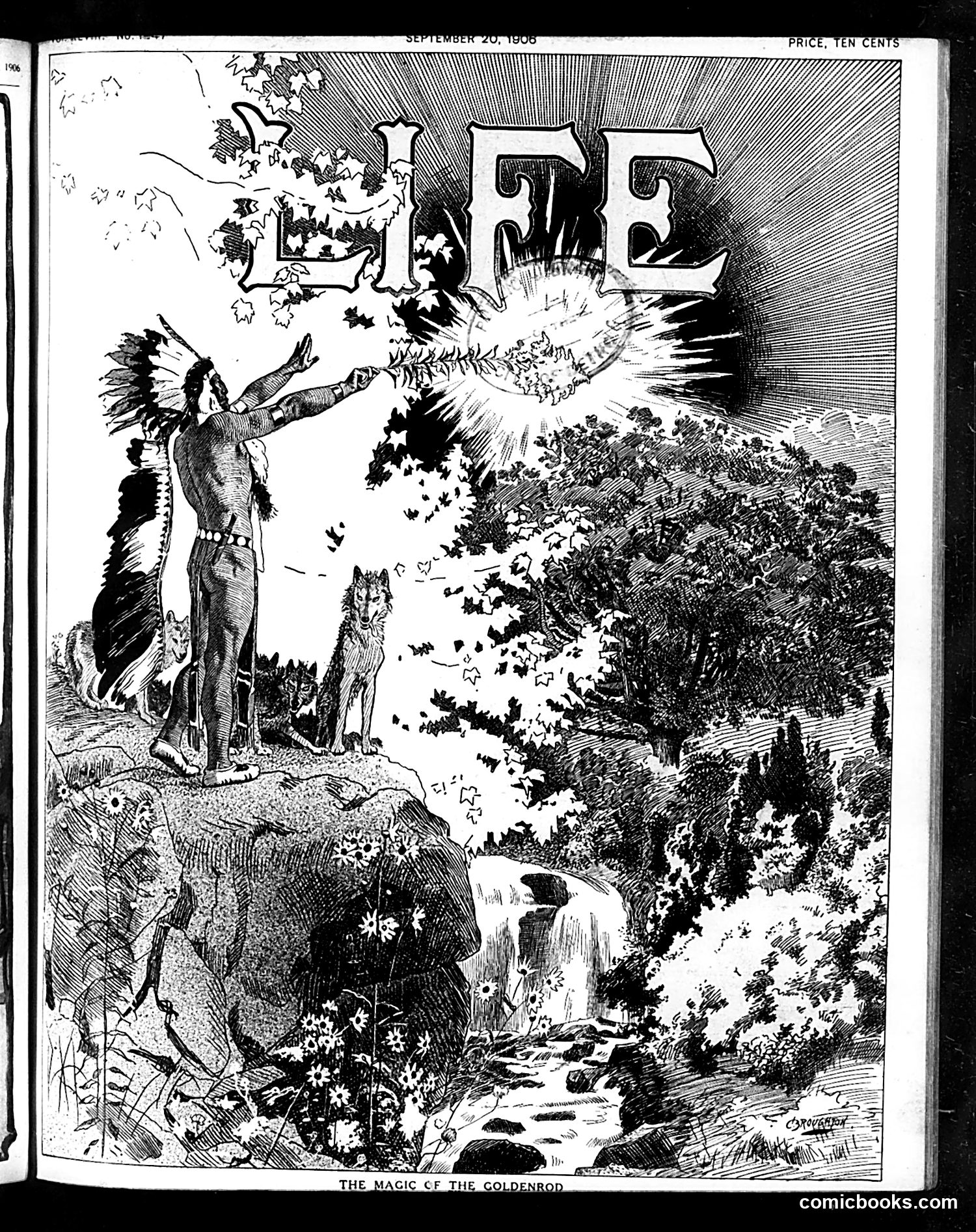
This illustration depicts a Native American figure standing on a cliff or elevated outcrop, arms raised dramatically toward a glowing sky filled with stars. The figure appears to be performing a mystical or ceremonial gesture over a landscape of trees and vegetation below. The title "The Magic of the Goldenrod" suggests this is satirizing or romanticizing Native American spirituality and connection to nature. The dramatic pose and supernatural imagery—the radiating light, floating leaves—mock the contemporary popular fascination with "noble savage" mysticism that was common in early 1900s American culture. The engraving style and composition suggest this is likely social commentary on how Americans exoticized and fantasized about Indigenous peoples' supposed magical or spiritual powers.
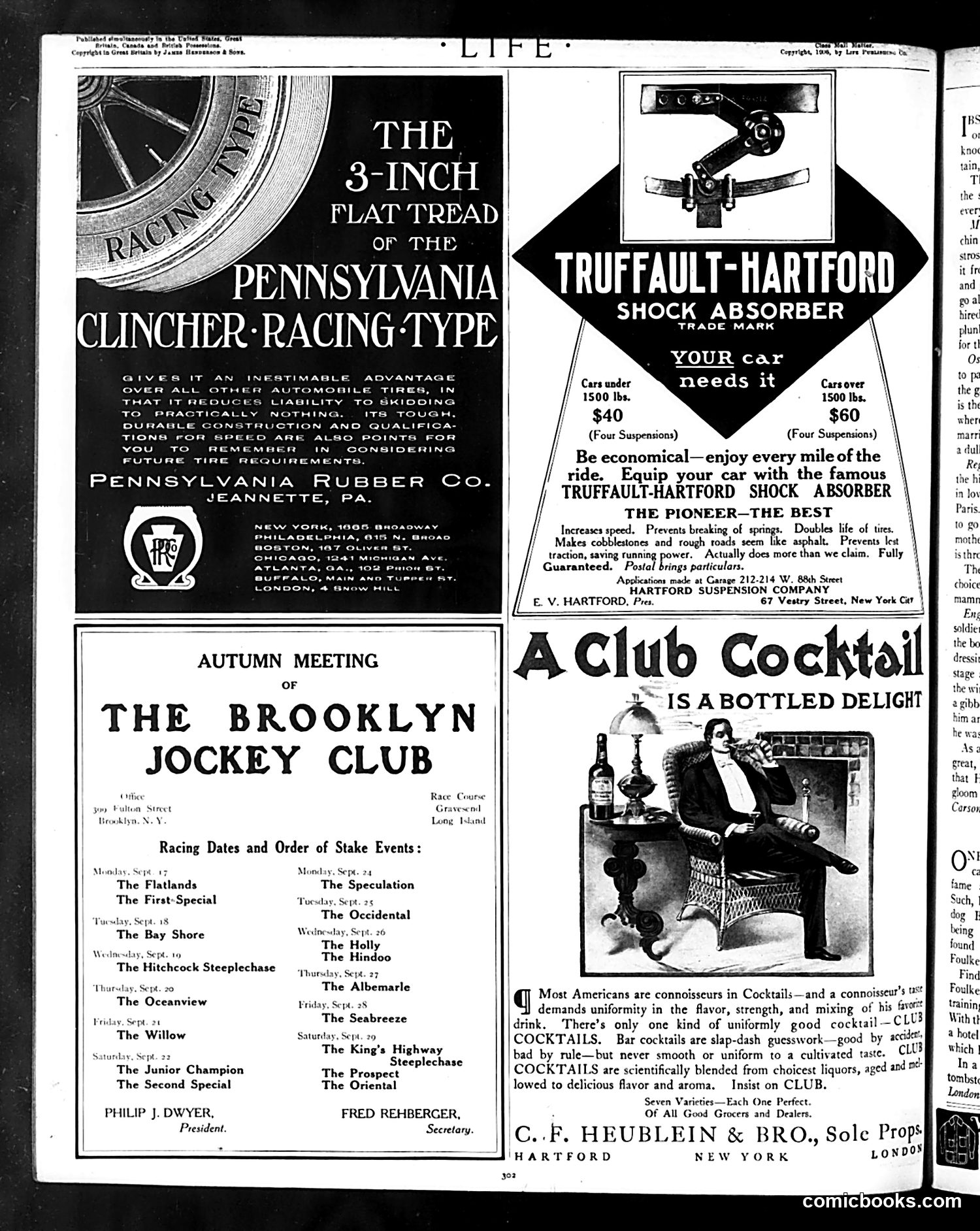
This page is **primarily advertising** rather than satirical content. It contains four advertisements: 1. **Pennsylvania Clincher Racing-Type tire** — promoting a 3-inch flat tread for racing vehicles 2. **Truffault-Hartford Shock Absorber** — a car suspension product claiming to reduce skidding 3. **Brooklyn Jockey Club** — announcing an autumn racing meeting with event dates and stakes races 4. **Club Cocktail** — bottled cocktail advertisement from C.F. Heublein & Bros., emphasizing consistency and quality The cocktail ad includes an illustration of a well-dressed man in formal wear, but this is a product advertisement rather than political satire. The page reflects 1920s automotive and leisure products targeting affluent readers.
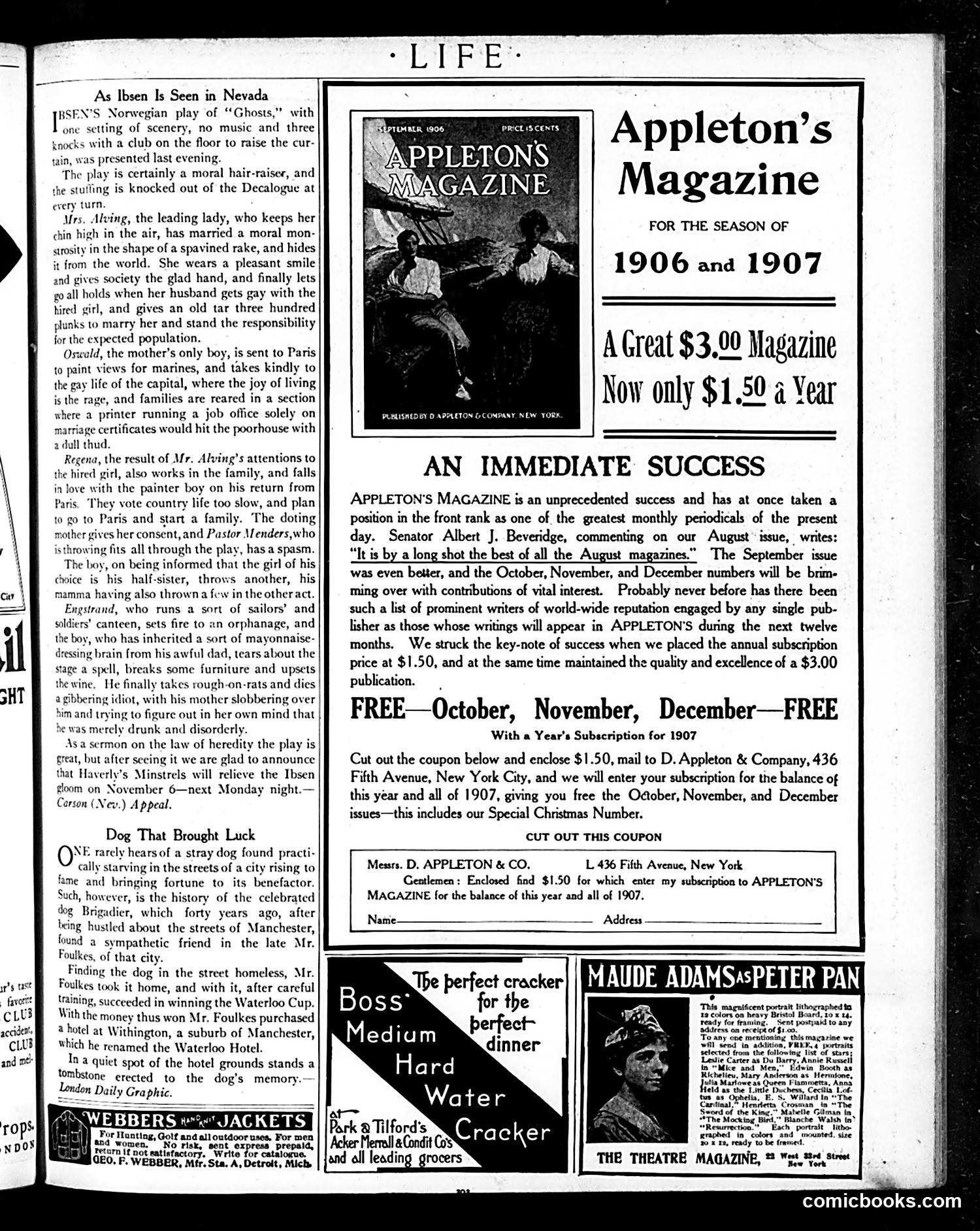
This page is **primarily advertising**, not political satire. The dominant content promotes Appleton's Magazine—a $3.00 monthly publication being discounted to $1.50/year for 1906-1907, with free October-December issues included. The small text columns discuss **Ibsen's "Ghosts"** theatrical production and a human-interest story about "a stray dog found practically starving" that became "the celebrated dog Brigadier." The lower advertisements include Boss Medium Hard Water Crackers and "Maude Adams as Peter Pan" theatrical promotion. **No political cartoons appear on this page.** The content reflects early 20th-century magazine publishing and consumer advertising, with literary/theatrical references serving as editorial material between ads.
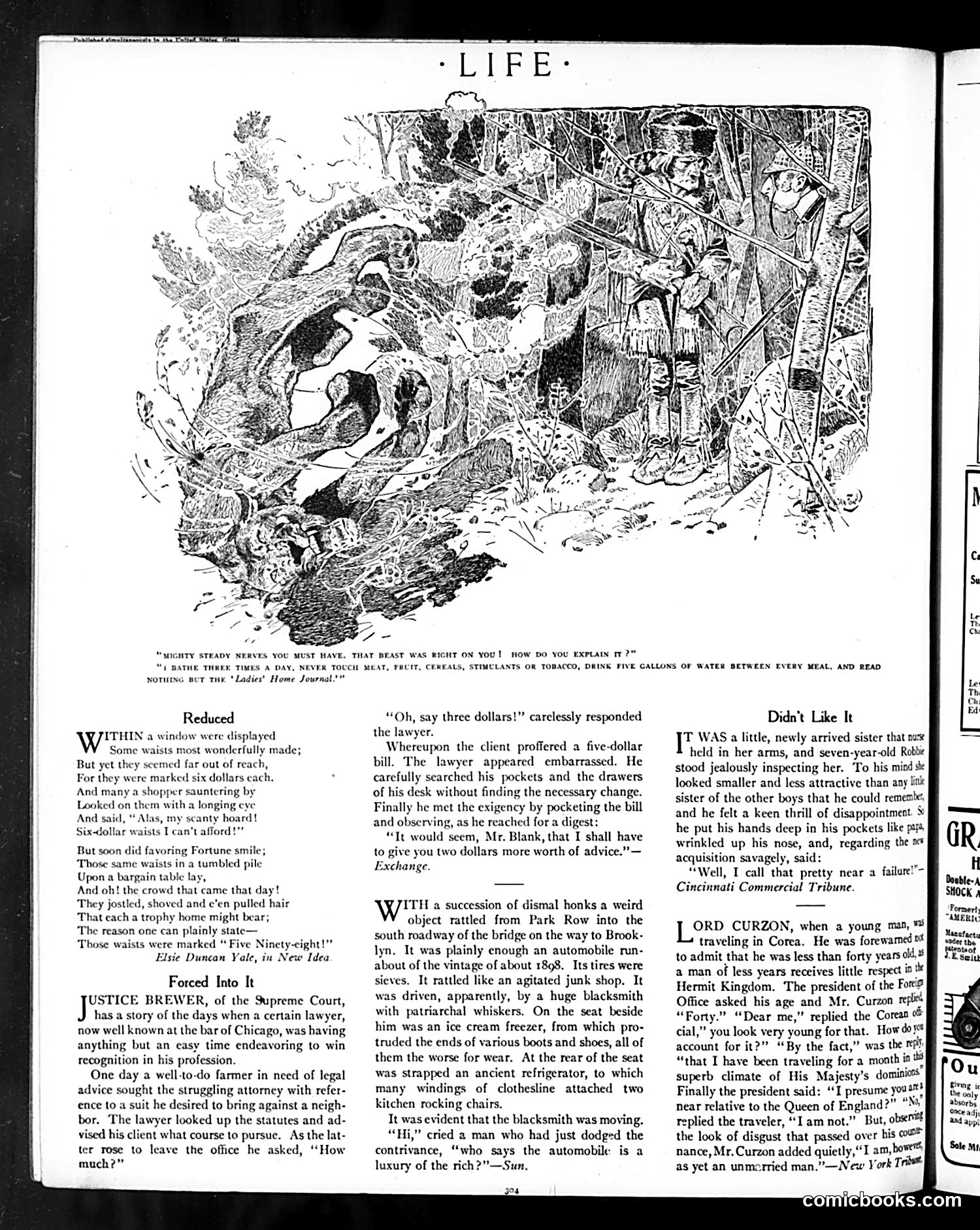
This page contains three separate humorous anecdotes rather than political cartoons: 1. **"Reduced"**: A satirical poem about a shopper at a store sale, mocking consumerism and bargain-hunting behavior. 2. **"Forced Into It"**: A joke about a struggling lawyer who charges a client only $3 instead of $5, then must awkwardly admit he cannot make change—satirizing both legal incompetence and poverty. 3. **"Didn't Like It"**: A story about a newly-arrived sister who feels inferior to her brother's fiancée, ultimately rejecting the engagement out of jealousy. 4. **Two brief items** ("Oh, say three dollars!" and "Lord Curzon") about lawyers and travel. The page represents *Life*'s typical content: light social satire targeting middle-class anxieties, consumer culture, and domestic relationships rather than explicit political commentary. The detailed illustration depicts a forest scene, likely accompanying one of these stories.
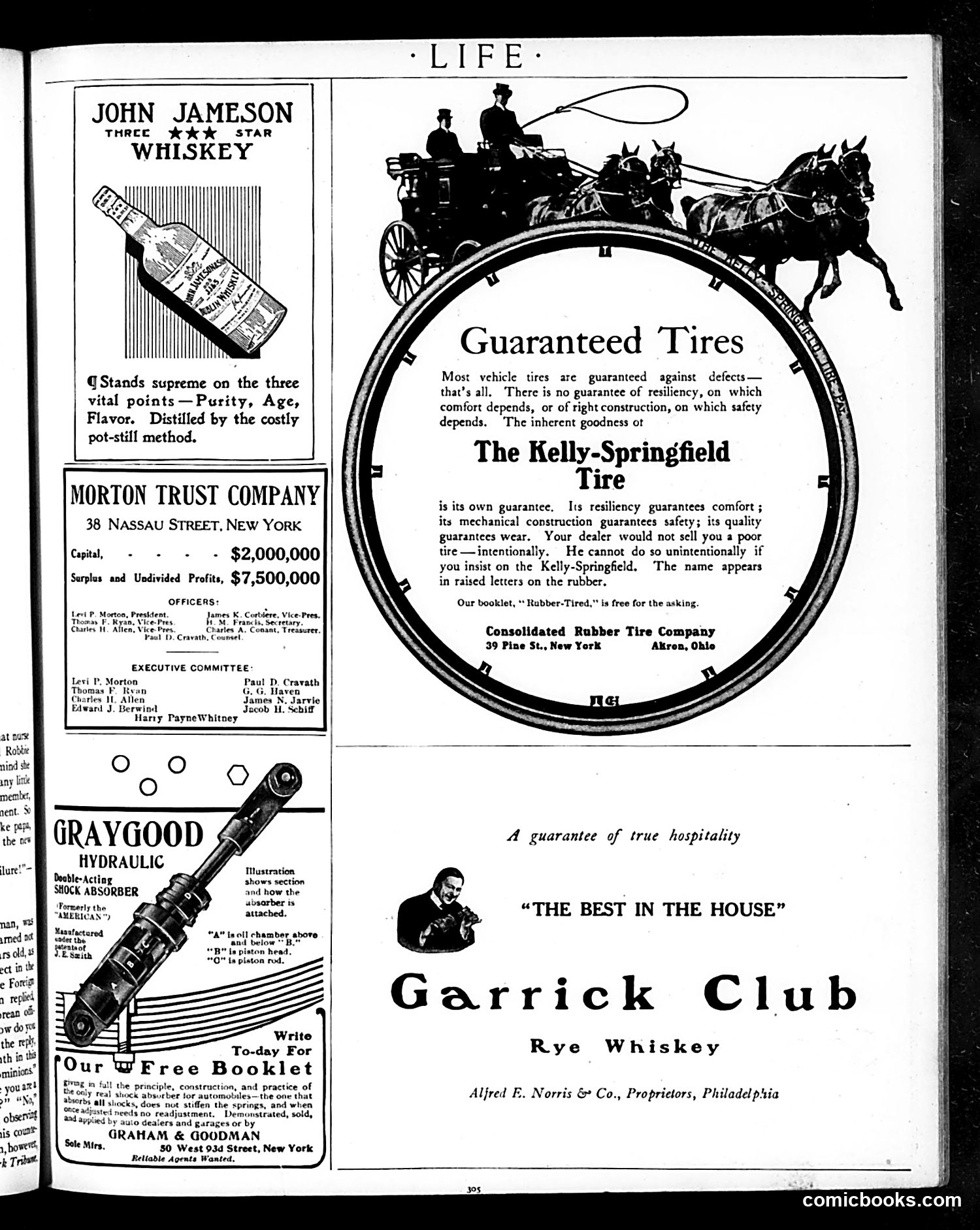
This page is primarily **advertising**, not political satire. It contains four commercial advertisements from what appears to be an early 20th-century magazine: 1. **John Jameson Whiskey** — promoting Irish whiskey's "three vital points" 2. **Morton Trust Company** — a financial institution advertisement 3. **Graygood Hydraulic Shock Absorber** — automobile parts with technical diagrams 4. **Kelly-Springfield Tire** — featuring a horse-drawn carriage illustration 5. **Garrick Club Rye Whiskey** — another spirits advertisement The page reflects the advertising conventions of its era, mixing liquor promotions with automotive products. There is **no political cartoon or social satire** present — this is a standard advertising section from *Life* magazine's business pages, showcasing products and services typical of the period.
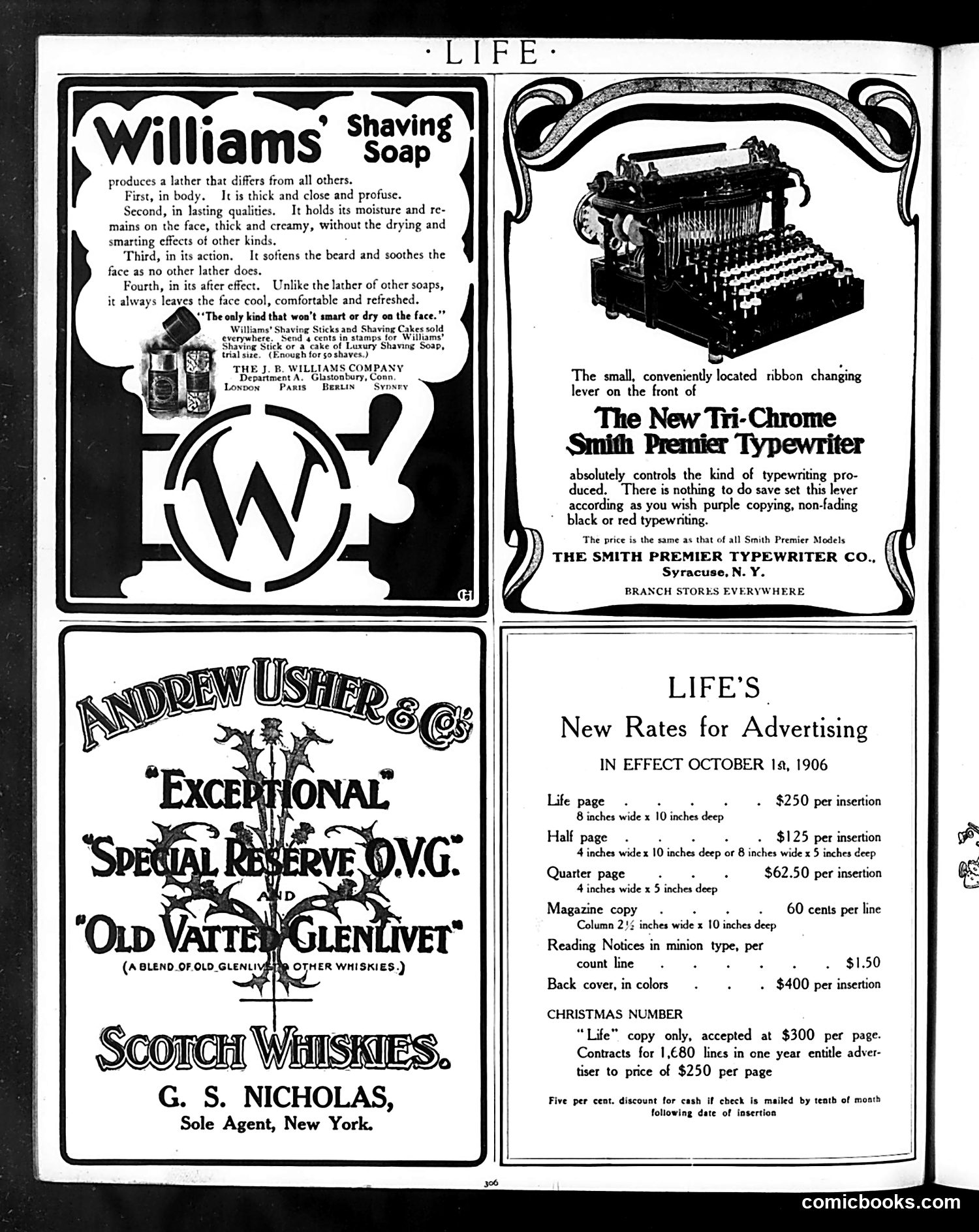
This page is primarily **advertising, not satire or political content**. It contains four advertisements from October 1906: 1. **Williams' Shaving Soap** - highlights product benefits (lather quality, moisturizing properties) 2. **Smith Premier Typewriter** - emphasizes a ribbon-changing lever and color-typing capability 3. **Andrew Usher Scotch Whiskies** - promotes three whisky brands 4. **Life's Advertising Rates** - a rate card showing subscription costs for various ad sizes, ranging from $62.50 for quarter-page to $400 for back cover in color There are no political cartoons, caricatures, or satirical commentary visible. This represents standard commercial magazine advertising from the early 1900s, demonstrating Life magazine's revenue model and the products marketed to its contemporary audience.
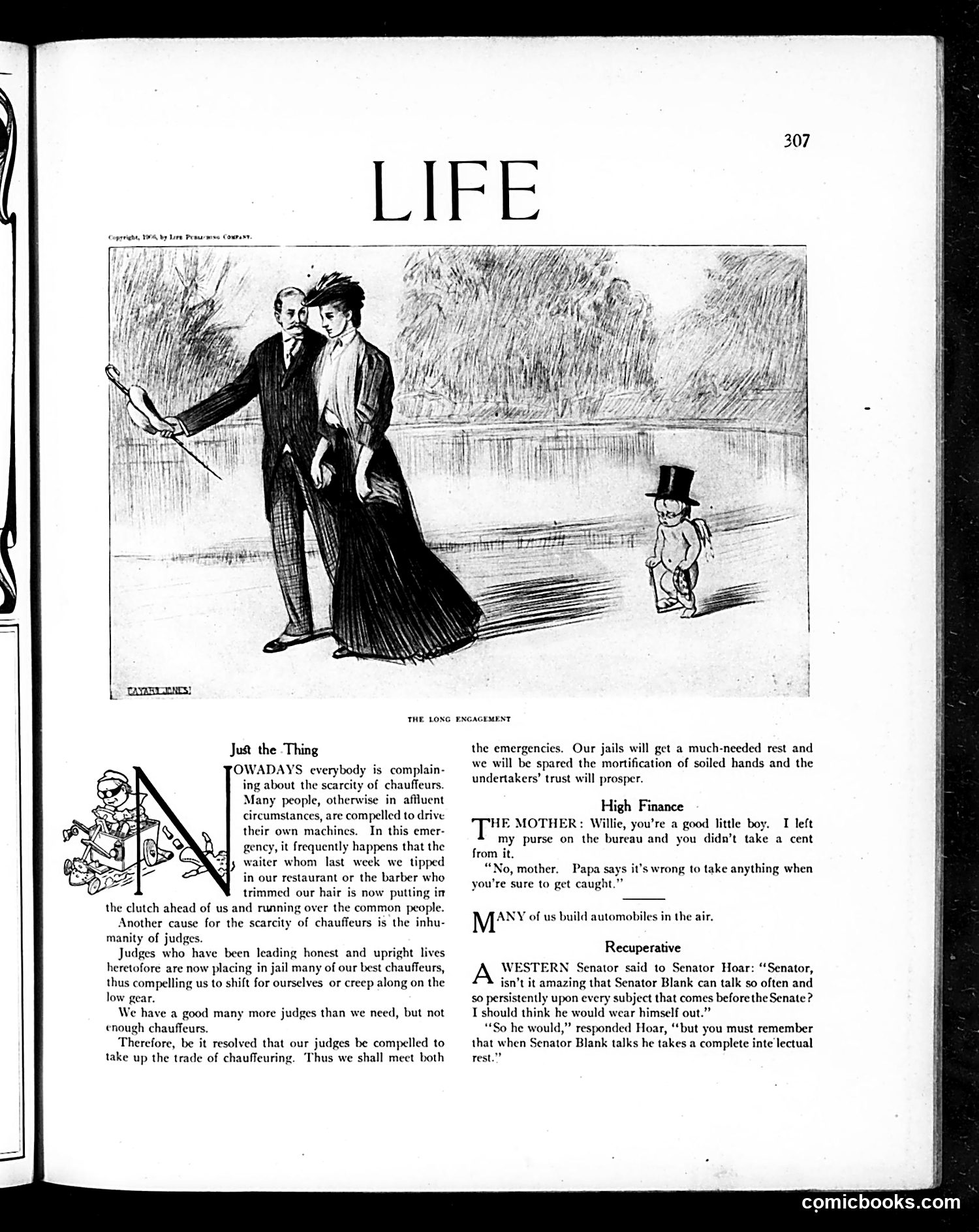
The main cartoon depicts a well-dressed man and woman by a riverbank, with a small child in the background wearing a top hat. The title "The Long Engagement" suggests satirizing prolonged courtships. Below are three brief humorous pieces: **"Just the Thing"** criticizes the scarcity of taxi drivers (chauffeurs), blaming judges who should be compelled to drive instead of sitting on the bench—a jest about judicial surplus versus transportation shortage. **"High Finance"** depicts a mother praising her son's honesty for not taking money from her purse, though his father says it's wrong to take anything when you might get caught—mocking hypocritical parental morality. **"Recuperative"** jokes about Senator Blank talking excessively, suggesting he needs intellectual rest between speeches.
This page critiques New York State Democratic politics. The text discusses Brother Bryan's failed presidential ambitions and criticizes him for endorsing railroad interests—a major political issue of the Progressive era. The cartoon (left) depicts Bryan as a figure destroyed or defeated, illustrating the article's argument that his compromises damaged the Democratic Party's credibility. The piece argues that if Democrats truly belong to William Randolph Hearst (a newspaper magnate and political figure), they should nominate him openly rather than secretly backing Hearst's preferred candidates. The satire ridicules Democratic hypocrisy and power-brokering behind closed doors while claiming to represent popular will. References to Cambridge and Harvard crews appear separate, discussing boat racing competitions.
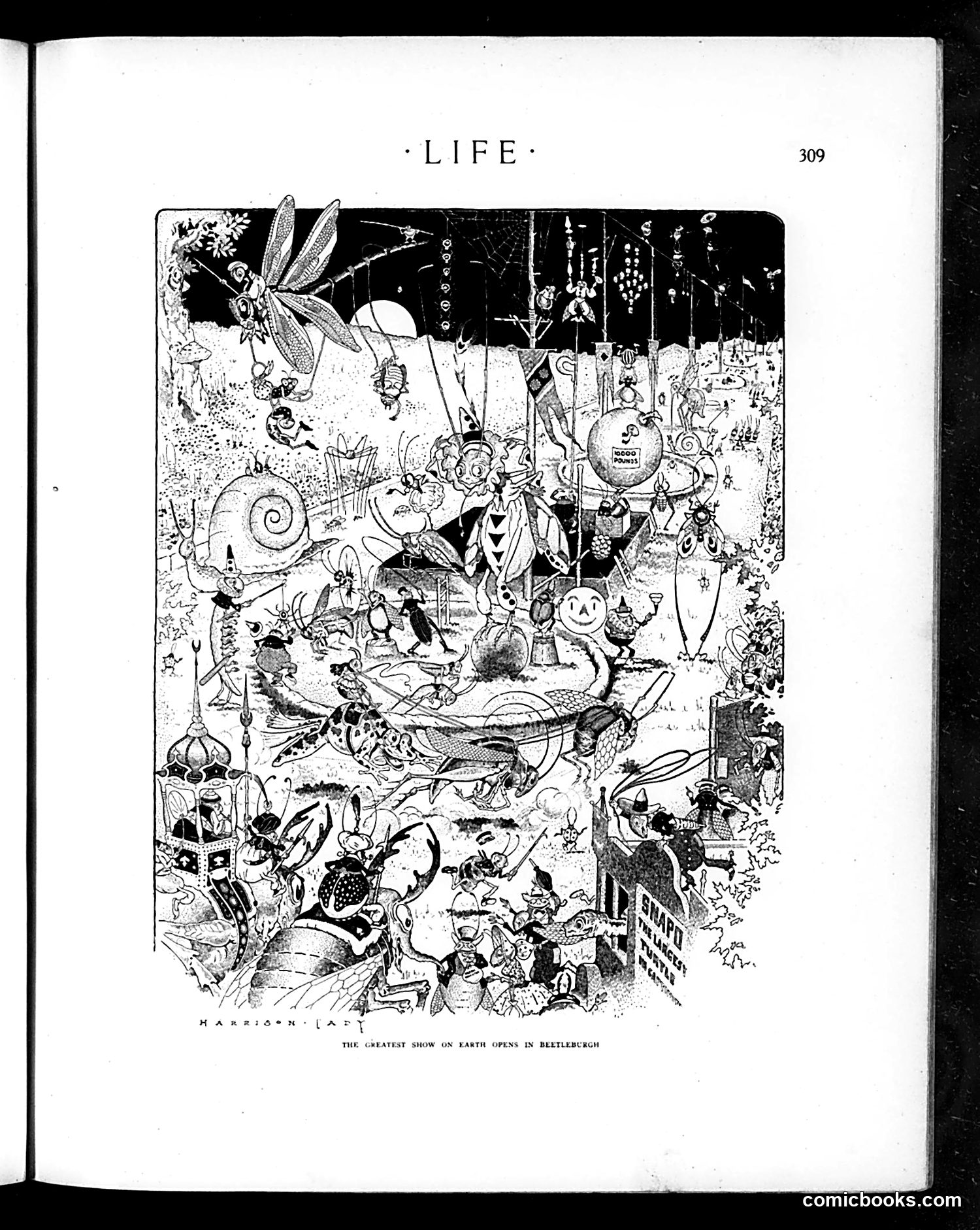
This is a densely packed satirical illustration by Harrison Cady titled "The Greatest Show on Earth Opens in Beetleburgh." The cartoon depicts an elaborate circus or carnival scene populated entirely by anthropomorphized insects and beetles in a chaotic, fantastical setting. The satire appears to mock human society by replacing people with insects—a common device to critique social hierarchies, absurdity, and behavioral folly. The "greatest show on earth" framing suggests commentary on contemporary entertainment, spectacle, or perhaps broader human civilization presented as an insect carnival. Without clearer textual context, the specific political targets remain unclear, though the elaborate visual chaos conveys general satirical commentary on societal chaos or vanity.
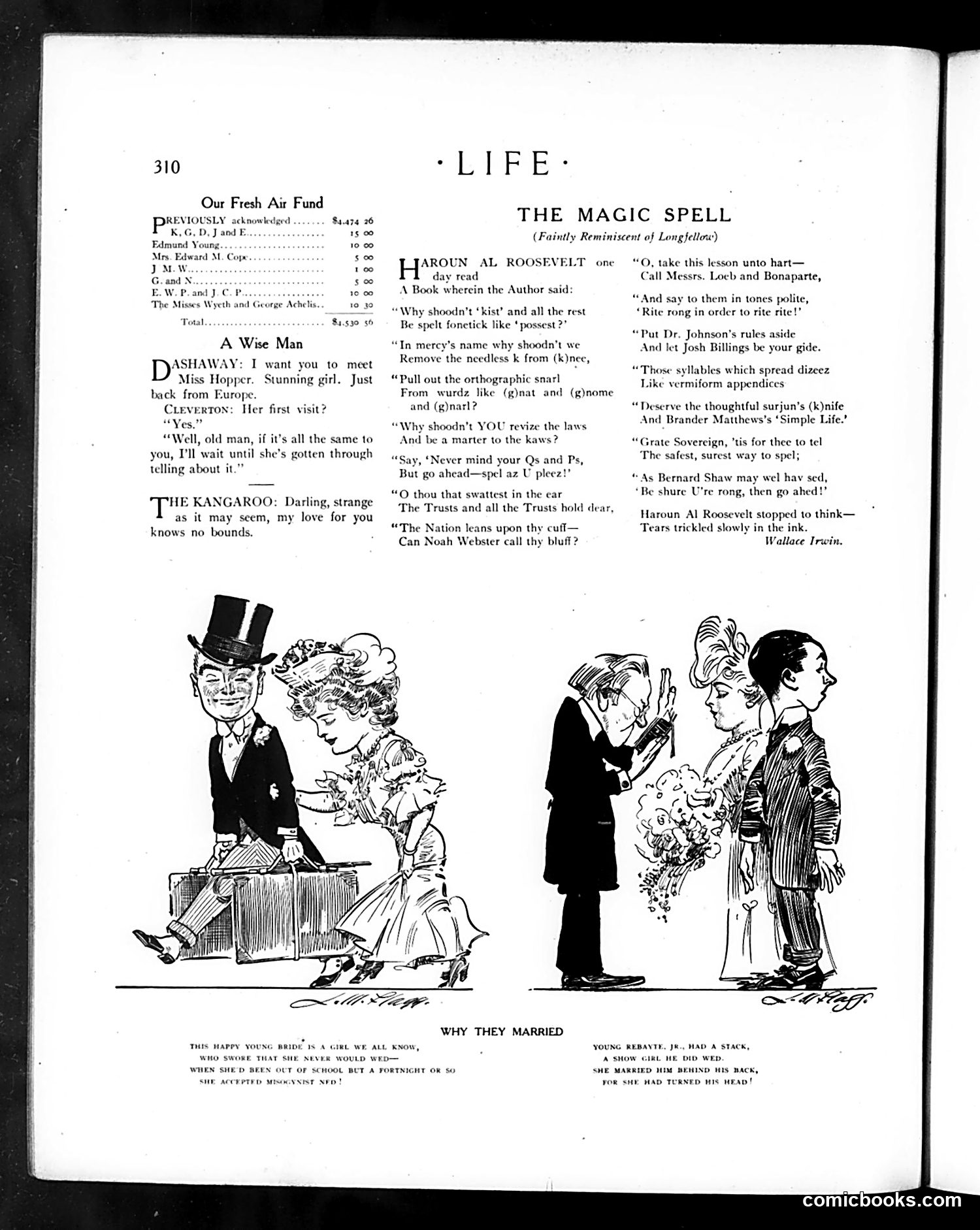
This page contains two satirical cartoons about marriage and courtship conventions. **"The Magic Spell"** presents humorous "rules" for spelling reform and proper etiquette, attributed to various figures including "Haroun al Roosevelt" (likely Theodore Roosevelt). The jokes mock overly complicated English spelling rules and suggest simpler alternatives—typical turn-of-the-century humor about linguistic pedantry. **"Why They Married"** shows two contrasting couples with cynical captions. The left cartoon mocks a bride who "swore she never would wed" until opportunity arose. The right depicts a man marrying "behind his back" after a woman "turned his head"—satirizing how romantic entanglement overrides stated intentions. Both lampoon the gap between people's professed values and their actual behavior regarding marriage.
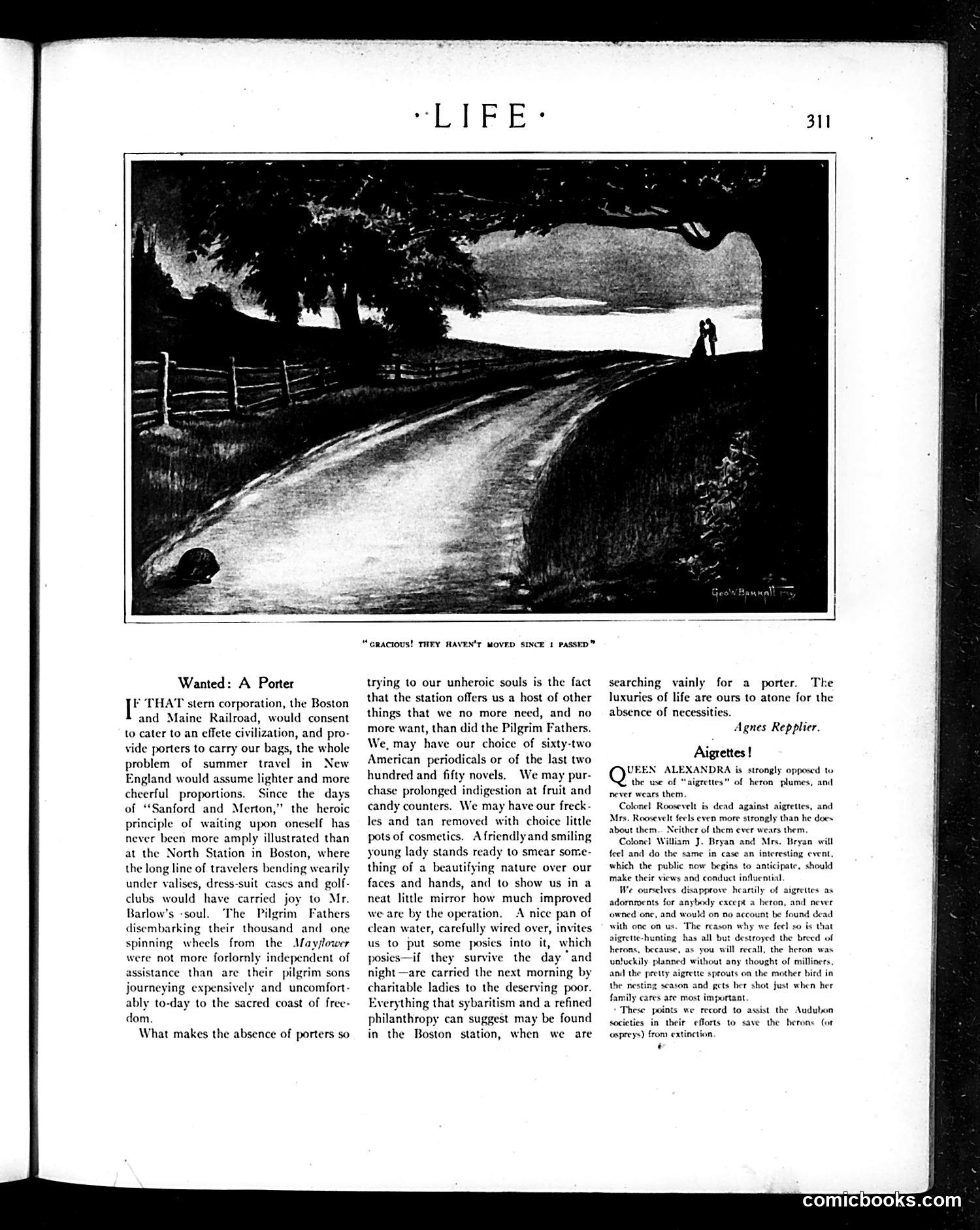
This page contains two distinct pieces: an illustrated essay titled "Wanted: A Porter" and a brief social commentary section called "Angries!" The main illustration depicts a rural country road with figures in the distance, captioned "Gracious! They haven't moved since I passed." The accompanying essay criticizes the Boston and Maine Railroad's lack of porters at its North Station, contrasting this service gap with the railroad's other amenities. The author argues that absent porters force travelers to manage luggage themselves—an indignity the writer suggests contradicts modern civilization's supposed progress. The "Angries!" section addresses various social grievances, including commentary on Colonel William J. Bryan and discussions about preserving herons (osprey). The overall tone is satirical complaint about inadequate service and social standards.
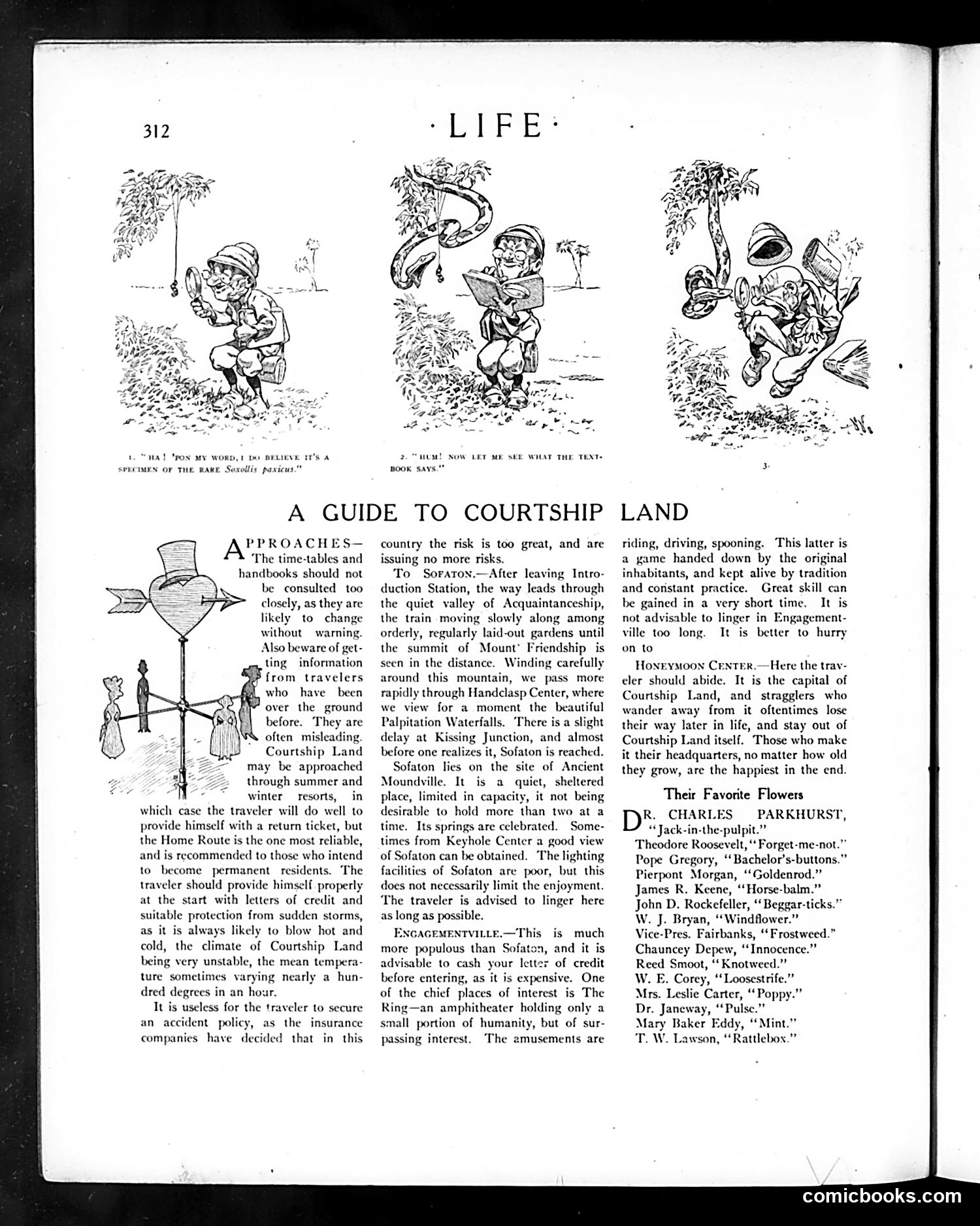
This is a humorous travel guide to romantic courtship, illustrated with three cartoon panels at the top showing couples engaged in courting activities (swinging, walking, playful antics) near trees. The main article provides satirical "travel advice" for young people seeking romance, treating courtship as if it were a geographical destination with landmarks like "Sofaton," "Engagementville," and "Honeymoon Center." It humorously warns travelers about risks, insurance policies, and proper etiquette. The bottom section lists famous public figures' "favorite flowers" as romantic gifts—including Theodore Roosevelt, politicians like John D. Rockefeller, and entertainers like Fairbanks and Mary Baker Eddy. The satire gently mocks both the formality of courtship rituals and the commercialization of romance through gift-giving, presenting love-seeking as an elaborate journey requiring planning and proper credentials.
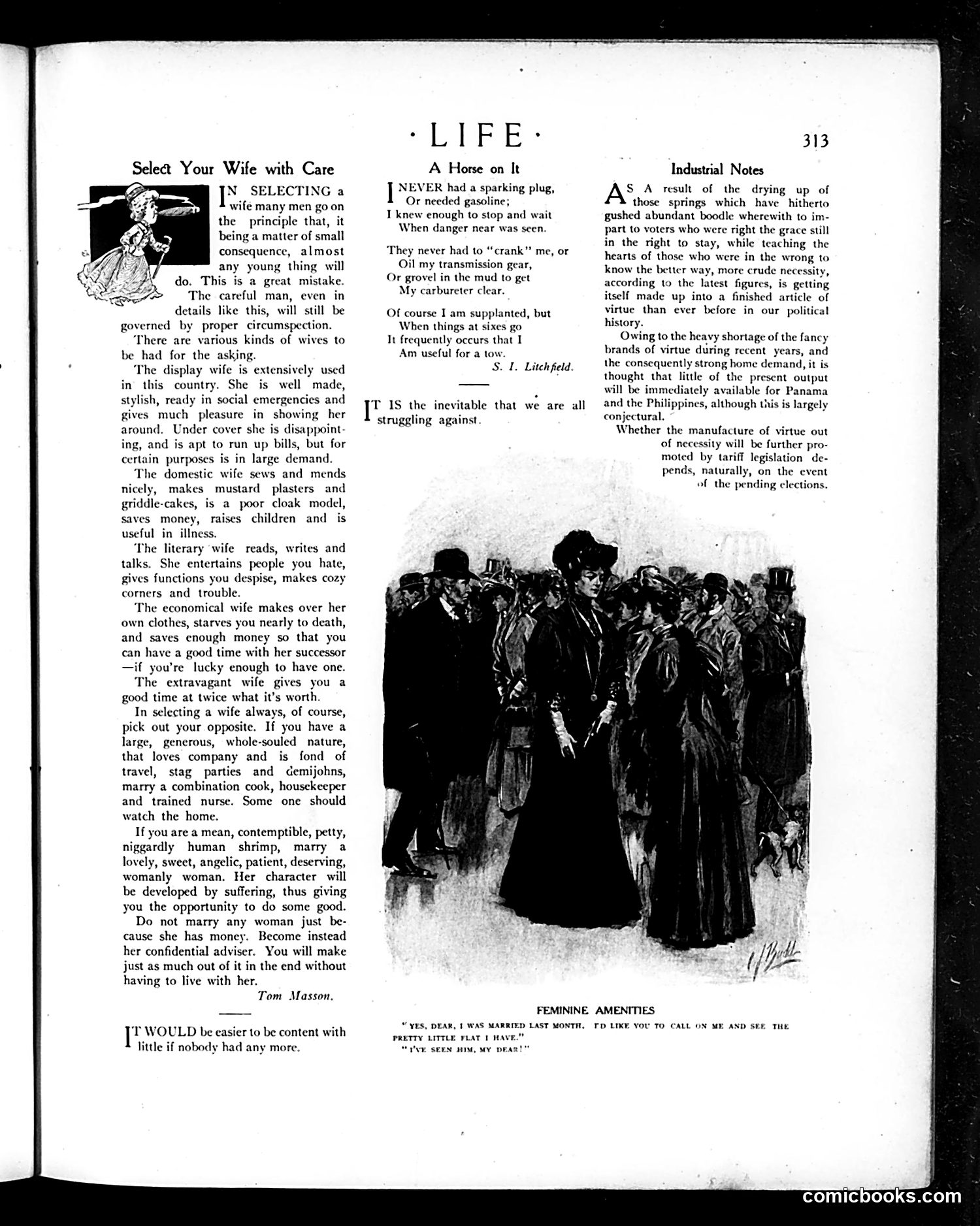
This page combines three distinct pieces: **"Select Your Wife with Care"** (left column) satirizes marriage advice literature, mocking different "wife types"—the display wife, domestic wife, literary wife, economical wife, and extravagant wife. The tone is darkly humorous about marital compromise. **"A Horse on It"** (center) is a poem by S. I. Litchfield celebrating a reliable horse that never needs maintenance, contrasting with human unreliability—likely satirizing industrial/technological progress. **"Industrial Notes"** (right) discusses tariff legislation affecting Panama's agricultural output, touching on election politics. **"Feminine Amenities"** (bottom illustration) shows a woman among men, with dialogue about a recent marriage and a flat—social commentary on women's domestic roles and expectations in early 20th-century society.
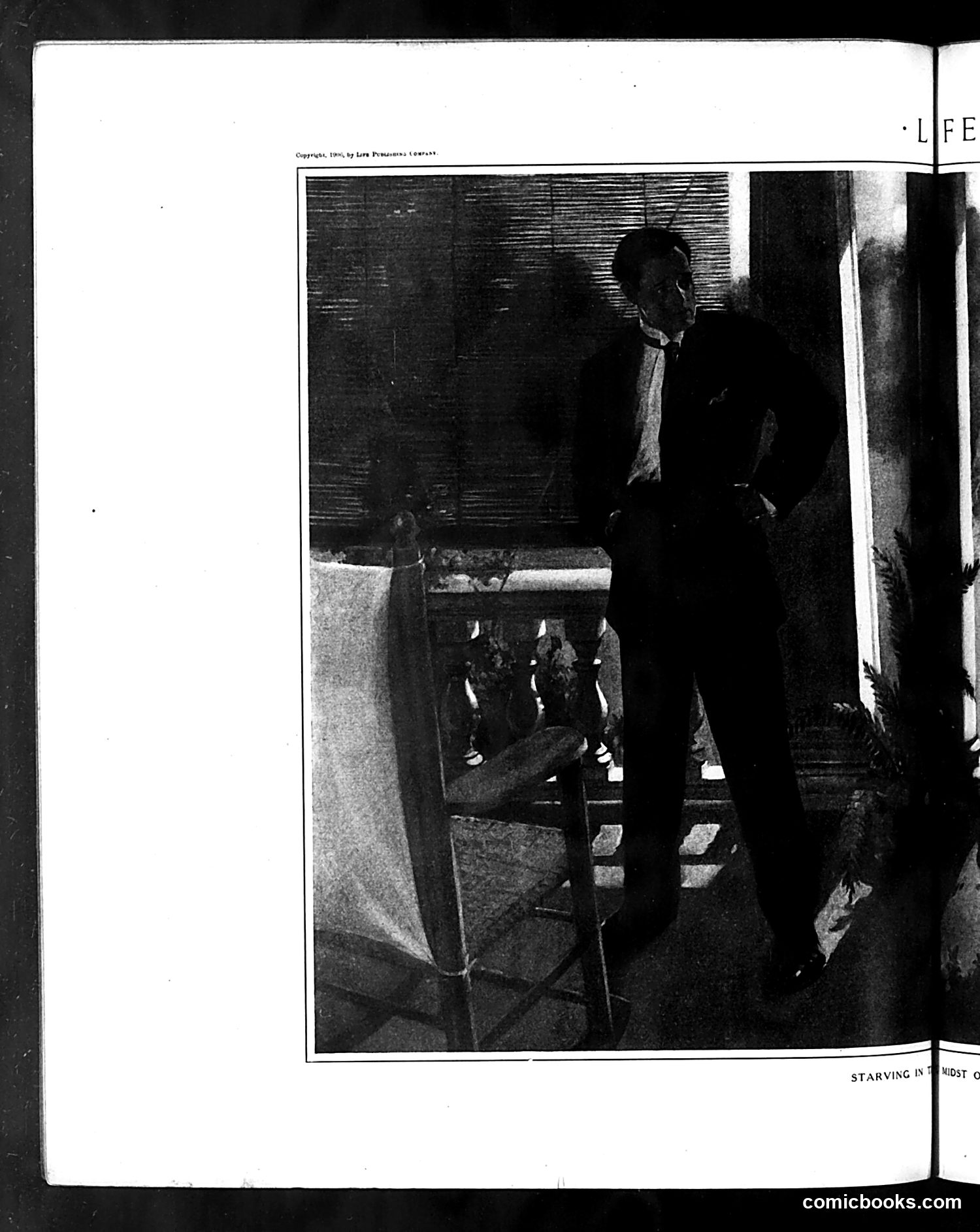
This appears to be a page from Life magazine featuring a black and white photograph rather than a cartoon. The image shows a man in formal attire (suit and tie) standing in what appears to be an interior space, with other figures visible in the background. The partial caption "STARVING IN" suggests this is likely a satirical commentary on economic conditions, possibly referencing unemployment or poverty during a specific historical period. However, without complete context—the full caption, date, or identifying information visible on this fragment—I cannot definitively identify the specific political figure, event, or social commentary being referenced. The satirical intent appears to involve irony about someone's circumstances, but the full meaning requires information not legible in this page excerpt.
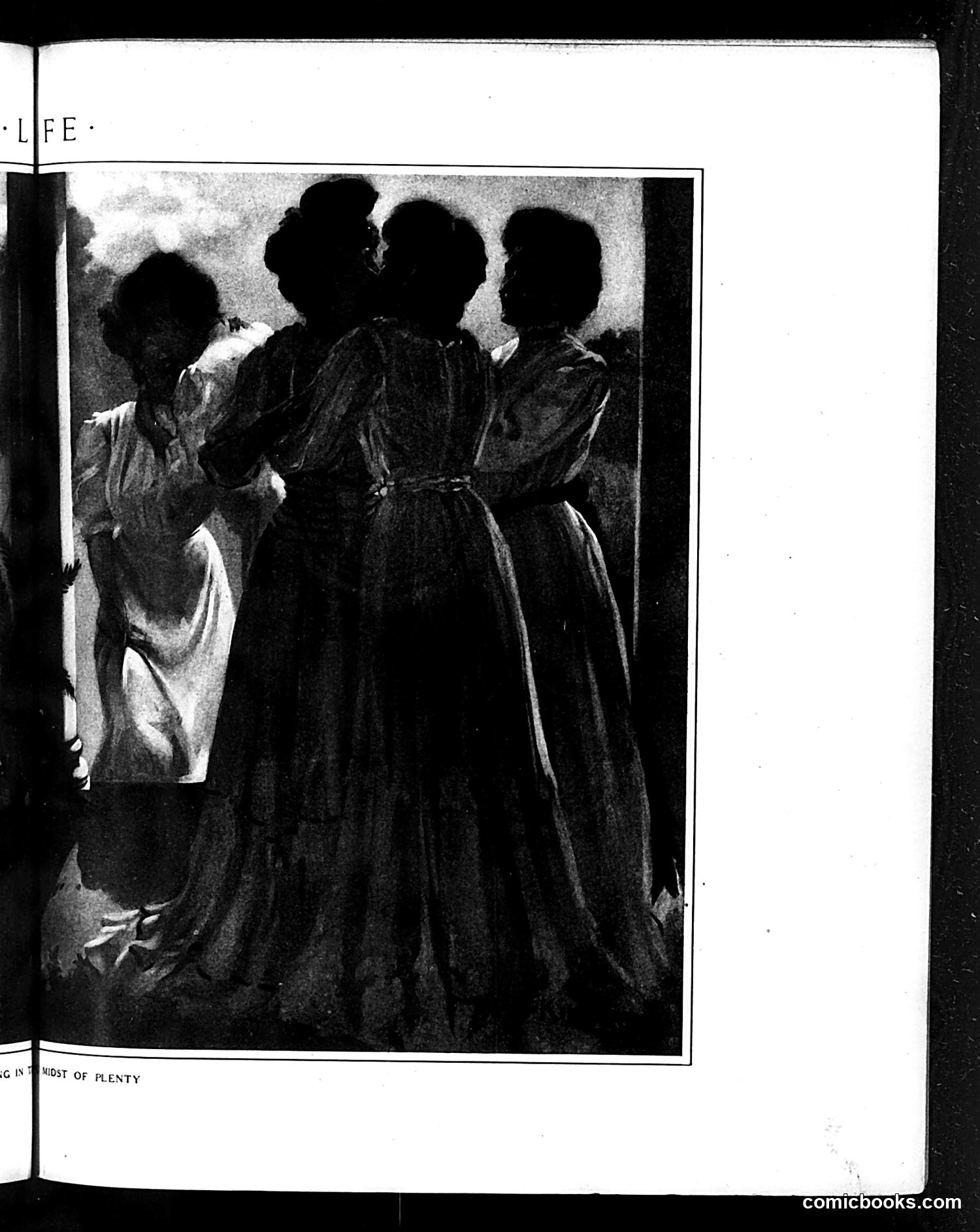
This appears to be a page from Life magazine featuring a dramatic black and white photograph or illustration showing four women in long dark dresses gathered together in what seems to be an interior setting. The caption reads "IN MIDST OF PLENTY," suggesting social commentary about inequality or hardship despite abundance. The image's artistic style and the women's period clothing suggest this is likely early-to-mid 20th century satirical content, possibly critiquing economic disparity or social conditions during a time of national prosperity. However, without additional context or clearer caption text visible in the image, the specific political or social target of this satire remains unclear. The dramatic lighting and composition suggest serious social commentary rather than humor.
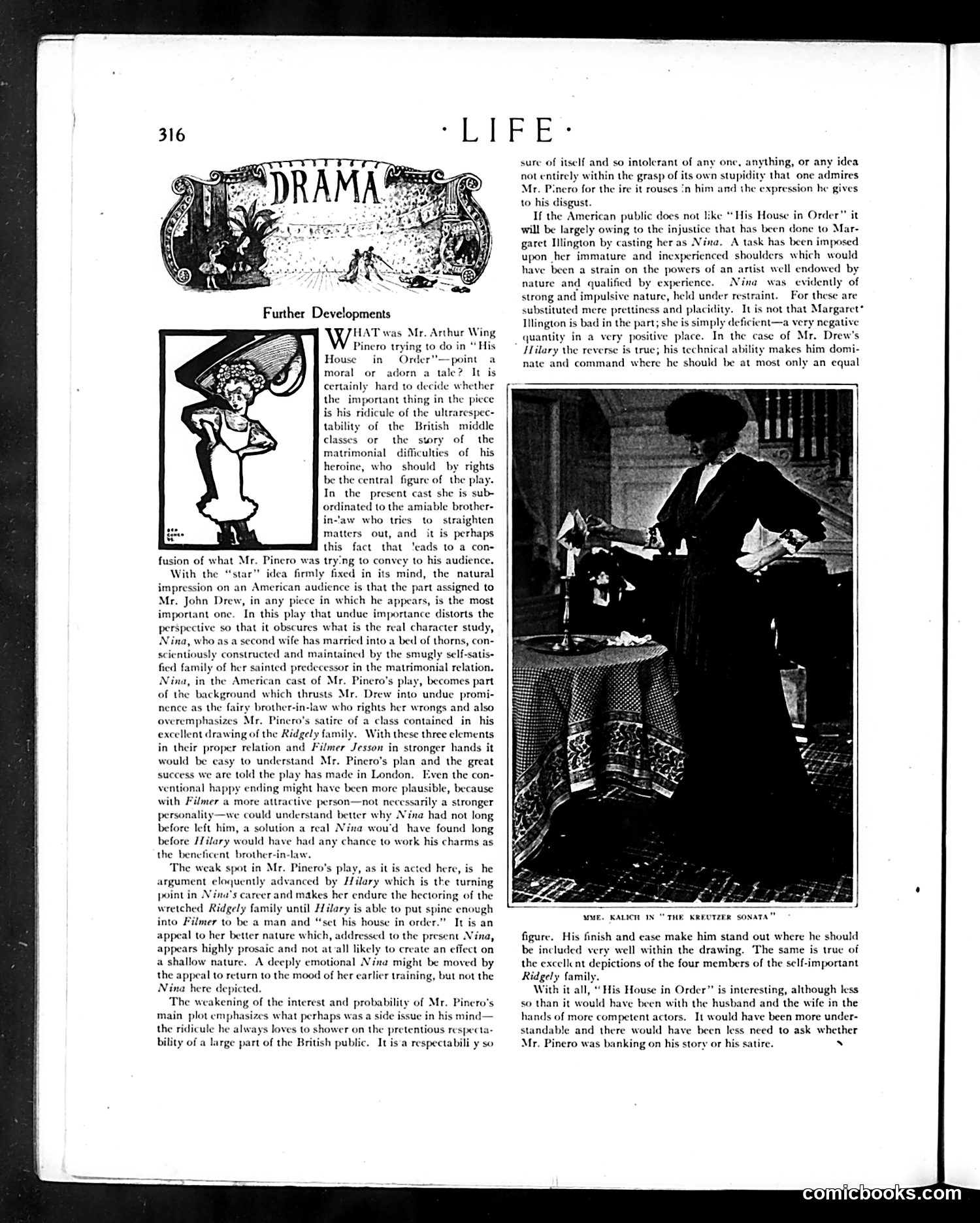
This is a theater review of Arthur Wing Pinero's play "His House in Order," with a cartoon mocking the production's casting choices. The text criticizes how American actor John Drew's star power distorted the play's structure. Pinero intended the play to spotlight **Nina**, a second wife trapped in a dysfunctional family, as the central character study—satirizing British middle-class respectability and hypocrisy. However, Drew's prominent role as the "fairy brother-in-law" who solves everyone's problems overshadows Nina's story. The review faults actress Margaret Ilington as miscast—the role requires an emotionally complex, mature performer, but she delivers a shallow interpretation. This casting error weakens the play's central argument about duty and emotional restraint. The cartoon (left) depicts the theatrical confusion—a performer gesturing dramatically, embodying the "star system" problem: famous actors demand prominent roles regardless of dramatic logic.
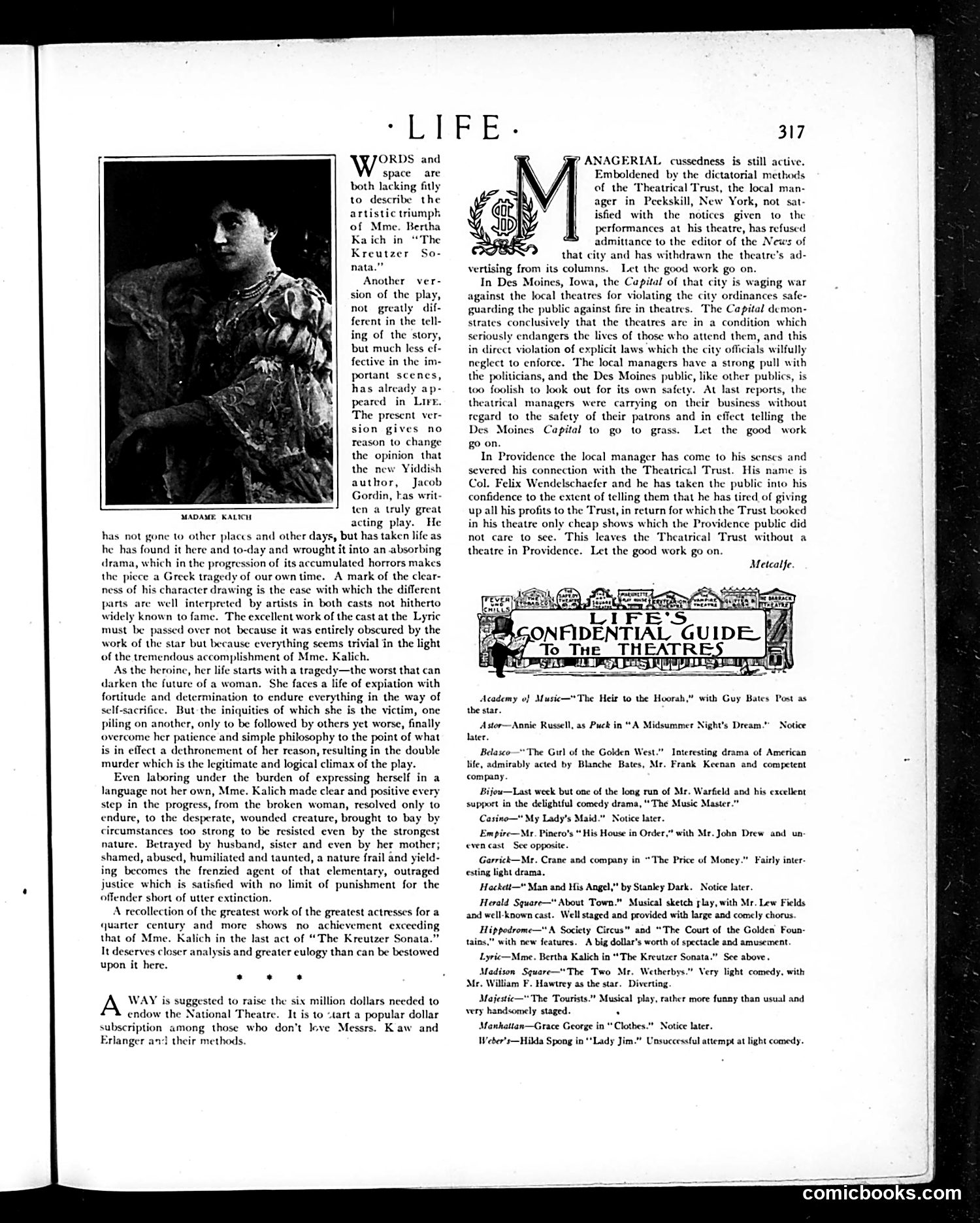
This page combines a theater review with industry criticism. The left side features a photograph of **Madame Bertha Kalich**, a Yiddish actress, praised extensively for her performance in "The Kreutzer Sonata." The review portrays her acting as transcendent, particularly her portrayal of a woman driven to murder by accumulated betrayals and injustice. The right column shifts to satire about **theatrical management corruption**. It attacks: 1. **A Peekskill, New York theater manager** who punished a newspaper editor for unfavorable reviews by banning him and withdrawing advertising 2. **Des Moines theaters** violating fire safety ordinances while city officials negligently refuse enforcement 3. **The "Theatrical Trust"** (the Klaw-Erlanger monopoly), whose dictatorial methods allegedly embolden such abuses The closing paragraph sarcastically suggests raising funds for a National Theatre independent of these corrupt managers, implying the existing theater industry is controlled by self-interested monopolists indifferent to public safety or press freedom.
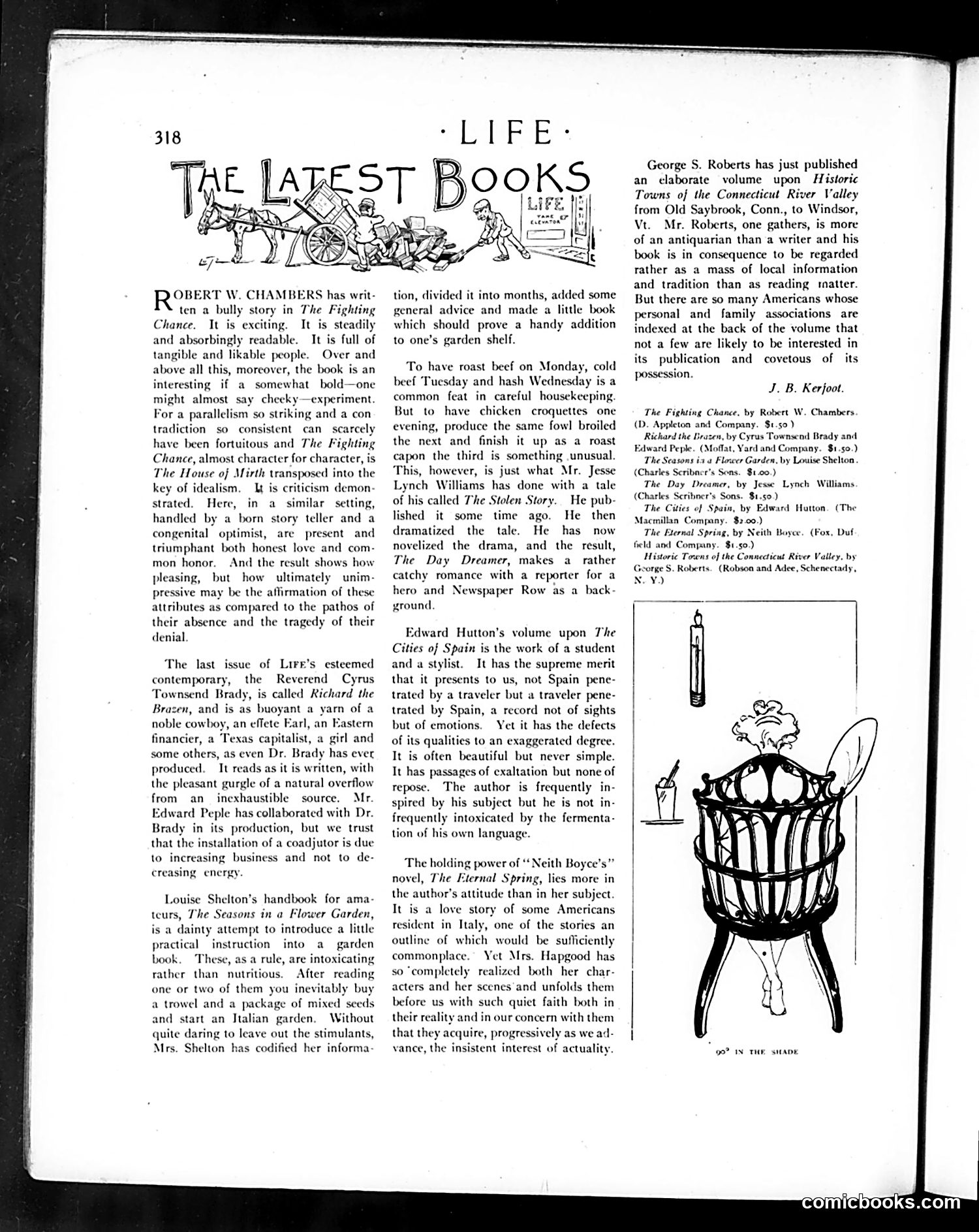
This is a book review section from *Life* magazine featuring literary criticism of contemporary novels. The page reviews works by Robert W. Chambers, Edward Hutton, and others, comparing *The Fighting Chance* to Edith Wharton's *The House of Mirth* as similar in structure but idealistic rather than tragic. The two illustrations are generic decorative vignettes—a bottle labeled "0" IN THE SHADE" and a basket of produce—accompanying the garden book review by Louise Shelton. These aren't political cartoons but editorial illustrations typical of early 20th-century magazine design. The satire is literary rather than political: *Life* critiques Hutton's flowery prose about Spain as occasionally "intoxicated by the fermentation of his own language"—mocking overwrought writing. This reflects *Life*'s role as a sophisticated cultural arbiter for educated readers.
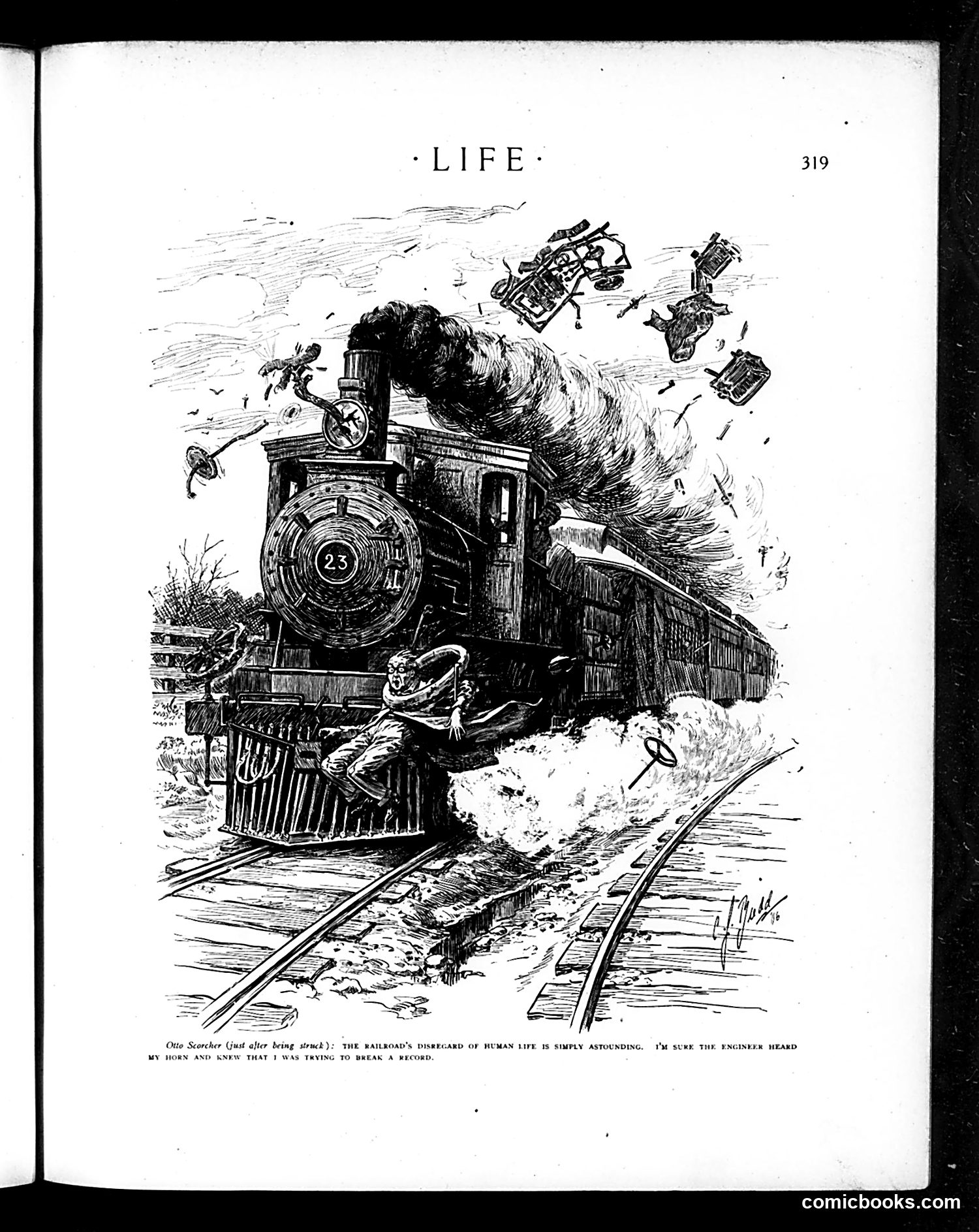
This is a satirical cartoon about railroad safety and reckless behavior. A character named Otto Scorcher, apparently struck by a train numbered 23, complains that the railroad disregarded human life—while simultaneously revealing his own irresponsibility. He claims he was "trying to break a record," suggesting he was attempting a dangerous speed stunt. The joke mocks Scorcher's hypocrisy: he blames the railroad for negligence while admitting he was engaged in foolish, risk-taking behavior that caused the accident. The cartoon satirizes both industrial-era railroad safety concerns and the era's fascination with speed records and daredevil stunts, suggesting that personal recklessness, not corporate indifference alone, was often responsible for such accidents.
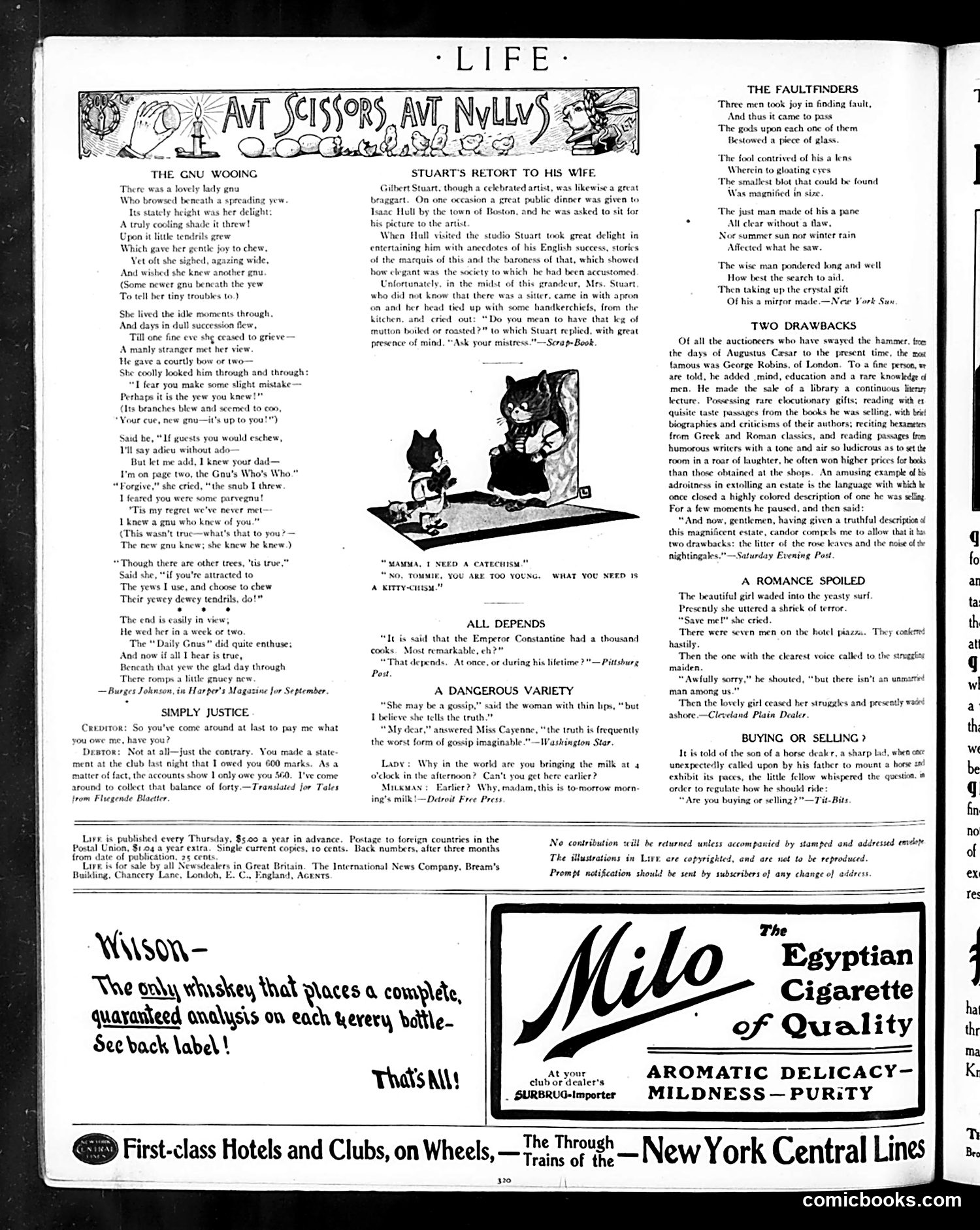
This page from *Life* magazine contains several brief humorous pieces typical of early 20th-century American satirical humor: **"The Gnu Wooing"** is a whimsical poem about anthropomorphized gnu (wildebeest) courtship, relying on puns ("yew/you") and contrived rhymes for comic effect—gentle, nonsensical humor aimed at family readers. **The other pieces** are short comic anecdotes: "Simply Justice" presents a debtor cleverly reversing a creditor's claim; "Stuart's Retort" shows the artist Gilbert Stuart deflecting embarrassment when his wife interrupts during a sitting; various one-liners about Constantinople's cooks, gossip, and milk delivery play on logical absurdities. **"The Faultfinders"** is a moral fable suggesting that criticism distorts perception like a lens. The page reflects *Life's* formula: lighthearted, pun-based humor with no political edge—domestic comedy and wordplay for middle-class readers. The advertisements (Wilson whiskey, Milo cigarettes, hotels) confirm the upscale audience. The satire is gentle and escapist rather than pointed social commentary.
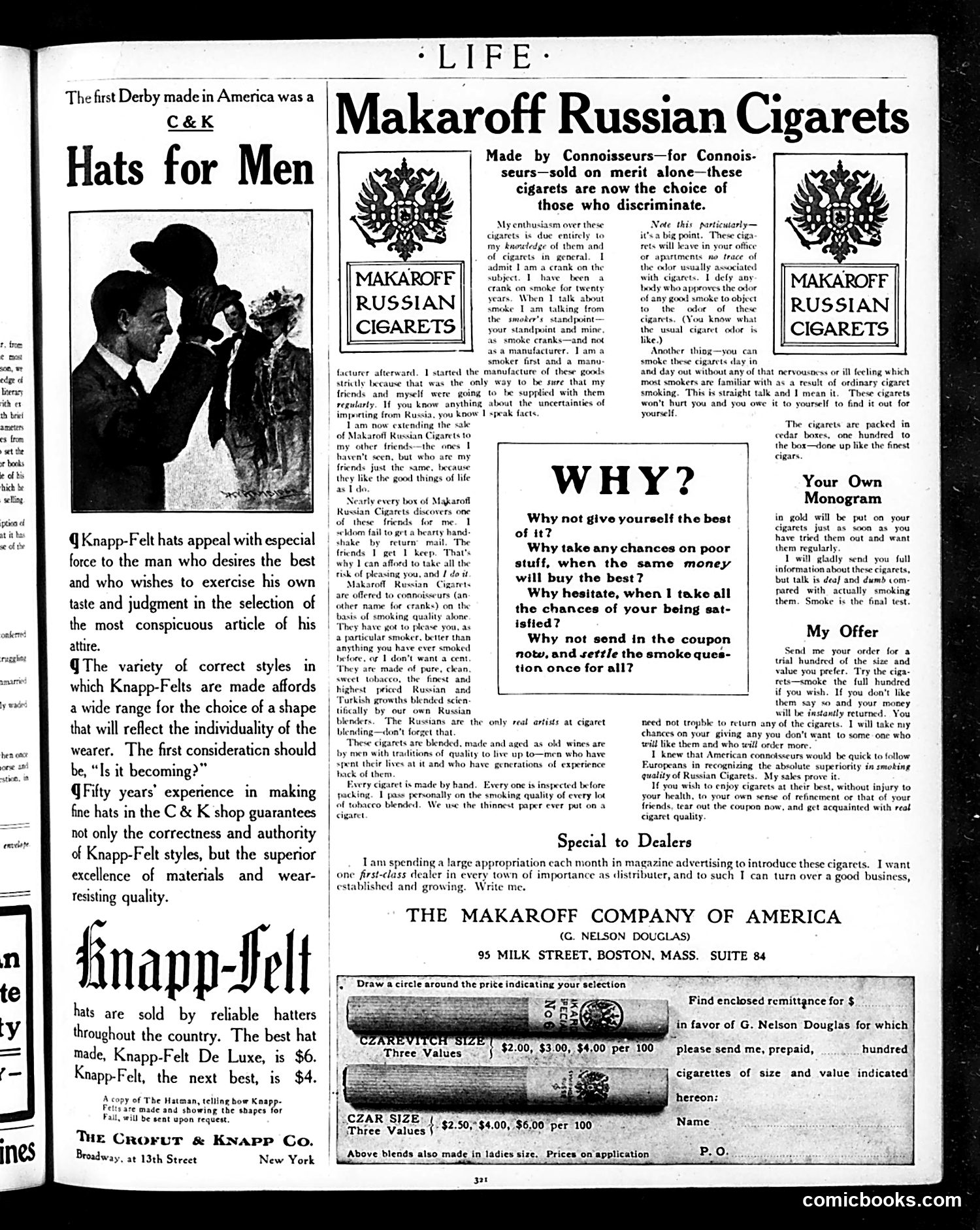
This page is primarily **advertising**, not satire. It contains two unrelated ads: **Left side:** Knapp-Felt hat company advertisement emphasizing quality, style variety, and 50 years of manufacturing expertise. The appeal targets men concerned with appearing fashionable and discriminating. **Right side:** Makaroff Russian Cigarettes advertisement featuring a long testimonial from the manufacturer (G. Nelson Douglas). The pitch emphasizes luxury, refinement ("made by connoisseurs"), and practical benefits: no offensive odor, no nervousness from smoking, and premium packaging. The "Your Own Monogram" detail suggests personalized luxury goods for wealthy consumers. Both ads target affluent, status-conscious men of the early 20th century and use similar rhetoric about quality, taste, and discrimination to justify premium pricing. There is no political cartoon or satire present—this is straightforward period advertising from *Life* magazine's commercial pages.
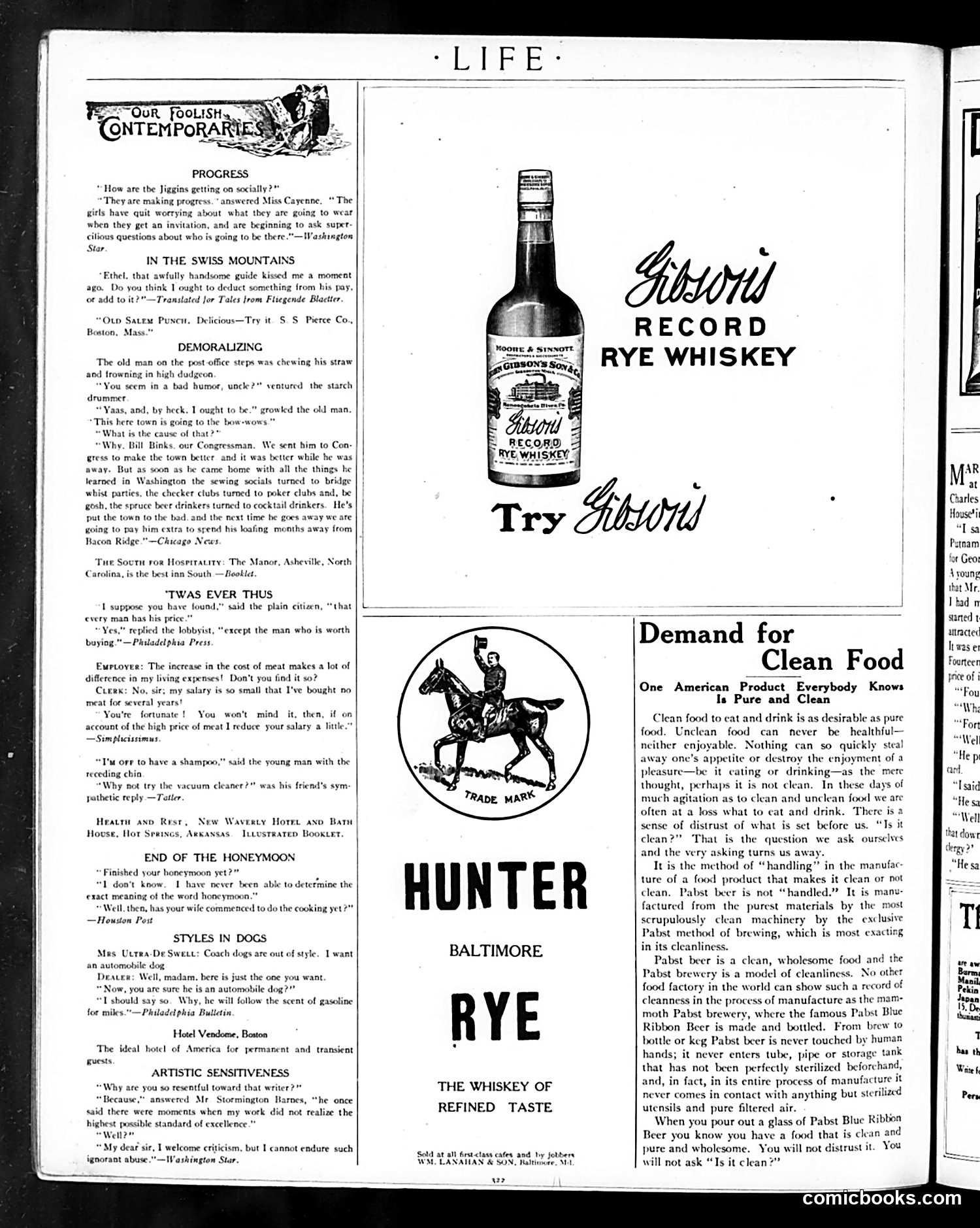
This page contains **brief satirical humor pieces** typical of Life's early 20th-century format, plus advertisements. The cartoons mock contemporary social anxieties: - **"Progress"**: The Jiggins (a recurring family in Life) worry about social etiquette—showing anxieties about rising middle-class status and social climbing. - **"Demoralizing"**: A congressman returns home and corrupts the town by introducing modern vices (bridge, poker, cocktails) instead of wholesome activities (checkers, beer). This reflects **rural anxiety about urban corruption and modernization**. - **"Honeymoon"**: A husband can't define "honeymoon" until his wife stops cooking—implying wives' household failures end marital romance. - **"Styles in Dogs"**: A woman wants an "automobile dog" (one that chases gasoline fumes)—satirizing the nouveau riche adopting whatever is fashionable. The humor assumes readers' shared concerns about social propriety, modernization's dangers, and class anxiety—all **distinctly early 1900s preoccupations**. The advertisements for whiskey and clean food reflect period consumer culture.
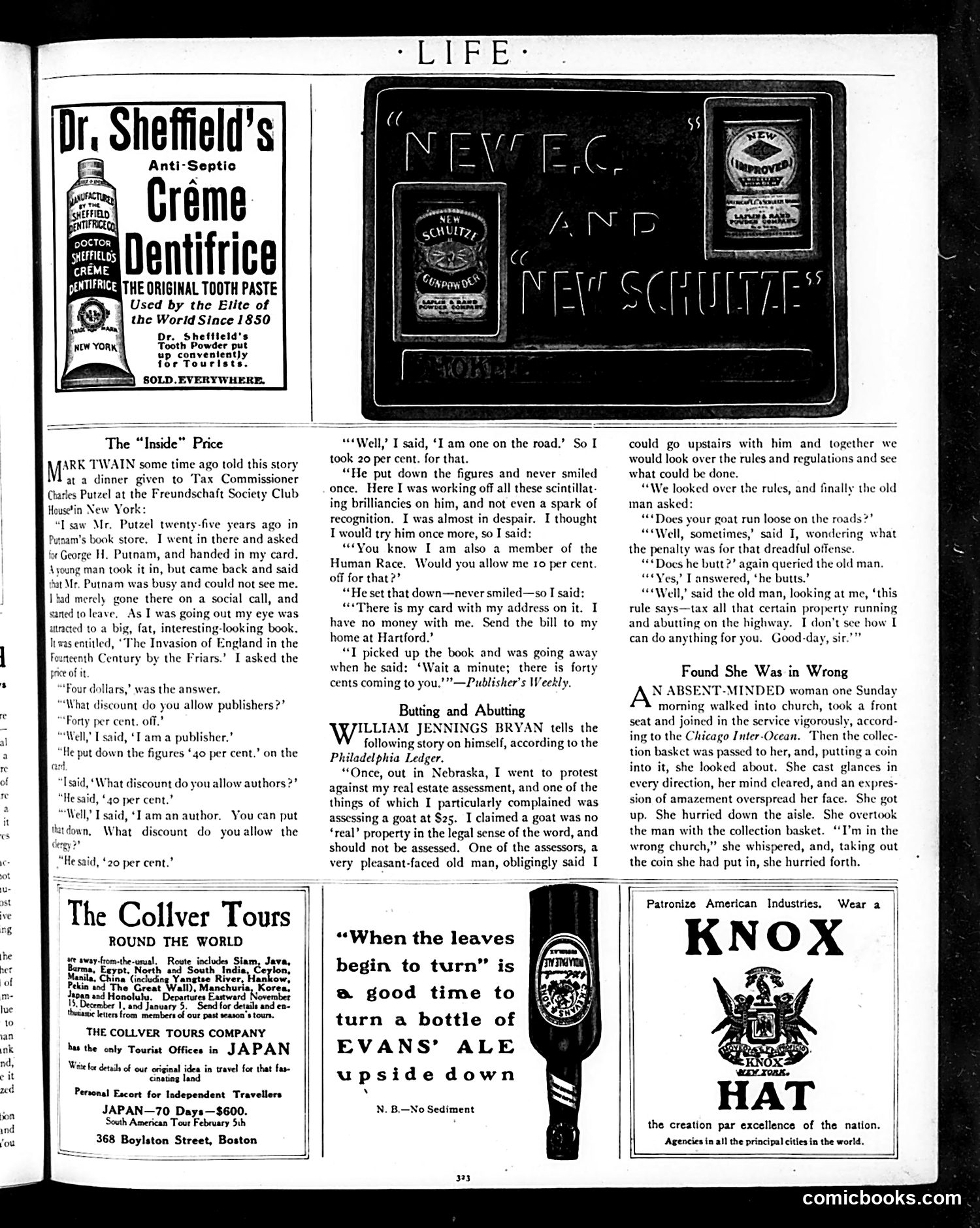
This page from *Life* magazine (a satirical publication) contains three humorous anecdotes showcasing wit through wordplay and bureaucratic absurdity: **"The 'Inside' Price"**: Mark Twain's story mocks booksellers' arbitrary discount structures. Twain progressively claims different identities (publisher, author, traveler, human) to extract larger discounts, culminating in the clerk's deadpan realization that Twain has negotiated himself into receiving *payment* rather than paying. **"Butting and Abutting"**: William Jennings Bryan's anecdote exploits a homophone trap. When protesting his goat's tax assessment, an assessor cites a regulation taxing property "abutting on the highway"—deliberately conflating "abutting" (bordering) with "butting" (the goat's charging behavior) to justify the tax. **"Found She Was in Wrong"**: A brief story (text cut off) about an absentminded woman entering the wrong church, mocking absent-mindedness. The page exemplifies early 20th-century American humor: clever linguistic tricks and encounters with obtuse bureaucrats presented as amusing anecdotes rather than political commentary.
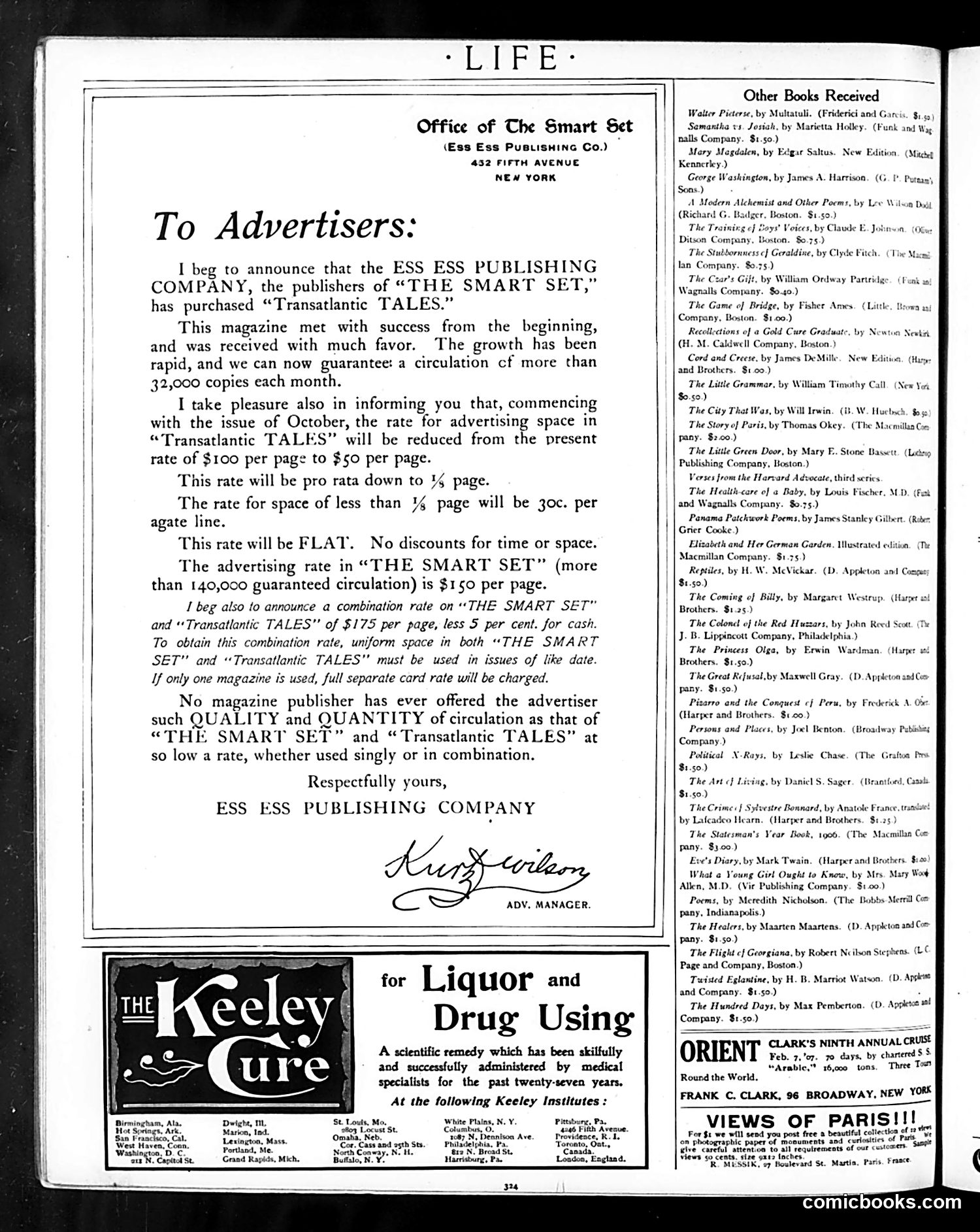
This page is primarily **advertising and publishing announcements**, not political satire or cartoon content. The main feature is a business letter from Ess Ess Publishing Company announcing they've acquired *Transatlantic Tales* magazine and are reducing advertising rates from $100 to $50 per page. They're promoting combination advertising deals across their two publications (*The Smart Set* and *Transatlantic Tales*). Below this is an advertisement for "The Keeley Cure"—a medical treatment facility claiming to remedy "Liquor and Drug Using" through methods administered by specialists over 27 years. This reflects early-1900s attitudes toward addiction as a medical condition treatable at specialized institutes. The right column lists newly received books, typical of *Life* magazine's literary review section. **No cartoons or satire appear on this page.** It's primarily commercial content and book notices from an early 20th-century magazine issue.
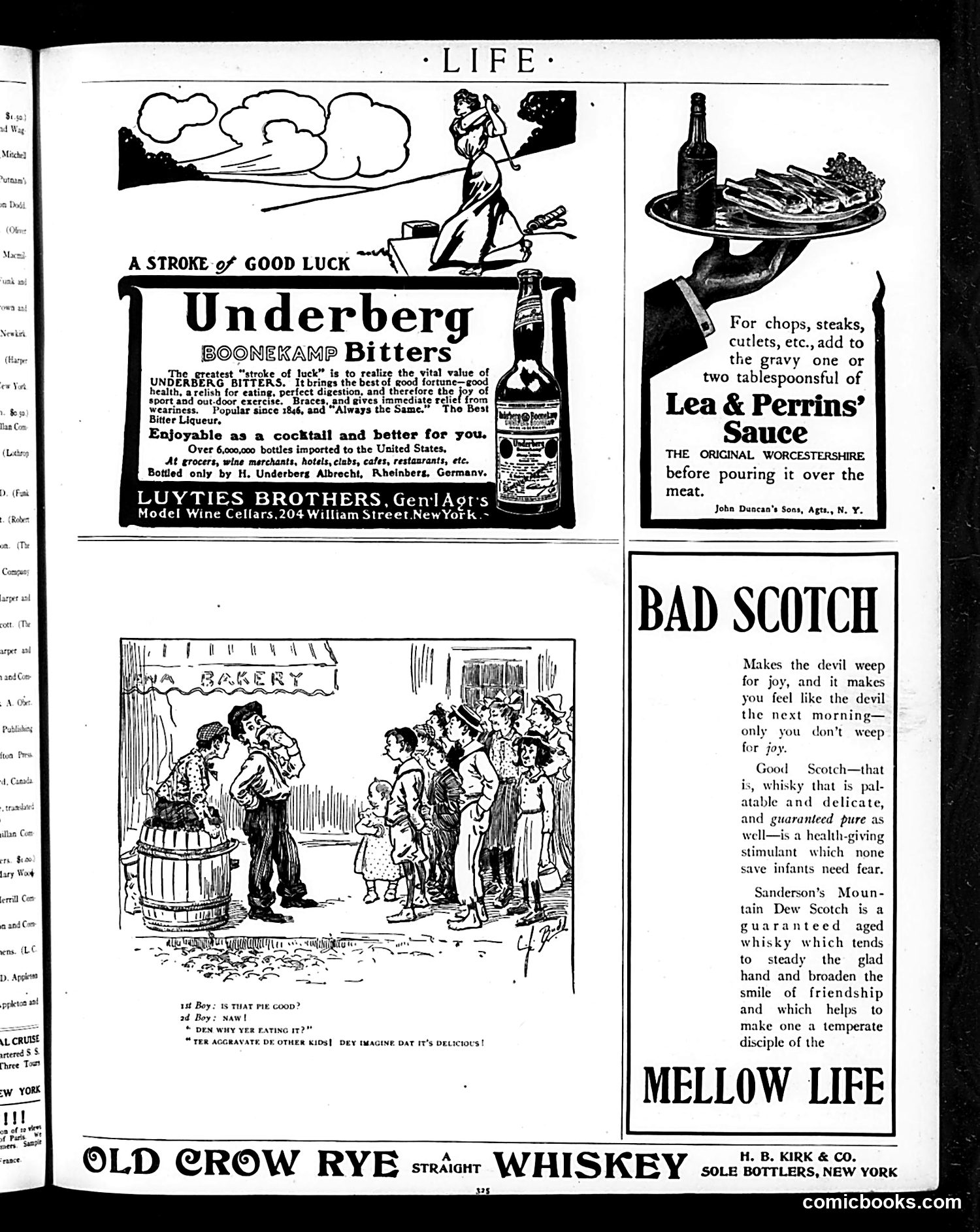
This page is primarily **advertising content** rather than editorial satire. It features multiple liquor and condiment advertisements from the early 20th century, each employing period marketing strategies: **Notable ads include:** - **Underberg Bitters**: Claims health benefits ("perfect digestion," "immediate relief from weariness"), marketed as both medicinal tonic and cocktail ingredient - **Lea & Perrins Sauce**: Simple product endorsement for cooking - **Bad Scotch/Sanderson's Mountain Dew**: Humorous copywriting acknowledging inferior whisky makes one feel "like the devil" the next morning, contrasting with quality Scotch as promoting friendship and temperance - **Old Crow Rye**: Bottom banner advertisement The only actual **cartoon** is a small comic strip depicting bakery customers, with children asking why they're eating (unclear dialogue), likely a humorous vignette unrelated to the advertisements. These ads reflect pre-Prohibition attitudes toward alcohol as acceptable consumer products marketed with health claims now considered dubious or illegal.
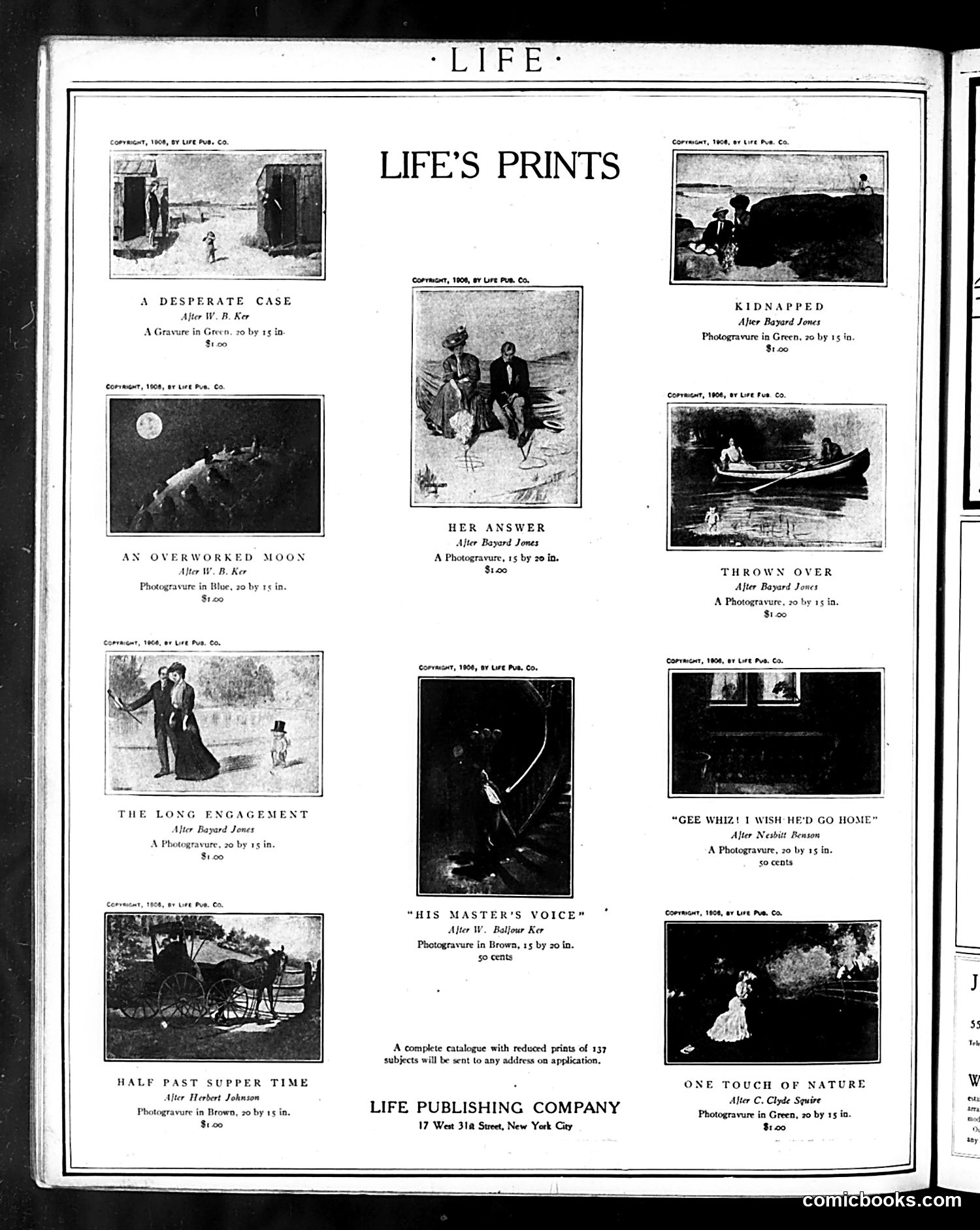
This is a catalog/advertisement page from *Life* magazine offering art prints for sale. It's not satirical commentary but rather a sales listing for photogravures—high-quality reproductions of original artworks—all priced between 50 cents and $1.20. The prints depict early 20th-century domestic and romantic scenarios: engagements, rejection ("Thrown Over"), kidnapping, and comedic domestic moments ("Gee Whiz! I Wish He'd Go Home"). Artists include W.B. Ker, Bayard Jones, and Herbert Johnson—illustrators popular with *Life* magazine's audience. The page demonstrates how *Life* monetized its editorial content by selling fine-art reproductions to middle-class readers who could afford quality home décor. The variety of subjects and price points suggests marketing to different customer segments. This was standard practice for illustrated magazines of the era.
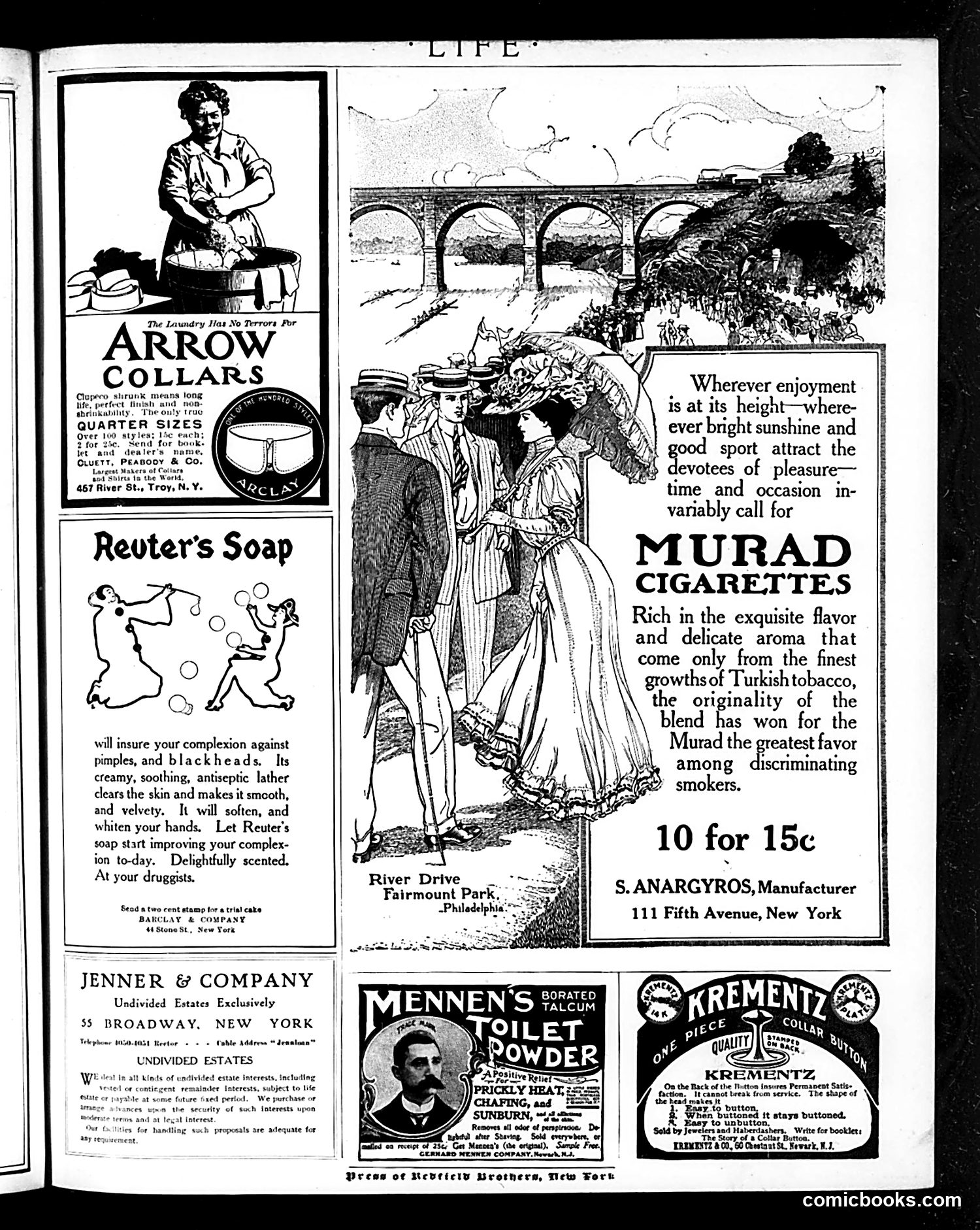
This is primarily an **advertising page** from an early 20th-century issue of *Life* magazine, containing no political cartoons or satire requiring historical context. The page features six product advertisements typical of the era: - **Arrow Collars**: Men's shirt collars marketed as shrink-resistant - **Reuter's Soap**: Complexion soap promising to clear pimples and blackheads - **Jenner & Company**: Real estate brokerage - **Murad Cigarettes**: Turkish tobacco cigarettes positioned as premium for "discriminating smokers" - **Mennen's Talcum Powder**: Boasted talc product - **Krementz Collar Button**: A practical fastening device marketed for durability The only visual elements are product illustrations and a pastoral scene (River Drive, Fairmount Park, Philadelphia) accompanying the Murad ad. There is no satire, caricature, or political commentary present—this is straightforward commercial promotion reflecting early 1900s consumer goods and marketing conventions.
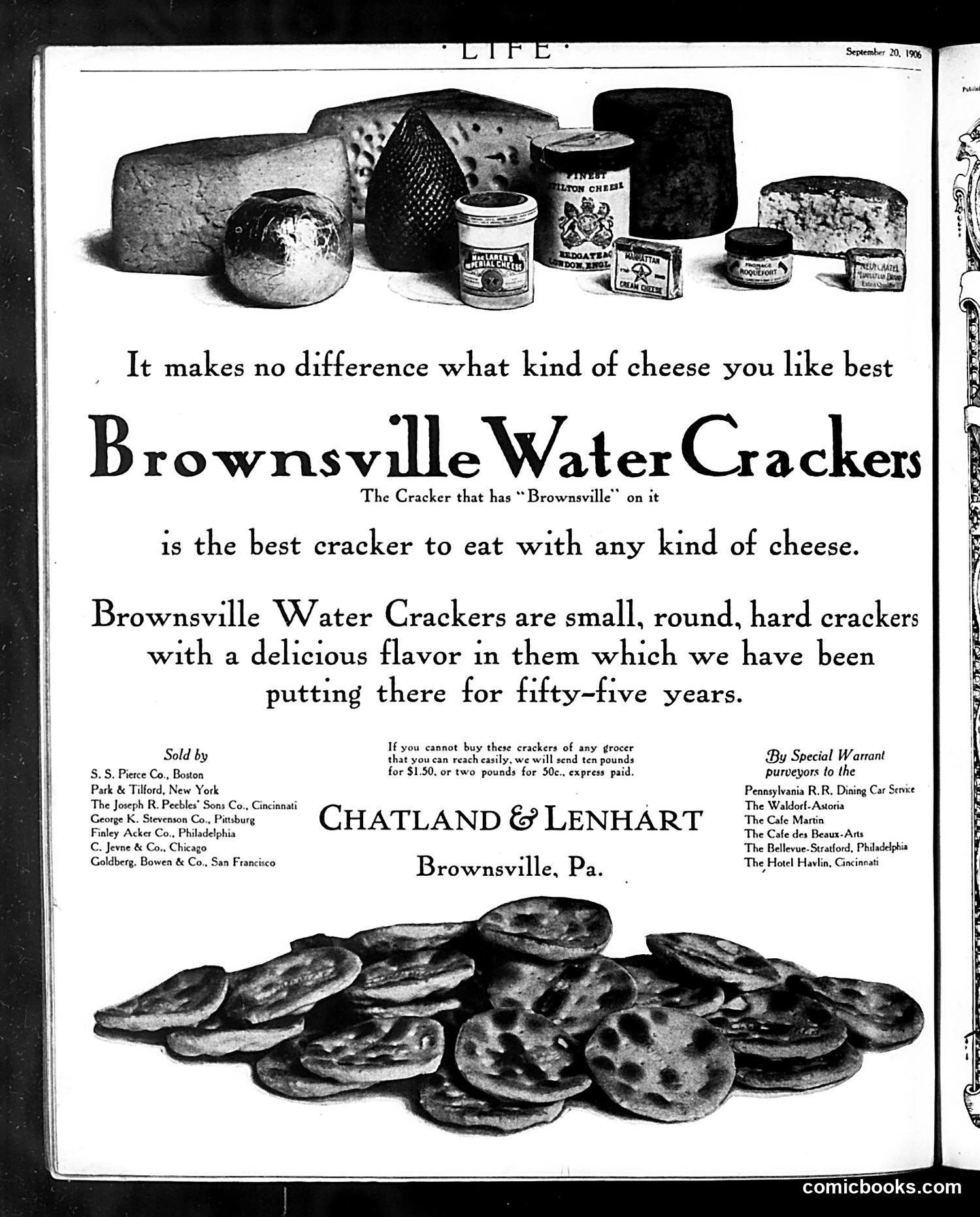
This is **a product advertisement, not political satire or a cartoon**. It promotes Brownsville Water Crackers made by Chatland & Lenhardt of Brownsville, Pennsylvania. The top image shows various cheese types to emphasize the product's versatility—the crackers pair with "any kind of cheese." The bottom shows the crackers themselves. The marketing angle is longevity and prestige: the crackers have had the same "delicious flavor" for fifty-five years, and are sold through upscale venues (Pennsylvania Railroad dining cars, the Waldorf-Astoria hotel, etc.). The "By Special Warrant" seal mimics royal warrant branding, lending authority. For modern readers: this reflects early 20th-century advertising strategy—associating products with luxury establishments and emphasizing tradition as a quality marker. There is no satire or political content here; it's straightforward product promotion in a magazine that, while satirical elsewhere, also carried paid advertising.