
Life, 1906-09-20 · page 18 of 28
Life — September 20, 1906 — page 18: what you’re looking at
What you’re looking at
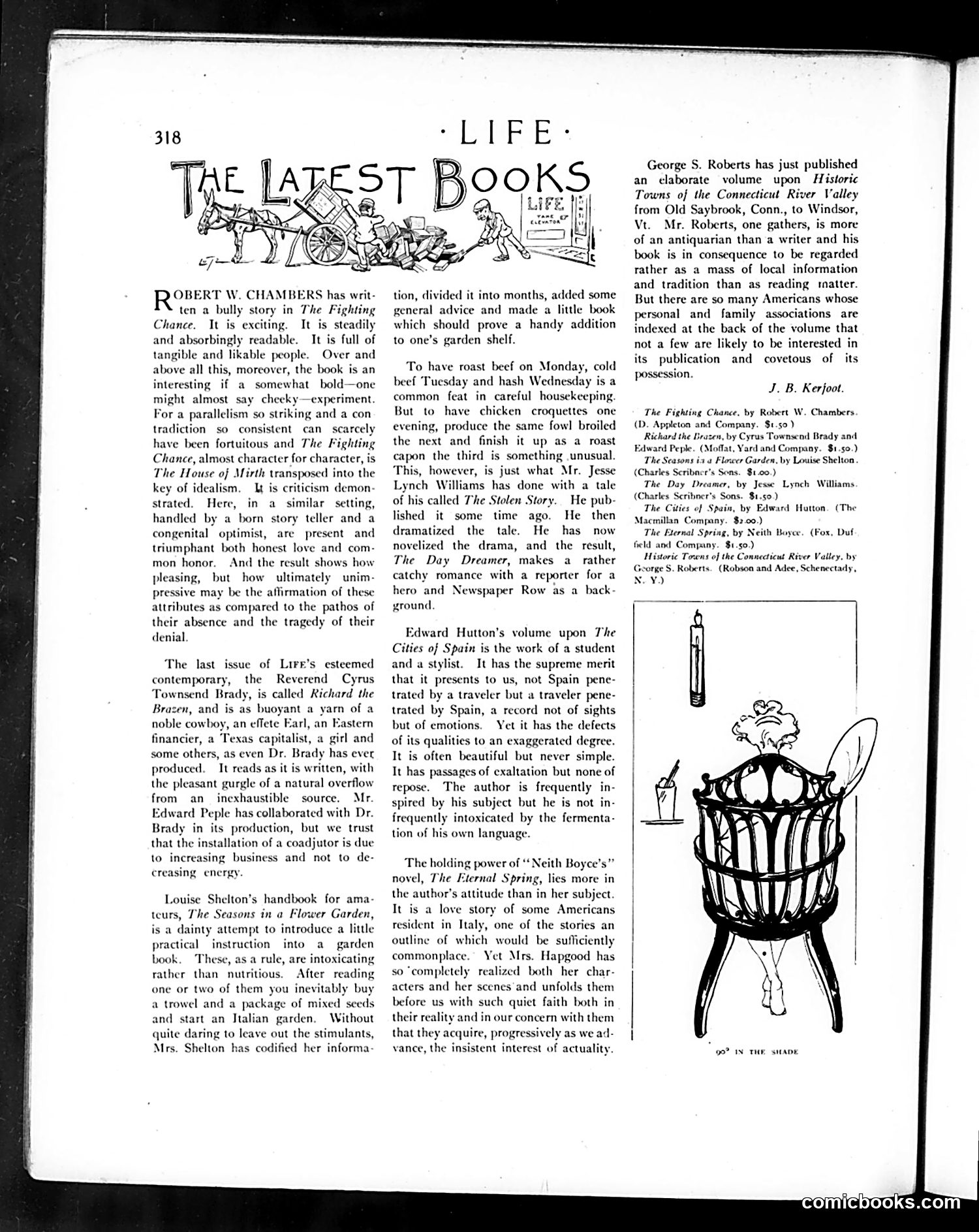
This is a book review section from *Life* magazine featuring literary criticism of contemporary novels. The page reviews works by Robert W. Chambers, Edward Hutton, and others, comparing *The Fighting Chance* to Edith Wharton's *The House of Mirth* as similar in structure but idealistic rather than tragic. The two illustrations are generic decorative vignettes—a bottle labeled "0" IN THE SHADE" and a basket of produce—accompanying the garden book review by Louise Shelton. These aren't political cartoons but editorial illustrations typical of early 20th-century magazine design. The satire is literary rather than political: *Life* critiques Hutton's flowery prose about Spain as occasionally "intoxicated by the fermentation of his own language"—mocking overwrought writing. This reflects *Life*'s role as a sophisticated cultural arbiter for educated readers.
📄 Transcribed text from this page (OCR, searchable)
Machine-transcribed from the original scan — historical spelling and the odd misread are preserved.
OBERT W. CHAMBERS has wri ten a bully story in The Fighting Chance. It is exciting. It is steadily and absorbingly readable. It is full of tangible and likable people. Over and above all this, moreover, the book is an interesting if a somewhat bold—one might almost say cheeky—experiment. For a parallelism so striking and a con tradiction so consistent can scarcely have been fortuitous and The Fighting Chance, almost character for character, is The House of Mirth transposed into the key of idealism. lt is criticism demon- strated. Here, in a similar setting, handled by a born story teller and a congenital optimist, are present and triumphant both honest love and com- mon honor. And the result shows how sing, but how ultimately unim- essive may be the aflirmation of these attributes as compared to the pathos of their absence and the tragedy of their denial issue of Lirr’s esteemed the The last contemporary, Reverend Cyrus Townsend Brac called Richard the Brazen, and is as buoyant a yarn of a an effete Earl, an Eastern financier, a as capitalist, a girl and some others, as even Dr. Brady has ever produced. It reads as it is written, with the pleasant gurgle of a natural overflow from an inexhaustible source. Mr. Edward Peple has collaborated with Dr. Brady in its production, but we trust that the installation of a coadjutor is due to increasing business and not to de- sing energy. noble cowbo: cre Lou Shelton’s handbook for a teurs, The Seasons in a Flower Garden, is a dainty attempt to introduce a little practical instruction into a garden book. Thi a rule, are intoxicating rather than nutritious. After reading one or two of them you inevitably buy a trowel and a package of mixed seeds and start an Italian garden, Without quite daring to leave out the stimulants, Mrs. Shelton has codified her informa tion, divided it into months, added some general advice and made a little book which should prove a handy addition to one’s garden shelf. To have roast beef on Monday, cold beef Tuesday and hash Wednesday is a common feat in careful housekeeping. But to have chicken croquettes one evening, produce the same fowl broiled the next and finish it up as a roast capon the third is something .unusual. This, however, is just what Mr. Jesse Lynch Williams has done with a tale of his called The Stolen Story. He pub- lished it some time ago. He then dramatized the tale. He has now ovelized the drama, and the result, The Day Dreamer, makes a_ rather catchy romance with a reporter for a hero and Newspaper Row as a back- ground. Edward Hutton’s volume upon The Cities of Spain is the work of a student and a stylist. It has the supreme merit that it presents to us, not Spain pene- trated by a traveler but a traveler pene- trated by Spain, a record not of sights but of emotions. Yet it has the defects of its qualities to an exaggerated degree. It is often beautiful but never simple. It has passages of exaltation but none of repose. The author is frequently in- spired by his subject but he is not in- frequently intoxicated by the fermenta- anguage. tion of his own The holding power of “Neith Boyce’s” novel, The Eternal Spring, lies more in the author's attitude than in her subject. It is a love story of some Americans resident in Italy, one of the stories an outline of which would be sufficiently commonpla Yet Mrs. Hapgood has so ‘completely realized both her char- acters and her scenes'and unfolds them before us with such quiet faith both in their reality and in our concern with them that they acquire, progres: as we ad- vance, the insistent interest of actuality. George S. Roberts has just published an elaborate volume upon Historic Towns of the Connecticut River Valley from Old Saybrook, Conn., to Windsor, Vt. Mr. Roberts, one gathers, is more of an antiquarian than a writer and his book is in consequence to be regarded rather as a mass of local information and tradition than as reading tnatter. But there are so many Americans whose personal and family associations are indexed at the back of the volume that not a few are likely to be interested in its publication and covetous of its possession. J. B. Kerjoot. The Fighting Chance, by Robert W. Chambers. (D. Appleton and Company. $1.50) Rickard the Brazen, by Cyrus Townsend Brady and Edward Peple. (Moffat, Yard and Company. $1.50.) The Seasons ia a Flower Garden, by Louise Shelton (Charles Scribace’s Sons. $1.00.) The Day Dreamer, by Jesse Lynch Williams (Charles Scribner's Sons. $1.50.) The Cities of Spain, by Edward Hutton. (The Macmillan Company. $2.00.) The Eternal Spring, by Neith Boyce. (Fox, Duf Geld and Company. $1.50.) Historic Towns of the Connecticut River Valley. by orge S. Roberts. (Robson and Adee, Schenectady, N.Y) 997 IN THR SHADE