
Life, 1906-09-20 · page 17 of 28
Life — September 20, 1906 — page 17: what you’re looking at
What you’re looking at
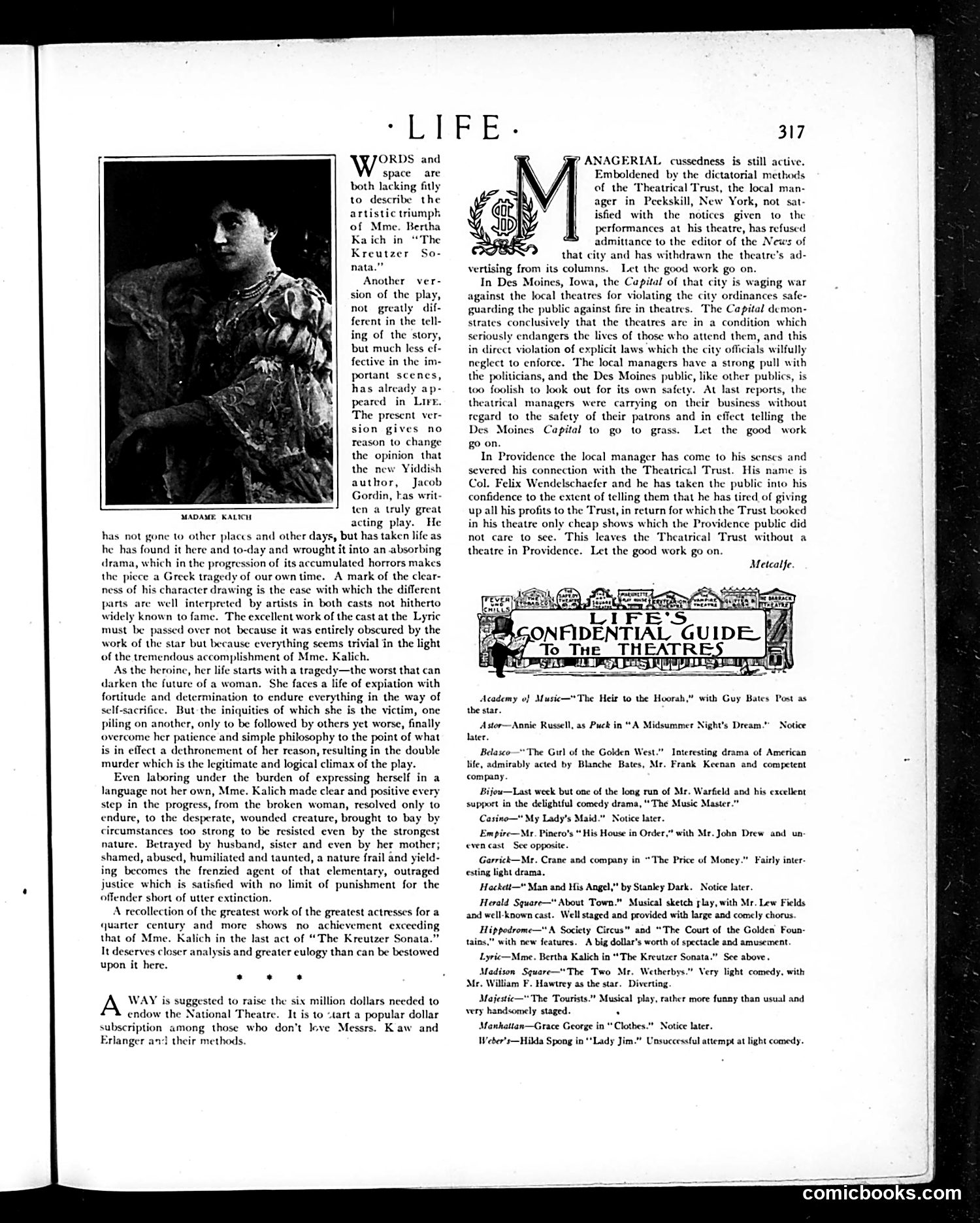
This page combines a theater review with industry criticism. The left side features a photograph of **Madame Bertha Kalich**, a Yiddish actress, praised extensively for her performance in "The Kreutzer Sonata." The review portrays her acting as transcendent, particularly her portrayal of a woman driven to murder by accumulated betrayals and injustice. The right column shifts to satire about **theatrical management corruption**. It attacks: 1. **A Peekskill, New York theater manager** who punished a newspaper editor for unfavorable reviews by banning him and withdrawing advertising 2. **Des Moines theaters** violating fire safety ordinances while city officials negligently refuse enforcement 3. **The "Theatrical Trust"** (the Klaw-Erlanger monopoly), whose dictatorial methods allegedly embolden such abuses The closing paragraph sarcastically suggests raising funds for a National Theatre independent of these corrupt managers, implying the existing theater industry is controlled by self-interested monopolists indifferent to public safety or press freedom.
📄 Transcribed text from this page (OCR, searchable)
Machine-transcribed from the original scan — historical spelling and the odd misread are preserved.
ETIPE ORDS and space are both lacking fitly to describe the artistic triumph of Mme. Bertha Ka ich in Kreutzer nata.”” Another ver- sion of the pla not greatly dif- ferent in the tel ing of the story, but much less ef- fective in the im- portant scenes, has already ap- peared in Lire. The present ver- sion gives no reason to change the opinion that the new Yiddish author, Jacob Gordin, kas writ- ten a truly great acting play. He has not gone to other places and other days, but has taken life as he has found it here and to-day and wrought it into an absorbing drama, which in the progression of its accumulated horrors makes the picce a Greek tragedy of our own time. A mark of the clear- ness of his character drawing is the ease with which the different parts are well interpreted by artists in both casts not hitherto widely known to fame. The excellent work of the cast at the Lyric must be passed over not because it was entirely obscured by the work of the star but because everything scems trivial in the light of the tremendous accomplishment of Mme. Kalich. As the heroine, her life starts with a tragedy—the worst that can darken the future of a woman. She faces a life of expiation with fortitude and determination to endure everything in the way of :If-sacrifice. But the iniquitics of which she is the victim, one ing on another, only to be followed by others yet worse, finally overcome her patience and simple philosophy to the point of what is in effect a dethronement of her reason, resulting in the double murder which is the legitimate and logical climax of the play. Even laboring under the burden of expressing herself in a language not her own, Mme. Kalich made clear and positive every step in the progress, from the broken woman, resolved only to endure, to the desperate, wounded creature, brought to bay by circumstances too strong to be resisted even by the strongest nature. Betrayed by husband, sister and even by her mother; shamed, abused, humiliated and taunted, a nature frail and yield- ing becomes the frenzied agent of that elementary, outraged justice which is satisfied with no limit of punishment for the offender short of utter extinction. A recollection of the greatest work of the greatest actresses for a quarter century and more shows no achievement exceeding that of Mme. Kalich in the last act of “The Kreutzer Sonata.” It deserves closer analysis and greater eulogy than can be bestowed upon it here. MADAME. KALICH WAY is suggested to raise the six million dollars needed to endow the National Theatre. It is to “tart a popular dollar subscription among those who don’t Ieve Messrs. K aw and Erlanger an‘i their methods. 317 Qe ANAGERIAL cussedness is still active. Emboldened by the dictatorial methods of the Theatrical Trust, the local man- ager in Peekskill, New York, not sat- isfied with the notices given to the performances at his theatre, has refused admittance to the editor of the News of that city and has withdrawn the theatre's ad- vertising from its columns. Let the good work go on. In Des Moines, Iowa, the Capital of that city is waging war against the local theatres for violating the city ordinances safe- guarding the public against fire in theatres. The Capital demon- strates conclusively that the theatres are in a condition which seriously endangers the lives of those who attend them, and this in direct violation of explicit laws which the city officials wilfully neglect to enforce. ‘The local managers have a strong pull with the politicians, and the Des Moines public, like other publics, is too foolish to look out for its own safety. At last reports, the theatrical managers were carrying on their business without regard to the safety of their patrons and in effect telling the Des Moines Capital to go to grass. Let the good work go on. In Providence the local manager has come to his senses and severed his connection with the Theatrical Trust. His name is Col. Felix Wendelschaefer and he has taken the public into his confidence to the extent of telling them that he has tired of giving up all his profits to the Trust, in return for which the Trust booked in his theatre only cheap shows which the Providence public did not care to see. This leaves the Theatrical Trust without a theatre in Providence. Let the good work go on. Metcalfe. Academy o} Music—"The Heir to the Hoorah," with Guy Bates Post as the star. Astor—Annic Russell, as Puck in “A Midsummer Night's Dream.” later. Belasco—"The Gurl of the Golden West.” Interesting drama of American life, admirably acted by Blanche Bates, Mr. Frank Keenan and competent company. Bijou—Last week but one of the long run of Mr. Warfield and his excellent support in the delightful comedy drama, “The Music Master.” Casino—" My Lady's Maid.” Notice later. Empire—Mr. Pinero's “ His House in Order, even cast See opposite. Garrick—Mr. Crane and company in ~ esting light drama, Heckett—" Man and His Angel,” by Stanley Dark. Notice later. Herald Square—" About Town." Musical sketch play, with Mr. Lew Fields and well-known cast. Well staged and provided with large and comely chorus Hippodrome—" A Society Circus” and “The Court of the Golden Foun- tains,” with new features. A big dollar's worth of spectacle and amusement. Lyric—Mme. Bertha Kalich in “The Kreutzer Sonata.” See above. Madison Square—"The Two Mr. Wetherbys.” Very light comedy, with Mr. William F. Hawtrey as the star. Diverting. Notice ith Mr. John Drew and un- ‘The Price of Money.” Fairly inter. Mojestic—""The Tourists.” Musical play, rather more funny than usual and very handsomely staged. . Manhattan—Grace George in“ Clothes." Notice later. Weber’s—Hilda Spong in ‘Lady Jim.” Unsuccessful attempt at light comedy. comicbooks.com