
Life, 1906-09-20 · page 16 of 28
Life — September 20, 1906 — page 16: what you’re looking at
What you’re looking at
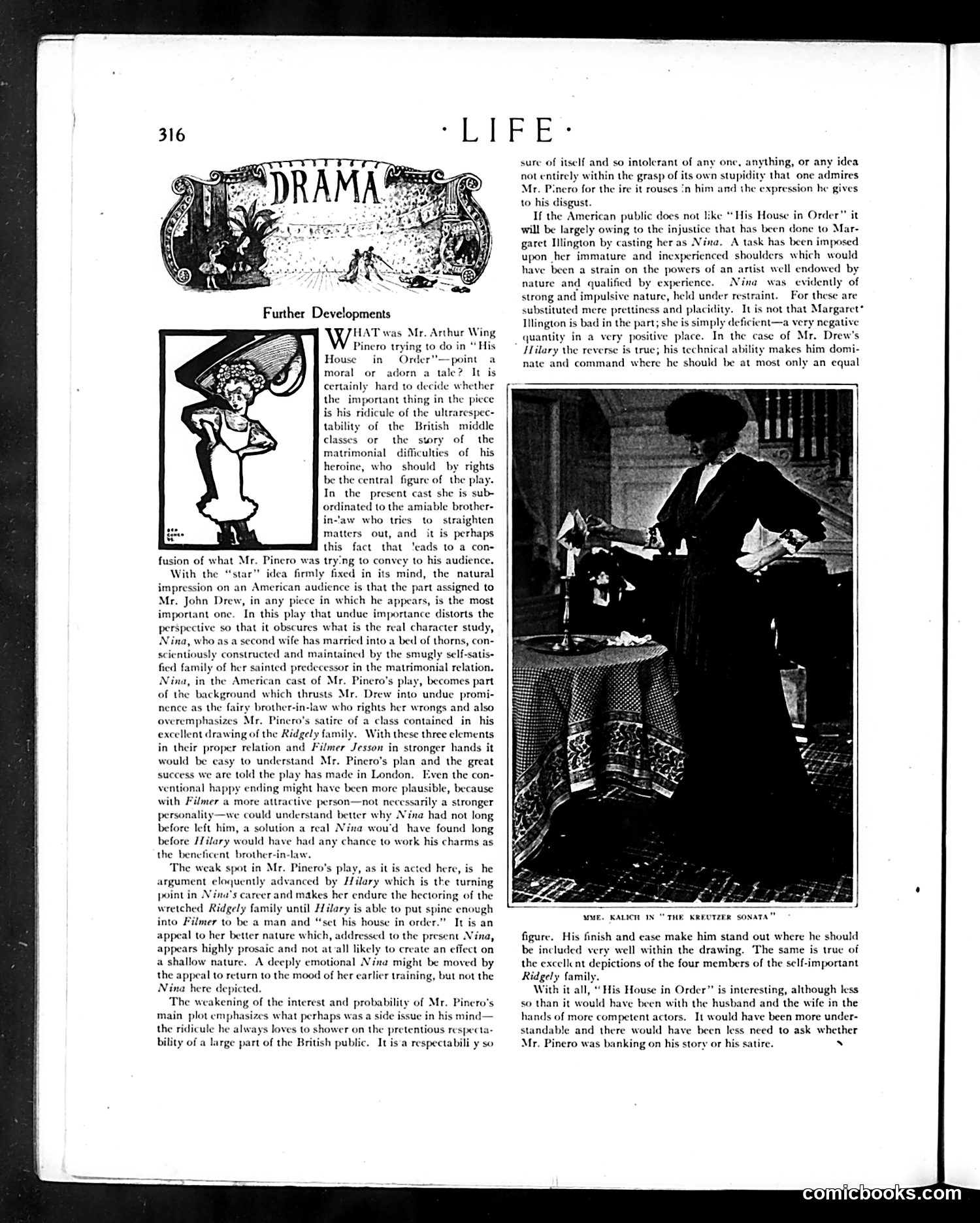
This is a theater review of Arthur Wing Pinero's play "His House in Order," with a cartoon mocking the production's casting choices. The text criticizes how American actor John Drew's star power distorted the play's structure. Pinero intended the play to spotlight **Nina**, a second wife trapped in a dysfunctional family, as the central character study—satirizing British middle-class respectability and hypocrisy. However, Drew's prominent role as the "fairy brother-in-law" who solves everyone's problems overshadows Nina's story. The review faults actress Margaret Ilington as miscast—the role requires an emotionally complex, mature performer, but she delivers a shallow interpretation. This casting error weakens the play's central argument about duty and emotional restraint. The cartoon (left) depicts the theatrical confusion—a performer gesturing dramatically, embodying the "star system" problem: famous actors demand prominent roles regardless of dramatic logic.
📄 Transcribed text from this page (OCR, searchable)
Machine-transcribed from the original scan — historical spelling and the odd misread are preserved.
*LIFE> Further Developments HAT was Mr. Arthur Wing Pinero trying to do in “His House in Order"—point a moral or adorn a tale? It is certainly hard to decide whether the important thing in the piece is his ridicule of the ultrarespec- tability of the British middle classes or the story of the matrimonial difficulties of _ his heroine, who should by rights be the central figure of the play. In the present cast she is sub- ordinated to the amiable brother- in-'aw who tries to. straighten matters out, and it is perhaps this fact that 'cads to a con- fusion of what Mr. Pincro was try:ng to convey to his audienc: With the “star” idea firmly fixed in its mind, the natural impression on an American audience is that the part assigned to Mr. John Drew, in any piece in which he appears, is the most important one. In this play that undue importance distorts the perspective so that it obscures what is the real character study, Nina, who as a second wife has married into a bed of thorns, con- scientiously constructed and maintained by the smugly self-satis« fied family of her sainted predecessor in the matrimonial relation. Nina, in the American cast of Mr. Pinero's play, becomes part of the background which thrusts Mr. Drew into undue promi- nence as the fairy brother-in-law who rights her wrongs and also overemphasizes Mr. Pinero’s satire of a class contained in his excellent drawing of the Ridgely family. With these three elements in their proper relation and Filmer Jesson in stronger hands it would be easy to understand Mr. Pinero's plan and the great success we are told the play has made in London. Even the con- ventional happy ending might have been more plausible, because with Filmer a more attractive person—not necessarily a stronger personality—we could understand better why Nina had not long before left him, a solution a real Nina wou'd have found long before Hilary would have had any chance to work his charms as the beneficent brother-in-law. ‘The weak spot in Mr. Pinero's play, as it is acted here, is he argument eloquently advanced by Hilary which is the turning point in Nina's career and makes her endure the hectoring of the wretched Ridgely family until Hilary is able to put spine enough into Filmer to be a man and “set his house in order.” It is an appeal to her better nature which, addressed to the present Nina, appears highly prosaic and not at-all likely to create an effect on a shallow nature. A deeply emotional Nina might be moved by the appeal to return to the mood of her earlier training, but not the Nina here depicted. The weakening of the interest and probability of Mr. Pincro’s main plot emphasizes what perhaps was a side issue in his mind— the ridicule he always loves to shower on the pretentious respecta- bility of a large part of the British public. It isa respectabili y so sure of itself and so intolerant of any one, anything, or any idea not entirely within the grasp of its own stupidity that one admires Mr. Pinero for the ire it rouses in him and the expression he gives to his disgust If the American public docs not like “His House in Order” it will be largely owing to the injustice that has been done to Mar- garet Ilington by casting her as Nina. A task has been imposed upon her immature and inexperienced shoulders which would have been a strain on the powers of an artist well endowed by nature and qualified by experience. Ning was evidently of strong and impulsive nature, held under restraint. For these are substituted mere prettiness and placidity. It is not that Margarct* Ilington is bad in the part; she is simply deficient—a very negative quantity in a very posit ace. In the case of Mr. Drew's Hilary the reverse is truc; his technical ability makes him domi- nate and command where he should be at most only an equal MIME. KALICH IN “THE KREUTZER SONATA" figure. His finish and case make him stand out where he should be included very well within the drawing. The same is true of the excell nt depictions of the four members of the self-important Ridgely family. With it all, “His House in Order” is interesting, although less so than it would have been with the husband and the wife in the hands of more competent actors. It would have been more under standable and there would have been less need to ask whether Mr. Pinero was banking on his story or his satire. SN