
Life, 1906-09-20 · page 8 of 28
Life — September 20, 1906 — page 8: what you’re looking at
What you’re looking at
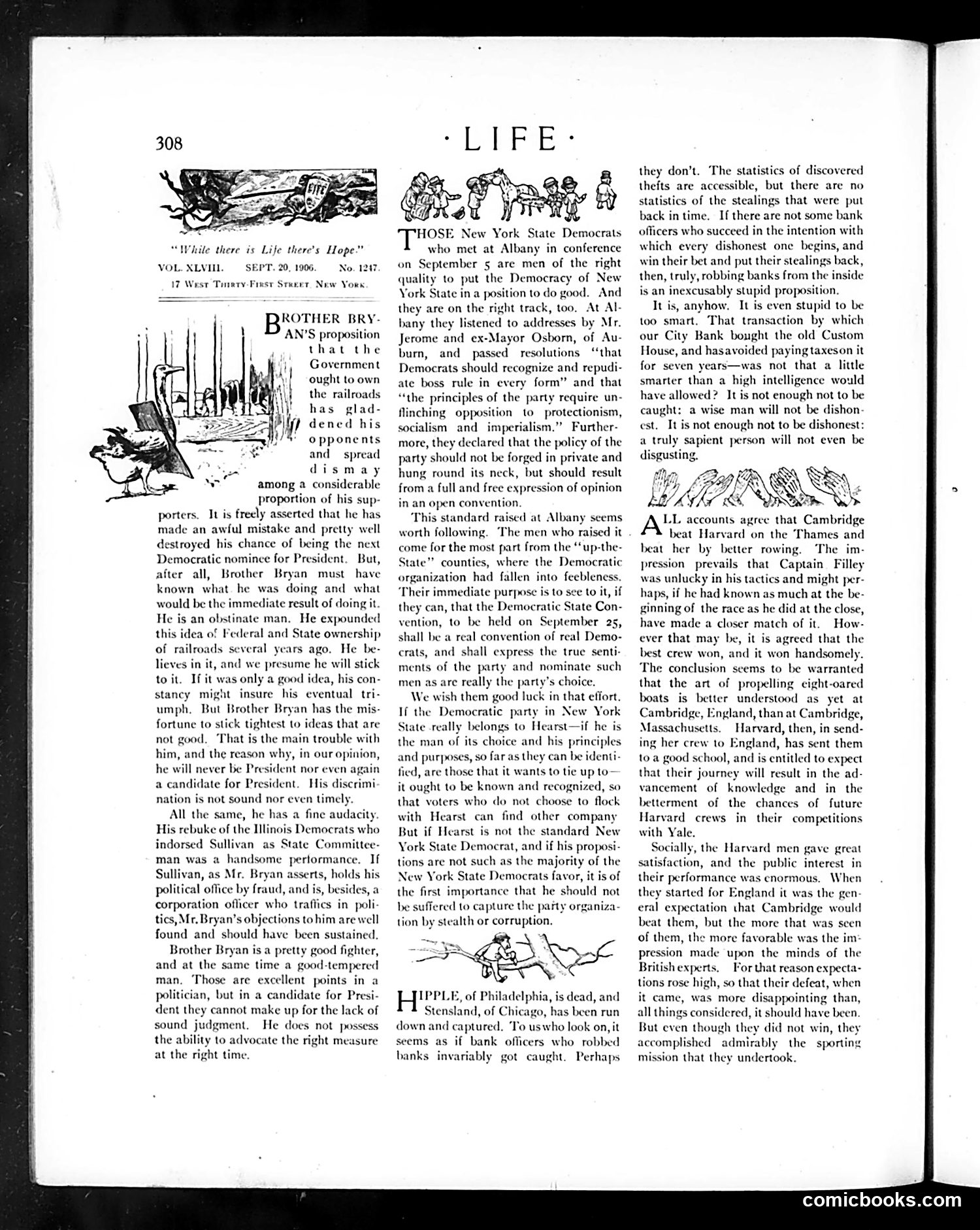
This page critiques New York State Democratic politics. The text discusses Brother Bryan's failed presidential ambitions and criticizes him for endorsing railroad interests—a major political issue of the Progressive era. The cartoon (left) depicts Bryan as a figure destroyed or defeated, illustrating the article's argument that his compromises damaged the Democratic Party's credibility. The piece argues that if Democrats truly belong to William Randolph Hearst (a newspaper magnate and political figure), they should nominate him openly rather than secretly backing Hearst's preferred candidates. The satire ridicules Democratic hypocrisy and power-brokering behind closed doors while claiming to represent popular will. References to Cambridge and Harvard crews appear separate, discussing boat racing competitions.
📄 Transcribed text from this page (OCR, searchable)
Machine-transcribed from the original scan — historical spelling and the odd misread are preserved.
While there is Life there's Hope” VOL. XLVI. ". 20, 1906. 17 West Tinety-Fixsr Stacet New Yors No. 1247) ROTHER BRY- AN’S proposition that the Government ought to own the railroads has glad- dened his opponents and spread dismay among a considerable proportion of his sup- porters. It is freely asserted that he has made an awful mistake and pretty well destroyed his chance of being the next Democratic nomince for President. But, after all, Brother Bryan must have known what. he was doing and what would be the immediate result of doing it. He is an obstinate man, He expounded this idea of Federal and State ownership of railroads several ye ago. He be- lieves in it, and we presume he will stick to it. If it was only a good idea, his con- stancy might insure his eventual tri- umph, But Brother Bryan has the mis- fortune to stick tightest to ideas that are not good, That is the main trouble with him, and the reason why, in our opinion, he will never be President nor even again a candidate for President. His discrimi nation is not sound nor even timely, All the same, he has a fine audacity. His rebuke of the Illinois Democrats who indorsed Sullivan as State Committee- man was a handsome perlormance. If Sullivan, as Mr. Bryan asserts, holds his political office by fraud, and is, besides, a corporation officer who traflics in poli- tics, Mr. Bryan’s objections to him are well found and should have been sustained. Brother Bryan is a pretty good fighter, and at the same time a good-tempered Those are excellent points in a politician, but in a candidate for Pre: dent they cannot make up for the lack of sound judgment. He does not possess the ability to advocate the right measure at the right time. HOSE New York State Democrats who met at Albany in conference on September 5 are men of the right quality to put the Democracy of New York State in a position to do good. And they are on the right track, too, At Al- bany they listened to addresses by Mr. Jerome and ex-Mayor Osborn, of Au- burn, and pa esolutions ‘that Democrats should recognize and repudi- ate boss rule in every form” and that “the principles of the party require un- flinching opposition to protectionism, socialism and imperialism.” Further- more, they declared that the policy of the party should not be forged in private and hung round its neck, but should result from a full and free expression of opinion in an open convention. This standard raised at Albany seems worth following. The men who raised it come for the most part from the “up-th State” counties, where the Democratic organization had fallen into feeblenes ‘Their immediate purpose is to see to it, if they can, that the Democratic State Con- vention, to be held on September 25, | be a real convention of real Demo- crats, and shall express the true senti- ments of the party and nominate such men as are really the party’s choic We wish them good luck in that effort. > Democratic party in New York State really belongs to Hearst—if he is the man of its choice and his principles and purposes, so far as they can be identi- fied, are those that it wants to tic up to— it ought to be known and recognized, so that voters who do not choose to flock with Hearst can find other company But if Hearst is not the standard New York State Democrat, and if his proposi- tions are not such as the majority of the New York State Democrats favor, it is of the first importance that he should not be suffered to capture the pafty organiza- tion by stealth or corruption, 2, of Philadelphia, is dead, and Stensland, of Chicago, has been run down and captured. ‘To uswho look on, it seems as if bank officers who robbed banks invariably got caught. Perhaps they don’t. The statistics of discovered thefts are accessible, but there are no statistics of the stealings that were put back in time. If there are not some bank officers who succeed in the intention with which every dishonest one begins, and win their bet and put their stealings back, then, truly, robbing banks from the inside is an inexcusably stupid proposition. It is, anyhow, It is even stupid to be too smart. That transaction by which our City Bank bought the old Custom House, and hasavoided paying taxeson it for seven years—was not that a little smarter than a high intelligence would have allowed? It is not enough not to be caught: a wise man will not be dishon est. It is not enough not to be dishonest: a truly sapient person will not even be disgusting, LL accounts agree that Cambridge beat Harvard on the Thames and beat her by better rowing. The im- pression prevails that Captain. Filley was unlucky in his tactics and might per- haps, if he had known as much at the be- ginning of the race as he did at the clo: have made a closer match of it. How- ever that may be, it is agreed that the best crew won, and it won handsomely. The conclusion seems to be warranted that the art of propelling cight-oared boats is better understood as yet at Cambridge, England, than at Cambridge, Massachusetts. Harvard, then, in send- ing her crew to England, has sent them toa good school, and is entitled to expect that their journey will result in the ad- vancement of knowledge and in the betterment of the chances of future Harvard crews in their competitions with Yale, Socially, the Harvard men gave great satisfaction, and the public interest in their performance was enormous. When they started for England it was the gen- eral expectation that Cambridge would beat them, but the more that was scen of them, the more favorable was the im- pression made upon the minds of the British experts. For that reason expecta- tions rose high, so that their defeat, when it came, was more disappointing than, all things considered, it should have been. But even though they did not win, they accomplished admirably the sporting mission that they undertook. comicbooks.com