
Life, 1906-09-20 · page 4 of 28
Life — September 20, 1906 — page 4: what you’re looking at
What you’re looking at
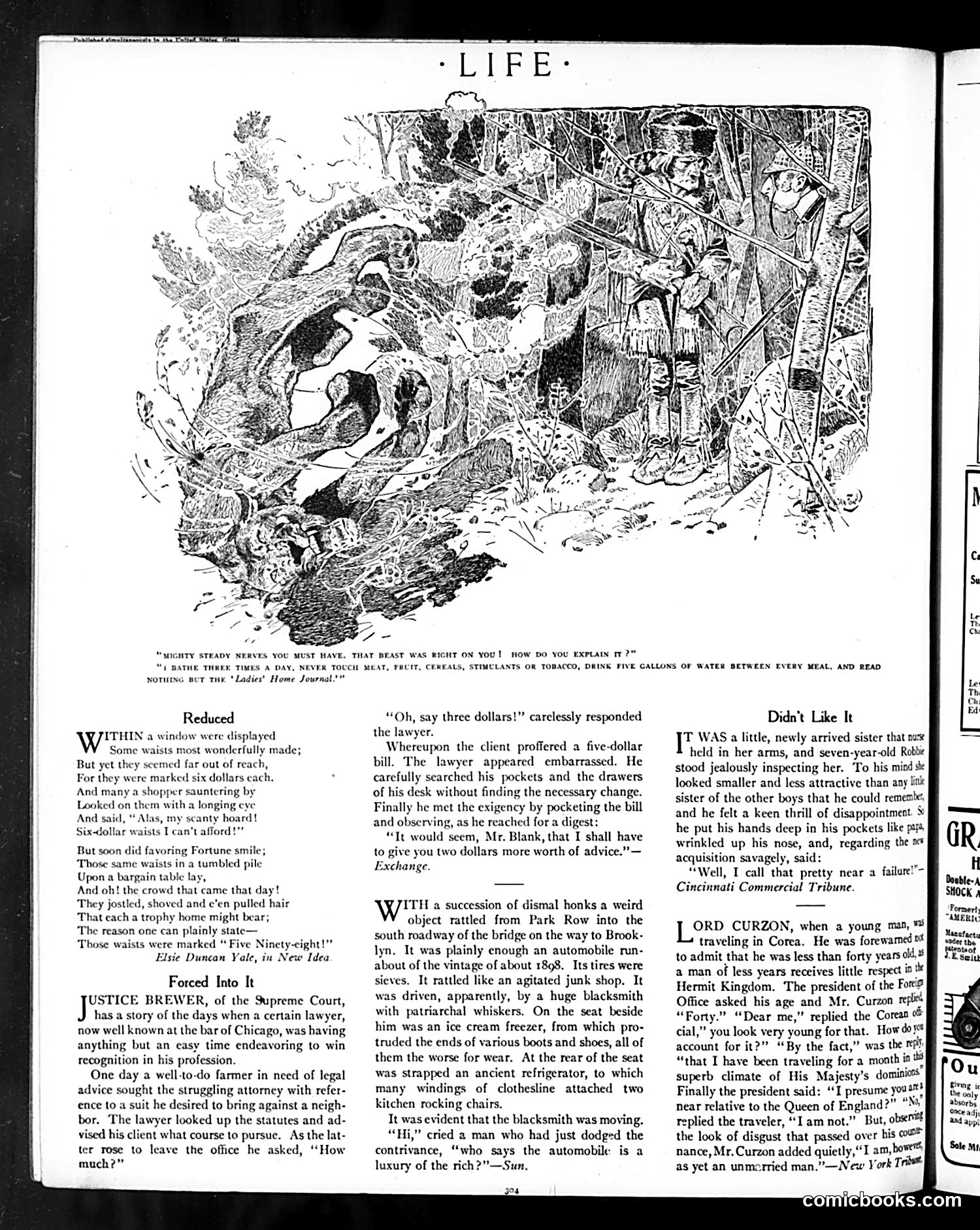
This page contains three separate humorous anecdotes rather than political cartoons: 1. **"Reduced"**: A satirical poem about a shopper at a store sale, mocking consumerism and bargain-hunting behavior. 2. **"Forced Into It"**: A joke about a struggling lawyer who charges a client only $3 instead of $5, then must awkwardly admit he cannot make change—satirizing both legal incompetence and poverty. 3. **"Didn't Like It"**: A story about a newly-arrived sister who feels inferior to her brother's fiancée, ultimately rejecting the engagement out of jealousy. 4. **Two brief items** ("Oh, say three dollars!" and "Lord Curzon") about lawyers and travel. The page represents *Life*'s typical content: light social satire targeting middle-class anxieties, consumer culture, and domestic relationships rather than explicit political commentary. The detailed illustration depicts a forest scene, likely accompanying one of these stories.
📄 Transcribed text from this page (OCR, searchable)
Machine-transcribed from the original scan — historical spelling and the odd misread are preserved.
GHTY STRADY NERVES YOU MUST HAVE. THAT BEAST WAS RICIIT ON YoU! HOW DO YoU EXPLAIN Tr?" 4 BATHE THRE NoTHiNe BUT THK ‘Ladies’ Home Journal!” Reduced ITHIN a window were displayed Some waists most wonderfully made; But yet emed far out of reach, For they were marked six dollars each. And many a shopper sauntering by Looked on them with a longing eye And said, ‘Alas, my scanty hoard! Six-dollar waists I can’t afford!” But soon did favoring Fortune smile; ‘Those same waists in a tumbled pile Upon a bargain table lay, And oh! the crowd that came that day! ‘They jostled, shoved and e’en pulled hair ‘That cach a trophy home might bear; The reason one can plainly state— Those waists were marked “Five Ninety-cight!”” Elsie Duncan Yale, in New Idea Forced Into It USTICE BREWER, of the Supreme Court, has a story of the days when a certain lawyer, now well known at the bar of Chicago, was having anything but an easy time endeavoring to win recognition in his profession. One day a well-to-do farmer in need of legal advice sought the struggling attorney with refer- ence to a suit he desired to bring against a neigh- bor. The lawyer looked up the statutes and ad- vised his client what course to pursue. As the lat- ter rose to leave the office he asked, “How much?” “Oh, say three dollars!” carelessly responded the lawyer. Whereupon the client proffered a five-dollar bill. The lawyer appeared embarrassed. He carefully searched his pockets and the drawers of his desk without finding the necessary change. Finally he met the exigency by pocketing the bill and observing, as he reached for a digest: “Tt would seem, Mr. Blank, that I shall have to give you two dollars more worth of advice.”— Exchange. ITH a succession of dismal honks a weird object rattled from Park Row into the south roadway of the bridge on the way to Brook- lyn. It was plainly enough an automobile run- about of the vintage of about 1898. Its tires were sieves. It rattled like an agitated junk shop. It was driven, apparently, by a huge blacksmith with patriarchal whiskers. On the seat beside him was an ice cream freezer, from which pro- truded the ends of various boots and shoes, all of them the worse for wear. At the rear of the seat was strapped an ancient refrigerator, to which many windings of clothesline attached two kitchen rocking chairs. It was evident that the blacksmith was moving, “Hi,” cried a man who had just dodged the contrivance, “who says the automobile is a luxury of the rich?” —Sun, aot TIMES A DAY, NEVER TOUCH MEAT, FRUIT, CEREALS, STIMCLANTS OR TOBACCO, DRINK FIVE GALLONS OF WATER BETWEEN EVERY MEAL, AND READ Didn't Like It r. WAS a little, newly arrived sister that nx held in her arms, and seven-year-old Robie stood jealously inspecting her. ‘To his mind looked smaller and less attractive than any lite sister of the other boys that he could remembe, and he felt a keen thrill of disappointment. he put his hands deep in his pockets like poy vrinkled up his nose, and, regarding the + ion savagely, said: “Well, I call that pretty near a failure!” Cincinnati Commercial Tribune. Lok CURZON, when a young man, traveling in Corea. He was forewamed tt to admit that he was less than forty years old, a man of less years receives little respect in th Hermit Kingdom. The president of the Forig Office asked his age and Mr. Curzon replies “Forty.” “Dear me,” replied the Coreat & cial,” you look very young for that. How 0! account for it?” “By the fact,” was the rl “that I have been traveling for a month ia ts superb climate of His Majesty’s dominios Finally the president said: “I presume yous! near relative to the Queen of England?” “Ss replied the traveler, “I am not.” But, obs the look of disgust that passed over his com nance, Mr. Curzon added quietly,““I am, howe as yet an unmorried man.”—New York 11