
A complete issue · 48 pages · 1905
Life — November 2, 1905
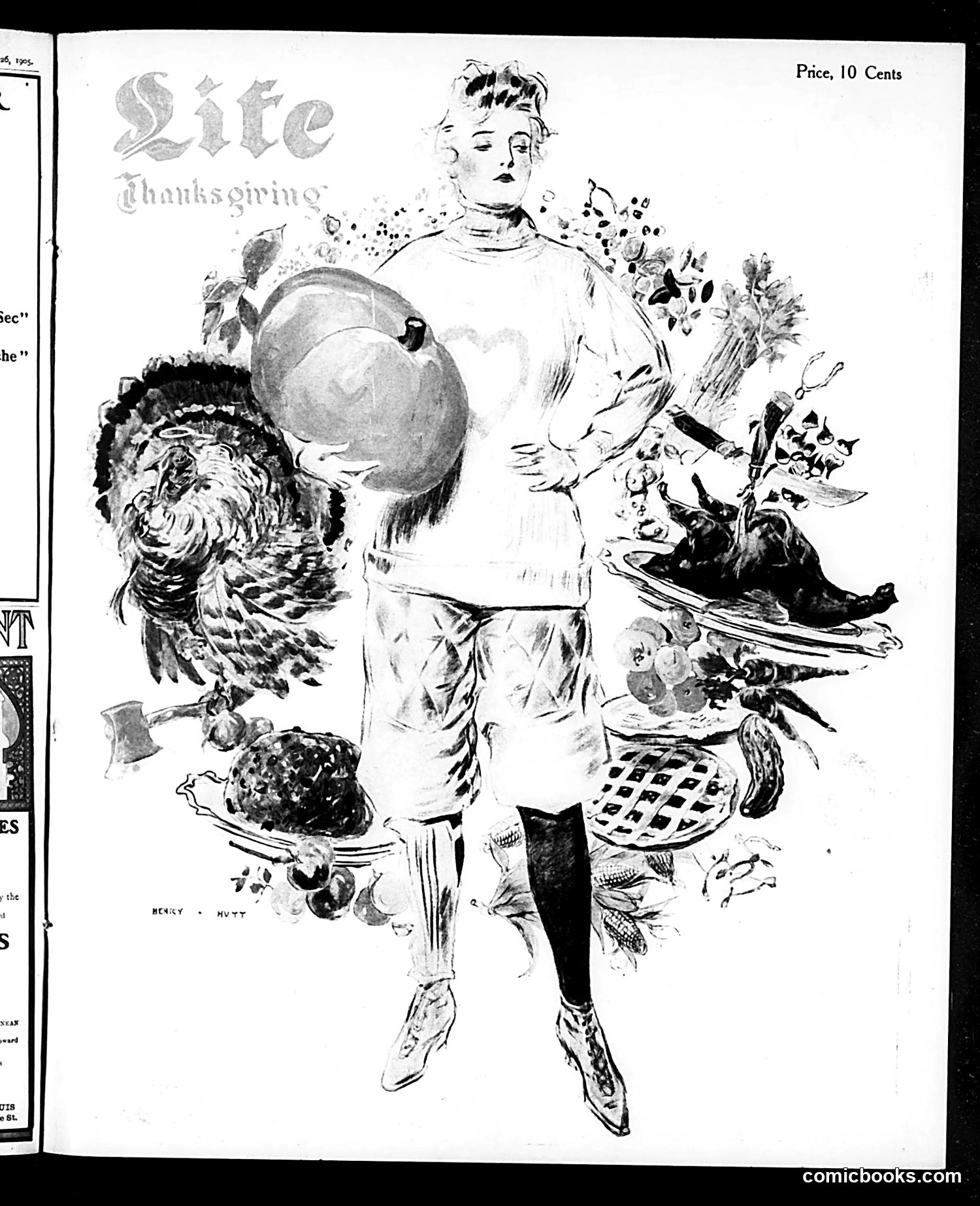
This is a **Life magazine Thanksgiving cover** (priced at 10 cents), featuring an illustration by Henry Hutt. The central figure is a woman in early 1900s dress juggling Thanksgiving's traditional abundance—a turkey, pie, vegetables, and a large bowl or pot—while maintaining perfect balance and grace. The satire targets the **domestic labor expected of women during holidays**. Rather than celebrating abundance, the image humorously depicts the frenzy of holiday meal preparation: the woman manages multiple dishes simultaneously, suggesting the overwhelming work Thanksgiving cooking required. Her composed expression contrasts sharply with the chaotic pile of food, creating comedic irony about women's holiday responsibilities and the physical demands of traditional domestic work.
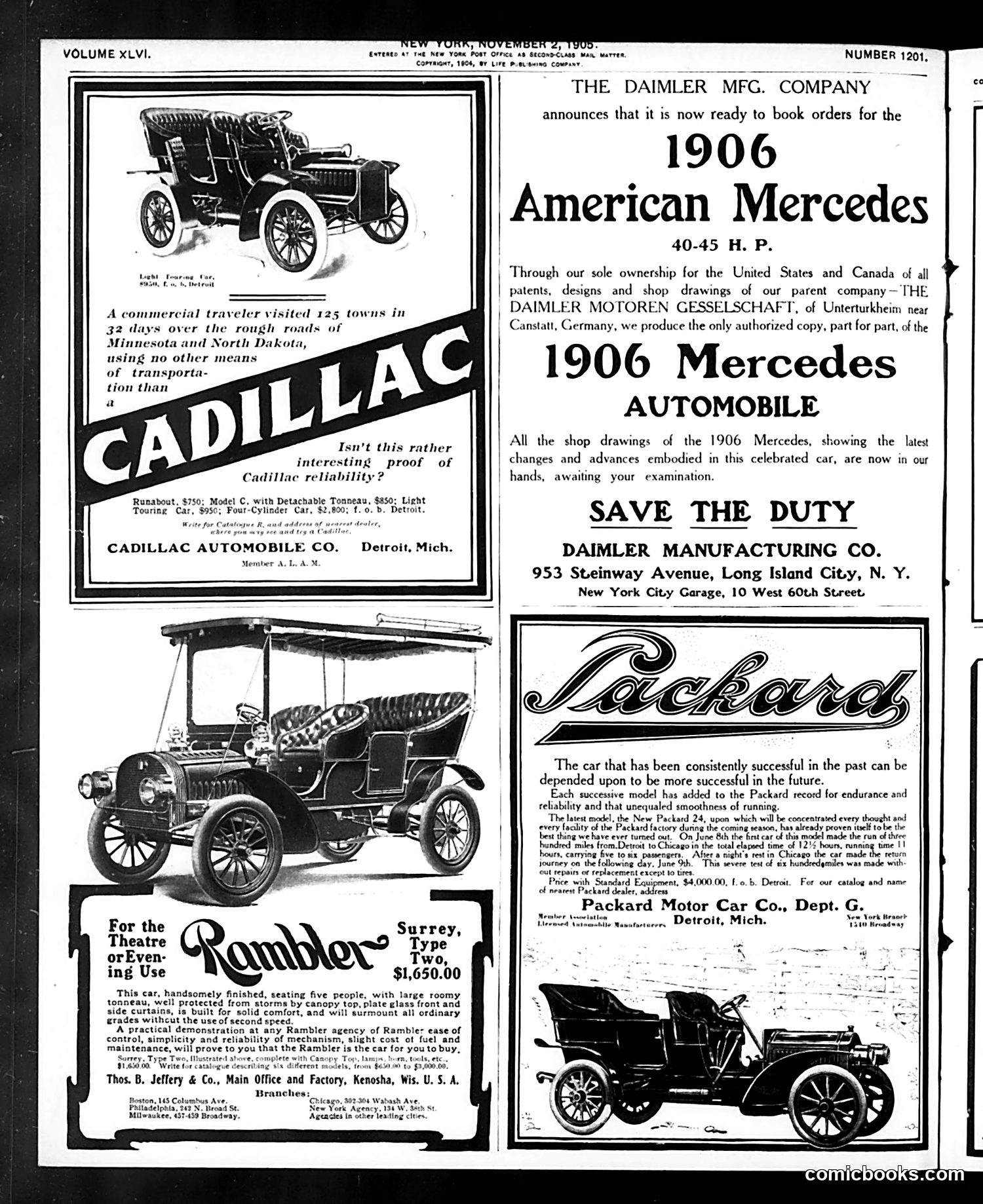
This page is primarily **automobile advertising**, not political satire. It contains four car advertisements from 1906: 1. **Cadillac** - emphasizes reliability through a commercial traveler's 125-town journey 2. **American Mercedes** - announces the 1906 model's availability, with a note to "SAVE THE DUTY" (likely referencing tariff costs) 3. **Rambler** - promotes a Surrey-type vehicle for theater or evening use 4. **Packard** - highlights the brand's endurance record and the new Model 24 The only potentially satirical element is the Mercedes ad's "SAVE THE DUTY" tagline, which appears to reference import tariffs on foreign automobiles—a real economic concern of the era. Otherwise, this is straightforward early automotive marketing showcasing luxury vehicles and their specifications to wealthy consumers.
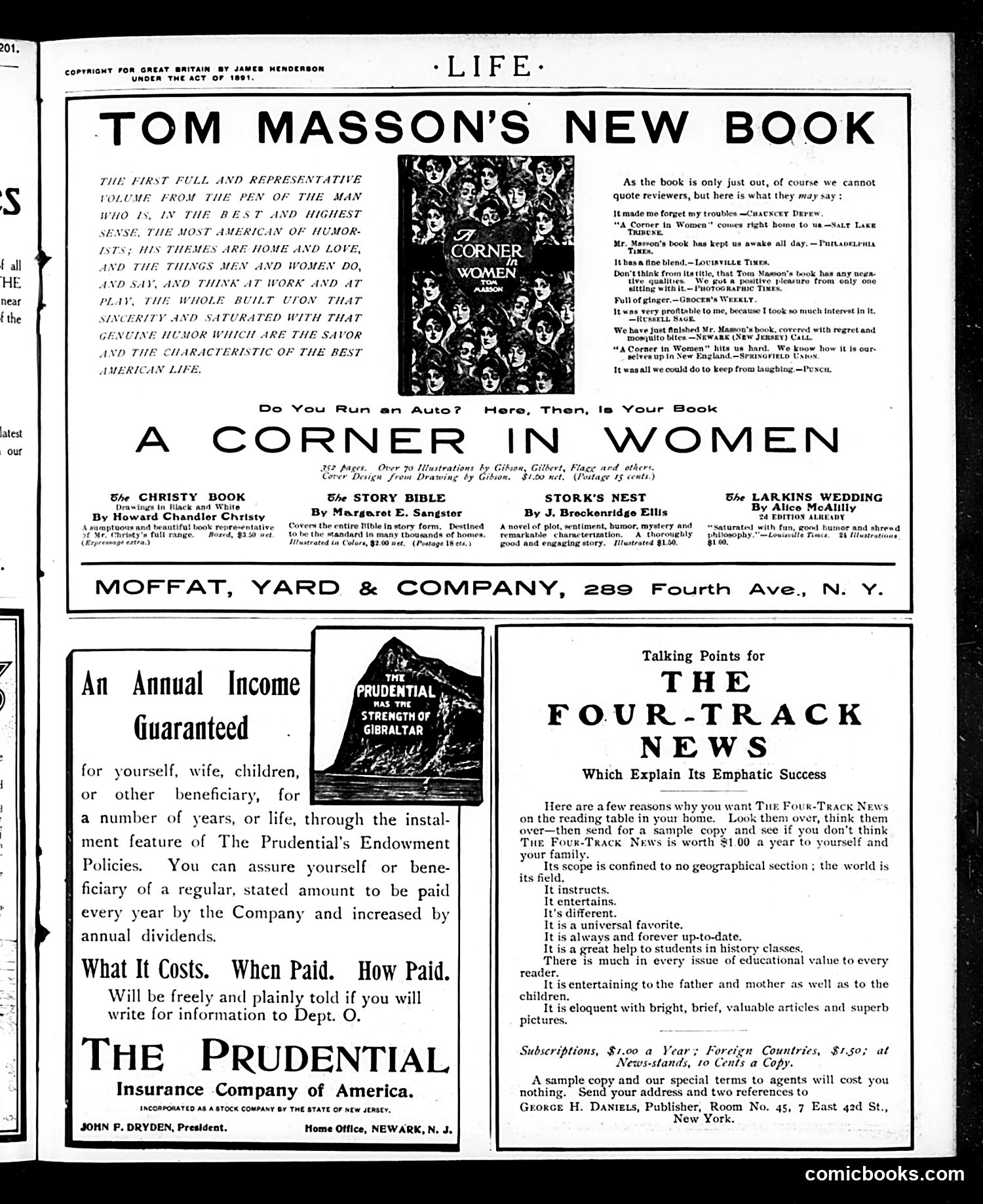
This page is primarily **advertising and promotional content** rather than political satire or editorial cartoons. The main feature is an advertisement for Tom Mason's new book "*A Corner in Women*," described as humorous observations on American life. The ad includes praise quotes from various publications and other book advertisements below it. The remaining content consists of standard magazine advertising: The Prudential Insurance Company's endowment policy promotion (featuring the Rock of Gibraltar logo) and an advertisement for "*The Four-Track News*" magazine, highlighting its educational and entertainment value. There are **no political cartoons or satirical commentary** on this particular page—it represents typical early 20th-century magazine monetization through advertisements interspersed with content announcements.
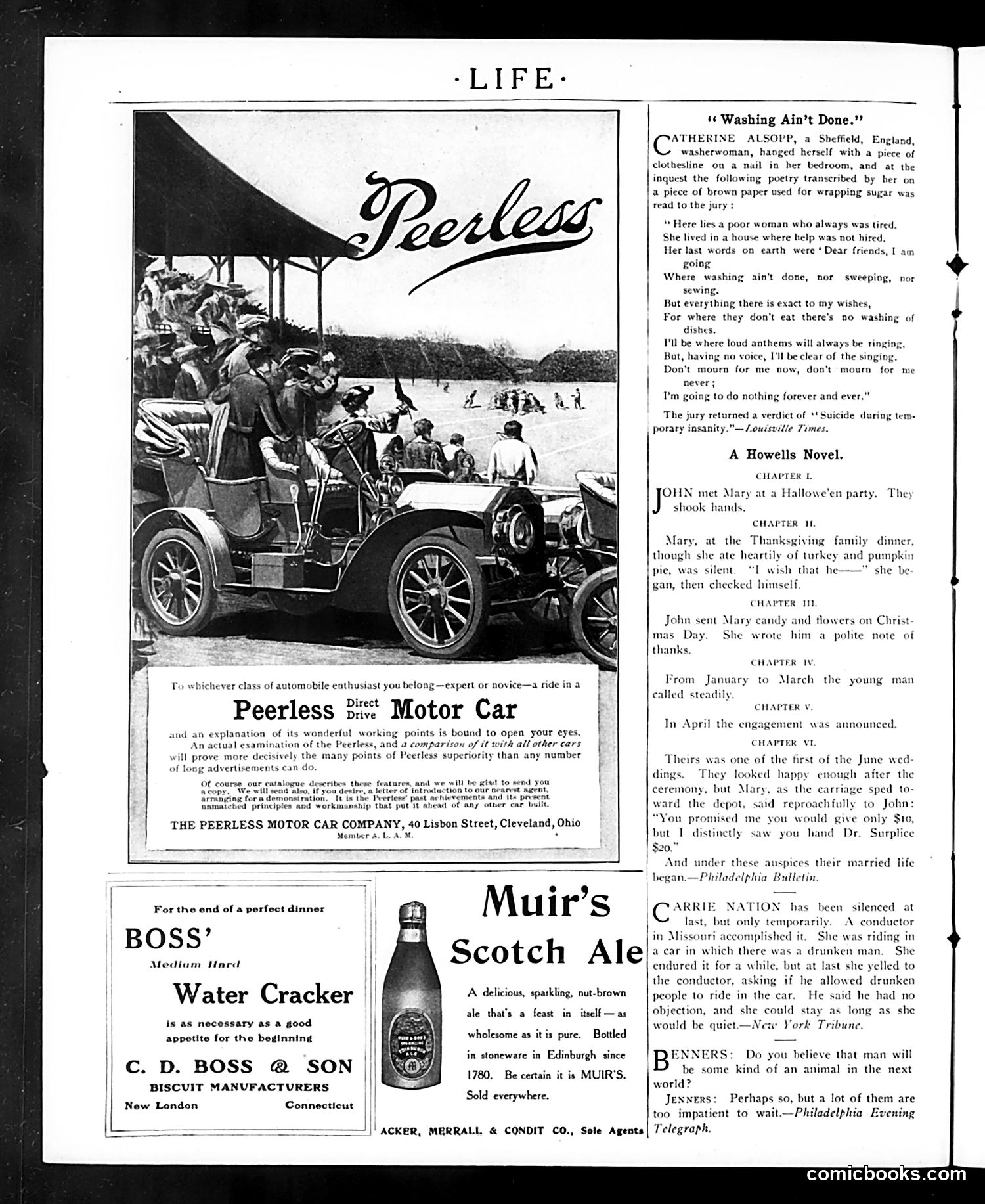
This page is primarily **advertising and fiction**, not political satire. The main content features: 1. **Peerless Motor Car advertisement** - A large illustrated ad showing an early automobile at what appears to be a leisure outing, emphasizing the car's quality and appeal to "automobile enthusiasts." 2. **"A Howells Novel"** - A serialized fiction piece by William Dean Howells titled with chapter summaries about characters named John and Mary, their romance, and marriage. 3. **Supporting advertisements** - Including Boss Water Crackers and Muir's Scotch Ale. The page reflects early 20th-century consumer culture, promoting automobiles as status symbols and leisure goods alongside traditional products. There is no evident political cartoon or satire present on this page.
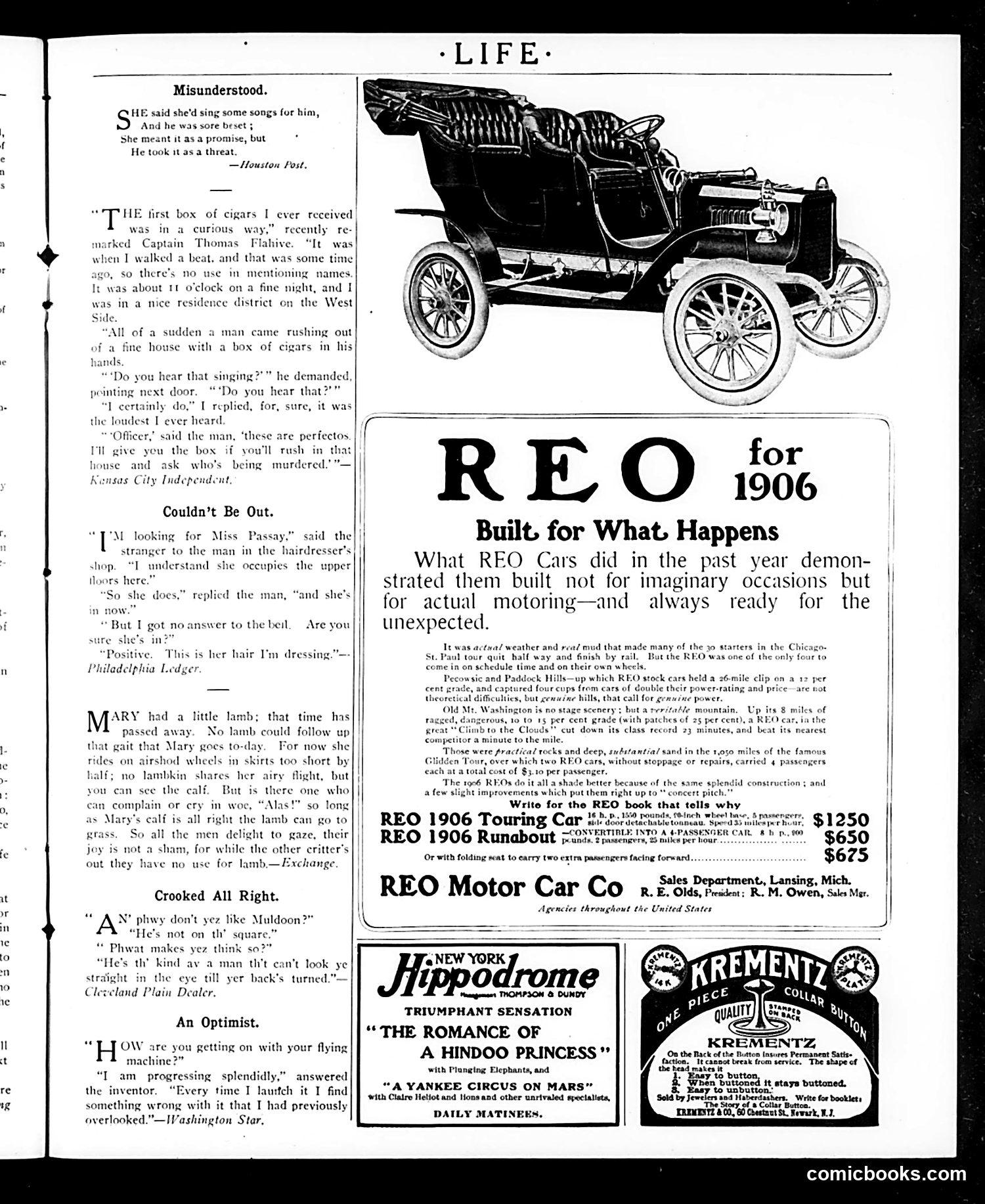
This page is primarily **advertising and humorous anecdotes** rather than political cartoons. The main content features four short satirical stories ("Misunderstood," "Couldn't Be Out," "Mary," "Crooked All Right," "An Optimist") depicting everyday social misunderstandings and ironies—typical of Life magazine's humor style. The dominant advertisement is for **REO Motor Cars** (1906), highlighting the vehicle's reliability and performance. The ad emphasizes durability through anecdotes about extreme conditions. Secondary advertisements include the **New York Hippodrome** theater and **Krementz collar buttons**. **No political figures or events** are referenced. The page reflects early 1900s consumer culture and middle-class domestic humor rather than social or political satire.
This page is **primarily advertising** with some humorous filler content. The main advertisements are: - **Liqueur Pères Chartreux** (left): promoting a French herbal liqueur with its heritage - **White Rock mineral water** (right): emphasizing refreshment and pleasant memories - **Penn Mutual Life Insurance** (lower left): using a narrative about unpaid debts to sell life insurance policies - **Wassermann Brothers** (lower right): a brokerage firm The satirical content ("Sandy on Andy," "Close," "Adulterated Ground") consists of brief humorous anecdotes—a poem mocking someone named Andy, a legal joke about Arkansas jurors, and a grocer joke about ground coffee. These are typical filler humor common in early 20th-century magazines, not political cartoons. The page reflects period advertising and light comedy rather than serious social satire.
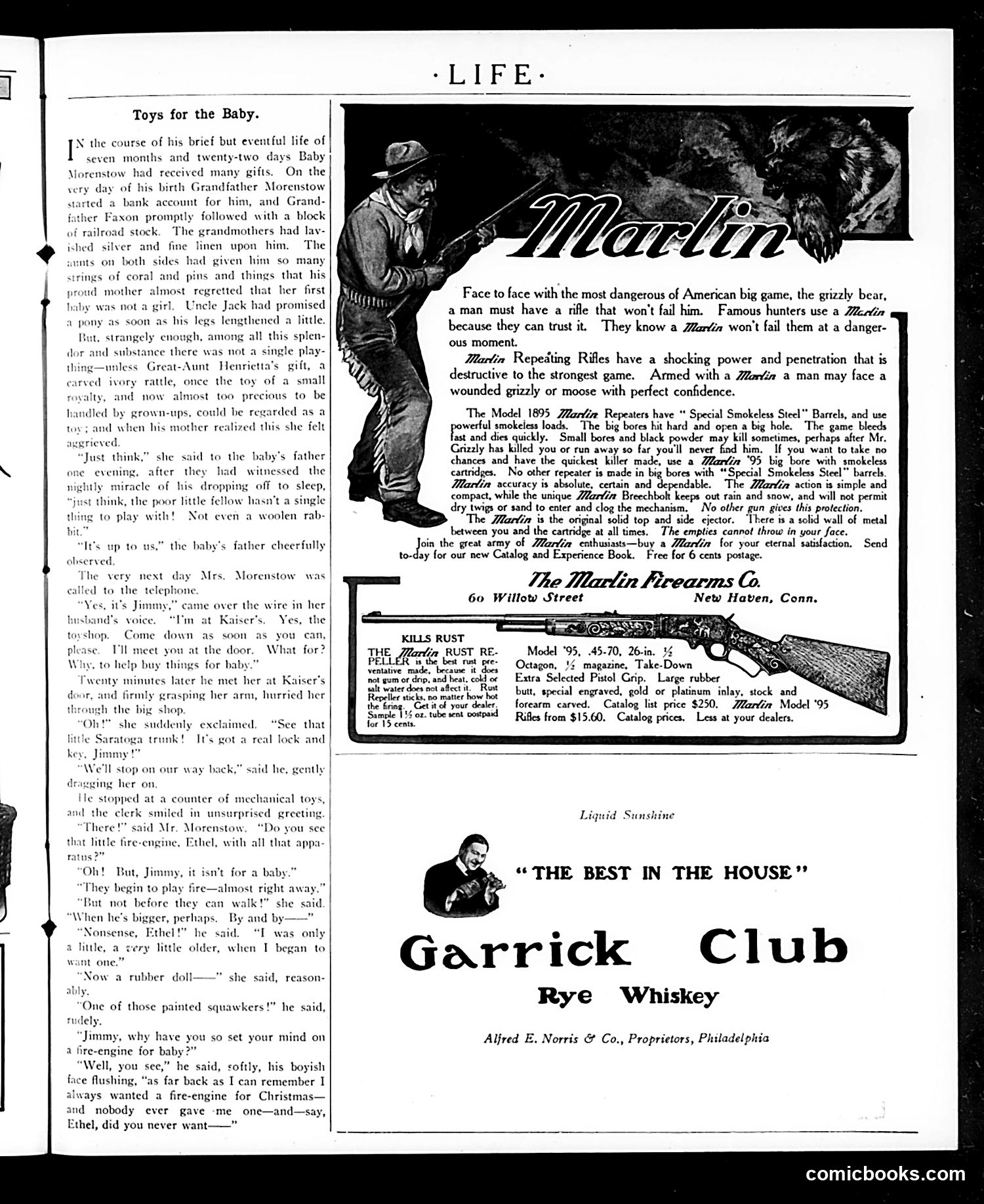
This page is **primarily advertising** rather than editorial satire. The main content consists of three advertisements: 1. **Marlin Firearms** (center): Features a hunter confronting a grizzly bear, emphasizing the rifle's reliability and stopping power for dangerous game hunting. 2. **Garrick Club Rye Whiskey** (bottom): A simple product advertisement for whiskey from Philadelphia, using the tagline "The Best in the House." The left column contains a short story titled "Toys for the Baby," describing a couple's gift-giving decisions for their newborn son—notably the father's desire for a toy fire-engine rather than toys more traditionally appropriate for an infant. The page reflects early 20th-century consumer culture and gender expectations, but contains no political cartoon or significant satire worth analyzing for modern readers.
This page is primarily **advertising content** rather than editorial cartoons or satire. It features multiple advertisements for consumer products popular in the early 20th century: - **Nestor Cigarettes**: promoting Egyptian cigarettes being manufactured in Boston - **Jaeger Underwear**: emphasizing comfort and available in seven weights - **Surrug's Arcadia Mixture**: tobacco product claiming no one smokes better - **Club Cocktails**: promoting pre-mixed cocktail ingredients The page also contains brief fictional anecdotes (about a piano-playing burglar and a restaurant veal cutlet incident), which appear to be filler content rather than editorial commentary. There are **no political cartoons or identifiable caricatures** on this page. It represents Life magazine's reliance on advertising revenue during this period.
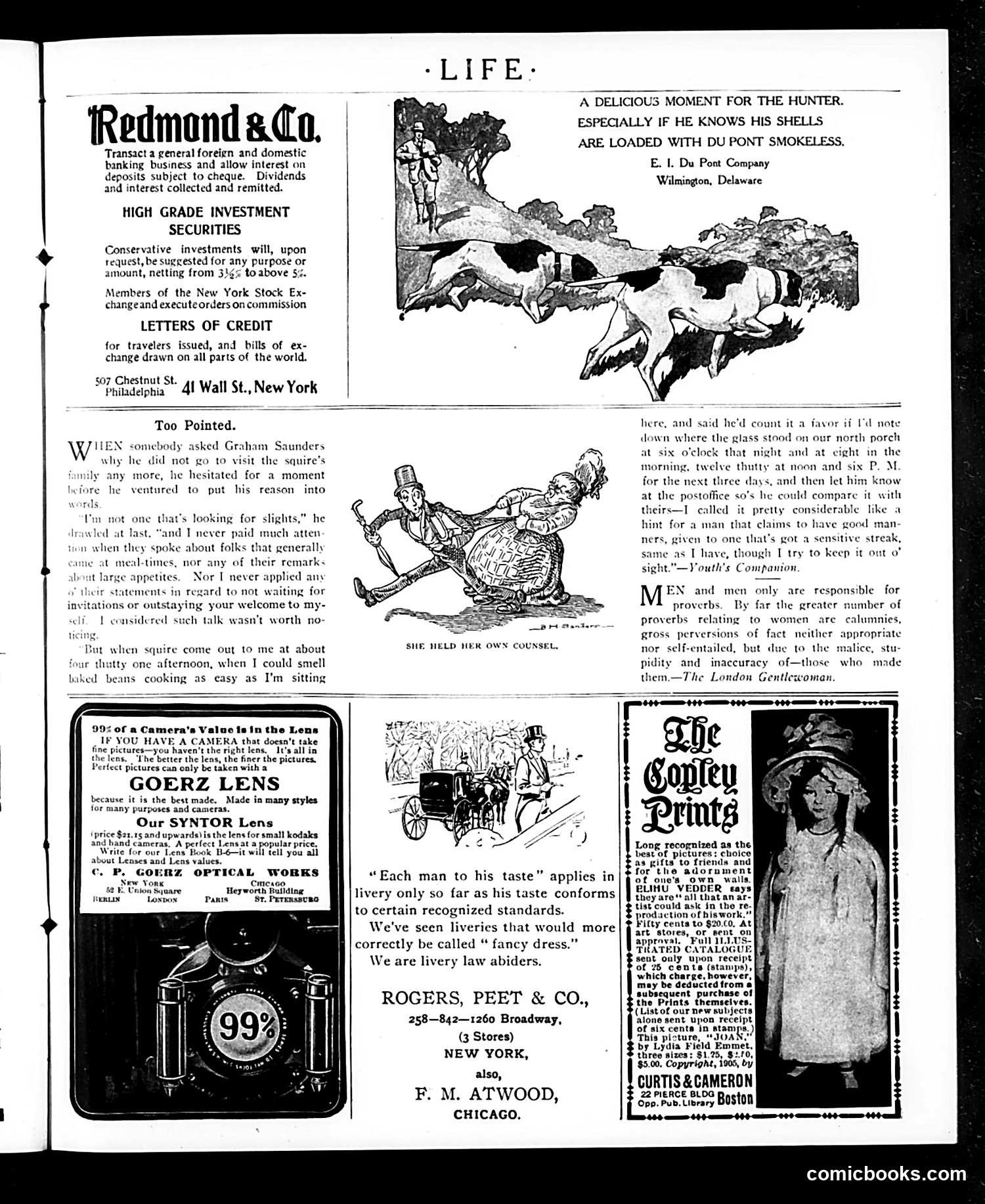
This page is primarily **advertising and humor content** rather than political satire. The main elements include: **"Too Pointed" story**: A humorous anecdote about Graham Saunders avoiding his squire's family visits, then complaining when the squire invites him during bean-cooking time—illustrating the folly of ungrateful complaints. **"She Held Her Own" cartoon**: Depicts a woman confidently handling reins while a man tumbles from a carriage, satirizing gender roles by showing a woman's competence. **"Each man to his taste"**: A brief joke about livery standards by Rogers, Peet & Co., a clothing company. The page also contains **product advertisements** for investment securities, camera lenses, optical equipment, and reproductions of classical art prints—typical of Life's era as a general-interest illustrated magazine mixing humor with commercial content.
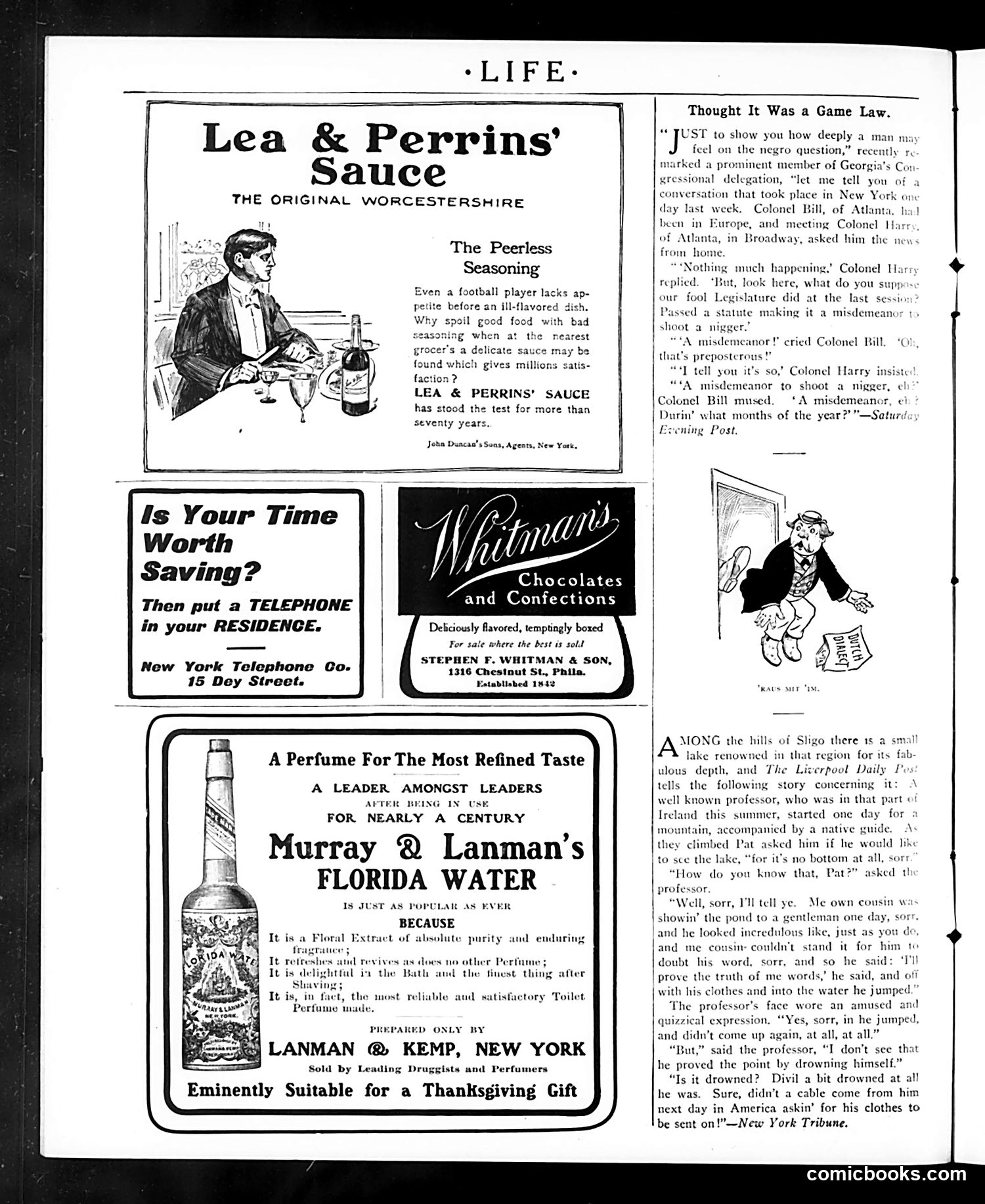
This page is primarily **advertisements** interspersed with a brief humorous anecdote titled "Thought It Was a Game Law." The main ads feature **Lea & Perrins' Sauce**, **Whitman's Chocolates**, **Murray & Lanman's Florida Water** (perfume), and a telephone company pitch. The cartoon/text piece describes a conversation between **Colonel Harry** and **Colonel Bill** about Georgia's legislature. Colonel Harry mentions a statute passed regarding "a misdemeanor to shoot a nigger" (using period language). The humor derives from the deliberate misreading: Colonel Bill interprets this as protecting someone from being shot, when actually it criminalized shooting a Black person—likely an unintended consequence of poorly-worded legislation that revealed problematic assumptions. The satire critiques legislative incompetence and racial attitudes of the era.
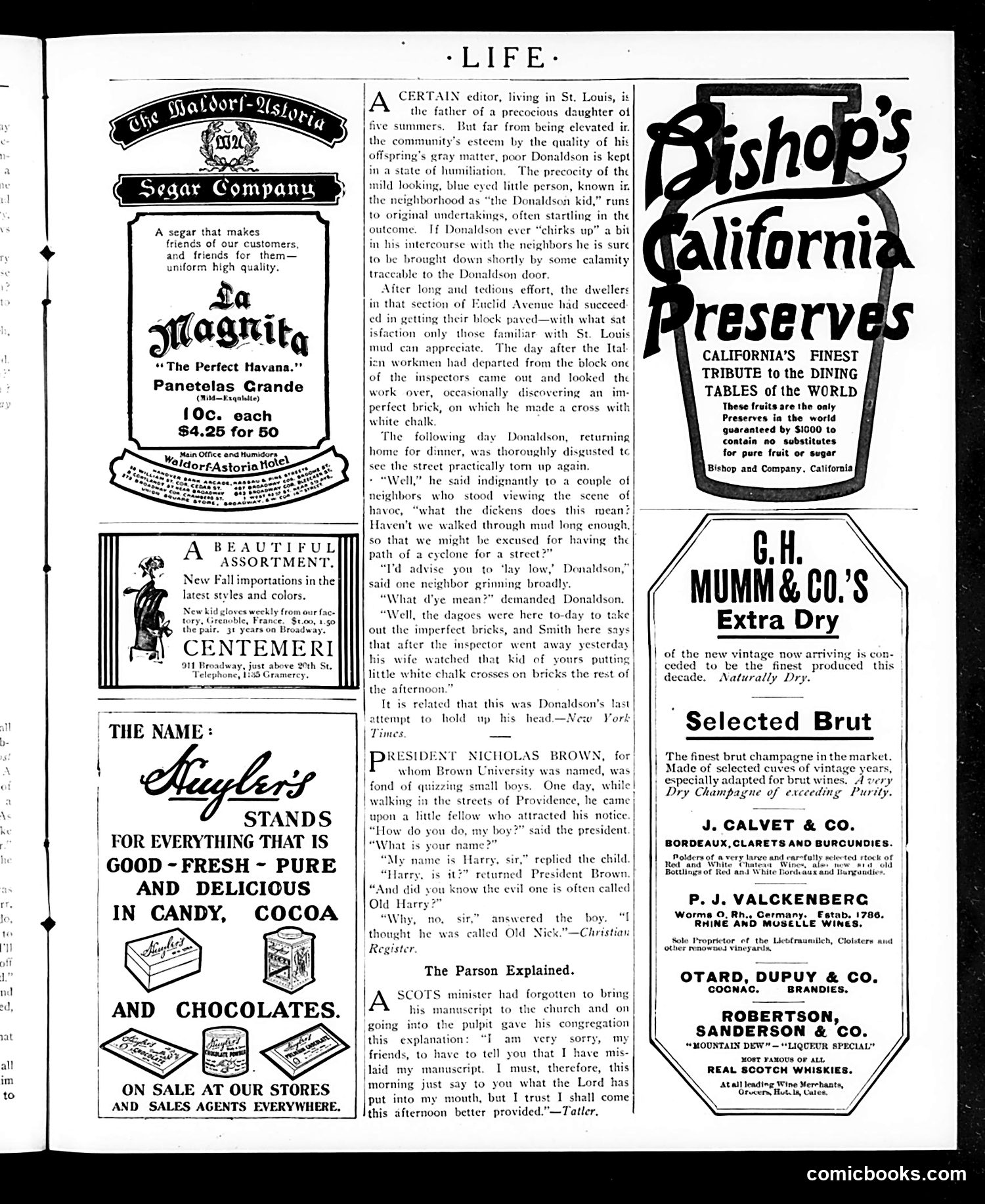
This page is primarily **advertising with one satirical article**. The main content piece, "The Waladorf-Distoria," mocks a St. Louis editor whose daughter is embarrassed by her father's low social status. The satire describes the editor's humiliation when his neglectful parenting leads neighbors to call their son "the Donaldson kid." After street construction near his home, Donaldson complains to neighbors—who sarcastically tell him to "lay low." The piece ridicules his social pretensions and poor judgment. The surrounding advertisements promote luxury goods: La Magrita cigars, Centimeri fashions, Suyler's candies, and champagne brands. These ads emphasize quality and exclusivity, contrasting ironically with the satirized middle-class anxiety in the main article.
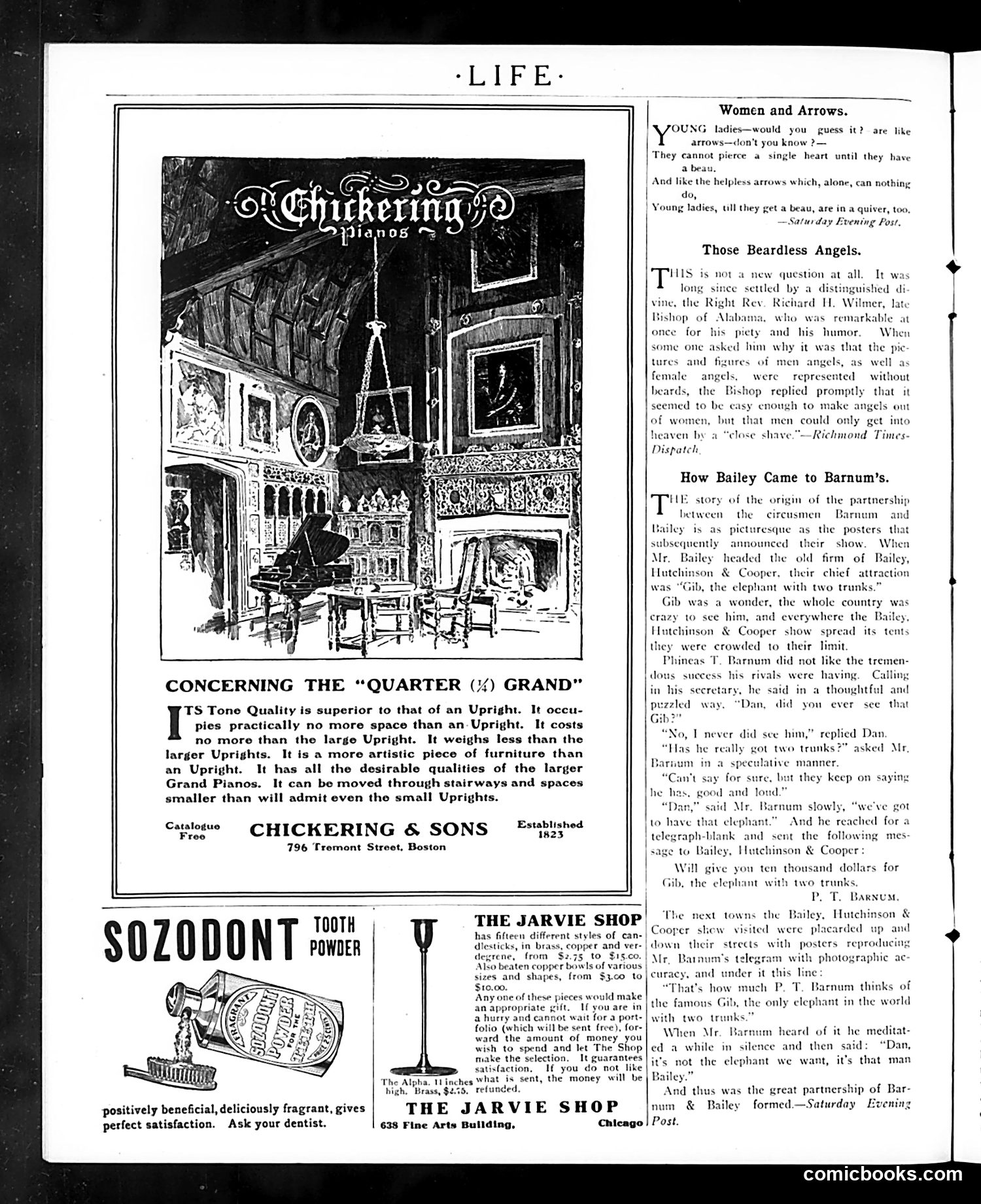
This page is primarily **advertising and light feature content** rather than political satire. The main elements are: 1. **Chickering & Sons Piano Advertisement** (center-left): Features an ornate Victorian piano room interior, promoting their "Quarter Grand" model as superior in tone and space-efficiency compared to uprights. 2. **Sozodont Tooth Powder Ad** (lower left): A period dental hygiene product advertisement emphasizing fragrance and satisfaction. 3. **The Jarvie Shop Advertisement** (lower right): Promoting decorative copper and brass candlesticks, various styles priced $2.75-$15.00. 4. **Three Short Stories** (right column): "Women and Arrows," "Those Beardless Angels," and "How Bailey Came to Barnum's"—humorous pieces referencing Bishop Richard Wilmer and circus showman P.T. Barnum. This appears to be a typical early 20th-century *Life* magazine page mixing advertisements with light entertainment content.
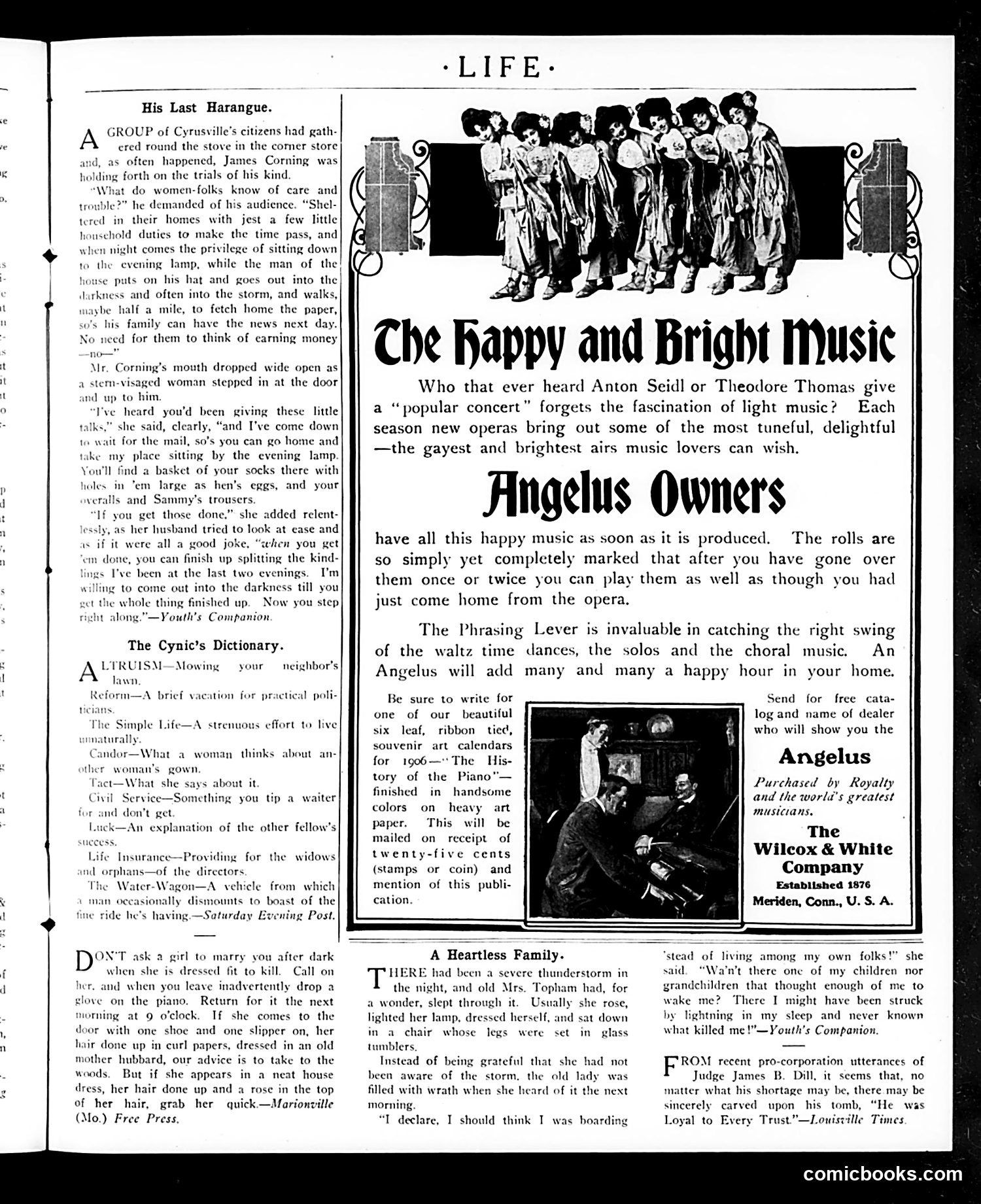
This page is primarily **advertising and humor columns**, not political satire. The content includes: **"His Last Harangue"** - A satirical anecdote mocking James Corning, a man holding forth at a store, lecturing women about household economics. The humor targets his presumptuous mansplaining about domestic duties. **"The Cynic's Dictionary"** - Satirical definitions of social concepts (Reform, The Simple Life, Candor, etc.), typical of Life's social commentary tradition. **Main Advertisement** - Large promotion for "Angelus Owners" player piano rolls, featuring operatic music. References "Anton Seidl or Theodore Thomas" (famous conductors), targeting affluent households. **Minor Stories** - "A Heartless Family" and other brief humorous pieces about social situations. The page reflects early 1900s concerns: domestic labor, class aspirations through music ownership, and gender dynamics—but it's primarily commercial rather than politically satirical.
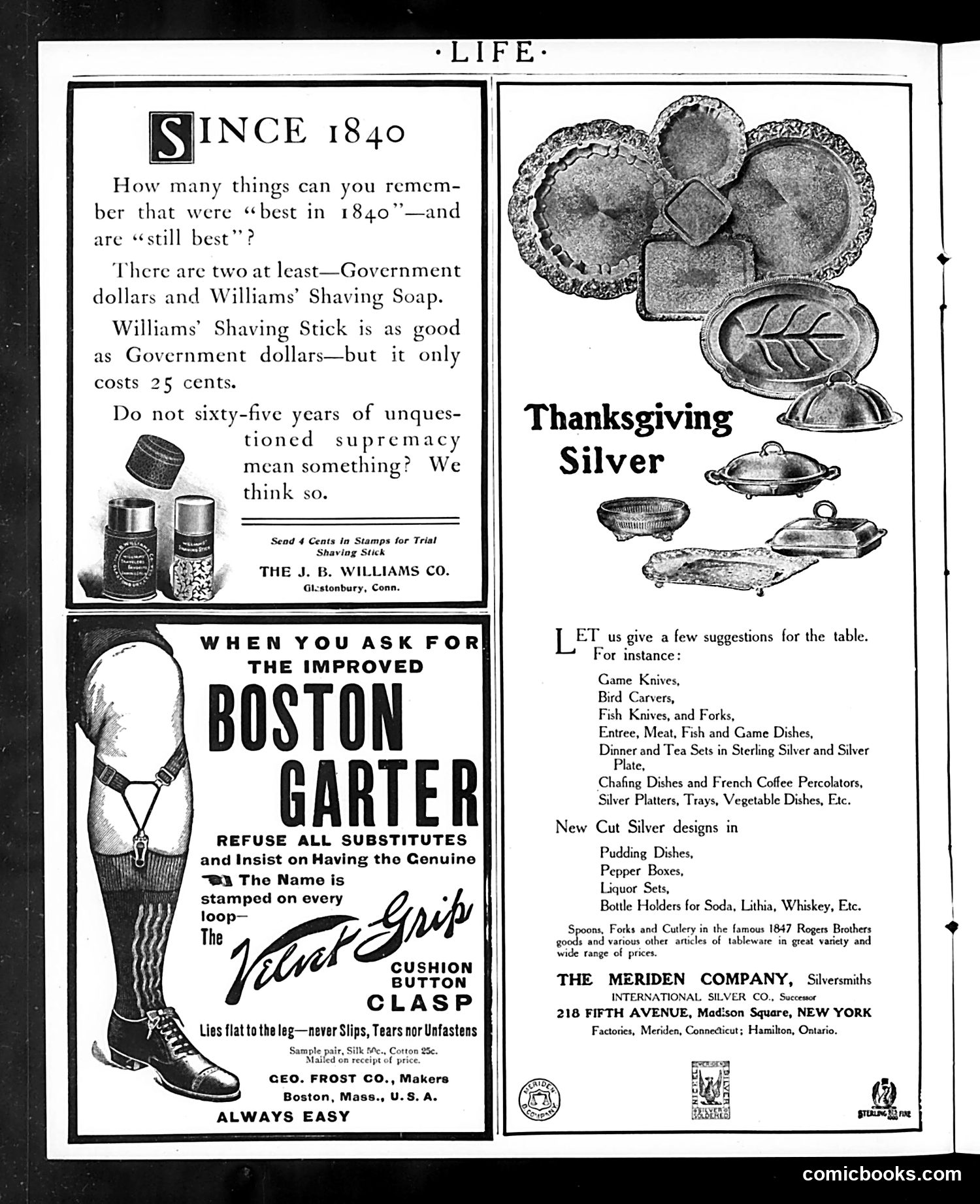
This is primarily a **commercial advertising page** rather than political satire. It contains three product advertisements from circa 1905 (65 years after 1840). The top-left ad for **Williams' Shaving Soap** uses a nostalgic marketing angle, claiming the product has maintained quality for 65 years—comparing its reliability to government currency itself. The bottom-left advertises the **"Improved Boston Garter"** (a men's leg garter/sock supporter), emphasizing it "lies flat to the leg" and won't slip. The cushion button design prevents chafing—a practical concern for early 1900s menswear. The right page promotes **Thanksgiving Silver tableware** from the Meriden Company, listing decorative and functional pieces: serving dishes, cutlery, chafing dishes, and specialty items like liquor bottle holders. This targets wealthy households preparing formal holiday tables. All three ads appeal to **consumer loyalty and product durability**—the unspoken message being that established brands warrant trust and investment, a common sales strategy in this era.
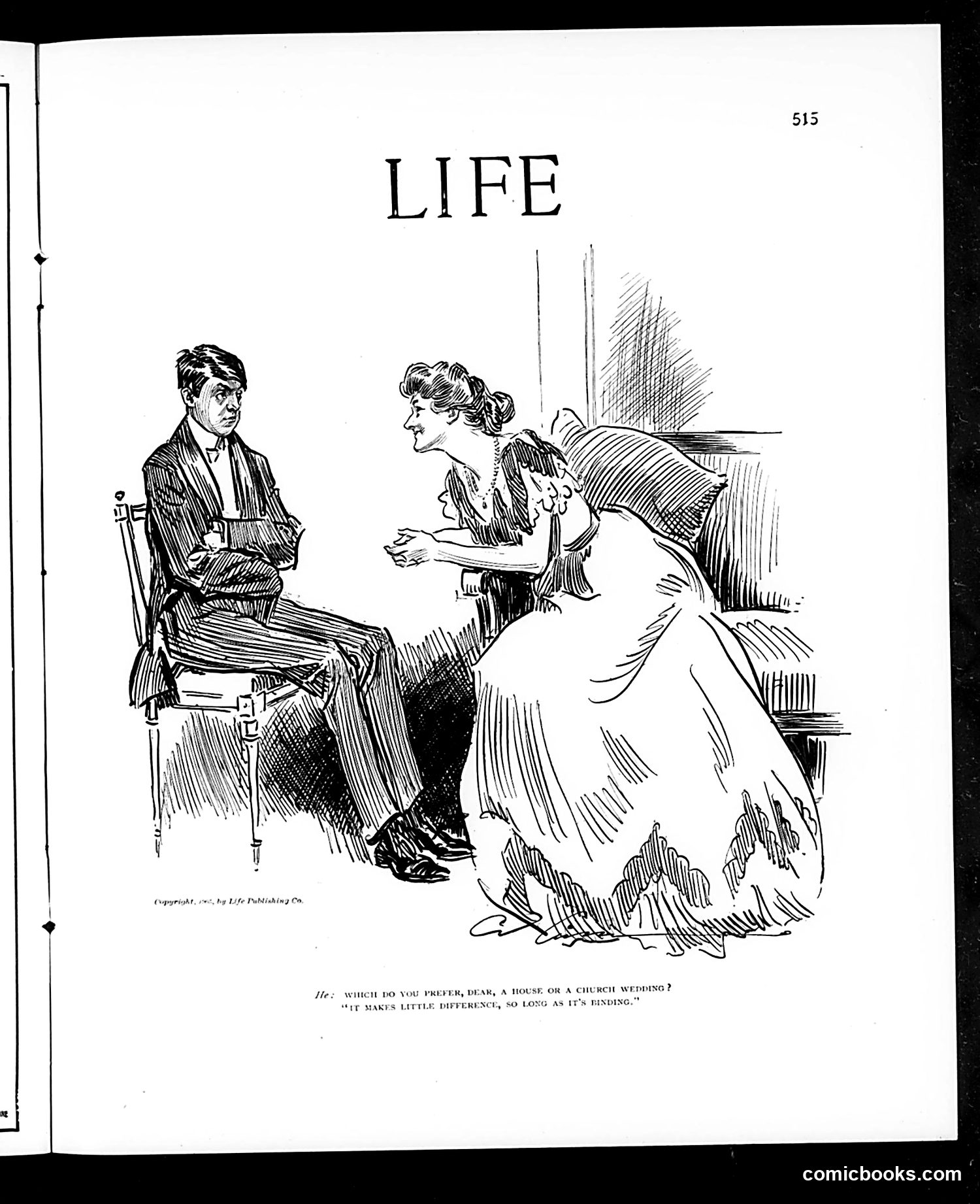
This single-panel cartoon depicts a conversation between a man and woman. The caption reads: "Which do you prefer, dear, a house or a church wedding? 'It makes little difference, so long as it's binding.'" The joke plays on the double meaning of "binding"—literally referring to ceremonial location preferences, but the woman's response suggests she means "binding" as in a legally binding or serious commitment. The humor lies in her casual deflection of the actual question, implying that what matters most isn't *where* they marry, but that the commitment itself is secure and permanent. This reflects early 20th-century courtship humor typical of Life magazine's satirical commentary on relationships and gender dynamics.
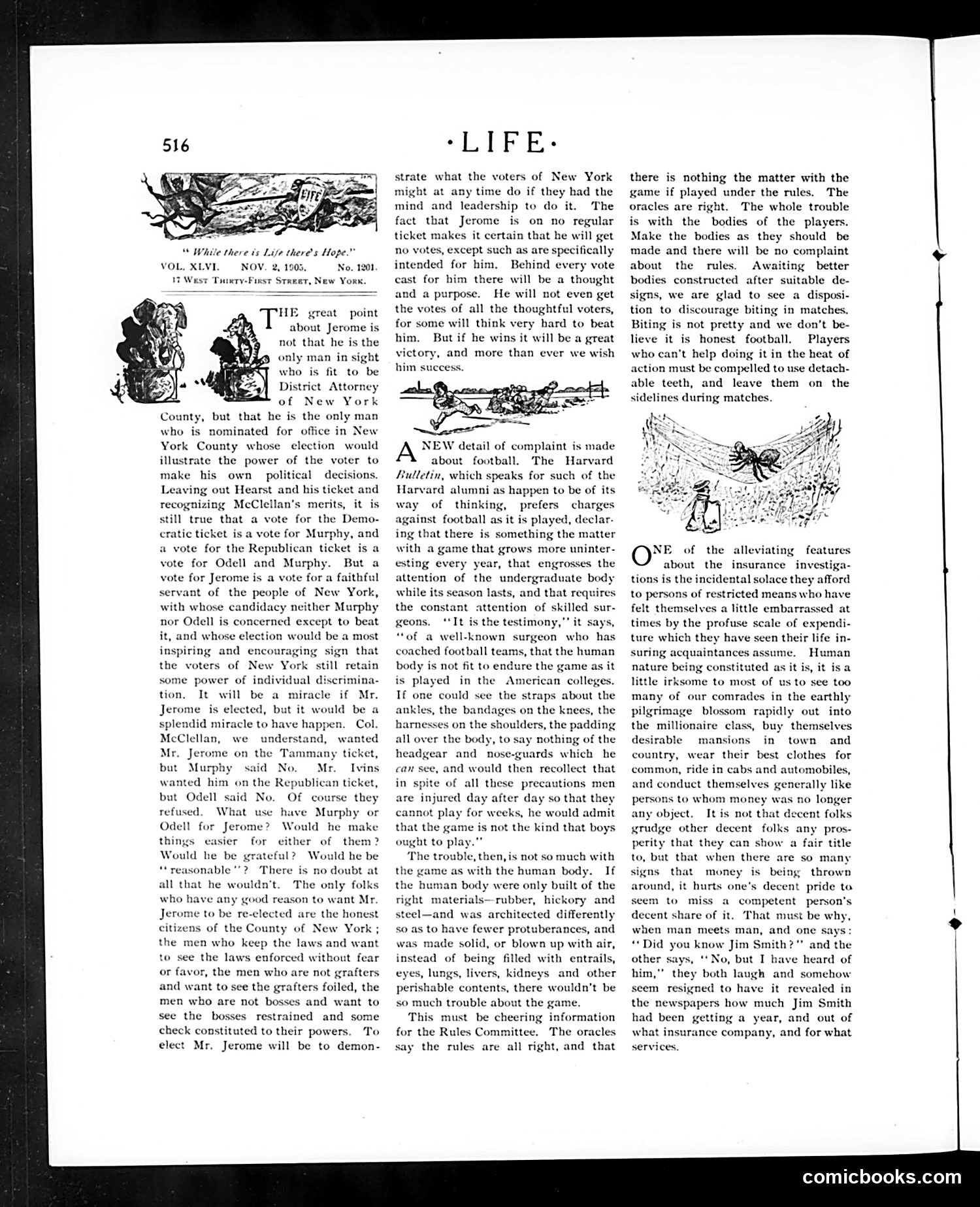
This page advocates for William Travers Jerome as District Attorney of New York County in the 1905 election. The satire targets political machine bosses—specifically Tammany Hall's Murphy and Republican boss Odell—who refuse to support Jerome despite his qualifications. The cartoon's point: Jerome represents genuine democratic choice, independent of party machines. Unlike other candidates beholden to Murphy or Odell, Jerome would serve the people honestly. Life argues voting for him demonstrates voters retain "individual discrimination" against corrupt bosses. The editors frame Jerome's likely defeat as symbolic of how political machinery constrains voter freedom, even in a democracy. The secondary article critiques college football as physically dangerous, sardonically suggesting the human body needs redesigning (with "rubber, hickory and steel") to survive the game's brutality.
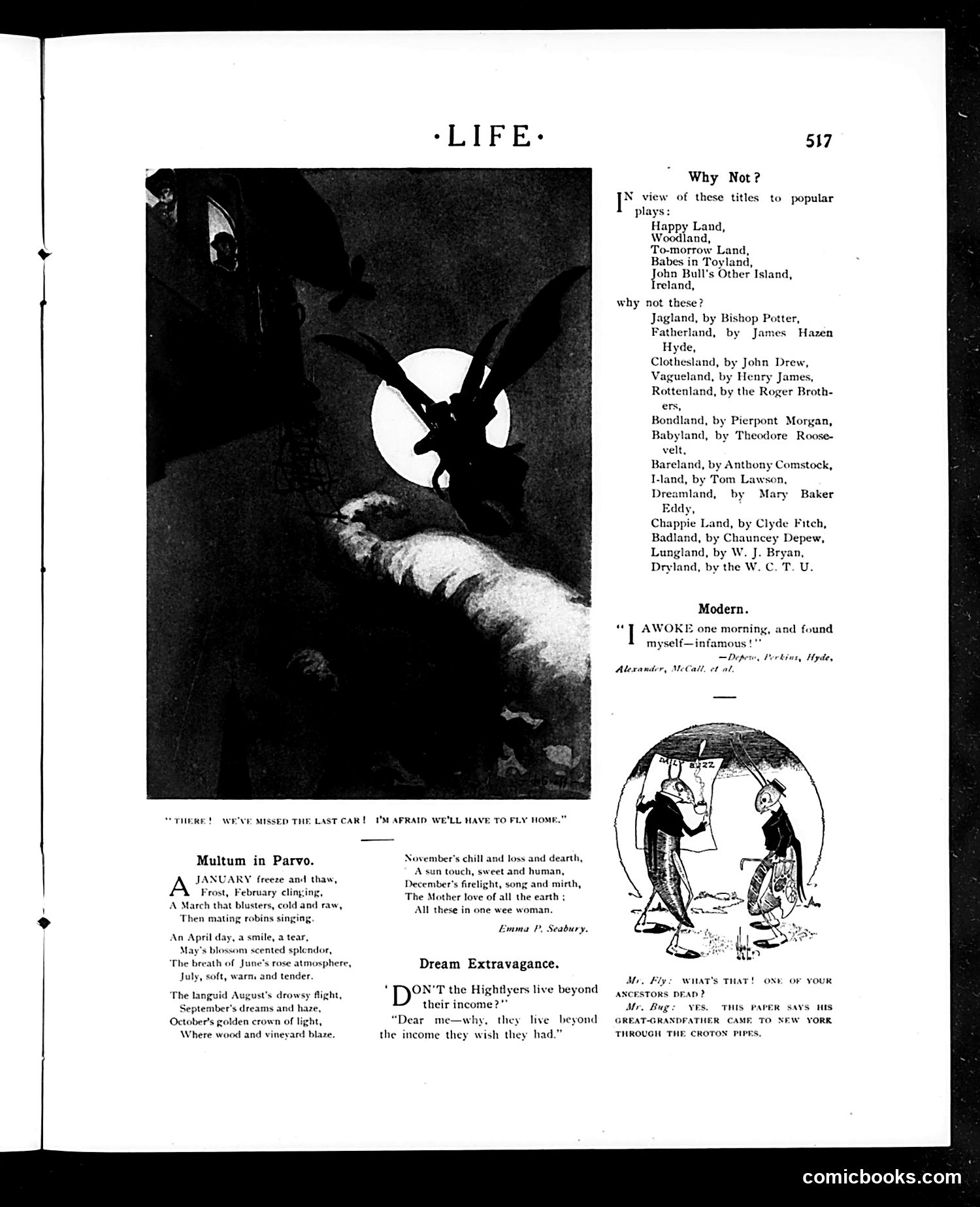
**"Why Not?" Section:** A satirical list proposing play titles mimicking popular shows (Happy Land, Babes in Toyland). The joke pairs real prominent figures with "-land" titles: Theodore Roosevelt's "Babyland," Anthony Comstock's "Bareland" (referencing his censorship campaigns), William Jennings Bryan's "Lungland," and the WCTU's "Dryland" (temperance reference). Each pairing mocks the figure's public association or known cause. **"Multum in Parvo" Section:** A sentimental poem about motherhood progressing through seasons—standard period sentiment. **"Dream Extravagance" Cartoon:** Two anthropomorphic insects discuss a family living "beyond their income." The punchline involves a bug ancestor arriving via New York's Croton water pipes—absurdist humor suggesting the family's poverty or humble origins, typical of Life's working-class mockery. The page reflects early 1900s satire targeting prominent public figures and social pretension.
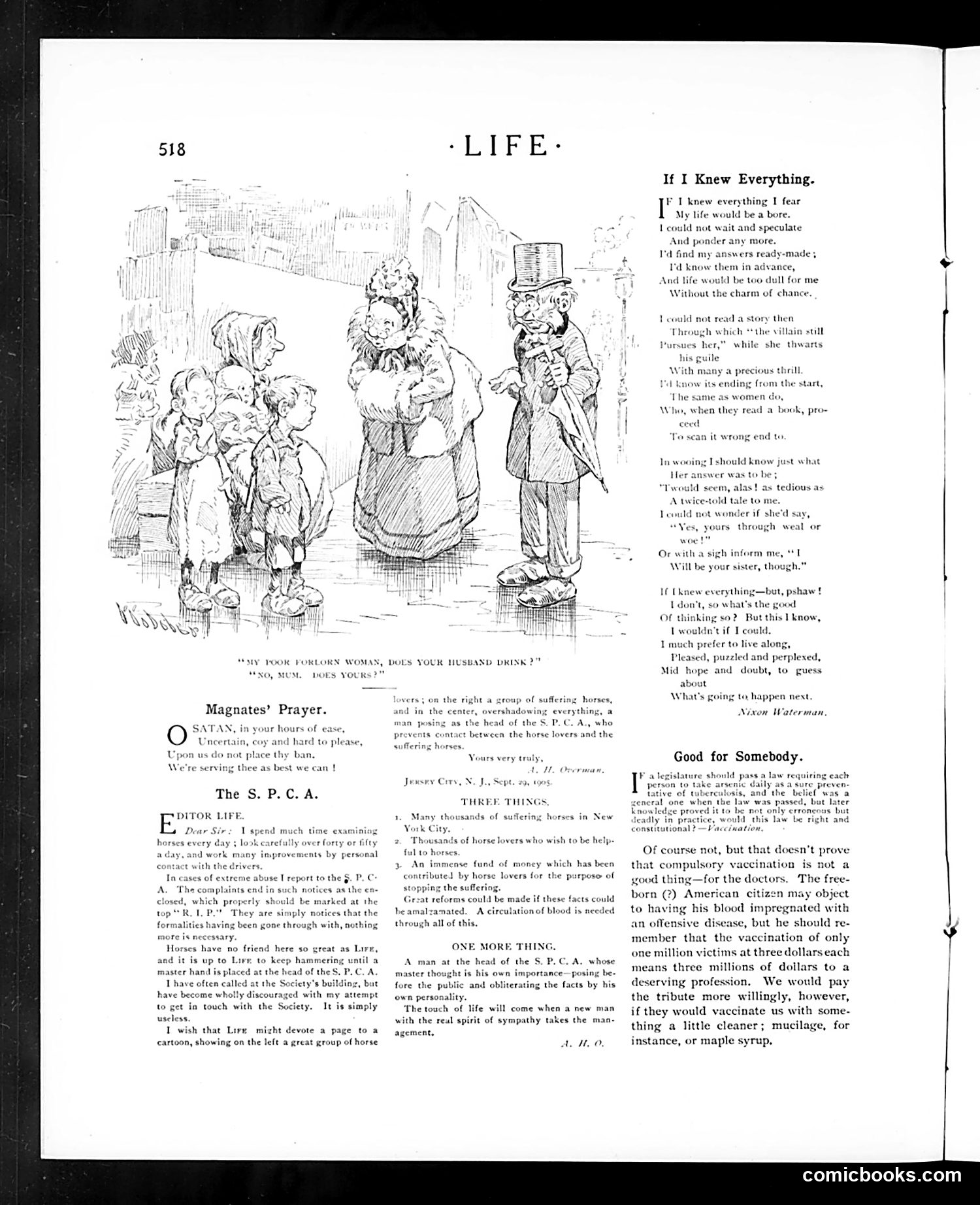
The main cartoon illustrates the hypocrisy of wealthy industrialists regarding animal welfare. On the left stands a group of neglected, suffering horses; on the right, well-dressed "magnates" (wealthy businessmen); in the center towers a figure representing the S.P.C.A. (Society for the Prevention of Cruelty to Animals). The caption "My book forlorn woman, does your husband drink?" / "No, mum, does yours?" satirizes how these same men who publicly support animal protection through the S.P.C.A. may mistreat their own animals or workers. The accompanying letter criticizes the S.P.C.A.'s ineffectiveness, claiming it's hampered by the egotistical leadership of one man more concerned with personal prominence than actually helping horses. **Lower sections** include unrelated humor pieces: "If I Knew Everything" (a poem about life's uncertainties) and "Good for Somebody" (satirizing mandatory vaccination as beneficial mainly to doctors' profits, not public health). The satire targets institutional corruption and the gap between public virtue-signaling and private conduct among the wealthy.
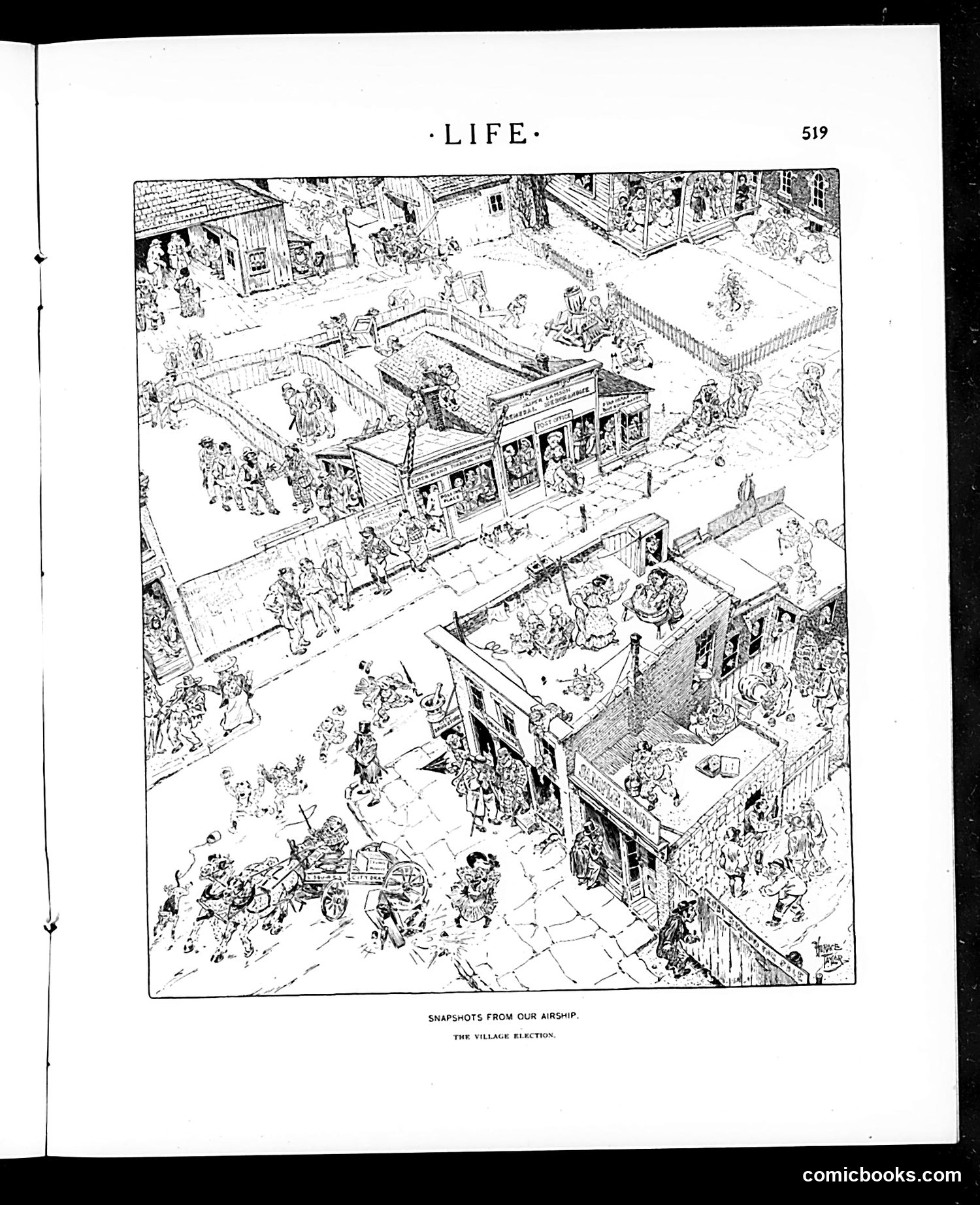
This is an aerial perspective cartoon depicting a rural village election day. The birds-eye view—as if drawn "from our airship"—was a novelty perspective for the era, allowing satire of small-town democratic processes. The scene shows villagers gathered around various buildings and polling areas. The humor appears to satirize typical village election behavior: crowded, chaotic scenes with people milling about, possibly showing the disorganization or social nature of local voting rather than serious civic engagement. The specific details of what characters represent or what joke is being made are difficult to discern from this distance and detail level, but the overall point seems to be gently mocking rural American election customs and the somewhat haphazard nature of small-town democratic participation.
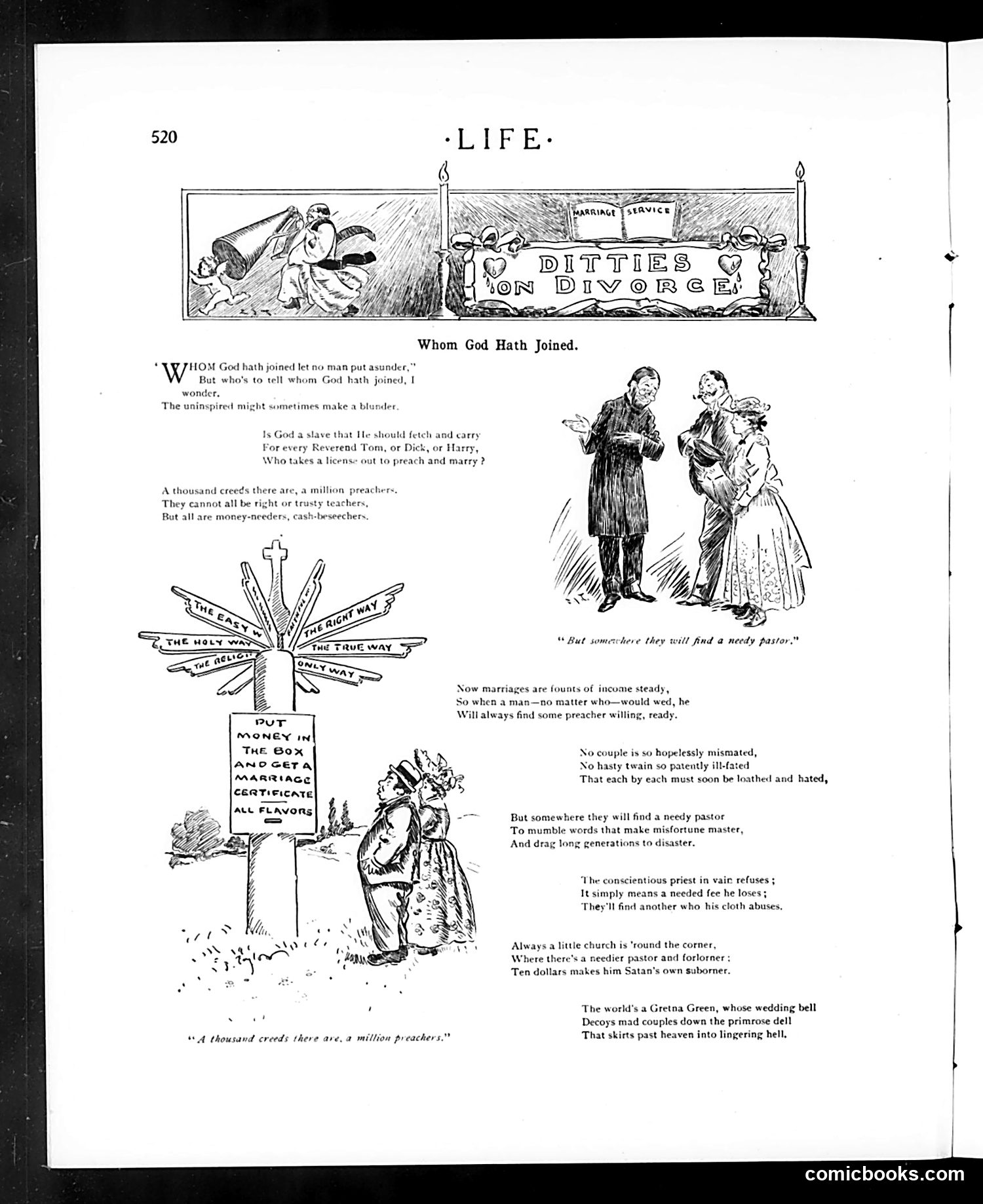
This satirical poem attacks mercenary clergy who perform marriages without moral scrutiny. The central complaint: unscrupulous preachers will marry *any* couple for a fee, regardless of compatibility or likelihood of disaster. The key visual metaphor shows a cross labeled "PUT MONEY IN THE BOX AND GET A MARRIAGE CERTIFICATE ALL FLAVORS"—suggesting marriage licenses are commodities sold like consumer goods, stripped of spiritual meaning. The satire names no specific individuals but broadly indicts the religious establishment for prioritizing income over conscience. References to "Reverend Tom, Dick, or Harry" and "a little church 'round the corner" suggest this was a widespread practice among desperate clergymen. The poem's closing warns that such marriages, blessed by mercenary priests, doom couples to "lingering hell"—conflating Gretna Green (famous for quick marriages) with moral corruption. The core joke: marriage has become a commercialized service with no ethical standards.
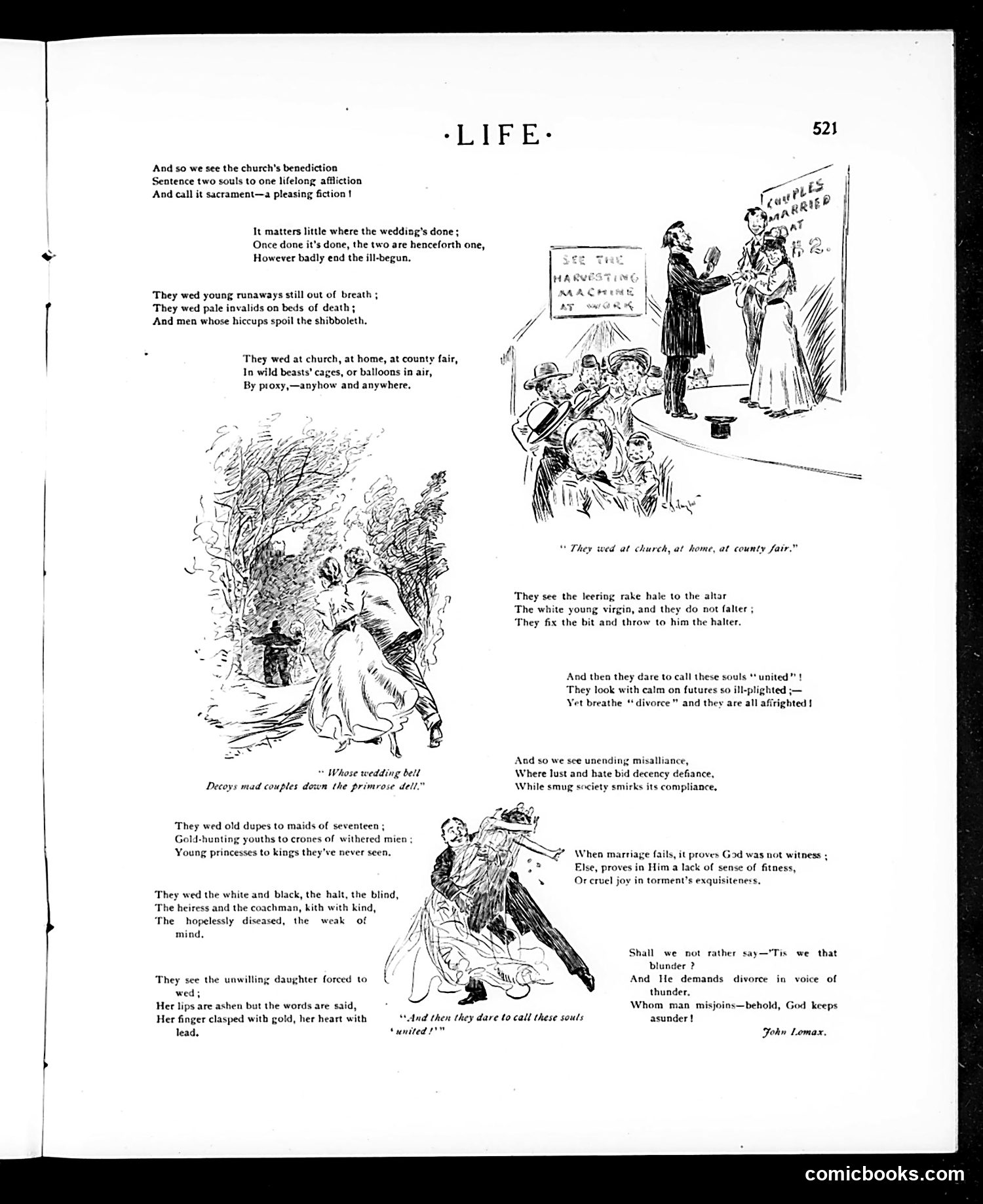
This is a scathing critique of marriage as an institution, illustrated with multiple vignettes. The central argument: society blesses deeply mismatched unions while condemning divorce, revealing hypocrisy. The satire depicts various problematic marriages—forced weddings, age-gap unions ("old dupes to maids of seventeen"), cross-class matches ("heiress and the coachman"), mismatched couples in ill health or mental state. The cartoons show ceremonies occurring anywhere from churches to hot air balloons, emphasizing marriage's casual treatment despite its permanence. The poem's key point: people condemn divorce as sinful while ignoring that many marriages are fundamentally unsuitable from the start. The final stanzas argue that if God divorces unsuitable unions, humans shouldn't blame God—they should blame themselves for creating bad matches in the first place. This reflects late-19th/early-20th-century debates over divorce reform and women's marital autonomy, criticizing society's willingness to trap people in unhappy marriages while maintaining moral outrage against separation.
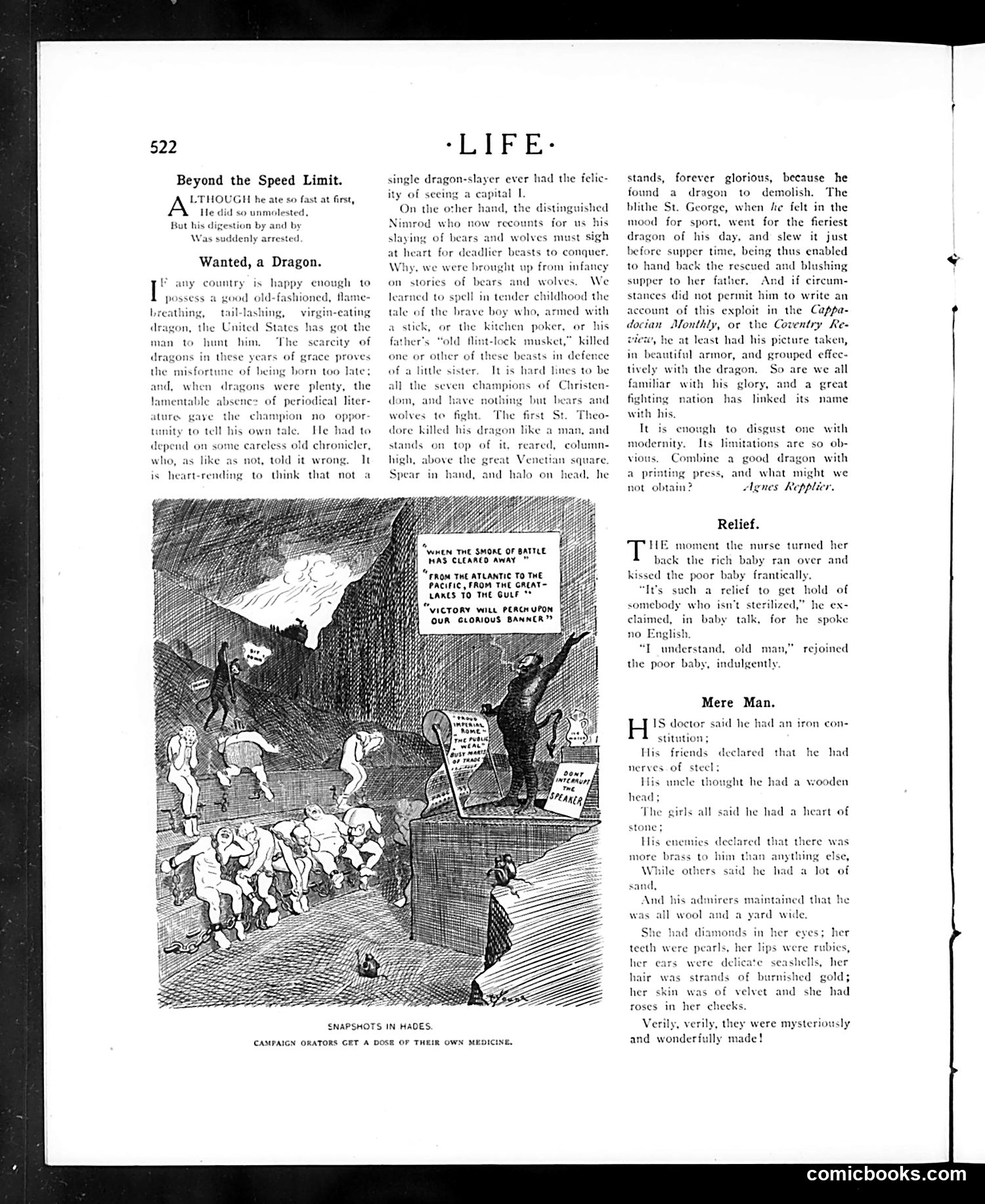
This page contains three satirical pieces typical of early 20th-century American humor: **"Wanted, a Dragon"** critiques modern life's lack of grand challenges. The author (attributed to Agnes Repplier) laments that historical heroes like St. George had dragons to slay and could publicize their deeds, while modern men face only mundane opponents. The piece mocks how combining "a good dragon with a printing press" would improve contemporary society—a witty jab at celebrity culture and the sensationalism enabled by mass media. **"Snapshots in Hades"** (the cartoon) shows campaign orators receiving "a dose of their own medicine," depicting political rhetoric as poisonous. The illustration's text bubbles contain hollow patriotic platitudes ("Victory will perch upon our glorious banner"), satirizing politicians' bombastic wartime speeches. **"Relief," "Mere Man,"** and related short pieces are brief comedic sketches poking fun at social pretension, medical fads, and the absurdity of romanticized descriptions—typical filler humor for the magazine. The overall tone reflects Progressive Era skepticism toward political oratory and nostalgic yearning for simpler, more heroic times.
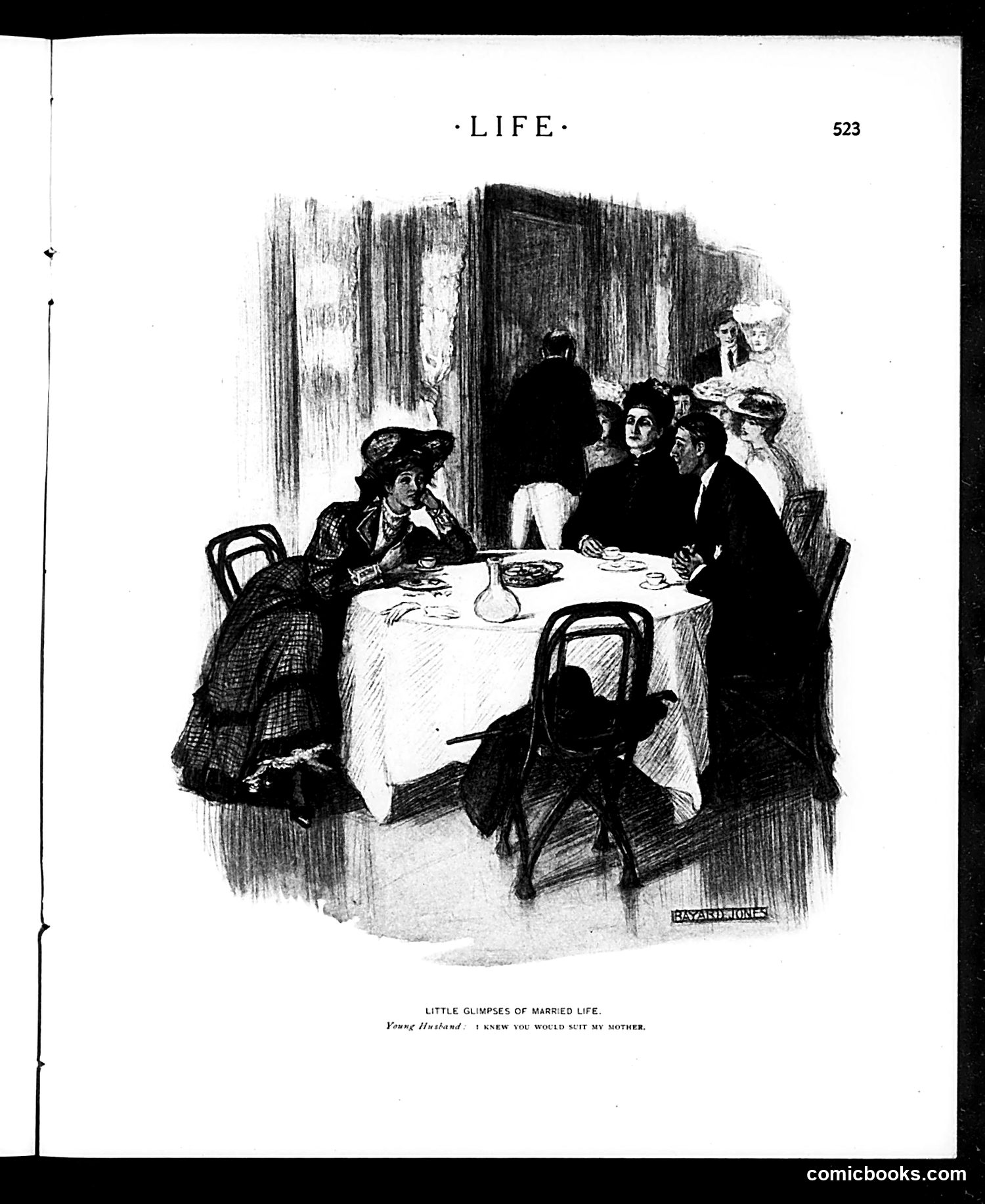
This cartoon satirizes the tension between a newlywed husband's loyalty to his mother versus his wife. The young husband sits at a dinner table with his wife and several other figures (likely in-laws or family members), telling her: "I knew you would suit my mother." The joke's sting lies in what this reveals: rather than marrying for love or because the wife suits *him*, he chose her based on his mother's approval. This mocks both the husband's dependency on maternal judgment and the era's social reality where mothers-in-law held considerable domestic influence over young marriages. The cartoon reflects early 20th-century anxieties about marriage dynamics—specifically the "domineering mother-in-law" stereotype and husbands who prioritized family obligation over spousal partnership. It's gentle domestic satire typical of *Life* magazine's social commentary.
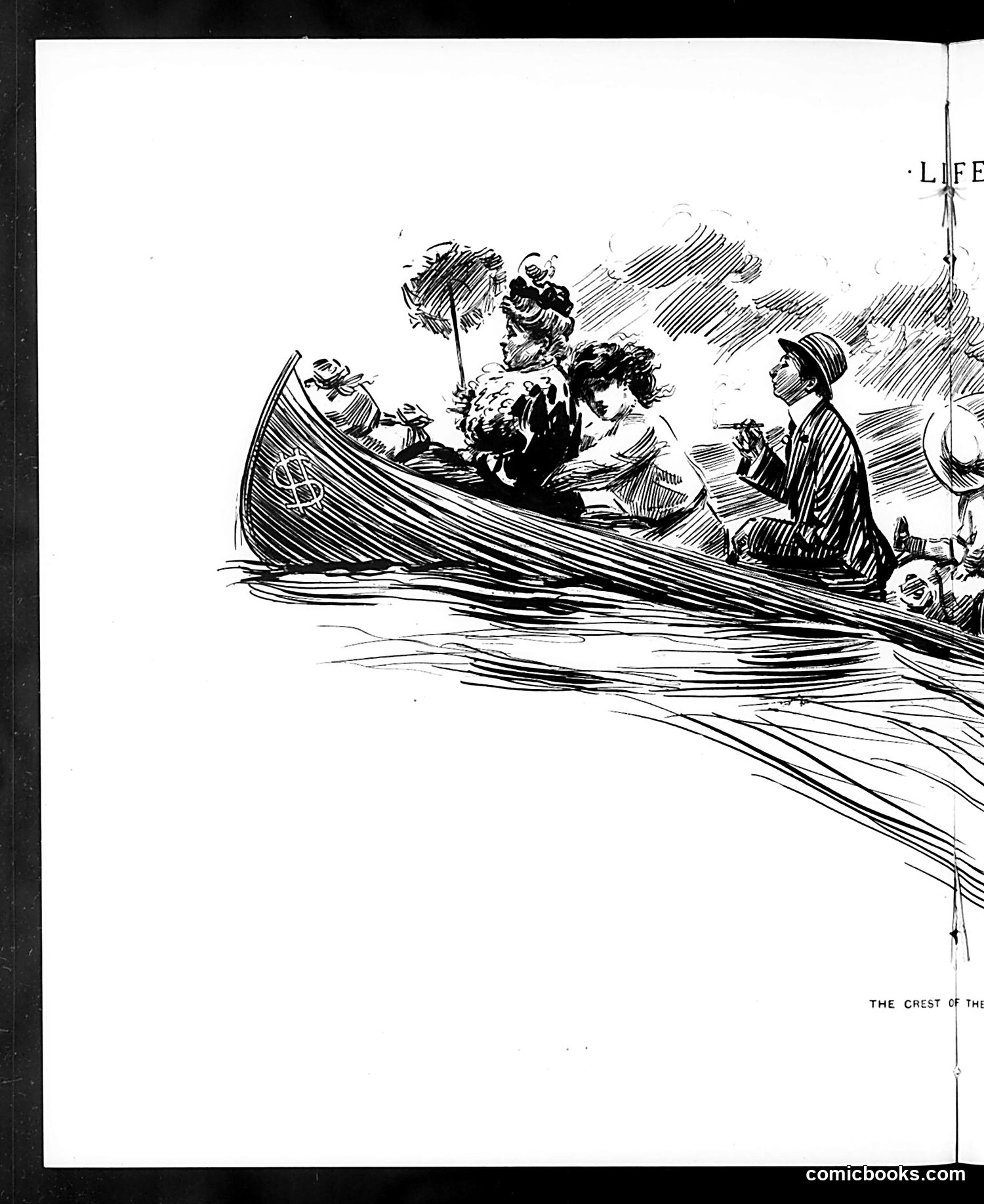
This appears to be a title page or section opener from *Life* magazine, featuring an ink sketch of figures in a small boat on water. The visible text reads "LIFE" (top right) and partially "THE CREST OF THE" (bottom right, likely "THE CREST OF THE WAVE"). The illustration shows elegantly dressed figures—appearing to be women in early 20th-century fashion with elaborate hats—in a small vessel. The style suggests social satire typical of *Life* magazine's content during this era. However, without the complete text or caption, I cannot definitively explain the specific political or social commentary intended. The title fragment "crest of the wave" might reference social trends or cultural moments, but the full meaning remains unclear from this page alone.
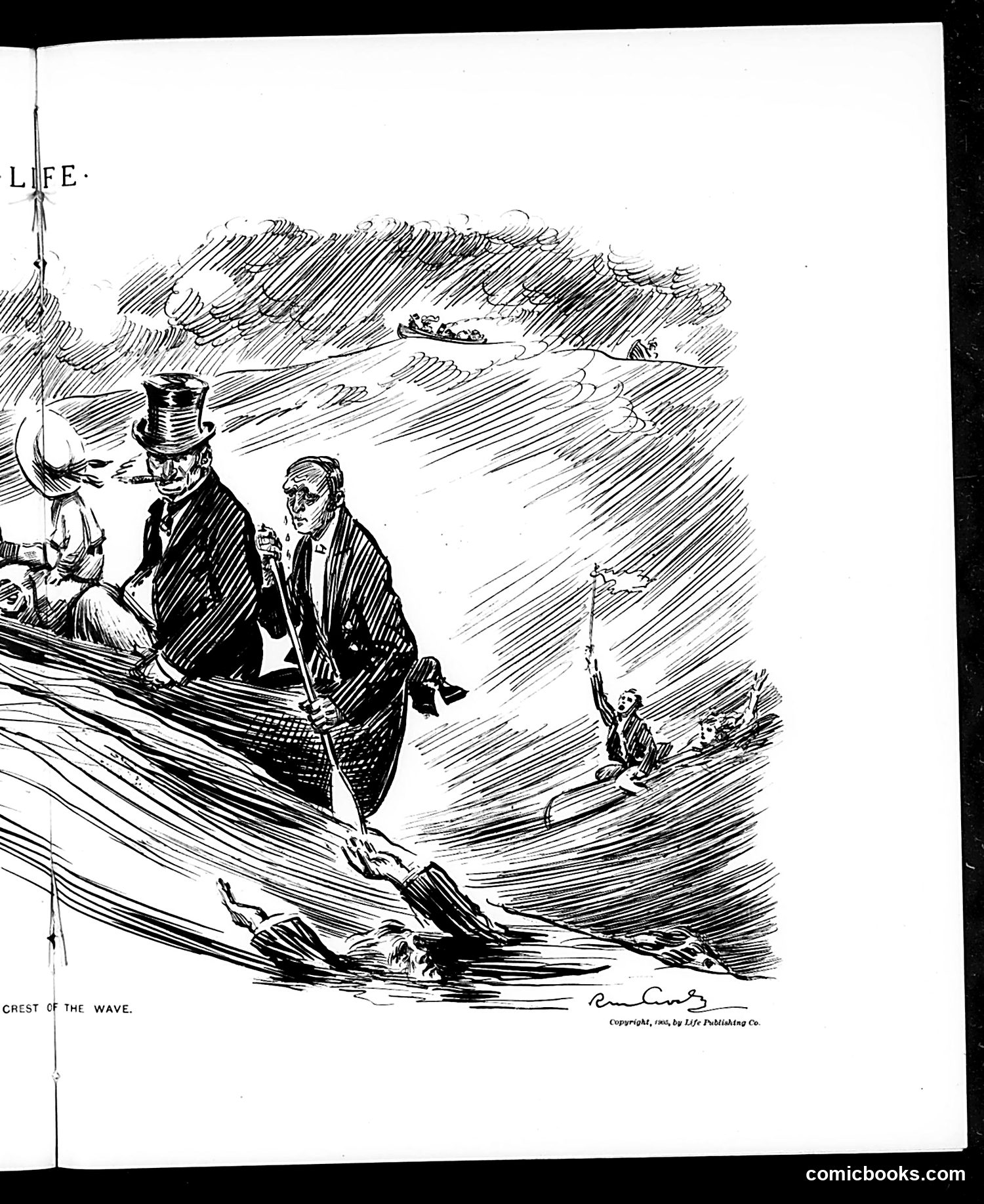
This Life magazine cartoon depicts two well-dressed gentlemen in top hats and formal coats navigating turbulent water, while figures struggle in the waves below them. The title "Crest of the Wave" suggests commentary on economic or social stratification during a crisis. The cartoon satirizes class inequality: the wealthy upper-class men remain safely positioned at the wave's peak, seemingly oblivious or indifferent to those drowning beneath them. The contrast between their formal attire and composed demeanor versus the desperate figures below emphasizes how economic hardship (possibly a financial panic or recession) affects different social classes unequally. The specific historical context is unclear without publication date confirmation, but the imagery conveys typical turn-of-century or early 20th-century critique of wealth disparity during economic turmoil.
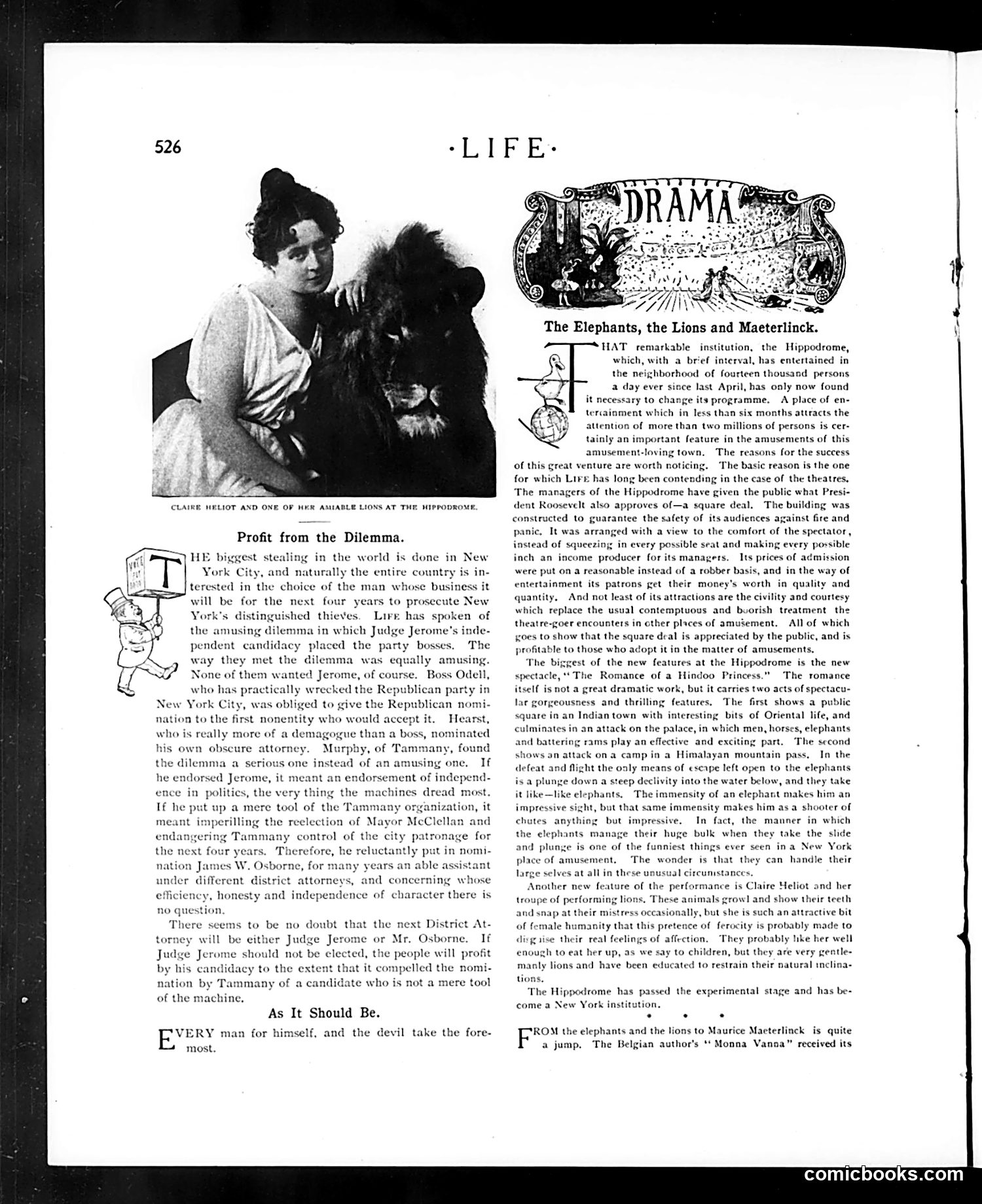
This page contains two distinct sections: **Left side ("Profit from the Dilemma"):** Political satire about New York City corruption and the 1906 District Attorney race. The piece mocks how Republican and Democratic party "machines" (Boss Odell and Murphy of Tammany Hall) faced a dilemma when reform-minded Judge Jerome ran as an independent candidate. Both parties reluctantly nominated weak "tools" rather than endorse Jerome, illustrating Life's critique of machine politics prioritizing power over merit. **Right side ("The Elephants, the Lions and Masterlinck"):** Drama criticism praising the Hippodrome theater's new production "The Romance of a Hindoo Princess." The unsigned article applauds the venue's "square deal" approach—reasonable prices, safe construction, courteous treatment—contrasting it favorably with typical theatrical exploitation. President Roosevelt's approval is invoked to legitimize this consumer-friendly model. The photograph shows performer Claire Heliot with lions at the Hippodrome, illustrating the spectacular animal acts discussed.
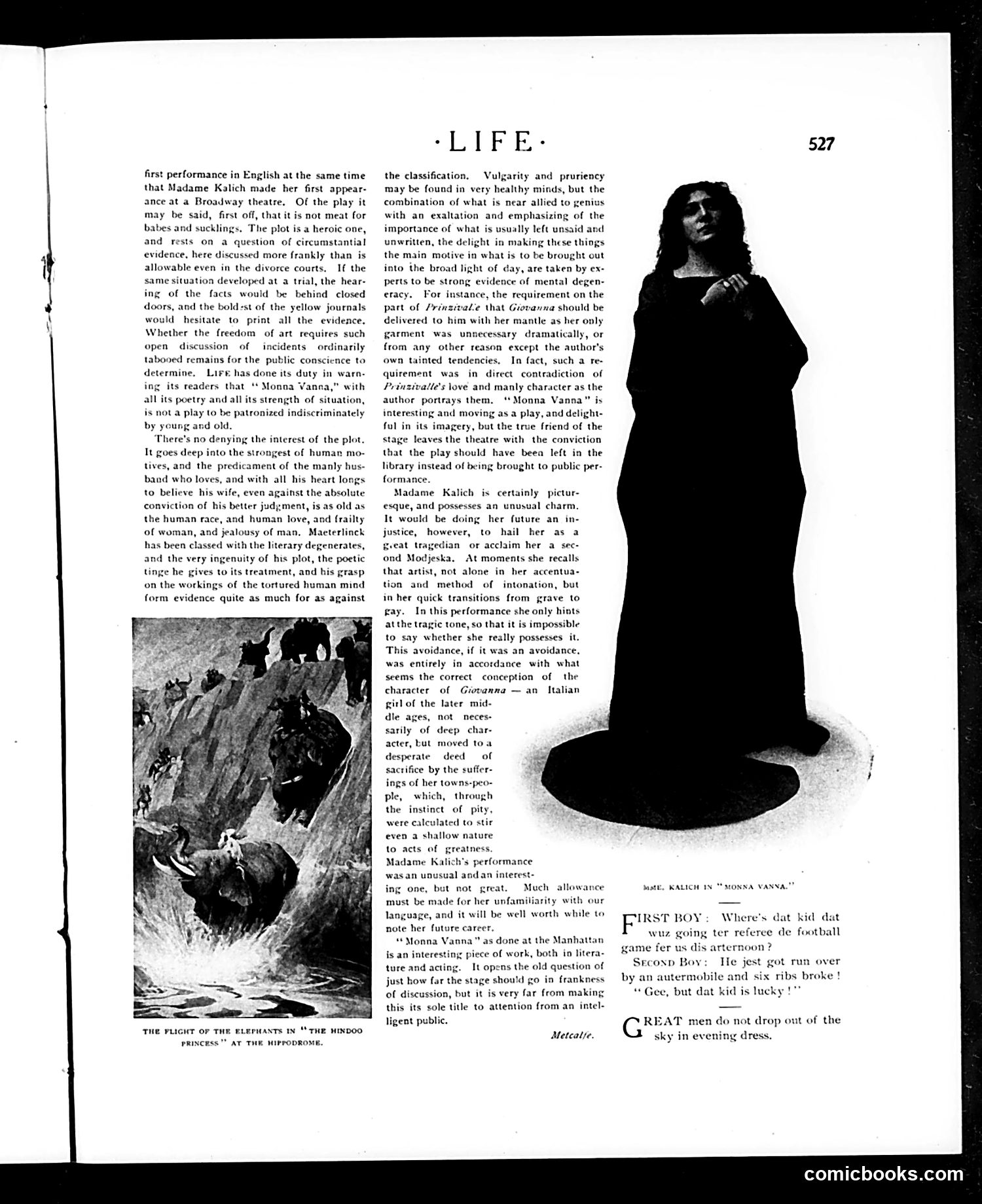
This page reviews Madame Kalich's Broadway debut in the play "Monna Vanna," a work by Belgian symbolist Maurice Maeterlinck. The text presents a moral critique of the play itself while assessing the actress's performance. **The Play's Controversy:** "Monna Vanna" depicts a married woman who must strip naked and go to an enemy general to save her city. The critic warns readers that the play is unsuitable for young people, arguing that while Maeterlinck possesses literary talent, he exploits morally questionable content—specifically, the requirement that the heroine appear nude is dramatically unnecessary and reveals "tainted tendencies." **On Madame Kalich:** She's praised as "picturesque" with "unusual charm" but judged not a great tragedian. Her performance avoids deep tragic depth, which the critic deems appropriate for the character—an ordinary Italian woman driven to desperate sacrifice by compassion. **The Images:** Show scenes from "The Hindoo Princess" at the Hippodrome (a separate theatrical production) and a portrait of Kalich in the title role.
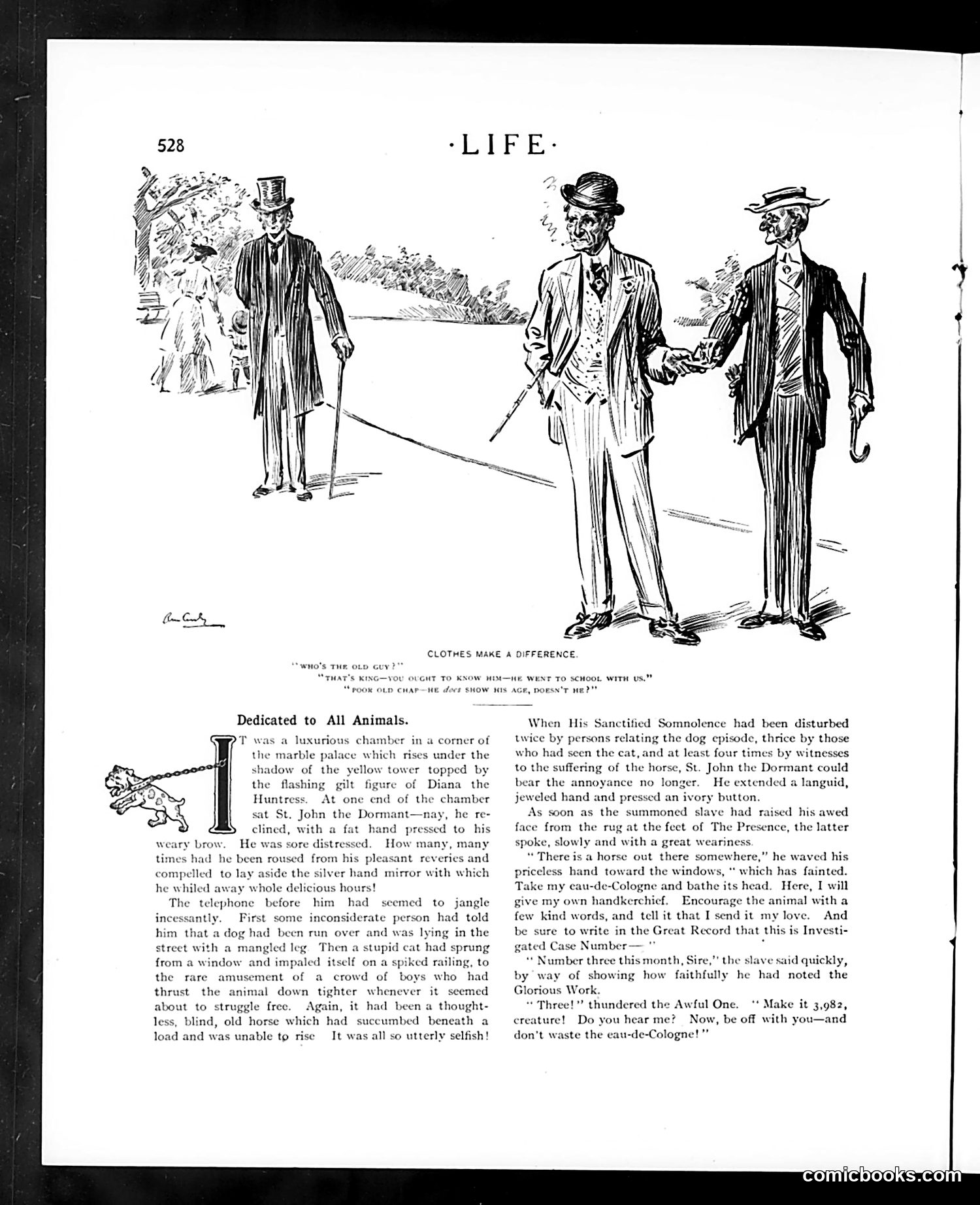
This page contains two distinct satirical pieces from *Life* magazine: **Top cartoon ("Clothes Make a Difference"):** Three men in suits discuss a fourth poorly-dressed man. The joke is that clothing determines social perception—the shabby man appears unrecognizable to people who went to school with him, revealing how thoroughly appearance shapes how society judges and treats individuals. **Bottom story ("Dedicated to All Animals"):** This is savage satire mocking wealthy philanthropists and their performative charity. "St. John the Dormant" is a self-satisfied rich man disturbed by reports of animal suffering (a dog hit by a car, a cat impaled on a railing, an overworked horse). Rather than help directly, he performs theatrical "concern"—sending his slave with eau-de-Cologne and recording the gesture as "Investigated Case Number 3,982" (implying thousands of such meaningless acts). The satire ridicules those who make charity about themselves rather than actual relief.
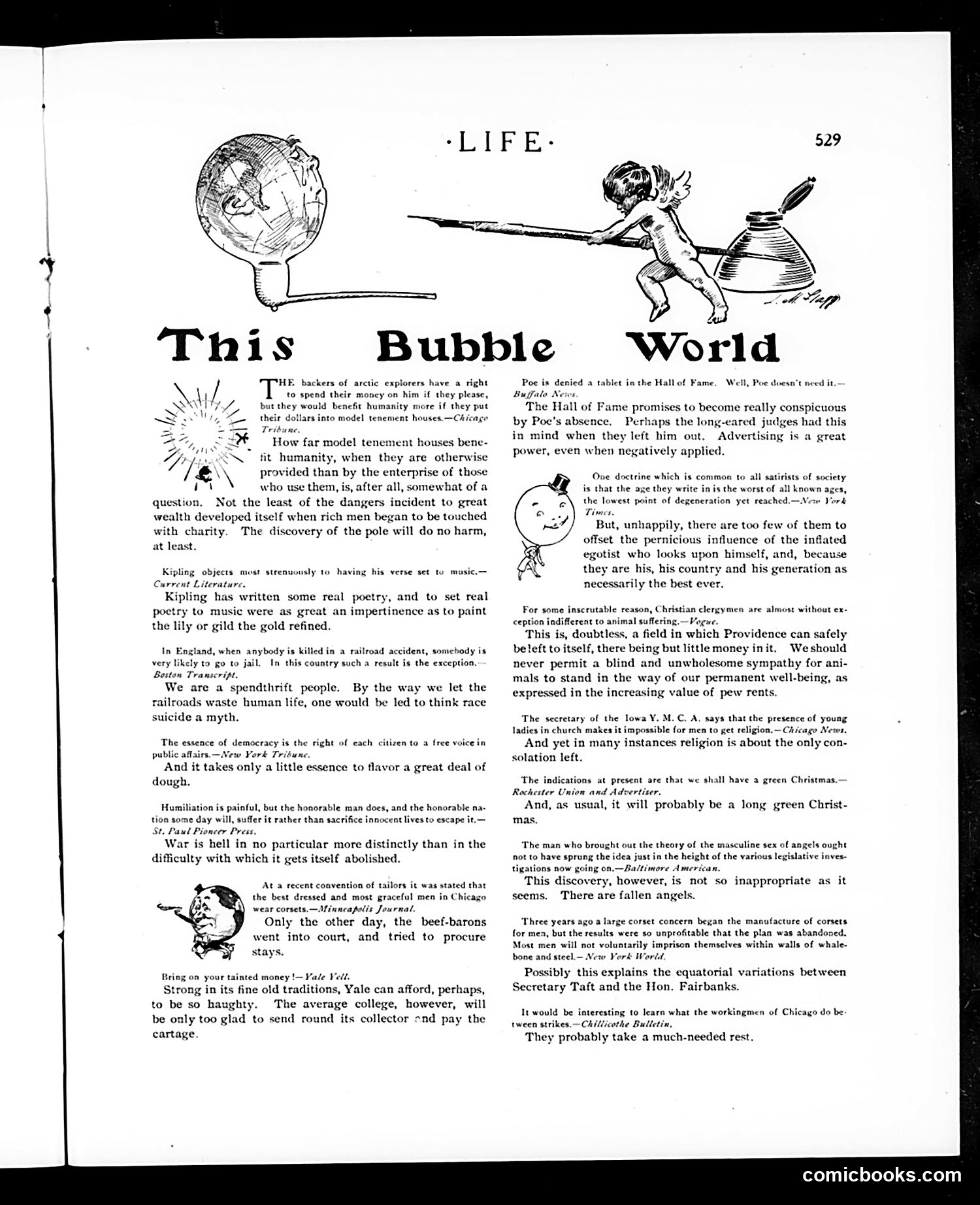
This page collects brief satirical comments on contemporary American society, typical of Life's editorial format. The title illustration shows cherubs blowing bubbles, metaphorically representing fragile, ephemeral social conditions. The satire targets multiple subjects: wealthy industrialists' charity (arctic exploration versus tenement housing), railroad companies' indifference to worker deaths, wealthy institutions like Yale accepting "tainted money" from donors, the exclusion of poet Edgar Allan Poe from the Hall of Fame due to lack of commercial "advertising," and Christian clergy's apathy toward animal suffering—attributed to lack of financial incentive. A recurring theme is hypocrisy: institutions and individuals claiming virtue while prioritizing profit. The "inflated egotist" section mocks those viewing their era as uniquely degenerate. The final jab about "green Christmas" suggests economic hardship masquerading as seasonal cheer. The tone is caustic social commentary typical of progressive-era American humor magazines.
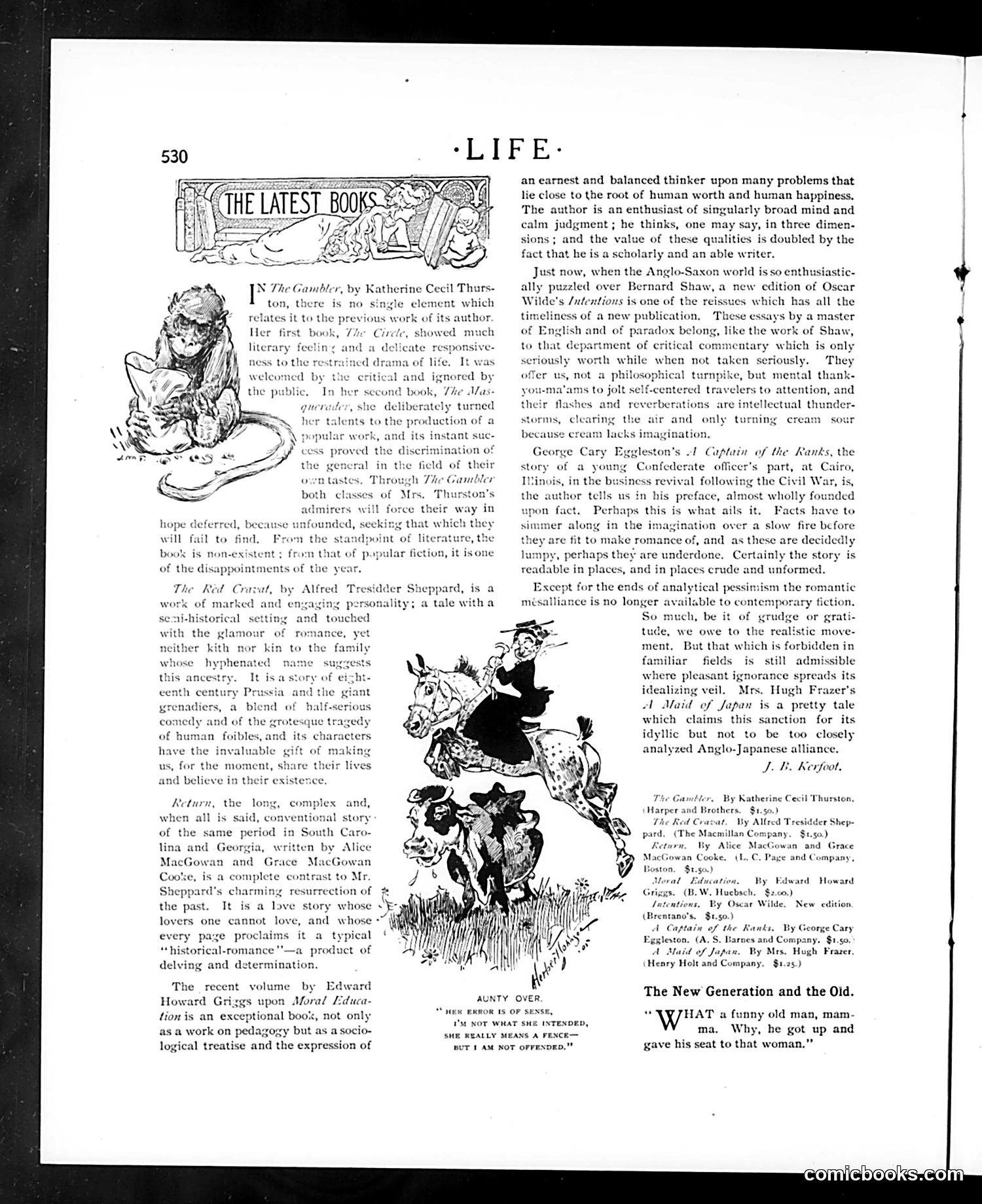
This is a book review section from *Life* magazine featuring literary criticism of contemporary novels. The small cartoon labeled "AUNTY OVER" depicts a humorous intergenerational moment: a child finds it absurd that an elderly man would give up his seat to a woman—a courtesy that represents old-fashioned chivalry. The joke satirizes changing social manners, suggesting that younger generations found such traditional gentlemanly behavior quaint or outdated. The page reviews works by Katherine Cecil Thurston, Alfred Tresidder Sheppard, Alice MacGowan, Edward Howard Griggs, Oscar Wilde, George Cary Eggleston, and Mrs. Hugh Frazer. Critics discuss whether these novels successfully balance romance with realism, and whether analytical pessimism serves contemporary fiction better than idealized romanticism. The reviews treat literature as worthy of serious intellectual engagement.
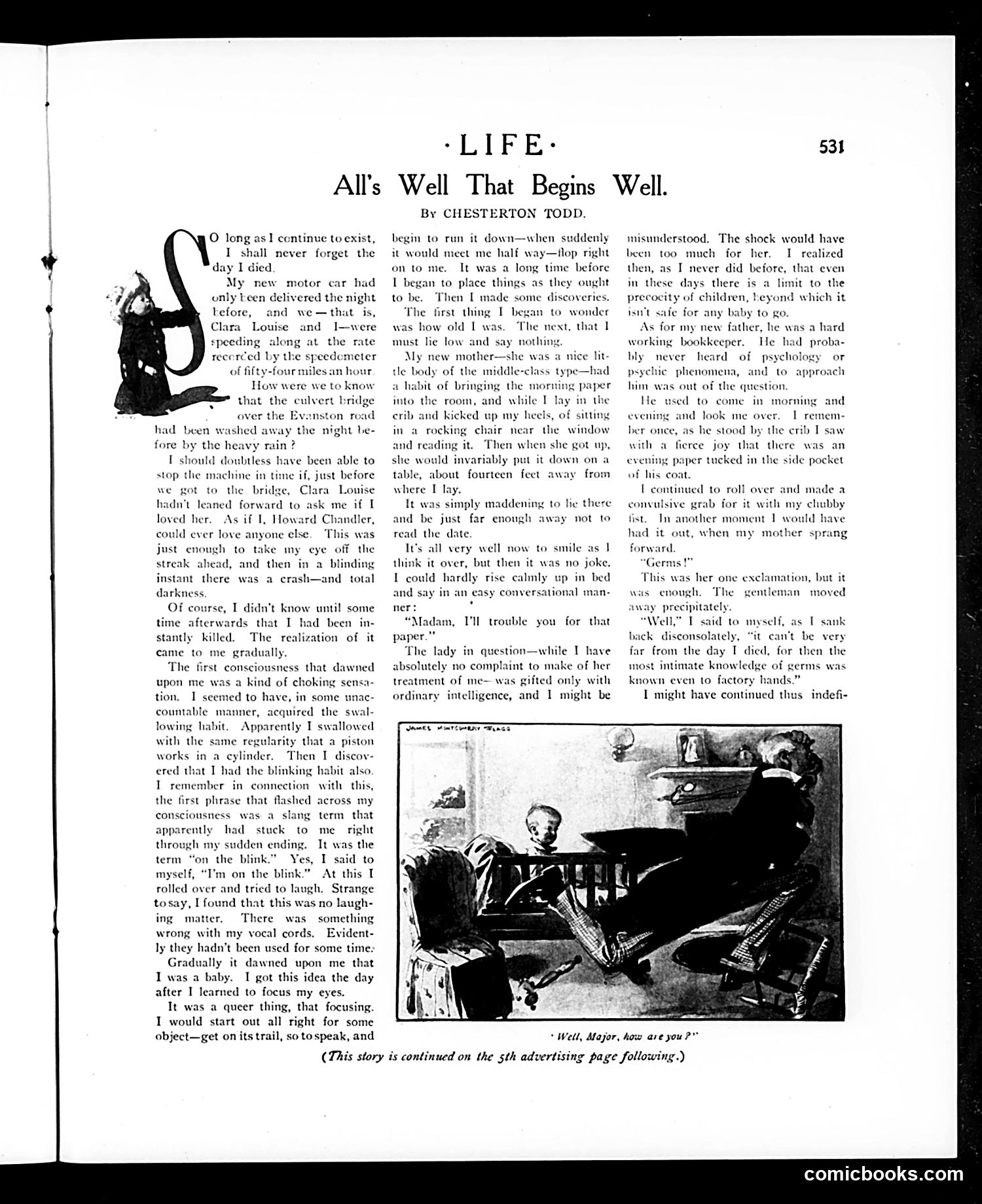
This is a humorous fantasy story, not political satire. The narrative follows a man who dies in a car crash (caused when his fiancée Clara Louise distracts him by asking if he loves her), only to discover he has been reincarnated as a baby. The joke centers on the protagonist's predicament: he retains adult consciousness and knowledge but is trapped in an infant's helpless body. His frustration is comedic—he desperately wants to read the date from a newspaper his mother leaves on a table "fourteen feet away," but cannot reach it or communicate his extraordinary intelligence without terrifying his ordinary parents (a bookkeeper father and conventionally intelligent mother). The illustration shows him as an adult-minded infant in a crib, observing his new parents. The satire mocks the gap between intellectual capability and physical limitation, playing on early-1900s ideas about reincarnation and the absurdity of possessing adult reasoning in an infant's circumstances.
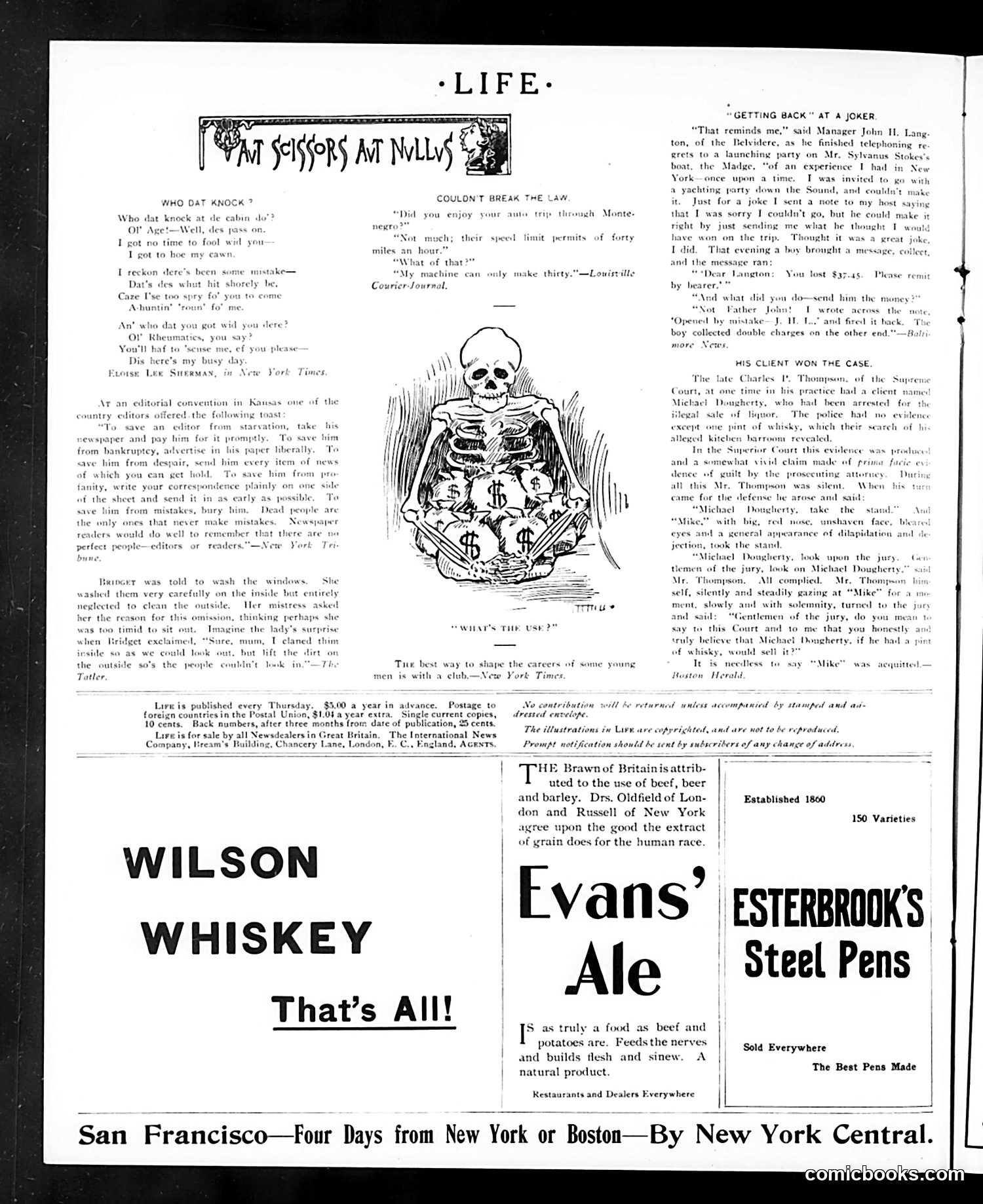
This page contains three distinct humorous pieces typical of Life's satirical style: **"Who Dat Knock"**: A dialect joke (in the offensive racial comedy style of the era) playing on miscommunication—a man uses "cab of Age" as a punchline about being old enough to drink. **"Couldn't Break the Law"**: A practical joke story where someone sends a fake speeding ticket to a manager. The manager retaliates by sending a fake receipt demanding repayment, turning the tables on the joker. **"His Client Won the Case"**: An anecdote about lawyer Charles P. Thompson and client Michael Dougherty, arrested for illegal liquor sales. During trial, Thompson dramatically turns Dougherty around to show the jury his disreputable appearance, sarcastically asking if they'd believe *this man* would sell whiskey—implying his obvious guilt makes him the type who would. The page is primarily **advertising** (Wilson Whiskey, Evans' Ale, Esterbrook's Steel Pens) surrounding these brief comic pieces. The humor relies on period stereotypes, practical jokes, and courtroom irony typical of early 1900s American comedy magazines.
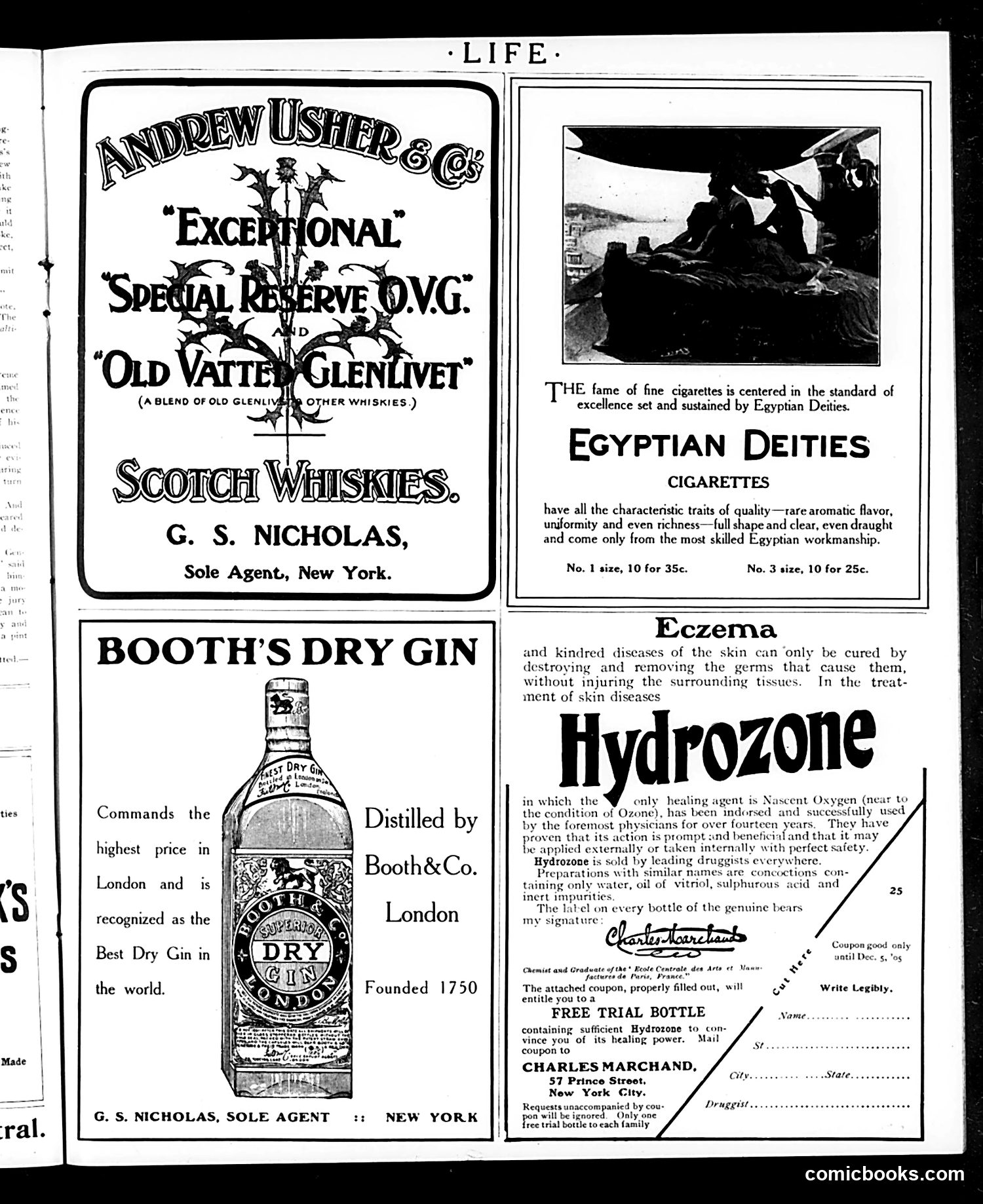
This is **not a cartoon or satirical content** — it's a straightforward **advertising page** from Life magazine, likely early 1900s based on styling and product claims. The page contains four product advertisements: 1. **Andrew Usher Scotch Whisky** — promoting "Old Vattie Glenlivet" through New York agent G.S. Nicholas 2. **Egyptian Deities Cigarettes** — marketed with claims of "rare aromatic flavor" and "skilled Egyptian workmanship" 3. **Booth's Dry Gin** — established 1750, claiming to be "the Best Dry Gin in the world" 4. **Hydrozone** — a patent medicine claiming to cure eczema and skin diseases using "Nascent Oxygen," with a coupon for a free trial bottle from Charles Marchand in New York City The Hydrozone ad is notable for its pseudo-scientific language typical of unregulated patent medicines of this era — claims that would be illegal today. The page reflects pre-FDA advertising standards where such health claims went unchallenged.
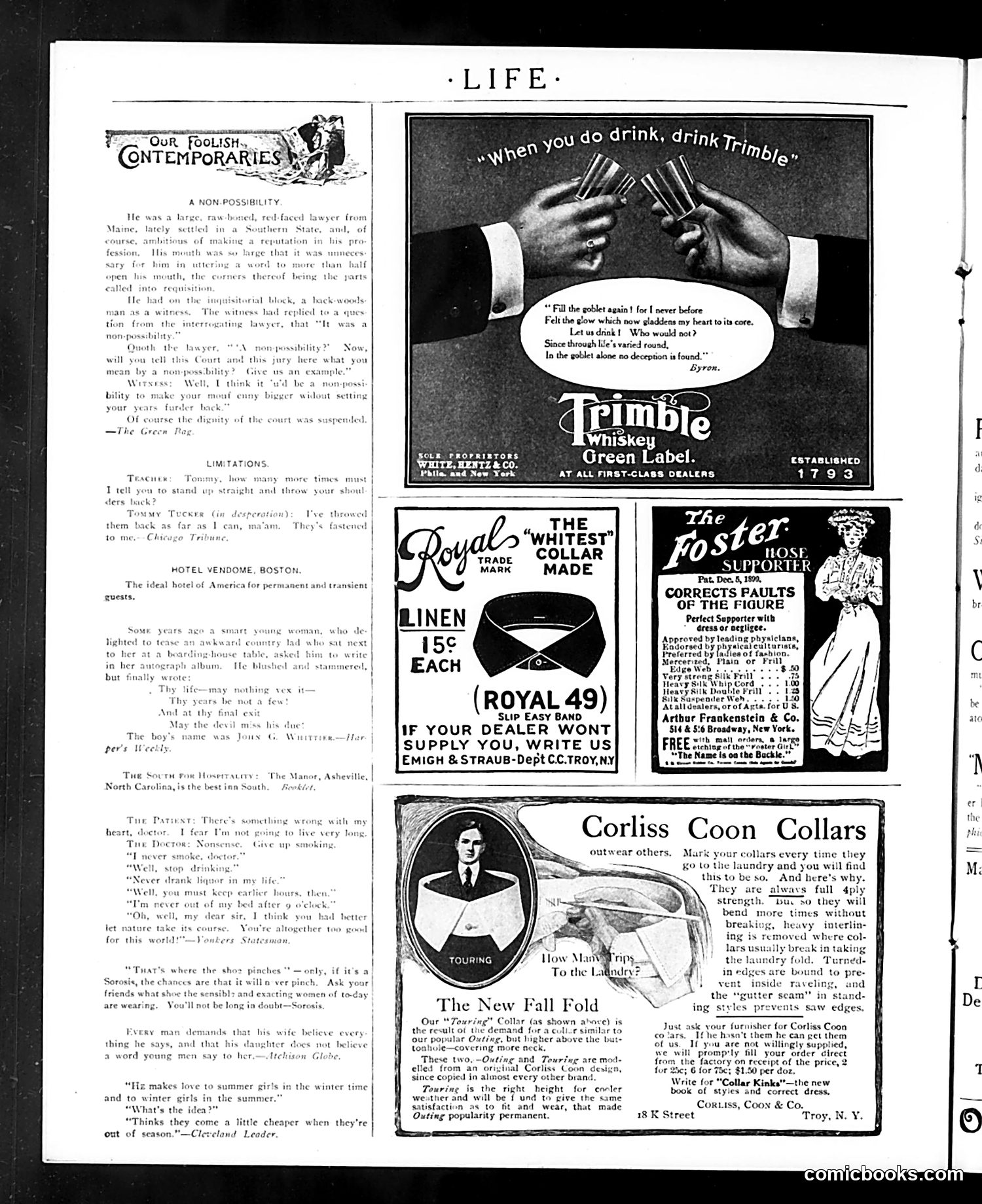
This *Life* magazine page contains satirical articles and period advertisements (circa 1910s, based on styling). **The Cartoons/Articles:** The left side features humorous anecdotes labeled "Our Foolish Contemporaries"—short jokes mocking human nature and social pretension. These include: a lawyer's logical contradiction, someone claiming to cure hiccups, and various domestic absurdities. The satire targets everyday foolishness rather than specific political figures. **The Advertisements:** The right side advertises consumer products typical of the era: - Trimble Whiskey (emphasizing the "golden" glow of the drink) - Royal collars (15¢ each, Easy Band style) - Foster hose supporters (corrective undergarment) - Corliss Coon Collars (competing collar brand) These ads reflect consumer culture of the 1910s, targeting middle-class men's fashion and grooming. The collar advertisements particularly highlight competition in men's neckwear—a significant fashion market then. **Overall:** This is primarily a humor and advertising page rather than political satire.
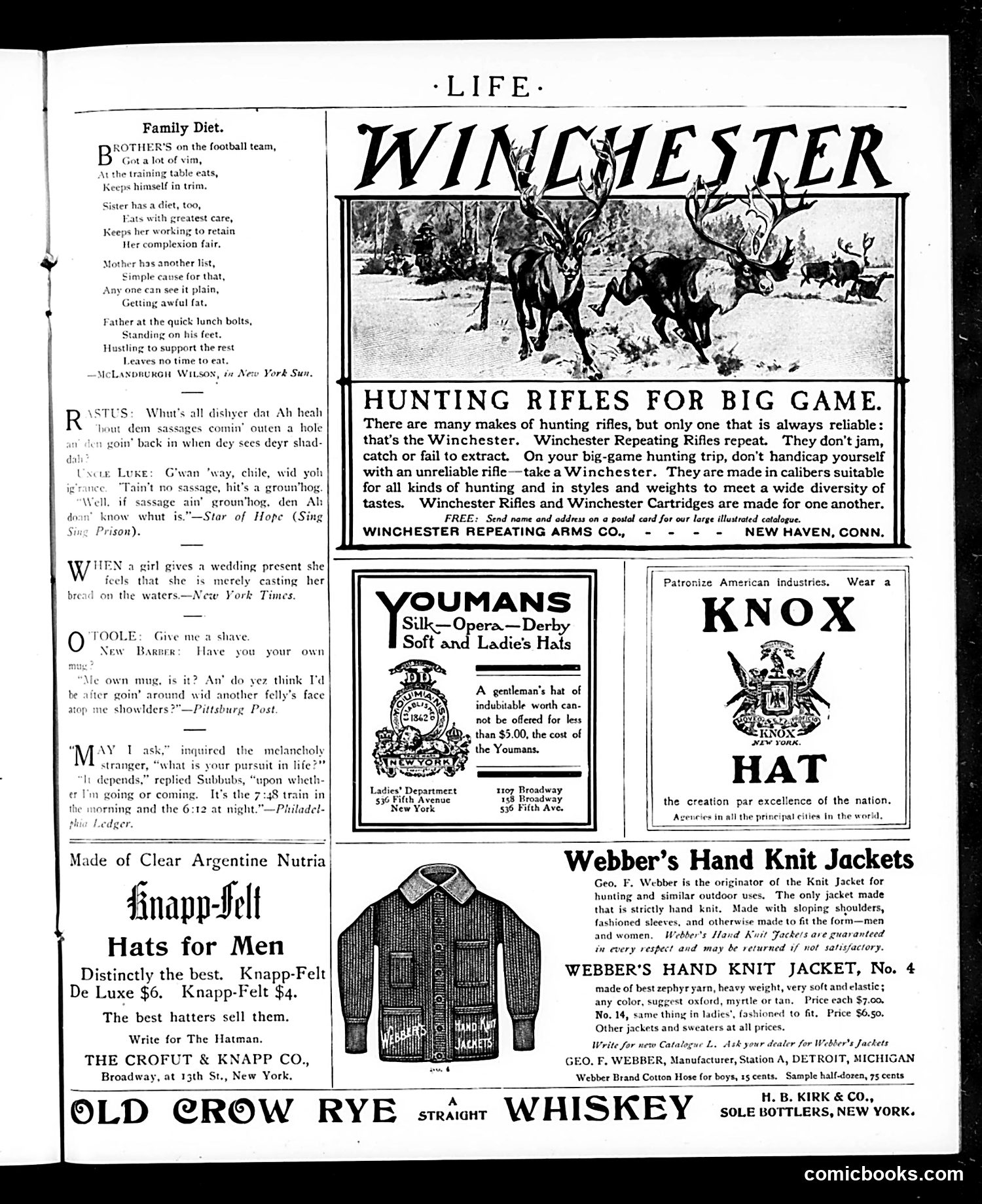
This page is primarily **advertising with humorous short jokes** rather than political cartoons. The "Family Diet" section opens with light satirical verses about different family members' eating habits—a brother on the football team eating well, a sister dieting to maintain her complexion, a mother gaining weight, and a father eating hastily at lunch counters. The humor is domestic and gentle. Below are several brief dialect jokes, including one featuring an African American character debating whether sausage is ground hog, and others about wedding gifts, barber shop conversation, and commuter train schedules—all reflecting everyday American life circa early 1900s. The remainder is **product advertising**: Winchester rifles, Youmans hats, Knox hats, Knapp-Felt hats, Webber's hand-knit jackets, and Old Crow whiskey. The ads emphasize quality and patriotic consumption ("Patronize American industries"). **No significant political satire or caricature appears here**—it's a typical Life magazine page balancing light humor with commercial content.
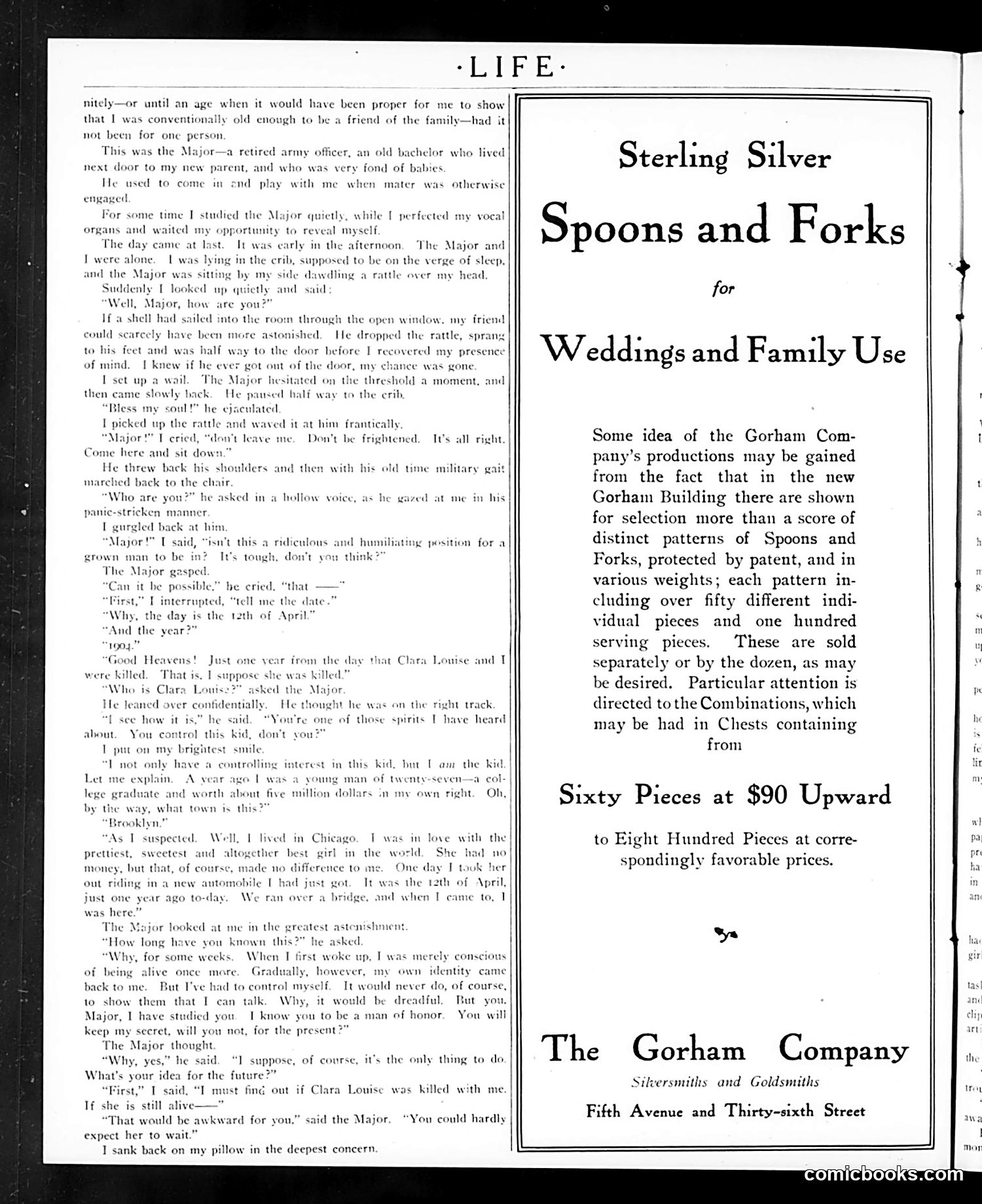
This page contains a serialized fiction story (left column) interrupted by a full-page advertisement for The Gorham Company (right side). The narrative appears to be a supernatural or reincarnation tale: a man, now an infant, has mysteriously regained consciousness and the ability to speak. He confides in "the Major," a retired army officer neighbor, revealing that he died exactly one year prior—April 12, 1904—in an automobile accident in Brooklyn with a woman named Clara Louise. He has somehow been reborn as a baby and now possesses his adult memories and intellect trapped in an infant's body. The story's central tension concerns whether Clara Louise survived the crash. The Major, shocked but honorable, agrees to keep this impossible secret. The advertisement for sterling silver flatware interrupts the narrative, offering 50+ spoon and fork patterns for weddings and family use, priced from $90 upward. The juxtaposition creates an odd tonal clash typical of Life's layout: fantastical fiction meets mundane consumer goods.
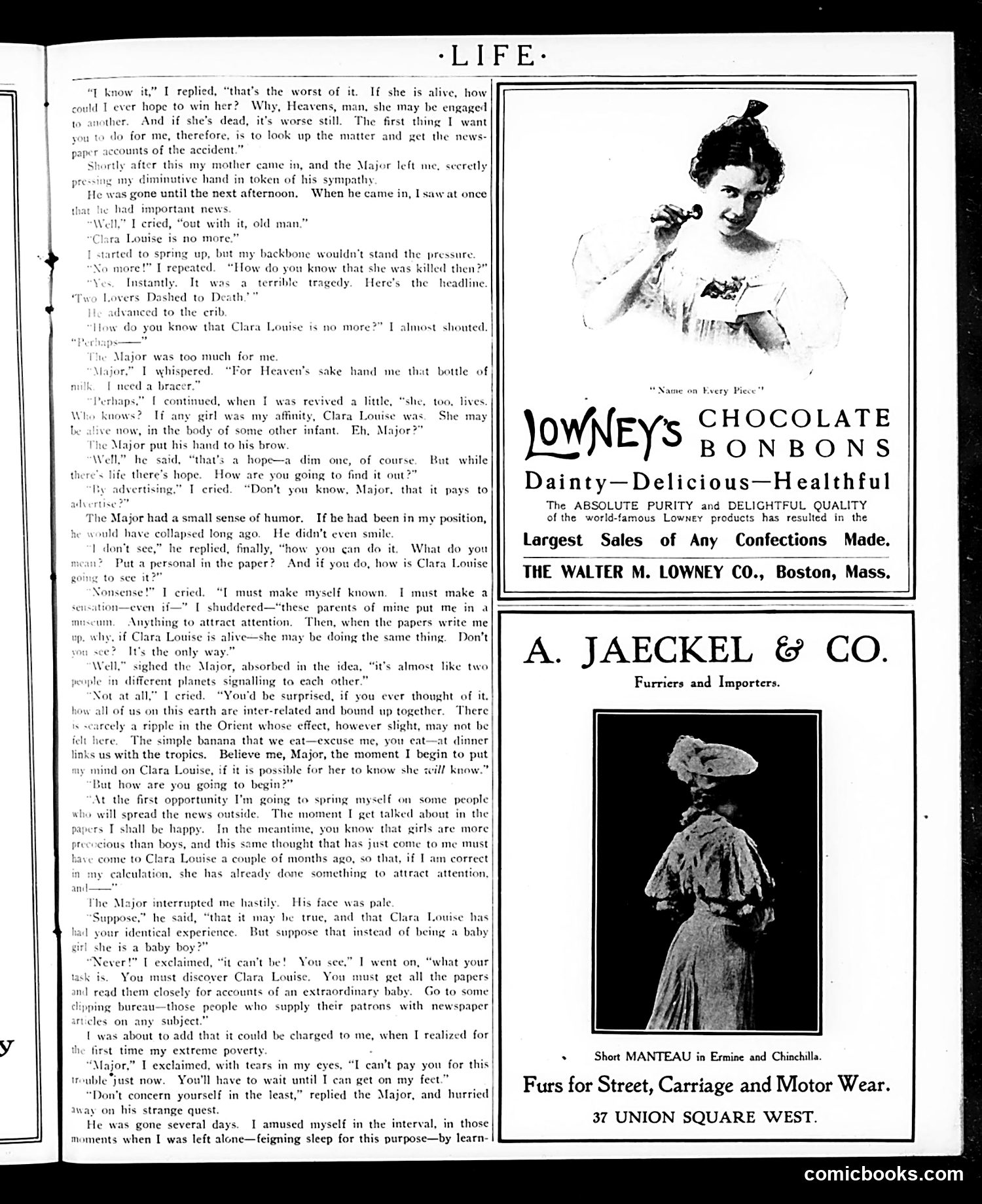
This page is primarily **advertising with serialized fiction**, not a political cartoon. The left column continues a humorous story about a narrator searching for a woman named Clara Louise who may have died or been reincarnated as an infant. The narrator plans to attract newspaper attention to signal to her across "different planets"—a absurdist premise the Major finds oddly compelling. The satire targets **turn-of-century romanticism and newspaper culture**: the protagonist believes personal newspaper ads and manufactured scandals can solve romantic problems, reflecting contemporary anxieties about mass media's growing power. The humor lies in his elaborate, illogical reasoning. The right side features **period advertisements** for Lowney's chocolates and A. Jaeckel & Co. furs—typical *Life* magazine content from this era. No specific political figures are caricatured here; the satire is social rather than political, mocking romantic idealism and sensationalism generally.
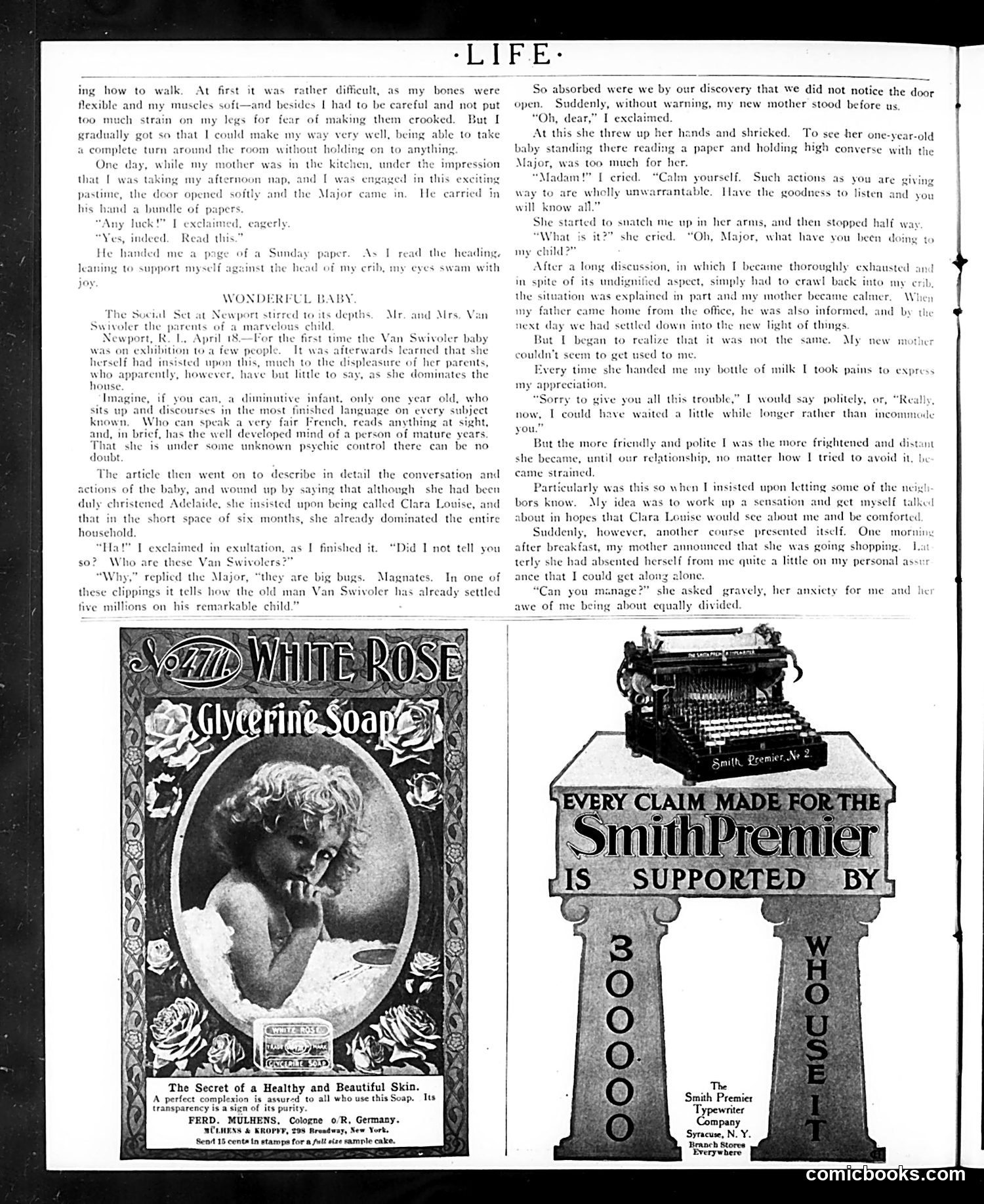
This page contains a serialized story about a supposedly miraculous infant—a one-year-old child named Adelaide (who insists on being called Clara Louise) who speaks fluent French, reads newspapers, and engages in sophisticated conversation. The narrative is a **satire of sensationalist journalism and wealthy Newport society's gullibility**. The story mocks: - **Credulous newspaper coverage** of extraordinary claims about children of the rich (the Van Swivoler family) - **Parental vanity** among the wealthy elite, who parade their children as proof of superiority - **Class pretension**, with the family dominating their household and society through their "remarkable child" The advertisements on the page (White Rose Glycerine Soap, Smith-Premier Typewriter) are period product placements unrelated to the satire. The joke hinges on the impossibility of the child's abilities—Life's readers would recognize this as obvious fiction designed to ridicule Newport society's self-importance and the press's willingness to promote dubious stories about the wealthy.
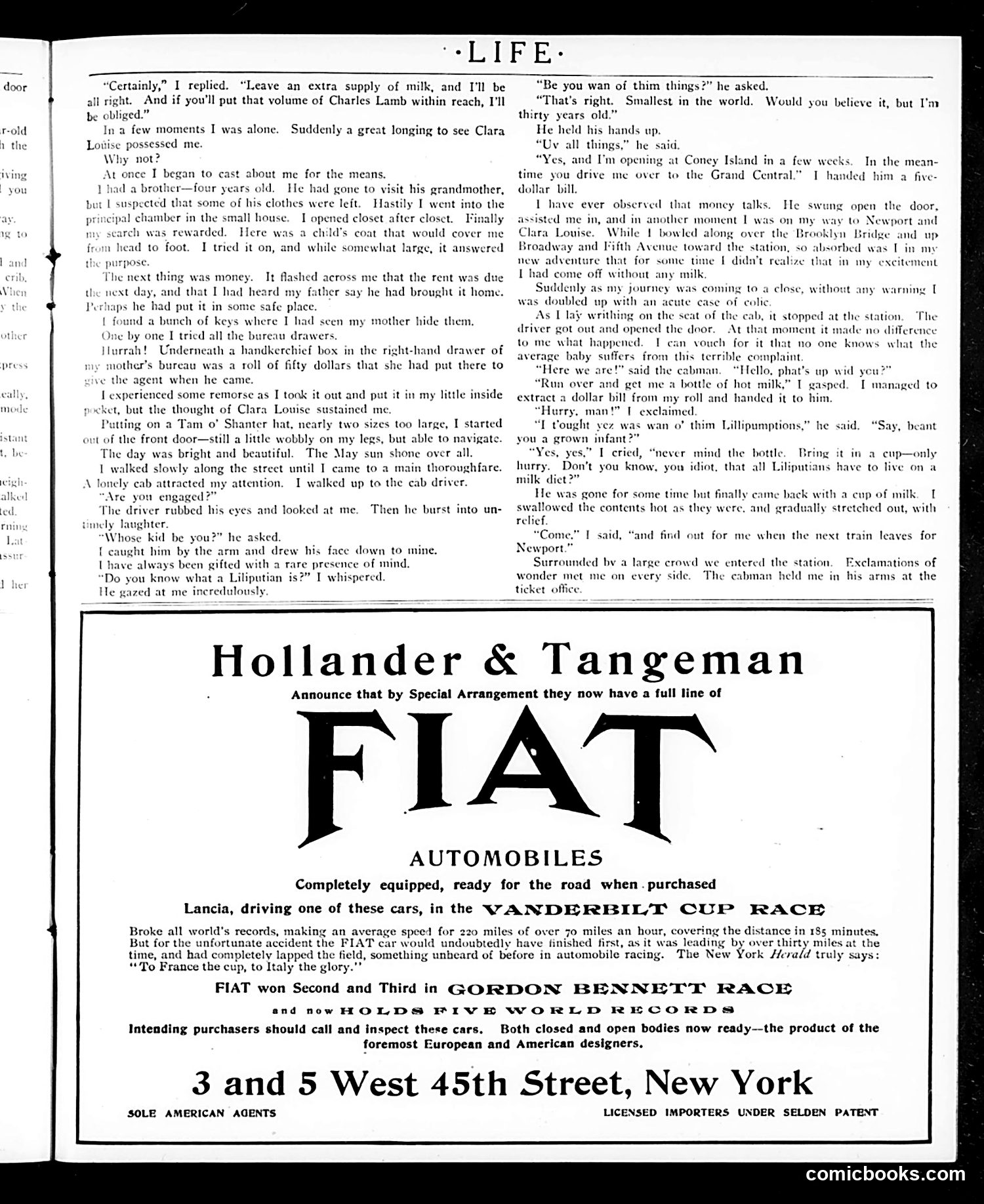
This page contains a **serialized short story** (titled "LIFE") about an adult who disguises himself as a child in an oversized coat and hat to visit a woman named Clara Louise. The narrative involves him stealing fifty dollars from his mother's bureau, convincing a cab driver he's a 30-year-old "Liliputian" (tiny person) opening at Coney Island, and suffering from colic during his journey. The humor relies on **absurdist role-play**: an adult pretending to be a child, fabricating an elaborate cover story, and experiencing infantile ailments as a consequence. The page also contains a **FIAT automobiles advertisement** from Hollander & Tangeman, emphasizing the car's racing victories and that models are "completely equipped, ready for the road." For modern readers: the story's comedy—an adult in child's clothing claiming to be a circus performer—would seem peculiar today. The advertisement demonstrates early automotive marketing through performance bragging rather than practical features. The page reflects 1910s American magazine culture mixing serialized fiction with commercial advertising.
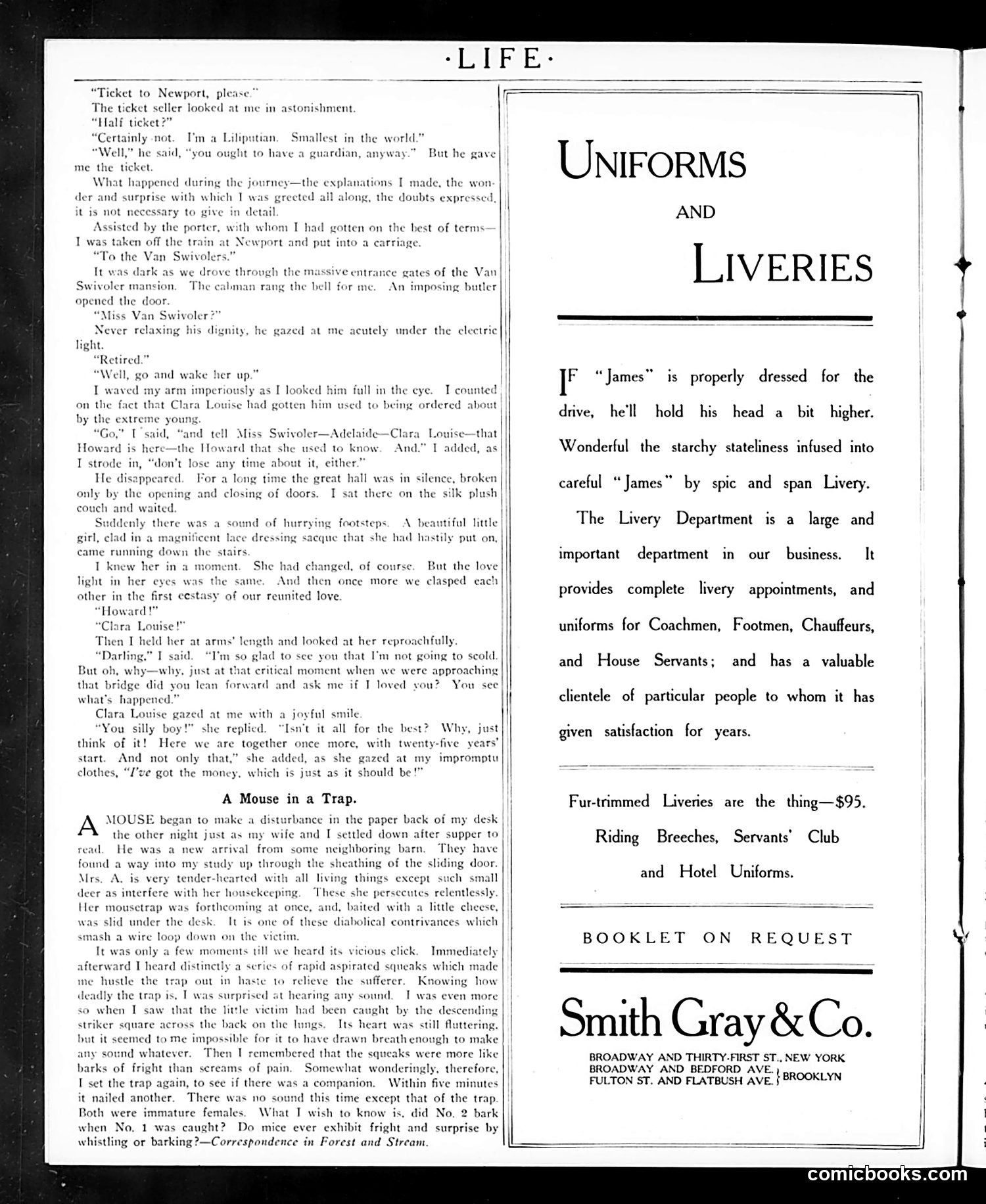
This page contains two distinct pieces of fiction rather than political cartoons: **"Ticket to Newport"** (left): A romantic short story about a man claiming to be a Lilliputian (reference to Jonathan Swift's *Gulliver's Travels*—a tiny person) buying a train ticket to Newport, Rhode Island. He reconnects with an old love, Clara Louise Van Swivoler, at a wealthy estate. The humor lies in the absurdist premise of the ticket seller's deadpan response and the reunion's melodrama. It's gentle satire of upper-class romance conventions. **"A Mouse in a Trap"** (left continuation): A humorous anecdote about a mouse caught in a mousetrap in the author's study. The piece explores the tension between the wife's tenderness toward animals and her ruthlessness toward household pests, culminating in observations about the mouse's suffering and survival instincts. **Right side**: Advertisement for Smith Gray & Co.'s livery services—uniforms and appointments for household staff in New York and Brooklyn. This is primarily *entertainment content*—fiction and advertising—rather than satirical commentary on contemporary politics or events.
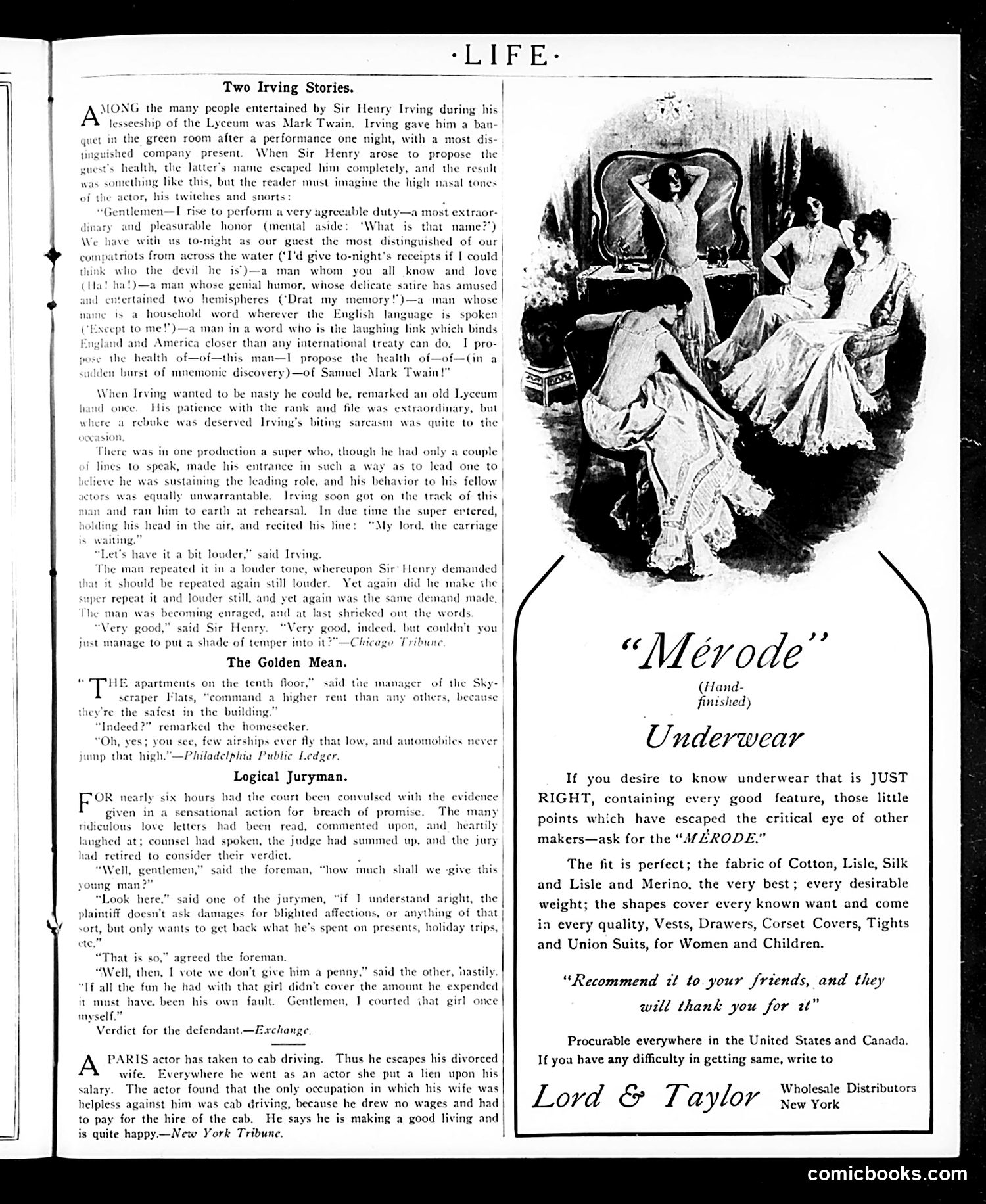
This page contains three brief satirical anecdotes about famous figures, plus an advertisement. **The Irving Stories** recount incidents involving Sir Henry Irving, the renowned British actor and Lyceum Theatre manager. The first story mocks Irving's absent-mindedness: while toasting guest Mark Twain at a banquet, Irving forgets Twain's name mid-speech, creating awkward pauses filled with theatrical muttering. The second anecdote illustrates Irving's cutting wit: he repeatedly demands a minor actor ("super") deliver a single line louder and louder until the man becomes visibly angry—then praises him for finally achieving the right "shade of temper." The humor derives from contrasting Irving's distinguished reputation with his very human flaws (forgetfulness) and his manipulative rehearsal tactics. **The remaining short items** satirize everyday situations: overpriced high-rise apartments, a jury deciding a breach-of-promise case, and a Parisian actor evading his ex-wife by driving a cab. The **"Merode" advertisement** on the right promotes handfinished women's undergarments.
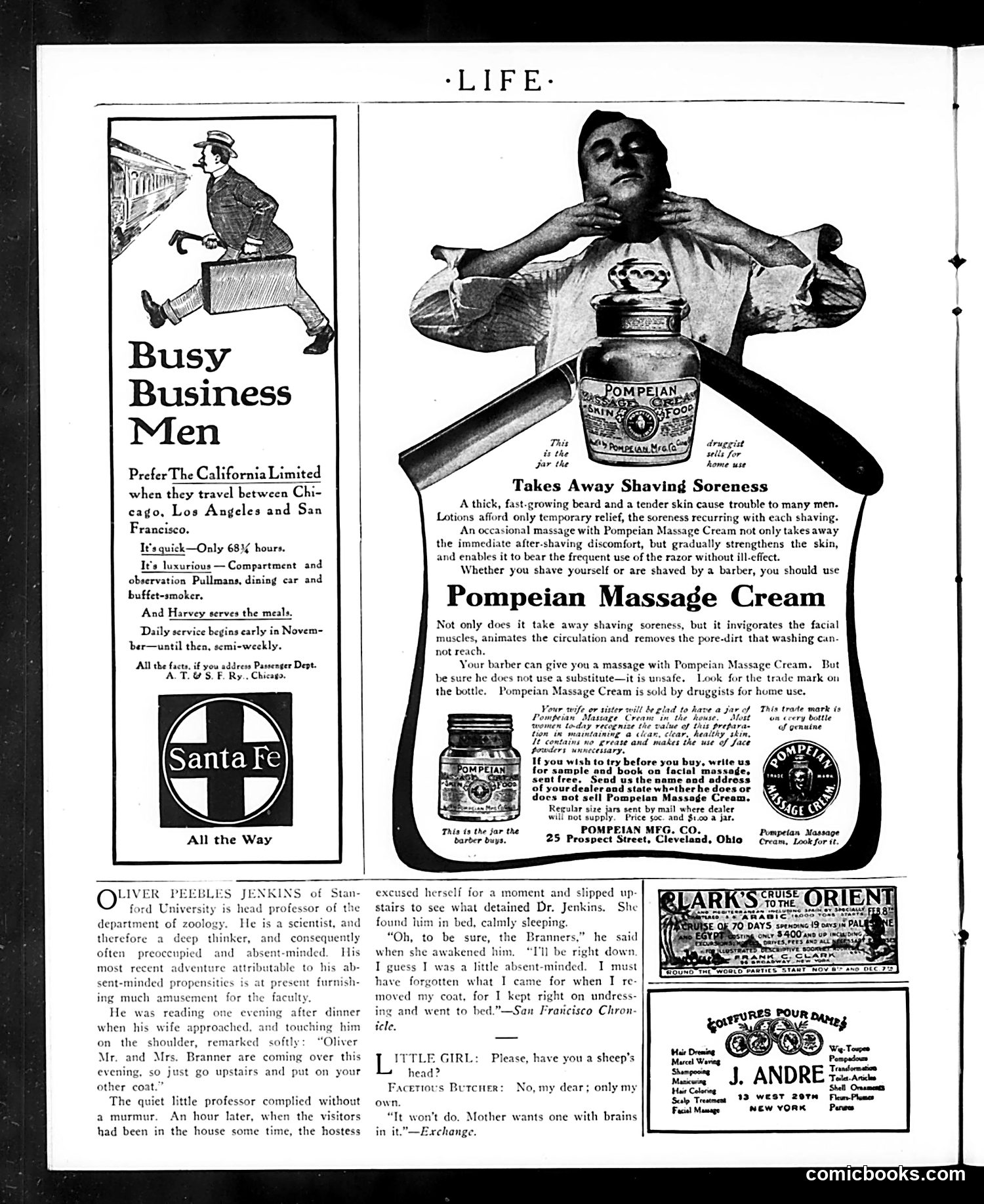
This page combines **advertisements** with **humorous anecdotes**—typical of Life magazine's format. The main content consists of three short jokes: 1. **"Busy Business Men"** advertises the California Limited train, targeting professionals who value luxury and speed (68½ hours Chicago to San Francisco). 2. **The central cartoon** depicts a man suffering from shaving irritation, promoting Pompeian Massage Cream. The humor is implicit: the product claims to solve a "manly" grooming problem while the exaggerated illustration suggests the soreness causes real distress. 3. **Two brief comedic anecdotes** at bottom: One about an absent-minded zoology professor who, distracted by dinner guests, undresses and goes to bed instead of changing his coat. The second is a butcher-shop joke where a little girl asks for a sheep's head "with brains"—the humor lying in the butcher's crude retort that he only has his own. The page reflects early 20th-century American humor: gentle domestic comedy and light satire aimed at middle-class readers.
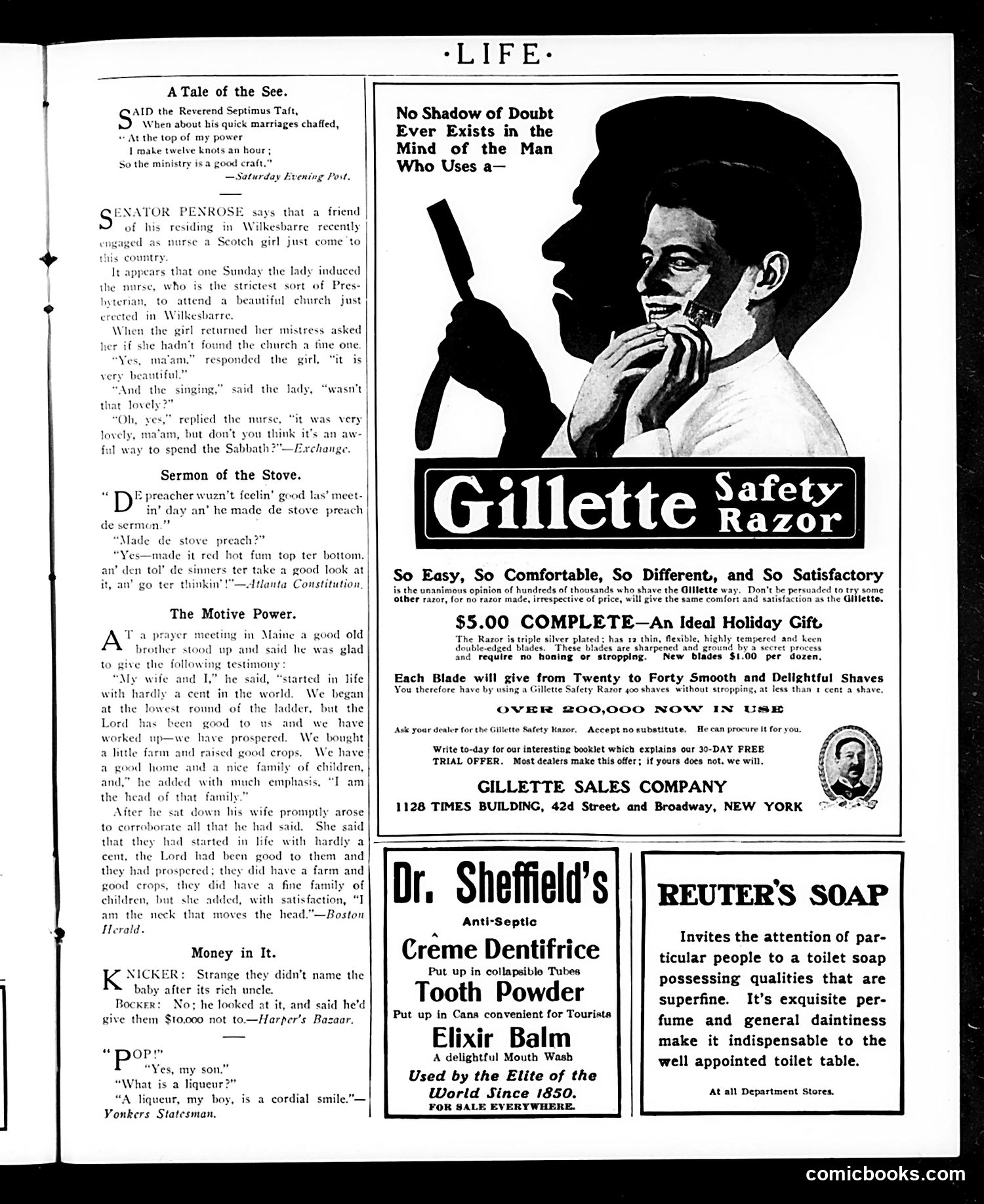
This page is primarily **advertising with some short satirical pieces** in the left column. The main visual content is a **Gillette Safety Razor advertisement** featuring a man shaving, with the headline "No Shadow of Doubt Ever Exists in the Mind of the Man Who Uses a—Gillette Safety Razor." The left column contains brief humorous anecdotes labeled "A Tale of the Sea," "Sermon of the Stove," "The Motive Power," "Money in It," and "Pop"—typical of Life magazine's satirical short-form humor. These appear to mock various figures (a reverend, a preacher, a businessman) through funny dialogue, though the specific targets are unclear from context alone. The page also includes advertisements for **Dr. Sheffield's dental products** and **Reuter's Soap**, typical of early 20th-century consumer goods marketing.
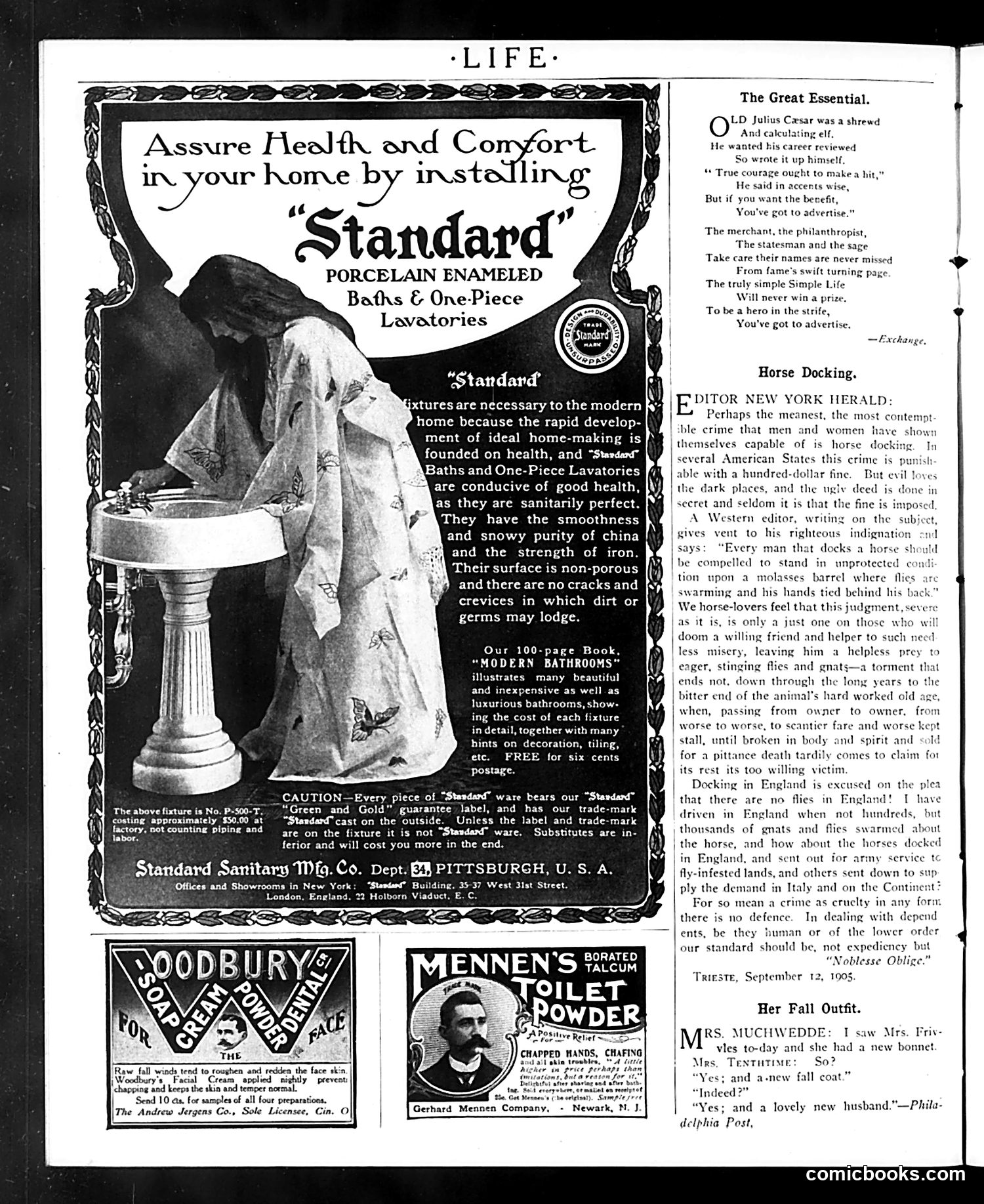
This page mixes advertising with editorial content and satirical poetry. **"The Great Essential"** is a satirical poem mocking the era's obsession with advertising. It references Julius Caesar and argues that even noble pursuits (merchant work, philanthropy, statesmanship) require self-promotion to succeed. The poem's joke is that in modern times, mere virtue isn't enough—you must advertise yourself to matter. **"Horse Docking"** is a serious letter to the editor condemning the practice of docking horses' tails (a cosmetic procedure causing animal suffering). The writer proposes severe punishment: standing exposed to flies with hands tied. Though harsh-sounding, this appears sincere advocacy for animal welfare, contrasting with the satirical tone above. The page also contains advertisements for **Standard plumbing fixtures** and toilet products, typical of early 1900s Life magazine's mixed editorial-advertising format. The juxtaposition creates irony: while the poem satirizes hollow self-promotion, the horse-docking letter demonstrates genuine moral conviction—suggesting authentic principles still matter despite the advertising age.
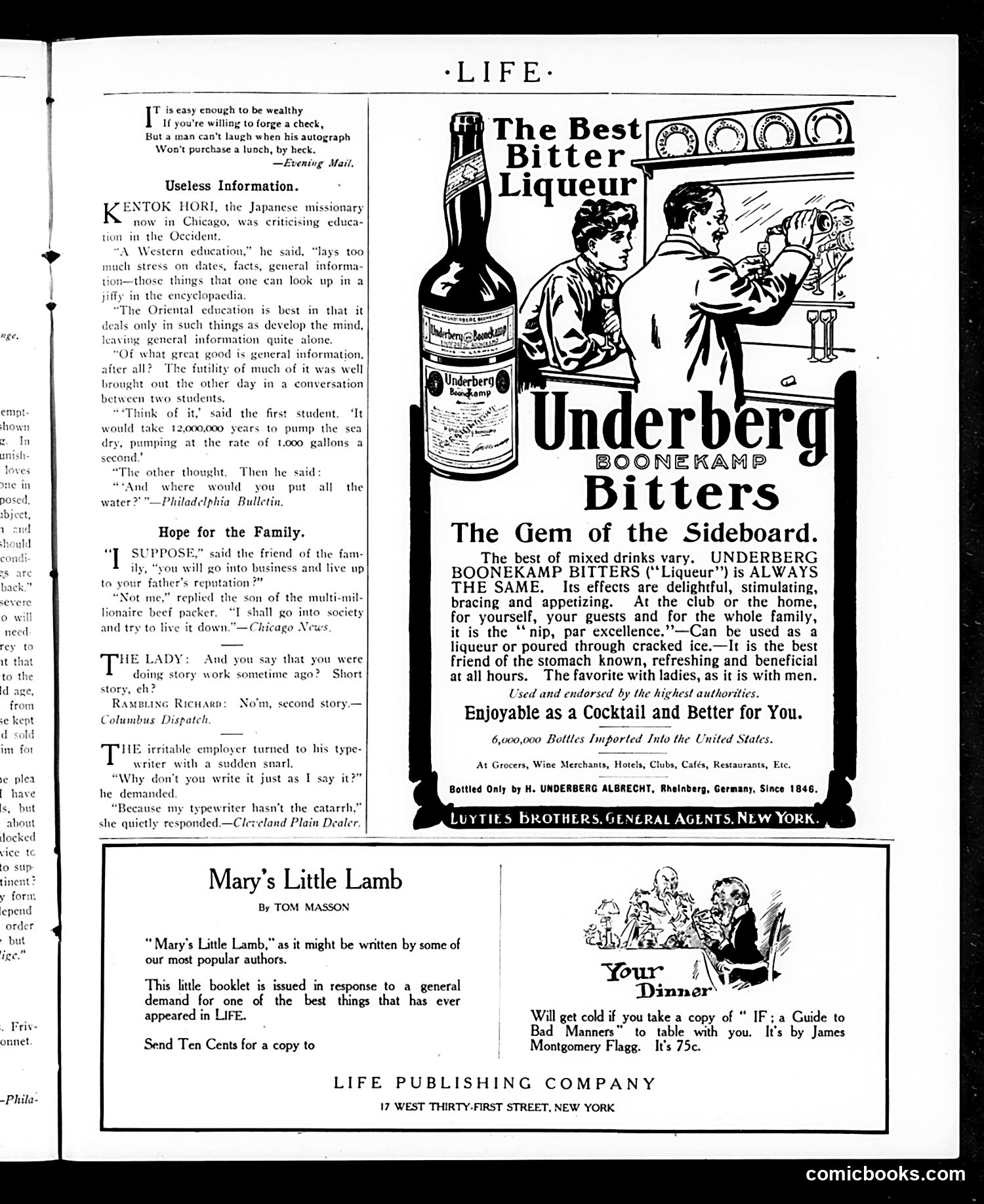
This page contains several satirical pieces and advertisements typical of early 20th-century Life magazine: **Main Satirical Content:** The page features humorous anecdotes mocking "useless information" and social pretension. One joke ridicules the absurdity of trivia (calculating 12 million years to pump the sea dry, then asking where the water goes). Another depicts a wealthy industrialist's son rejecting his father's business legacy to "live it down" in high society—satirizing both inherited wealth and social climbing. **Dominant Advertisement:** The large Underberg Boonekamp Bitters advertisement occupies significant space, marketing this German digestive liqueur as suitable for "the club or the home" and "the favorite with ladies." This reflects pre-Prohibition American drinking culture and the common marketing of bitter liqueurs as medicinal tonics. **Minor Content:** Brief humor pieces about typewriter mishaps and story-writing appear alongside these ads. The page overall reflects Life's satirical focus on American social and economic follies while accommodating period advertising.
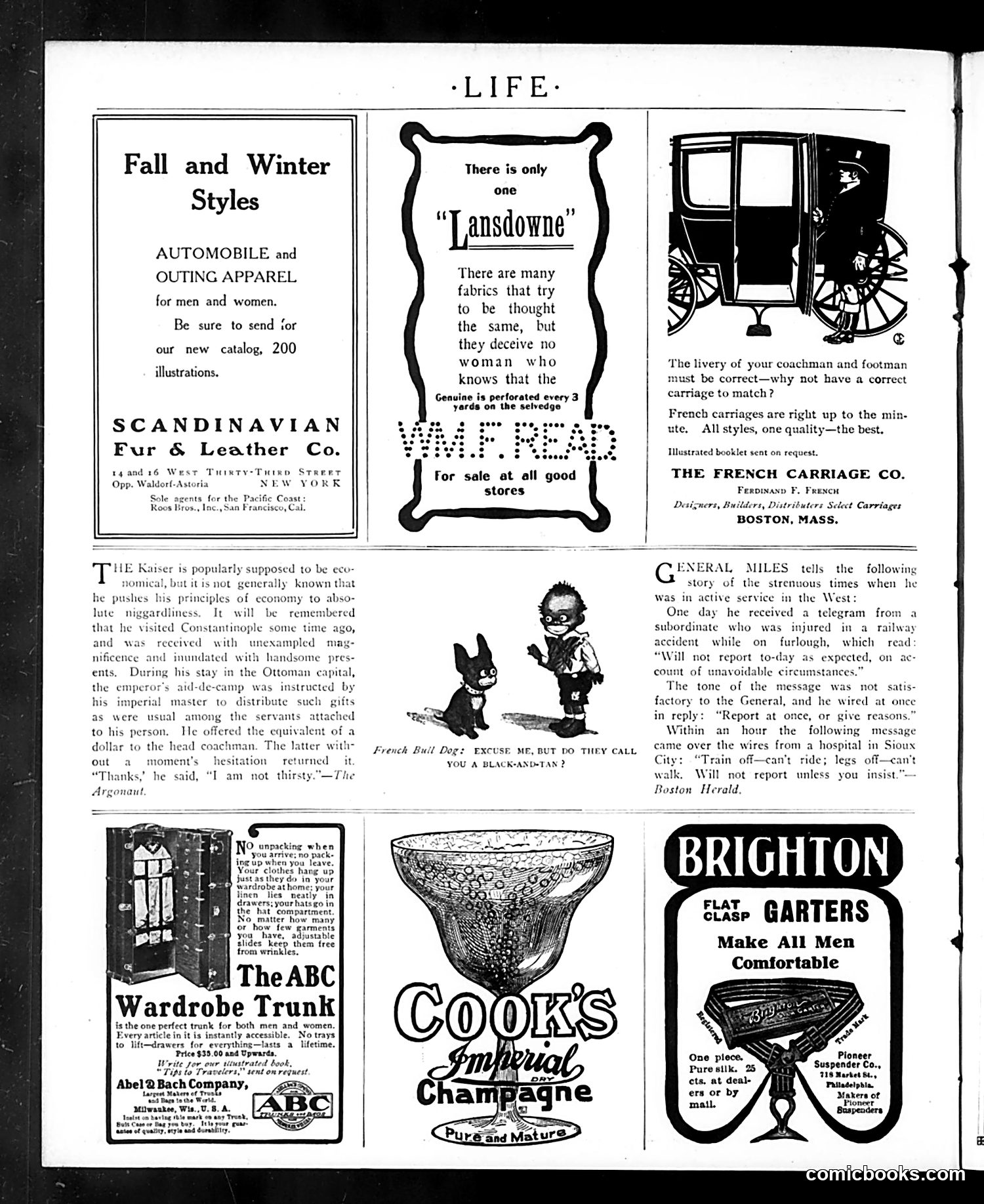
This is primarily an **advertising page** from Life magazine, with one notable satirical story about Kaiser Wilhelm II. ## The Kaiser Anecdote The main editorial content mocks the German Kaiser's reputation for economy. The story claims that despite his economical reputation, when visiting Constantinople (Istanbul), he received lavish gifts from the Ottoman Empire. When distributing equivalent gifts to his servants, one servant declined, saying "I am not thirsty"—a subtle jab suggesting the Kaiser's gifts were cheap or meager compared to what he received. The satire criticizes the Kaiser's hypocrisy: he preaches frugality while accepting extravagant treatment. ## Other Content A small illustration shows a French Bulldog making a pun about being called a "black-and-tan"—likely wordplay on dog breeding terminology. The rest of the page consists of period product advertisements: fur coats, carriage services, wardrobe trunks, champagne, and garters—typical of early 1900s Life magazine. These advertisements reveal consumer culture of the era's wealthy classes.
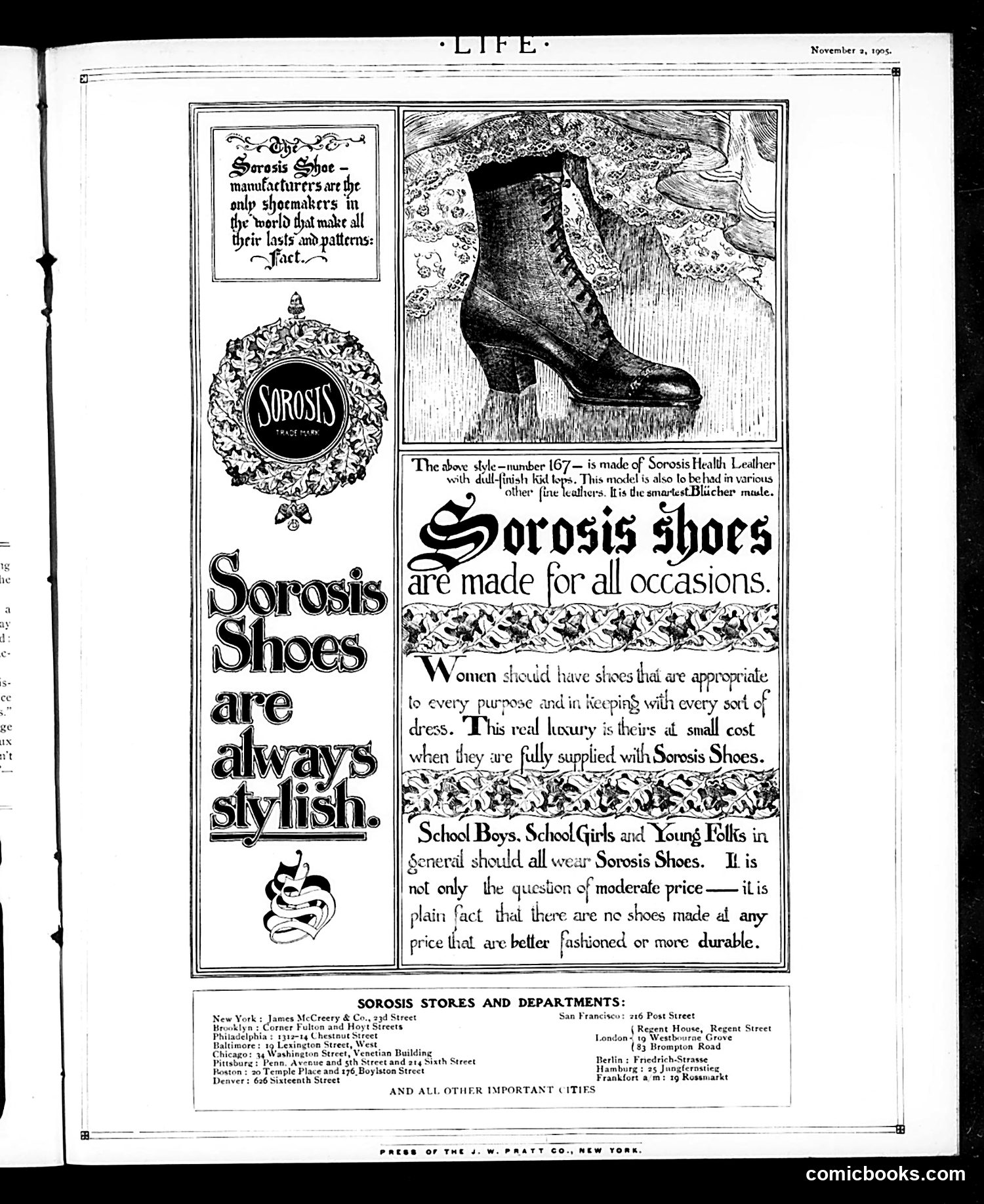
This is a **full-page advertisement**, not political satire. It promotes Sorosis brand shoes, emphasizing their stylishness and quality across all occasions and social classes. The page features a detailed illustration of a high-button women's boot (style #167) made from "Sorosis Health Leather." The ad's key claims are that Sorosis manufactures shoes with distinctive lasts (shoe forms) and patterns, making them superior in both fashion and durability. The marketing targets multiple demographics: women seeking appropriate shoes for various purposes, schoolchildren, and young people. The repeated assertion that Sorosis shoes are "always stylish" and offer "real luxury at small cost" suggests the brand positioned itself as affordable quality. The extensive list of store locations across America and Europe (New York, Boston, Philadelphia, London, Berlin, Hamburg, etc.) indicates Sorosis was a major, established retailer—likely part of early 20th-century retail expansion. This represents typical turn-of-century advertising style in *Life* magazine.
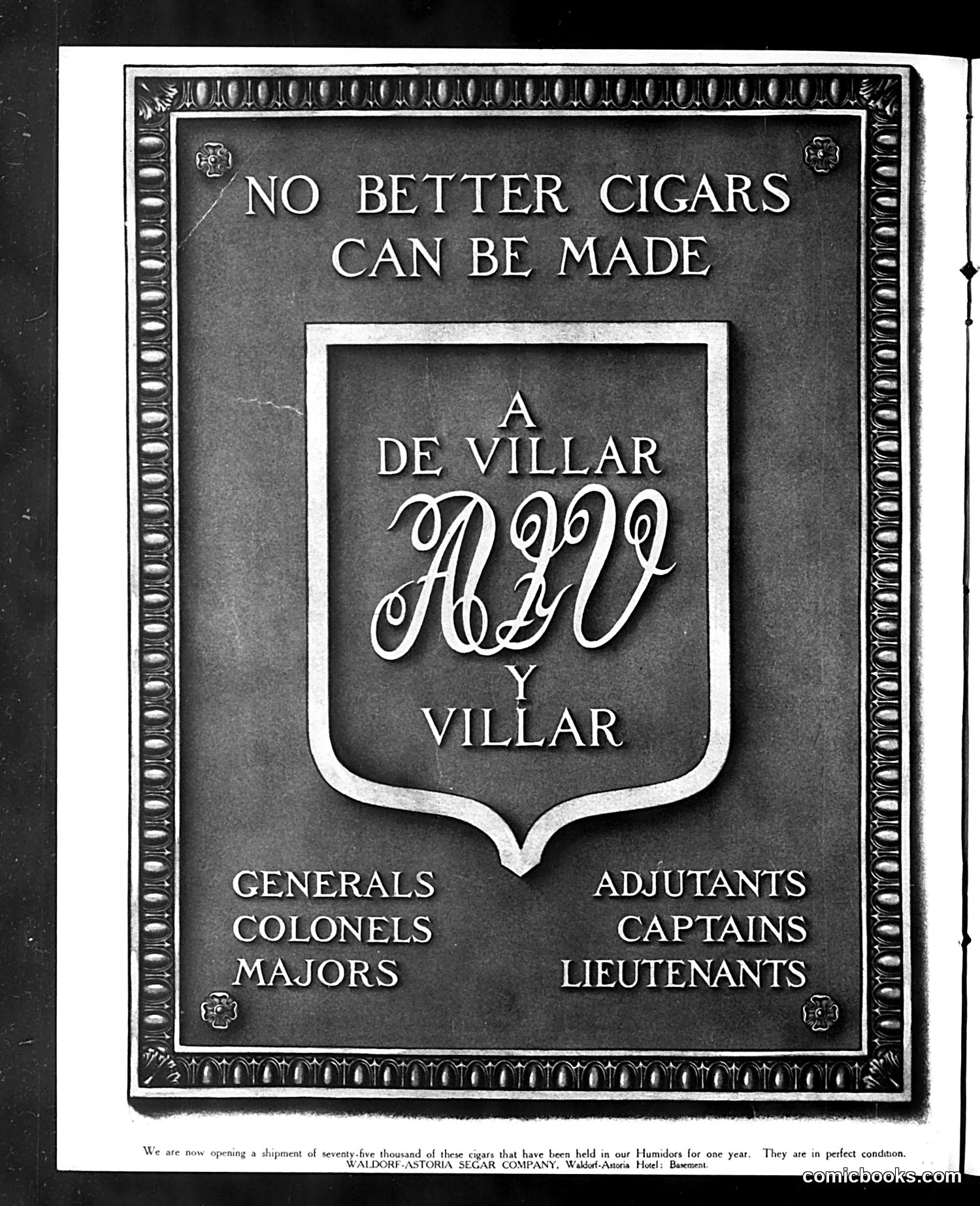
This is a **cigar advertisement**, not political satire. The page promotes "A De Villar" cigars, claiming "No Better Cigars Can Be Made." The shield-shaped emblem displays the brand name and appears designed to convey prestige and quality. Below the shield, military ranks are listed—Generals, Colonels, Majors, Adjutants, Captains, and Lieutenants—likely suggesting the product appeals to a distinguished, high-status clientele or that military officers endorse the brand. The small text at bottom indicates the company is announcing receipt of 75,000 cigars that had been stored in their humidors for one year, now in "perfect condition." This is a straightforward commercial advertisement from the Waldorf-Astoria Hotel in Beaumont, using military association as a marketing strategy to suggest quality and exclusivity rather than making any satirical point.