
Life, 1905-11-02 · page 21 of 48
Life — November 2, 1905 — page 21: what you’re looking at
What you’re looking at
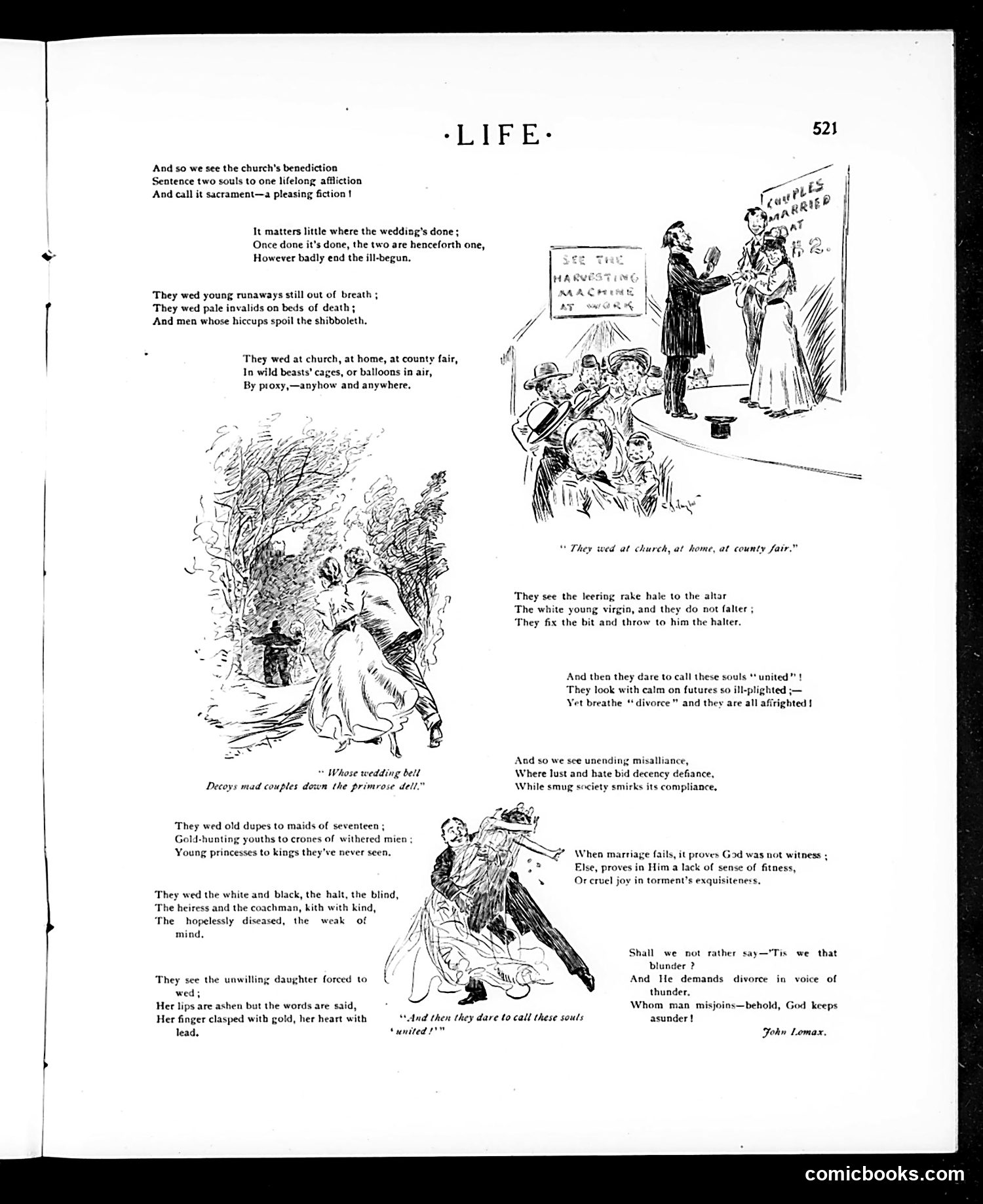
This is a scathing critique of marriage as an institution, illustrated with multiple vignettes. The central argument: society blesses deeply mismatched unions while condemning divorce, revealing hypocrisy. The satire depicts various problematic marriages—forced weddings, age-gap unions ("old dupes to maids of seventeen"), cross-class matches ("heiress and the coachman"), mismatched couples in ill health or mental state. The cartoons show ceremonies occurring anywhere from churches to hot air balloons, emphasizing marriage's casual treatment despite its permanence. The poem's key point: people condemn divorce as sinful while ignoring that many marriages are fundamentally unsuitable from the start. The final stanzas argue that if God divorces unsuitable unions, humans shouldn't blame God—they should blame themselves for creating bad matches in the first place. This reflects late-19th/early-20th-century debates over divorce reform and women's marital autonomy, criticizing society's willingness to trap people in unhappy marriages while maintaining moral outrage against separation.
📄 Transcribed text from this page (OCR, searchable)
Machine-transcribed from the original scan — historical spelling and the odd misread are preserved.
-LIFE- 524 And so we see the church's benediction Sentence two souls to one lifelong affliction And call it sacrament—a pleasing fiction | It matters little where the wedding’s done ; Once done it's done, the two are henceforth one, However badly end the ill-begun. ‘They wed young runaways still out of breath ; ‘They wed pale invalids on beds of death ; And men whose hiccups spoil the shibboleth, ‘They wed at church, at home, at county fair, In wild beasts’ cages, or balloons in air, By ptoxy,—anyhow and anywhere, “ They wed at church, at home, at county fair.” ‘They see the leering rake hale to the altar The white young virgin, and they do not falter; ‘They fix the bit and throw to him the halter. And then they dare to call these souls * united” ! They look with calm on futures so ill-plighted ;— Yet breathe ‘divorce " and they are all afirighted | And so we sce unending misalliance, * Whose wedding bell Where lust and hate bid decency defiance, Decoys mad couples down the primrose dell.” While smug society smirks its compliance, They wed old dupes to maids of seventeen ; Gold-hunting youths to crones of withered mien ; Young princesses to kings they've never seen, Else, proves in Him a lack of sense of fitness, Or cruel joy in torment’s exquisiteness, ‘They wed the white and black, the halt, the blind, ‘The heiress and the coachman, kith with kind, The hopelessly diseased, the weak of mind, Shall we not rather say—'Tis we that | blunder ? | ‘They sce the unwilling daughter forced to And He demands divorce in voice of wed; thunder. Her lips are ashen but the words are said, . Whom man misjoins—behold, God keeps Her finger clasped with gold, her heart with “And then they dare to call these souls asunder! lead, “united 1°" John Lomax. comicbooks.com