
Life, 1905-11-02 · page 27 of 48
Life — November 2, 1905 — page 27: what you’re looking at
What you’re looking at
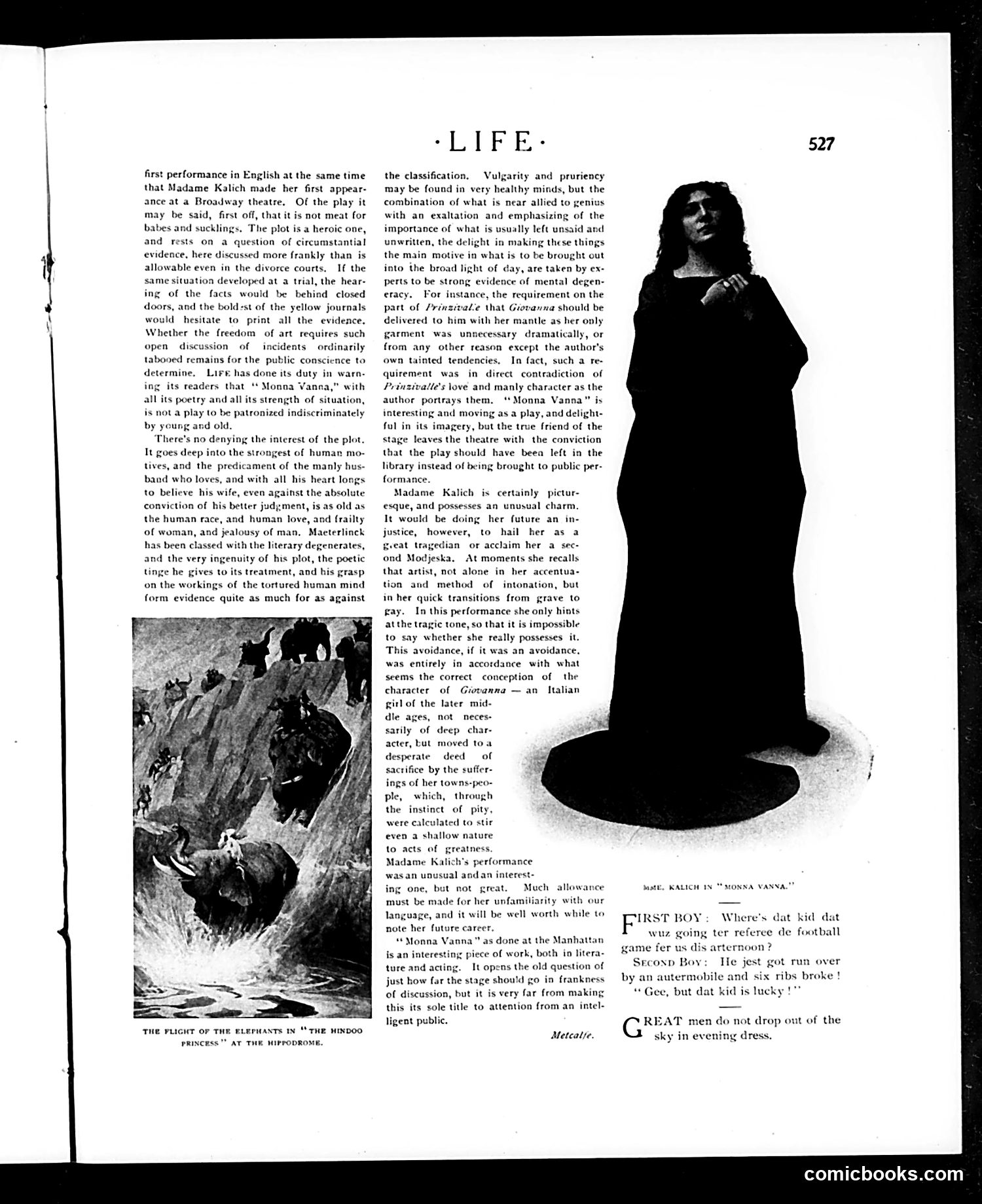
This page reviews Madame Kalich's Broadway debut in the play "Monna Vanna," a work by Belgian symbolist Maurice Maeterlinck. The text presents a moral critique of the play itself while assessing the actress's performance. **The Play's Controversy:** "Monna Vanna" depicts a married woman who must strip naked and go to an enemy general to save her city. The critic warns readers that the play is unsuitable for young people, arguing that while Maeterlinck possesses literary talent, he exploits morally questionable content—specifically, the requirement that the heroine appear nude is dramatically unnecessary and reveals "tainted tendencies." **On Madame Kalich:** She's praised as "picturesque" with "unusual charm" but judged not a great tragedian. Her performance avoids deep tragic depth, which the critic deems appropriate for the character—an ordinary Italian woman driven to desperate sacrifice by compassion. **The Images:** Show scenes from "The Hindoo Princess" at the Hippodrome (a separate theatrical production) and a portrait of Kalich in the title role.
📄 Transcribed text from this page (OCR, searchable)
Machine-transcribed from the original scan — historical spelling and the odd misread are preserved.
first performance in English at the same time that Madame Kalich made her first appear- ance at a Broadway theatre, Of the play it may be said, first off, that it is not meat for babes a and rests on a question of circumstantial evidence, here discussed more frankly than is allowable even 1 sucklings, The plot is a heroic one, n the divorce courts. If the same situation developed at a trial, the hear- ing of the facts would be behind closed doors, and the bold-st of the yellow journals would hesitate to print all the evidence. Whether the freedom of art requires such open discussion of incidents ordinarily tabooed remains for the public conscience to determine, Lire has done its duty in warn- ing its readers that * Monna Vana,” with all its poetry and all its strength of situation, is not a play to be patronized indiscriminately by young and old, There's no denying the interest of the plot, It goes deep into the trongest of human mo- tives, and the predicament of the manly hus- ith all his heart longs to believe his wife, even against the absolute conviction of his better judy ment, is as old as the human race, and human love, and (railty of woman, and jealousy of man, Maeterlinck band who loves, and w has been classed with the literary degenerates, and the very ingenuity of his plot, the poetic Linge he gives to its treatment, and his grasp on the workings of the tortured human mind form evidence quite as much for as against THE PLIGHT OF THE ELEPHANTS IN PRINCESS? AT THE MIPFODRO: ‘THE MINDOO *LIFE- the classification, Vulgarity and_ pruriency may be found in very healthy minds, but the combination of what is near allied to genius with an exaltation and emphasizing of the importance of what is usually left unsaid and unwritten, the delight in making these things the main motive in what is to be brought out into the broad light of day, are taken by ex- perts to be strong evidence of mental degen- eracy. For instance, the requirement on the part of Prinsivale that Giovanna should be delivered to him with her mantle as her only garment was unnecessary dramatically, or from any other reason except the author's own tainted tendencies, In fact, such a re- quirement was in direct contradiction of Prinzivalle’s \ove and manly character as the author portrays them, ‘Monna Vanna" is interesting and moving asa play, and delight- ful in its imagery, but the true friend of the stage leaves the theatre with the conviction that the play should have beea left in the library instead of being brought to public per- formance. Madame Kalich is certainly pictur- esque, and possesses It would be doing her future an in- justice, however, to hail her as a Keeat trayedian or acclaim her a sec- ond Modjeska, At moments she recalls that artist, not alone in her accentua- tion and method of intonation, but in her quick transitions from grave to gay. In this performance she only hints at the tragic tone, so that it is impossible to say whether she really possesses it. n unusual charm, This avoidance, if it was an avoidance, was entirely in accordance with what seems the correct conception of the character of Giovanna — an Italian gitlof the later mid- dle ages, not neces- sarily of deep char- acter, but_ moved toa desperate deed of sacrifice by the suffer- ings of her towns-peo- ple, which, through the were calculated to stir stinct of pity, even a shallow nature of gr Madame Kalich’s performance to acts tness, wasan unusual andan interest- ing one, but not great. Much allowance must be made for her unfamiliarity with our language, and it will be well worth while to note her future career. s done at the Manhat is an interesting piece of work, both in litera- ture and acting. It opens the old question of just how far the stage should go in frankness of discussion, but it is very far from making this its sole title to attention from an inte ligent public. “ Monna Vanna” ny Metcalfe. Bist. KALICH IN MONNA VANNA."” Fisst BOY: Where's dat kid dat wuz going ter referee de football game fer us dis arternoon ? Srconp Boy He jest got run over by an autermobile and six ribs broke ! dee, but dat kid is lucky!" REAT men do not drop out of the sky in evening dress, comicbooks.com