
Life, 1905-11-02 · page 31 of 48
Life — November 2, 1905 — page 31: what you’re looking at
What you’re looking at
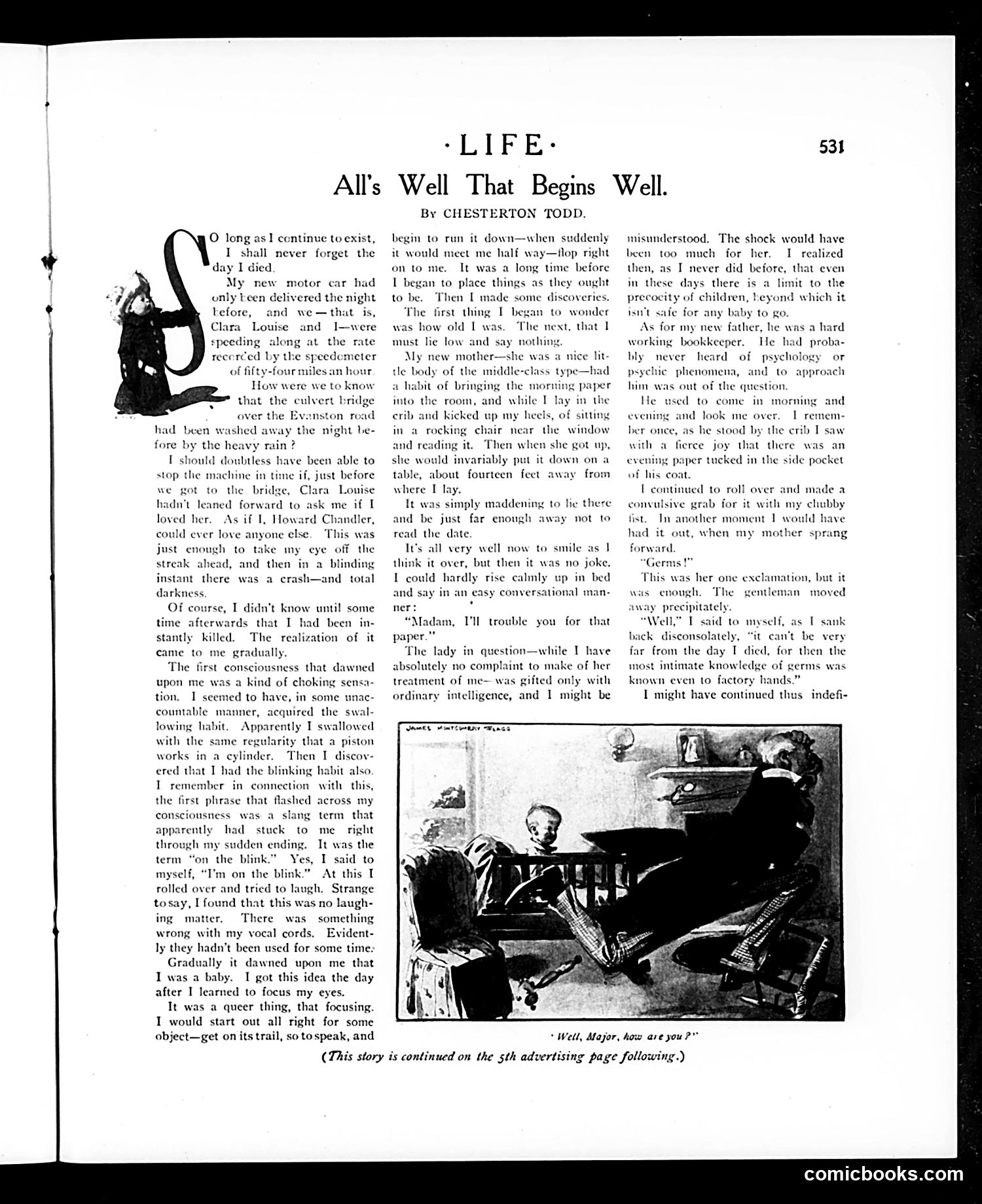
This is a humorous fantasy story, not political satire. The narrative follows a man who dies in a car crash (caused when his fiancée Clara Louise distracts him by asking if he loves her), only to discover he has been reincarnated as a baby. The joke centers on the protagonist's predicament: he retains adult consciousness and knowledge but is trapped in an infant's helpless body. His frustration is comedic—he desperately wants to read the date from a newspaper his mother leaves on a table "fourteen feet away," but cannot reach it or communicate his extraordinary intelligence without terrifying his ordinary parents (a bookkeeper father and conventionally intelligent mother). The illustration shows him as an adult-minded infant in a crib, observing his new parents. The satire mocks the gap between intellectual capability and physical limitation, playing on early-1900s ideas about reincarnation and the absurdity of possessing adult reasoning in an infant's circumstances.
📄 Transcribed text from this page (OCR, searchable)
Machine-transcribed from the original scan — historical spelling and the odd misread are preserved.
oe i oe All's Well That Begins Well. O long asI continue to exist, 1 never forget th day I died My new motor car had only been delivered the night before, nd we—that is, Clara Louise and speeding along at the rate recerced by the speedemeter of fifty-four miles an hour How were we to know that the culvert bric over the Evanston road I—were had been washed away the ni fore by the heavy rain ? I should doubtless have been able to ¢ if, just before we got to the Clara Louise hadn't leaned forward to ask me if I loved her. As if 1, Moward Chandler, This y stop the machine in bridge, could ever love anyone else just cnough to take my eye off the streak ahead, and then in a blinding instant there was a crash—and total darkness, Of course, I didn’t know until some time afterwards that I had been in- stantly killed. The realization of it came to me gradually. The first consciousness that dawned upon me was a kind of choking sensa- tion, I seemed to have, in some unac- countable manner, acquired the swal- lowing habit. Apparently T swallowed with the same regularity that a piston works in a cylinder. Then I discov- ered that I had the blinking habit also, connection with this, the first phrase that flashed across my consciousness was a slang term that apparently had stuck to me right through my sudden ending. It was the term “on the blink. Yes, I said to myself, “I'm on the blink.” At this T rolled over and tried to laugh. Strange tosay, I found that this was no laugh- ing matter, There was something wrong with my vocal cords. Evident- ly they hadn't been used for some time: Gradually it dawned upon me tha I was a baby. I got this idea the day after I learned to focus my eyes. It was a queer thing, that focusing. I would start out all right for some object—get on its trail, so tospeak, and T remember in By CHESTERTON TODD. begin to run it down—when suddenly it would meet me half way—flop right on to me. It was a long time before I began to place things as they ought to be. Then I made some discoveries. The first thing I began to wonder The next, that I y nothing was how old I was. must lie low and he was a nice lit- class type—had My new mother— tle body of the middle a habit of bringing the morning paper into the room, and while I lay in the crib and kicked up my heels, of sitting in a rocking chair near the window and reading it. Then when she got up, she would invariably put it down on a table, about fourteen feet away from where I It was simply maddening to lie there and be just far enough away not to read the date. It’s all very well now to smile as 1 think it over, but then it was no joke. I could hardly rise calmly up in bed and sa ner: “Madam, T'll paper.”” The lady in question—while I have absolutely no complaint to make of her treatment of me— was gifted only with ordinary intelligence, and I might be y in an easy conversational man- trouble you for that Pre aesTe rary misunderstood. The shock would have been too much for her. I realized then, as I never did before, that even in these days there is a limit to the precocity of children, keyond which it isn't safe for any baby to go. As for my new father, he was a hard working bookkeeper. He had proba- bly never heard of psychology or psychic phenomena, and to approach him was out of the question. He used to come in morning and evening and look me over. I remem- her once, as he stood by the crib I saw with a fierce joy that there was an evening paper tucked in the side pocket of his coat. I continued to roll over and made a convulsive grab for it with my chubby fist. In another moment 1 would have had it out, when my mother sprang forward. “Gerny This was her one exclamation, but it The gentleman away precipitately “Well,” T back disconsolately, “it can't be very far from the day I died, for then the most intimate knowledge of germs was known even to factory hands.” I might have continued thus indefi- was enough. moved said to myself, as [ sank * Well, Major, how are you P™ (This story is continued on the 5th advertising page following.) comicbooks.com