
Life, 1905-11-02 · page 16 of 48
Life — November 2, 1905 — page 16: what you’re looking at
What you’re looking at
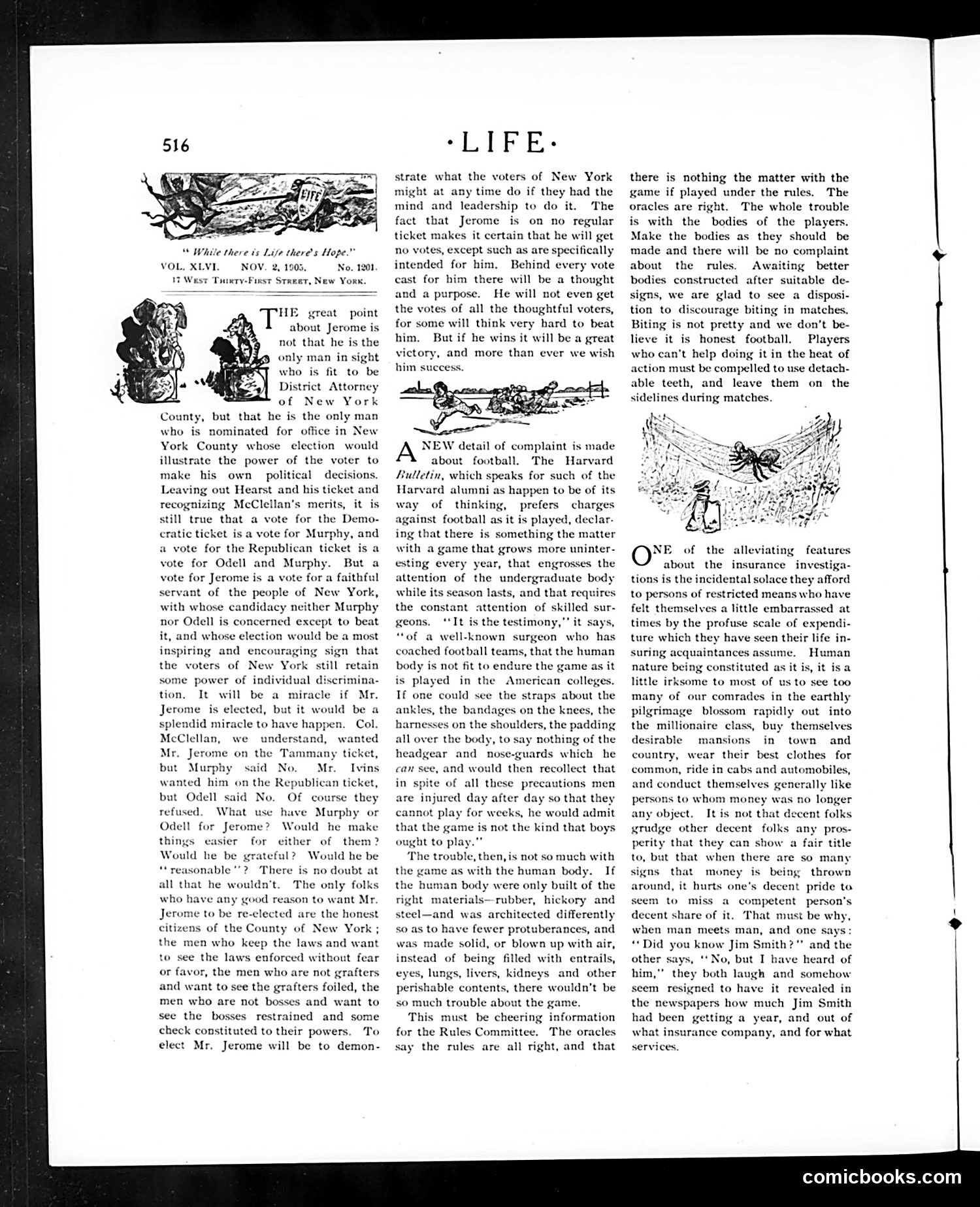
This page advocates for William Travers Jerome as District Attorney of New York County in the 1905 election. The satire targets political machine bosses—specifically Tammany Hall's Murphy and Republican boss Odell—who refuse to support Jerome despite his qualifications. The cartoon's point: Jerome represents genuine democratic choice, independent of party machines. Unlike other candidates beholden to Murphy or Odell, Jerome would serve the people honestly. Life argues voting for him demonstrates voters retain "individual discrimination" against corrupt bosses. The editors frame Jerome's likely defeat as symbolic of how political machinery constrains voter freedom, even in a democracy. The secondary article critiques college football as physically dangerous, sardonically suggesting the human body needs redesigning (with "rubber, hickory and steel") to survive the game's brutality.
📄 Transcribed text from this page (OCR, searchable)
Machine-transcribed from the original scan — historical spelling and the odd misread are preserved.
“ While there is Life there's Hope.” VOL, XLVI. NOV. 2, 1905 17 Wes Touery-Finst Str HE great point about Jerome is not that he is the y man in sight who is fit to be District Attorney of New York County, but that he is the only man who nominated for office in New York County whose clection would illustrate the power of the voter to make his own political decisions. Leaving out Hearst and his ticket and recognizing McClellan's merits, it is still true that a vote for the Demo- cratic ticket is a vote for Murphy, and a vote for the Republican ticket is a vote for Odell and Murphy. But a vote for Jerome is a vote for a faithful servant of the people of New York, with whose candidacy neither Murphy nor Odell is concerned except to beat it, and whose election would be a most inspiring and encouraging sign that the voters of New York still retain some power of individual discrimina- tion. It will be a miracle if Mr. Jerome is elected, but it would be a splendid miracle to have happen. Col. McClellan, we understand, wanted Mr. Jerome on the Tammany ticket, but Murphy said No. Mr. Ivins wanted him on the Republican ticket, but Odell said No. Of course they refused. What use have Murphy or Odell for Jerome? Would he make things easier for either of them? Would he be grateful? Would he be ** reasonable’? There is no doubt at all that he wouldn't. The only folks who have any good reason to want Mr, Jerome to be re-elected are the honest citizens of the County of New York ; the men who keep the laws and want to see the laws enforced without fear or favor, the men who are not grafters and want to see the grafters foiled, the men who are not bosses and want to see the bosses restrained and some check constituted to their powers. To Mr. Jerome will be to demon- *“LIFE- strate what the voters of New York might at any time do if they had the mind and leadership to do it. The t that Jerome is on no regular ticket makes it certain that he will get no votes, except such as are specifically intended for him, Behind every vote cast for him there will be a thought and a purpose. He will not even get the votes of all the thoughtful voters, for some will think very hard to beat him. But if he wins it will be a great victory, and more than ever we wish him success, A NEW detail of complaint is made about football. The Harvard Bulletin, which speaks for such of the Harvard alumni as happen to be of its way of thinking, prefers charg’ against football as it is played, declar- ing that there is something the matter with a game that grows more uninter- esting every year, that engrosses the attention of the undergraduate body while its season lasts, and that requires the constant attention of skilled sur- geons. ‘‘It is the testimony,"’ it says, “of a well-known surgeon who has coached football teams, that the human body is not fit to endure the game as it is played in the American colleges. If one could sce the straps about the ankles, the bandages on the knees, the harnesses on the shoulders, the padding all over the body, to say nothing of the headgear and nose-guards which he can see, and would then recollect that in spite of all these precautions men are injured day after day so that they cannot play for weeks, he would admit that the game is not the kind that boys ought to play.” ‘The trouble, then, is not so much with the game as with the human body. If the human body were only built of the right materials—rubber, hickory and steel—and was architected differently so as to have fewer protuberances, and s made solid, or blown up with air, instead of being filled with entrails, , lungs, livers, kidn and other perishable contents, there wouldn't be so much trouble about the game. This must be cheering information for the Rules Committee. The oracles say the rules are all right, and that there is nothing the matter with the ame if played under the rules. The oracles are right. The whole trouble is with the bodies of the players. Make the bodies as they should be made and there will be no complaint about the rules. Awaiting better bodies constructed after suitable de- signs, we are glad to see a disposi- tion to discourage biting in matches. Biting is not pretty and we don't be- lieve it is honest football. Players who can't help doing it in the heat of action must be compelled to use detach- able teeth, and leave them on the sidelines during matches. NE of the viating featur about the insurance investiga tions is the incidental solace they afford to persons of restricted means who have felt themselves a little embarrassed at times by the profuse scale of expendi- ture which they have seen their life in- suring acquaintances assume, Human nature being constituted as it is, it is a little irksome to most of us to see too many of our comrades in the earthly pilgrimage blossom rapidly out into the millionaire class, buy themselves desirable mansions in town and country, wear their best clothes for common, ride in cabs and automobiles, and conduct themselves generally like persons to whom money was no longer any object. It is not that decent folks grudge other decent folks any pros- perity that they can show a fair title to, but that when there are so many signs that money is being thrown around, it hurts one’s decent pride to seem to miss a competent person's decent share of it. That must be wh when man meets man, and one s “Did you know Jim Smith?" and the other says, ‘‘No, but I have heard of him," they both laugh and somehow seem resigned to have it revealed in the newspapers how much Jim Smith had been getting a year, and out of what insurance company, and for what services. comicbooks.com