
A complete issue · 44 pages · 1905
Life — July 6, 1905
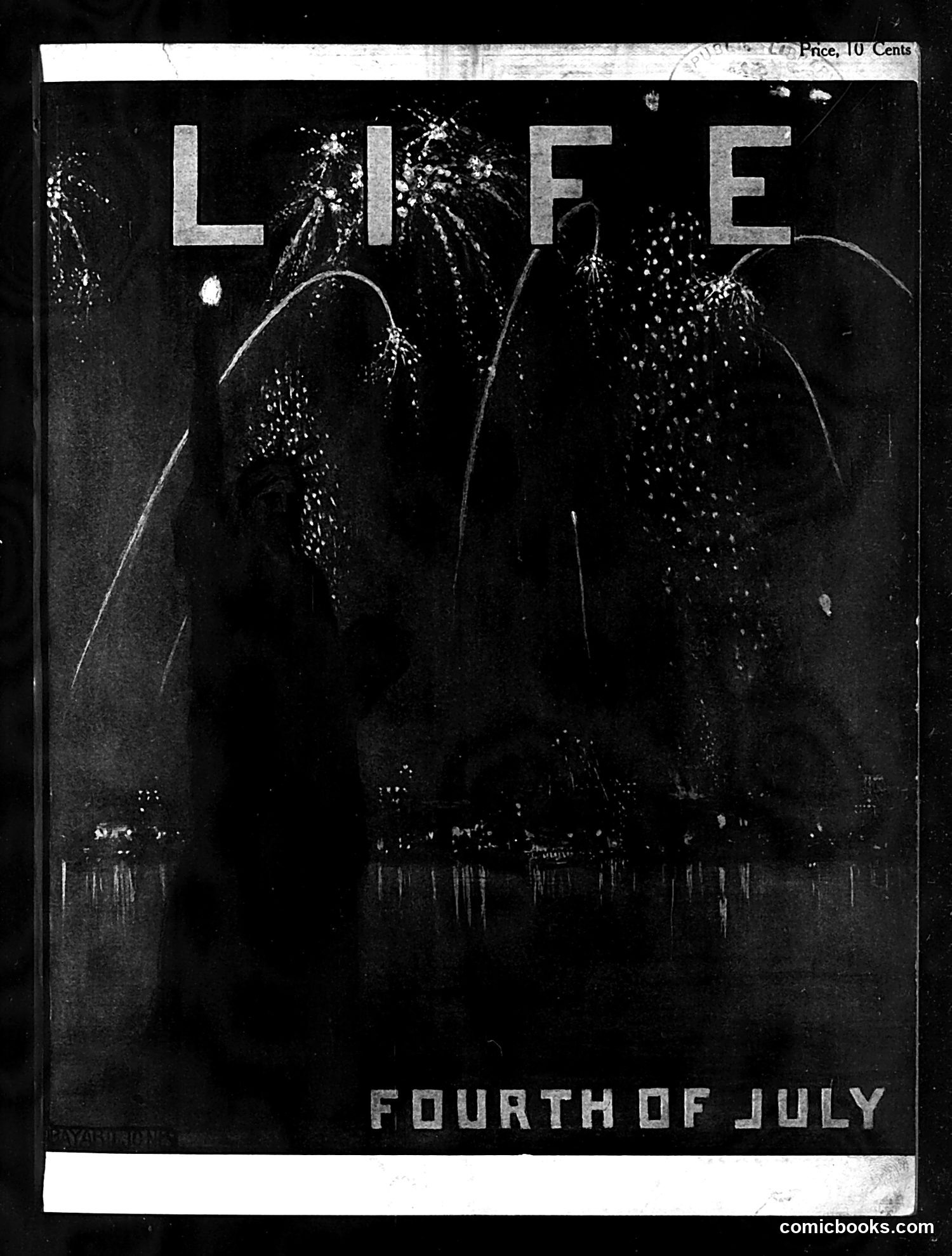
This appears to be a Life magazine cover commemorating the Fourth of July, priced at 10 cents. The image shows fireworks exploding over what seems to be a cityscape or landscape silhouette at night. The cover is straightforward patriotic imagery rather than political satire—fireworks bursting overhead represent American Independence Day celebrations. The dramatic black-and-white photography emphasizes the spectacle of the holiday's traditional fireworks display. Without additional visible text or caricatures, this cover functions as a holiday-themed cover rather than containing satirical commentary. It celebrates American national pride through iconic Fourth of July imagery. The specific year and any accompanying interior content aren't determinable from this image alone.
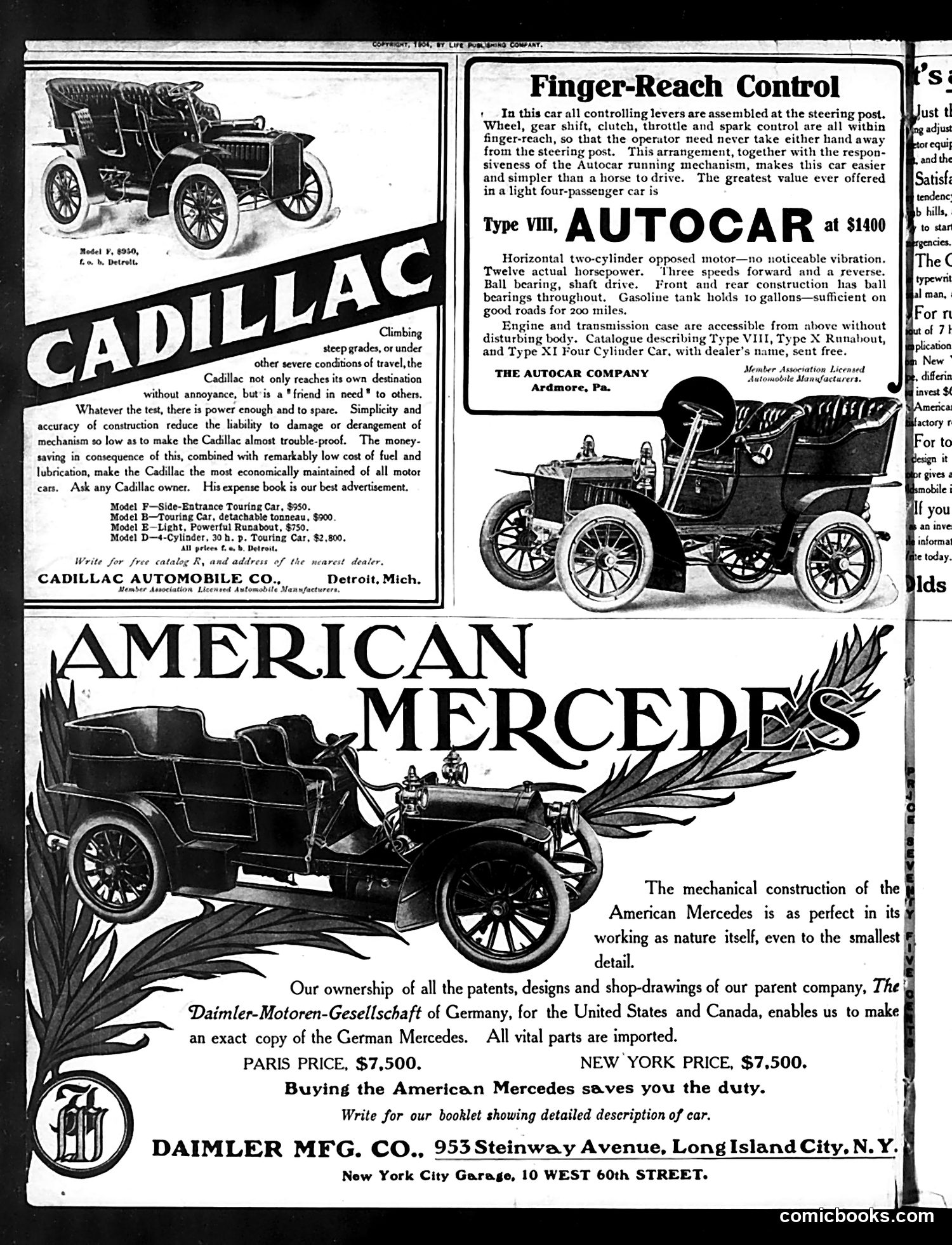
This page is primarily **advertising**, not editorial content or satire. It contains three automobile advertisements from the early 1900s: 1. **Cadillac** (top left): Emphasizes reliability and low cost of maintenance compared to other cars. 2. **Autocar** (top right): Highlights its "finger-reach control" system where steering and throttle levers are clustered at the steering post for driver convenience. 3. **American Mercedes** (bottom): The main advertisement, emphasizing that the American version is an exact copy of the German Mercedes, with vital parts imported. It notes that buying American saves import duty. There is **no political satire or cartoon** on this page—it's a straightforward collection of early automobile marketing materials aimed at wealthy consumers. The decorative wheat sheaves around the Mercedes name are purely ornamental branding.
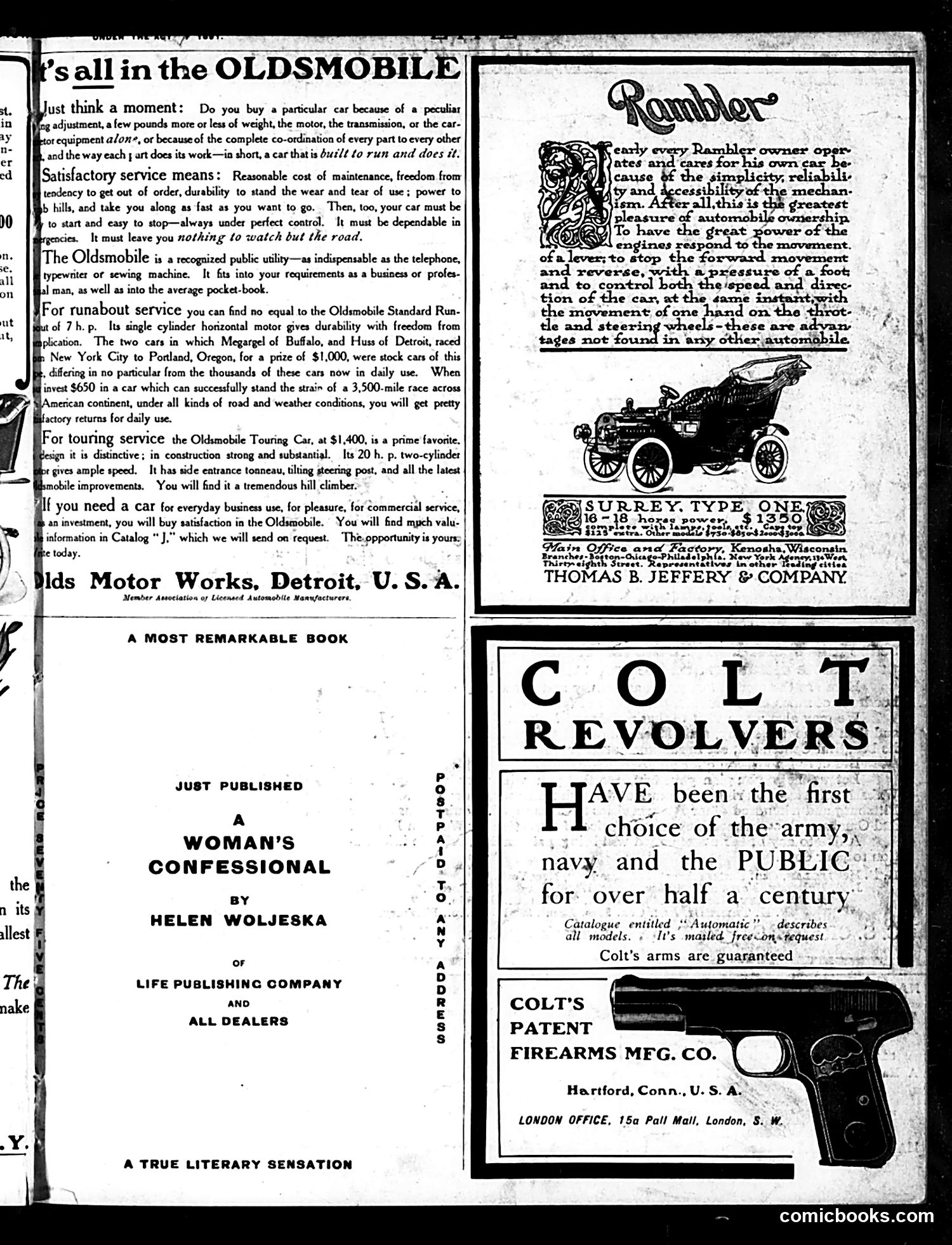
This page is primarily **advertising**, not satirical editorial content. The left column advertises **Oldsmobile automobiles**, emphasizing their reliability, serviceability, and value for various uses (touring, business, pleasure). The copy stresses practical benefits like hill-climbing ability and durability across American terrain. The right side contains two unrelated product advertisements: a **Rambler automobile** (with decorative tiger illustration) and **Colt Revolvers**, promoting their military and public acceptance over "half a century." There is also a book advertisement for *A Woman's Confessional* by Helen Woljeska. The page represents turn-of-the-century American consumer advertising rather than political satire or cartoon commentary. No caricatured political figures or satirical commentary appears on this page.
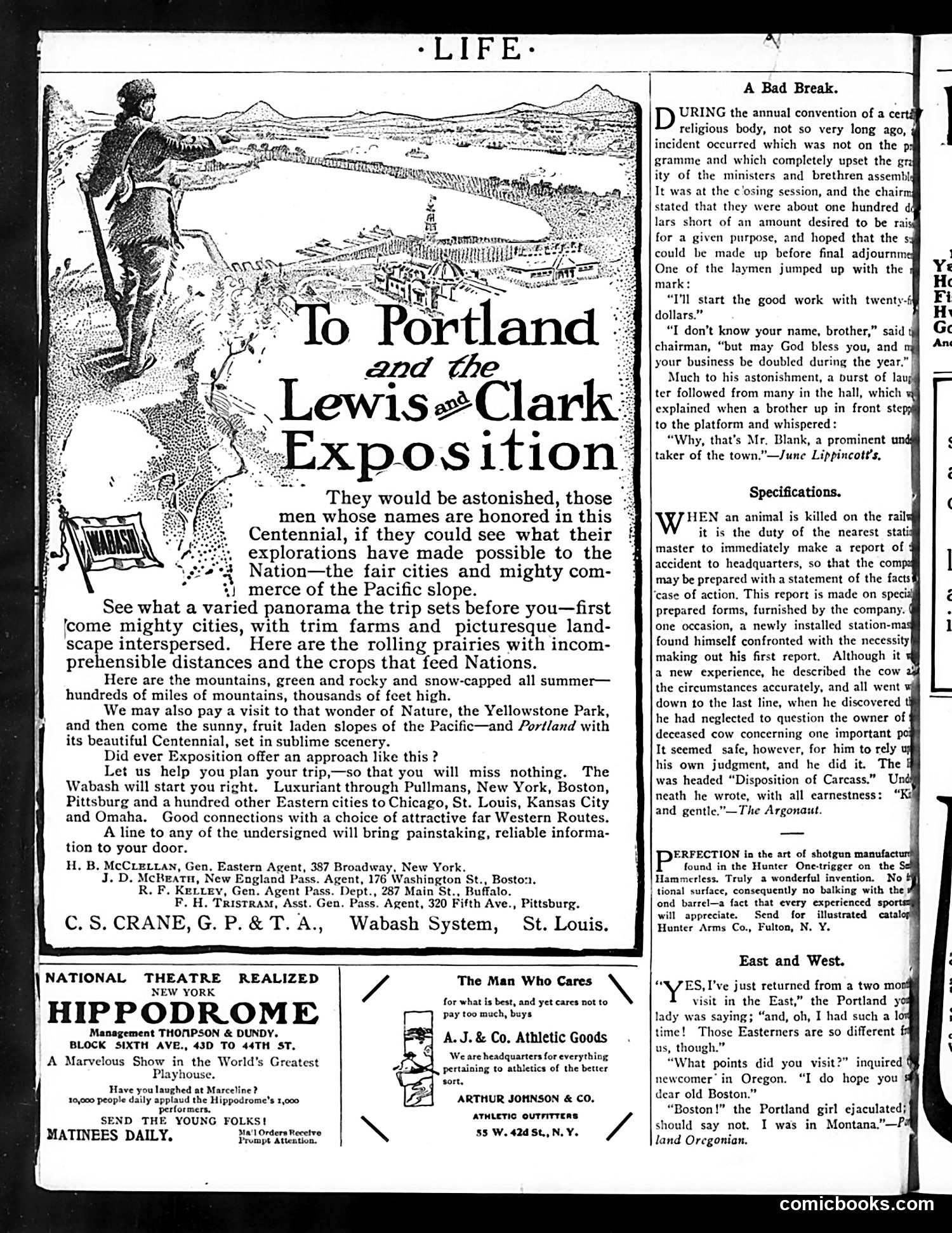
This page is primarily **advertising content** for the 1905 Lewis and Clark Exposition in Portland, Oregon, celebrating the centennial of the famous exploration expedition. The large illustration shows a figure overlooking a panoramic landscape with mountains and settlements. The advertisement emphasizes tourism opportunities: Pullman train travel through varied terrain (prairies, mountains, Yellowstone Park) to reach Portland and the exposition. Travel agents are listed for booking. The right column contains unrelated brief articles about convention fundraising ("A Bad Break"), railroad accident reporting procedures ("Specifications"), and regional attitudes ("East and West")—typical filler content for the era. The bottom advertises the Hippodrome theater in New York and various athletic goods companies. This is a standard mixed-content magazine page blending ads with editorial material.
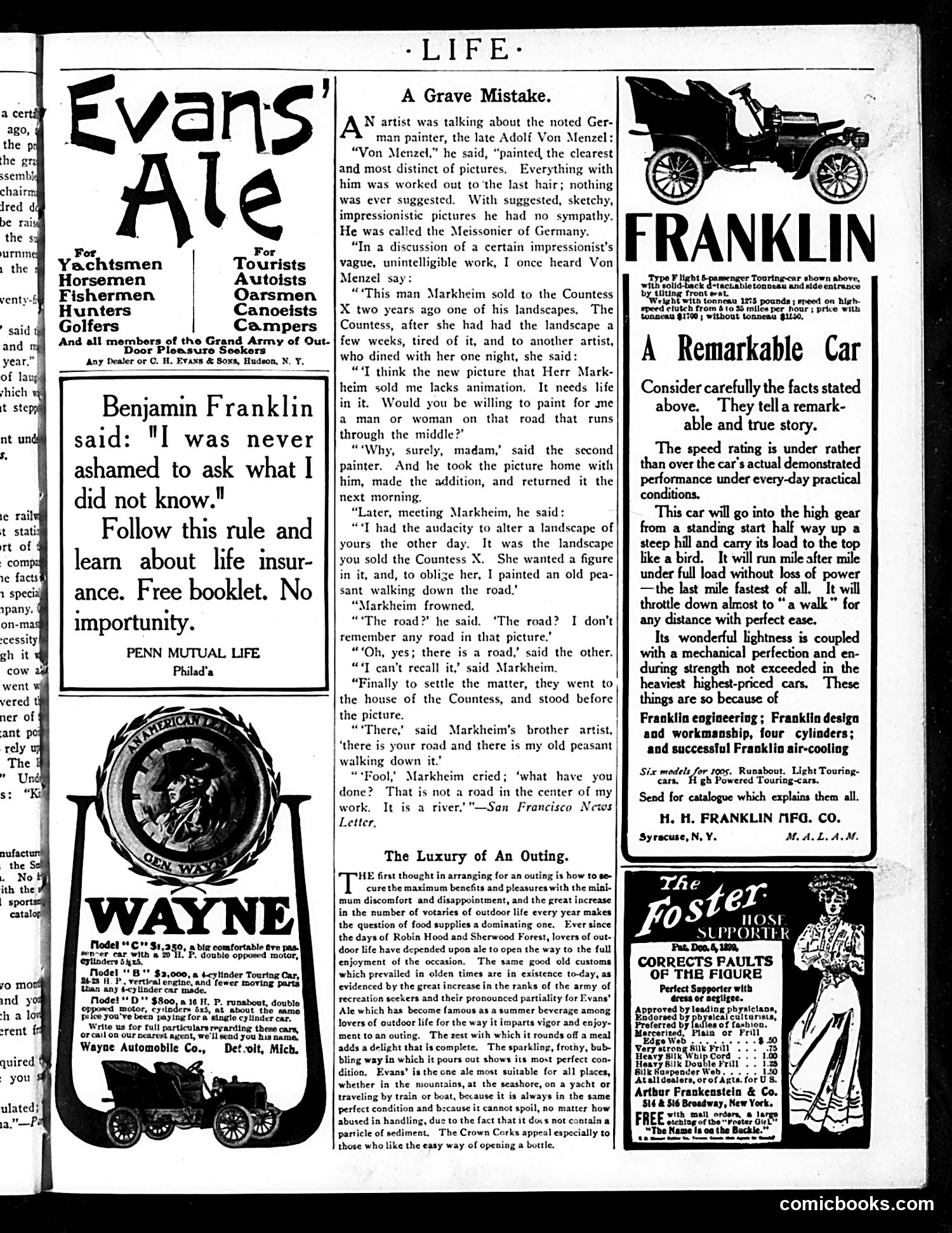
This page contains primarily **advertisements** rather than political satire. The main content includes: **Evans' Ale ad** - A historical beverage advertisement listing target consumers (yachtsmen, horsemen, hunters, etc.). **Benjamin Franklin quote** - A motivational saying about asking questions without shame, used by Penn Mutual Life Insurance to encourage learning. **"A Grave Mistake" story** - An anecdote about German painter Adolf Von Menzel being tricked into adding a figure to a landscape painting, creating an absurd composition with a peasant walking down the middle of what should be a river. **Franklin automobile ads** - Multiple advertisements highlighting the car's performance capabilities and engineering. **The Foster Supporter** - A corset advertisement. The page reflects early 20th-century commercial messaging rather than satirical commentary on contemporary politics or events.
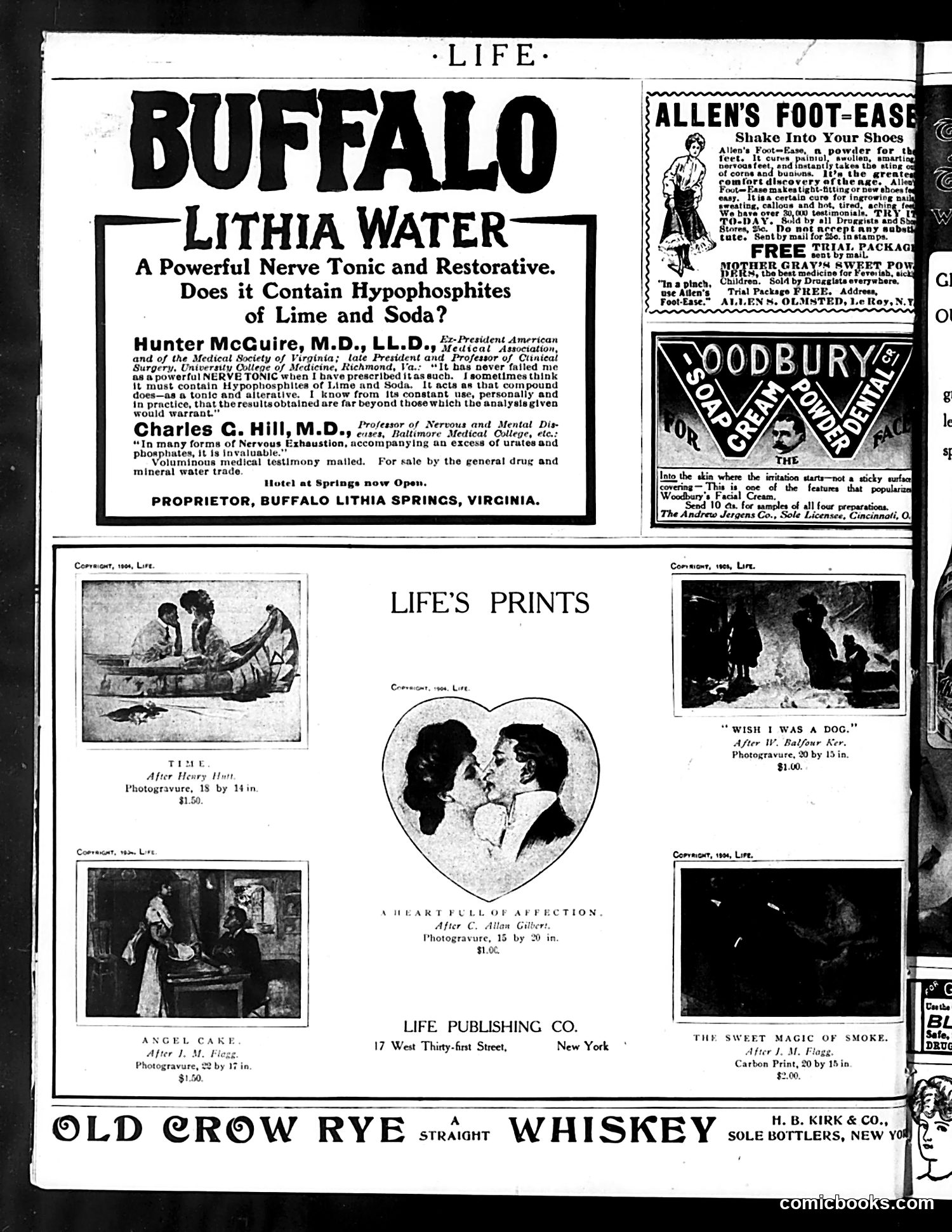
This page is primarily **advertising**, not satirical content. The top half features ads for Buffalo Lithia Water (a medicinal tonic with endorsements from doctors), Allen's Foot-Ease powder, and Woodbury's Facial Soap. The center section, "Life's Prints," showcases photogravure prints available for purchase from Life Publishing Co., including romantic or sentimental images like "A Heart Full of Affection" and "Wish I Was a Dog." The bottom advertises Old Crow Rye Whiskey. There are no political cartoons or satirical commentary visible on this page. It represents typical **early 20th-century magazine advertising and merchandise**, mixing patent medicines with sentimental artwork sales—reflecting the era's commercial practices and aesthetic preferences.
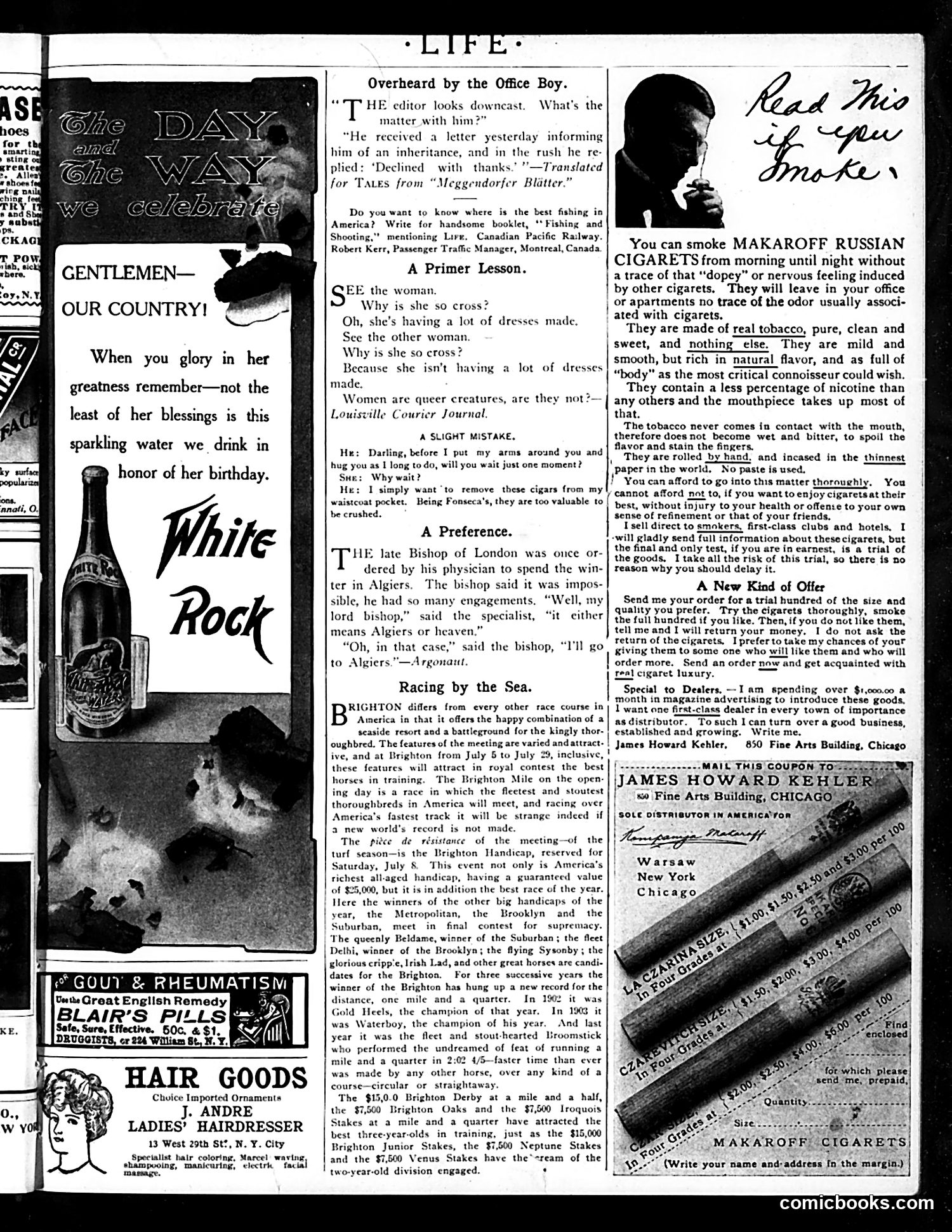
This page is primarily **advertising and humor columns**, not political satire. The content includes: **Left side:** Advertisement for "White Rock" mineral water, using patriotic language ("honor of her birthday") to promote the product to gentlemen. **Center:** Three humorous anecdotes titled "Overheard by the Office Boy," "A Primer Lesson," "A Slight Mistake," "A Preference," and "Racing by the Sea"—brief jokes about everyday situations (women's dresses, cigars, bishops, horse racing). **Right side:** A large advertisement for Makaroff Russian Cigarettes, emphasizing their quality and purity, with a mail-order coupon. **Bottom:** Advertisements for Blair's Pills, hair goods, and a hairdresser. The page reflects early 20th-century advertising aesthetics and humor conventions rather than political commentary.
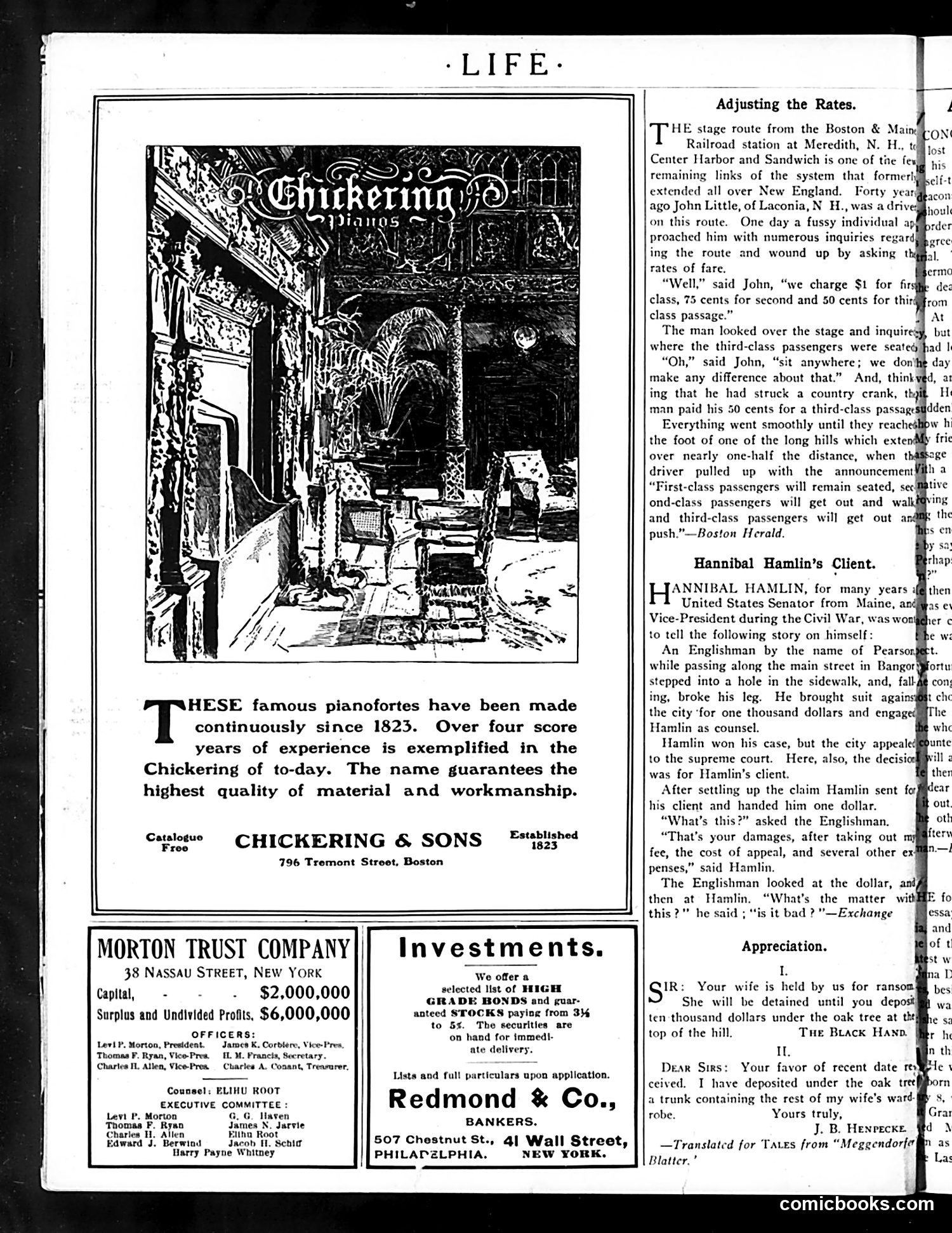
This page is primarily **commercial advertising** rather than political satire. The dominant image shows a detailed wood-engraving of an ornate piano interior, accompanying an advertisement for Chickering & Sons pianos (established 1823), emphasizing their quality and long manufacturing history. Below are additional advertisements for investment services (Morton Trust Company, Redmond & Co. bankers) and brief anecdotal pieces in the "Life" section, including stories about a Boston stagecoach driver and Hannibal Hamlin (the Civil War-era Vice President). The page reflects early 20th-century Life magazine content: **mixing high-end product advertising with humorous short stories** aimed at educated, affluent readers. There is no political cartoon present.
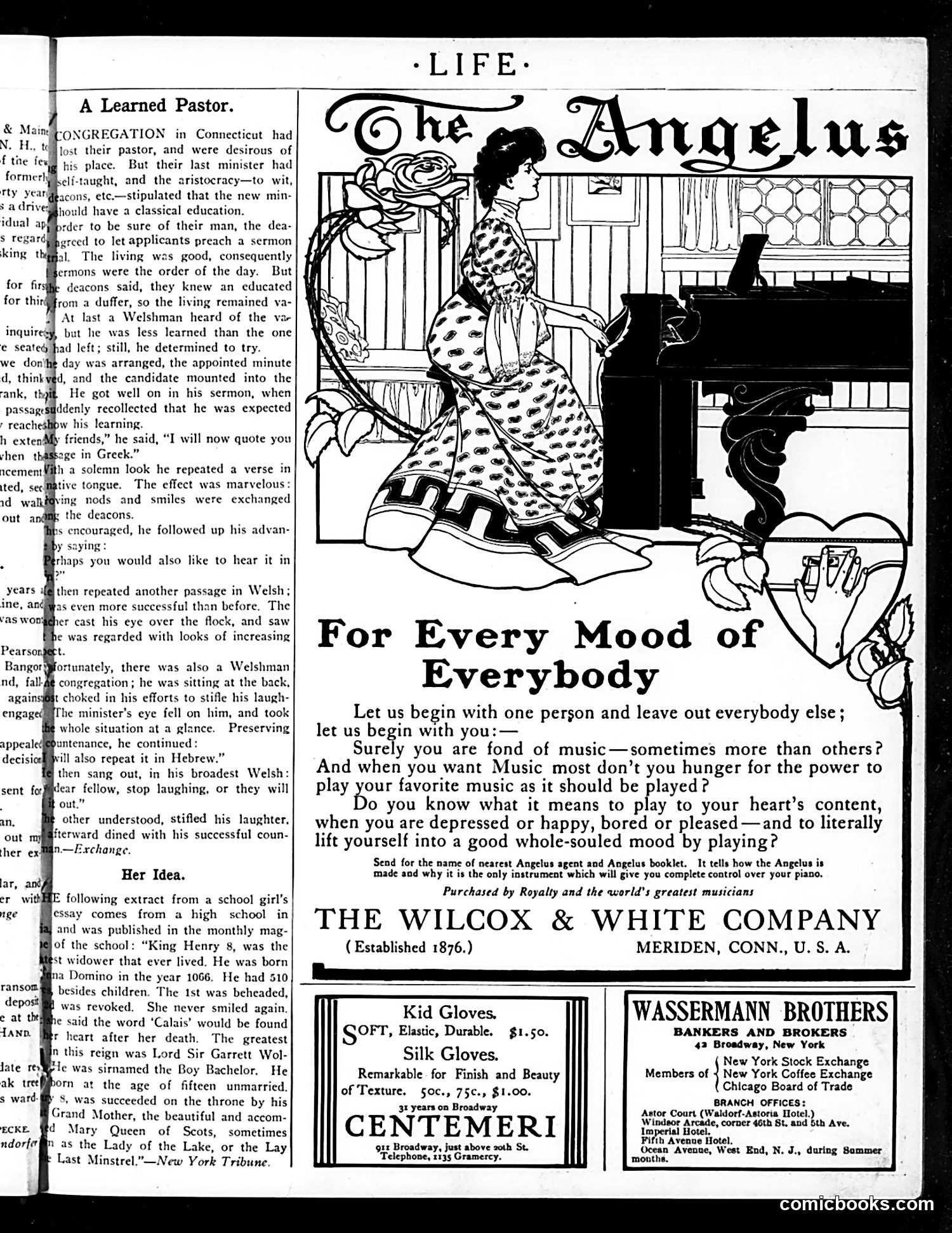
This page is primarily **advertising copy**, not political satire. The main feature is a large advertisement for "The Angelus" piano manufactured by Wilcox & White Company in Meriden, Connecticut (established 1876). The advertisement uses an illustration of an elegant woman at a piano to market the instrument as a solution for emotional well-being. The copy emphasizes that music can improve mood and that this particular piano offers "complete control over your piano." The left column contains unrelated editorial content titled "A Learned Pastor" (about a Connecticut congregation seeking a minister) and "Her Idea" (an anecdote about a girl's essay). The bottom includes smaller ads for gloves and coffee merchants. This reflects early 1900s American consumer culture emphasizing music as a refinement and mood-management tool.
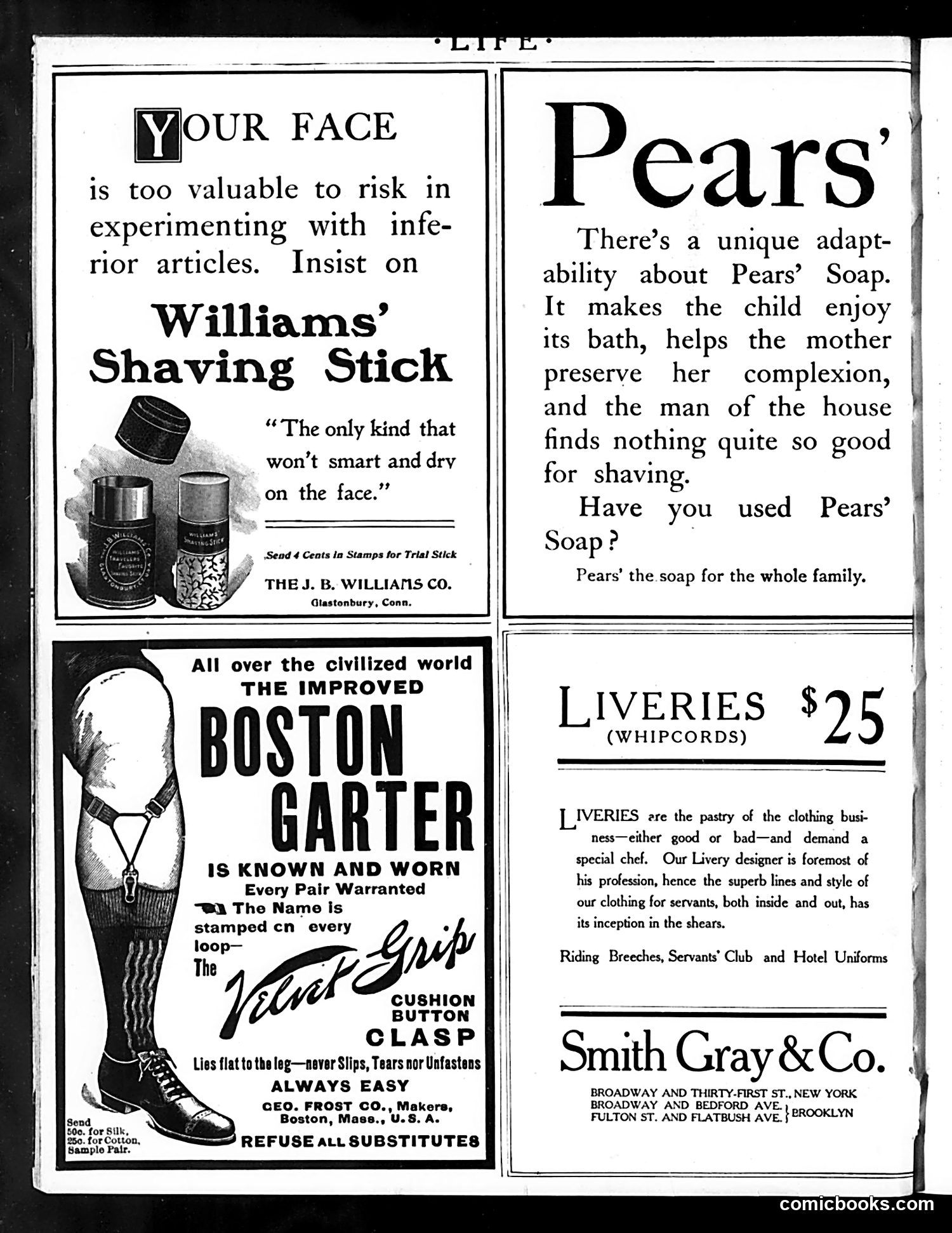
This page contains **four period advertisements**, not political cartoons or satire. The ads promote: 1. **Williams' Shaving Stick** — emphasizes the product won't "smart and dry on the face," addressing a common complaint about shaving products of the era. 2. **Pears' Soap** — marketed as beneficial for children's baths, women's complexion care, and men's shaving, positioning it as a multi-purpose family product. 3. **Boston Garter** — a leg garter with "Velvet Grip" cushion button clasp, designed to stay in place without slipping. The illustration shows the product on a leg. 4. **Liveries (whipcords)** — clothing for servants and staff, priced at $25, marketed to employers seeking professional servant attire. These are straightforward commercial advertisements typical of early-to-mid 20th century *Life* magazine, aimed at upper and middle-class readers.
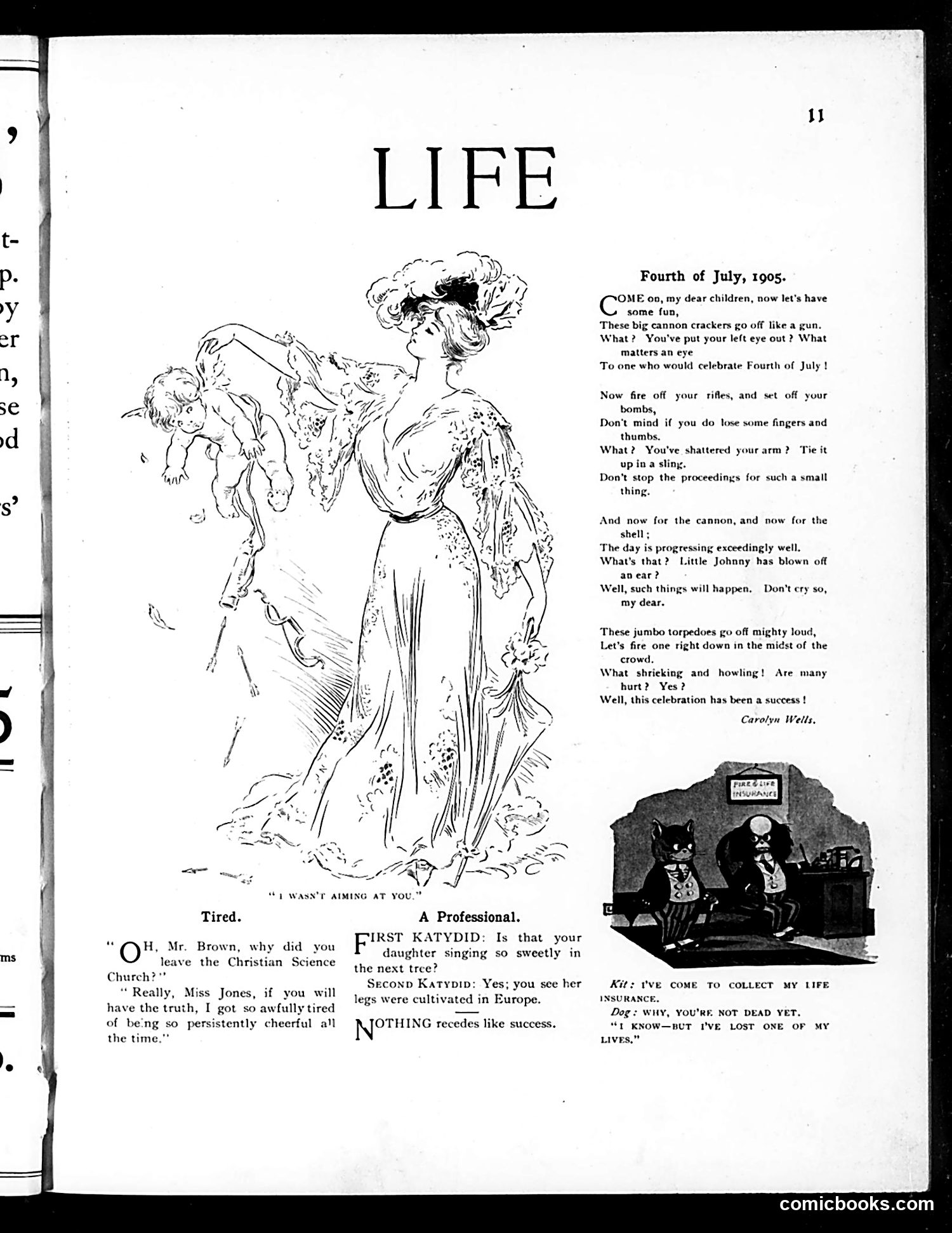
The main illustration depicts a fashionable woman holding an injured child, satirizing dangerous Fourth of July celebrations. The accompanying poem by Carolyn Wells mocks the holiday's carnage with dark humor—children losing fingers, arms shattered, ears blown off by fireworks and cannons, yet parents dismissing injuries as trivial ("Don't cry so, my dear"). The lower section contains two unrelated items: a brief dialogue mocking Christian Science (a contemporary religious movement), and a cartoon showing what appears to be a debt collector confronting a man, playing on financial anxieties. The overall message criticizes the recklessness of Independence Day festivities and society's casual acceptance of preventable childhood injuries during celebrations.
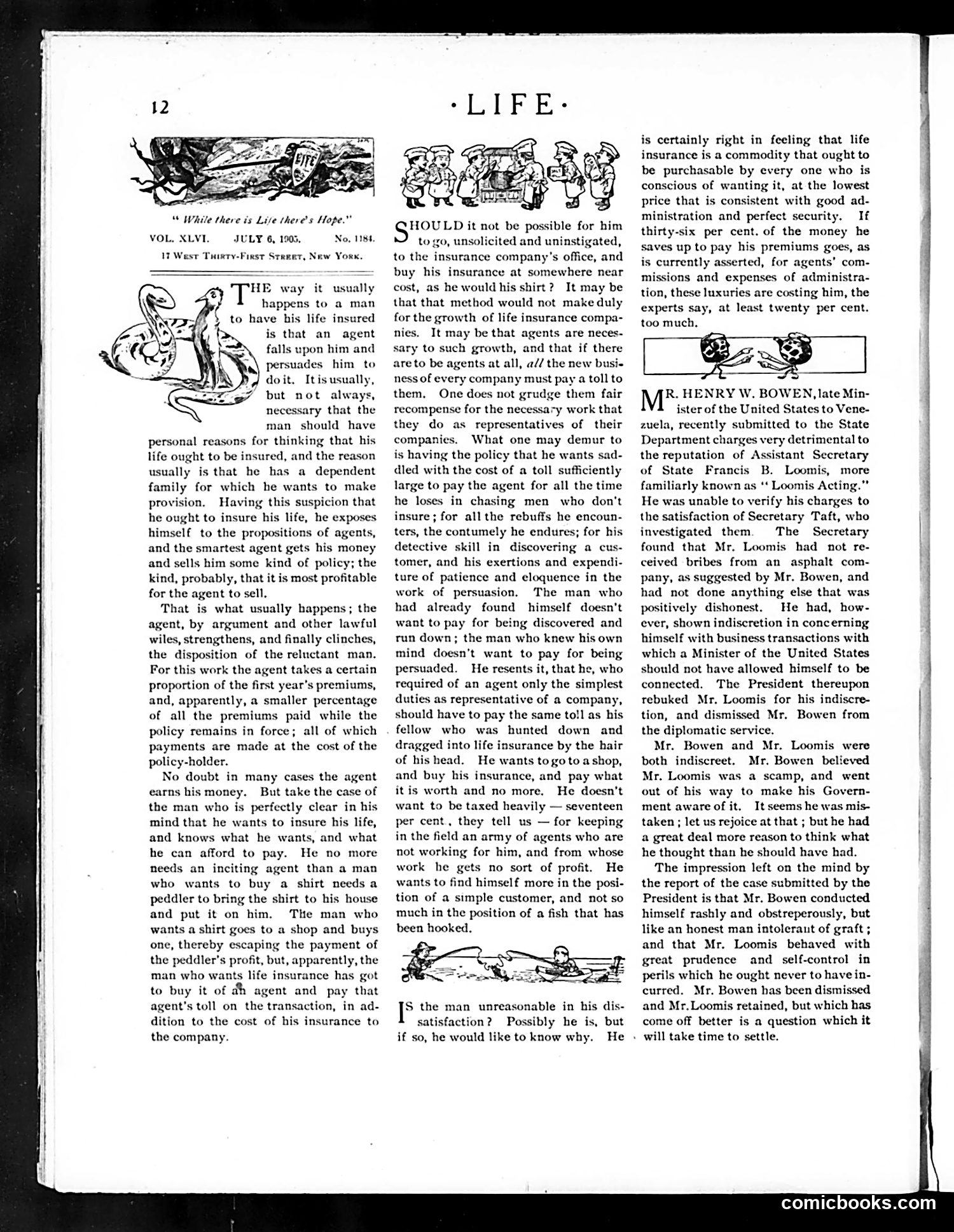
This page critiques life insurance industry practices, particularly agent commissions. The text argues that insurance should be affordable and accessible, but agents' high commissions make policies expensive for ordinary people. The article specifically attacks **Mr. Henry W. Bowen**, late U.S. Minister to Venezuela, for allegedly accepting bribes from an asphalt company while in office. It claims Secretary of State Francis B. Loomis showed "indiscretion" by hiring Bowen despite these charges. The President subsequently dismissed Bowen. The cartoons (featuring ducks and other figures) appear to illustrate the article's point about financial predation—likely depicting how agents or corrupt officials "hook" ordinary people into unfavorable deals. The satire targets both insurance industry practices and government corruption.
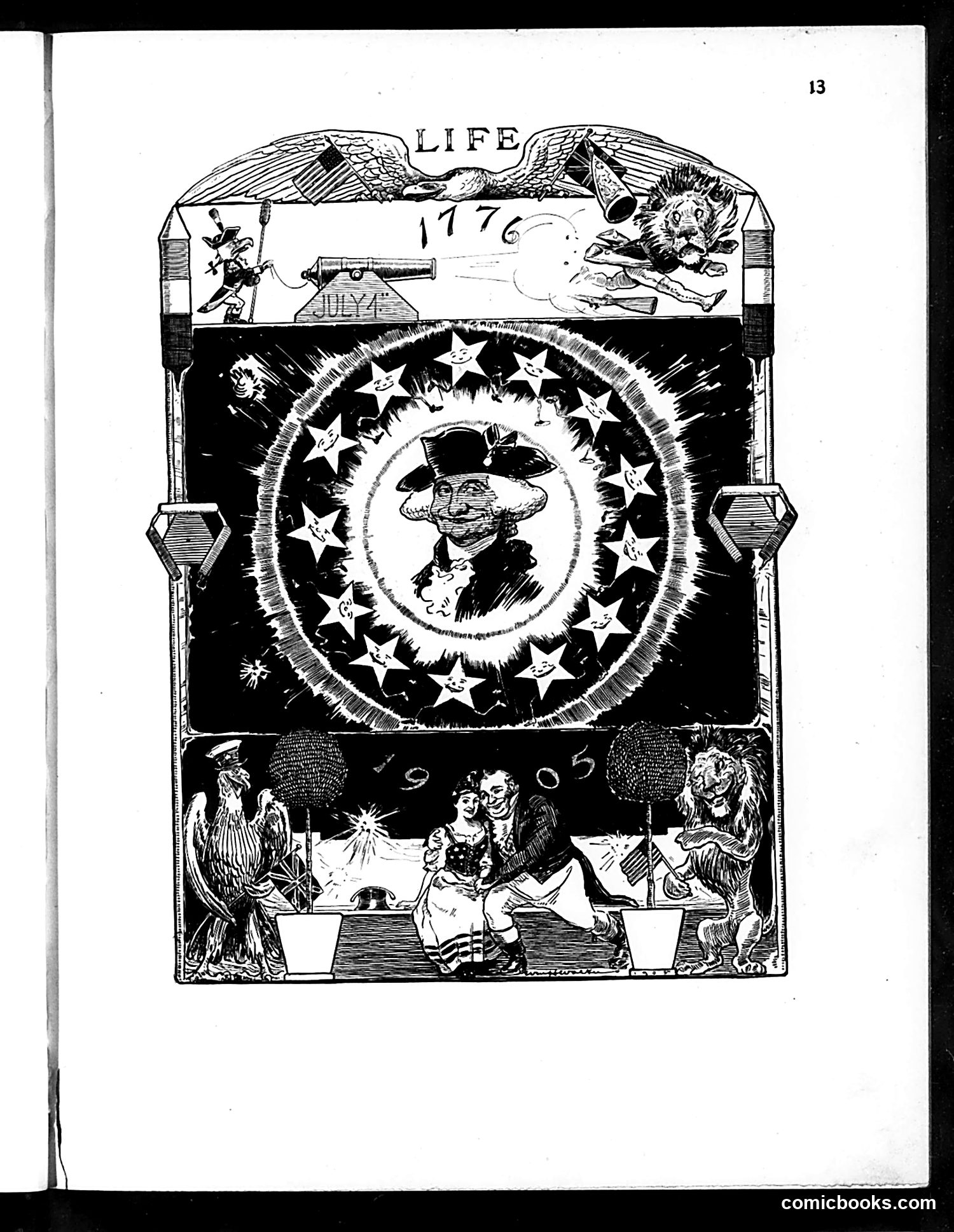
This is a Life magazine cover from 1776 (visible in the top panel), creating a **bicentennial commemorative design** for American independence. The central circular medallion features a man in colonial dress surrounded by stars—likely representing a founding father or patriotic figure. The top panel depicts Revolutionary War imagery: a cannon, soldiers, and military action. The bottom panel shows what appears to be a **theatrical or ceremonial scene** with figures in period costume, suggesting a celebration or reenactment. The overall design is ornate and symmetrical, emphasizing national pride. This appears to commemorate **America's 200th anniversary** (1976), using historical imagery and formal design to celebrate the nation's founding era. The specific figures' identities are unclear from the image alone.
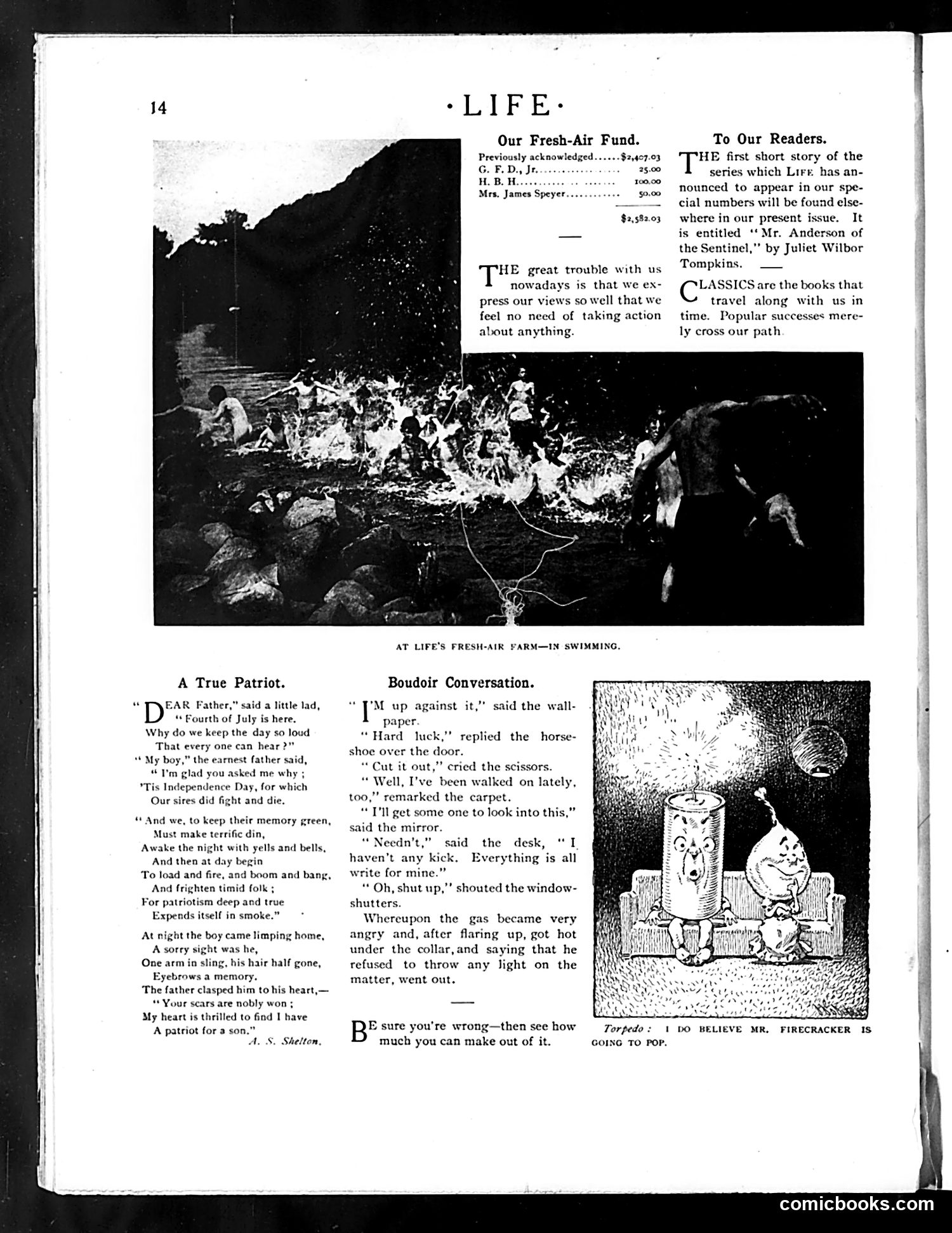
This poem mocks the disconnect between patriotic *intent* and destructive *practice* on Independence Day. A father explains to his son that loud noise and fireworks honor the Revolutionary War sacrifice—that "patriotism deep and true / Expends itself in smoke." The satire's punchline: the boy returns home injured (arm in sling, hair burned off, eyebrows gone), yet the father celebrates his wounds as noble patriotic scars, completely missing that he's glorified dangerous, reckless behavior rather than actual patriotism. The joke targets Americans who conflate noisemaking and fireworks with genuine patriotic commemoration. By having the father praise accidental self-harm as heroic sacrifice, the author exposes how empty ritualistic explosions have become divorced from the serious values they supposedly represent. The page also includes unrelated satirical pieces: "Boudoir Conversation" (household items arguing) and notes on LIFE's charitable Fresh-Air Fund.
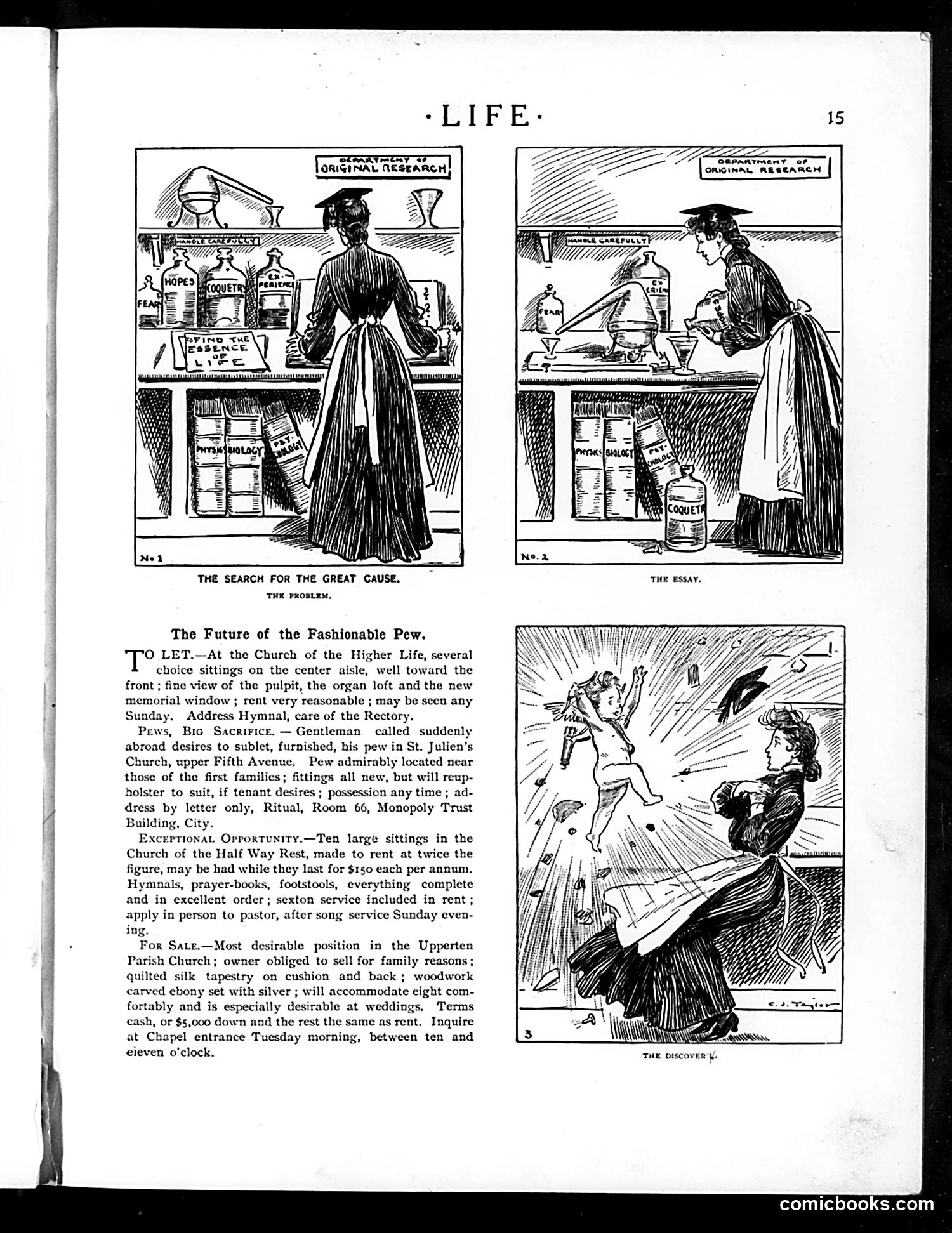
The top two panels satirize women conducting scientific research. Panel 1 shows a woman at a cluttered laboratory bench labeled "Department of Original Research," surrounded by jars marked "Hopes," "Coquetry," and "Experience," searching for "The Great Cause"—mocking the idea that women pursuing intellectual or scientific work are merely disguising shallow motivations. Panel 2 shows another woman presenting "The Essay," suggesting women's scholarly output is superficial performance rather than genuine contribution. The lower section parodies wealthy New Yorkers treating church pews as luxury real estate. Multiple classified ads describe renting, subletting, and selling prestigious church seating positions—complete with details about location near "first families," upholstery options, and financing terms. This satirizes how fashionable Manhattan churches had become status symbols where wealthy congregants treated pew ownership like property investment, reducing religion to social standing. The cartoon at right remains unclear from the image provided.
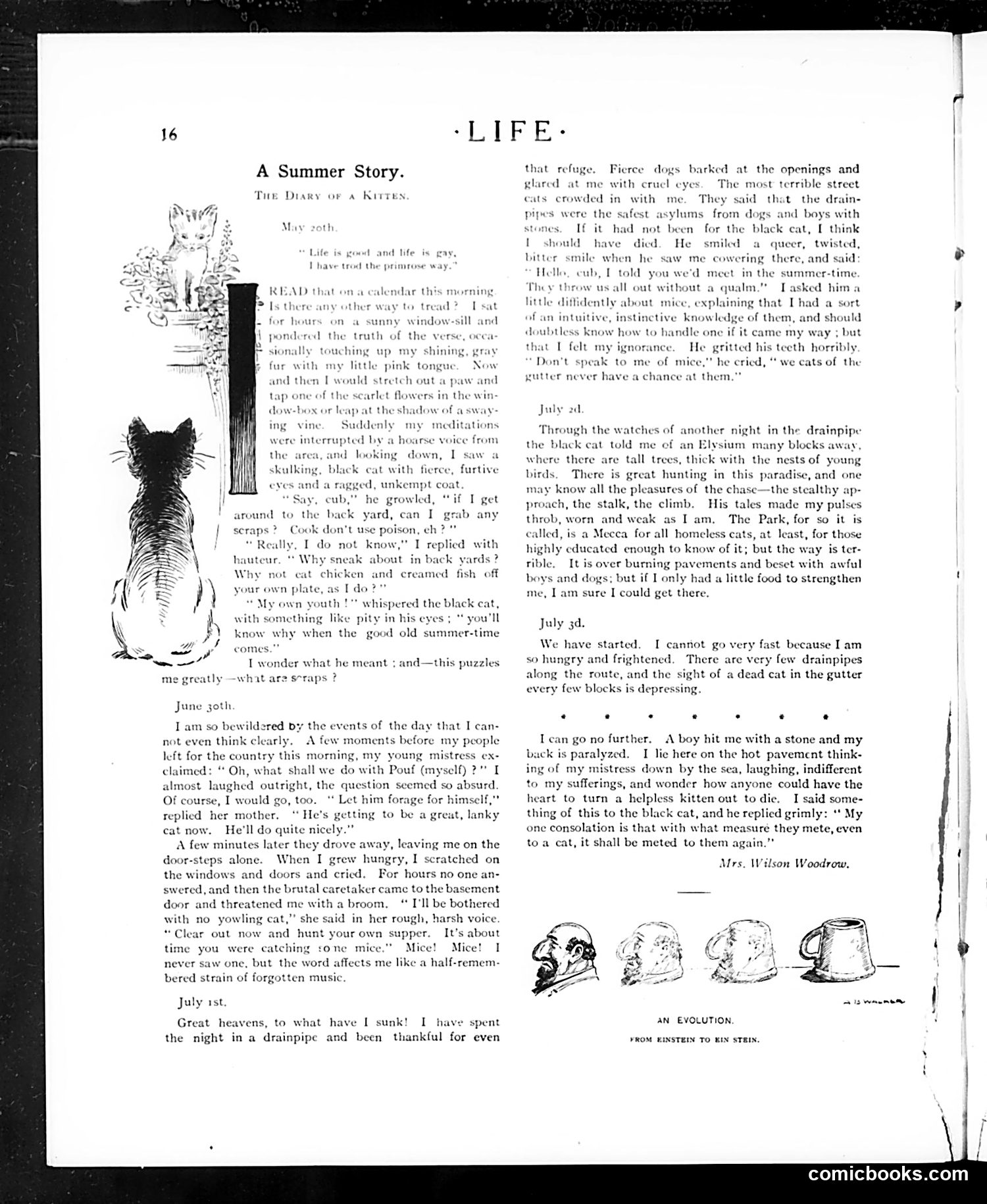
This is a humorous narrative piece, not political satire. It's a serialized first-person account by an abandoned house cat named "Pouf" left behind when his family departs for the summer. The satire targets the callousness of the wealthy toward pets—the mistress dismisses him as "a great, lanky cat" who should "forage for himself." The story chronicles his descent from pampered house cat to street vagrant, encountering a cynical stray who serves as both guide and dark mirror. The cartoon at bottom ("An Evolution: From Kitten to His Stein") appears to show the physical/moral degradation of a cat through stages, reinforcing the story's theme of a genteel creature reduced to survival. The piece is sentimental social commentary wrapped in animal humor—common for *Life* magazine's mix of light entertainment with gentle critique of upper-class indifference.
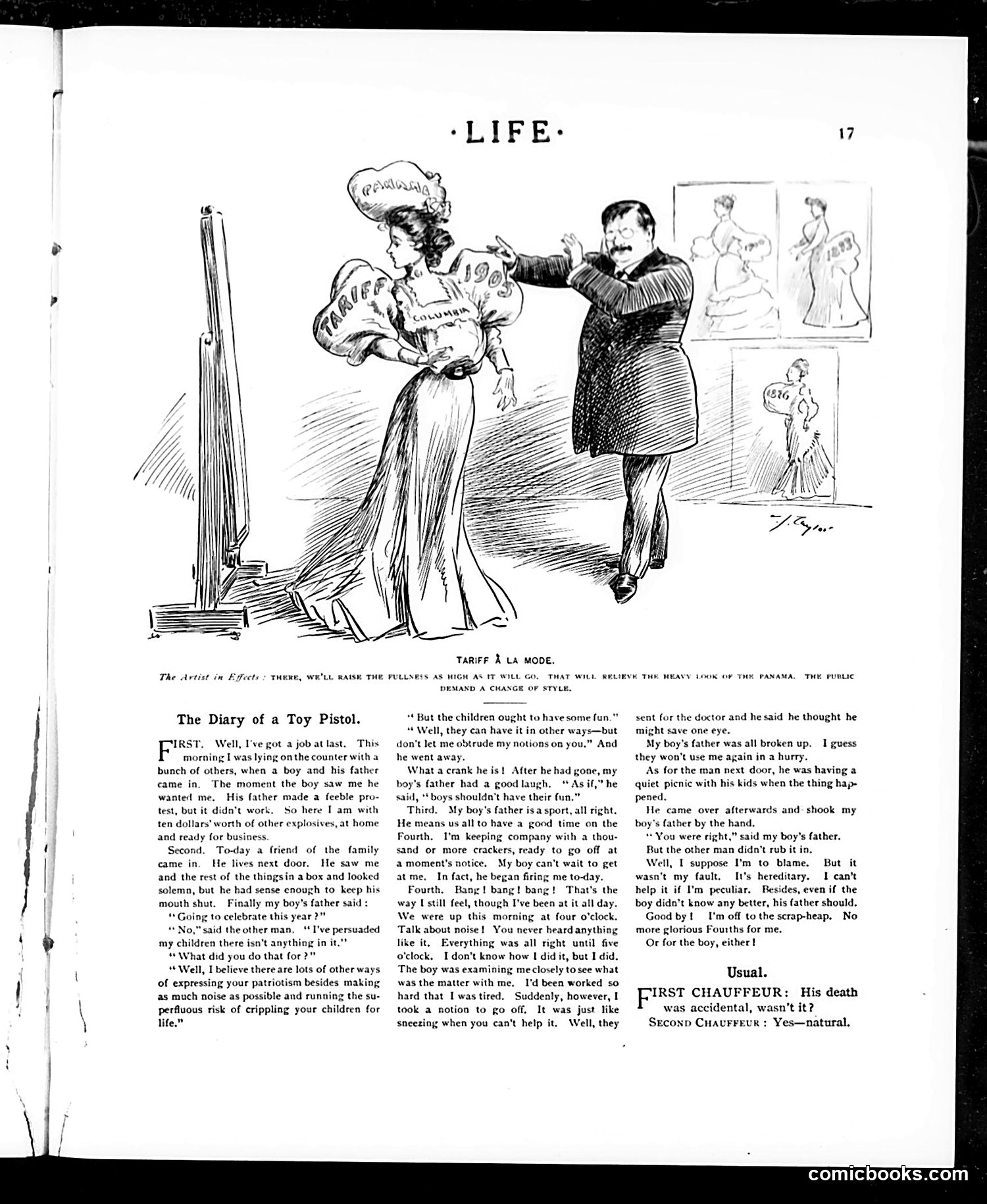
This page contains two distinct satirical pieces from early 1900s *Life* magazine: ## "The Diary of a Toy Pistol" A first-person narrative from a toy firecracker criticizing Fourth of July celebrations. One neighbor refuses to let his children use firecrackers, arguing patriotism needn't involve "making as much noise as possible and running the superfluous risk of crippling your children for life." The toy pistol accidentally blinds the boy using it, vindicating the cautious father's position. The satire targets American enthusiasm for noisy Independence Day celebrations despite obvious child safety hazards—a genuine concern in an era before modern consumer safety regulations. ## "Tariff à la Mode" (top cartoon) A fashion designer shows a woman sketched designs while gesturing dismissively. The caption references raising "fullness" to relieve the "heavy look" of the Panama (likely the Panama hat, fashionable then). This appears to mock either fashion industry pretension or possibly tariff policy affecting imported goods, though the exact political reference is unclear. ## "Usual" (brief dialogue) A dark joke: two chauffeurs discuss a death being "accidental" versus "natural"—implying chauffeurs cause deaths so regularly that distinguishing the cause seems absurd.
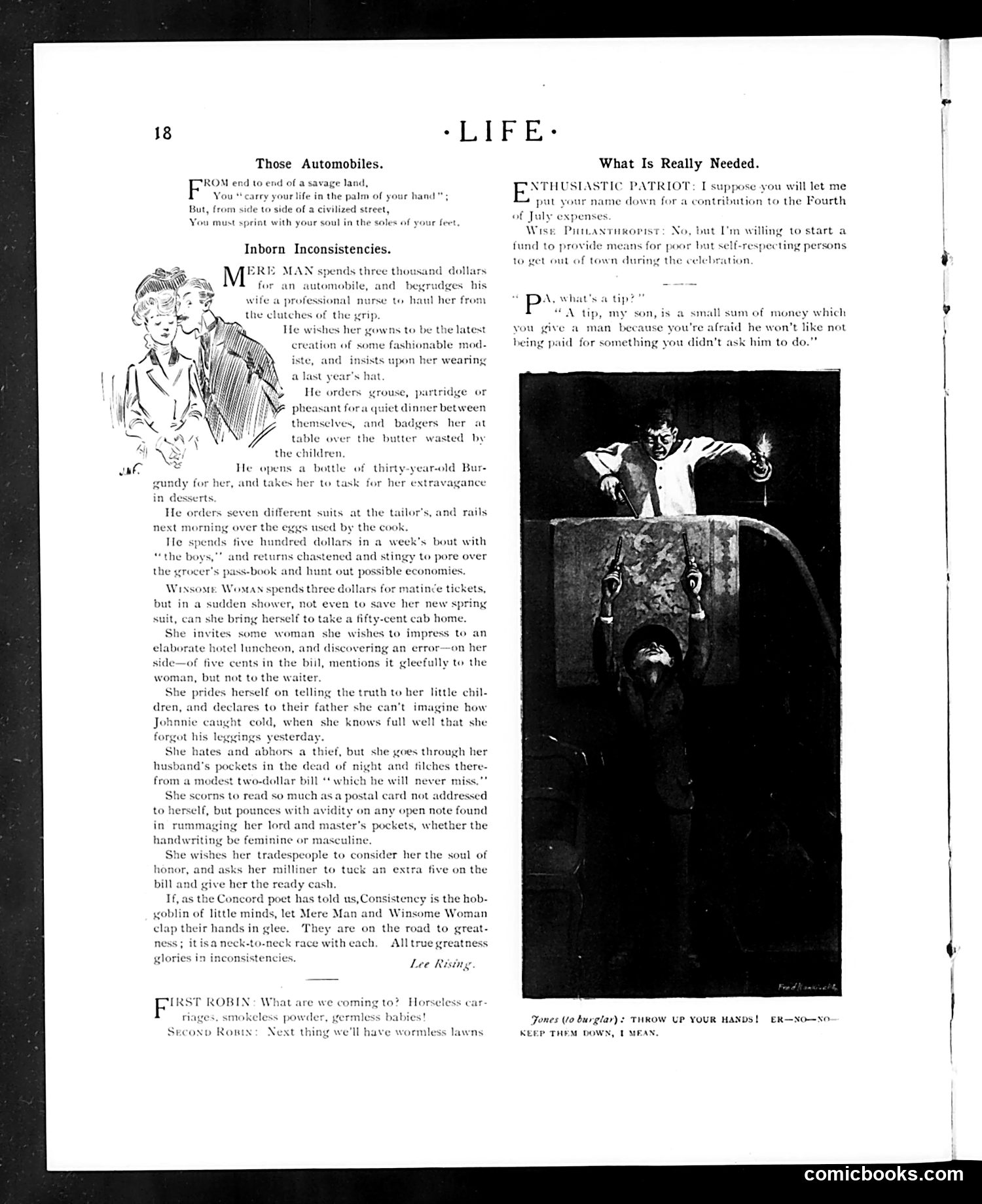
This page satirizes the hypocrisies of American middle and upper-class life circa early 1900s. **"Inborn Inconsistencies"** is the main feature, cataloging contradictions in wealthy men and women: A man spends $3,000 on an automobile yet begrudges his wife cab fare; he orders expensive wines and clothes but scolds her over wasted dessert and eggs; he splurges $500 weekly on boats then obsessively hunts "economies" in household expenses. Similarly, "Winsome Woman" won't take a 50-cent cab home after spending $3 on theater tickets; she prides herself on honesty with children while lying to her husband; she despises thieves yet steals from her husband's pockets. **The cartoon jokes** below address contemporary concerns: First Robin and Second Robin discuss "horseless carriages" and other modern innovations. The "Patriot vs. Philanthropist" exchange satirizes selective charity—the philanthropist won't donate to July Fourth celebrations but will fund a "poor self-respecting person's" escape from town. The final panel jokes about confused communication between Jones and a burglar. The satire targets wealthy hypocrisy and the absurdities of new consumer culture.
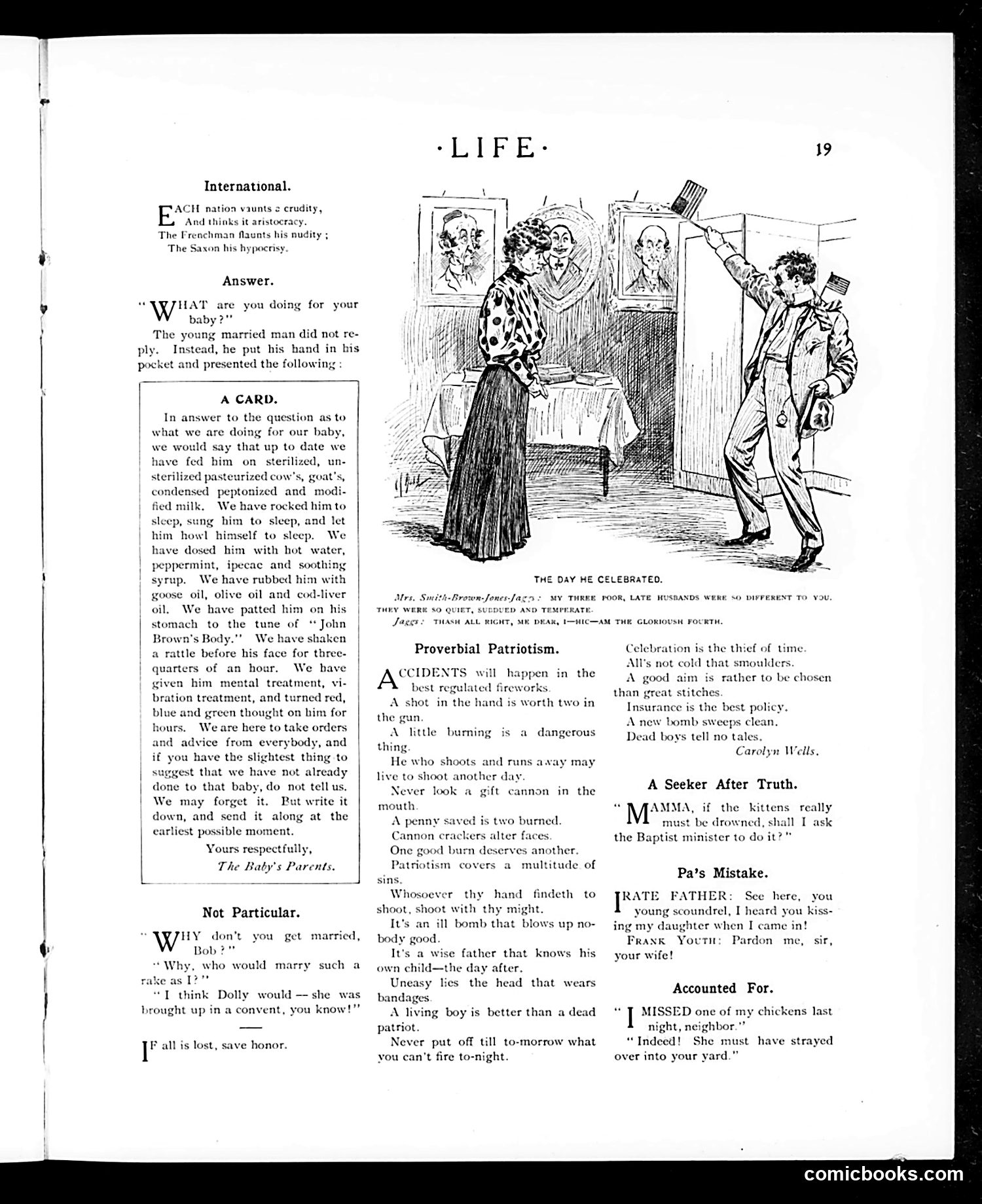
This page from *Life* magazine contains several satirical pieces mocking early 20th-century American parenting obsessions and patriotic excess. **"The Day He Celebrated"** cartoon depicts a man returning home from Fourth of July festivities, apparently injured (bandaged). His wife notes his late husbands were "so different"—suggesting he's hurt himself during Independence Day fireworks, a common occurrence. **"Proverbial Patriotism"** parodies traditional proverbs by replacing them with fireworks-related ones ("A shot in the hand is worth two in the gun"). The satire ridicules blind patriotism that accepts casualties—"Dead boys tell no tales"—as acceptable costs of celebration. **"The Baby's Parents"** card mocks new parents who obsessively apply every trendy childcare method (sterilized milk, vibration treatment, "mental treatment") while desperately seeking more advice. It satirizes excessive parental anxiety and faddish over-management. The smaller pieces ("Not Particular," "Pa's Mistake," "Accounted For") are brief joke exchanges poking fun at marriage and everyday absurdities.
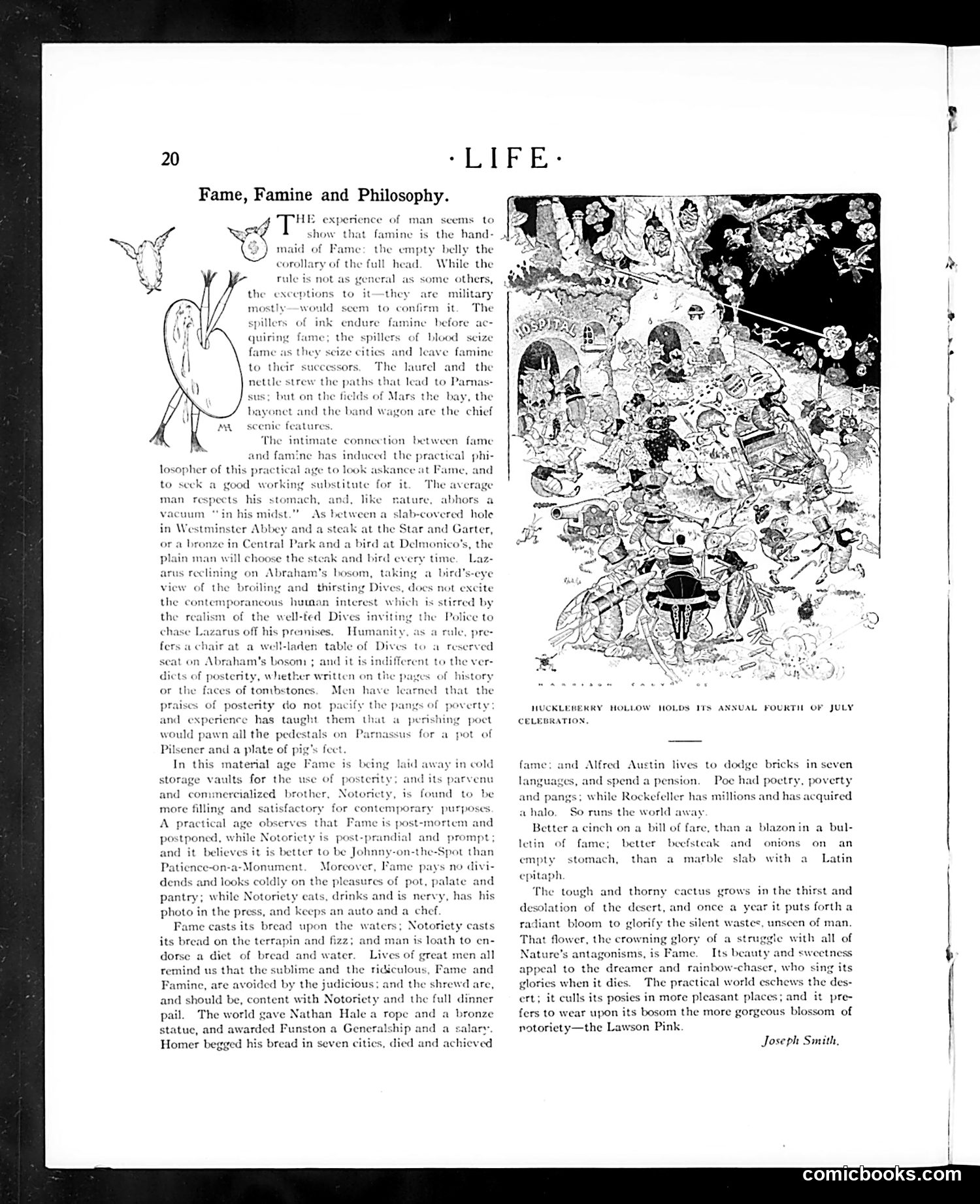
This satirical essay argues that **fame and famine are inseparable**—great artistic or intellectual achievement historically comes with poverty. The author mocks philosophers who seek "a good working substitute" for fame by pursuing **notoriety instead**. The distinction is key: Fame is posthumous (you're dead before recognized); Notoriety is immediate and profitable. The piece sarcastically celebrates choosing **notoriety and a full dinner pail over starving for art**—better to be "Johnny-on-the-Spot" than "Patience-on-a-Monument." Examples cited include Homer (starved), Nathan Hale (executed), and Poe (died poor), contrasted with Funston (received a generalship while alive) and Rockefeller (acquired millions). The accompanying illustration depicts **Huckleberry Hollow's Fourth of July celebration**—a bucolic scene suggesting that ordinary contentment and community (notoriety in one's own place) beats the grinding poverty of pursuing historical fame. The essay's target: Romantic notions that great art requires suffering. Its message: pragmatically, choose comfort and recognition over posthumous glory.
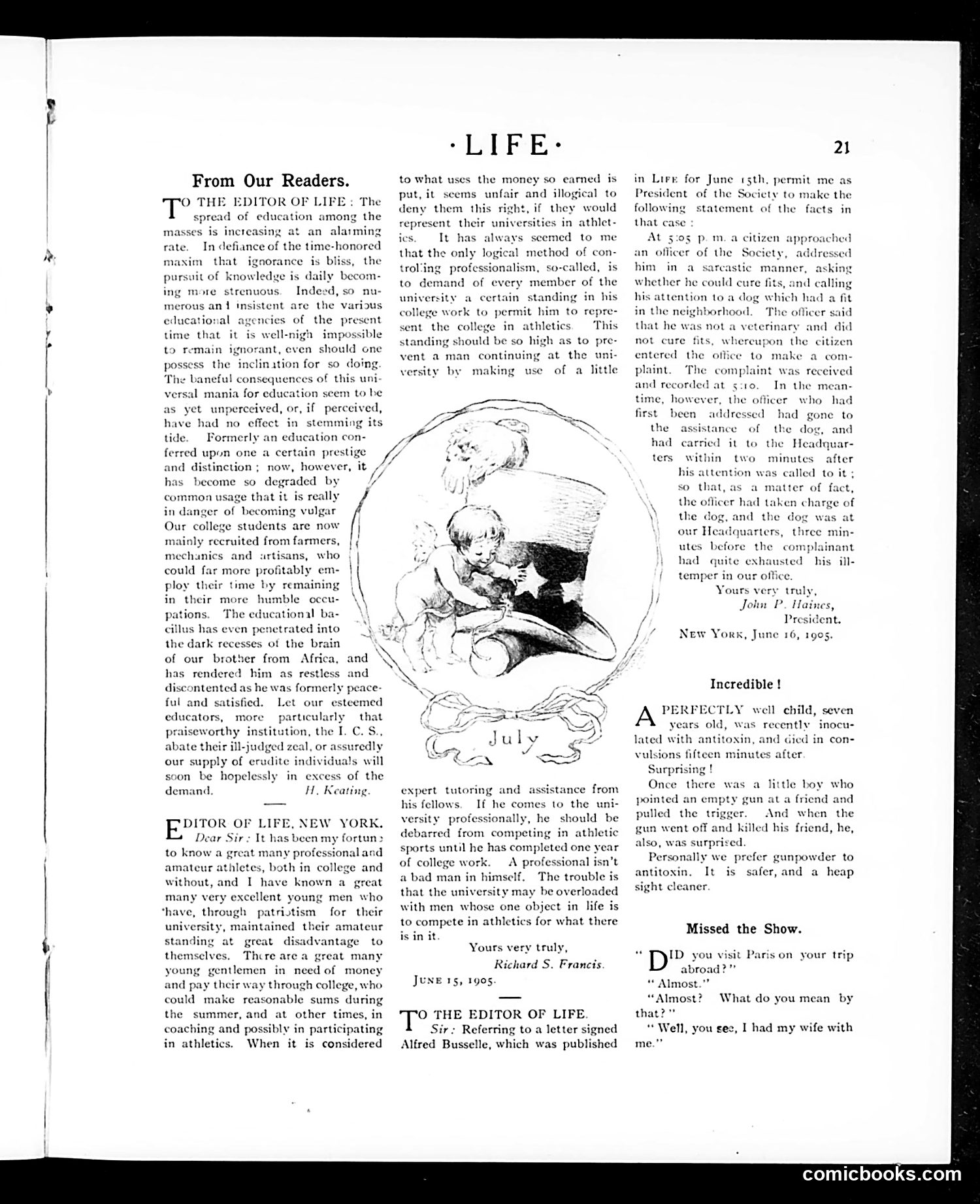
This page from *Life* magazine (dated June 1905) contains reader letters debating college education and athletics—not political cartoons. **The Illustration**: A sketch shows two figures (appearing to be children or youths) in a domestic scene, likely accompanying one of the letters about education. **Main Satire**: The lead letter from "H. Keating" satirizes the spread of mass education, arguing that widespread schooling has degraded education's prestige. The author ironically warns that education has become so common it's "in danger of becoming vulgar"—the joke being that he laments education reaching farmers, mechanics, and even "our brother from Africa." This reveals period attitudes about who "deserved" education. **The Debate**: Subsequent letters defend athletic scholarships and professionalism in college sports, arguing poor students shouldn't be prevented from earning money while attending university. **Historical Context**: This reflects early-1900s anxieties about democratizing education and the emerging debate over college athletic professionalization—issues still relevant today, though the racist and class-based language now appears starkly offensive.
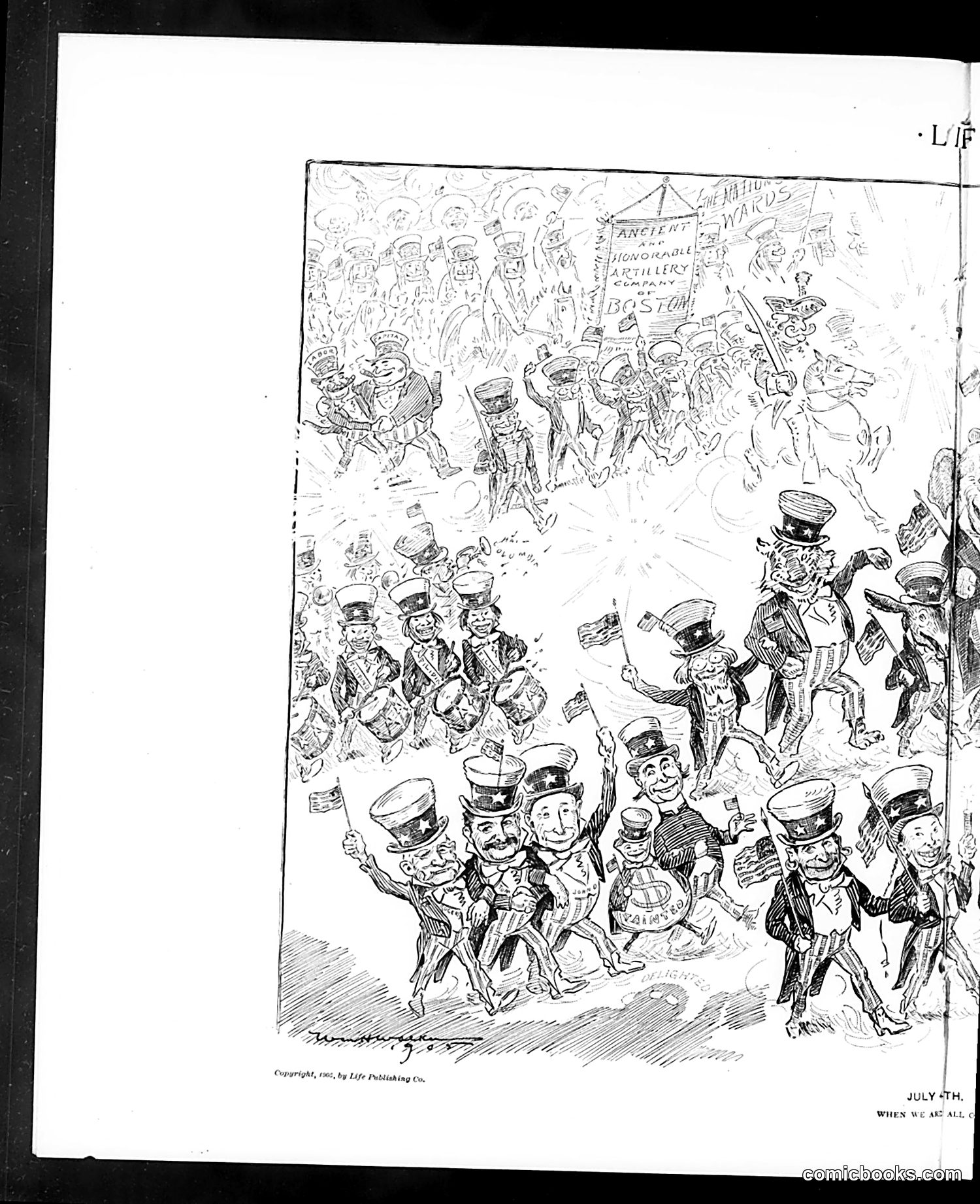
This 1902 Life magazine cartoon depicts a patriotic parade or celebration featuring figures in military and formal dress wearing top hats and waving American flags. The banner visible in the background reads "ANCIENT AND HONORABLE ARTILLERY COMPANY OF BOSTON," referencing a real historical militia organization. The cartoon appears to satirize American patriotism and military pageantry around the turn of the century, likely commenting on the Spanish-American War era (1898) and subsequent American imperial expansion. The exaggerated caricatures and crowded, chaotic composition suggest mockery of jingoistic enthusiasm and blind nationalism. The specific reference to Boston's Artillery Company—a prestigious but anachronistic institution—may underscore the satire about clinging to outdated martial traditions.
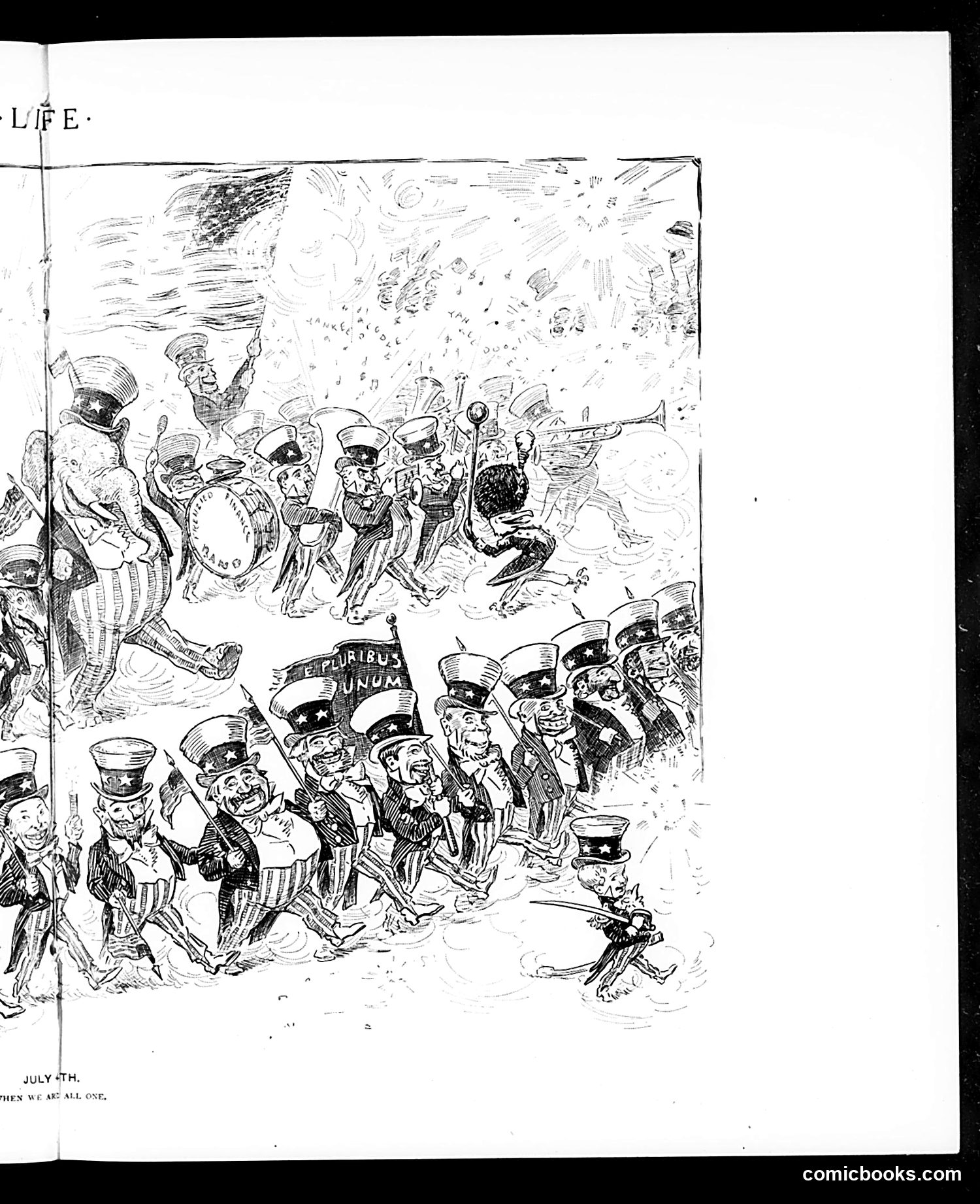
This is a satirical cartoon commemorating July 4th, the American Independence Day. The bottom portion shows caricatured figures wearing Uncle Sam hats and striped clothing, appearing to be politicians or public figures of the era, gathered together. A banner reading "E PLURIBUS UNUM" (Latin for "out of many, one") is visible—the U.S. national motto. The upper portion depicts chaos: soldiers, musicians with instruments, and figures in disarray, suggesting discord or conflict. The caption "MEN WE ARE ALL ONE" appears ironic given the chaotic scene above. The satire likely critiques American political divisions or hypocrisy—suggesting that despite the national motto and Independence Day ideals of unity, American leaders or society remain fragmented and conflicted. Without a visible date or artist signature, the specific historical moment referenced remains unclear, though this reflects common Life magazine themes about political discord.
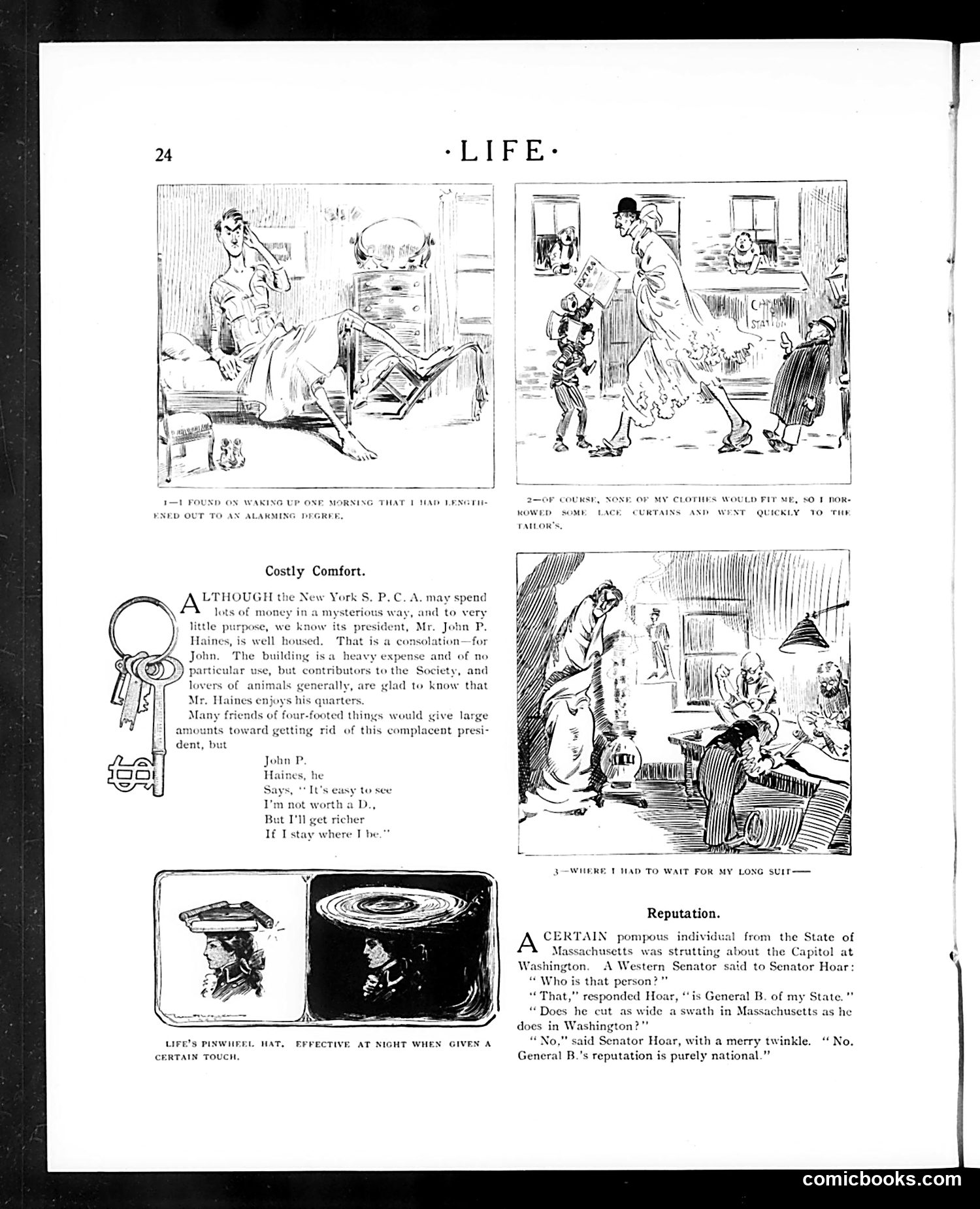
This page contains three satirical pieces mocking wealthy individuals and institutions: **"Costly Comfort"** ridicules the New York S.P.C.A. (Society for the Prevention of Cruelty to Animals), specifically its president John P. Haines. The satire suggests that while the organization claims noble purposes, Haines lives lavishly in an expensive building—implying the organization's funds benefit the leadership rather than animals. The accompanying verse suggests he'll stay in his comfortable position indefinitely. **The cartoons above** show domestic mishaps: a man waking to find his legs stretched unusually long, and someone borrowing lace curtains to improvise clothing for a tailor's appointment—humorous takes on everyday inconveniences. **"Reputation"** satirizes a pompous Massachusetts politician meeting a Western Senator at the Capitol. When asked about "General B," Senator Hoar jokes that while the general has no reputation in Massachusetts (his home state), his reputation is "purely national"—a cutting insult suggesting he's known everywhere for the wrong reasons rather than respected anywhere.
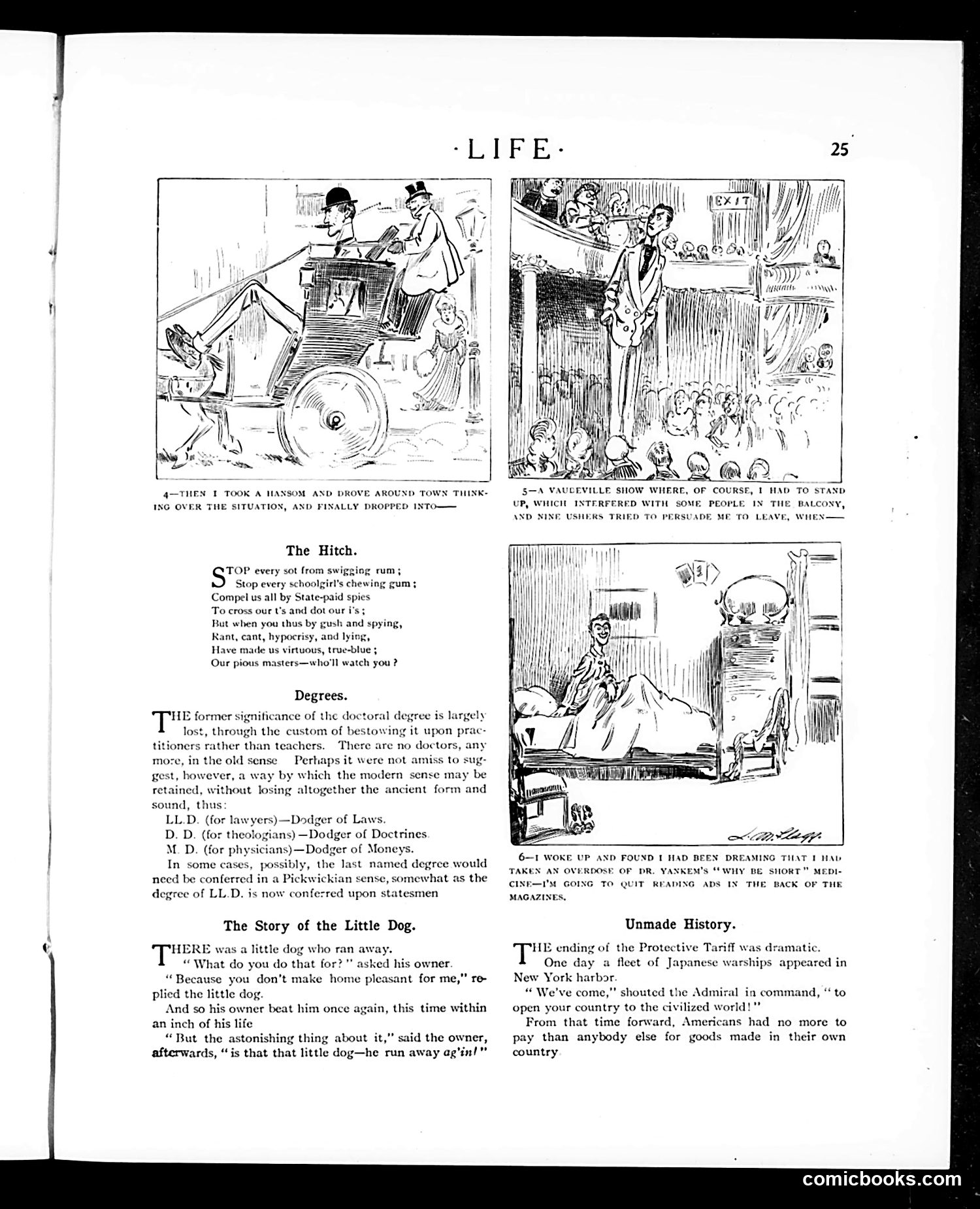
This page contains satirical commentary on American social and political issues circa early 20th century: **"The Hitch"** is a poem mocking government overreach and moral policing—criticizing state surveillance ("State-paid spies") and enforced virtue through regulation, then sarcastically asking who will watch the "pious masters" themselves. **"Degrees"** satirizes the devaluation of doctoral degrees, suggesting they're now given to practitioners and politicians rather than scholars. The author proposes renaming them based on their true purpose: LL.D. = "Dodger of Laws," D.D. = "Dodger of Doctrines," M.D. = "Dodger of Moneys." **"The Story of the Little Dog"** uses a dog's repeated escape as metaphor for how punishment without addressing root causes fails—the owner beats the dog for running away without making home pleasant. **"Unmade History"** imagines Japan forcing America to abandon protective tariffs, allowing cheap foreign goods to flood the market—satire of tariff debate and anxieties about foreign trade competition. The cartoon panels illustrate these vignettes with period-appropriate illustrations.
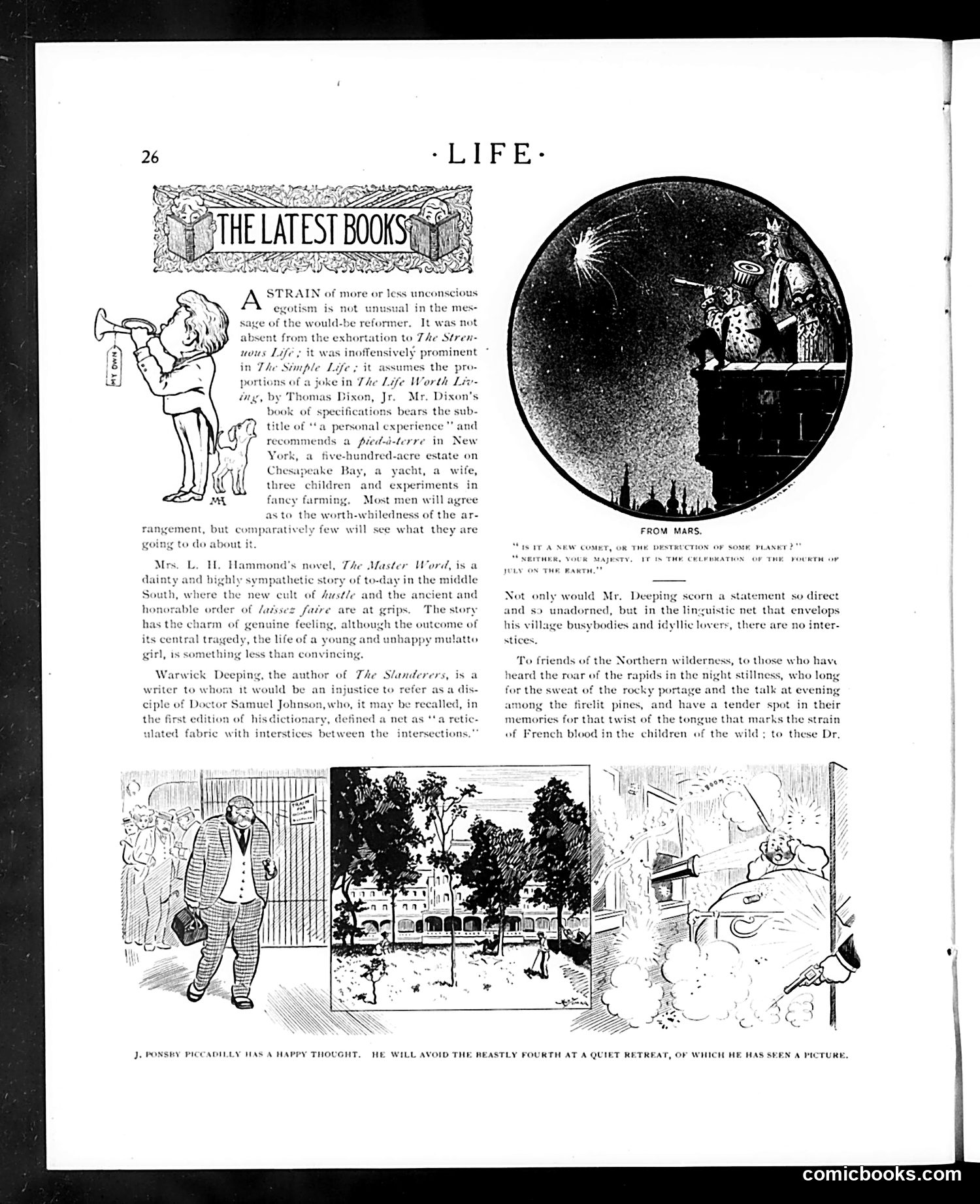
This is a book review section titled "The Latest Books" from Life magazine. The page discusses several contemporary novels, including works by Thomas Dixon Jr. and L.H. Hammond, which explore themes of social reform and rural life—popular concerns of the early 20th century. The cartoon at top right labeled "From Mars" depicts a Martian observer viewing Earth, with the caption questioning whether a comet or planetary destruction is occurring—a satirical commentary on the chaotic state of human civilization. The three illustrations at bottom show a businessman named "J. Ponsby Piccadilly" considering escape to a quiet country retreat to avoid the Fourth of July celebrations, suggesting satirical commentary on urban anxiety and the appeal of rural retreat. The page reflects Life's characteristic blend of literary criticism and gentle social satire, poking fun at reformist impulses and the era's fascination with "simple life" philosophy.
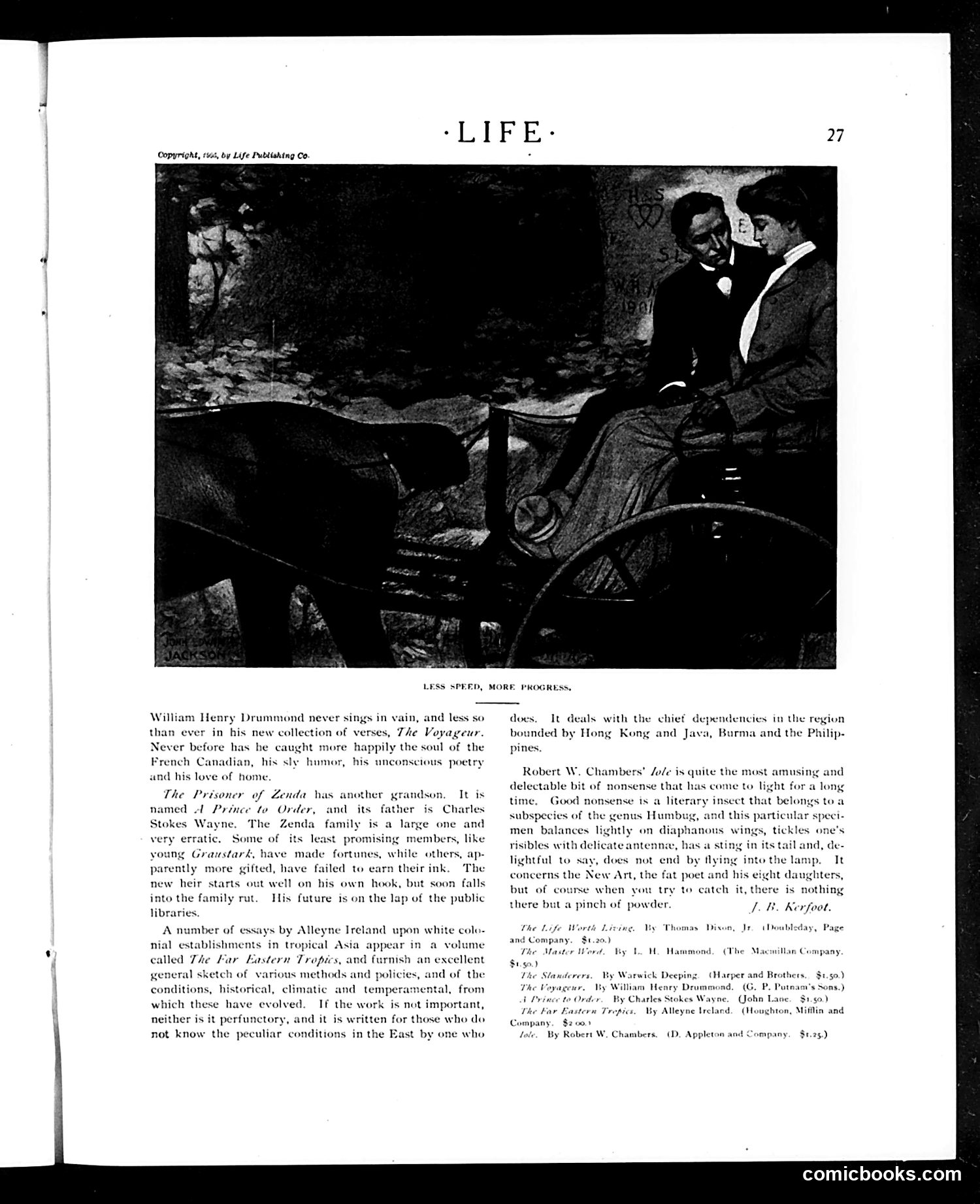
This page from *Life* magazine consists primarily of book reviews rather than political cartoons. The illustration at top shows two well-dressed men conversing near what appears to be industrial machinery or construction equipment—likely a visual pun supporting the caption's message about prioritizing progress over reckless speed. The reviews discuss contemporary fiction and essays, including works about French-Canadian culture, tropical colonial administration, and literary nonsense. The caption's sentiment—"Less Speed, More Progress"—reflects early 20th-century anxieties about industrial progress and the tension between rapid modernization and substantive advancement. It suggests that mere velocity (whether in business, technology, or society) doesn't guarantee meaningful improvement; thoughtful, deliberate work matters more.
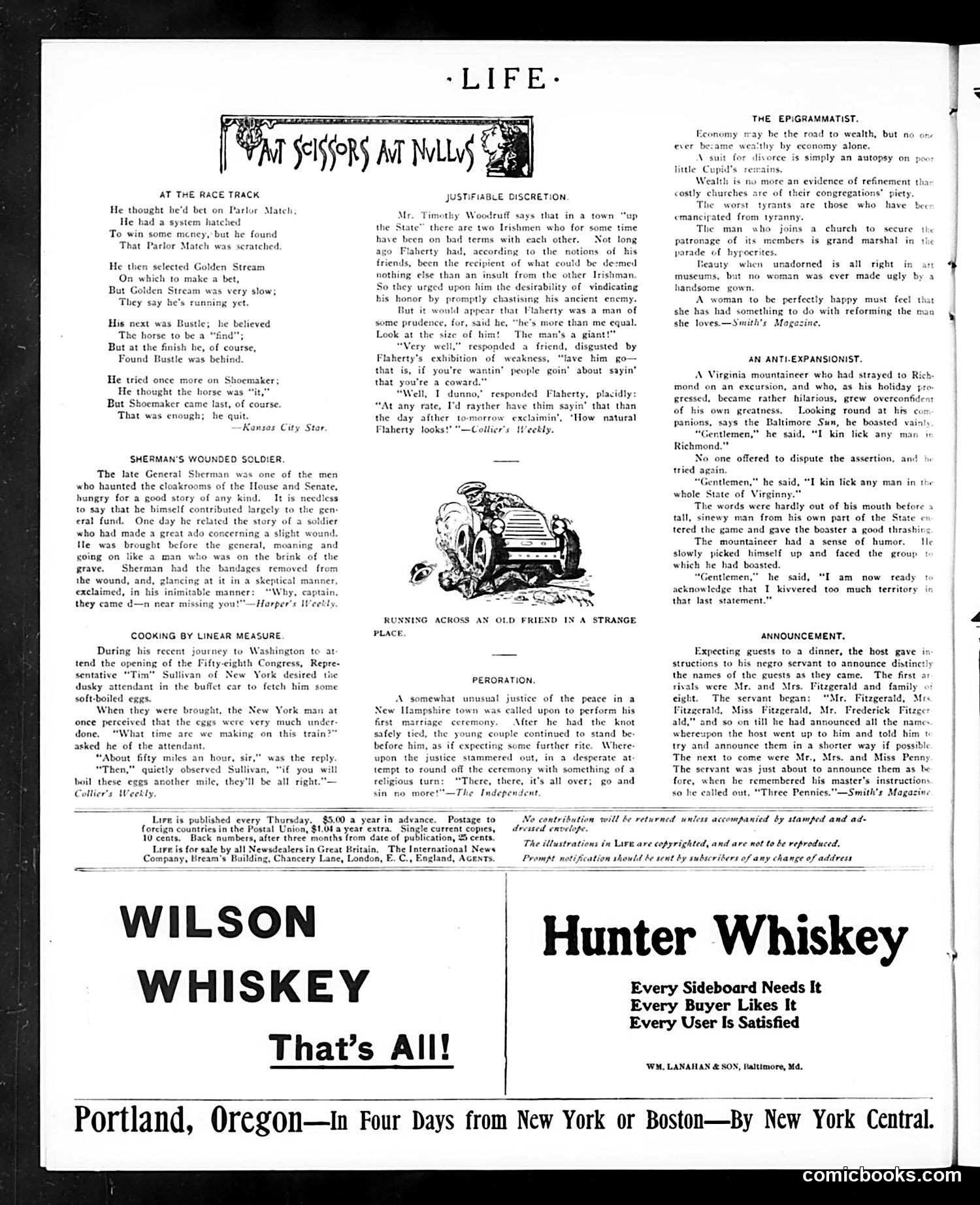
This page from *Life* (a satirical weekly) contains several short humorous anecdotes typical of the era's humor: **"At the Race Track"** mocks a habitual gambler whose "system" repeatedly fails—each horse he bets on either is scratched or finishes last. The joke satirizes the false confidence of amateur bettors. **"Sherman's Wounded Soldier"** recounts General Sherman's anecdote about a soldier exaggerating a minor wound. The humor lies in Sherman's deadpan response: the bullet "came d—n near missing you"—deflating the soldier's self-pity. **"Cooking by Linear Measure"** features Representative Sullivan requesting the dining car attendant boil eggs "another mile" instead of "another minute," confusing distance with time. The joke plays on absent-mindedness. **"Justifiable Discretion"** depicts an Irishman named Flaherty declining to fight a rival, justifying cowardice by saying he'd rather be called cowardly than have people say "How natural Flaherty looks!"—implying his appearance is naturally ridiculous. The page includes whiskey advertisements. These are period-typical short jokes targeting educated readers through wordplay and situational humor.
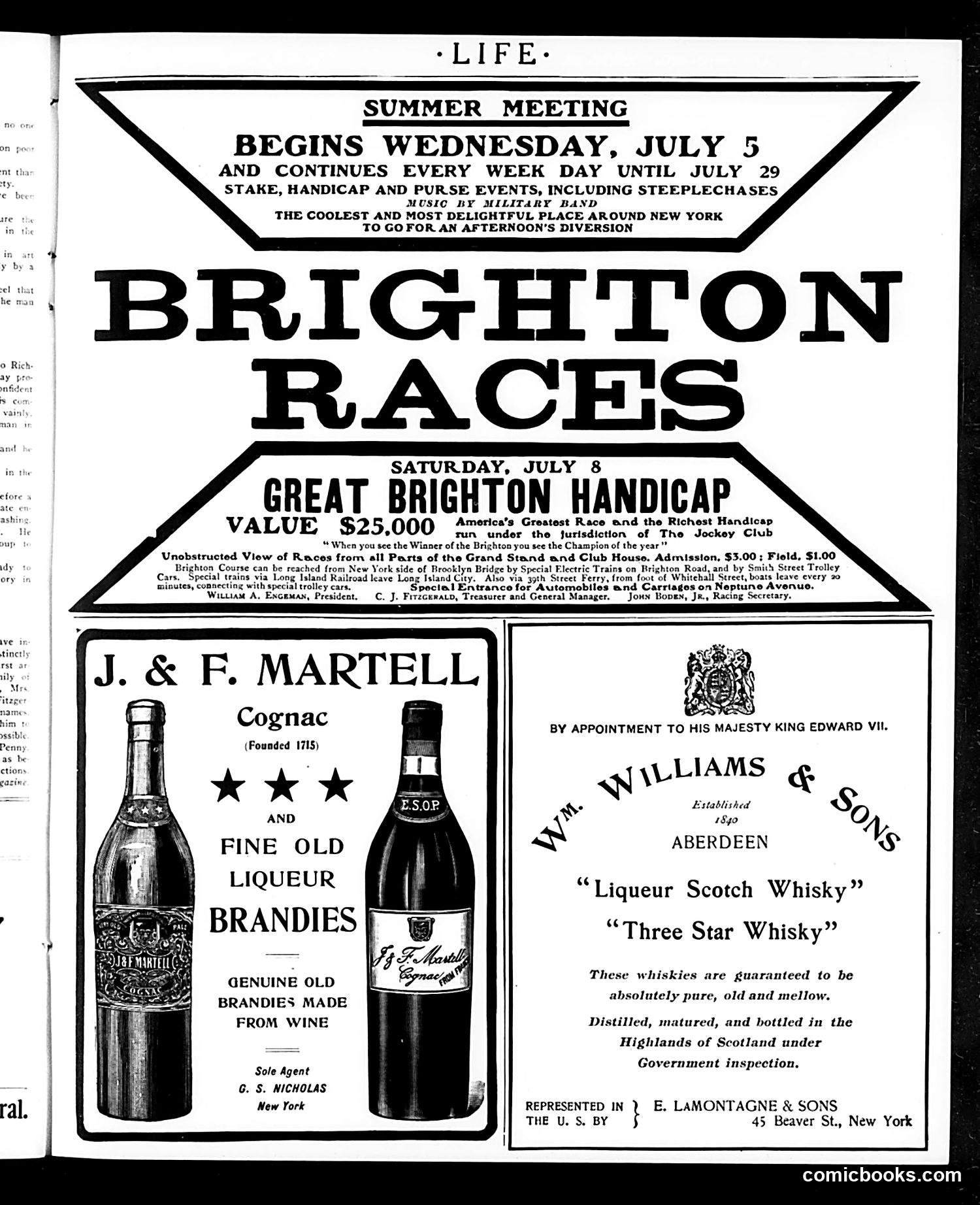
This is primarily a **commercial advertisement page**, not satire. It promotes the Brighton Beach Racetrack's summer racing season (July 5-29) and a major event—the Great Brighton Handicap horse race on July 8, worth $25,000. The page includes practical details: admission prices ($3 general, $1 field), transportation options (electric trains, trolleys, ferries from Brooklyn and Manhattan), and track officials' names. Below the racing promotion are **product advertisements**: J. & F. Martell cognac (founded 1715, with royal appointment) and Wm. Williams & Sons Scottish whisky (established 1840, sold in New York). Both emphasize quality and authenticity—the whisky is "guaranteed pure" and "distilled, matured, and bottled in the Highlands of Scotland under Government inspection." The page reflects **early 20th-century leisure culture** where horse racing was a major entertainment destination accessible by public transit.
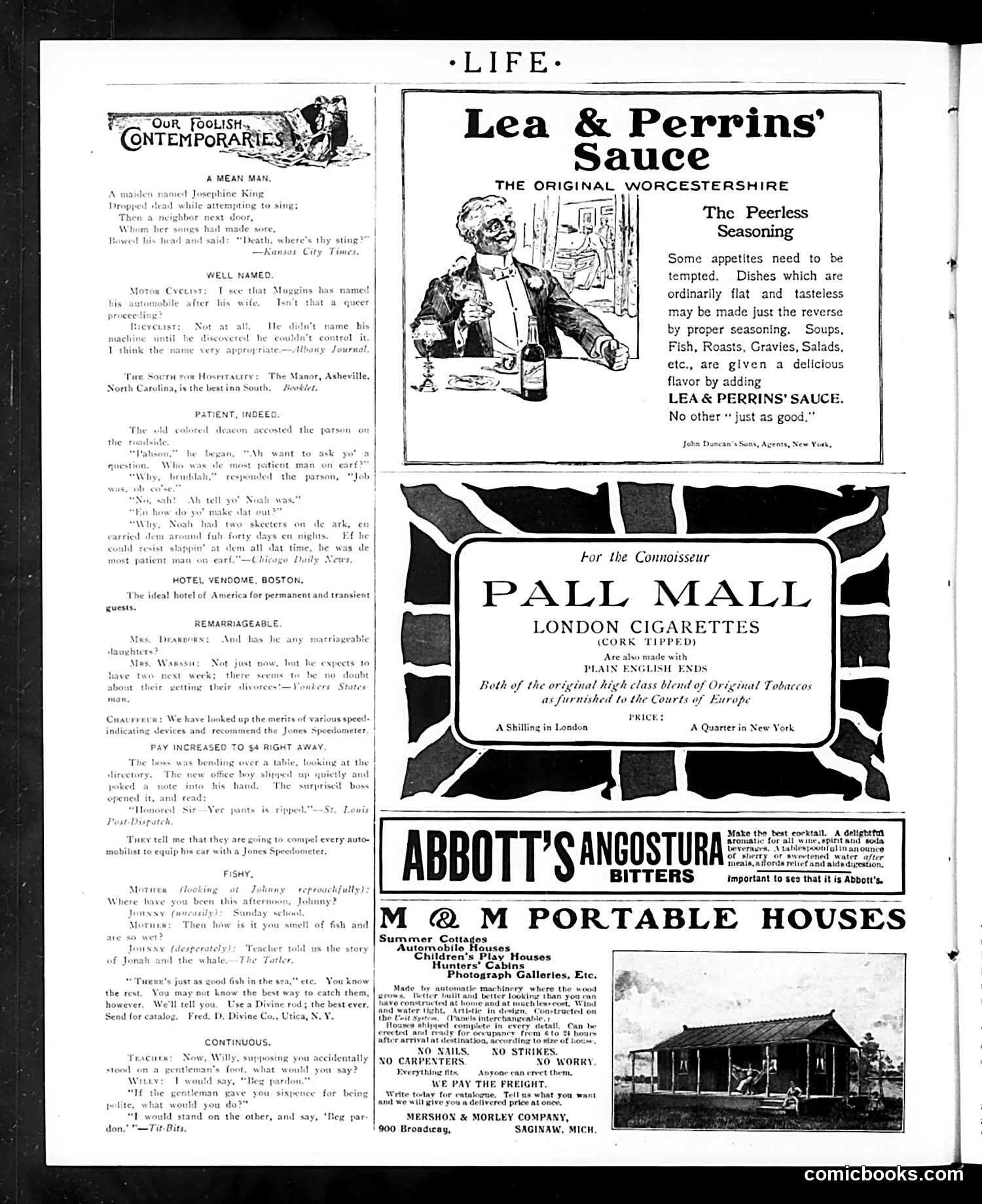
This page from *Life* magazine consists primarily of **advertisements and brief humor snippets**, rather than sustained political cartoons. The left column contains short satirical anecdotes labeled "Our Foolish Contemporaries"—brief jokes mocking various social types: a mean man who dies singing, someone with an aptly ironic surname, an overly patient man, and absurd modern scenarios (like equipping an automobile with specialized equipment, or someone claiming fishing expertise while smelling of fish). The right side features **product advertisements**: Lea & Perrins' Worcestershire sauce, Pall Mall cigarettes, Abbott's bitters, and M&M portable houses. These ads use period-appropriate marketing language emphasizing quality and sophistication ("For the Connoisseur"). The satire here is gentle and observational rather than politically pointed—humor derived from everyday human foibles and social pretension typical of early 20th-century American magazine humor. The page reflects *Life*'s role as both satirical publication and advertising vehicle.
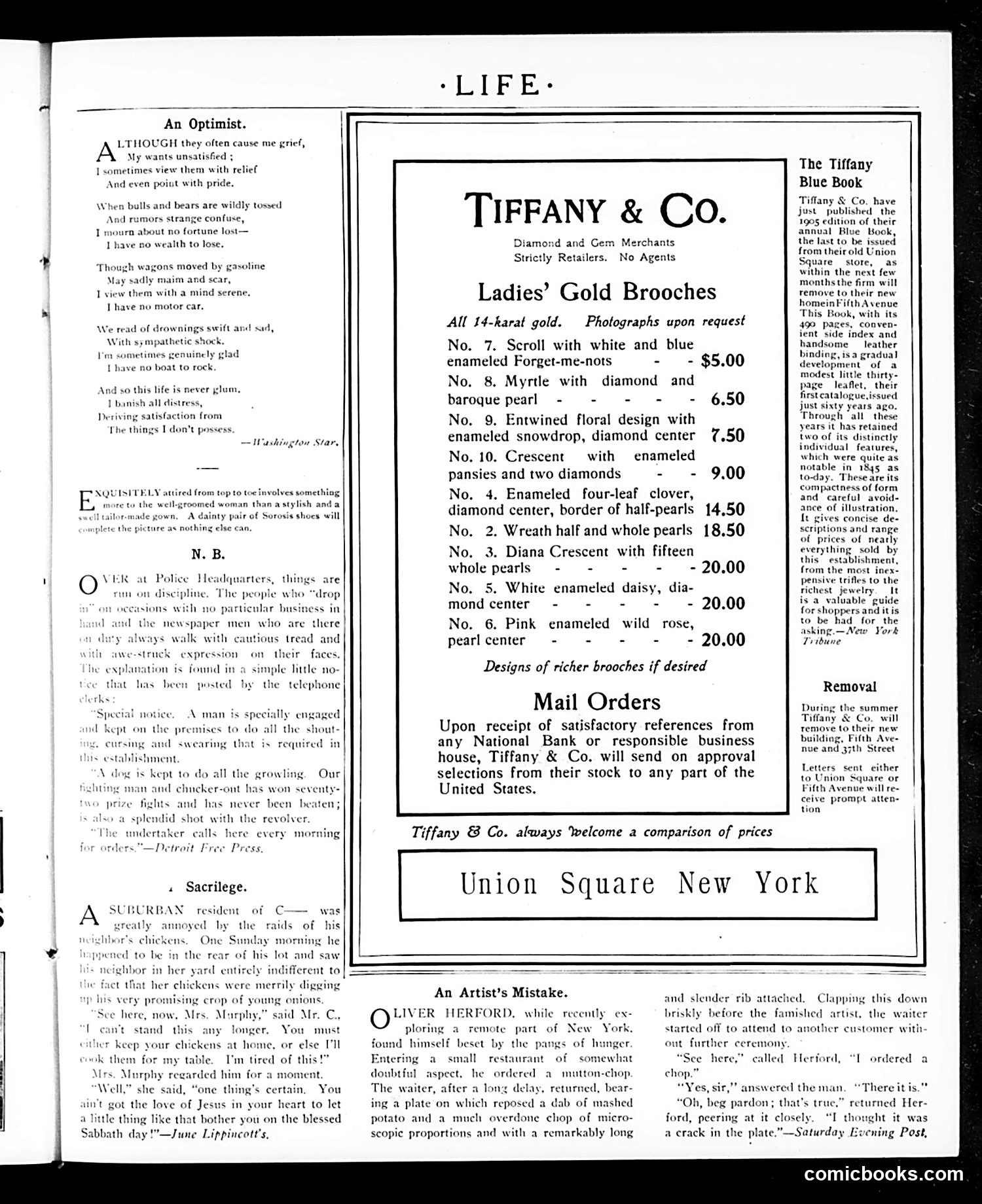
This page is primarily **advertising and literary content** rather than political satire. The left side contains three short humorous pieces: "An Optimist" (a poem about finding silver linings despite modern anxieties like stock market crashes and automobiles), "Over Police Headquarters" (satirizing police station discipline), and "Sacrilege" (an anecdote about a suburban resident annoyed by a neighbor's chickens). The right side is dominated by a **Tiffany & Co. advertisement** for ladies' gold brooches priced $5-$20, along with promotional text about their mail-order service and upcoming relocation from Union Square to Fifth Avenue. The content reflects early 1900s middle-class concerns: financial uncertainty, automobile anxiety, and luxury consumer goods. The humor is gentle and domestic rather than pointed political satire. This appears to be a typical Life magazine page blending entertainment with commercial advertising.
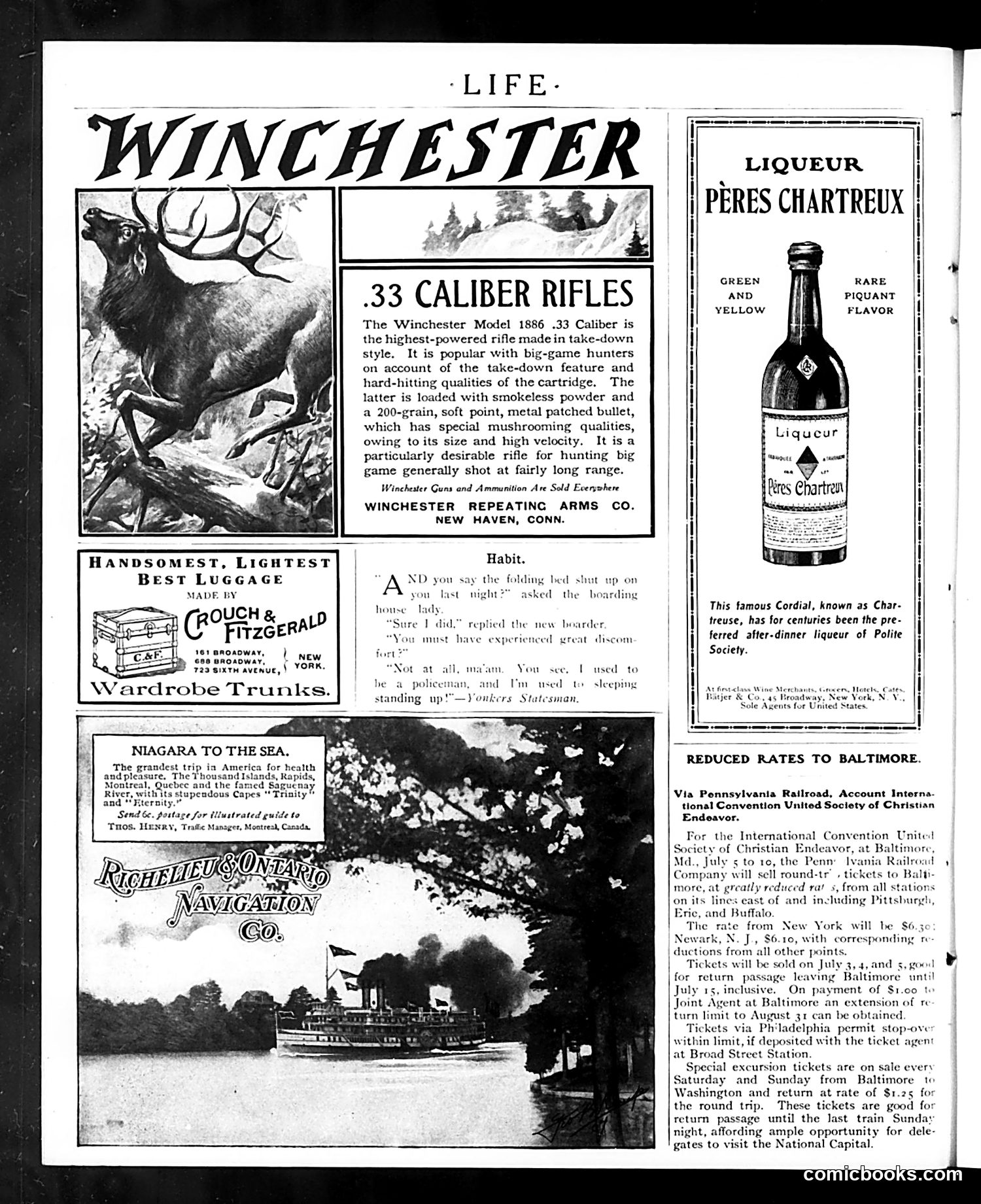
This page is primarily **advertising**, not political satire. It contains four distinct ads: 1. **Winchester .33 Caliber Rifles** — promotes the Model 1886 rifle for big-game hunters, emphasizing its take-down feature and power. 2. **Crouch & Fitzgerald Luggage** — advertises "handsome, lightest" travel trunks. 3. **A brief humorous anecdote** titled "Habit" — a mild joke about a new boarder who admits to sleeping standing up, implying he's a former policeman accustomed to the habit. 4. **Richilieu & Ontario Navigation Co.** — promotes the "grandest trip in America" via Niagara to the Sea, featuring a steamboat image. 5. **Liqueur Pères Chartreux** — advertises French cordial as a preferred after-dinner drink of polite society. 6. **Pennsylvania Railroad Baltimore excursion rates** — reduced fares for the International Convention of the United Society of Christian Endeavor. There is no political cartoon here. The page reflects early 1900s consumer advertising and leisurely travel culture.
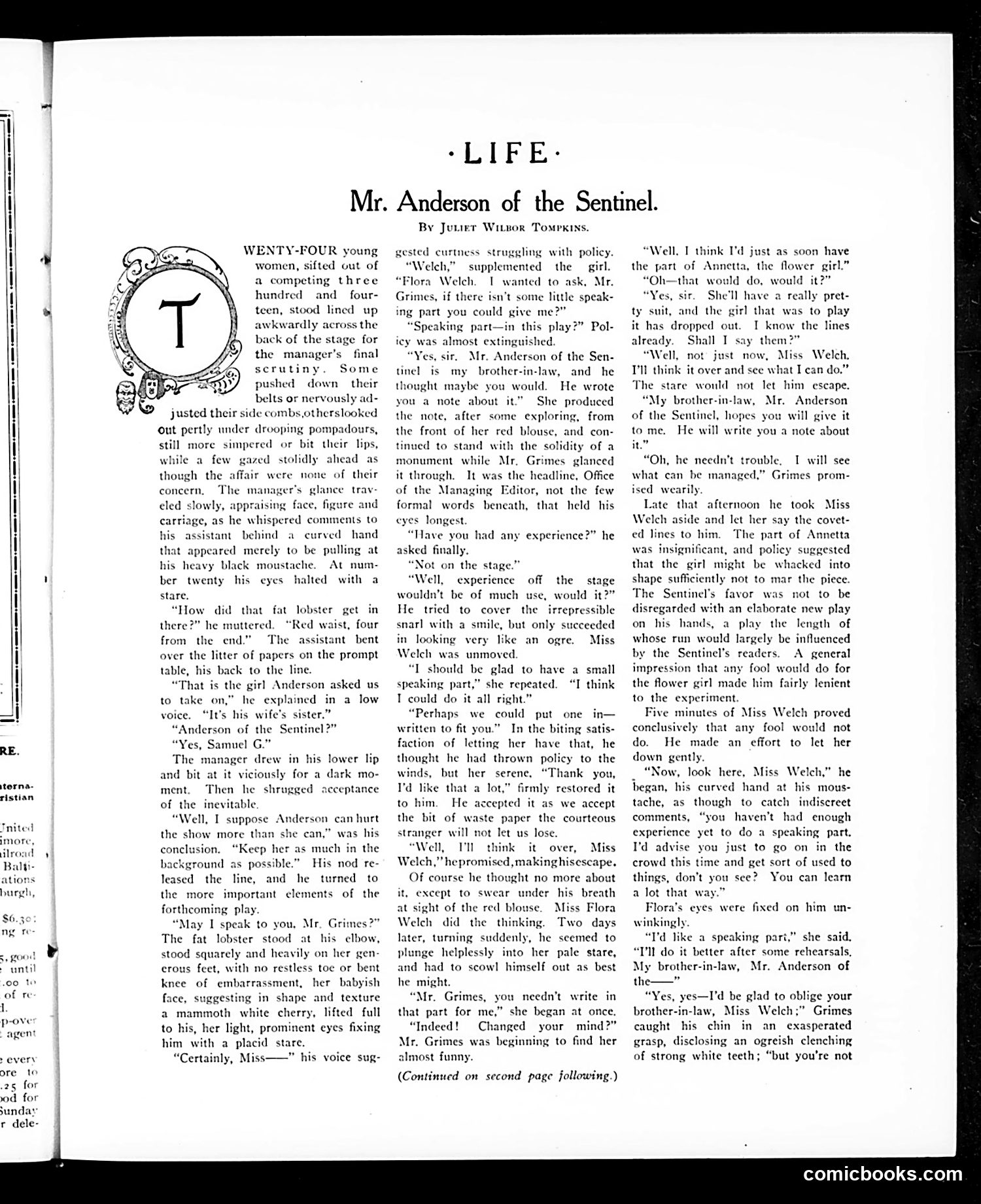
This is the opening installment of a serialized short story (marked "Continued on second page following"). The narrative concerns theater casting politics in what appears to be the early 1900s. The plot: A theater manager reluctantly hires Flora Welch, an unattractive young woman with no stage experience, because her brother-in-law is Samuel G. Anderson—apparently an influential newspaper editor at the Sentinel. The manager fears Anderson's editorial power and accepts Welch to avoid negative press coverage, even as he's visibly disgusted by her appearance ("fat lobster"). The satire targets **newspaper influence over business decisions** and the coercive power of media criticism. Anderson hasn't personally pressured the theater; his mere editorial position makes others preemptively accommodate his family members. The story likely explores whether Welch will succeed or fail despite her obvious unsuitability—a commentary on nepotism and editorial power in the era.
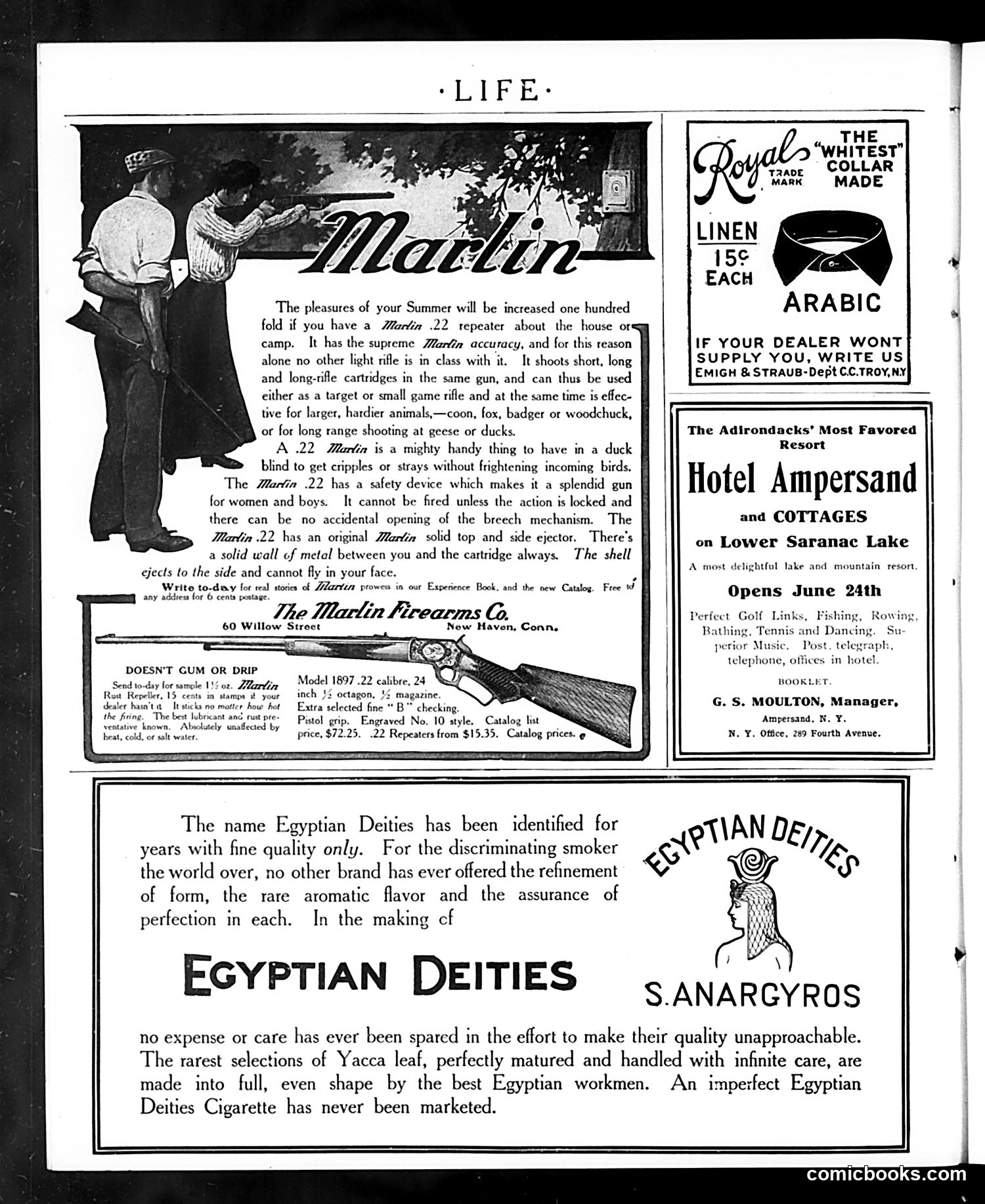
This page is primarily **advertising**, not satire or political commentary. It contains four distinct product advertisements from the early 20th century: 1. **Marlin .22 Rifle**: Marketed as versatile for hunting (small and large game, waterfowl) and notably as "a splendid gun for women and boys" due to its safety features—reflecting period gender assumptions about who used firearms. 2. **Royals Linen**: Budget offering (15¢) for Arabic linen cloth. 3. **Hotel Ampersand**: Resort advertisement for Adirondack lodging, opening June 24th, emphasizing leisure activities (golf, fishing, tennis, dancing). 4. **Egyptian Deities Cigarettes**: Luxury cigarette brand emphasizing quality and hand-crafted Egyptian tobacco, targeting "discriminating smokers." The page reflects early 1900s consumer culture and period attitudes (women as gun users needing safety features, luxury goods marketing). There is **no identifiable political cartoon or satire present**—this is straightforward commercial promotion.
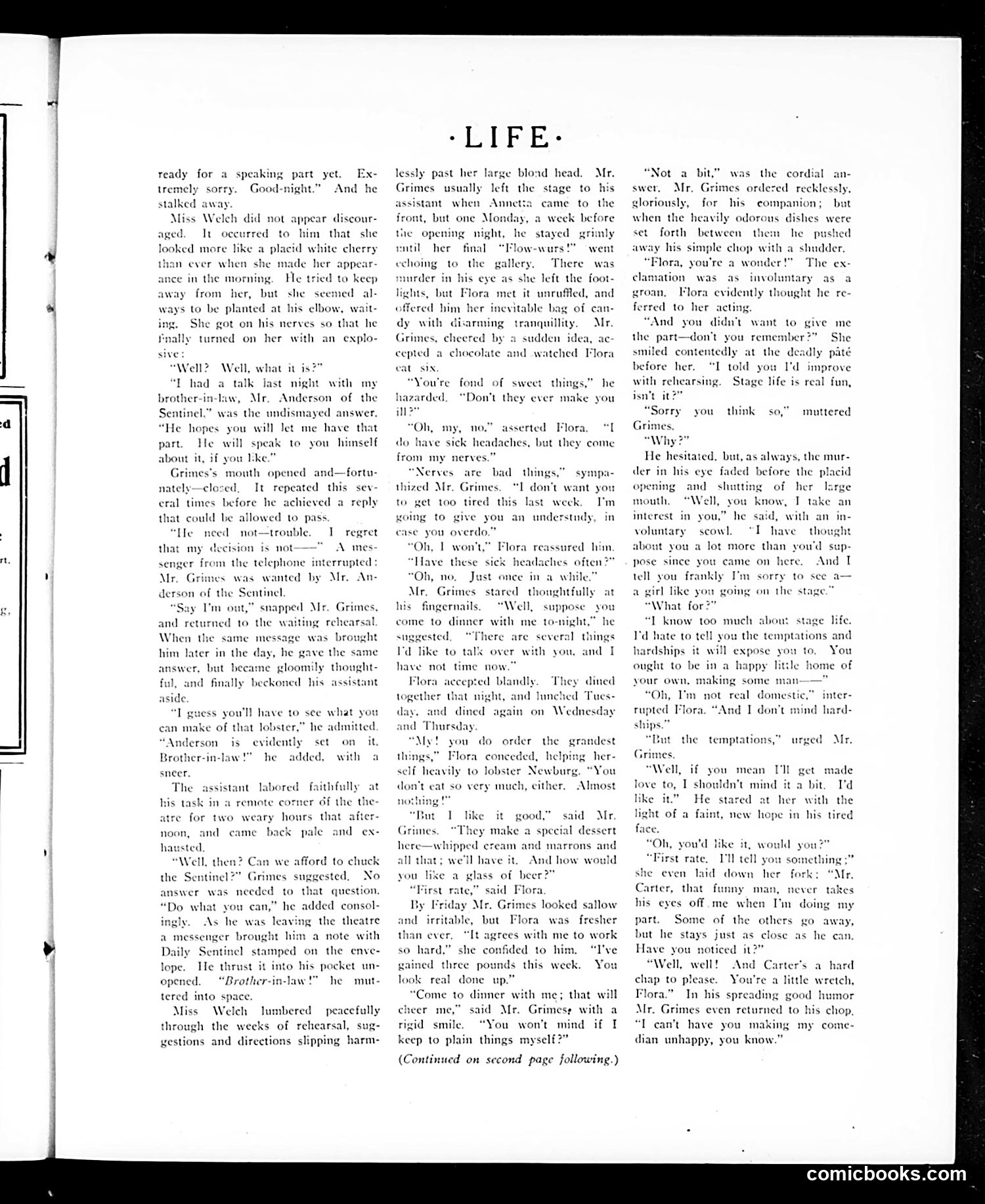
This page contains no political cartoon. Instead, it's a serialized short story titled "Life" depicting workplace dynamics in early 20th-century theater. The narrative concerns Mr. Grimes, a theater director, and Miss Welch (Flora), an actress seeking a stage role. Her brother-in-law, connected to the newspaper *Sentinel*, pressures Grimes for her advancement. Grimes resists the nepotistic request but eventually capitulates, casting Flora in the production. The satire targets **newspaper influence peddling** and **theatrical nepotism**—common social irritants of the era. Grimes's reluctant capitulation to media pressure (represented by the Sentinel reference) satirizes how newspapers wielded social power. The story also gently mocks Flora's naive persistence and Grimes's transparent attempts at manipulation through expensive dinners and attention. The humor derives from character dynamics and social observation rather than visual caricature, reflecting Life's dual identity as both satirical and literary publication.
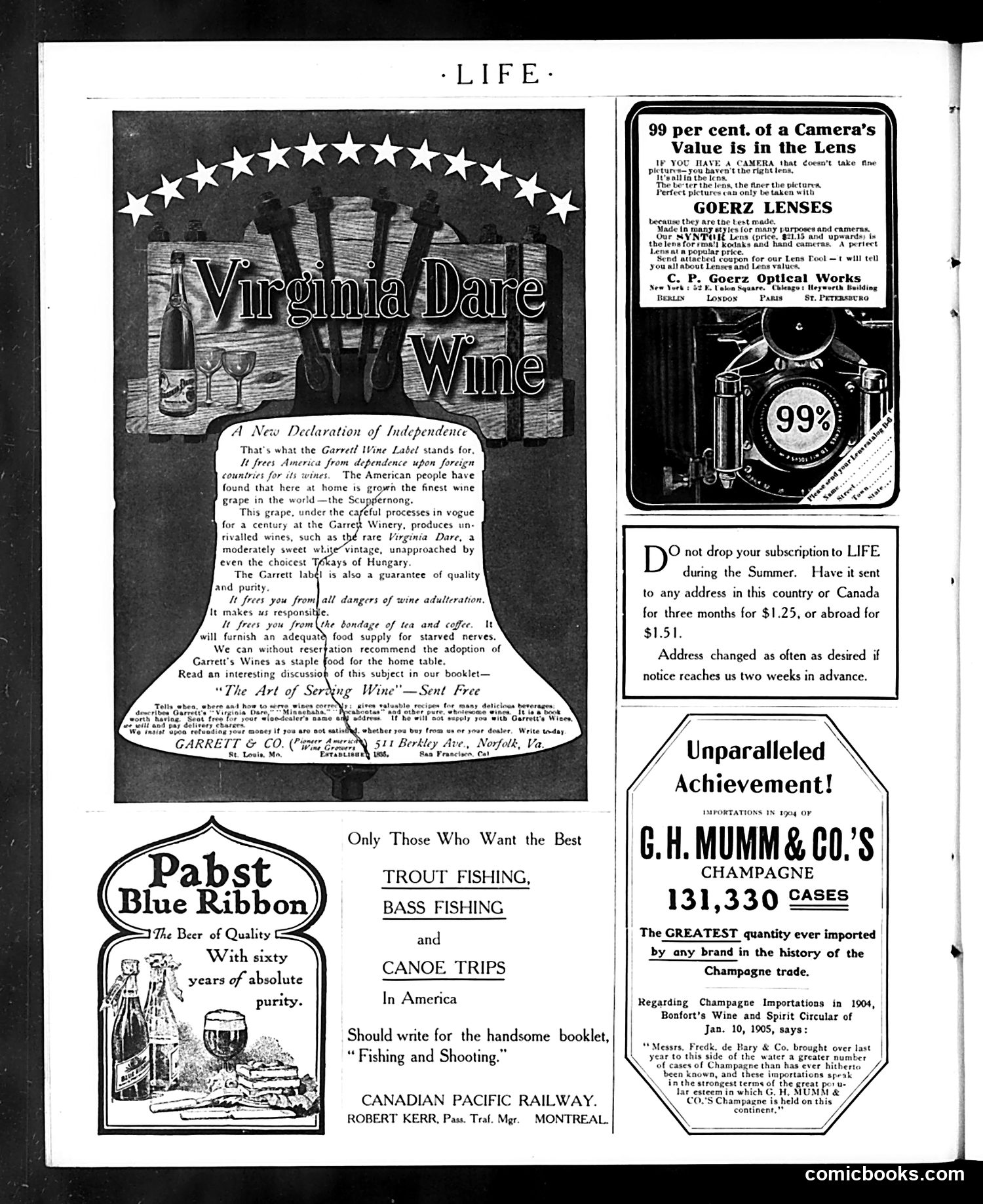
This is primarily a **advertisements page**, not a political cartoon. The main content features several product ads from the early 1900s. The dominant advertisement uses patriotic imagery—a "Declaration of Independence" framing—to market **Garrett's Virginia Dare wine** as an American product, positioning domestic wine as preferable to imported foreign wines. This reflects **turn-of-the-century American protectionism and nationalism**, appealing to consumers to support homegrown goods. The other ads promote **Pabst Blue Ribbon beer**, **Goerz camera lenses**, **Canadian Pacific Railway** travel packages, and **G.H. Mumm champagne**. The Mumm ad boasts of record 1904 importation volumes, ironically appearing alongside the nationalist wine advertisement. The page represents typical **Life magazine advertising practice**—mixing product promotions with editorial content. There is no satirical editorial cartoon visible; the "satire" operates subtly through the patriotic wine ad's rhetoric, which seems tongue-in-cheek about American independence applied to commercial products.
This page contains a serialized comedic short story (not a political cartoon) satirizing theatrical ambition and romantic melodrama circa early 1900s. **The Setup:** Flora, a stage-struck young woman, has attracted Mr. Carter, a comedian in her theatrical production. Carter claims he has "principles" against loving actresses. Flora's boss Mr. Grimes watches this romance develop with amusement. **The Satire:** The humor targets Flora's transparent self-delusion. She dramatically announces she'll *sacrifice* her budding romance to pursue her theatrical career—presenting herself as nobly dedicated to art. Yet the text reveals she's actually manipulating the situation for romantic attention while maintaining her stage position. Carter appears genuinely heartbroken; Flora remains self-absorbed. **The Point:** Life mocks the pretentious moral posturing of aspiring actresses who claim artistic integrity while actually pursuing personal advantage. Flora gets both the romance *and* her career, while congratulating herself on noble sacrifice. The story satirizes theatrical vanity and the gap between how people rationalize their selfish choices versus reality. This represents turn-of-century American magazine satire targeting show-business culture.
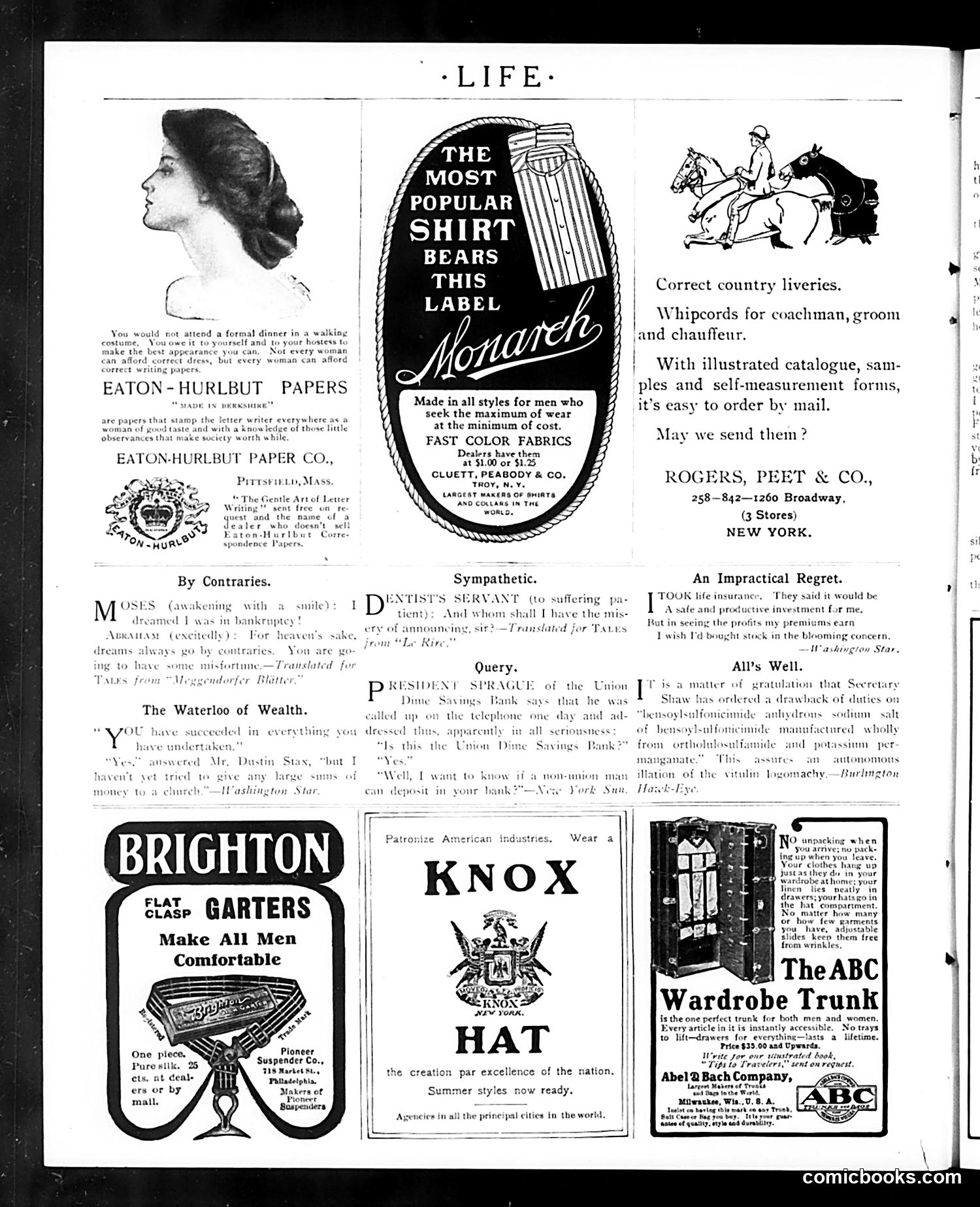
This is primarily an **advertising page** from Life magazine, with several small satirical humor pieces interspersed. The main content consists of product advertisements (Eaton-Hurlbut Papers, Monarch Shirts, Brighton Garters, Knox Hats, ABC Wardrobe Trunk, Rogers Peet clothing) typical of early 20th-century magazines. The humor pieces are brief vignettes: - **"By Contraries"**: A man dreams he's bankrupt, then wakes relieved—ironic contrast. - **"Sympathetic"**: A dentist's servant mistranslates the patient's name to the dentist. - **"The Waterloo of Wealth"**: A wealthy man claims success in everything, but hasn't given money to charity—satirizing hypocrisy. - **"Query"**: A bank president calls about union labor eligibility—likely commenting on labor disputes of the era. - **"An Impractical Regret"**: Someone regrets not buying life insurance after seeing profits—satirizing short-sighted financial thinking. These are light, domestic humor pieces typical of Life's satirical approach to contemporary social and economic concerns.
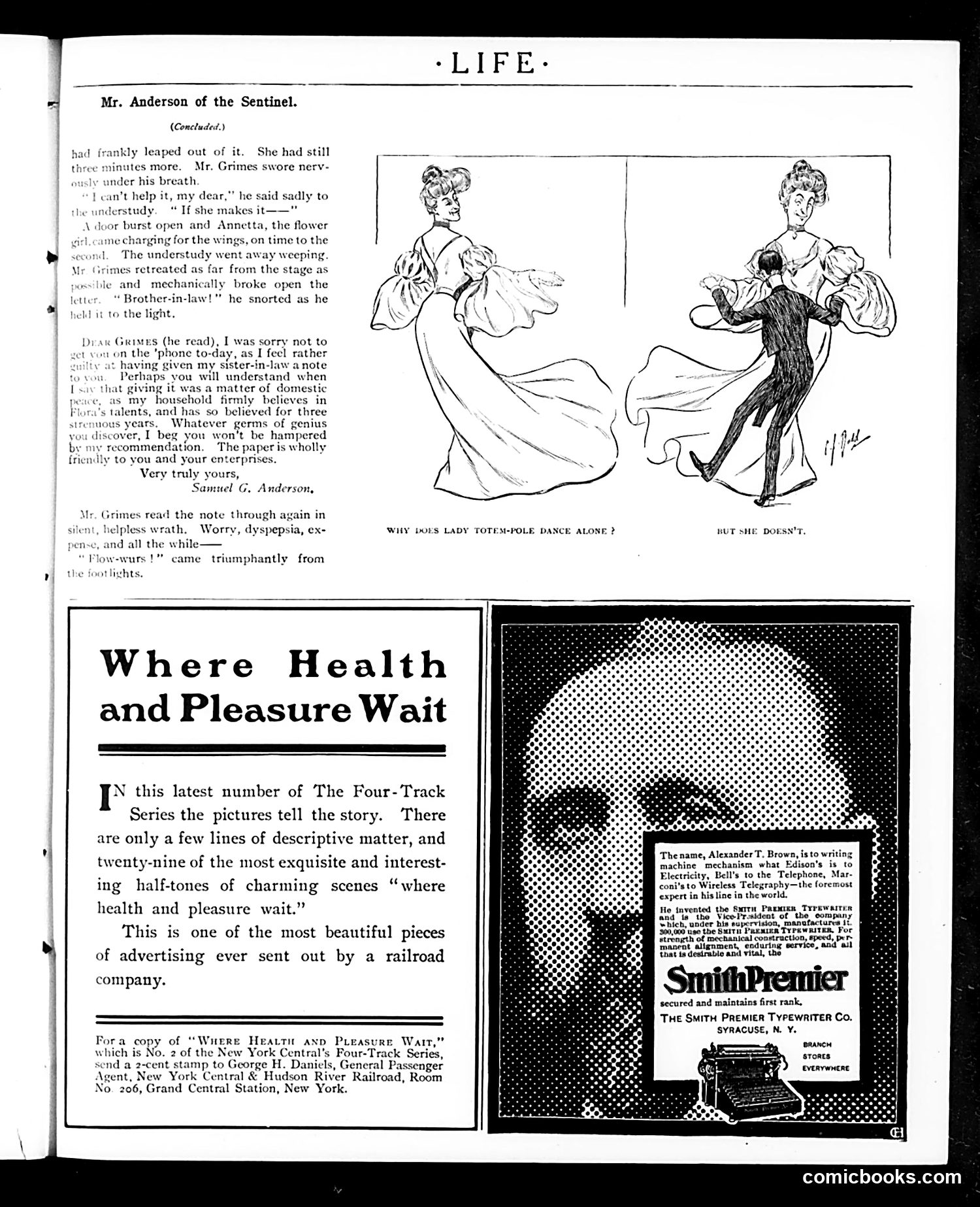
This page contains two unrelated items: **Top cartoon:** A domestic comedy sketch concluding a serialized story about theatrical mishaps. The humor involves Mr. Grimes discovering his understudy has sabotaged a performance, with a letter from "Mr. Anderson of the Sentinel" (a newspaper critic) adding complications about the family's reputation. The joke plays on backstage drama and marital tension typical of early-20th-century magazine humor. **Bottom section:** Railroad and typewriter advertisements. The New York Central & Hudson River Railroad promotes its "Four-Track Series" brochure emphasizing leisure travel ("Where Health and Pleasure Wait"). Below that, the Smith-Premier Typewriter Company advertises their product, claiming Alexander T. Brown as their expert inventor—comparable to Edison or Bell. Both ads reflect Gilded Age consumer culture marketing technological progress and comfort to middle-class readers. The page is primarily advertising-driven, with the cartoon serving as entertainment content to surround commercial pitches.
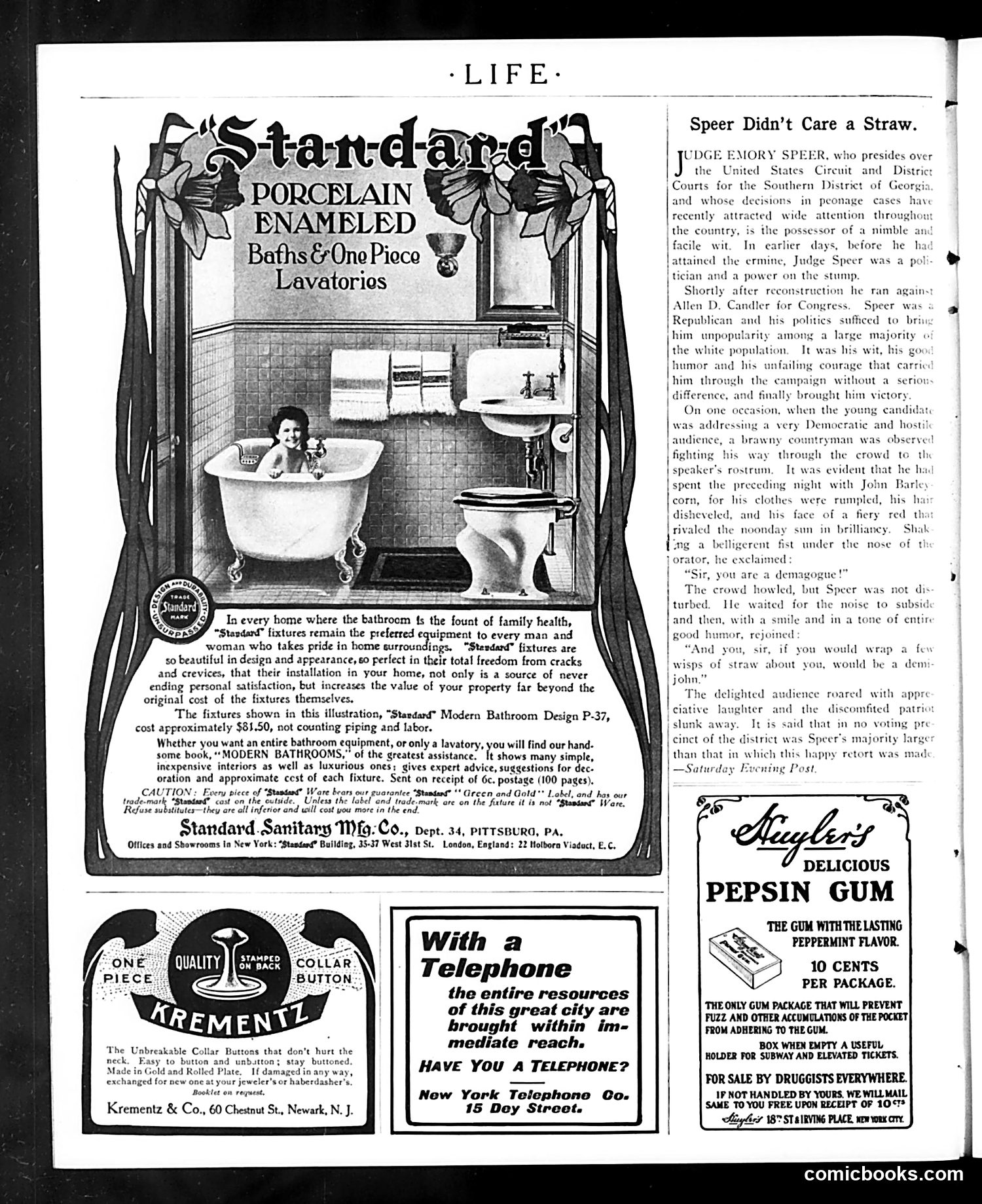
This article recounts a campaign story about **Judge Emory Speer**, a federal judge in Georgia's Southern District who presided over important peonage cases. The narrative describes his 1870s congressional race against Democrat Allen D. Candler, when Speer, a Republican, faced unpopularity among white voters due to his party affiliation. The anecdote illustrates Speer's political skill: during a speech to a hostile Democratic audience, a drunk heckler confronts him aggressively. Rather than escalate, Speer deflates the situation with wit, suggesting the man wrap straw around himself to become a "demijohn" (large bottle). The crowd laughs at the heckler instead of supporting him, and the story concludes that this incident increased Speer's support in that district. The piece celebrates Speer's intelligence and composure as political assets during Reconstruction—using humor to neutralize opposition rather than confrontation.
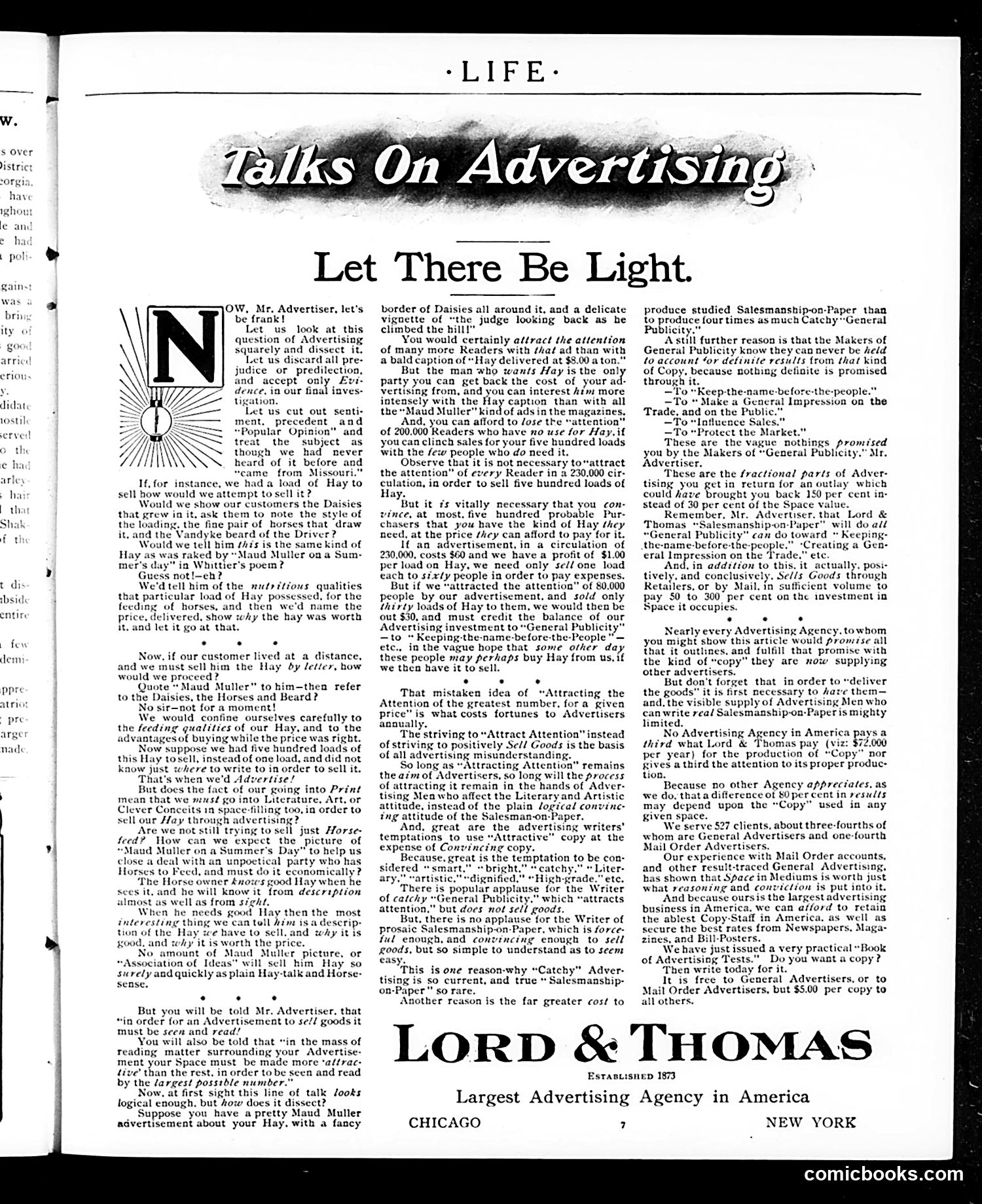
This page is primarily **advertising content disguised as editorial advice**, written by Lord & Thomas, a major advertising agency (established 1873). The piece uses satire and common-sense argument to defend straightforward, product-focused advertising against ornamental or "artistic" approaches. The author ridicules elaborate advertising aesthetics—specifically referencing John Greenleaf Whittier's poem "Maud Muller" as an example of sentimental decoration that distracts from selling. The central argument: when selling hay, focus on **nutritional value and price**, not poetic imagery or decorative borders featuring daisies and judges. The satire targets advertising practices that prioritize "attracting attention" from large audiences over converting actual buyers. The author contends that persuading 500 people who *need* hay matters more than impressing 200,000 who don't. Essentially, this is an **early articulation of direct-response advertising principles**—speak to your actual customer base, not the masses—wrapped in humorous criticism of wasteful, ornamental ad design.
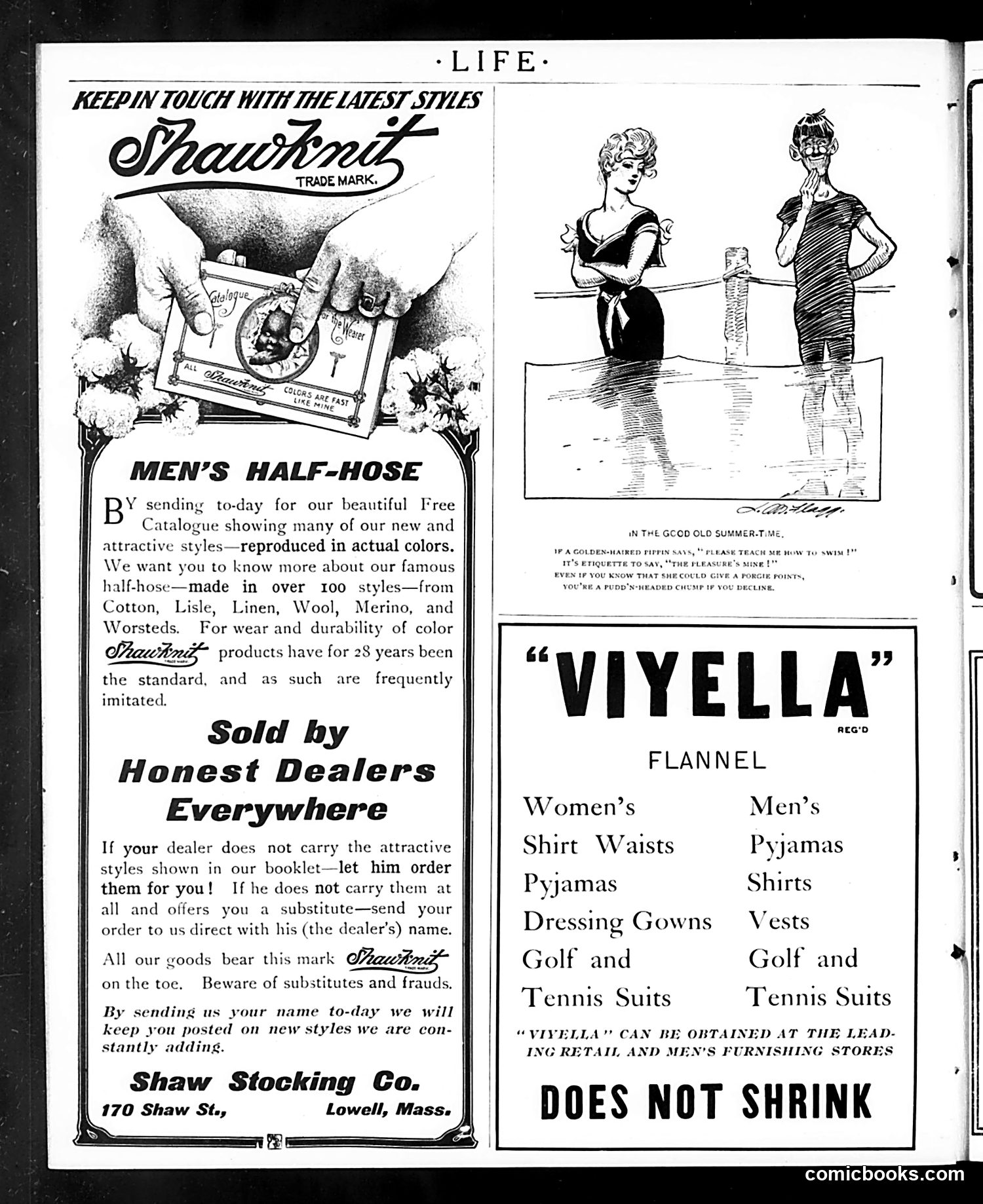
This page consists entirely of **advertisements**, not satire or editorial content. The left side advertises **Shawknit brand men's half-hose** (socks) from Shaw Stocking Co. in Lowell, Massachusetts. The pitch emphasizes durability and color-fastness over 28 years, warns against counterfeits, and encourages ordering from their catalog. The top right contains a **single-panel cartoon** (unattributed) depicting two women in a swimming scene. The caption references a "golden-haired pippin" (attractive young woman) offering swimming instruction, with crude dialogue about cowardice. The joke appears to concern social embarrassment or reluctance around swimming/bathing—likely a genteel satire on Victorian propriety around public swimming. The bottom right advertises **Viyella brand flannel garments**—women's and men's clothing including pajamas, shirts, and athletic wear. The key selling point: the fabric "does not shrink." All three items—socks, the cartoon, and flannel—reflect early 20th-century consumer goods and social attitudes, with no apparent connection between them beyond shared page placement.
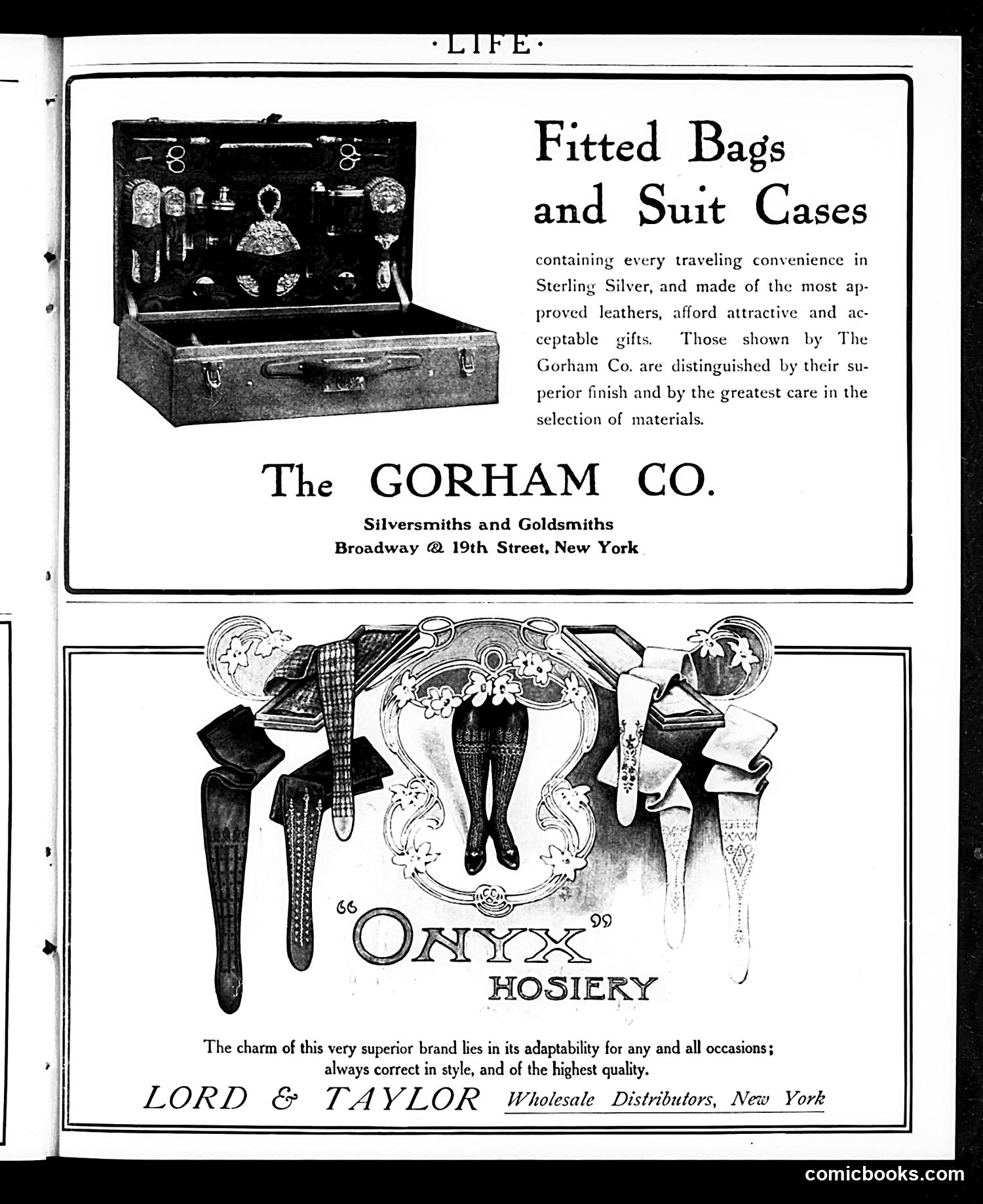
This is a page of **advertisements**, not satire or political cartoons. It contains two luxury product ads from what appears to be an early 20th-century *Life* magazine: 1. **Top ad**: The Gorham Co. advertises fitted traveling bags and suit cases made with sterling silver and leather—positioned as luxury gifts for the wealthy. 2. **Bottom ad**: Onyx brand hosiery, distributed by Lord & Taylor, emphasizes quality and style for "any and all occasions." Both ads target affluent consumers seeking high-end goods. The imagery—ornate leather cases, elegant women's stockings—reflects period luxury marketing. There is no political satire or social commentary present; this is straightforward commercial advertising typical of *Life* magazine's business model during this era.
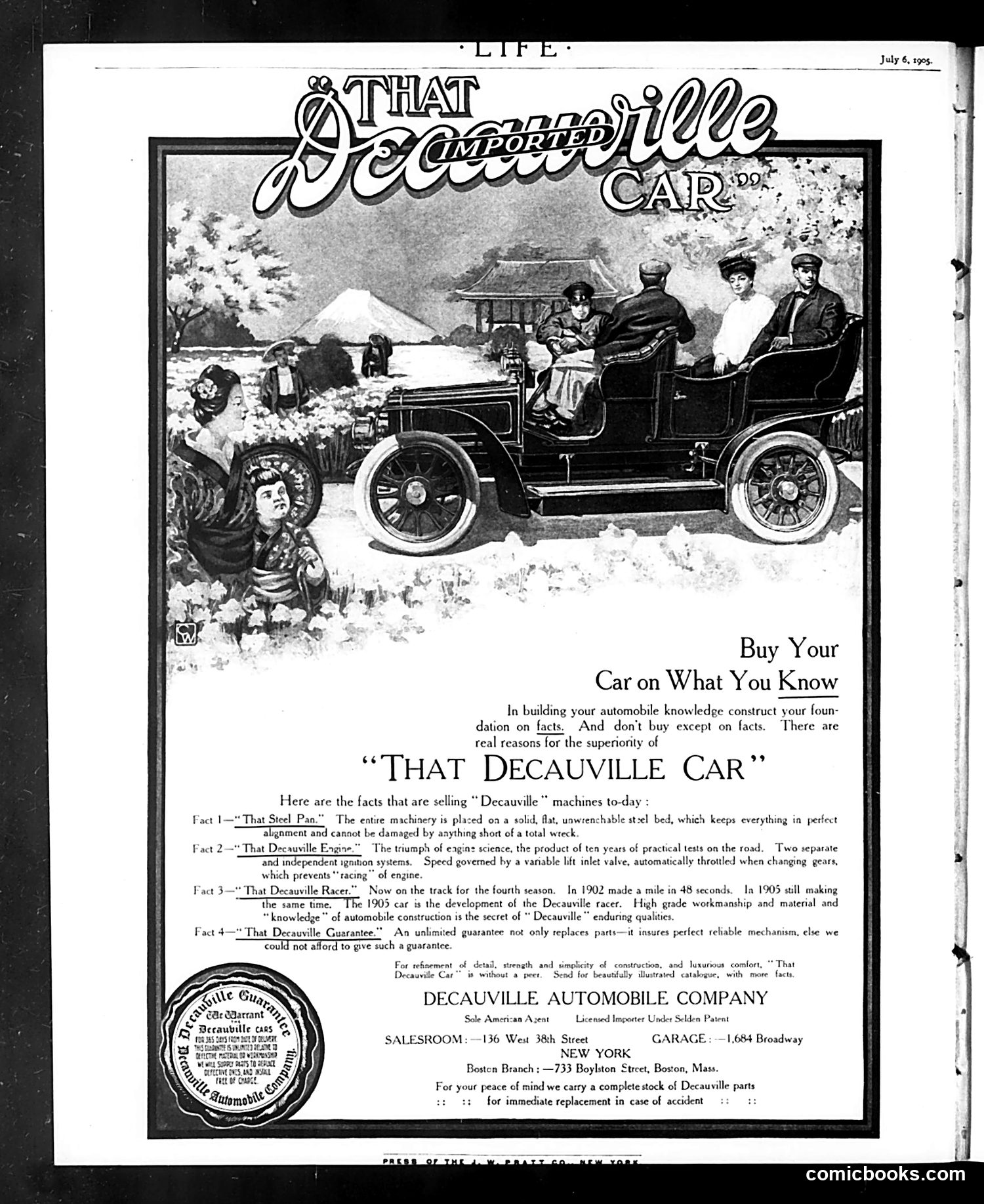
This is primarily a **car advertisement**, not satire. Published in *Life* magazine (July 6, 1905), it promotes the Decauville, a French imported automobile. The illustration shows an elegant touring car carrying well-dressed passengers through a snowy landscape with Mount Fuji in the background—suggesting the car's sophisticated, international appeal and reliability in challenging conditions. The "facts" listed are marketing claims emphasizing engineering superiority: a steel frame, dual ignition systems, racing heritage (noting a 1902 speed record still unbeaten in 1905), and an unlimited guarantee. The slogan "Buy Your Car on What You Know" appeals to rational, fact-based purchasing rather than impulse. The Selden Patent reference is significant: Selden held a monopoly patent on automobiles, and being "licensed" under it was a major selling point legitimizing the vehicle legally. This represents early automotive advertising targeting affluent, educated consumers during the industry's infancy.