
Life, 1905-07-06 · page 33 of 44
Life — July 6, 1905 — page 33: what you’re looking at
What you’re looking at
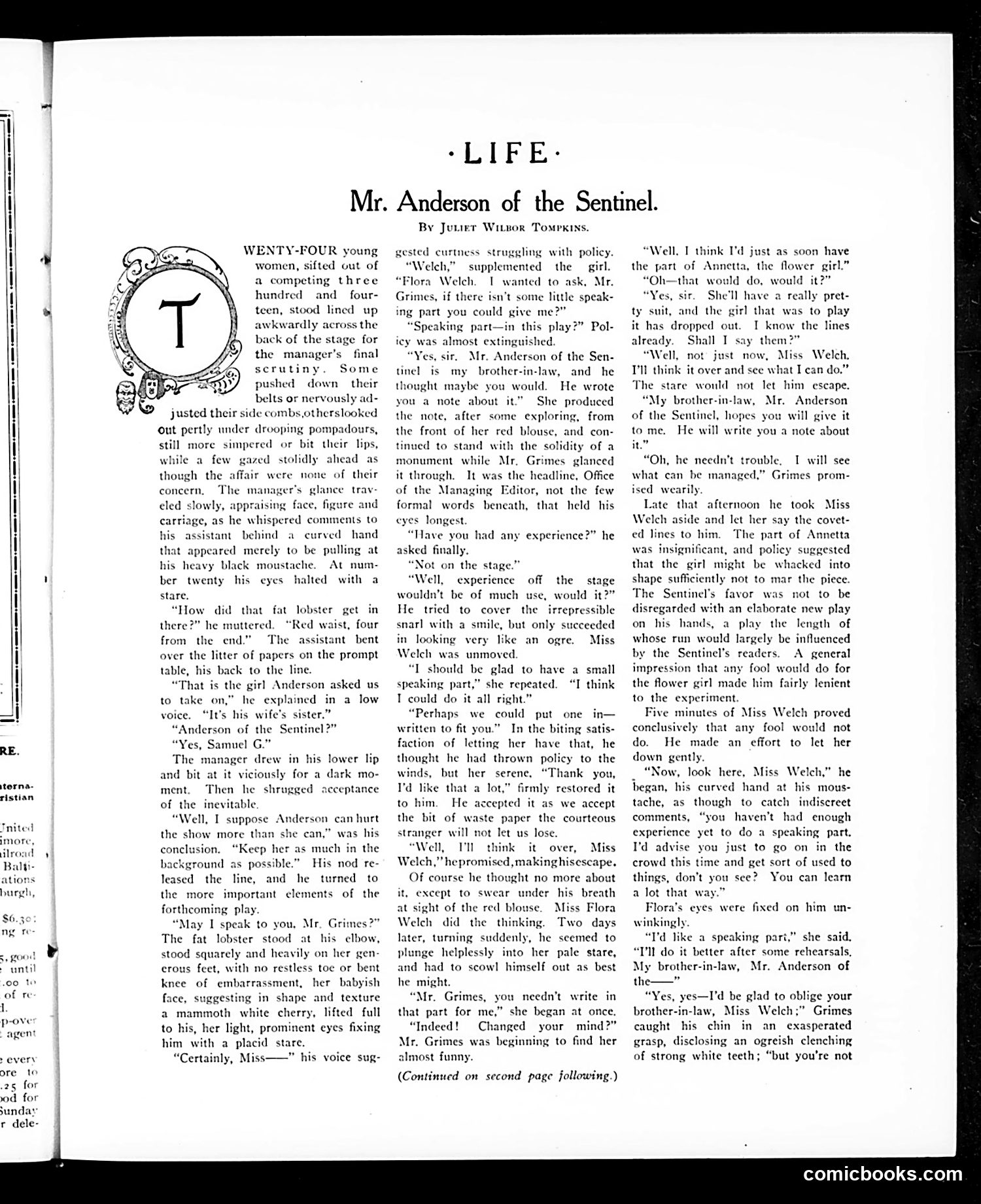
This is the opening installment of a serialized short story (marked "Continued on second page following"). The narrative concerns theater casting politics in what appears to be the early 1900s. The plot: A theater manager reluctantly hires Flora Welch, an unattractive young woman with no stage experience, because her brother-in-law is Samuel G. Anderson—apparently an influential newspaper editor at the Sentinel. The manager fears Anderson's editorial power and accepts Welch to avoid negative press coverage, even as he's visibly disgusted by her appearance ("fat lobster"). The satire targets **newspaper influence over business decisions** and the coercive power of media criticism. Anderson hasn't personally pressured the theater; his mere editorial position makes others preemptively accommodate his family members. The story likely explores whether Welch will succeed or fail despite her obvious unsuitability—a commentary on nepotism and editorial power in the era.
📄 Transcribed text from this page (OCR, searchable)
Machine-transcribed from the original scan — historical spelling and the odd misread are preserved.
torna- ristian Tnited more, ilroad Balti- ations burgh, p-ove agent ry Dre 10 25 for 0d for sunday’ r dele- “LIFE: Mr. Anderson of the Sentinel. WENTY-FOUR young women, sifted out of a competing three hundred and four- teen, stood lined up awkwardly across the back of the stage for the manager’s final scrutiny. Some pushed down their belts or nervously ad- justed their side combs ,otherslooked out pertly under drooping pompadours, still more simpered or bit their lips, wh few gazed stolidly ahead as though the affair were none of their concern, lance trav: sing face, fi The manager's eled slowly, app carriage, as he whispered comments to ¢ and his assistant’ behind a curved hand that appeared merely to be pulling at his heavy black moustache. At num- ber twenty his eyes halted with a stare, “How did that fat lobster get in there?” he muttered. “Red waist, four from the end.” The assistant bent over the litter of papers on the prompt table, his back to the line. “That is the girl Anderson asked us to take on,” he explained in a low voice. “It’s his wife's sister.” “Anderson of the Sentinel?” “Yes, Samuel G.” The manager drew in his lower lip and bit at it viciously for a dark mo- ment. Then he shrugged acceptance of the inevitable. “Well, I suppose Anderson can hurt the show more than she can,” was his conclusion. “Keep her as much in the background as possible.” His nod re- leased the line, and he turned to the more important clements of the forthcoming play. Jay I speak to you, Mr. Grim: The fat lobster stood at his elbow, stood squarely and heavily on her gen- crous feet, with no restless toe or bent knee of embarrassment, her babyish face, suggesting in shape and texture a mammoth white cherry, lifted full nis, her light, prominent eyes fixing him with a placid stare. “Certainly, Miss——” his voice sug- By Jurier Wituor Tosrxins. gested curtness struggling with policy. “Welch,” supplemented the — girl. Flora Welch. I wanted to ask, Mr. Grimes, if there isn’t some little speak- ing part you could give m ‘Speaking part—in this pl: icy was almost extinguished. s, sir. Mr. Anderson of the Sen- tine) is my brother-in-law, and he thought maybe you would. He wrote you a note about it.” She produced the note, after some exploring, from the front of her red blouse, and con- tinued to stand with the solidity of a monument while Mr, Grimes glanced it through. It was the headline, Office of the Managing Editor, not the fe formal words beneath, that held his ” Pol- longest “Have you had any experience?” he asked finally. “Not on the stage.” “Well, experience off the stage wouldn't be of much use, would it?” He tried to cover the irrepressible snarl with a smile, but only succeeded in looking very like an ogre. Miss Welch was unmoved. “IT should be glad to have a small speaking part,” she repeated. “I think T could do it all right.” “Perhaps we could put one in— written to fit you.” In the biting satis- faction of letting her have that, he thought he had thrown policy to the winds, but her serene, “Thank you, I'd) that a lot,” firmly restored it to him. He accepted it as we accept the bit of waste paper the courteous stranger will not let us lose. “Well, I'll think it over, Miss Welch,” hepromised,making hisescape. Of course he thought no more about it, except to swear under his breath at sight of the red blouse. Miss Flora Welch did the thinking. Two days later, turning suddenly, he seemed to plunge helplessly into her pale stare, and had to scowl himself out as best he might. “Mr. Grimes, you needn't write in that part for me,” she began at once, “Indeed! Changed your mind?” Mr. Grimes was beginning to find her almost funny. (Continued on second page following.) “Well, I think I'd just as soon have the part of Annetta, the flower girl.” “Oh—that would do, would it?” “Yes, sir. She'll have a really pret- ty suit, and the girl that was to play it has dropped out. I know the lines already. Shall I say them?” “Well, not just now, Miss Welch, I'll think it over and see what I can do.” The stare would not let him escape. “My brother-in-law, Mr. Anderson of the Sentinel, hopes you will give it to me. He will write you a note about it.” “Oh, he needn't trouble, I will see what can be mai ised wearily Late that afternoon he took Miss d,” Grimes prom- Welch aside and let her say the covet- ed lines to him. The part of Annetta was insignificant, and poli that the girl might be whacked into shape sufficiently not to mar the piece. The Sentinel’s favor was not to be disregarded with an elaborate new play on his hands, a play the length of whose run would largely be influenced by the Sentinel’s readers. A general impression that any fool would do for the flower girl made him fairly lenient to the experiment, Five minutes of Miss Welch proved conclusively that any fool would not do. He made an effort to let her down gently, “Now, look here, Miss Welch,” he began, his curved hand at his mous- tache, as though to catch indiscreet comments, “you haven’t had enough experience yet to do a speaking part. I'd advise you just to go on in the crowd this time and get sort of used to things, don't you see? You can learn a lot that way.” Flora’s eyes were fixed on him un- winkingly. “I'd like a speaking pari,” she said, “[’ll do it better after some rehearsals, My brother-in-law, Mr. Anderson of the—” “Yes, yes—I'd be glad to oblige your brother-in-law, Miss Welch;” Grimes caught his chin in an exasperated grasp, disclosing an ogreish clenching of strong white teeth; “but you're not comicbooks.com