
Life, 1905-07-06 · page 12 of 44
Life — July 6, 1905 — page 12: what you’re looking at
What you’re looking at
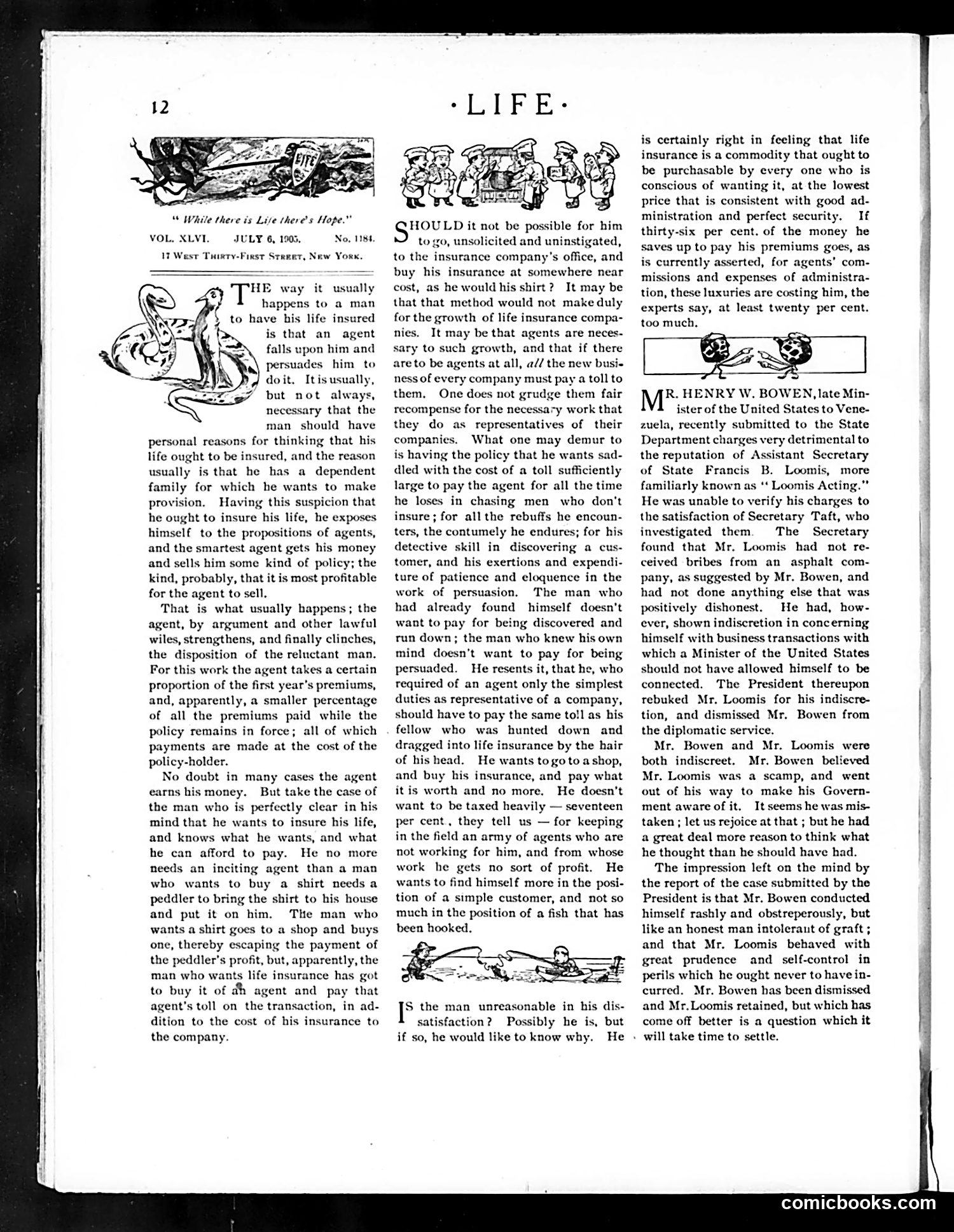
This page critiques life insurance industry practices, particularly agent commissions. The text argues that insurance should be affordable and accessible, but agents' high commissions make policies expensive for ordinary people. The article specifically attacks **Mr. Henry W. Bowen**, late U.S. Minister to Venezuela, for allegedly accepting bribes from an asphalt company while in office. It claims Secretary of State Francis B. Loomis showed "indiscretion" by hiring Bowen despite these charges. The President subsequently dismissed Bowen. The cartoons (featuring ducks and other figures) appear to illustrate the article's point about financial predation—likely depicting how agents or corrupt officials "hook" ordinary people into unfavorable deals. The satire targets both insurance industry practices and government corruption.
📄 Transcribed text from this page (OCR, searchable)
Machine-transcribed from the original scan — historical spelling and the odd misread are preserved.
“ While there is Lise there's Hope.” VOL. XLVI. JULY 6, 1905, 17 West Thuxty-First Street, New Yorn. No, 1184. TH way it usually happens to a man to have his life insured is that an agent falls upon him and persuades him to doit, Itis usually, but not always, necessary that the man should have personal reasons for thinking that his life ought to be insured, and the reason usually is that he has a dependent family for which he wants to make provision. Having this suspicion that he ought to insure his life, he exposes himself to the propositions of agents, and the smartest agent gets his money and sells him some kind of policy; the kind, probably, that it is most profitable for the agent to sell. That is what usually happens; the agent, by argument and other lawful wiles, strengthens, and finally clinches, the disposition of the reluctant man. For this work the agent takes a certain proportion of the first year’s premiums, and, apparently, a smaller percentage of all the premiums paid while the policy remains in force; all of which payments are made at the cost of the policy-holder. No doubt in many cases the agent earns his money. But take the case of the man who is perfectly clear in his mind that he wants to insure his life, and knows what he wants, and what he can afford to pay. He no more needs an inciting agent than a man who wants to buy a shirt needs a peddler to bring the shirt to his house and put it on him. The man who wants a shirt goes to a shop and buys one, thereby escaping the payment of the peddler's profit, but, apparently, the man who wants life insurance has got to buy it of dh agent and pay that agent's toll on the transaction, in ad- dition to the cost of his insurance to the company. HOULD it not be possible for him to go, unsolicited and uninstigated, to the insurance company’s office, and buy his insurance at somewhere near cost, as he would his shirt? It may be that that method would not make duly for the growth of life insurance compa- nies. It may be that agents are neces- sary to such growth, and that if there areto be agents at all, a// the new busi- ness of every company must pay a toll to them, One does not grudge them fair recompense for the necessary work that they do as representatives of their companies. What one may demur to is having the policy that he wants sad- dled with the cost of a toll sufficiently large to pay the agent for all the time he loses in chasing men who don't insure; for allthe rebuffs he encoun- ters, the contumely he endures; for his detective skill in discovering a cu: tomer, and his exertions and expendi- ture of patience and eloquence in the work of persuasion, The man who had already found himself doesn’t want to pay for being discovered and run down; the man who knew his own mind doesn't want to pay for being persuaded. He resents it, that he, who required of an agent only the simplest duties as representative of a company, should have to pay the same toll as his fellow who was hunted down and dragged into life insurance by the hair of his head. He wants togo toa shop, and buy his insurance, and pay what itis worth and no more. He doesn’t want to be taxed heavily — seventeen per cent, they tell us — for keeping in the field an army of agents who are not working for him, and from whose work he gets no sort of profit. He wants to find himself more in the posi- tion of a simple customer, and not so much in the position of a fish that has been hooked. eas. S the man unreasonable in his dis- satisfaction? Possibly he is, but if so, he would like to know why. He + is certainly right in feeling that life insurance is a commodity that ought to be purchasable by every one who is conscious of wanting it, at the lowest price that is consistent with good ad- ministration and perfect security, If thirty-six per cent. of the money he saves up to pay his premiums goes, as is currently asserted, for agents’ com- missions and expenses of administra- tion, these luxuries are costing him, the experts say, at least twenty per cent. too much, a M*. HENRY W. BOWEN, late Min- ister of the United States to Vene- zuela, recently submitted to the State Department charges very detrimental to the reputation of Assistant Secretary of State Francis B. Loomis, more familiarly known as ‘* Loomis Acting.” He was unable to verify his charges to the satisfaction of Secretary Taft, who investigated them The Secretary found that Mr. Loomis had not re- ceived bribes from an asphalt com- pany, as suggested by Mr. Bowen, and had not done anything else that was positively dishonest. He had, how- ever, shown indiscretion in concerning himself with business transactions with which a Minister of the United States should not have allowed himself to be connected. The President thereupon rebuked Mr. Loomis for his indiscre- tion, and dismissed Mr. Bowen from the diplomatic service. Mr. Bowen and Mr. Loomis were both indiscreet. Mr. Bowen believed Mr. Loomis was a scamp, and went out of his way to make his Govern- ment aware of it. It seems he was mis- taken ; let us rejoice at that ; but he had a great deal more reason to think what he thought than he should have had. The impression left on the mind by the report of the case submitted by the President is that Mr. Bowen conducted himself rashly and obstreperously, but like an honest man intolerant of graft ; and that Mr. Loomis behaved with great prudence and self-control in perils which he ought never to have in- curred. Mr. Bowen has been dismissed and Mr.Loomis retained, but which has come off better is a question which it will take time to settle. comicbooks.com