
Life, 1905-07-06 · page 21 of 44
Life — July 6, 1905 — page 21: what you’re looking at
What you’re looking at
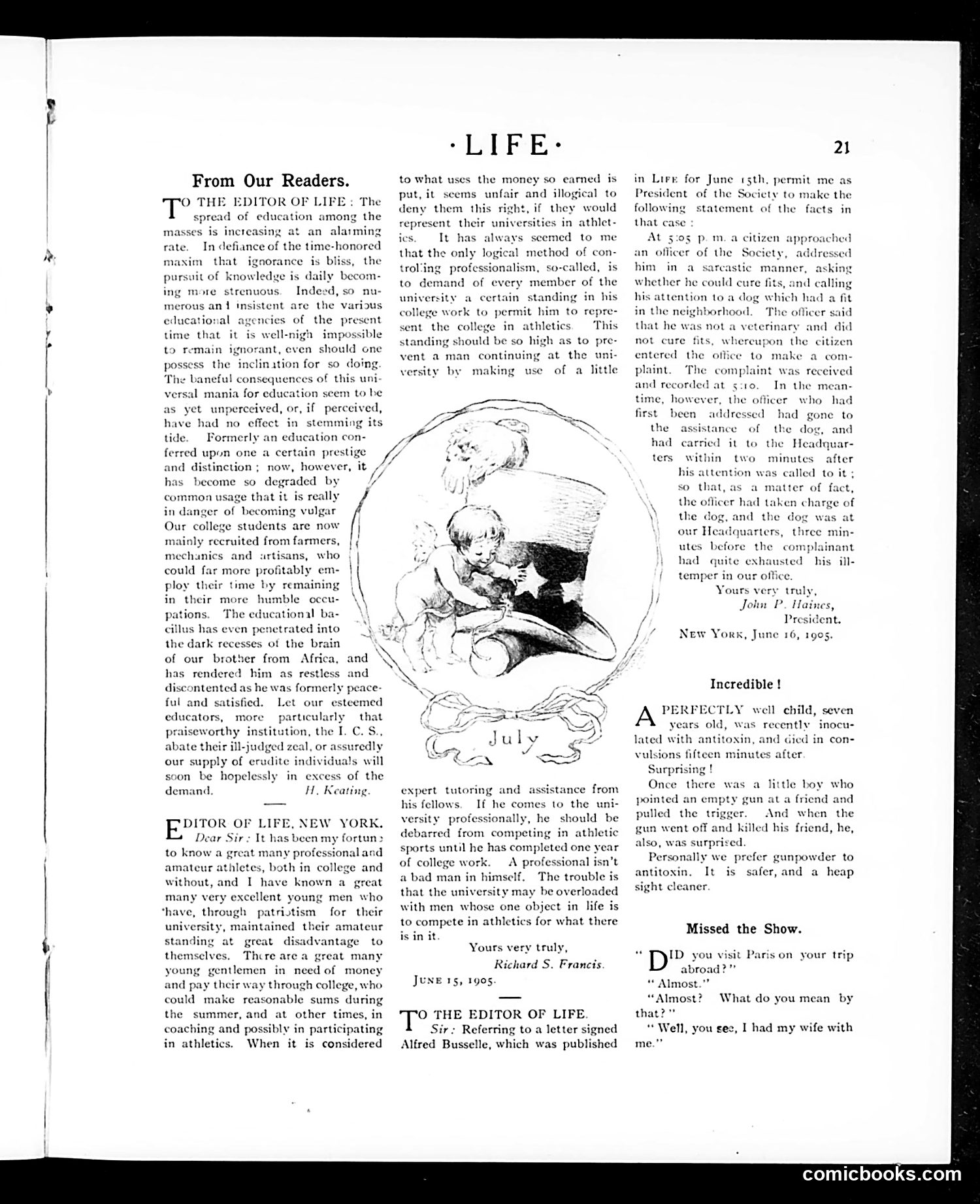
This page from *Life* magazine (dated June 1905) contains reader letters debating college education and athletics—not political cartoons. **The Illustration**: A sketch shows two figures (appearing to be children or youths) in a domestic scene, likely accompanying one of the letters about education. **Main Satire**: The lead letter from "H. Keating" satirizes the spread of mass education, arguing that widespread schooling has degraded education's prestige. The author ironically warns that education has become so common it's "in danger of becoming vulgar"—the joke being that he laments education reaching farmers, mechanics, and even "our brother from Africa." This reveals period attitudes about who "deserved" education. **The Debate**: Subsequent letters defend athletic scholarships and professionalism in college sports, arguing poor students shouldn't be prevented from earning money while attending university. **Historical Context**: This reflects early-1900s anxieties about democratizing education and the emerging debate over college athletic professionalization—issues still relevant today, though the racist and class-based language now appears starkly offensive.
📄 Transcribed text from this page (OCR, searchable)
Machine-transcribed from the original scan — historical spelling and the odd misread are preserved.
x wo — From Our Readers. ‘O THE EDITOR OF LIE The tion among the spread of educa masses is increasin t an alarming rate. In defiance of the time-h maxim that ignorance is bliss, the pursuit of k ing more strenuous. Indeed, so nu- merous ani insistent are the various educational agencies of the present time that it is well-nigh n should one nored nowledge is daily becom- mpossible to remain ignorant, ¢ possess the inclination for so doing. The baneful consequences of this uni versal mania for education seem to be as yet unperceived, or, if perceived, have had no effect in stemming its tide. Formerly an education con- ferred upon one a certain prestige and distinction ; now, however, it / / has become so degraded by V common usage that it is really J in danger of becoming vulgar Our college students are now [| mainly recruited from farmers, | { mechanics and artisans, who | | -LIFE- to what uses the money so eared is put, it seems unfair and illogical to deny them this right, if they would represent their universities in athlet- ies. It has always seemed to me that the only logical method of con- trol‘ing professionalism, so-called, is to demand of every member of the university certain standing in his college work to permit him to repre- sent the college in athletics This standing should be so high as to pre vent a man continuing at the uni- versity by making use of a little could far more profitably em- | ploy their time by remaining { in their more humble occu- \\ xp pations. The educational ba- me cillus has even penetrated into the dark recesses of the brain of our brother from Africa, and \\ has rendered him as restless and discontented as he was formerly peace- ful and satisfied. Let our esteemed educators, more particularly that praiseworthy institution, the I. C. S., abate their ill-judged zeal, or assuredly our supply of erudite individuals will soon be hopelessly in excess of the demand, H. Keating. DITOR OF LIFE, NEW YORK. Dear Sir: It has been my fortun: to know a great many professional and amateur athletes, both in college and without, and I have known a great many very excellent young men who “have, through patristism for th university, maintained their amateur standing at great disadvantage to themselves. Thcre are a great many young gentlemen in need of money nd pay their way through college, who could make reasonable sums during the summer, and at other times, in coaching and possibly in participating in athletic When it is considered expert tutoring and assistance from his fellows. If he comes to the uni- versity professionally, he should be debarred from competing in athletic sports until he has completed one year of college work. A professional isn’t a bad man in himself. The trouble is that the university may be overloaded with men whose one object in life is for what there to compete in athletics is in it Yours very truly, Richard S. Francis 15, 1905 T° THE EDITOR OF LIFE. Sir: Referring to a letter si; Alfred Busselle, which w: Jus igned s published 21 in Lire for June 15th, permit me as President of the Society to make tk following atement of the facts in that case At 5:05 p.m. a citizen approached an officer of the Society, ac him in a sarcastic manner, asking whether he could cure fits, and calling his attention to a dog which had a fit in the neig' 1¢ officer said rinary and did on the citizen ke a ec plaint. ‘The complaint was received and recorded at 5:10. In the mean- Iressed borhood. nat he was not a v not cure fits, where enterec the office to ma n= time, however, the officer who had first been addressed had gone to the assistance of dog, and Headquar- within two minutes after his attention was called to it ; r of fact, the officer had taken charge of the dog, and the dog was at our Headquarters, three min- had carried it to ters so that, as a ma inant exhausted his ill- (temper in our offi utes before the comy 1 quit c. Yours very truly, John P. Haines, President. New York, June 16, 1905. Incredible ! A PERFECTLY well child, seven years old, was recently inocu- lated with antitoxin, and Gicd in con- vulsions fifteen minutes after Surprising ! Once there was a little boy who pointed an empty gun at a friend and pulled the trigger. And when the gun went off and killed his friend, he, also, was surprised. Personally we prefer gunpowder to antitoxin. It is safer, and a heap sight cleaner. Missed the Show. * DID you visit Par abroad?” Almost.”’ “Almost? What do you mean by that?" “Well, you see, I had my wife with on your trip me comicbooks.com