
A complete issue · 36 pages · 1905
Life — January 5, 1905
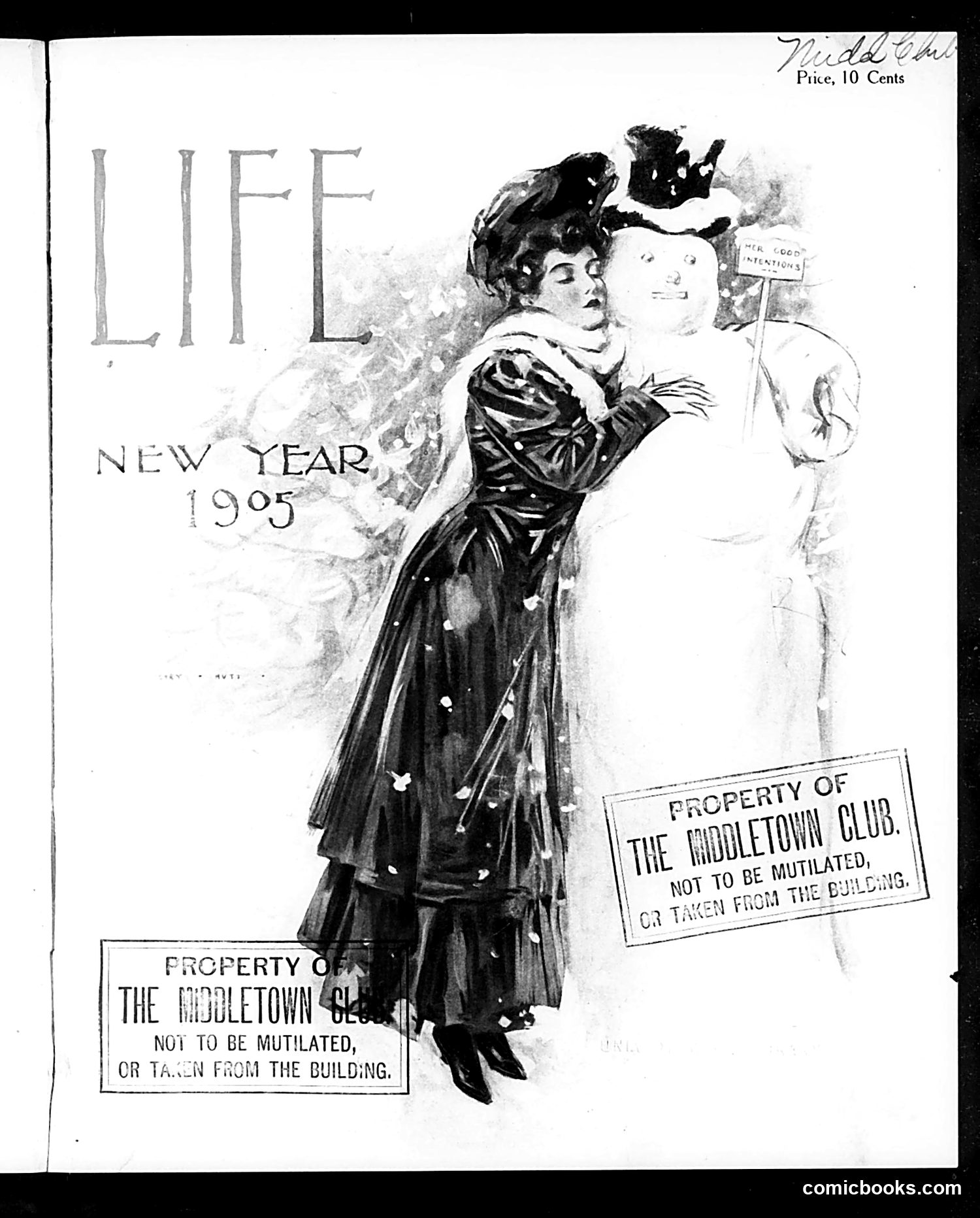
This is a New Year 1905 cover featuring a woman in an elegant black dress posing with a snowman. The title "LIFE" appears at top left, with "NEW YEAR 1905" printed below. The satire likely plays on the tradition of personifying the New Year as a figure—here represented by the blank-faced snowman wearing a hat. The fashionable woman appears to be presenting or introducing this new year with optimism. The repeated "Property of The Middletown Club" stamps are a humorous library ownership marking, standard for club publications of the era. This cover uses gentle visual wit rather than sharp political commentary—typical of Life magazine's sophisticated, upper-class satirical approach to the year's arrival.
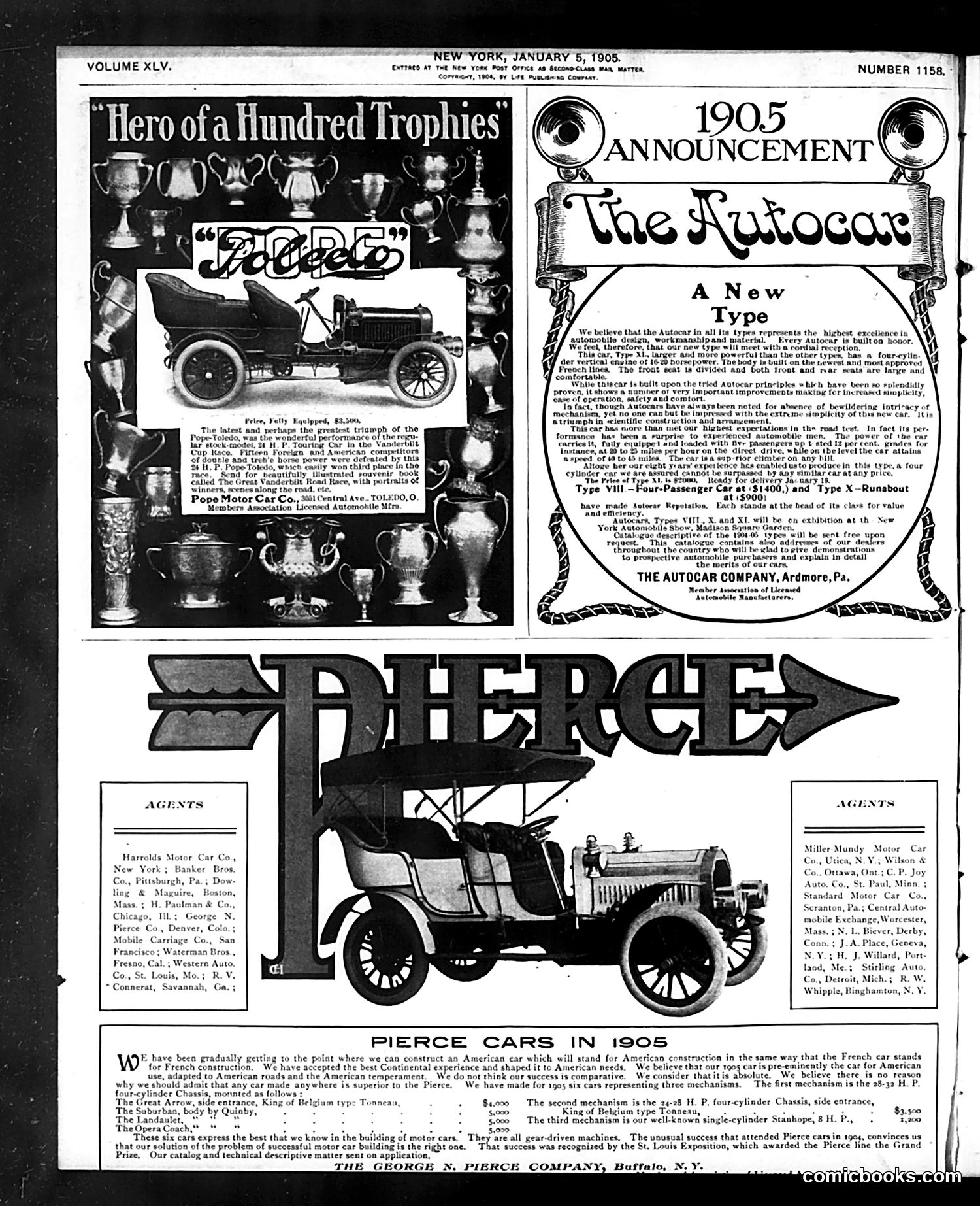
This page is **primarily automobile advertising** rather than political satire. It features three early motorcar advertisements: 1. **Peerless** ("Hero of a Hundred Trophies") - emphasizing racing victories and trophies won 2. **Autocar** - announcing a "New Type" vehicle with technical specifications 3. **Pierce** - promoting their 1905 car models with agent listings The advertisements occupy roughly 80% of the page. The only potential satirical element is the Peerless ad's title ironically calling a racing automobile a "Hero" - though this appears to be standard automobile marketing hyperbole rather than intentional satire. The page reflects early 1900s consumer culture when automobiles were luxury items and racing success was a major selling point. No clear political commentary is evident.
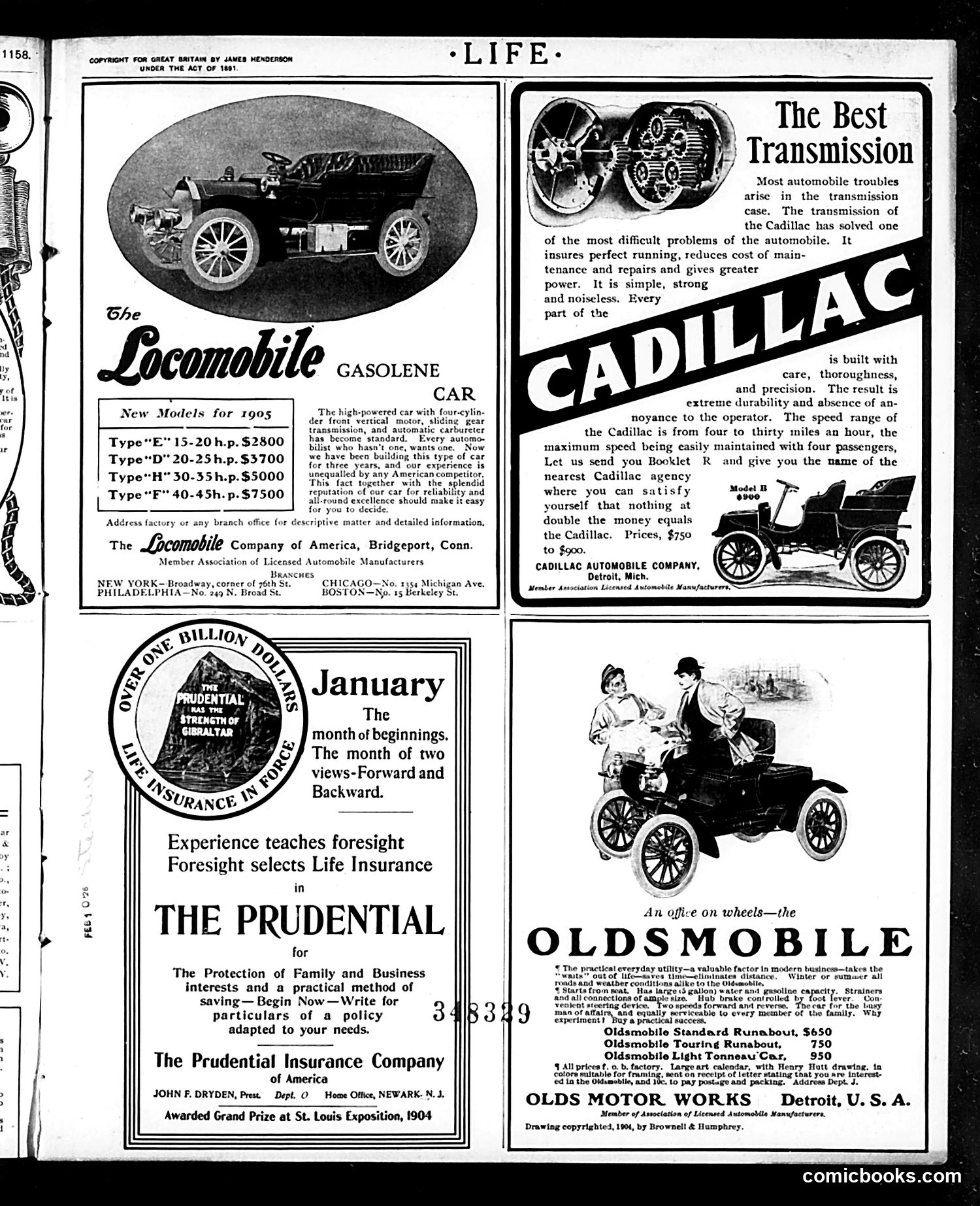
This page consists primarily of **automobile advertisements** from 1905, not political cartoons or satire. The ads feature: - **Locomotile**: A gasoline-powered car with multiple models listed ($2,800–$7,500) - **Cadillac**: Emphasizing transmission reliability as a solution to "most difficult problems" in automobiles - **Oldsmobile**: Described as "an office on wheels," marketed for practical business use There is one non-automotive ad: **The Prudential Insurance Company**, using January as a seasonal hook ("month of beginnings") to promote life insurance as foresight. No political satire or caricature is present. This is a straightforward commercial page showcasing the emerging automobile industry's marketing strategies to American readers circa 1905.
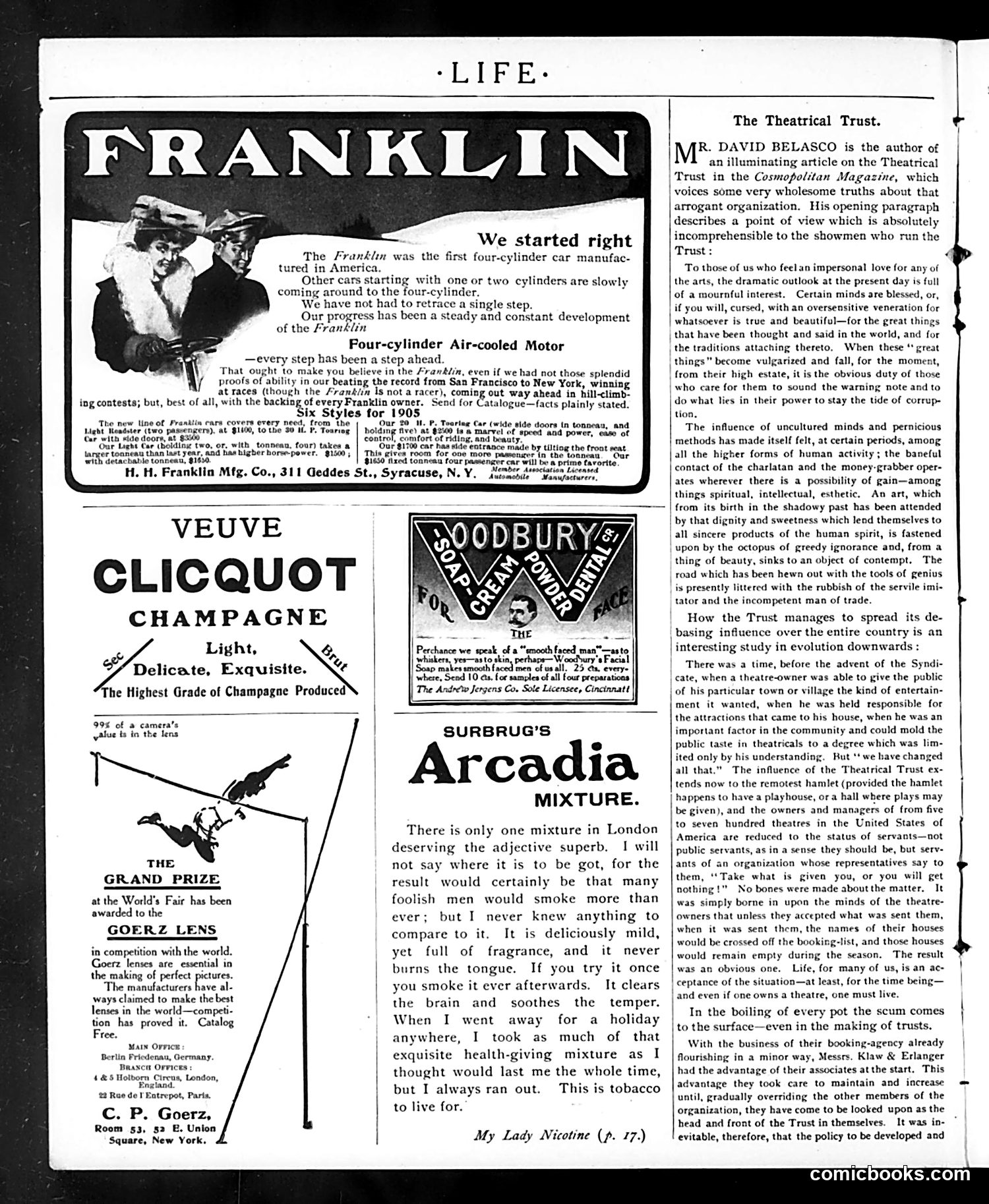
This page is primarily **advertising**, not political cartoon content. The main advertisements are: - **Franklin automobiles** (top): promoting their four-cylinder, air-cooled motor as superior technology - **Veuve Clicquot Champagne** (left): luxury goods marketing - **Woodbury's Soap** (center): beauty product advertisement - **Surbrug's Arcadia Mixture** (center-right): tobacco product The only editorial content is "The Theatrical Trust" article (right), which **does contain social criticism**. It criticizes an unnamed theatrical organization's monopolistic control over American theaters, describing how they manipulated public taste and prevented independent theater management. The author argues the Trust abused power and exploited theater owners. The page reflects early 1900s concerns about corporate monopolies controlling American industries, but it's fundamentally a commercial publication featuring luxury goods.
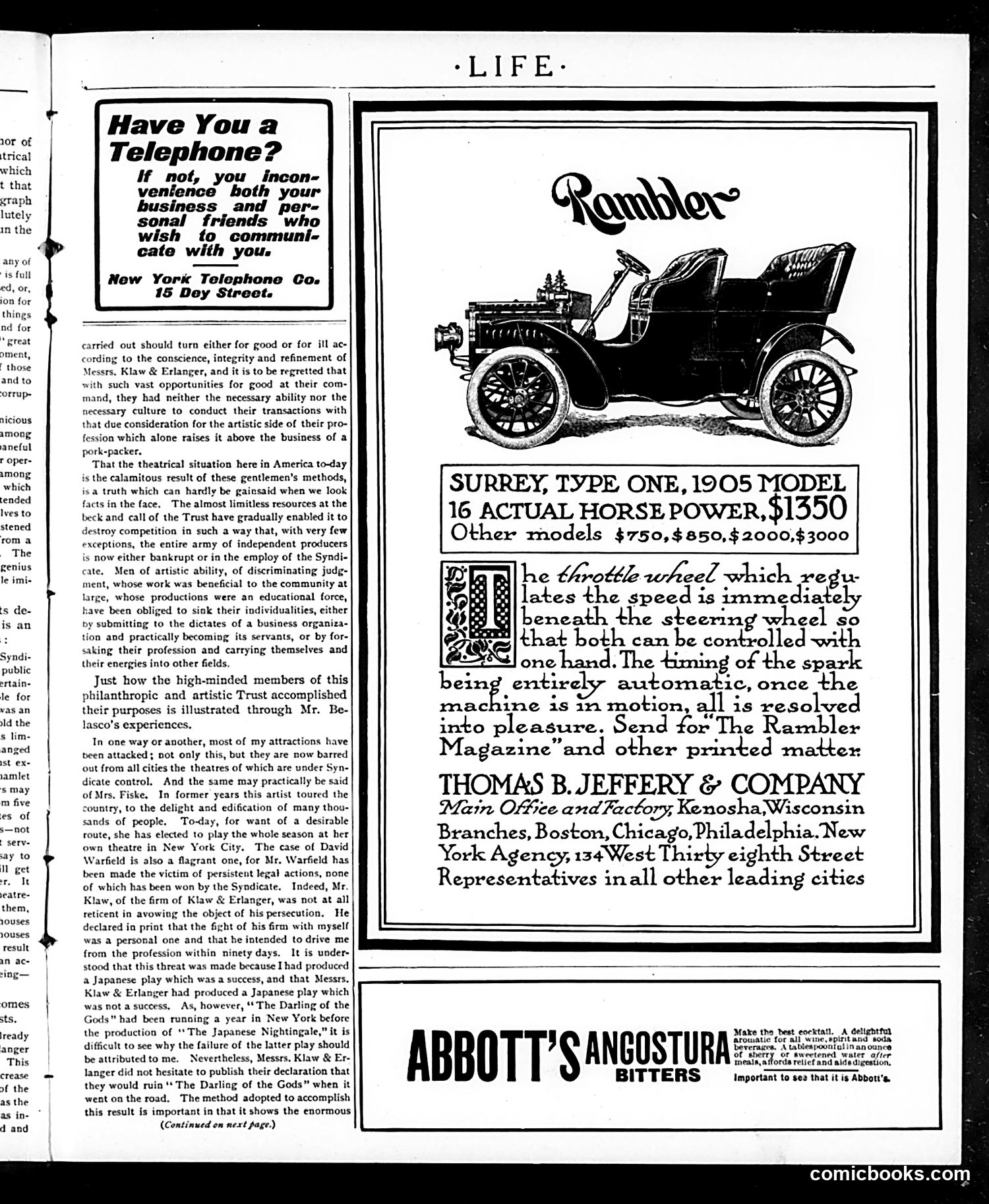
This page is **primarily advertising**, not satire or political commentary. The main content consists of: 1. **A telephone company advertisement** (top left) promoting New York Telephone service 2. **A Rambler automobile advertisement** (center-right) for a 1905 Surrey model priced at $1,350, manufactured by Thomas B. Jeffery & Company of Kenosha, Wisconsin 3. **Abbott's Angostura Bitters advertisement** (bottom) The left column contains what appears to be **theatrical criticism or arts commentary** discussing production methods and artistic disputes, but this is editorial content, not cartoon satire. There are **no political cartoons or caricatures** on this page. The single illustration is a straightforward product drawing of an early automobile, not satirical commentary.
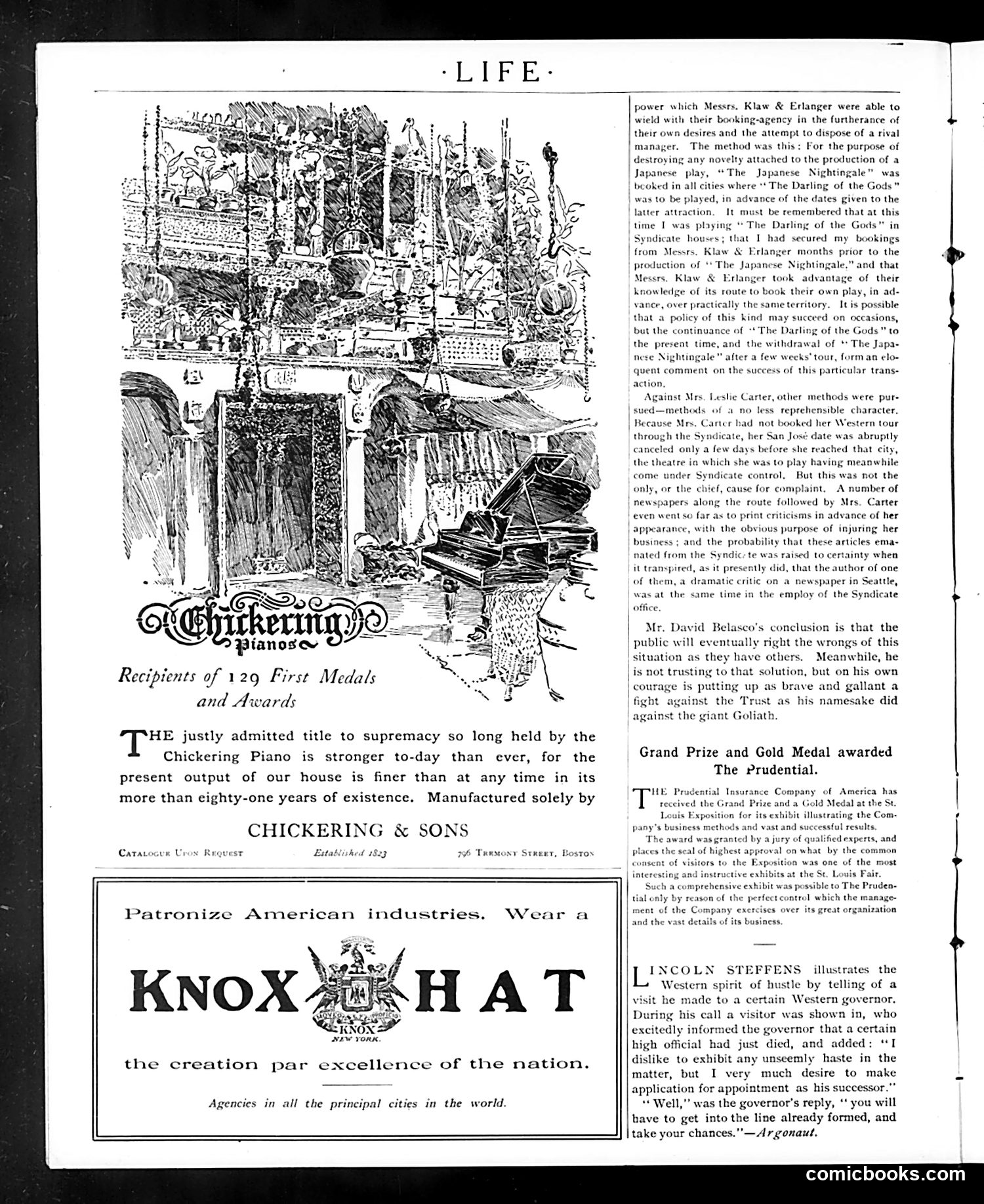
This page is **primarily advertising**, not political satire. It contains three distinct ads: 1. **Chickering Pianos** — emphasizing American manufacturing superiority and product longevity (81+ years of existence) 2. **Knox Hat** — patriotic messaging ("the creation par excellence of the nation") with "Agencies in all the principal cities in the world," positioning it as an American export 3. The right column contains brief **anecdotal humor** about theatrical booking disputes and a Western governor story—typical Life magazine filler content The decorative illustration at top appears to be a theatrical scene (possibly related to the text about "The Japanese Nightingale" play), not political commentary. **Overall**: This is a commercial and lifestyle page reflecting early 20th-century American consumer culture and national pride in domestic manufacturing.
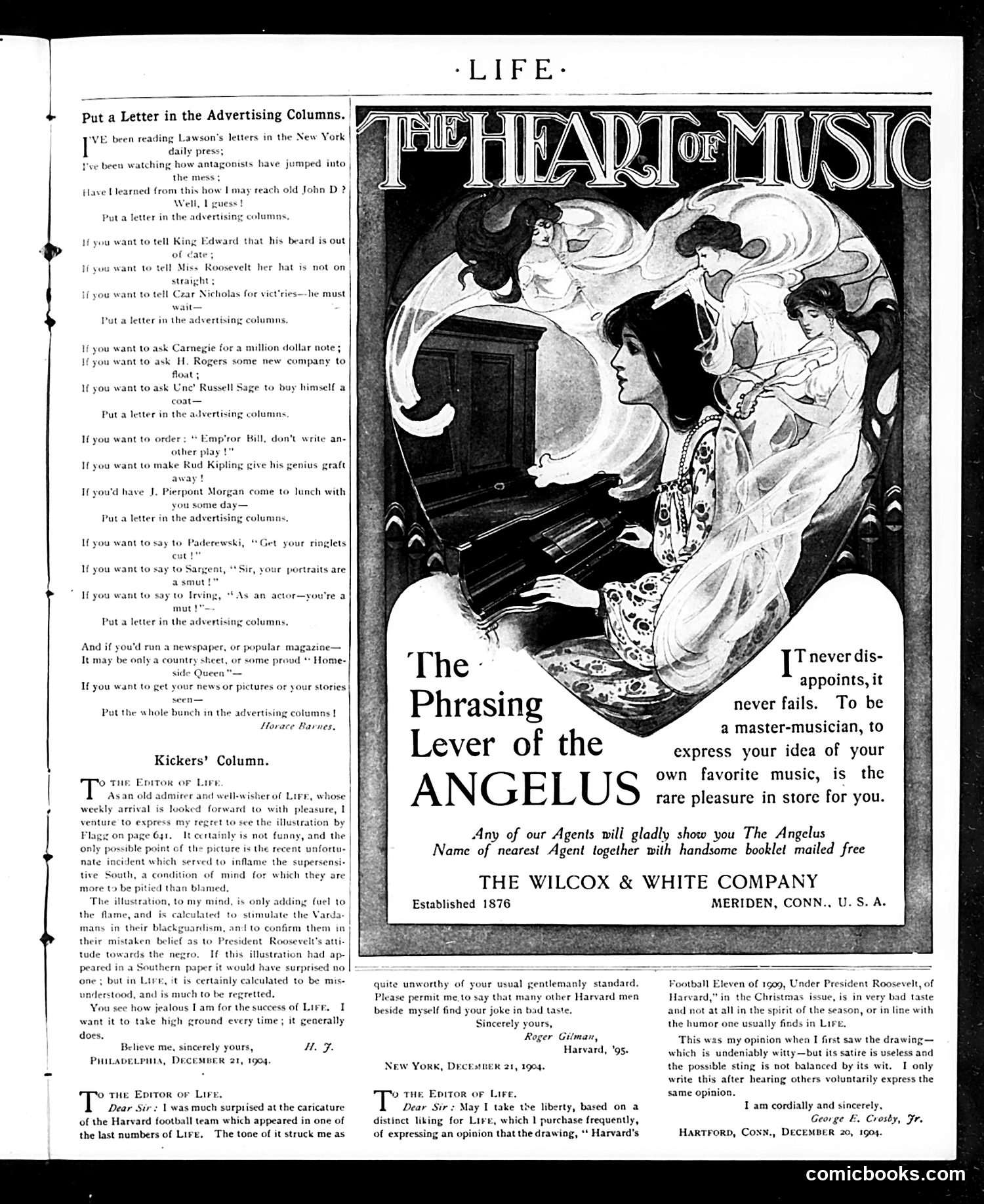
This page is primarily **advertising** for the Angelus piano by Wilcox & White Company (established 1876), featuring an art nouveau illustration of a woman at a piano surrounded by ethereal, musical figures. The left side contains reader letters to *Life* magazine's editor. One letter ("Kickers' Column") complains about an illustration depicting Harvard's football team in a way the writer found offensive—apparently showing "the South, a condition of mind" in poor taste. Another reader defends the drawing's wit. A third letter critiques a Christmas drawing as unbalanced and unfunny. These are typical magazine letters-to-editor complaints about editorial content, not political satire. The page reflects early 1900s debates about representational propriety and artistic judgment in a major American humor publication.
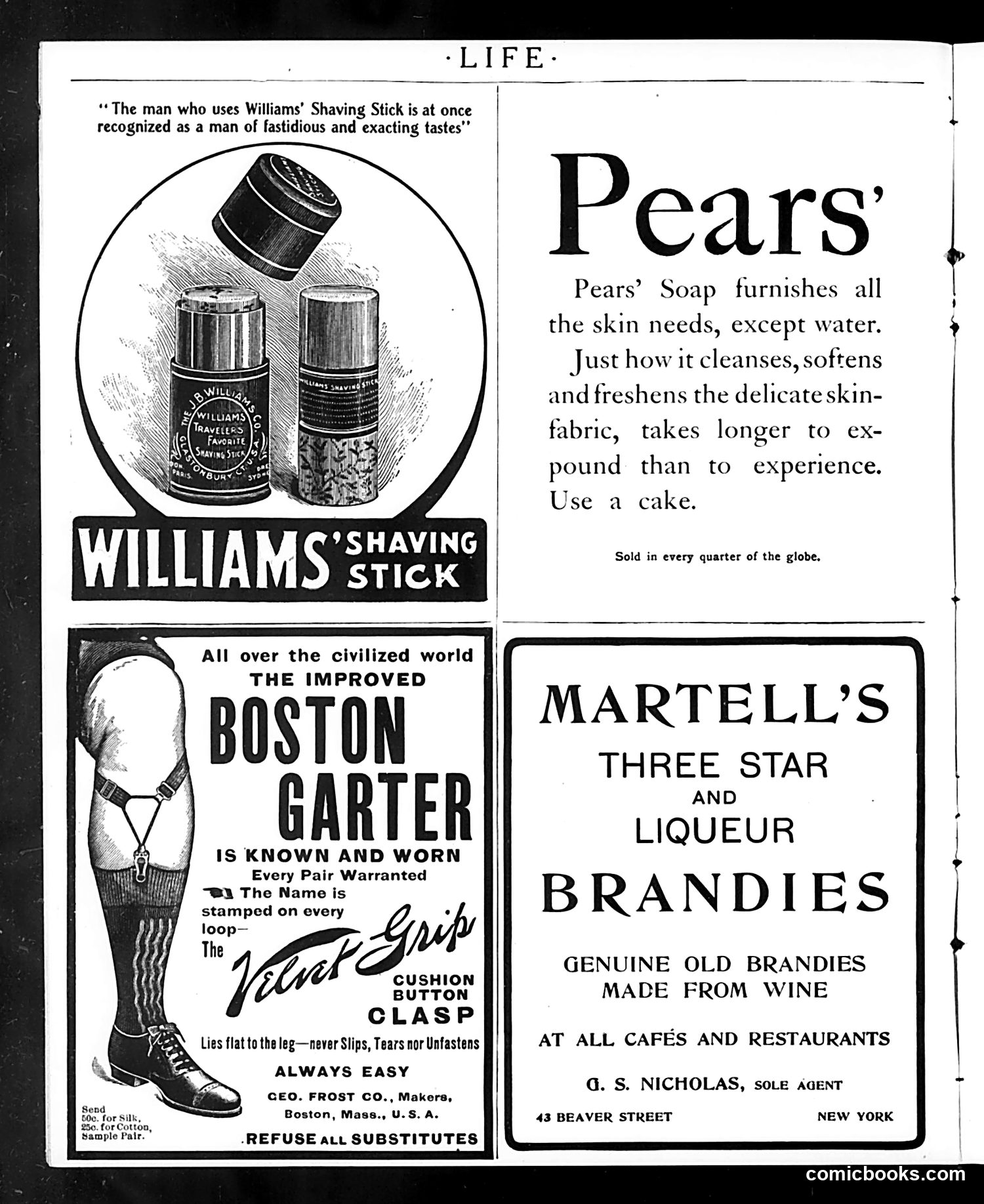
This is primarily an **advertisement page** from Life magazine, not a satirical cartoon. It contains four product advertisements: 1. **Williams' Shaving Stick** — markets to men of "fastidious and exacting tastes" 2. **Pears' Soap** — emphasizes gentle cleansing for delicate skin; claims superiority over water alone 3. **Boston Garter** — leg wear with "Velvet Grip" technology, marketed as reliable and easy-to-use 4. **Martell's Brandies** — liquor advertisement highlighting "genuine old brandies made from wine" The page reflects early 20th-century consumer culture, targeting middle and upper-class readers. The advertisements assume grooming, proper undergarments, and alcohol consumption signified respectability and social standing. No political satire is present—this is straightforward commercial promotion typical of Life's revenue model.
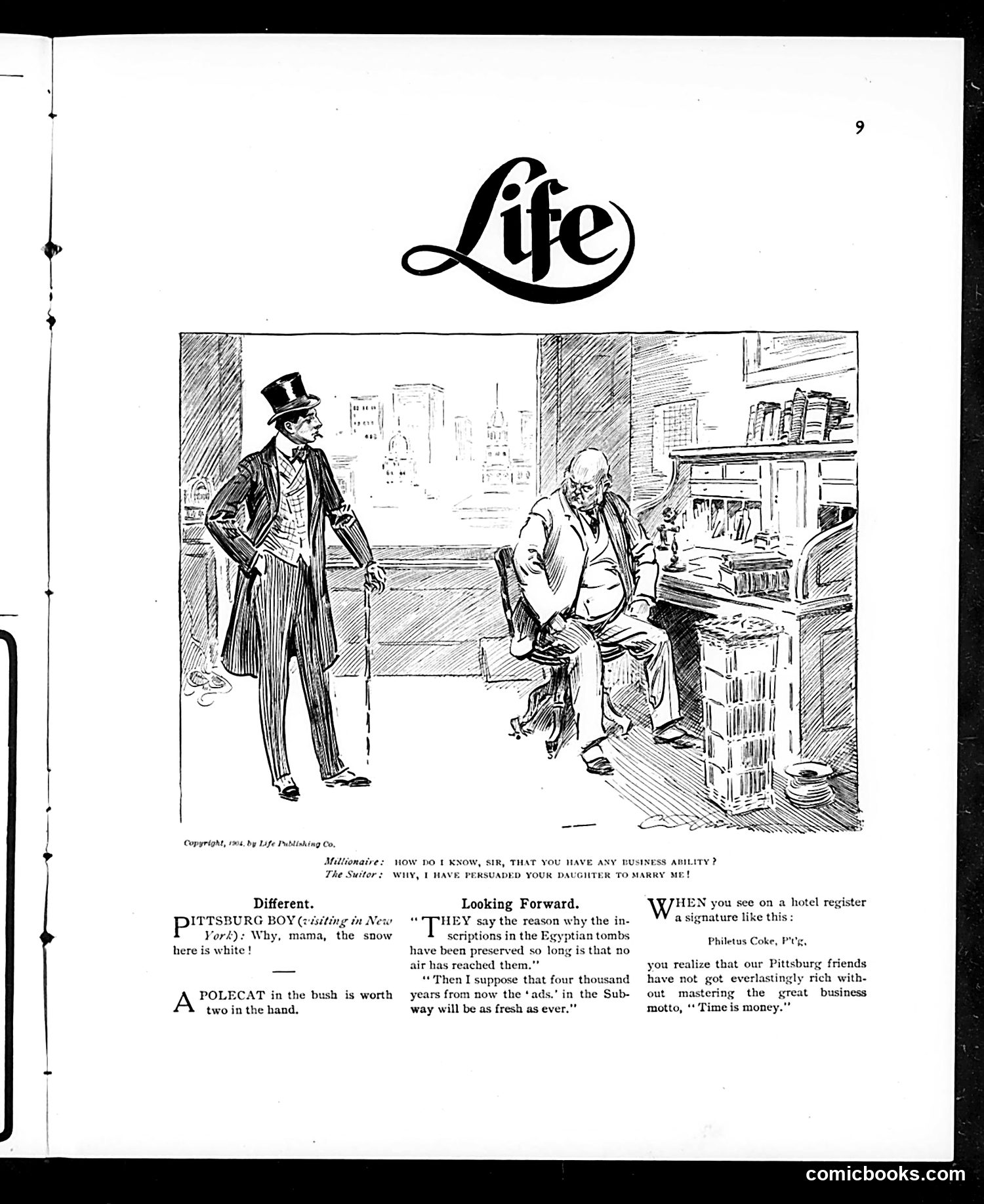
This page contains a satirical cartoon and brief humorous anecdotes about wealth and social status. **The Main Cartoon:** A well-dressed man in a top hat (representing a wealthy "millionaire") asks a disheveled older man about "business ability." The sailor replies that he's persuaded the millionaire's daughter to marry him—suggesting he's demonstrated considerable business acumen through this advantageous match. **The Satire:** The joke mocks both wealthy men's pretensions about "business ability" and the transactional nature of marriage among the upper classes, where marrying rich was itself considered a successful business venture. **The Brief Pieces:** "Different" and "Looking Forward" use wordplay about freshness and time's value, typical of the magazine's light humor. These appear designed as filler content alongside the main cartoon.
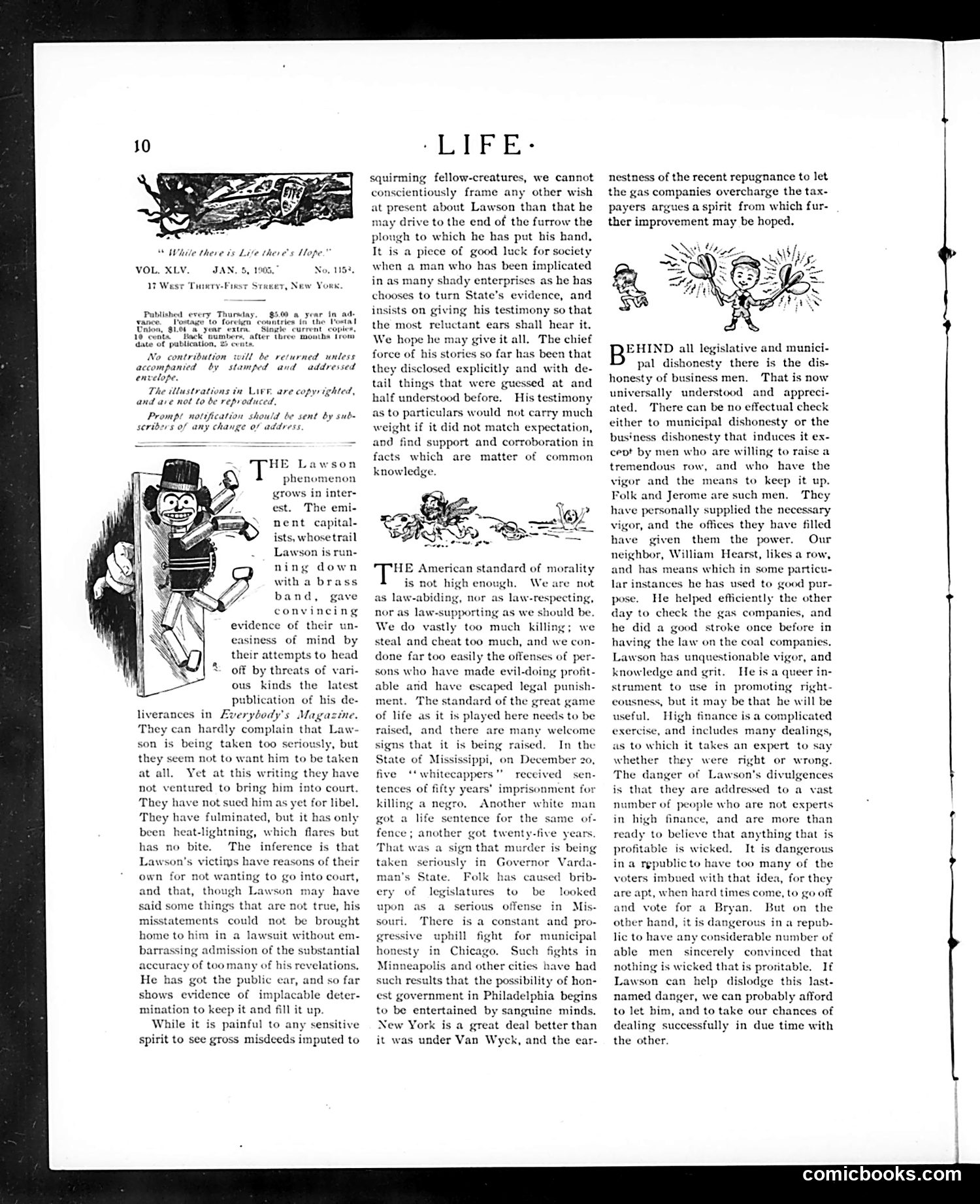
This page from *Life* magazine (Vol. XIV, Jan. 5, 1895) contains editorial commentary rather than a political cartoon. The left illustration shows a caricatured figure labeled "The Lawson phenomenon" being publicly ridiculed. The text indicates this refers to someone named Lawson who has been involved in exposing shady business practices but refuses to testify in court about his findings. The editorial criticizes Lawson's reluctance to provide sworn testimony while simultaneously publicizing his allegations. The author argues this behavior undermines credibility and suggests Lawson wants public attention without legal accountability—a common satirical criticism of public figures who make accusations but avoid legal consequences. The page also discusses municipal corruption and dishonesty more broadly, praising individuals like William Hearst for actively combating such practices.
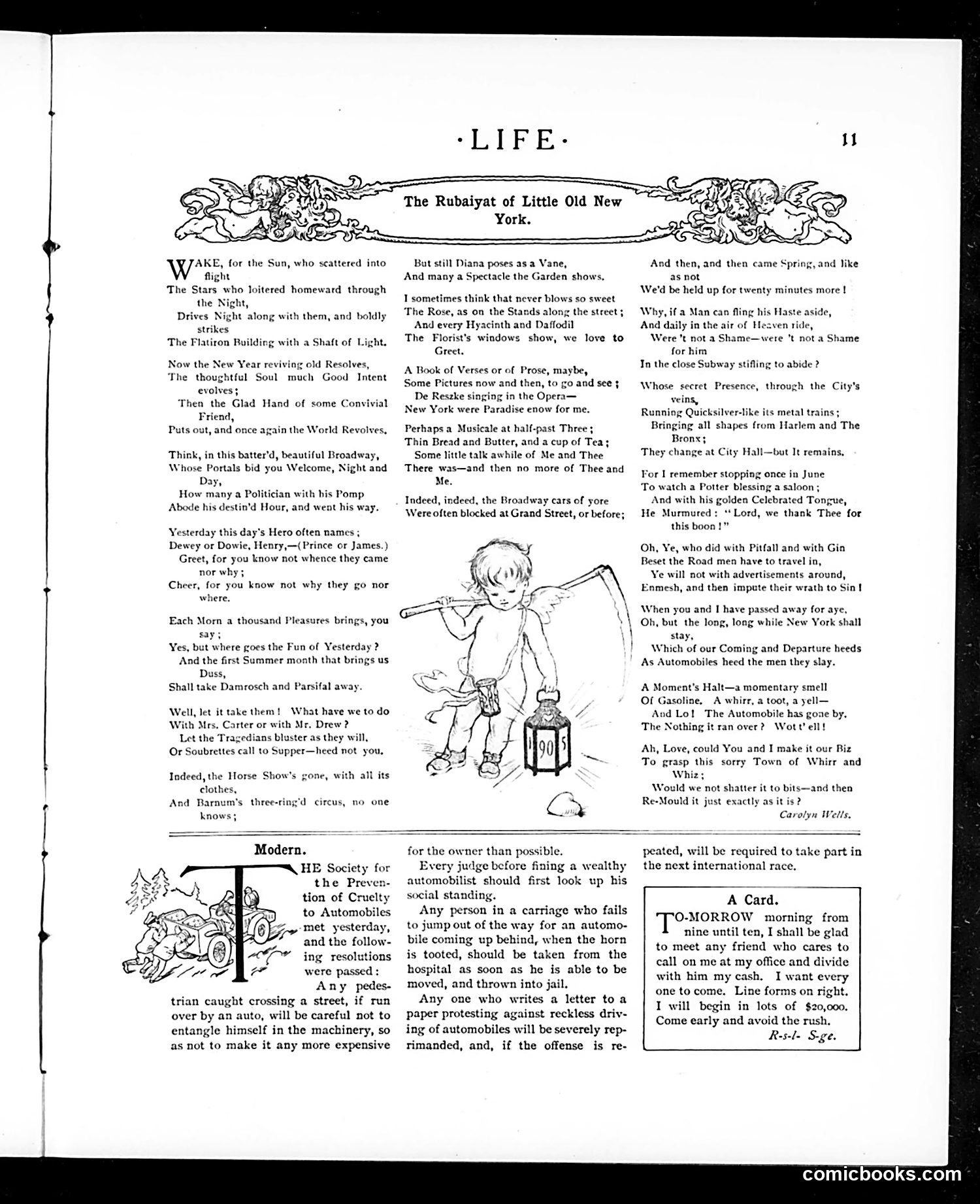
This page contains a poem titled "The Rubaiyat of Little Old New York" illustrated with a cherub figure, plus a separate section titled "Modern" featuring a cartoon about automobile safety. The poem is a satirical take on New York City life, referencing theaters, the subway, and urban pleasures. It addresses contemporary concerns about automobiles congesting streets ("Grand Street") and disrupting traditional city life. The "Modern" cartoon section presents resolutions from a fictional "Society for the Prevention of Cruelty to Automobiles," satirizing both reckless drivers and overly protective car owners. It proposes humorous (and harsh) penalties: pedestrians hit by cars shouldn't damage the machinery, and those complaining about reckless driving face jail time. The satire mocks the era's emerging car culture and society's prioritization of automobiles over pedestrian safety.
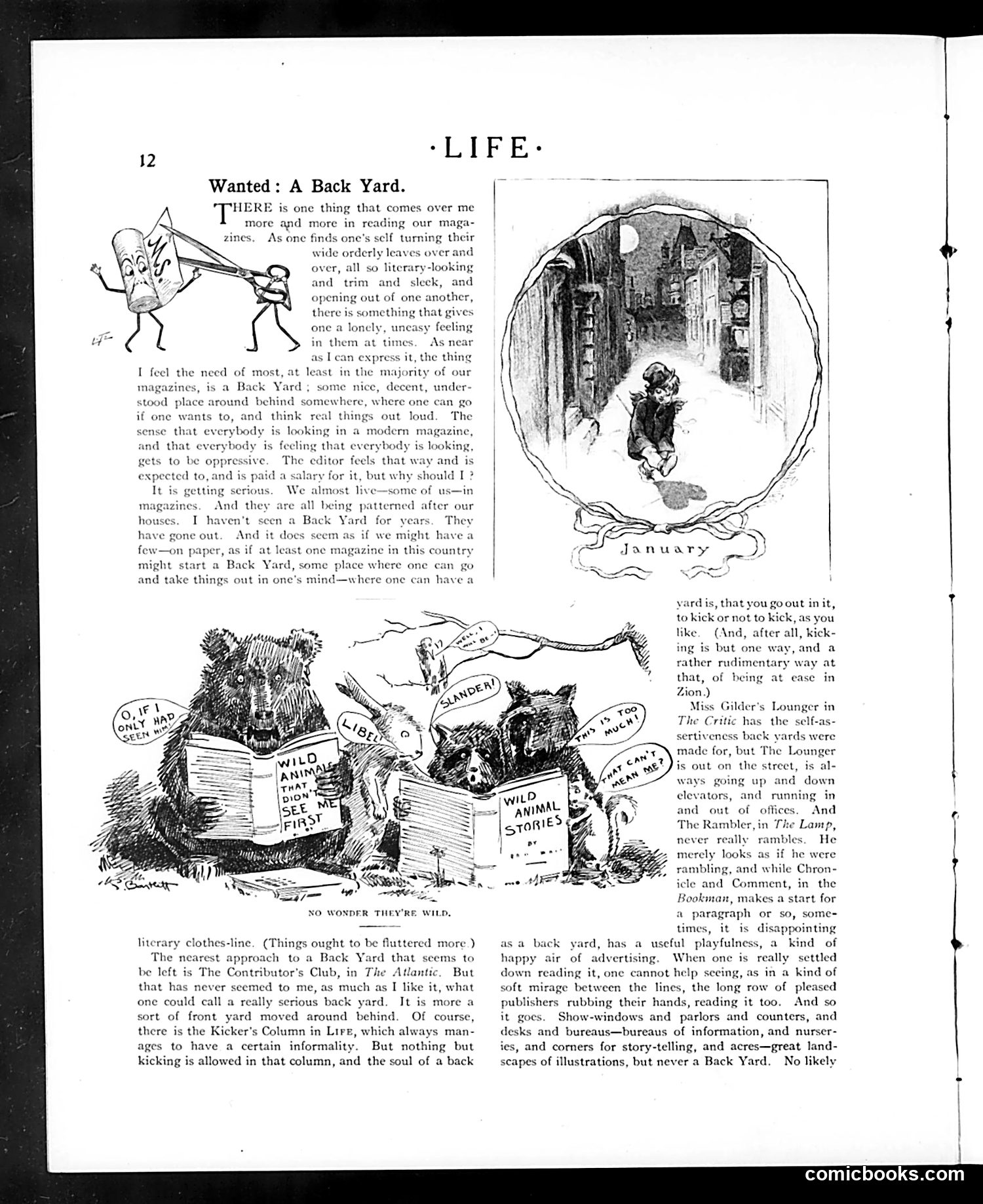
This page satirizes the absence of back yards in early 20th-century urban magazine culture. The author laments that magazines—patterned after houses—have lost their "back yards," those informal spaces where one could relax away from public scrutiny. The cartoon shows two animals (a bear and what appears to be a fox or similar creature) reading "Wild Animal Stories," humorously illustrating the point that even fictional narratives lack informal, comfortable spaces. The illustration labeled "January" depicts a solitary figure in an urban alley or narrow passage, visually reinforcing the author's complaint about cramped city living without private outdoor space. The satire critiques how modern magazines, like contemporary homes, have become overly formal and "literary-looking," losing the casual accessibility of earlier publications.
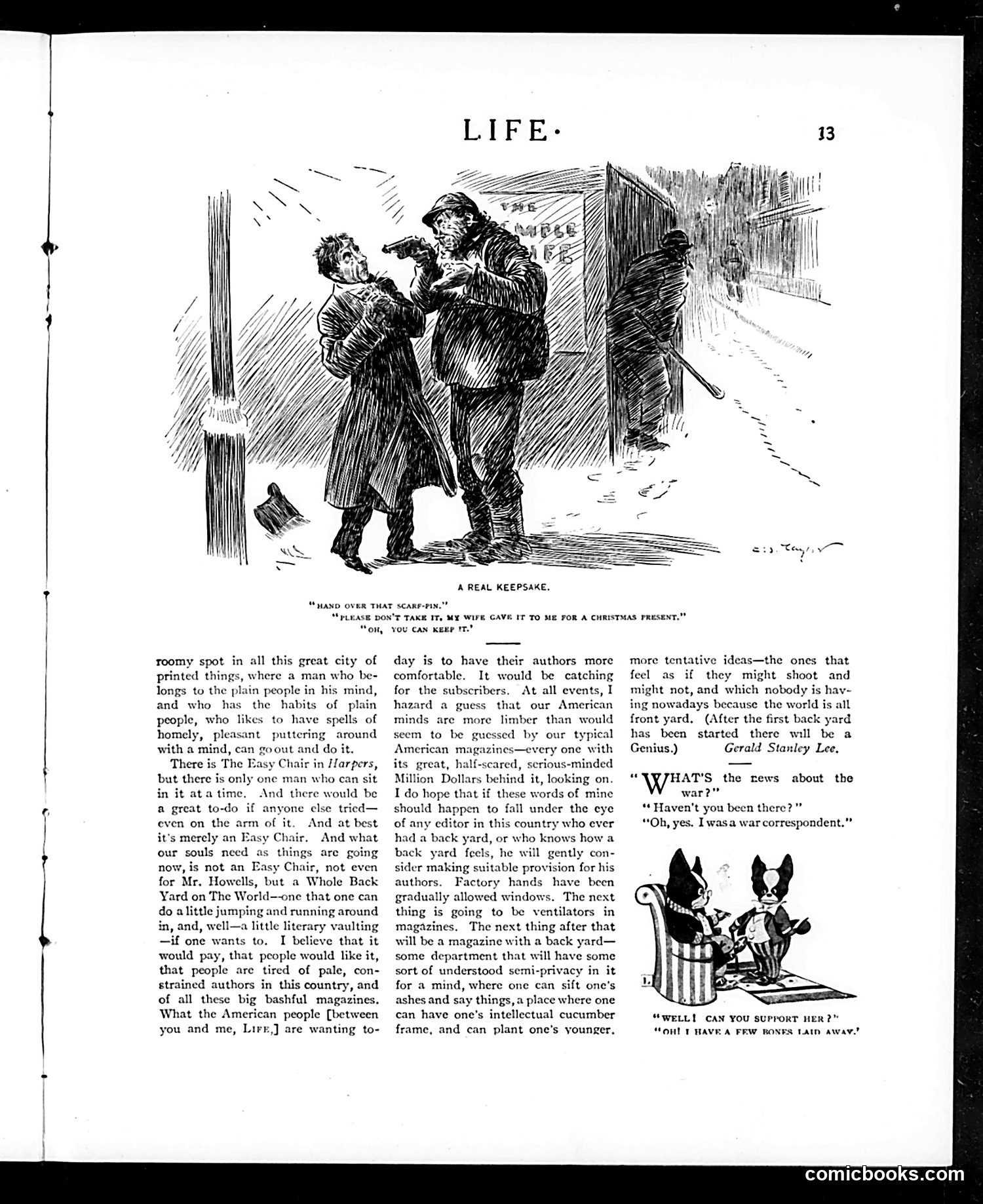
The top cartoon titled "A Real Keepsake" depicts a street robbery. A man is being accosted by a thief who demands a scarf-pin (a decorative pin worn on neckties). The victim protests that his wife gave it to him as a Christmas present, but the thief allows him to keep it anyway—a darkly humorous twist on the expected mugging. The accompanying article by Gerald Stanley Lee critiques American magazines as overly formal and constrained. He argues that magazine editors should provide authors with more creative freedom—metaphorically, a "back yard" where minds can roam freely rather than remaining confined to the "front yard" of respectable, cautious publication. The bottom cartoon shows a war correspondent being propositioned, apparently about supporting a woman. His reply—"I have a few bones laid away"—is a crude sexual joke about having savings or resources. Both pieces reflect early 20th-century attitudes about male independence, urban danger, and bohemian creative freedom.
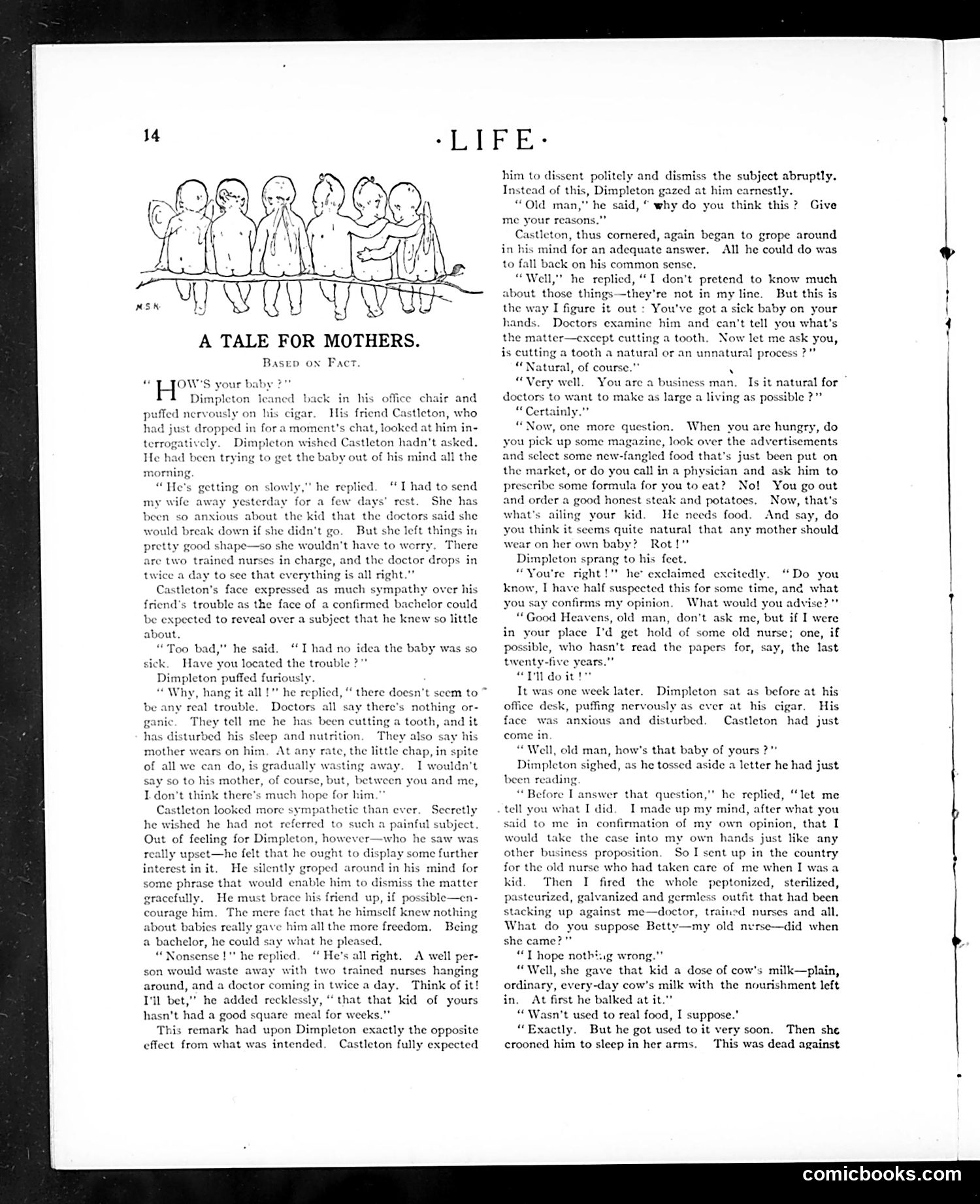
This story satirizes early 20th-century anxieties about infant care and medical over-treatment. The illustration shows mothers (representing the target audience of this cautionary tale). The narrative mocks two attitudes: First, the anxious mother who has left her baby with trained nurses and a doctor visiting twice daily for a teething infant—suggesting maternal paranoia. Second, it lampoons the bachelor Castleton, whose common-sense advice—that a sick baby simply needs good honest food, not medical formulas—accidentally resonates as wisdom. The satire's point appears to be that modern mothers were being sold unnecessary medical interventions and expert care for natural childhood processes like teething, when simple nutrition would suffice. The story advocates for practical, no-nonsense parenting over medicalized infant care, positioning "old-fashioned" solutions (good food, maternal care) as superior to contemporary professional medicine and nervous hovering.
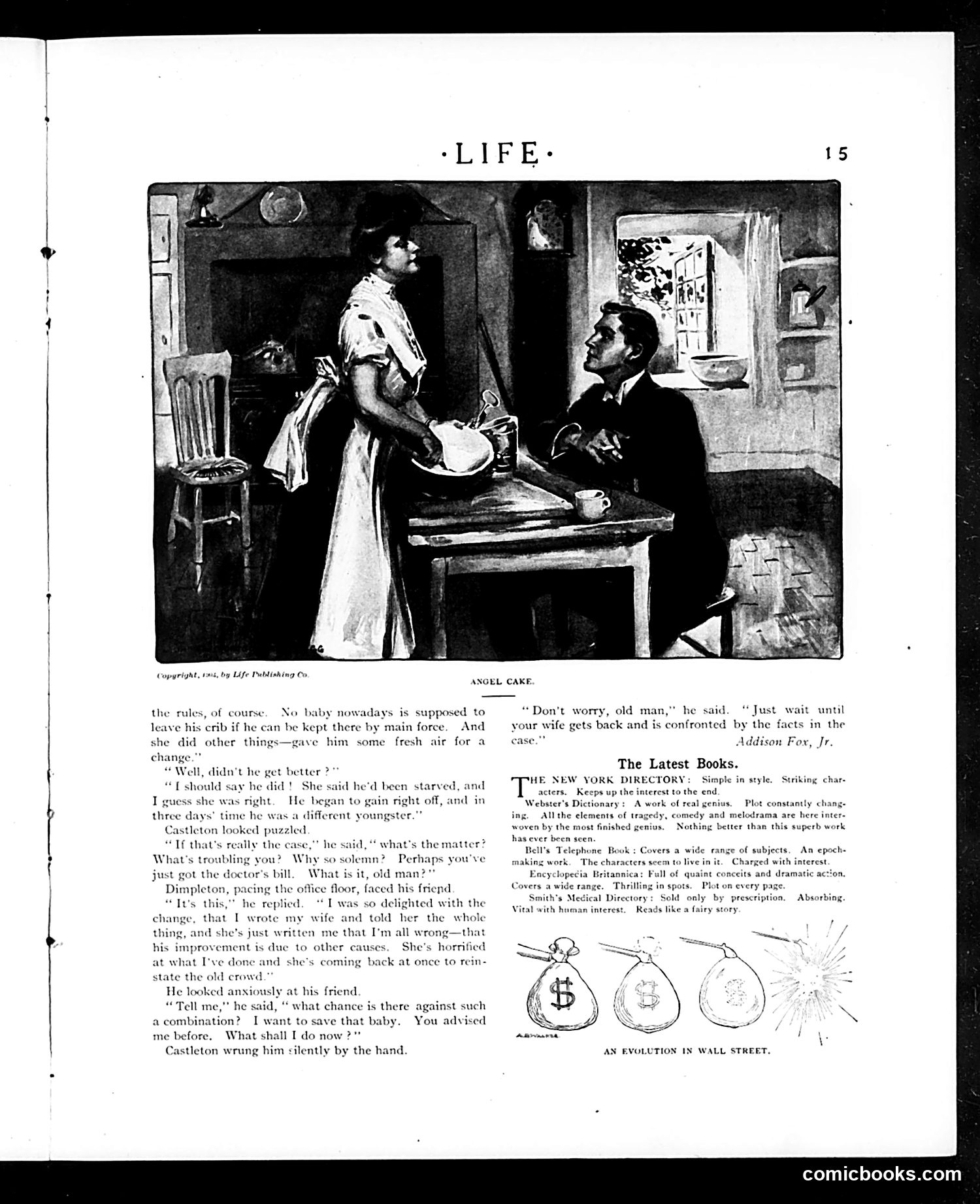
This satirical story-cartoon depicts a domestic comedy about modern parenting anxieties. A man named Dimpleton hired a nurse ("Angel Cake") who successfully improved his sickly baby through practical measures: fresh air, proper feeding, and breaking old restrictive rules about keeping infants confined to cribs. The joke hinges on masculine incompetence and marital dynamics: Dimpleton foolishly boasts to his wife about the nurse's success, crediting her methods. His wife responds by claiming she was *actually* responsible and is returning home to reinstate her original (harmful) practices. His friend Castleton advises patience, suggesting the baby's obvious improvement will vindicate the nurse's approach when the wife witnesses it. The satire mocks both paternal obliviousness and the period's conflicting medical theories about infant care—contrasting modern progressive methods (fresh air, nutrition) against older, stricter approaches. The title "Angel Cake" uses a culinary pun for the nurturing female figure. The page also includes unrelated book advertisements.
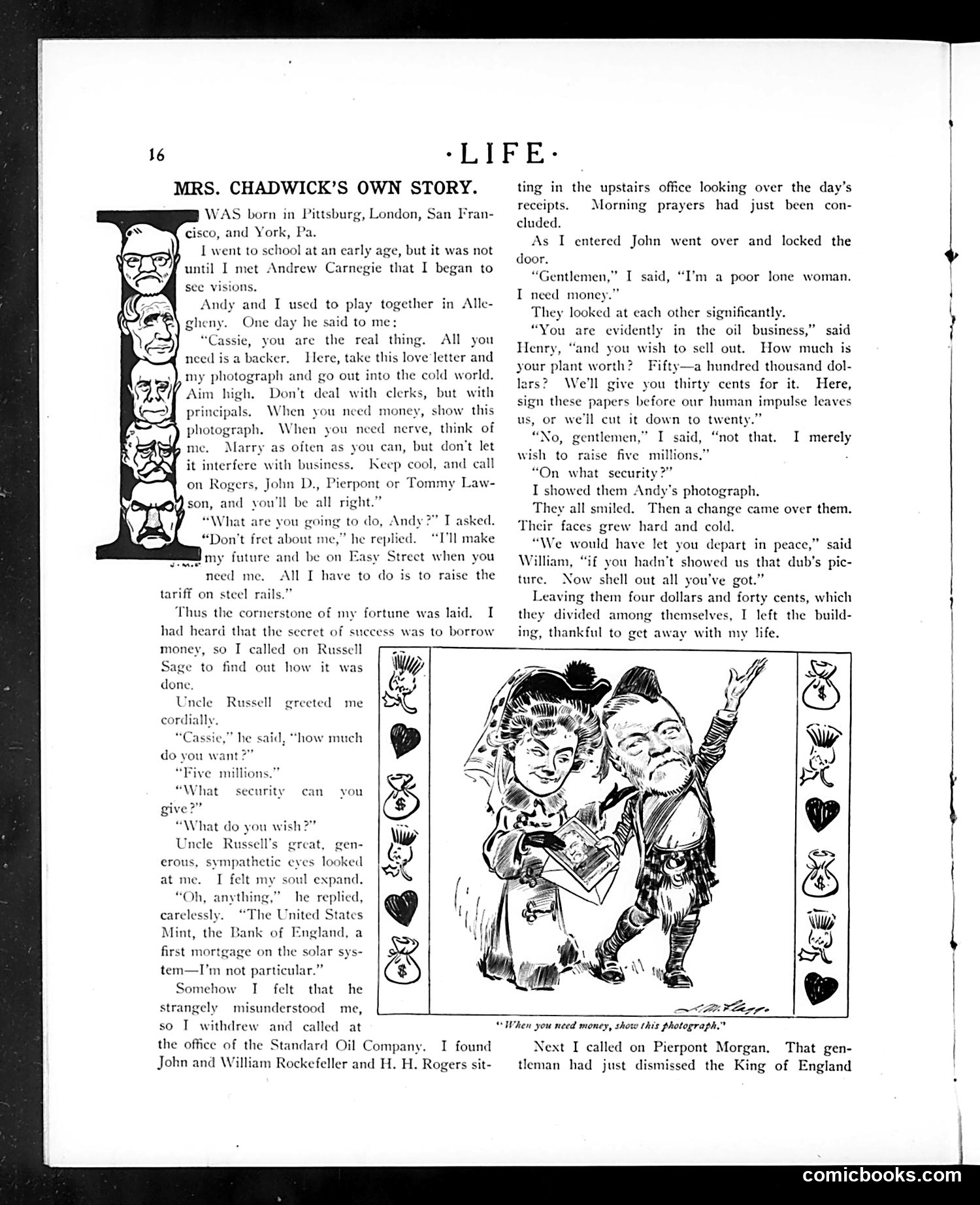
This is a mock autobiography of **Cassie Chadwick**, a real con artist who defrauded banks around 1904 by claiming to be Andrew Carnegie's illegitimate daughter. The satire ridicules both Chadwick's audacious fraud and the gullibility of wealthy industrialists. The joke: Chadwick claims Carnegie, John D. Rockefeller, Russell Sage, and J.P. Morgan all encouraged her criminal schemes and accepted dubious "security" (Carnegie's photograph, the Bank of England, even "a first mortgage on the solar system"). The cartoon shows her duping these titans of industry, who are depicted as either easily manipulated or complicit. The final line—that Morgan had "just dismissed the King of England"—hyperbolically suggests these men wielded absurd power. The satire targets wealthy financiers' arrogance and carelessness with money, and Chadwick's brazen exploitation of her name-dropping. Life magazine presents her fictional confession as dark comedy about American greed and credulity.
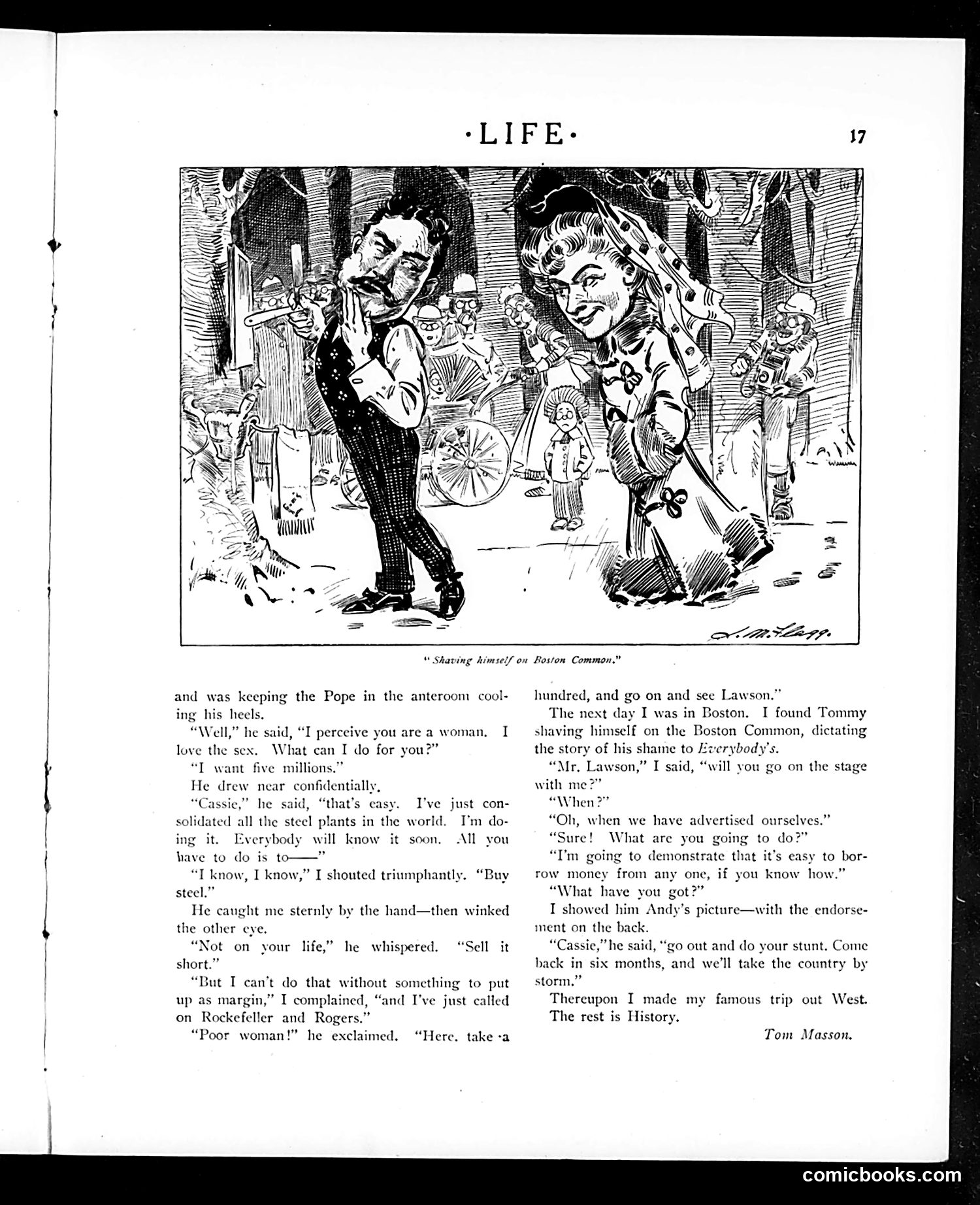
This is a satirical narrative by Tom Masson featuring caricatures of early 20th-century wealthy industrialists. The cartoon depicts a woman character ("Cassie") shaving herself on Boston Common while dictating her story—a visual joke about her shameless self-promotion. The text references prominent figures: an unnamed steel magnate (likely satirizing someone like Andrew Carnegie or J.P. Morgan), Rockefeller, and **Thomas Lawson**, a real Boston financier and muckraker known for exposing financial manipulation. The satire mocks: - **Stock market manipulation**: advice to "sell short" and use margin trading - **Wealthy industrialists' arrogance**: the magnate's casual consolidation of "all the steel plants" - **Celebrity self-promotion**: Lawson's willingness to stage a public stunt for publicity The humor targets gilded-age financial schemes and the era's scandal-mongering celebrity culture, where even shameful behavior could be monetized through publicity and endorsements.
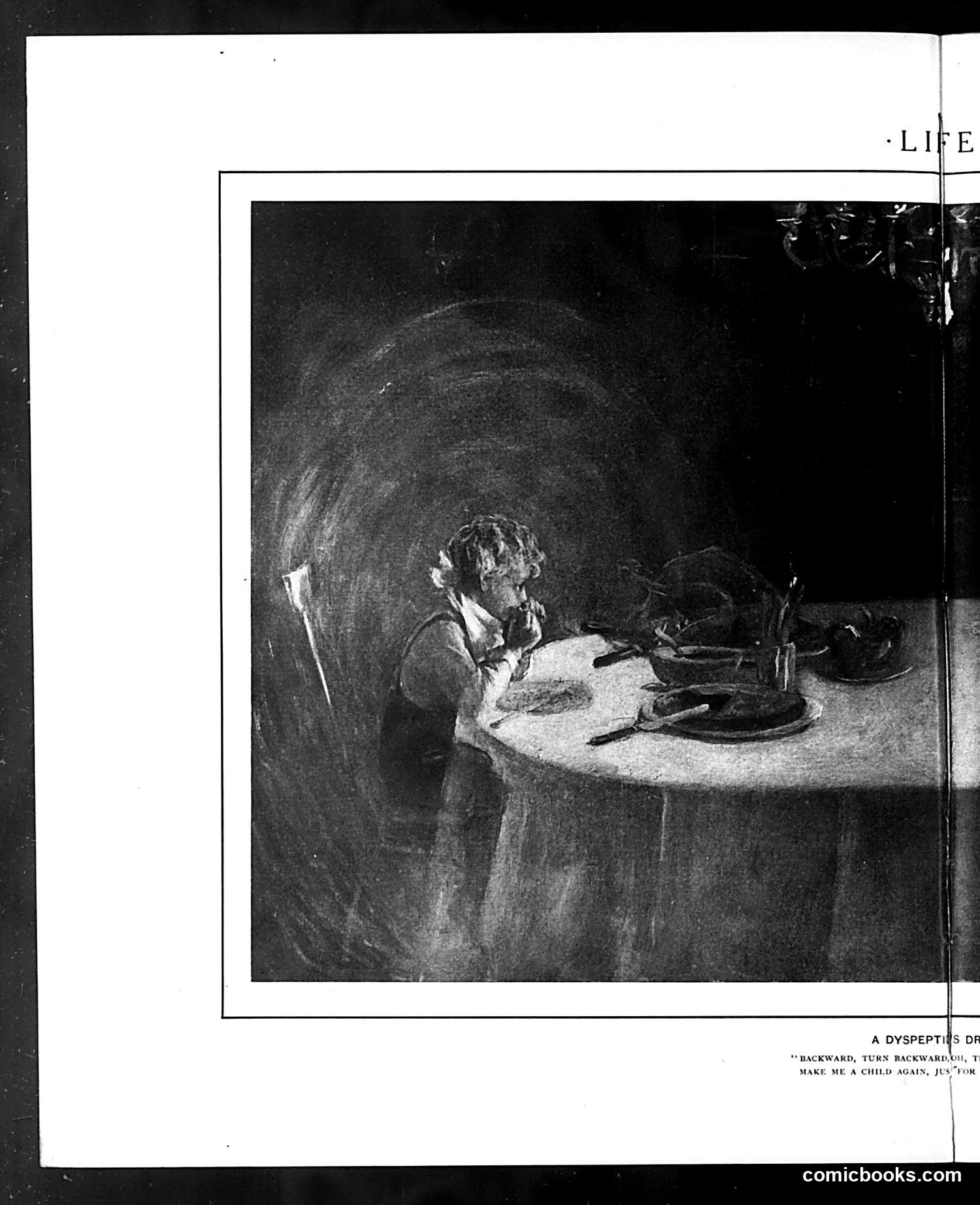
This appears to be a satirical illustration titled "A Dyspeptic Dream," depicting a figure at a dining table surrounded by swirling, ghostly imagery suggesting indigestion or troubled sleep. The caption reads: "Backward, turn backward, O time in your flight, / Make me a child again, just for tonight." This is a parody of the famous 1886 poem "Rock Me to Sleep" by Elizabeth Ackley Allen. The satire plays on the nostalgic desire to return to childhood innocence, but subverts it through the digestive nightmare premise—suggesting that adult anxieties and physical ailments (dyspepsia/indigestion) prevent such escape. The ghostly, unsettling visual treatment transforms what might be a sentimental wish into something uncomfortable and darkly comic, mocking both romantic nostalgia and the physical realities of aging.
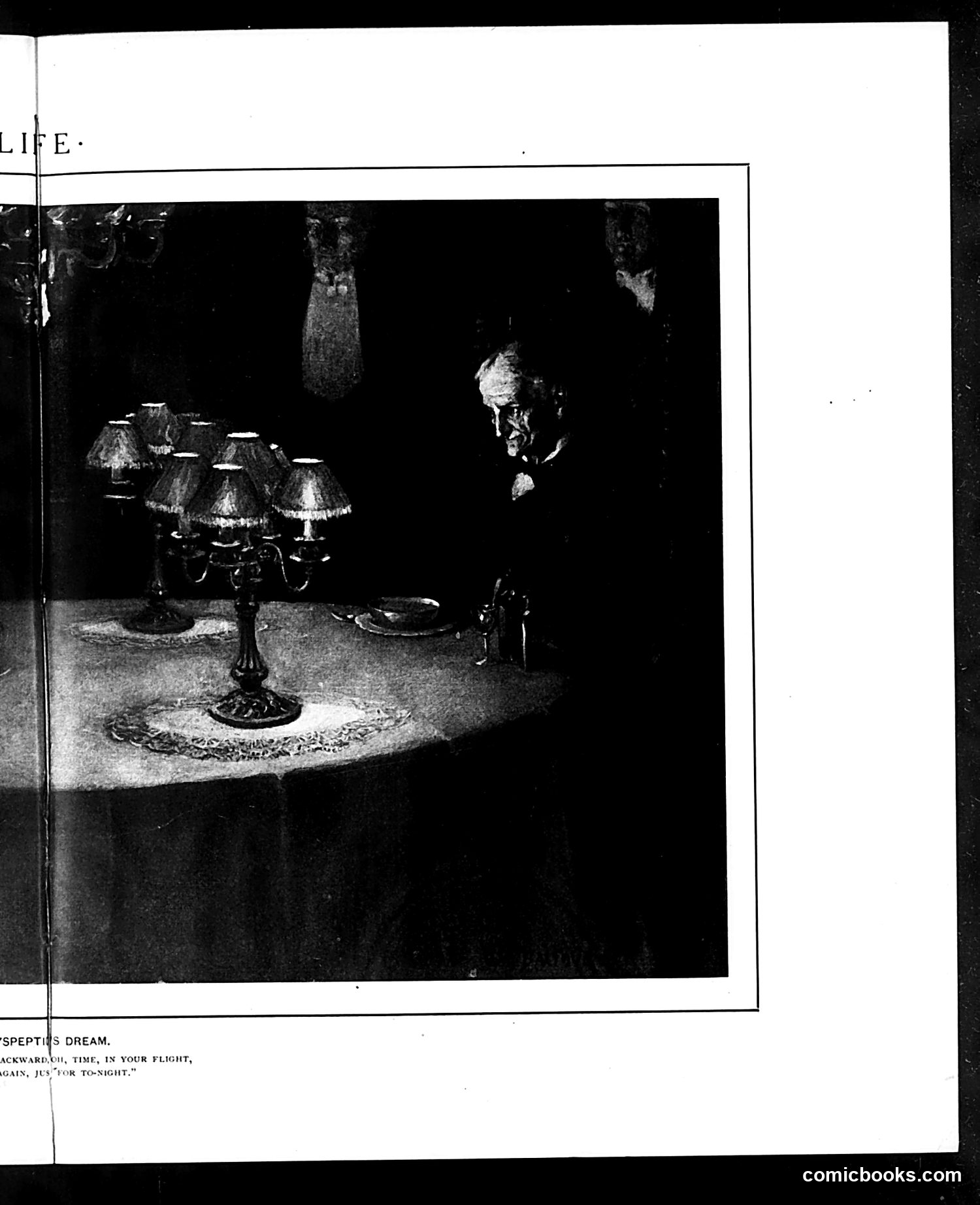
This appears to be a theatrical or dramatic scene rather than a political cartoon. The image shows a figure in period dress (likely late 19th or early 20th century) gazing at an ornate multi-armed lamp or candelabra on a draped table in darkened surroundings. The OCR'd text references "Septiys Dream" and quotes about time in flight ("Backward, oh, time, in your flight"), suggesting this illustrates a literary or theatrical work—possibly a romantic or fantastical scene. The dramatic lighting and staging indicate this may be documenting a stage production rather than satirizing current events. Without clearer context about which specific work "Septiys Dream" references, the exact satirical or narrative meaning remains unclear from this image alone.
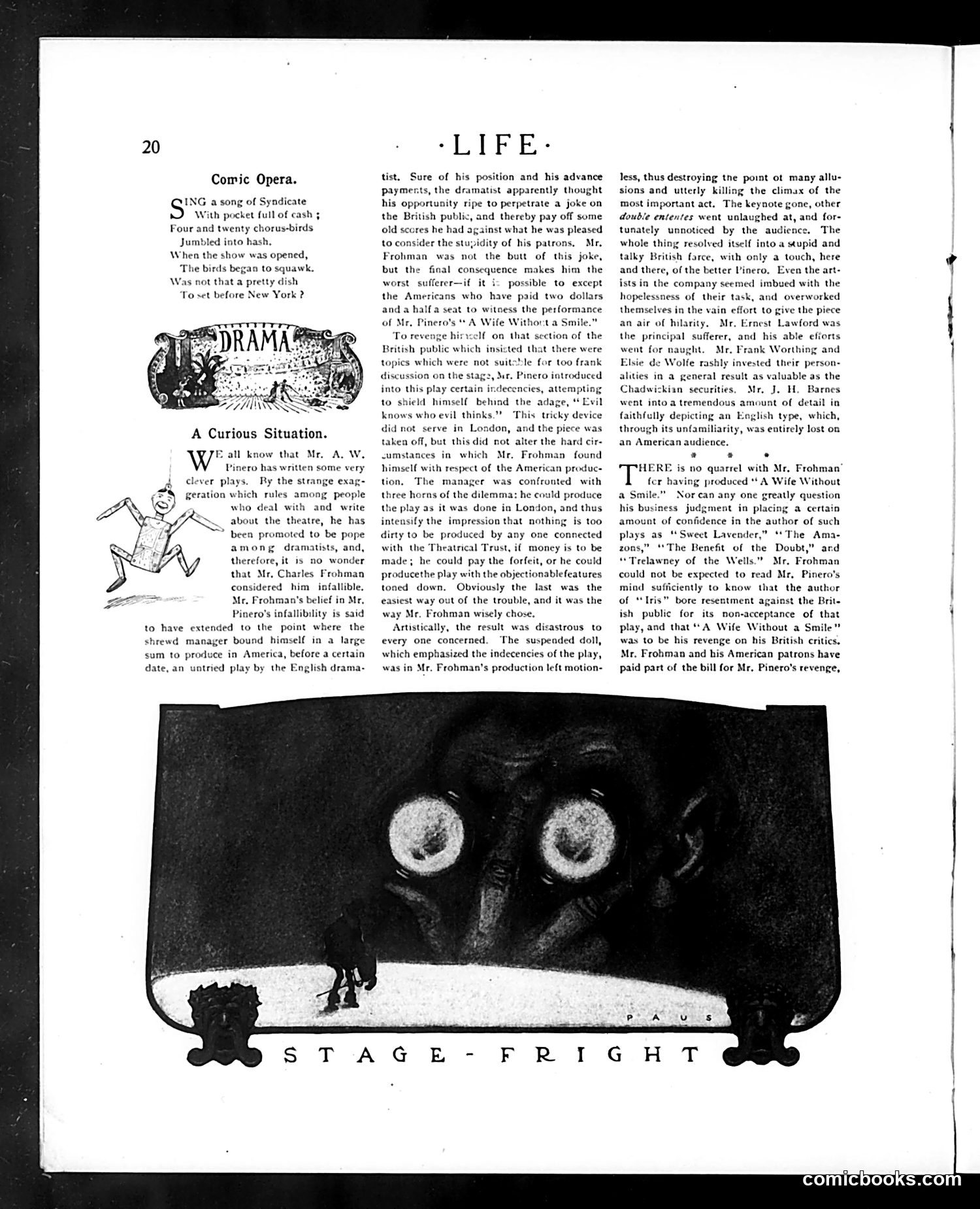
This page satirizes theatrical business practices of the early 1900s. The "Comic Opera" verse mocks the Syndicate system—a theatrical trust controlling Broadway productions—which bundled inferior shows for profit ("pocket full of cash," "four and twenty chorus-birds / Jumbled into hash"). The main article targets impresario **Charles Frohman** and British playwright **Arthur Wing Pinero**. The satire explains that Frohman, overestimating Pinero's infallibility, contracted to produce Pinero's untried play "A Wife Without a Smile" in America. The joke: Pinero allegedly inserted indecent material as revenge against the British public's prudishness. When Frohman removed these elements for American audiences, he accidentally destroyed the play's comedic structure—the "suspended doll" prop that emphasized the jokes became pointless. The result was a "stupid and talky British farce," wasting talent like **Elsie de Wolfe**. The satire mocks both theatrical monopolies and the collision between British theatrical conventions and American sensibilities.
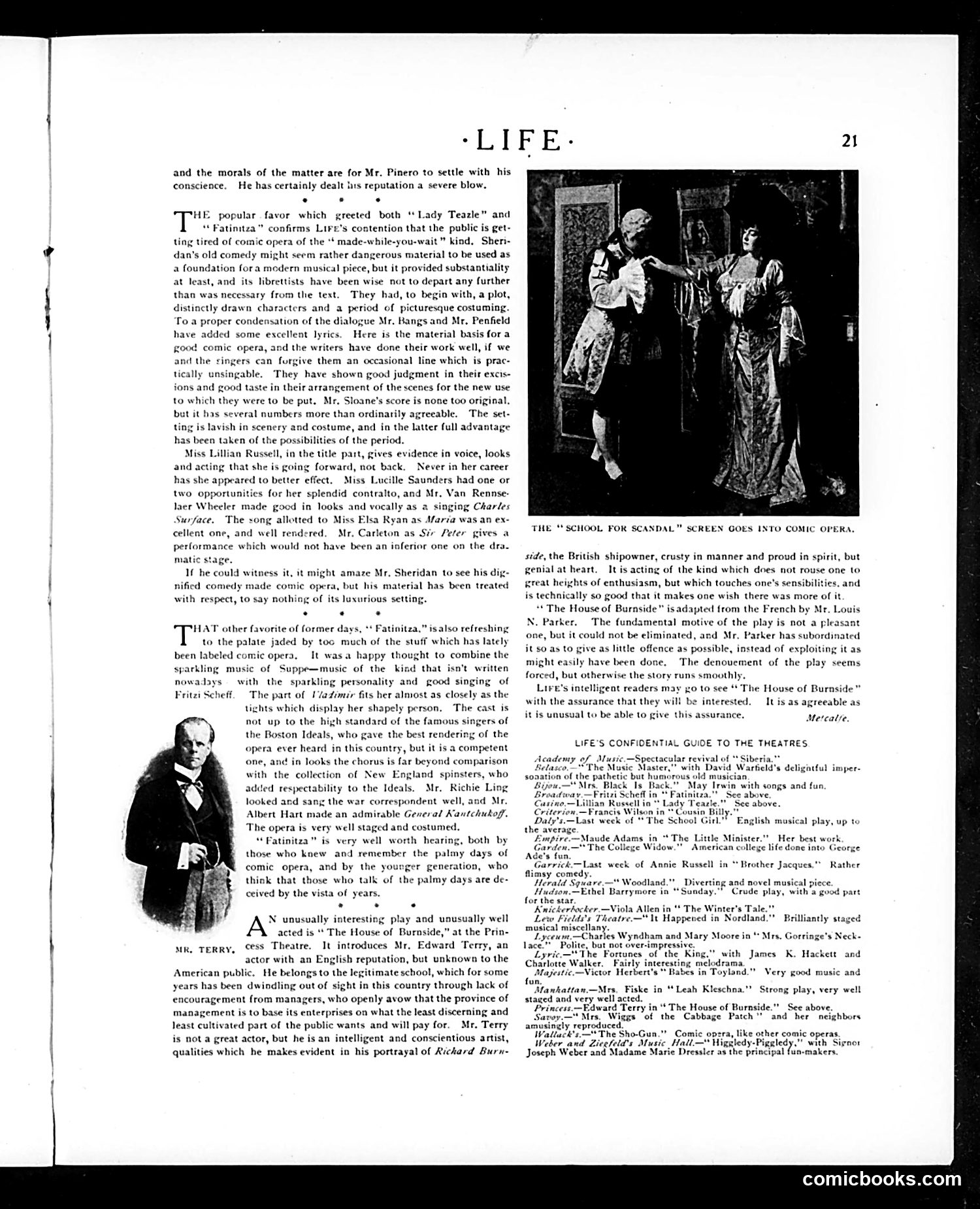
This page reviews theatrical productions, primarily discussing musical adaptations and stage performances. The key content focuses on: **Main Reviews:** - Adaptations of classic plays into comic operas ("Lady Teazle" and "Fatinitza"), which Life praises for moving away from frivolous "made-while-you-wait" comic opera toward more substantive material - Lillian Russell's starring role in the title part, praised for her voice and acting - "The House of Burnside," featuring English actor Edward Terry (pictured), presented as introducing sophisticated legitimate theater rather than lightweight entertainment **The Satire's Point:** Life critiques the popular trend of adapting serious classical comedies (like Sheridan's work) into musical vehicles, though acknowledges this represents an improvement over purely commercial comic operas. The reviews suggest Life's editorial stance favoring substantive drama over formulaic entertainment—a common position for the magazine's educated readership. The photograph of Mr. Terry underscores Life's interest in theatrical legitimacy and cultural sophistication.
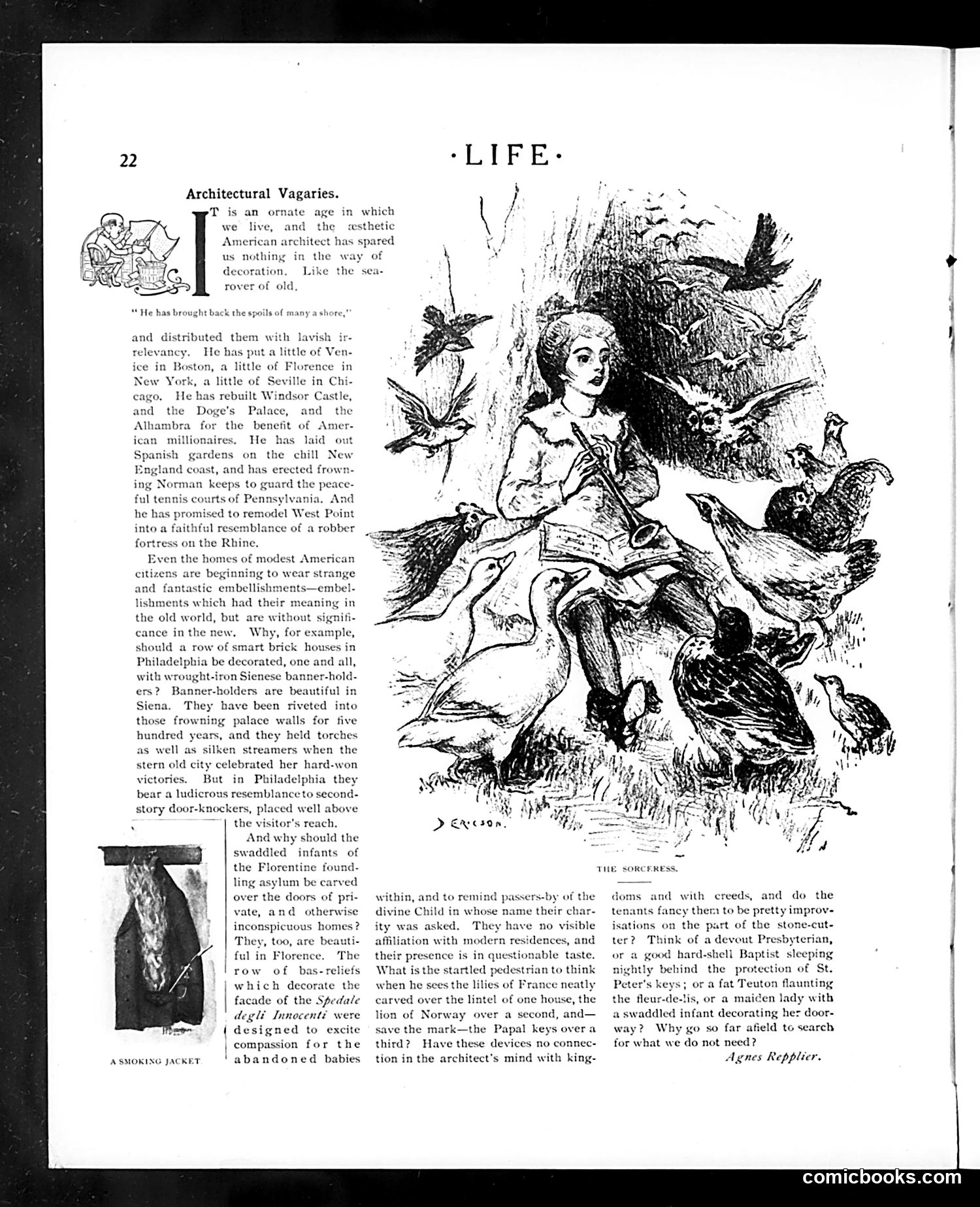
This article by Agnes Repplier satirizes wealthy American architects and homeowners who indiscriminately copy European architectural ornaments without understanding their original meaning or context. The piece attacks a specific architect (likely Stanford White, though unnamed) who has scattered Italian, Spanish, and Norman elements across America—banner-holders from Siena, foundling-hospital reliefs from Florence, Papal keys, Norwegian lions, and French fleur-de-lis on Philadelphia rowhouses. Repplier's satire targets the absurdity: these decorative elements are meaningless in American homes. A banner-holder designed to hold medieval torches becomes a ridiculous door-knocker. Symbols of Catholic charity or European nobility serve no purpose on Presbyterian or Baptist homes. The illustration "The Sorceress" appears to accompany this critique of imported artificiality, suggesting the almost magical spell these foreign styles cast over American taste. Repplier argues Americans should develop their own architectural identity rather than slavishly copying Europe's historical ornamentation.
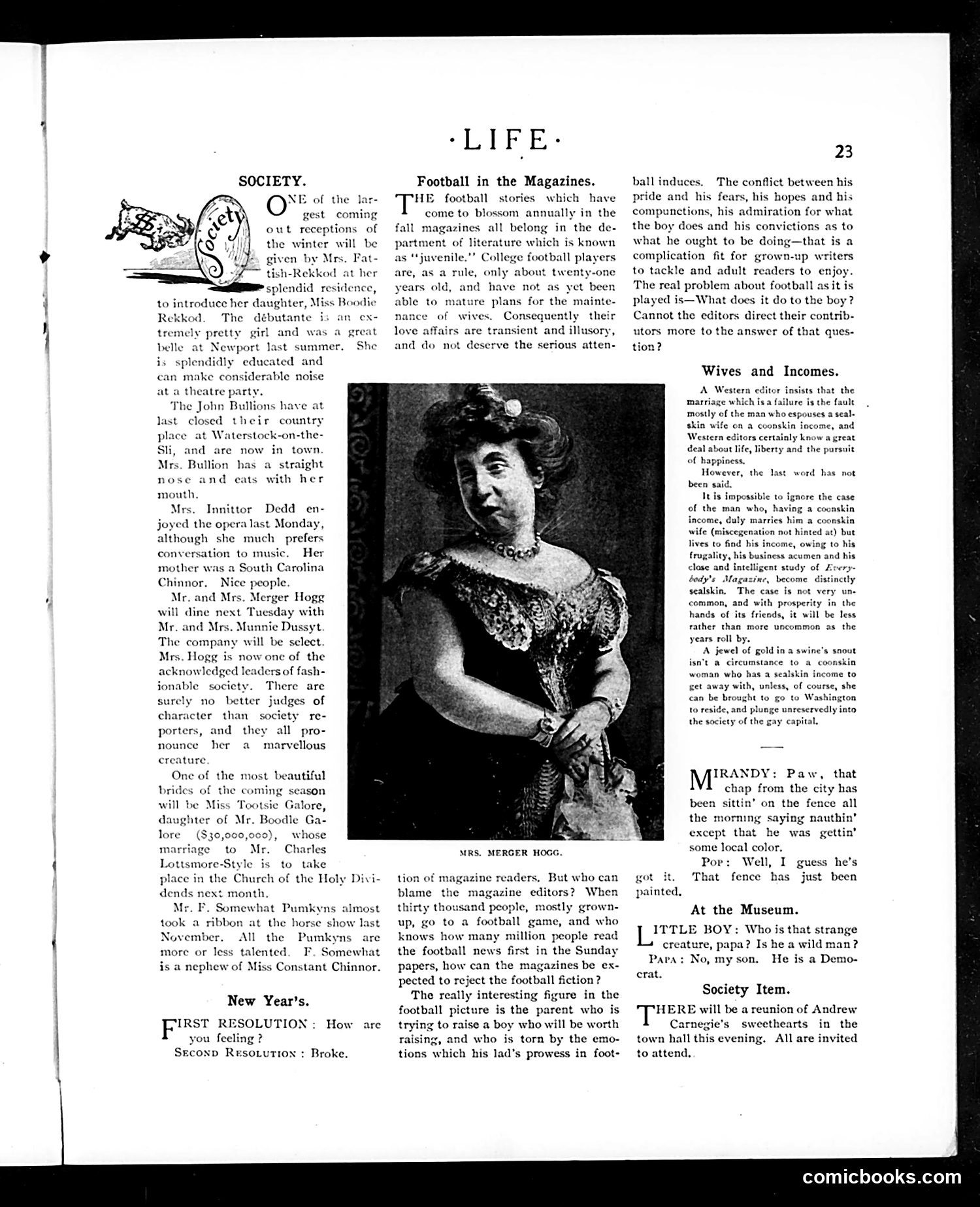
This page combines society gossip with satirical editorials. The **society section** mocks wealthy elites through absurdly transparent pseudonyms: "Mrs. Fattish-Rekkod" (fat-fish-reckoned?), "John Bullions," and "Merger Hogg"—names designed to ridicule their character flaws or business practices. The tone is deadpan ridicule of shallow debutante culture and society reporters' superficial judgments. The **football editorial** critiques magazine editors for publishing juvenile football fiction rather than exploring meaningful themes: the psychological toll on parents whose sons play the sport. The **"Wives and Incomes" section** satirizes mismatched marriages where ambitious men marry "above their means," then humorously reverses the scenario—when a man *becomes* prosperous, his wife's extravagant tastes make his wealth feel insufficient anyway. The racist language ("coonskin" and "sealskin" as class markers) reflects period attitudes but the satire targets economic anxiety and women's consumption patterns.
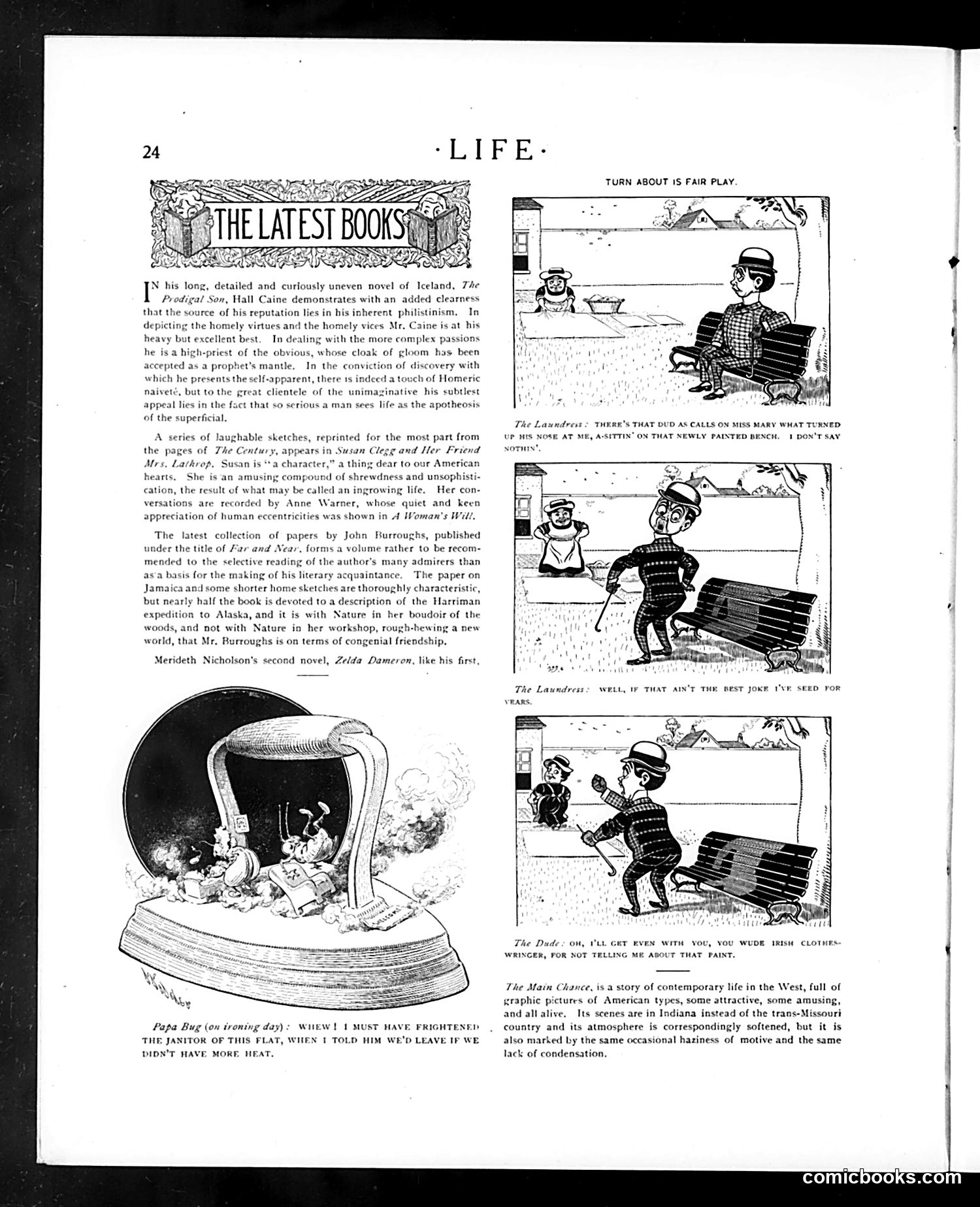
This page combines literary criticism with humorous comic strips depicting working-class domestic life. The title "Turn About Is Fair Play" appears to reference the comics below, which show servants or working people getting revenge on their employers or social betters. The three illustrated strips feature dialect-heavy dialogue typical of early 20th-century American humor: a laundress complaining about a woman who snubbed her, and a domestic worker threatening retaliation against an employer over paint damage. The "Papa Bug" cartoon at left shows an exasperated tenant threatening to leave over inadequate heat. These comics mock both the servants' resentment of class treatment and the employers' obliviousness. The page's upper section reviews contemporary novels by Hall Caine, John Burroughs, and Meredeth Nicholson—serious literary criticism contrasted sharply against the lowbrow humor below, itself perhaps satirizing Life's mixed readership.
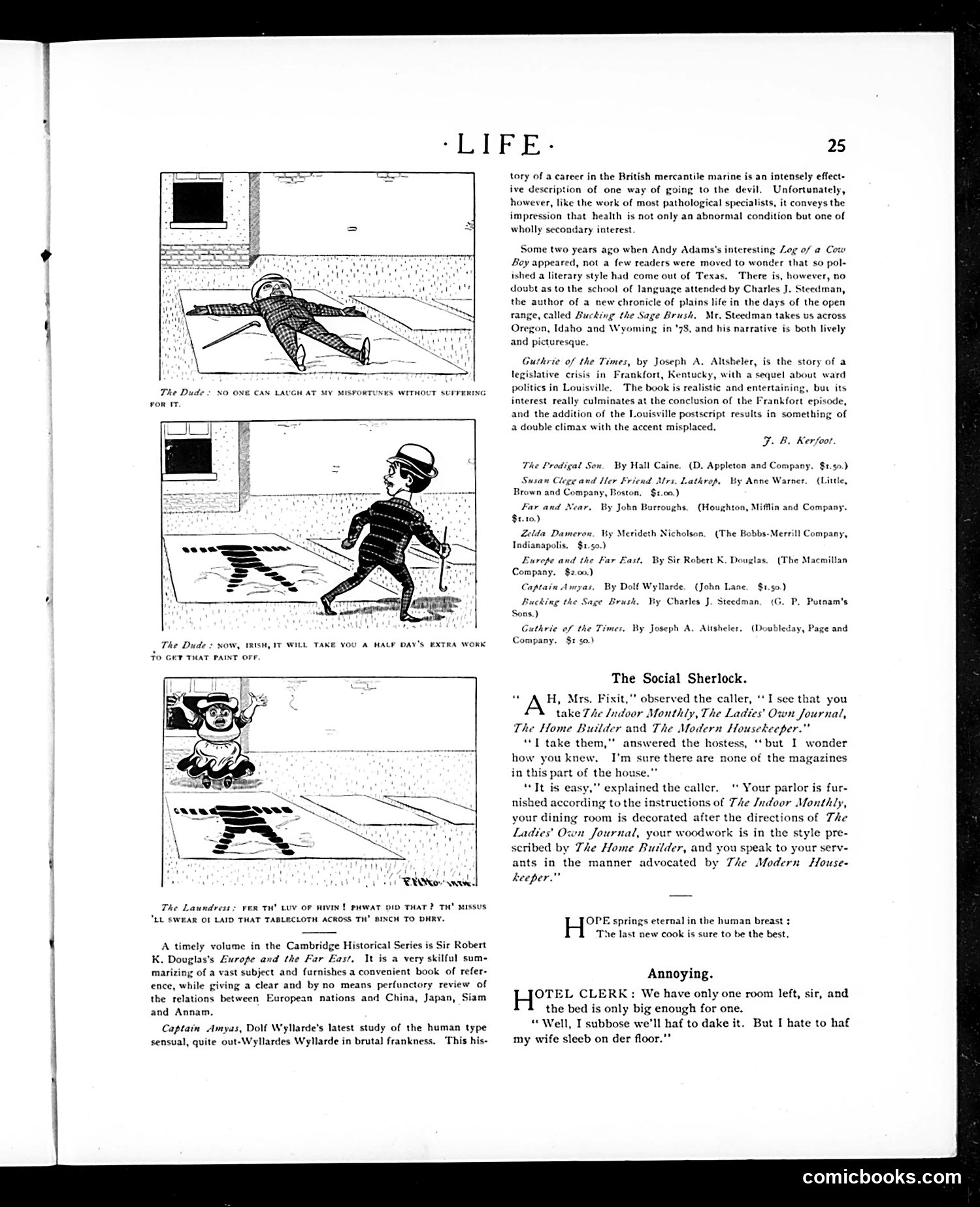
This page contains three cartoon strips satirizing American domestic life and social pretension: **"The Dude" series** mocks a fashionable man who carelessly gets paint on his clothes, then suffers comical consequences trying to remove it—the joke being that his vanity about appearance causes him greater misfortune. **"The Social Sherlock"** satirizes women's magazine culture. A caller demonstrates she can deduce a hostess's magazine subscriptions (*The Indoor Monthly*, *Ladies' Own Journal*, etc.) by observing how her home is decorated and servants are managed—all following magazine instructions. The satire targets how women blindly follow magazine advice rather than developing independent taste. **"The Laundress"** shows working-class dialect humor, with an Irish laundress explaining how she dried a tablecloth. The page's lower half reviews contemporary books, including Dolf Wyllarde's *Captain Amyas*, described as "sensual" and brutally frank. Together, these pieces satirize consumer culture, class aspirations, and the emerging "advice industry" of women's magazines during the early 20th century.
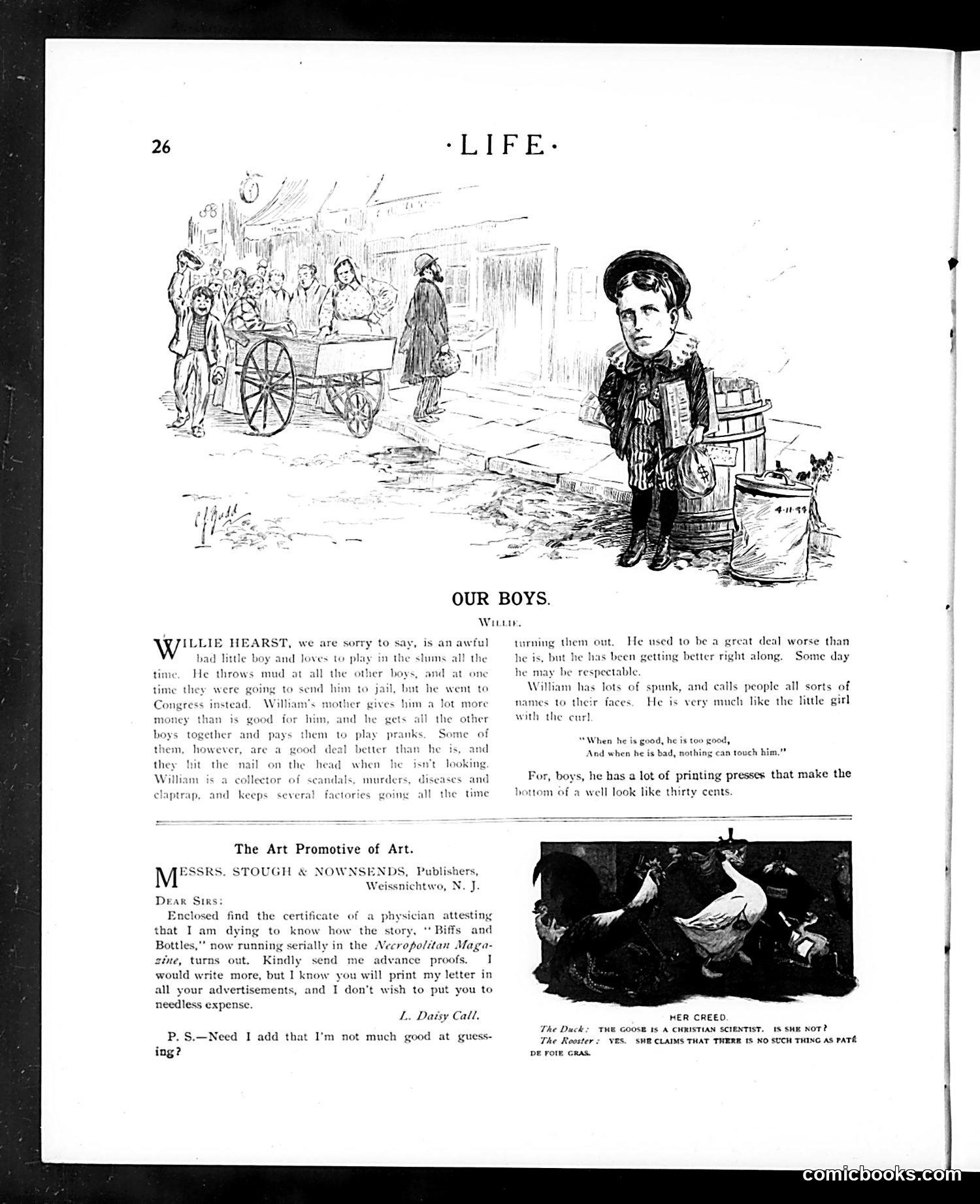
This page contains two distinct pieces of satire: **"Our Boys: Willie"** — A mock-serious character sketch mocking a corrupt political figure (likely a contemporary congressman). The satire lies in the progression: Willie is a bad boy who throws mud and should go to jail, but instead "went to Congress." The joke is that Congress itself is presented as a natural destination for a delinquent—implying that congressmen are essentially criminals. His mother gives him money, he collects scandals, and he runs printing presses producing worthless material. This is 19th-century political satire attacking congressional corruption and incompetence. **"The Art Promotive of Art"** — A humorous letter from a fake reader ("L. Daisy Call") claiming to be dying and asking for advance proofs of a serialized story. The P.S. joke reveals the writer is "not much good at guessing," implying the letter itself is fake/silly. **The illustration at bottom** appears to be unrelated satire about Christian Science, mocking its claims through animal characters. The overall tone is lighthearted political cynicism typical of *Life* magazine's satirical tradition.
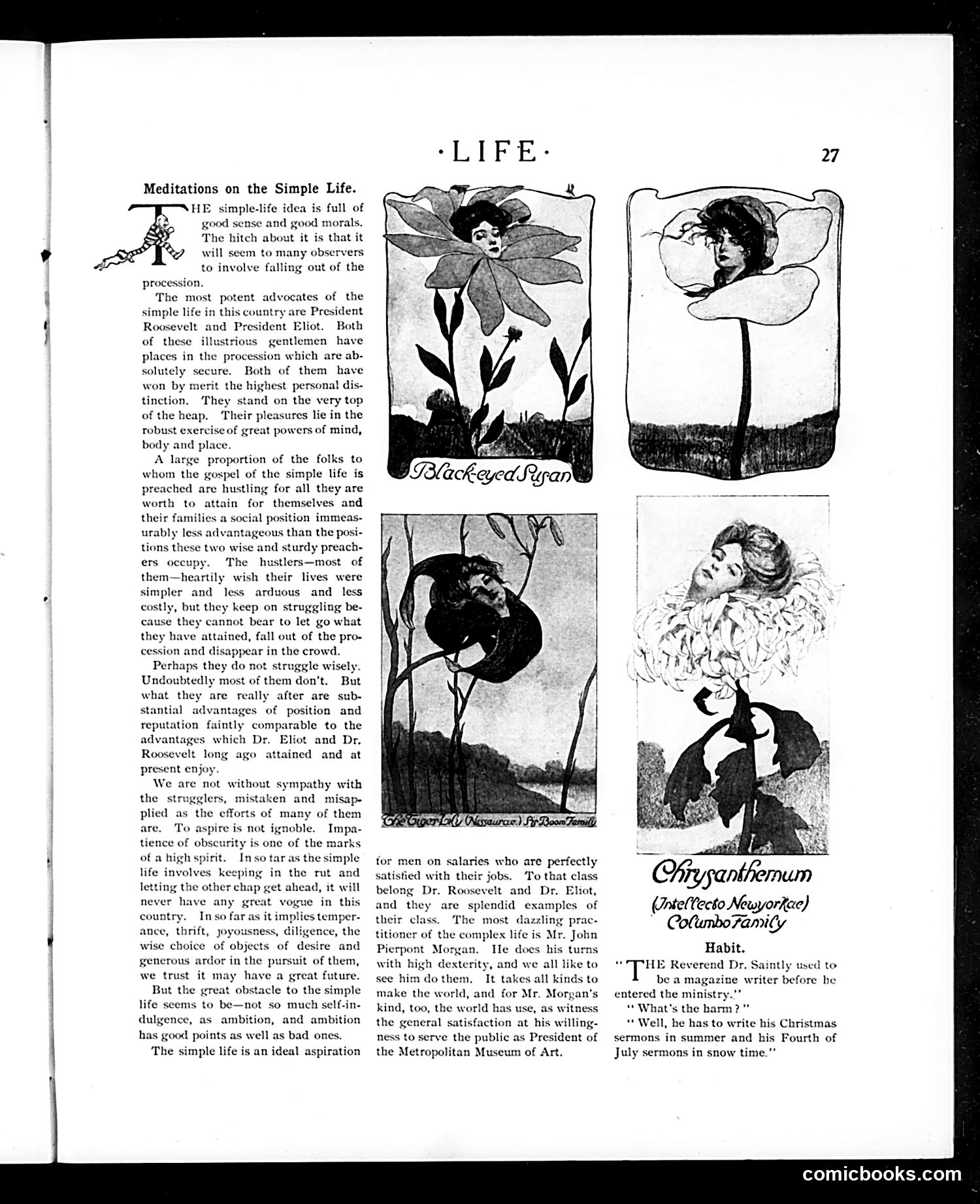
This satirical essay critiques the "simple life" movement championed by President Theodore Roosevelt and Harvard President Charles W. Eliot. The text argues these leaders advocate simplicity from positions of absolute security and achievement—they've already "won" and occupy the "top of the heap." The accompanying botanical illustrations (Black-eyed Susan, what appears to be morning glory, and chrysanthemum) are ironic visual metaphors for simplicity itself. The essay's central irony: ordinary working people cannot afford the simple life because ambition drives them to accumulate status and wealth. They're trapped in the "procession"—caught pursuing social advancement they feel compelled to maintain. The piece contrasts Roosevelt and Eliot with John Pierpont Morgan, the wealthy industrialist, suggesting the "complex life" of ambition and acquisition has its own validity. The final joke about "Reverend Dr. Saintly" underscores how even spiritual figures cannot escape society's pressures—he must write summer Christmas sermons in advance, failing to live simply or naturally.
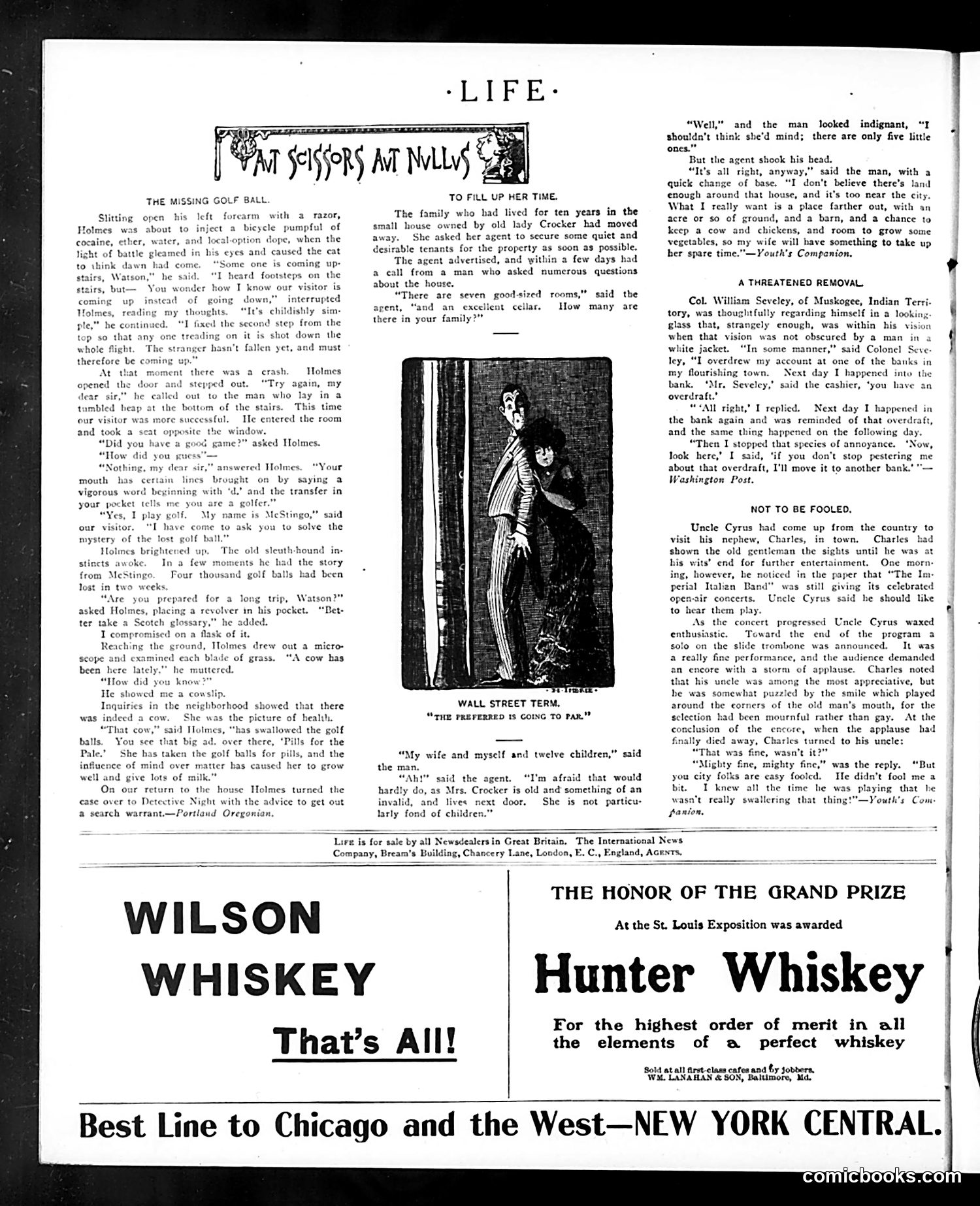
This page contains several satirical short stories typical of early 1900s Life magazine humor: **"The Missing Golf Ball"** parodies Sherlock Holmes detective stories. Holmes solves a mystery of 4,000 missing golf balls through absurdly simple deduction—he notices a cowslip flower, concludes a cow ate them, and the cow has swallowed the golf balls mistaking them for pills. The satire mocks both Holmes's overwrought deductive methods and the era's obsession with golf. **"To Fill Up Her Time"** and **"Wall Street Term"** are brief domestic humor pieces about a family seeking housing and stock market terminology, respectively. The page also includes period advertisements for Wilson Whiskey and Hunter Whiskey, reflecting the magazine's commercial content. The overall tone is gentle, class-conscious humor aimed at middle-class readers familiar with Conan Doyle's stories and contemporary social conventions around property, family size, and leisure activities.
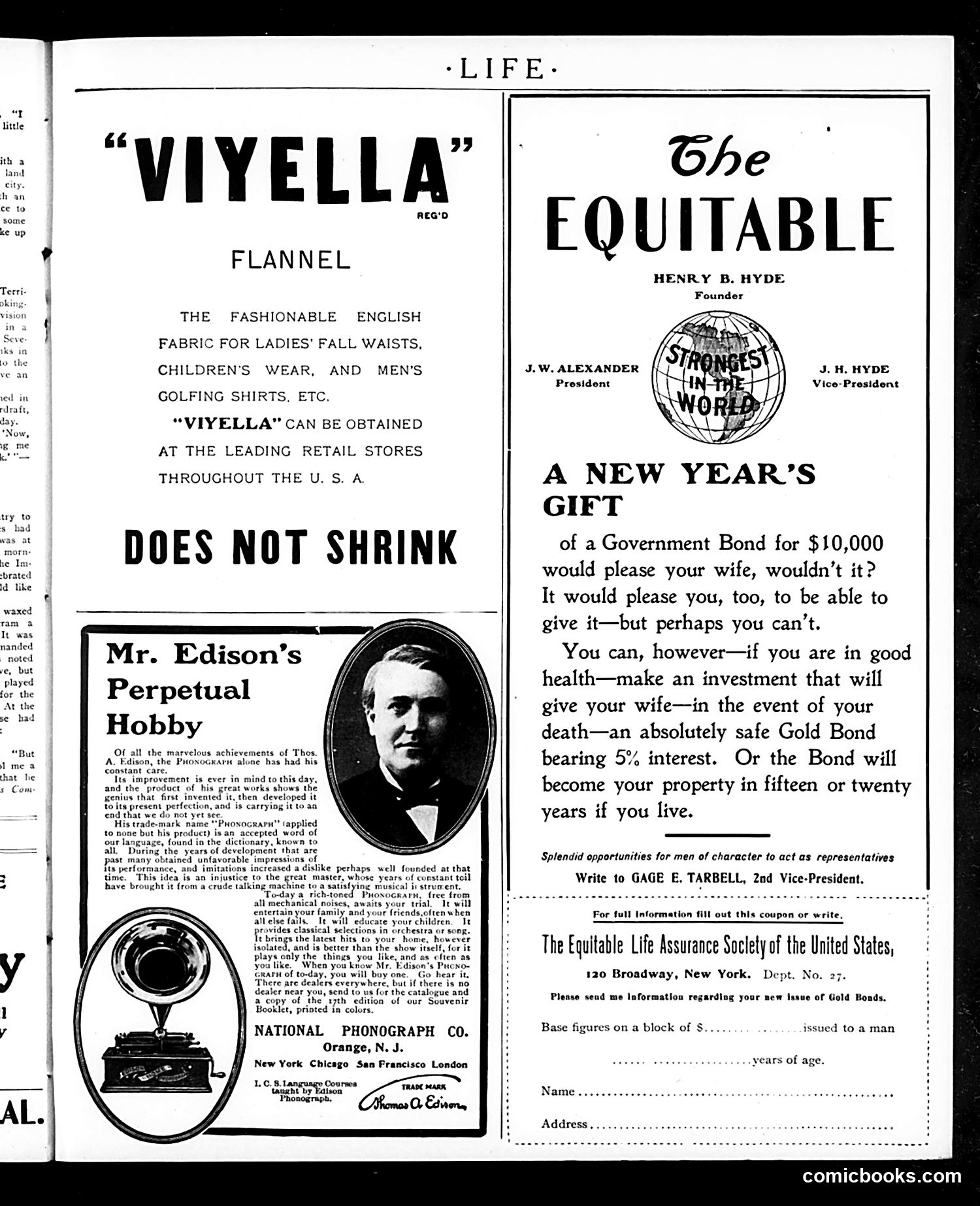
This page is primarily **advertising**, not satire. It contains three commercial promotions: 1. **Viyella Flannel** (top left): A British fabric brand marketed for ladies' waists and men's golfing wear, emphasizing it "does not shrink." 2. **Edison's Phonograph** (bottom left): A lengthy advertisement celebrating Thomas Edison's ongoing refinement of the phonograph. It positions the device as an entertainment and educational tool, addressing skepticism about earlier crude models by emphasizing decades of improvement. The text suggests visiting dealers or requesting a catalog. 3. **Equitable Life Insurance** (right): An ad for life insurance "Gold Bonds" offering 5% interest—pitched as a practical New Year's gift alternative when a $10,000 government bond isn't affordable. It targets health-conscious men seeking to provide for wives. The page reflects early 20th-century consumer culture: technological pride in American innovation (Edison), international fashion adoption (British fabric), and financial security products for the middle class. No political satire is evident.
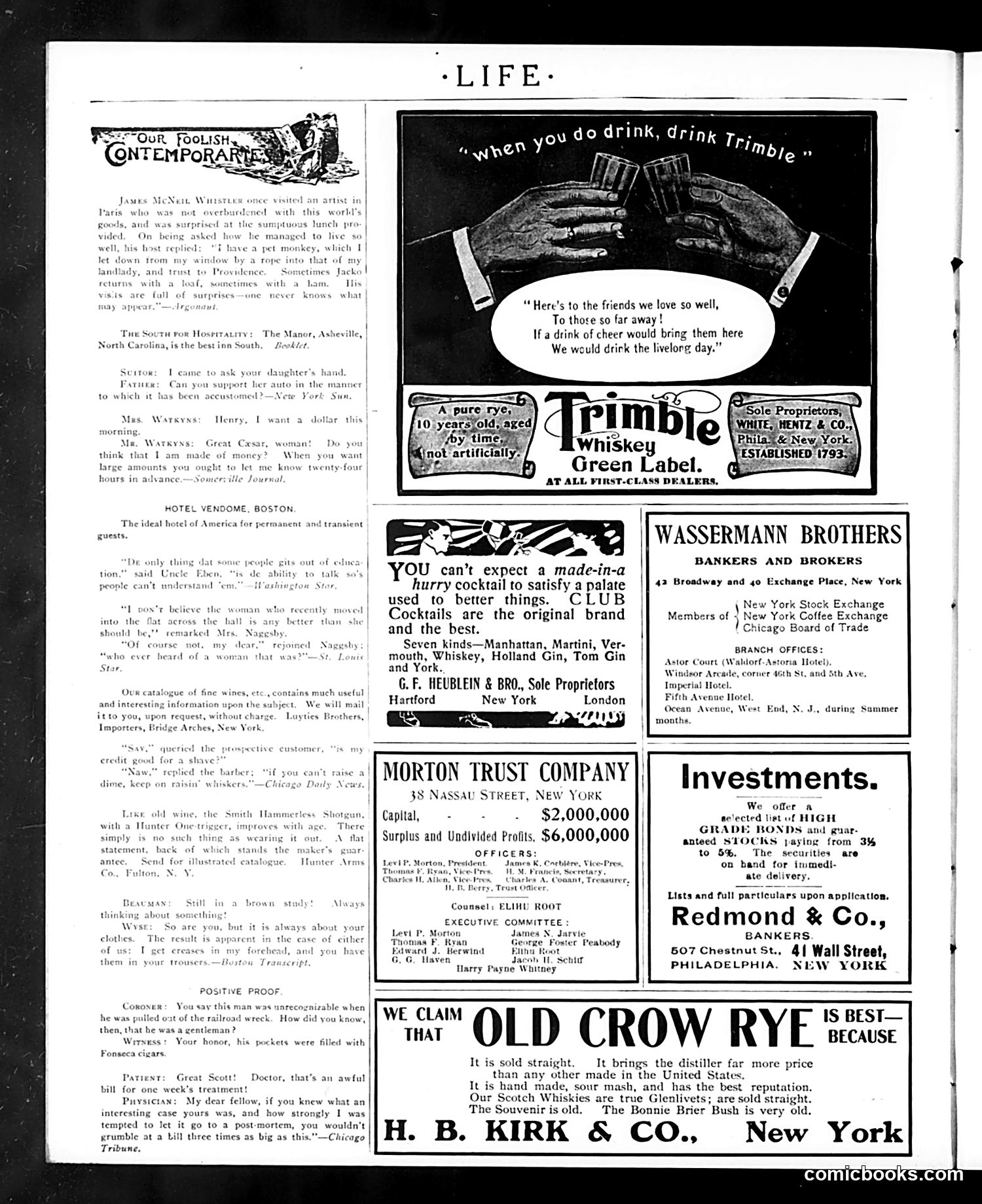
This page is primarily **advertising**, dominated by liquor and financial services ads typical of early 20th-century American magazines. The satirical "Our Foolish Contemporaries" column at top-left contains brief humorous anecdotes with no political cartoon. The main visual content features a **Trimble Whiskey advertisement** showing two hands toasting, with a sentimental verse about absent friends—a common advertising trope romanticizing alcohol consumption. Below it, competing whiskey brands (Club Cocktails, Old Crow Rye) make product claims, while the Heublein Brothers promote their cocktail mixers. The page's humor lies in the **juxtaposition**: moralistic or sentimental quotes about friendship and drinking appear alongside aggressive commercial pitches. One ad boasts of "made-in-a-hurry" cocktails; another claims Old Crow is "best" because it's expensive and hand-made. The scattered anecdotes mock contemporary social pretensions (about money, education, women) typical of Life's satirical style, but lack coherent political commentary. This reflects **Prohibition-era advertising** (pre-1920) when liquor companies still openly marketed their products.
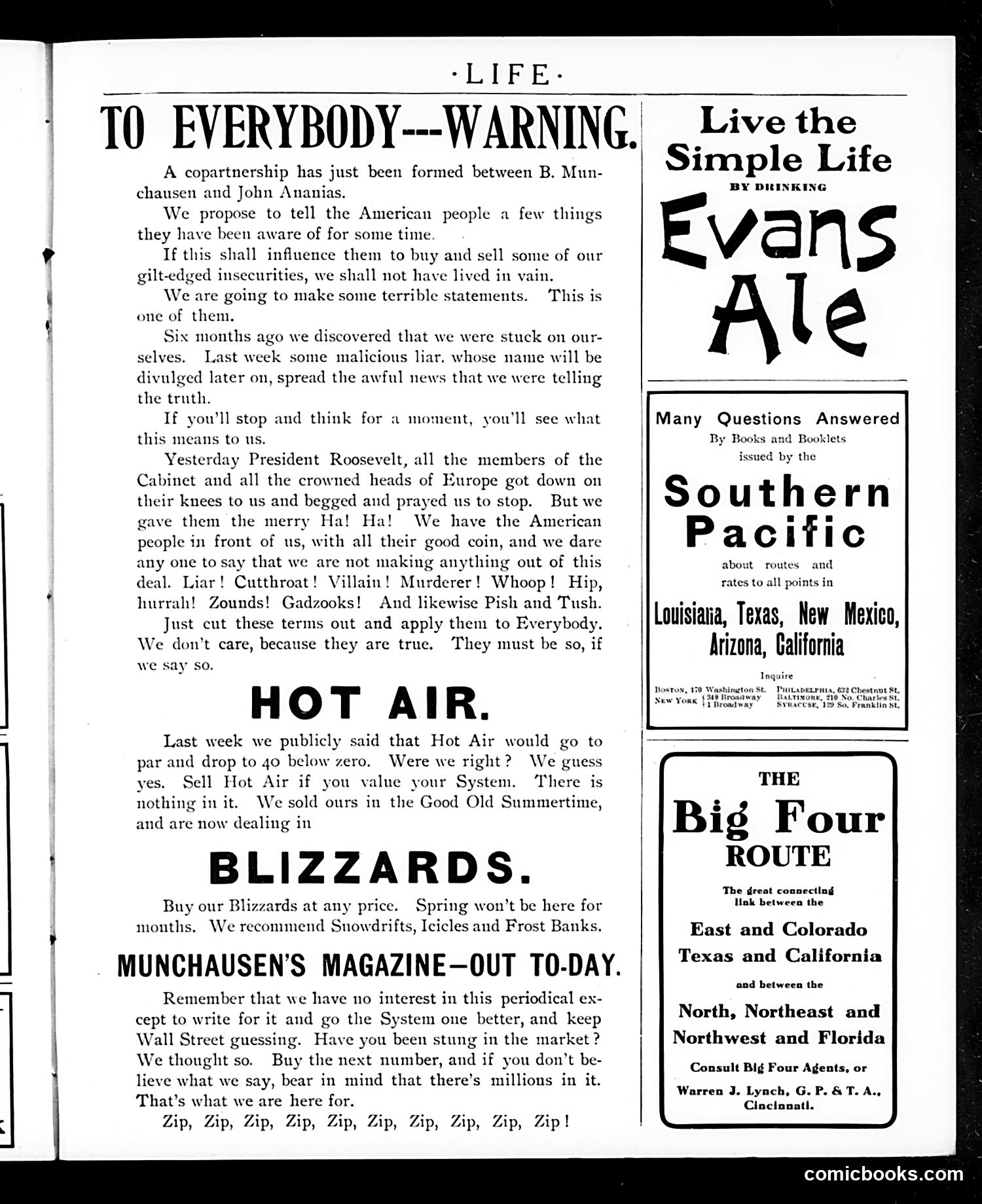
This is a scathing editorial attack on financial fraud and market manipulation. Life—using the fictional partnership of "B. Munchausen" (the notorious liar) and "John Ananias" (biblical deceiver)—mocks Wall Street operators who make false claims to swindle the public. The satire targets: - **Stock swindlers** selling worthless "gilt-edged insecurities" (fake securities) - **Market manipulation**: they boast of selling "Hot Air" and now "Blizzards"—metaphors for worthless investments - **Political complicity**: even President Roosevelt and European leaders allegedly beg them to stop (satirizing how powerful these fraudsters have become) The repeated insults ("Liar! Cutthroat! Villain!") are intentionally crude and theatrical, mocking the brazen audacity of con artists. The final tagline—"there's millions in it"—captures the real motive. This reflects Progressive-era skepticism of unregulated stock markets and financial schemes that devastated ordinary investors.
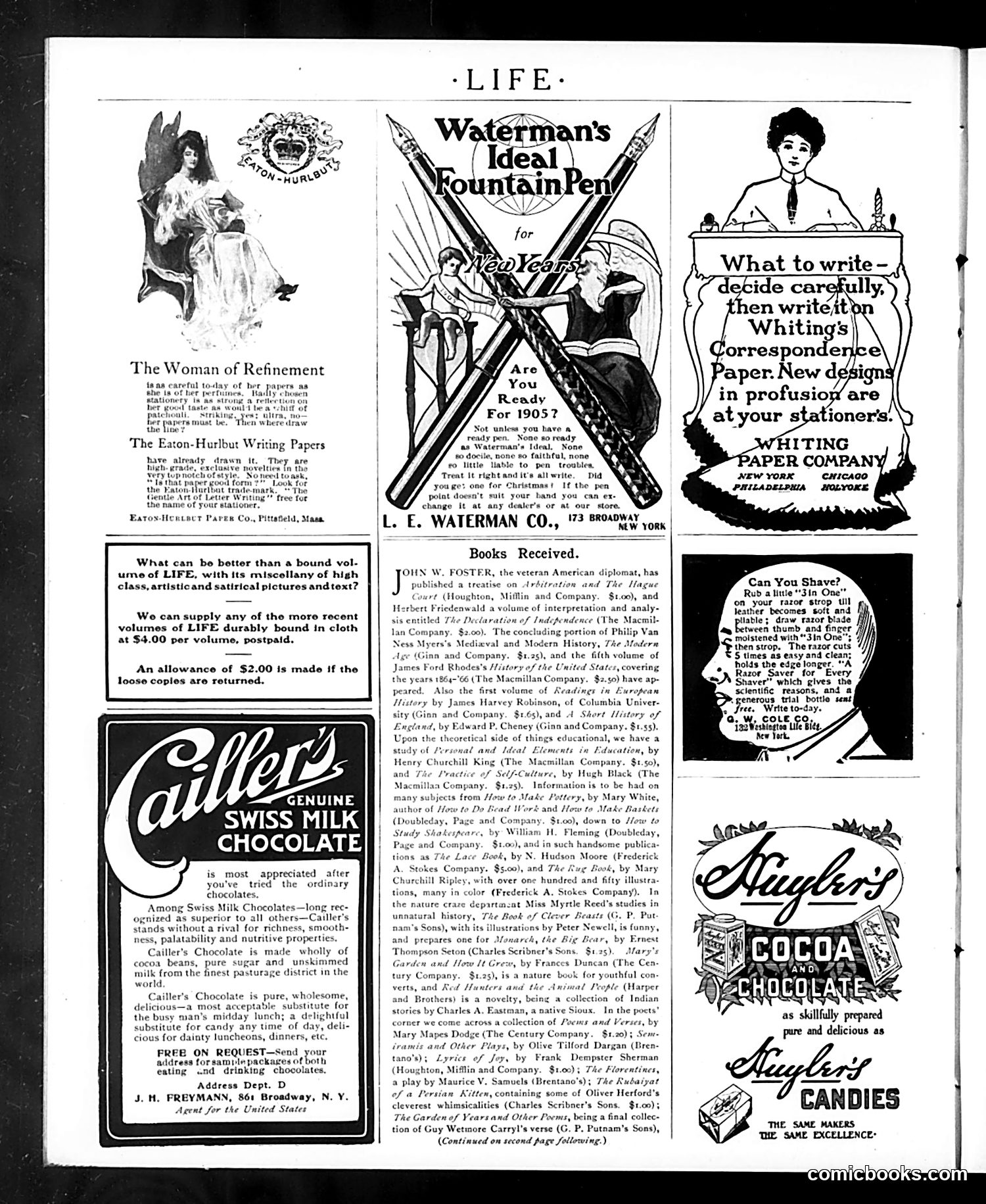
This is primarily an **advertising and book review page** from Life magazine's early 1900s era, with limited satirical content. The page features three product advertisements using period conventions: *Waterman's Ideal Fountain Pen* (center), positioned as a prestigious gift for the New Year; *Cailler's Swiss Milk Chocolate* (lower left), emphasizing European luxury and nutritional superiority; and *Stuyler's Cocoa and Candies* (right). The sole satirical element is "**The Woman of Refinement**" (top left), which mocks upper-class affectations—showing a woman of exaggerated pretension with a caption suggesting that careful stationery selection indicates social standing. This reflects Life's typical mockery of bourgeois status-consciousness. The bulk of the page comprises a "Books Received" section listing newly published titles across history, education, and literature, reflecting Life's role as a cultural arbiter for educated American readers circa 1904-1905.
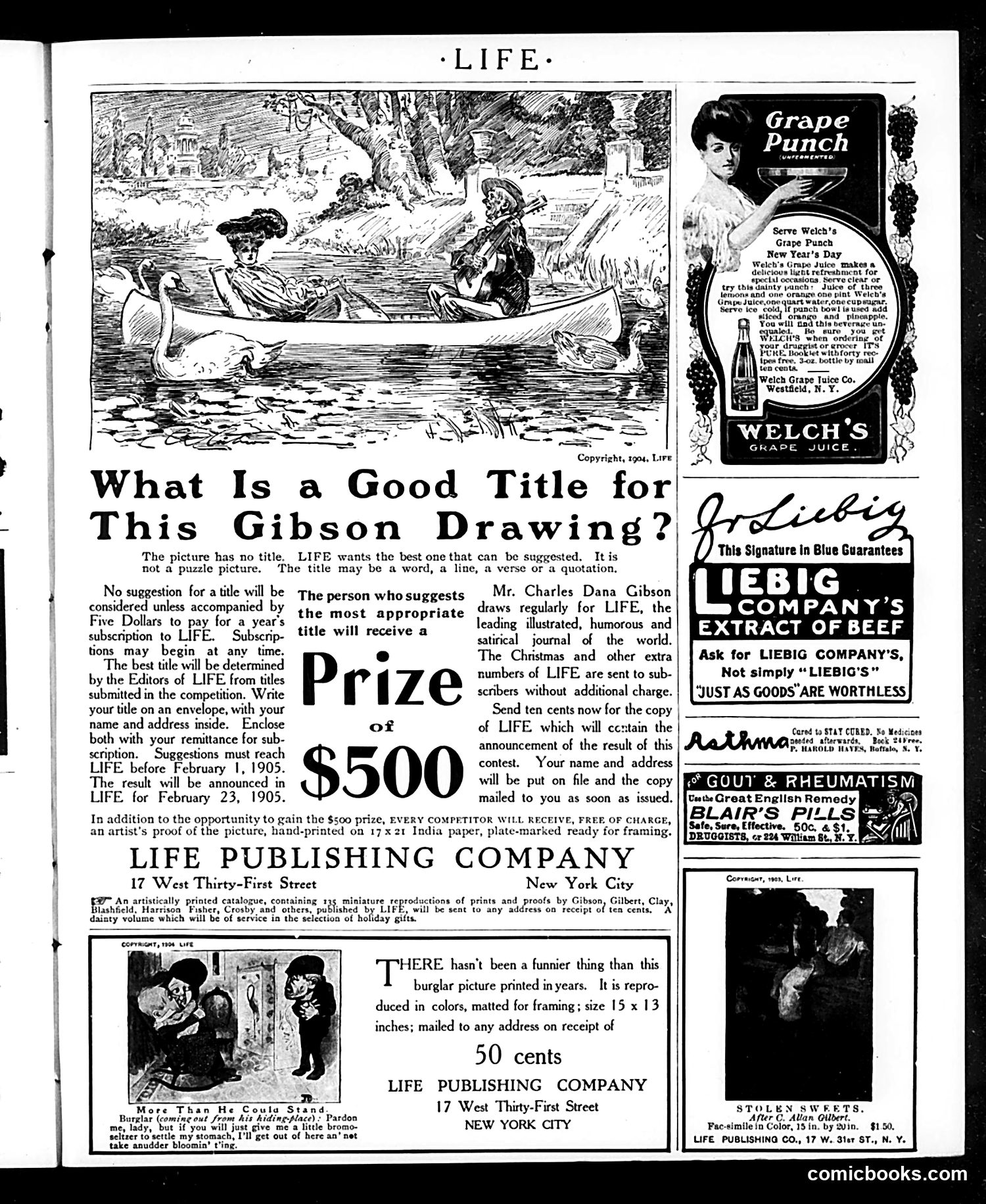
This page is primarily a **contest announcement and advertising layout** rather than political satire. The main content is a Gibson drawing contest offering a $500 prize for the best title for an illustration depicting a romantic scene by a river—a man serenading a woman in a boat. The cartoons present are: 1. **Top illustration**: A classical romantic scene (untitled, seeking reader suggestions) 2. **Bottom cartoon**: "More Than He Could Stand"—a burglar emerging from hiding to ask a lady for bromo-seltzer for his stomach, a humorous domestic intrusion scene The page is dominated by **product advertisements** (Welch's Grape Juice, Liebig's Extract of Beef, Blair's Pills for gout) and promotional offers for Life Publishing Company's prints and catalogs. This reflects Life's business model: satirical content mixed with commercial endorsements. The contest itself served dual purposes—generating reader engagement and selling subscriptions.
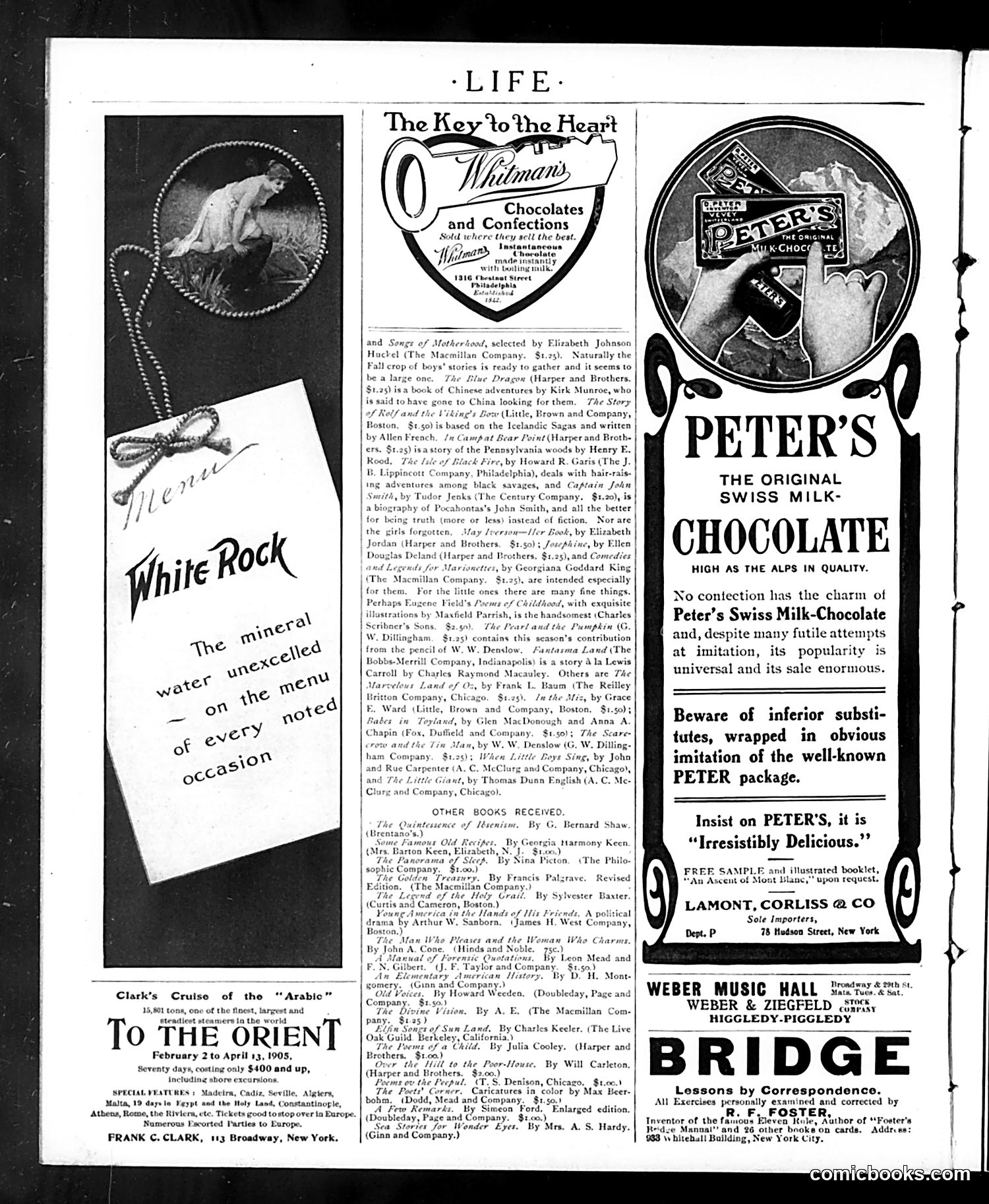
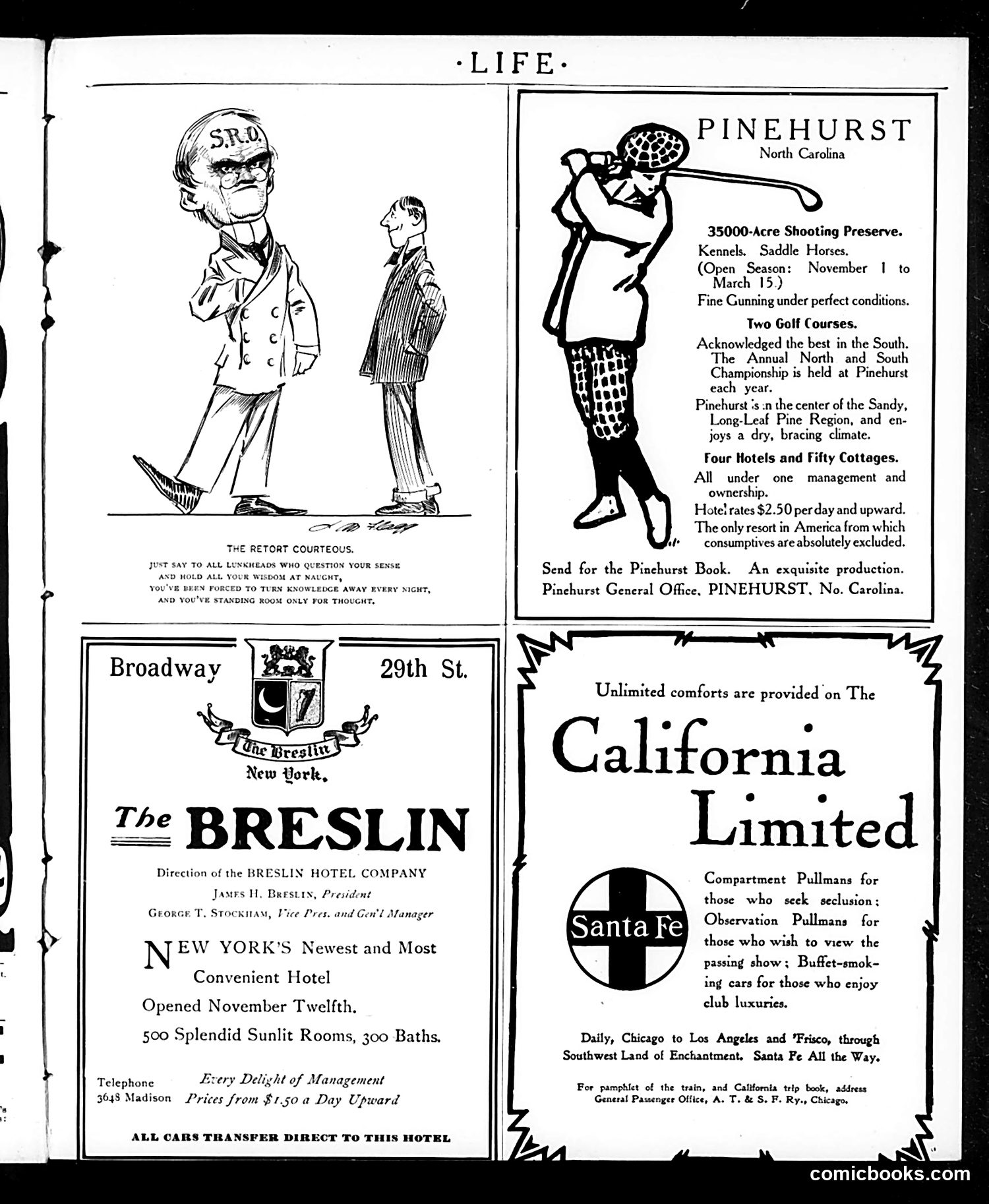
This page is primarily **advertising**, not political satire. It contains one small cartoon and three hotel/resort ads. **The Cartoon ("The Retort Courteous"):** The left side shows a caricatured figure labeled "S.R.O." (Standing Room Only) confronting a younger man. The caption mocks people who claim ignorance while pretending wisdom—essentially warning against fake intellectuals who reject genuine knowledge but have no room in their heads for actual thought. This is genteel social satire about pretension, not political commentary. **The Advertisements:** The page features upscale travel and hospitality pitches—Pinehurst golf resort in North Carolina (noting it excludes consumptives/tuberculosis patients), The Breslin Hotel in New York (newly opened, $1.50+/day), and the Santa Fe Railway's "California Limited" train service to Los Angeles and San Francisco. These target wealthy leisure travelers of the early 1900s. The overall page reflects *Life* magazine's dual role as satirical publication and venue for affluent-audience advertising.
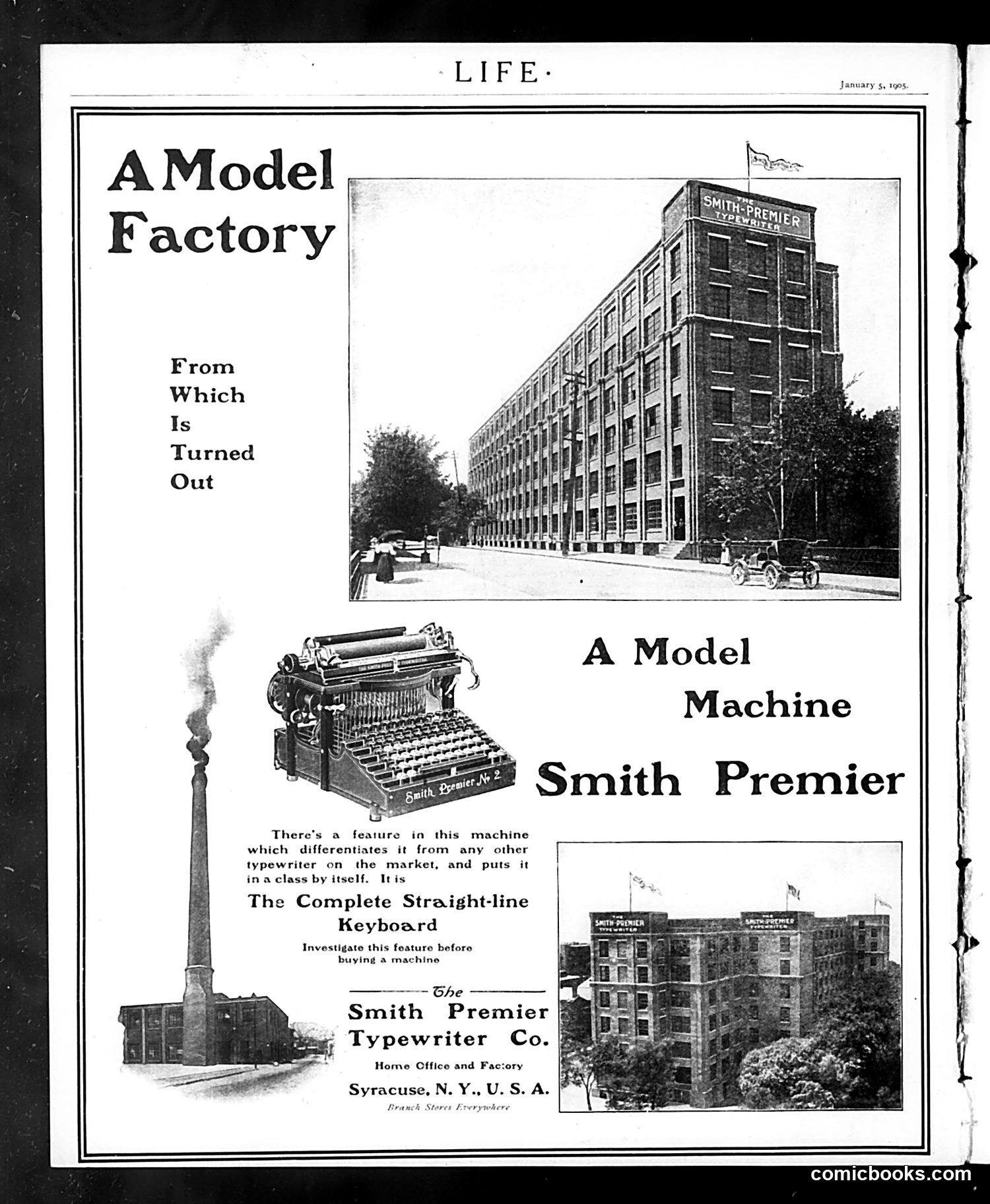
This is primarily **advertising, not political satire**. The page promotes the Smith Premier typewriter through images of the company's factory and facilities in Syracuse, New York. The layout contrasts the typewriter machine itself with photographs of the "model factory" that manufactures it—showing the main production building and what appears to be a power plant (the tall smokestack). This visual strategy argues that the quality product reflects the company's modern, well-organized manufacturing operation. The advertising copy emphasizes one distinguishing feature: the "Complete Straight-line Keyboard," presented as a technical innovation worthy of investigation before purchase. The only potential satire is the title "A Model Factory"—likely sincere praise rather than mockery, celebrating industrial efficiency standards of the early 1900s. This represents typical Progressive Era admiration for modern manufacturing facilities.